Leadership Styles: Managing Millennials in the Modern Workplace
VerifiedAdded on 2023/06/10
|9
|2046
|111
Report
AI Summary
This report delves into the crucial topic of adapting leadership styles to effectively manage the millennial generation within the workplace. It begins by introducing the concept of leadership styles and their impact on organizational sustainability, employee development, and market growth. The report then analyzes how various leadership styles, including autocratic, democratic, delegative, transactional, and transformational, can be adapted to meet the unique needs and expectations of millennials. It highlights the importance of fostering a positive working environment, recognizing the value of skills and knowledge, and promoting work-life balance. The report also examines the impact of leadership styles on employee motivation, decision-making processes, and organizational culture. Furthermore, the report explores the characteristics and benefits of each leadership style, providing insights into their application in today's organizations. The conclusion emphasizes the significance of adapting leadership approaches to create positive changes within organizations, ultimately leading to improved employee satisfaction and overall success. The report includes references to books and journals that support the findings.
Managing people and
system
system
Paraphrase This Document
Need a fresh take? Get an instant paraphrase of this document with our AI Paraphraser

Contents
INTRODUCTION...........................................................................................................................3
TASK...............................................................................................................................................4
Evaluate how leadership styles will have to adapt to manage the millennial generation................4
CONCLUSION................................................................................................................................8
REFERENCES................................................................................................................................9
INTRODUCTION...........................................................................................................................3
TASK...............................................................................................................................................4
Evaluate how leadership styles will have to adapt to manage the millennial generation................4
CONCLUSION................................................................................................................................8
REFERENCES................................................................................................................................9

INTRODUCTION
Leadership styles are the various forms in which organisation manages all the functions and
management as organisation maintains the sustainability in the market and market share and
market growth is increased in the market. These styles also helps in the continuous learning of
the employees for making them better and this also helps in the developing new skills and
behaviours. This report includes various leadership styles and how they can adapt these
management changes in the millennial generation. The analysation of various leadership styles
are described below.
Leadership styles are the various forms in which organisation manages all the functions and
management as organisation maintains the sustainability in the market and market share and
market growth is increased in the market. These styles also helps in the continuous learning of
the employees for making them better and this also helps in the developing new skills and
behaviours. This report includes various leadership styles and how they can adapt these
management changes in the millennial generation. The analysation of various leadership styles
are described below.
⊘ This is a preview!⊘
Do you want full access?
Subscribe today to unlock all pages.

Trusted by 1+ million students worldwide

TASK
Evaluate how leadership styles will have to adapt to manage the millennial
generation.
Leadership styles is known as the way by which any person can react to any situation or in the
group of people and this also helps in leading and making a positive working environment. For
the millennial generation the leadership styles are managed in the organisation for analysing the
short term goals and in this managers also helps in identifying for the better opportunities for
developing the new skills for the better maintenance and this aloes offers all the professional and
personal life balances for the better flexibility in the business operations and this also says and
this generation says that money is not everything as skills and knowledge are also equally
important in the business and these styles also helps the organisation in the better movement of
the leadership styles and impact positively in the decision making process and this also helps in
developing the better structure of the organisation in an effective manner(Al-Malki, and Juan,
2018). These kind leadership styles also strongly develops the culture of the organisation and this
also helps in recognising and appreciation which helps in the employee motivation and this also
indicates that it is important to take bad with the good points which increases the knowledge,
patience and capabilities of doing various things as a job role. As Millennial’s takes this
workforce as an opportunity and as a challenge which allows in the decision making process of
the organisation and team members effectively(Alblooshi, Shamsuzzaman, and Haridy, 2020). As
leadership is important for various functioning of business operations and this also clears the
mission and the vision of the organisation for the better operational work and for various
leadership styles as this helps in the coordination and motivating of the employees and this can
help and this also helps in the better advancement of the strategies and approaches which is used
in the business for attaining goals and objectives of the organisation in better terms and this can
result helpful for the employees and for the organisation also and this can also build various
techniques and this gives job satisfaction to the employees for the better assessment of the
business and for this effective leadership styles are used and this also helps in the better
functioning of the business operations and this also lead in the level of job satisfaction of the
employees.
Evaluate how leadership styles will have to adapt to manage the millennial
generation.
Leadership styles is known as the way by which any person can react to any situation or in the
group of people and this also helps in leading and making a positive working environment. For
the millennial generation the leadership styles are managed in the organisation for analysing the
short term goals and in this managers also helps in identifying for the better opportunities for
developing the new skills for the better maintenance and this aloes offers all the professional and
personal life balances for the better flexibility in the business operations and this also says and
this generation says that money is not everything as skills and knowledge are also equally
important in the business and these styles also helps the organisation in the better movement of
the leadership styles and impact positively in the decision making process and this also helps in
developing the better structure of the organisation in an effective manner(Al-Malki, and Juan,
2018). These kind leadership styles also strongly develops the culture of the organisation and this
also helps in recognising and appreciation which helps in the employee motivation and this also
indicates that it is important to take bad with the good points which increases the knowledge,
patience and capabilities of doing various things as a job role. As Millennial’s takes this
workforce as an opportunity and as a challenge which allows in the decision making process of
the organisation and team members effectively(Alblooshi, Shamsuzzaman, and Haridy, 2020). As
leadership is important for various functioning of business operations and this also clears the
mission and the vision of the organisation for the better operational work and for various
leadership styles as this helps in the coordination and motivating of the employees and this can
help and this also helps in the better advancement of the strategies and approaches which is used
in the business for attaining goals and objectives of the organisation in better terms and this can
result helpful for the employees and for the organisation also and this can also build various
techniques and this gives job satisfaction to the employees for the better assessment of the
business and for this effective leadership styles are used and this also helps in the better
functioning of the business operations and this also lead in the level of job satisfaction of the
employees.
Paraphrase This Document
Need a fresh take? Get an instant paraphrase of this document with our AI Paraphraser

The main purpose of using leadership styles are that this promotes the value to the organisation
success and make the employees capable of taking responsibilities and being accountable to
there work and this makes the better working environment for the employees and this also
provide guidance to them and make them learn new and innovative things, knowledge and skills
which further also helps in developing the personality of the individual employees and this also
helps in promoting creativity to the employees which increases the level of flexibility in the
business operations and this can make the work done in an effective and efficient form which
helps in increasing the level of productivity and organisational success and profit of the
business(Rabiul, and Yean, 2021). As there are many importance of various leadership styles as
this gives vision to all the organisational goals for the better and effective functioning of the
employees and this also builds effective communication which encourages the employees and
build confidence in them for there upgradation and this also further helps in the decision making
process which is done by the leadership styles and this also gives advantages and ensures all the
successful leadership and this also helps in fulfilling the requirement of the employees and this
also helps in guiding the employees for the better and allows long term goals commitment which
helps the team of the business helps in achieving the organisational common goal for the best
and this can further help in the integrity which builds ethical values and also builds confidence in
the employees for the positive feedback and improves morale and helps in the better expansion
and growth of the organisation(Berraies, and El Abidine, 2019). These leadership styles also
improve coordination among the employees and team members for attaining the goals and
objectives of the business for there job satisfaction and for achieving organisational goal. These
factors also impact in the better communication with the employees and allow them better
customer experience and build employees skills for the better and effective performance of the
employees(Adnan, and Valliappan, 2019). Leadership styles also beneficial in the managers
personality as this makes them learn about the new knowledge and leadership management
which motivates the employees and this also enhances the team power in the organisation and
these leadership styles has there characteristics which are as by these styles organisation can
easily manage the risk taking and risk management of the business and can make strategies and
approaches accordingly and these also involve in enhancing the technology of the organisation
for the better planning and decision making process in the business and this also done by various
techniques and practices happens in the organisation and this also makes the operational and
success and make the employees capable of taking responsibilities and being accountable to
there work and this makes the better working environment for the employees and this also
provide guidance to them and make them learn new and innovative things, knowledge and skills
which further also helps in developing the personality of the individual employees and this also
helps in promoting creativity to the employees which increases the level of flexibility in the
business operations and this can make the work done in an effective and efficient form which
helps in increasing the level of productivity and organisational success and profit of the
business(Rabiul, and Yean, 2021). As there are many importance of various leadership styles as
this gives vision to all the organisational goals for the better and effective functioning of the
employees and this also builds effective communication which encourages the employees and
build confidence in them for there upgradation and this also further helps in the decision making
process which is done by the leadership styles and this also gives advantages and ensures all the
successful leadership and this also helps in fulfilling the requirement of the employees and this
also helps in guiding the employees for the better and allows long term goals commitment which
helps the team of the business helps in achieving the organisational common goal for the best
and this can further help in the integrity which builds ethical values and also builds confidence in
the employees for the positive feedback and improves morale and helps in the better expansion
and growth of the organisation(Berraies, and El Abidine, 2019). These leadership styles also
improve coordination among the employees and team members for attaining the goals and
objectives of the business for there job satisfaction and for achieving organisational goal. These
factors also impact in the better communication with the employees and allow them better
customer experience and build employees skills for the better and effective performance of the
employees(Adnan, and Valliappan, 2019). Leadership styles also beneficial in the managers
personality as this makes them learn about the new knowledge and leadership management
which motivates the employees and this also enhances the team power in the organisation and
these leadership styles has there characteristics which are as by these styles organisation can
easily manage the risk taking and risk management of the business and can make strategies and
approaches accordingly and these also involve in enhancing the technology of the organisation
for the better planning and decision making process in the business and this also done by various
techniques and practices happens in the organisation and this also makes the operational and

functional management flexible for the better growth and expansion of the business and helps in
maintaining the proper structure of the business.
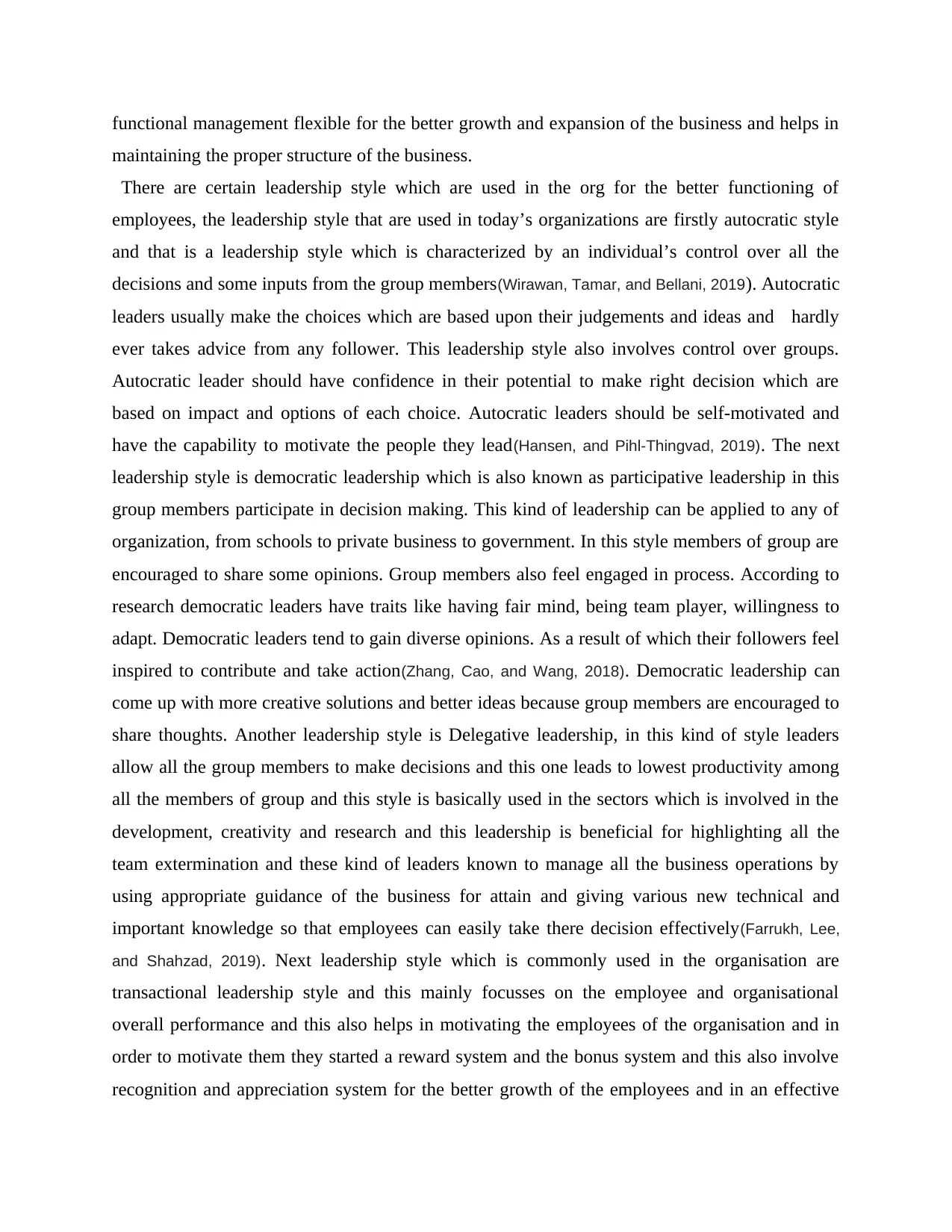
There are certain leadership style which are used in the org for the better functioning of
employees, the leadership style that are used in today’s organizations are firstly autocratic style
and that is a leadership style which is characterized by an individual’s control over all the
decisions and some inputs from the group members(Wirawan, Tamar, and Bellani, 2019). Autocratic
leaders usually make the choices which are based upon their judgements and ideas and hardly
ever takes advice from any follower. This leadership style also involves control over groups.
Autocratic leader should have confidence in their potential to make right decision which are
based on impact and options of each choice. Autocratic leaders should be self-motivated and
have the capability to motivate the people they lead(Hansen, and Pihl-Thingvad, 2019). The next
leadership style is democratic leadership which is also known as participative leadership in this
group members participate in decision making. This kind of leadership can be applied to any of
organization, from schools to private business to government. In this style members of group are
encouraged to share some opinions. Group members also feel engaged in process. According to
research democratic leaders have traits like having fair mind, being team player, willingness to
adapt. Democratic leaders tend to gain diverse opinions. As a result of which their followers feel
inspired to contribute and take action(Zhang, Cao, and Wang, 2018). Democratic leadership can
come up with more creative solutions and better ideas because group members are encouraged to
share thoughts. Another leadership style is Delegative leadership, in this kind of style leaders
allow all the group members to make decisions and this one leads to lowest productivity among
all the members of group and this style is basically used in the sectors which is involved in the
development, creativity and research and this leadership is beneficial for highlighting all the
team extermination and these kind of leaders known to manage all the business operations by
using appropriate guidance of the business for attain and giving various new technical and
important knowledge so that employees can easily take there decision effectively(Farrukh, Lee,
and Shahzad, 2019). Next leadership style which is commonly used in the organisation are
transactional leadership style and this mainly focusses on the employee and organisational
overall performance and this also helps in motivating the employees of the organisation and in
order to motivate them they started a reward system and the bonus system and this also involve
recognition and appreciation system for the better growth of the employees and in an effective
maintaining the proper structure of the business.
There are certain leadership style which are used in the org for the better functioning of
employees, the leadership style that are used in today’s organizations are firstly autocratic style
and that is a leadership style which is characterized by an individual’s control over all the
decisions and some inputs from the group members(Wirawan, Tamar, and Bellani, 2019). Autocratic
leaders usually make the choices which are based upon their judgements and ideas and hardly
ever takes advice from any follower. This leadership style also involves control over groups.
Autocratic leader should have confidence in their potential to make right decision which are
based on impact and options of each choice. Autocratic leaders should be self-motivated and
have the capability to motivate the people they lead(Hansen, and Pihl-Thingvad, 2019). The next
leadership style is democratic leadership which is also known as participative leadership in this
group members participate in decision making. This kind of leadership can be applied to any of
organization, from schools to private business to government. In this style members of group are
encouraged to share some opinions. Group members also feel engaged in process. According to
research democratic leaders have traits like having fair mind, being team player, willingness to
adapt. Democratic leaders tend to gain diverse opinions. As a result of which their followers feel
inspired to contribute and take action(Zhang, Cao, and Wang, 2018). Democratic leadership can
come up with more creative solutions and better ideas because group members are encouraged to
share thoughts. Another leadership style is Delegative leadership, in this kind of style leaders
allow all the group members to make decisions and this one leads to lowest productivity among
all the members of group and this style is basically used in the sectors which is involved in the
development, creativity and research and this leadership is beneficial for highlighting all the
team extermination and these kind of leaders known to manage all the business operations by
using appropriate guidance of the business for attain and giving various new technical and
important knowledge so that employees can easily take there decision effectively(Farrukh, Lee,
and Shahzad, 2019). Next leadership style which is commonly used in the organisation are
transactional leadership style and this mainly focusses on the employee and organisational
overall performance and this also helps in motivating the employees of the organisation and in
order to motivate them they started a reward system and the bonus system and this also involve
recognition and appreciation system for the better growth of the employees and in an effective
⊘ This is a preview!⊘
Do you want full access?
Subscribe today to unlock all pages.

Trusted by 1+ million students worldwide

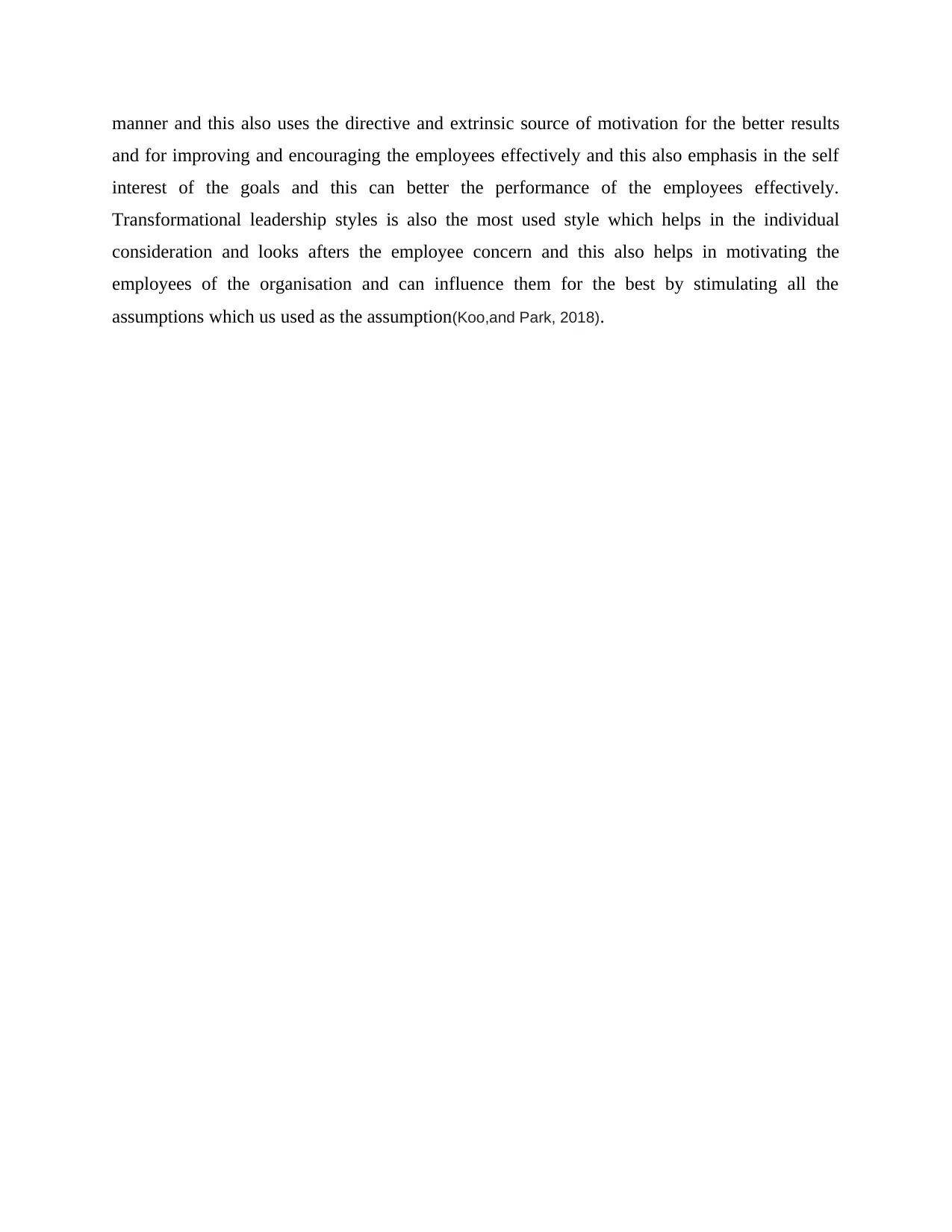
manner and this also uses the directive and extrinsic source of motivation for the better results
and for improving and encouraging the employees effectively and this also emphasis in the self
interest of the goals and this can better the performance of the employees effectively.
Transformational leadership styles is also the most used style which helps in the individual
consideration and looks afters the employee concern and this also helps in motivating the
employees of the organisation and can influence them for the best by stimulating all the
assumptions which us used as the assumption(Koo,and Park, 2018).
and for improving and encouraging the employees effectively and this also emphasis in the self
interest of the goals and this can better the performance of the employees effectively.
Transformational leadership styles is also the most used style which helps in the individual
consideration and looks afters the employee concern and this also helps in motivating the
employees of the organisation and can influence them for the best by stimulating all the
assumptions which us used as the assumption(Koo,and Park, 2018).
Paraphrase This Document
Need a fresh take? Get an instant paraphrase of this document with our AI Paraphraser

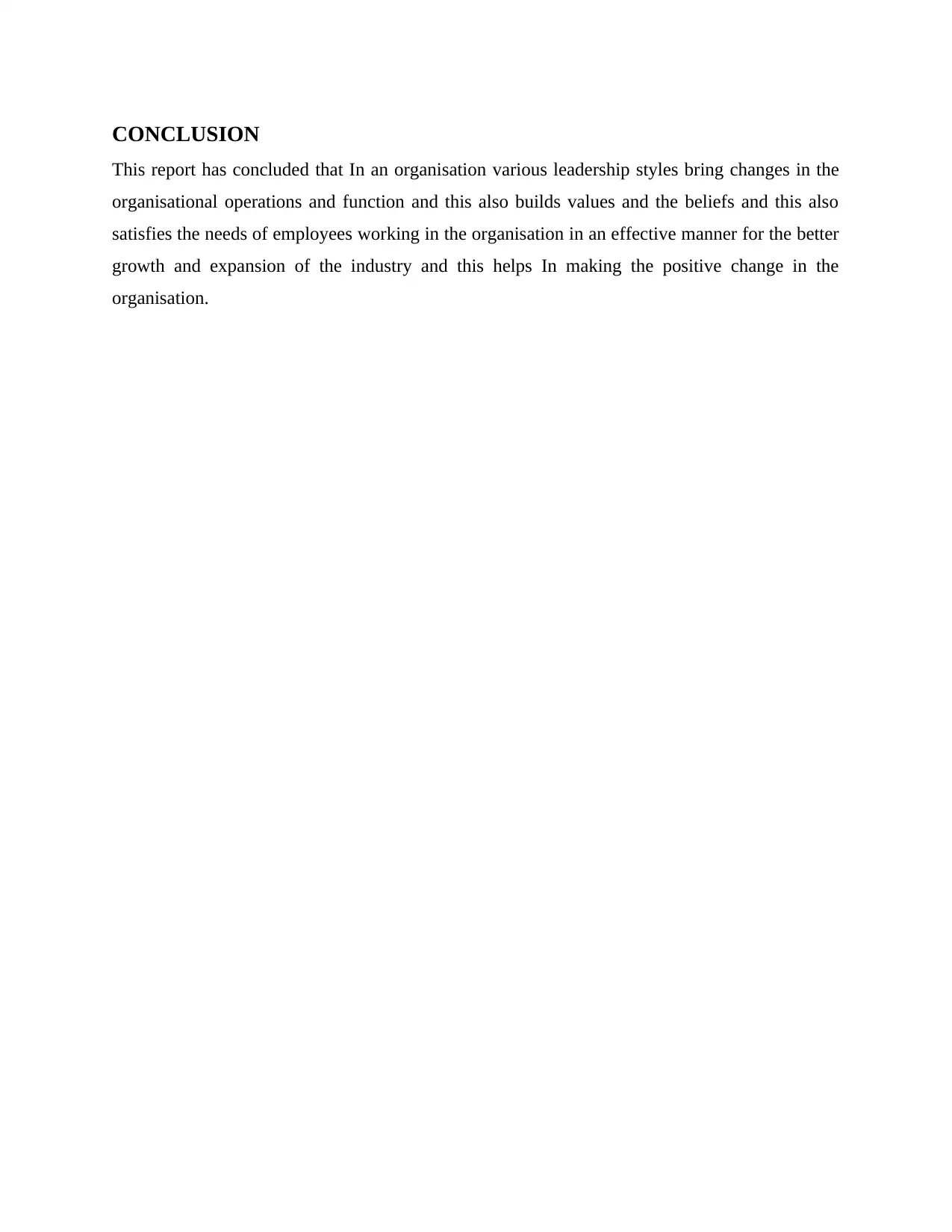
CONCLUSION
This report has concluded that In an organisation various leadership styles bring changes in the
organisational operations and function and this also builds values and the beliefs and this also
satisfies the needs of employees working in the organisation in an effective manner for the better
growth and expansion of the industry and this helps In making the positive change in the
organisation.
This report has concluded that In an organisation various leadership styles bring changes in the
organisational operations and function and this also builds values and the beliefs and this also
satisfies the needs of employees working in the organisation in an effective manner for the better
growth and expansion of the industry and this helps In making the positive change in the
organisation.

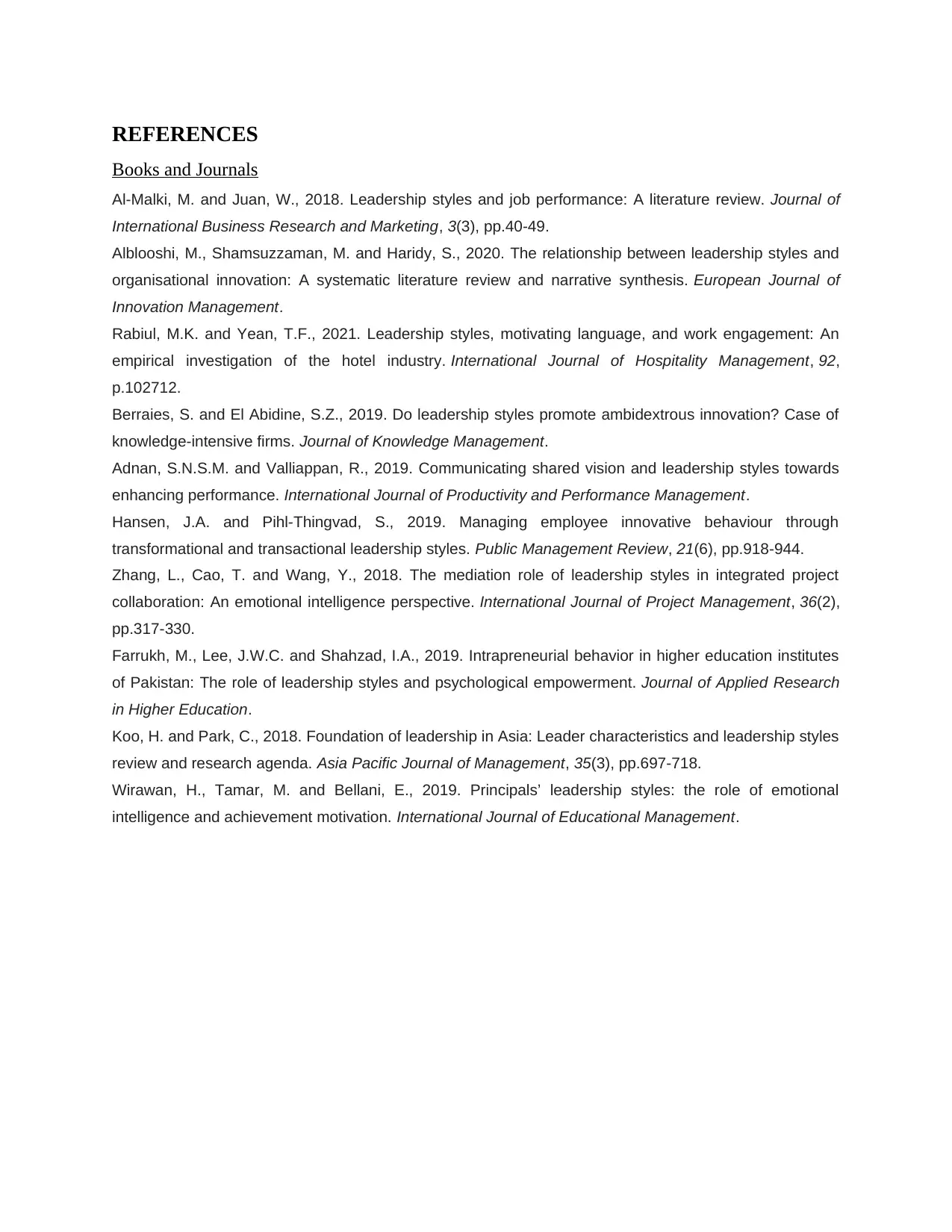
REFERENCES
Books and Journals
Al-Malki, M. and Juan, W., 2018. Leadership styles and job performance: A literature review. Journal of
International Business Research and Marketing, 3(3), pp.40-49.
Alblooshi, M., Shamsuzzaman, M. and Haridy, S., 2020. The relationship between leadership styles and
organisational innovation: A systematic literature review and narrative synthesis. European Journal of
Innovation Management.
Rabiul, M.K. and Yean, T.F., 2021. Leadership styles, motivating language, and work engagement: An
empirical investigation of the hotel industry. International Journal of Hospitality Management, 92,
p.102712.
Berraies, S. and El Abidine, S.Z., 2019. Do leadership styles promote ambidextrous innovation? Case of
knowledge-intensive firms. Journal of Knowledge Management.
Adnan, S.N.S.M. and Valliappan, R., 2019. Communicating shared vision and leadership styles towards
enhancing performance. International Journal of Productivity and Performance Management.
Hansen, J.A. and Pihl-Thingvad, S., 2019. Managing employee innovative behaviour through
transformational and transactional leadership styles. Public Management Review, 21(6), pp.918-944.
Zhang, L., Cao, T. and Wang, Y., 2018. The mediation role of leadership styles in integrated project
collaboration: An emotional intelligence perspective. International Journal of Project Management, 36(2),
pp.317-330.
Farrukh, M., Lee, J.W.C. and Shahzad, I.A., 2019. Intrapreneurial behavior in higher education institutes
of Pakistan: The role of leadership styles and psychological empowerment. Journal of Applied Research
in Higher Education.
Koo, H. and Park, C., 2018. Foundation of leadership in Asia: Leader characteristics and leadership styles
review and research agenda. Asia Pacific Journal of Management, 35(3), pp.697-718.
Wirawan, H., Tamar, M. and Bellani, E., 2019. Principals’ leadership styles: the role of emotional
intelligence and achievement motivation. International Journal of Educational Management.
Books and Journals
Al-Malki, M. and Juan, W., 2018. Leadership styles and job performance: A literature review. Journal of
International Business Research and Marketing, 3(3), pp.40-49.
Alblooshi, M., Shamsuzzaman, M. and Haridy, S., 2020. The relationship between leadership styles and
organisational innovation: A systematic literature review and narrative synthesis. European Journal of
Innovation Management.
Rabiul, M.K. and Yean, T.F., 2021. Leadership styles, motivating language, and work engagement: An
empirical investigation of the hotel industry. International Journal of Hospitality Management, 92,
p.102712.
Berraies, S. and El Abidine, S.Z., 2019. Do leadership styles promote ambidextrous innovation? Case of
knowledge-intensive firms. Journal of Knowledge Management.
Adnan, S.N.S.M. and Valliappan, R., 2019. Communicating shared vision and leadership styles towards
enhancing performance. International Journal of Productivity and Performance Management.
Hansen, J.A. and Pihl-Thingvad, S., 2019. Managing employee innovative behaviour through
transformational and transactional leadership styles. Public Management Review, 21(6), pp.918-944.
Zhang, L., Cao, T. and Wang, Y., 2018. The mediation role of leadership styles in integrated project
collaboration: An emotional intelligence perspective. International Journal of Project Management, 36(2),
pp.317-330.
Farrukh, M., Lee, J.W.C. and Shahzad, I.A., 2019. Intrapreneurial behavior in higher education institutes
of Pakistan: The role of leadership styles and psychological empowerment. Journal of Applied Research
in Higher Education.
Koo, H. and Park, C., 2018. Foundation of leadership in Asia: Leader characteristics and leadership styles
review and research agenda. Asia Pacific Journal of Management, 35(3), pp.697-718.
Wirawan, H., Tamar, M. and Bellani, E., 2019. Principals’ leadership styles: the role of emotional
intelligence and achievement motivation. International Journal of Educational Management.
⊘ This is a preview!⊘
Do you want full access?
Subscribe today to unlock all pages.

Trusted by 1+ million students worldwide
1 out of 9
Related Documents
Your All-in-One AI-Powered Toolkit for Academic Success.
+13062052269
info@desklib.com
Available 24*7 on WhatsApp / Email
Unlock your academic potential
Copyright © 2020–2025 A2Z Services. All Rights Reserved. Developed and managed by ZUCOL.