Analysis of Leadership Tactics, Power, and Influence in HRM

Verified

Added on  2022/10/02

|18
|1965
|154
Essay
AI Summary
This essay delves into the intricate relationship between leadership tactics, power, and influence within Human Resource Management. It explores how leadership tactics, such as the use of power, shape employee behavior and contribute to organizational goals. The paper analyzes the interaction between leaders and employees, emphasizing how this dynamic impacts influence and power. It further identifies and discusses five key sources of power: legitimate, reward, coercive, referent, and expert power, examining their respective roles and implications within an organization. The essay also examines the relationship between influence and power, highlighting how they can be used to drive task performance and affect employee behavior. The conclusion underscores the significance of these elements in effective leadership and achieving organizational success. The references include various academic sources that support the analysis.

Document Page
HUMAN RESOURCE
MANAGEMENT
Innovative Leadership
tabler-icon-diamond-filled.svg

Paraphrase This Document

Need a fresh take? Get an instant paraphrase of this document with our AI Paraphraser
Document Page
Introduction
Human resource management has a number of factors that determines the
influence, interaction and the structure of leadership within an organization.
The interaction within an organization determines the influence that enable
other people to performs certain tasks.
Leadership entails influence over other people that enable them to follow the
instruction of the leader hence preforms task
There are various leadership tactics that make influence other employee to
work towards attaining the goals of an organization
The following paper therefore, analyses the interrelationship and influence
among the leadership tactics (Singh & Rani, 2017).
Document Page
Interaction and influence among
leadership tactics
The level of interaction among leaders and their employees has profound
influence on staff and this determines the leadership.
How a leader relates to others staffs within an organization sets the pace of
influence that a leader has over staff.
In addition, the influence of leaders over staff determines the leadership tactics
Leadership tactics on the other hand is based on the influence that a leader has
making others staff to work towards achieving a particular goal of the
organization
The leadership tactics therefore, make employees to remain in line with the
organizational strategic direction.
Various leadership tactics interacts within an organization to result into
influence that make staff to perform a particular task (Flynn, 2011).
Document Page
Power
Power refers to the authority that enable one to change the behavior of other
people and make them perform a particular task in an organization
Power enable one to make other people comply rather than understanding the
idea behind task one does in an organization
Power is brought about with coercion and fear that an employee may place on
others
Power therefore is a negative aspect of leadership interactions that contributes
to the performance of an individual in an organization.
Power is connected to the authority that enable employee to work well in an
organization through fear and coercion (Goncalves, 2013).
tabler-icon-diamond-filled.svg

Paraphrase This Document

Need a fresh take? Get an instant paraphrase of this document with our AI Paraphraser
Document Page
How power relate to leadership
Leadership refers to the ability of one to influence others to change their behavior and
doe a particular task.
Power on the other hand is the authority that enable one to make others staff to change
behavior and doe certain task in an organization.
Power therefore is connected to the ability to influence as a leader through exercising
one’s authority (Luthans, 2011).
A leader can use power to make employee work in an organization under fear and
coercion.
Leadership therefore takes advantage of power to influence other junior employees to
work and produce better outcomes
This implies that leadership does not exist without the power to influence other people.
Moreover, high performance in an organization is resultant to proper use of power by
senior management within the organization (McShane & Von Glinow, 2011).
Document Page
How power relate to leadership,
Continues
Leaders give instruction to other people in an organization that is
followed through use of power by the leader
Staff believing on the leader enable that leader to have power that is
important for influencing others (Scouller, 2011).
Document Page
How relationship between leaders
and staff affects influence and
power The relationship between leaders and staffs has a profound impact on
influence and power
the respectful relationship between leaders and staff such as junior
staff and senior staffs affects the influence that these leaders has
over staff.
The influence of a leader over staff is the precursor for power and
enable leaders to effect change on others
Leadership entails ability to influence others staff within an
organization.
This gives the leaders that influence others power to change of
behavior in staffs (Oladosu & Nwaneka, July2014).
tabler-icon-diamond-filled.svg

Paraphrase This Document

Need a fresh take? Get an instant paraphrase of this document with our AI Paraphraser
Document Page
Five sources of power
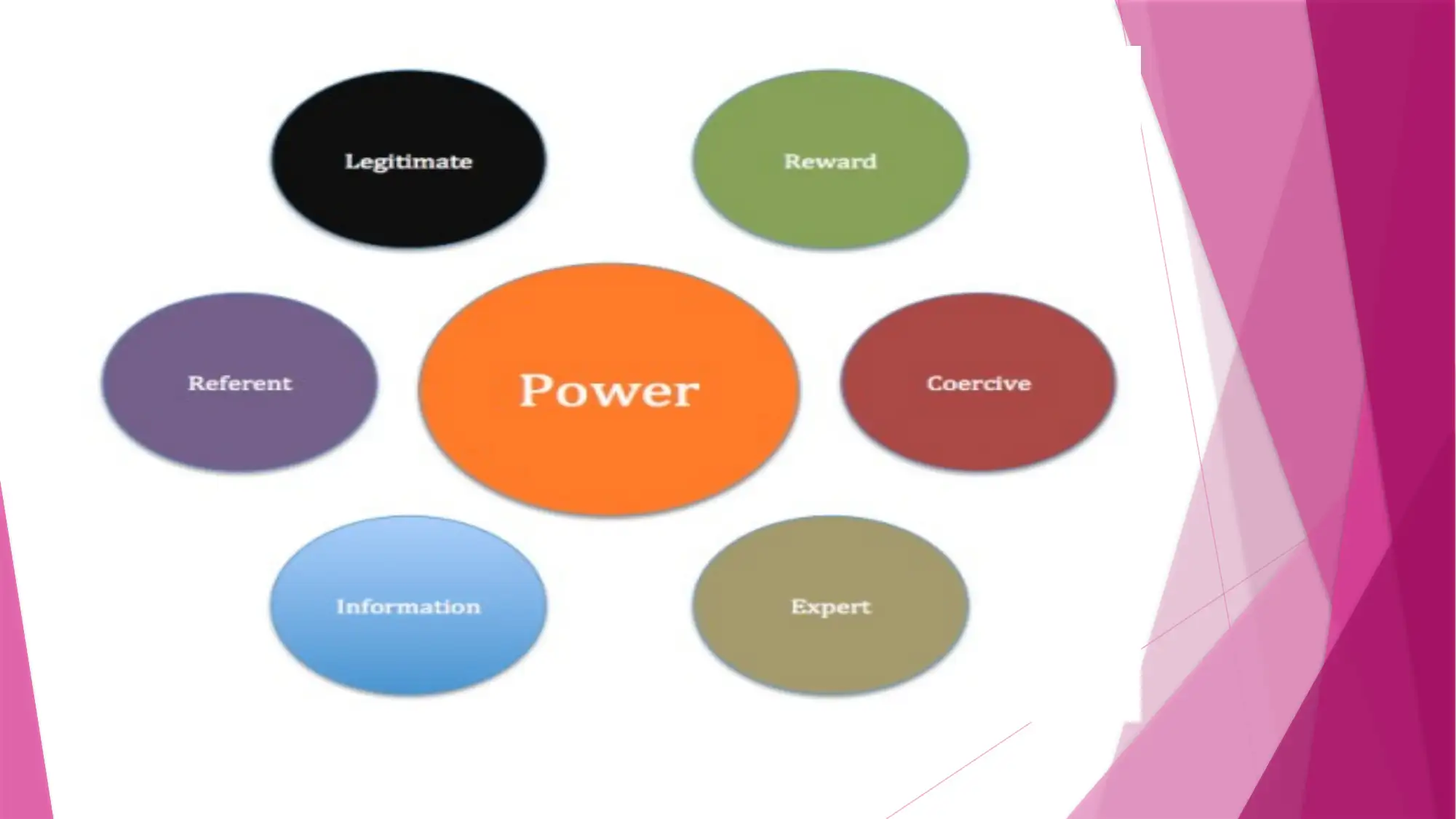
There are five sources of power within an organization. this sources of
power include
Legitimate power,
Reward power,
Coercive power,
Referent power, and
Expert power
Document Page
Document Page
1. Legitimate source of power
Legitimate source of power refers to the power that one get by the
virtue of the position they hold or the role they play within an
organization.
The legitimate source of power is also known as position power.
The position power is derived from promotion that enable various
people between one level of organization to report to a higher level of
the organization.
For instance, junior staff to senior staff, senior staff to directors hence
bringing about power on those in authority (Pfeffer, 2011).
tabler-icon-diamond-filled.svg

Paraphrase This Document

Need a fresh take? Get an instant paraphrase of this document with our AI Paraphraser
Document Page
2. Reward power
Reward power refers to the source of power that a staff hold due to the role of
giving out compensation and incentives in an organization.
The role that an employee may hold leading to reward power is derived from
factors such as praise, recognition, salary, bonuses and promotion.
The reward power is always attributed to motivation of employees within an
organization.
The motive and unfair giving out of reward to employees may result into
favoritism hence demotivates employees
This implies that the leader that uses the reward appeals to other people
through giving them reward
The amount of the reward that is given to the staff is proportionate to the
task that the staff perform enabling the leader to give out reward (Lussier &
Achua, 2010).
Document Page
3. Coercive Power
Coercive power is type of power that is derived from threatening and
punishing others due their performance.
Coercive source of power make the employee to change their work
behavior leading to early office and late leaving office.
The power is based on ability of the senior employee to scare other
employees leading to fear.
some of areas that many people wielding power uses include
demotion, firing, reprimanding
The knowledge that is castigated by employee that this type of power
is there make employees to remain in line of performance
(Lunenburg, 2012).
chevron_up_icon
1 out of 18
circle_padding
hide_on_mobile
zoom_out_icon
[object Object]