Employability Skills Report: Leadership, Teamwork, and Problem Solving
VerifiedAdded on 2020/06/04
|13
|3143
|31
Report
AI Summary
This report delves into the crucial aspects of employability skills, exploring their application within an organizational context, specifically referencing HSBC Financials. The report begins by defining employability skills and their significance, followed by an examination of personal responsibilities and performance objectives. It analyzes the importance of self-assessment and outlines recommendations for improvement, incorporating motivational techniques to enhance performance quality. The report further addresses solutions for workplace problems, communication styles, and time management strategies. It then moves on to discuss team dynamics, alternative approaches to task completion, and the achievement of team goals. Finally, the report explores tools and methods for problem-solving, the development of effective strategies, and the potential business impact of implementing these strategies. The report provides a comprehensive overview of essential skills for professional success, offering practical insights and strategies for effective leadership and teamwork in the financial sector.
Employability Skills

Paraphrase This Document
Need a fresh take? Get an instant paraphrase of this document with our AI Paraphraser
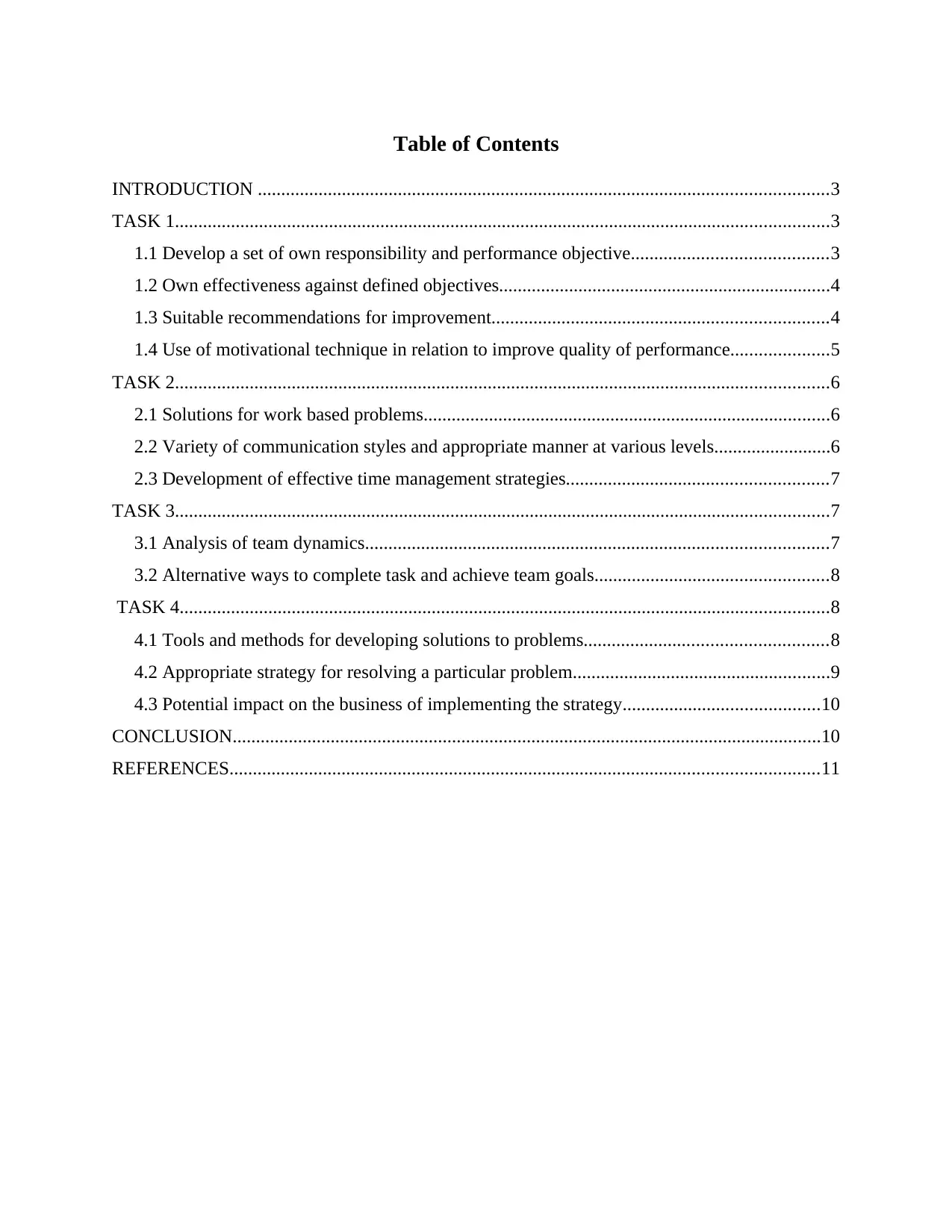
Table of Contents
INTRODUCTION ..........................................................................................................................3
TASK 1............................................................................................................................................3
1.1 Develop a set of own responsibility and performance objective..........................................3
1.2 Own effectiveness against defined objectives.......................................................................4
1.3 Suitable recommendations for improvement........................................................................4
1.4 Use of motivational technique in relation to improve quality of performance.....................5
TASK 2............................................................................................................................................6
2.1 Solutions for work based problems.......................................................................................6
2.2 Variety of communication styles and appropriate manner at various levels.........................6
2.3 Development of effective time management strategies........................................................7
TASK 3............................................................................................................................................7
3.1 Analysis of team dynamics...................................................................................................7
3.2 Alternative ways to complete task and achieve team goals..................................................8
TASK 4...........................................................................................................................................8
4.1 Tools and methods for developing solutions to problems....................................................8
4.2 Appropriate strategy for resolving a particular problem.......................................................9
4.3 Potential impact on the business of implementing the strategy..........................................10
CONCLUSION..............................................................................................................................10
REFERENCES..............................................................................................................................11
INTRODUCTION ..........................................................................................................................3
TASK 1............................................................................................................................................3
1.1 Develop a set of own responsibility and performance objective..........................................3
1.2 Own effectiveness against defined objectives.......................................................................4
1.3 Suitable recommendations for improvement........................................................................4
1.4 Use of motivational technique in relation to improve quality of performance.....................5
TASK 2............................................................................................................................................6
2.1 Solutions for work based problems.......................................................................................6
2.2 Variety of communication styles and appropriate manner at various levels.........................6
2.3 Development of effective time management strategies........................................................7
TASK 3............................................................................................................................................7
3.1 Analysis of team dynamics...................................................................................................7
3.2 Alternative ways to complete task and achieve team goals..................................................8
TASK 4...........................................................................................................................................8
4.1 Tools and methods for developing solutions to problems....................................................8
4.2 Appropriate strategy for resolving a particular problem.......................................................9
4.3 Potential impact on the business of implementing the strategy..........................................10
CONCLUSION..............................................................................................................................10
REFERENCES..............................................................................................................................11
INTRODUCTION
Employability skills indicates towards the capabilities and abilities to work and perform
professionally and ethically (De Cuyper, Van der Heijden and De Witte, 2011). These are the
skills which are the combination of certain skills like communication, teamwork, problem
solving skills, initiative and enterprise, planning and organising, self management and learning.
This report defines the meaning of employability skills in organisational context. What are the
responsibilities and interpersonal skills are required in to be a professional employee, leader and
manager described in this report. Creation of own responsibilities, interpersonal skills, team
work and decision making and strategic planning are the major skills which are explained in this
context.
TASK 1
1.1 Develop a set of own responsibility and performance objective
It is responsibility of employees that they fulfil their duties and responsibilities to
organisation by performing well (Aziz, Safiah and Zanariah, 2011). HSBC is one of the
international banking industry which is known for its professional and ethical work etiquettes
across the world. Every individual understand their personal responsibilities and duties and
maintain a professional working environment in organisation. There are self responsibilities and
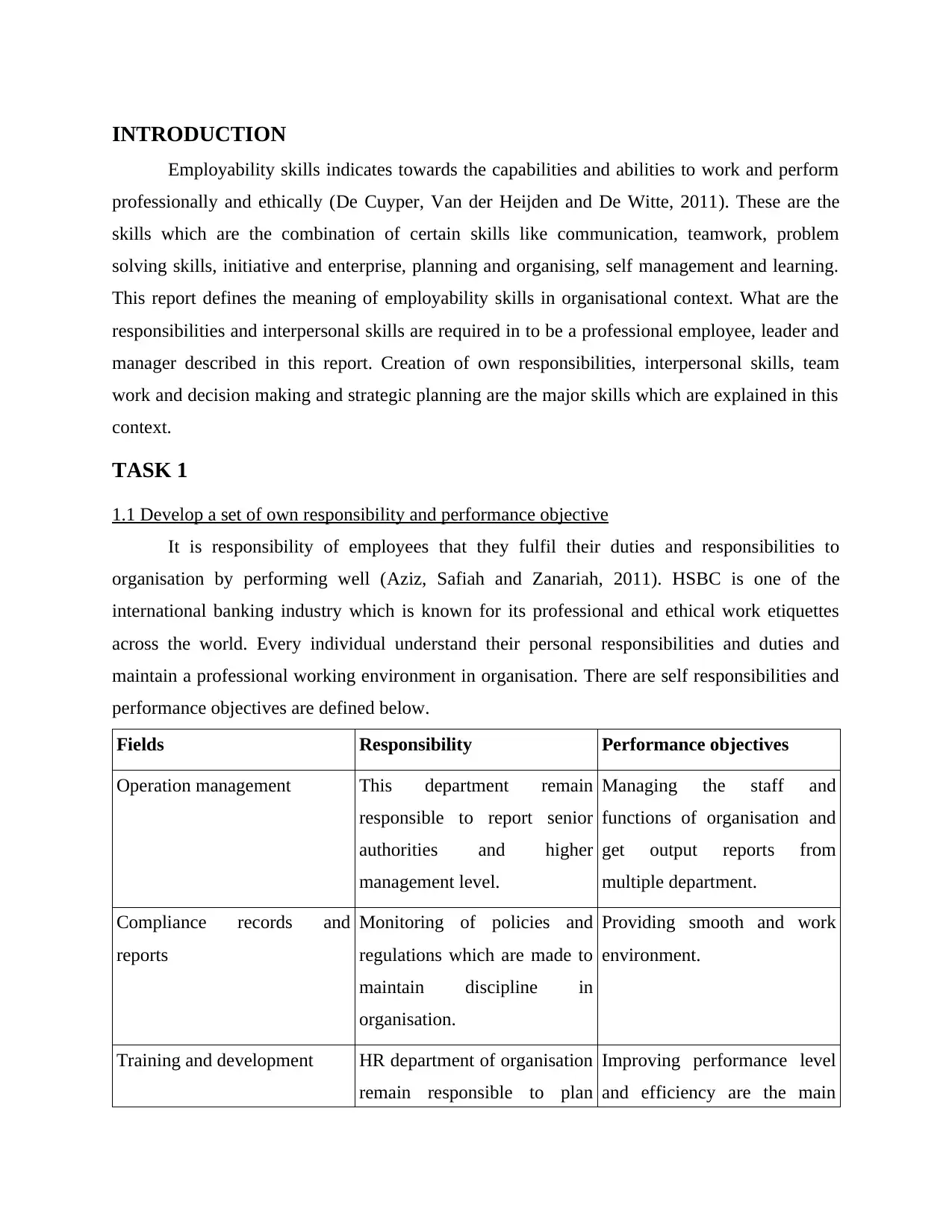
performance objectives are defined below.
Fields Responsibility Performance objectives
Operation management This department remain
responsible to report senior
authorities and higher
management level.
Managing the staff and
functions of organisation and
get output reports from
multiple department.
Compliance records and
reports
Monitoring of policies and
regulations which are made to
maintain discipline in
organisation.
Providing smooth and work
environment.
Training and development HR department of organisation
remain responsible to plan
Improving performance level
and efficiency are the main
Employability skills indicates towards the capabilities and abilities to work and perform
professionally and ethically (De Cuyper, Van der Heijden and De Witte, 2011). These are the
skills which are the combination of certain skills like communication, teamwork, problem
solving skills, initiative and enterprise, planning and organising, self management and learning.
This report defines the meaning of employability skills in organisational context. What are the
responsibilities and interpersonal skills are required in to be a professional employee, leader and
manager described in this report. Creation of own responsibilities, interpersonal skills, team
work and decision making and strategic planning are the major skills which are explained in this
context.
TASK 1
1.1 Develop a set of own responsibility and performance objective
It is responsibility of employees that they fulfil their duties and responsibilities to
organisation by performing well (Aziz, Safiah and Zanariah, 2011). HSBC is one of the
international banking industry which is known for its professional and ethical work etiquettes
across the world. Every individual understand their personal responsibilities and duties and
maintain a professional working environment in organisation. There are self responsibilities and
performance objectives are defined below.
Fields Responsibility Performance objectives
Operation management This department remain
responsible to report senior
authorities and higher
management level.
Managing the staff and
functions of organisation and
get output reports from
multiple department.
Compliance records and
reports
Monitoring of policies and
regulations which are made to
maintain discipline in
organisation.
Providing smooth and work
environment.
Training and development HR department of organisation
remain responsible to plan
Improving performance level
and efficiency are the main
⊘ This is a preview!⊘
Do you want full access?
Subscribe today to unlock all pages.

Trusted by 1+ million students worldwide
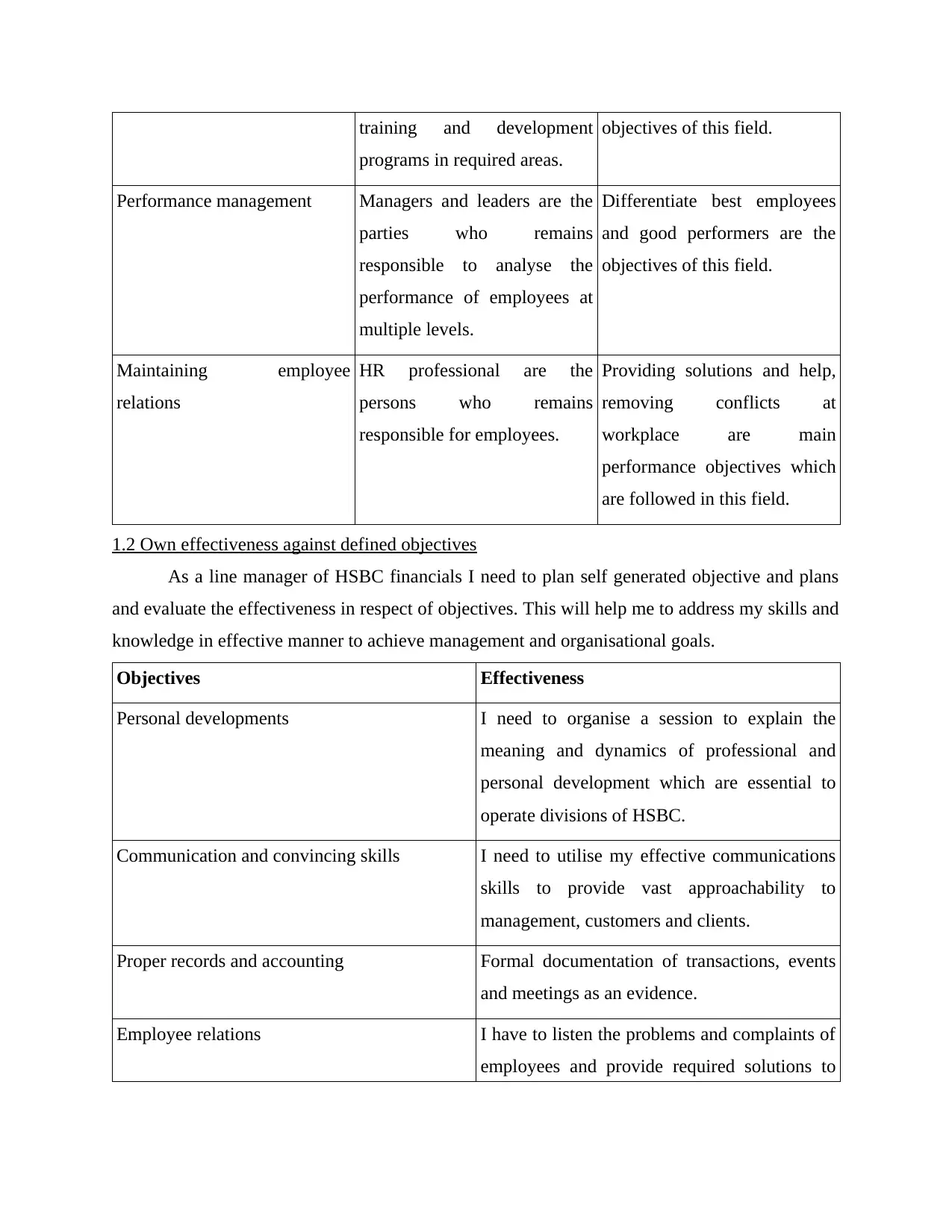
training and development
programs in required areas.
objectives of this field.
Performance management Managers and leaders are the
parties who remains
responsible to analyse the
performance of employees at
multiple levels.
Differentiate best employees
and good performers are the
objectives of this field.
Maintaining employee
relations
HR professional are the
persons who remains
responsible for employees.
Providing solutions and help,
removing conflicts at
workplace are main
performance objectives which
are followed in this field.
1.2 Own effectiveness against defined objectives
As a line manager of HSBC financials I need to plan self generated objective and plans
and evaluate the effectiveness in respect of objectives. This will help me to address my skills and
knowledge in effective manner to achieve management and organisational goals.
Objectives Effectiveness
Personal developments I need to organise a session to explain the
meaning and dynamics of professional and
personal development which are essential to
operate divisions of HSBC.
Communication and convincing skills I need to utilise my effective communications
skills to provide vast approachability to
management, customers and clients.
Proper records and accounting Formal documentation of transactions, events
and meetings as an evidence.
Employee relations I have to listen the problems and complaints of
employees and provide required solutions to
programs in required areas.
objectives of this field.
Performance management Managers and leaders are the
parties who remains
responsible to analyse the
performance of employees at
multiple levels.
Differentiate best employees
and good performers are the
objectives of this field.
Maintaining employee
relations
HR professional are the
persons who remains
responsible for employees.
Providing solutions and help,
removing conflicts at
workplace are main
performance objectives which
are followed in this field.
1.2 Own effectiveness against defined objectives
As a line manager of HSBC financials I need to plan self generated objective and plans
and evaluate the effectiveness in respect of objectives. This will help me to address my skills and
knowledge in effective manner to achieve management and organisational goals.
Objectives Effectiveness
Personal developments I need to organise a session to explain the
meaning and dynamics of professional and
personal development which are essential to
operate divisions of HSBC.
Communication and convincing skills I need to utilise my effective communications
skills to provide vast approachability to
management, customers and clients.
Proper records and accounting Formal documentation of transactions, events
and meetings as an evidence.
Employee relations I have to listen the problems and complaints of
employees and provide required solutions to
Paraphrase This Document
Need a fresh take? Get an instant paraphrase of this document with our AI Paraphraser
them. For better formulation of work in HSBC.
1.3 Suitable recommendations for improvement
There are some suggestions and feedbacks are given in respect of improvement (James
and Field, 2013). HSBC is one of the large banking and financial organisation. Services are
provided to customers and their feedbacks and recommendations are considered essential to
improve required sectors and fields of HSBC. There are also some recommendations and
suggestions are provided by managers and employees regarding improvement.
As a line manager of financial operations of HSBC I want suggest that there should be
management committee assigned to record monthly targets and performance
management.
There must be an proper forecasting plan prepared every month to completing monthly
targets and plans.
There must be an executive committee to monitor the compliance activities in
organisation.
There should be a separate management team which will record the data and informations
of internal departments. This team will help me in reporting and managing the
departments.
1.4 Use of motivational technique in relation to improve quality of performance
Motivational techniques helps to encourage employees for working effectively and
actively.
Seminars and conversations
There are some seminars and conferences are organised by organisation (Taatila, 2010).
Experts and professional share their professional and personal experience with employees that
how they achieved milestones in organisation.
Remunerations and Incentives
Extra payment for extra and excellent work is one of the common technique which used
in various corporate and business sectors. Employees wants more and get more by delivering
excellent and extra work. They get incentives and additional benefits apart from salary. This is
one of the motivating techniques which enhance the spirit of work in employees.
Assigning goals
1.3 Suitable recommendations for improvement
There are some suggestions and feedbacks are given in respect of improvement (James
and Field, 2013). HSBC is one of the large banking and financial organisation. Services are
provided to customers and their feedbacks and recommendations are considered essential to
improve required sectors and fields of HSBC. There are also some recommendations and
suggestions are provided by managers and employees regarding improvement.
As a line manager of financial operations of HSBC I want suggest that there should be
management committee assigned to record monthly targets and performance
management.
There must be an proper forecasting plan prepared every month to completing monthly
targets and plans.
There must be an executive committee to monitor the compliance activities in
organisation.
There should be a separate management team which will record the data and informations
of internal departments. This team will help me in reporting and managing the
departments.
1.4 Use of motivational technique in relation to improve quality of performance
Motivational techniques helps to encourage employees for working effectively and
actively.
Seminars and conversations
There are some seminars and conferences are organised by organisation (Taatila, 2010).
Experts and professional share their professional and personal experience with employees that
how they achieved milestones in organisation.
Remunerations and Incentives
Extra payment for extra and excellent work is one of the common technique which used
in various corporate and business sectors. Employees wants more and get more by delivering
excellent and extra work. They get incentives and additional benefits apart from salary. This is
one of the motivating techniques which enhance the spirit of work in employees.
Assigning goals
By setting individual goals and objective managers and leaders get positive and
favourable results as a team or group. Employee remain responsible for their tasks and objectives
and put their efforts in delivering best.
Rewards and recognitions
Managers and leaders appreciate their best employees in organisation who remain
effective in delivering best every time (Clark, 2011). This techniques motivates every individual
and group of organisation and build an healthy competitive environment.
TASK 2
2.1 Solutions for work based problems
Managers and leaders operate functions and operations of an organisation. Conflicts and
problems are the barriers which affect the efforts and work of employees in organisation (Ju,
Zhang and Pacha, 2012). There are different workplace problems occurs which affect the
formation of work in organisation. Below are some work place problems in HSBC are discussed
Baking and financing services in UK are centralised around small scale enterprises and
individual needs. Employees face communication and presentation skills while
explaining the policies and plans to customers and clients. An systematic induction
program help in removing the conflicts which occur while performing the tasks.
There is an unequal payment procedure is made in organisation which is also one of the
conflict which affect the performance of employees in organisation. There must be a
specific limit should be setted regarding incentives plans and remunerations to control
extra payment and centralisation of income.
Variable economic conditions and government police affect the plans and project.
Managers face challenges in deciding interest rates on loans, investments, deposits and
overdrafts.
2.2 Variety of communication styles and appropriate manner at various levels
There are basic communication styles are discussed below which are used in corporates
(Dhiman, 2012). Communication levels are required at employee level, manager level and senior
level. Formal and informal communications are two main methods which are used at every
corporate level.
favourable results as a team or group. Employee remain responsible for their tasks and objectives
and put their efforts in delivering best.
Rewards and recognitions
Managers and leaders appreciate their best employees in organisation who remain
effective in delivering best every time (Clark, 2011). This techniques motivates every individual
and group of organisation and build an healthy competitive environment.
TASK 2
2.1 Solutions for work based problems
Managers and leaders operate functions and operations of an organisation. Conflicts and
problems are the barriers which affect the efforts and work of employees in organisation (Ju,
Zhang and Pacha, 2012). There are different workplace problems occurs which affect the
formation of work in organisation. Below are some work place problems in HSBC are discussed
Baking and financing services in UK are centralised around small scale enterprises and
individual needs. Employees face communication and presentation skills while
explaining the policies and plans to customers and clients. An systematic induction
program help in removing the conflicts which occur while performing the tasks.
There is an unequal payment procedure is made in organisation which is also one of the
conflict which affect the performance of employees in organisation. There must be a
specific limit should be setted regarding incentives plans and remunerations to control
extra payment and centralisation of income.
Variable economic conditions and government police affect the plans and project.
Managers face challenges in deciding interest rates on loans, investments, deposits and
overdrafts.
2.2 Variety of communication styles and appropriate manner at various levels
There are basic communication styles are discussed below which are used in corporates
(Dhiman, 2012). Communication levels are required at employee level, manager level and senior
level. Formal and informal communications are two main methods which are used at every
corporate level.
⊘ This is a preview!⊘
Do you want full access?
Subscribe today to unlock all pages.
Trusted by 1+ million students worldwide
1. Passive behaviour – This is one of the style which remain focused around the main
objective and aims of department. It does not contains needs, opinion and feelings. This
style shows the enforceability of rights and orders which need to follow by employees.
2. Aggressive behaviour – this communication style correlate the performance and efforts
with others. This is one the style which apply competitive approach in communication
which is considered less approachable and effective. It reduce the interaction level in
employees.
3. Passive- aggressive behaviour – This is the combination of both the passive and
aggressive behaviours. There is an active interaction level maintained through providing
competitive and combative approach.
4. Assertive behaviour – In this style person remain stable and straight to the point subject
to topic and plans. This approach is used to both difficult and easy people in organisation.
2.3 Development of effective time management strategies
Time is one of the valuable and important resource of organisation (Misra and Mishra,
2011). Time management strategies help in achieving the goals and objectives. In HSBC most
of the operations and functions work around specific deadlines and targets. There is proper
manner must be formed in an organisation to get optimum advantages from efforts and hard
work. Time management strategies : Scheduling – It is a process of making a time table and deadlines of targets. Before
assigning a task or project a scheduled timeline is provided to department of organisation.
Management department of HSBC decide the time schedule and deadlines of task which
are followed by sub departments of organisation. Systematize – Step by step formulation of work is the key of effective time management
strategy. Specified format of work help in completing the task in given deadline.
Breaks – Regular and continuous working reduce the energy and efficiency level of
manpower. There is an idle time is evaluated when an employee feel dull and inactive.
Managers utilise that time duration by proving breaks and pause.
TASK 3
3.1 Roles play in a team and work together help to achieve goals
Roles of a team
objective and aims of department. It does not contains needs, opinion and feelings. This
style shows the enforceability of rights and orders which need to follow by employees.
2. Aggressive behaviour – this communication style correlate the performance and efforts
with others. This is one the style which apply competitive approach in communication
which is considered less approachable and effective. It reduce the interaction level in
employees.
3. Passive- aggressive behaviour – This is the combination of both the passive and
aggressive behaviours. There is an active interaction level maintained through providing
competitive and combative approach.
4. Assertive behaviour – In this style person remain stable and straight to the point subject
to topic and plans. This approach is used to both difficult and easy people in organisation.
2.3 Development of effective time management strategies
Time is one of the valuable and important resource of organisation (Misra and Mishra,
2011). Time management strategies help in achieving the goals and objectives. In HSBC most
of the operations and functions work around specific deadlines and targets. There is proper
manner must be formed in an organisation to get optimum advantages from efforts and hard
work. Time management strategies : Scheduling – It is a process of making a time table and deadlines of targets. Before
assigning a task or project a scheduled timeline is provided to department of organisation.
Management department of HSBC decide the time schedule and deadlines of task which
are followed by sub departments of organisation. Systematize – Step by step formulation of work is the key of effective time management
strategy. Specified format of work help in completing the task in given deadline.
Breaks – Regular and continuous working reduce the energy and efficiency level of
manpower. There is an idle time is evaluated when an employee feel dull and inactive.
Managers utilise that time duration by proving breaks and pause.
TASK 3
3.1 Roles play in a team and work together help to achieve goals
Roles of a team
Paraphrase This Document
Need a fresh take? Get an instant paraphrase of this document with our AI Paraphraser
Shaper role: these are the roles performed by the people who contains enthusiasm and
dynamic nature. They keep positive and mental attitude in respect of framing and sorting the task
and project.
Coordinator role: These roles helps to execute the plans and projects among team
members equally. These roles work as a communication path in team.
Monitoring role: Evaluating the performance of workers and analysation of information
considered in these type of roles.
Completer-Finisher: there are some people are found who retain experience related to
task and projects.
Specialist role: These roles are found in experts and specialist. People who contains vast
knowledge and information about task and projects.
Plants role: Innovations and plants are the type of roles remain associated with new ideas
to help team members in solving the problems in unique way.
3.2Analysis of team dynamics
Organisational goals are accomplished by combine efforts of employee. There are
different type of teams and groups are found in general context of organisation. They all work
together to achieve a common goal. There are various type of team phenomenon are found in
HSBC. Resource investigator – There is a team which find out best options and methods of
working are considered in this type of team. Monitor evaluators – this form of team helps in evaluating and monitoring the
performance of employees. Co-ordinator – This type of team formation help in co-ordinating and help sub divisions
and departments of organisation. Specialist – There is a team of specialist formulated to access and guide the groups and
subordinates in effective manner. These teams help in sorting out the issues and conflicts
and solve the problems.
Completer-Finisher – Motive of this type of teams remain centralised towards
completing the task in given time period.
dynamic nature. They keep positive and mental attitude in respect of framing and sorting the task
and project.
Coordinator role: These roles helps to execute the plans and projects among team
members equally. These roles work as a communication path in team.
Monitoring role: Evaluating the performance of workers and analysation of information
considered in these type of roles.
Completer-Finisher: there are some people are found who retain experience related to
task and projects.
Specialist role: These roles are found in experts and specialist. People who contains vast
knowledge and information about task and projects.
Plants role: Innovations and plants are the type of roles remain associated with new ideas
to help team members in solving the problems in unique way.
3.2Analysis of team dynamics
Organisational goals are accomplished by combine efforts of employee. There are
different type of teams and groups are found in general context of organisation. They all work
together to achieve a common goal. There are various type of team phenomenon are found in
HSBC. Resource investigator – There is a team which find out best options and methods of
working are considered in this type of team. Monitor evaluators – this form of team helps in evaluating and monitoring the
performance of employees. Co-ordinator – This type of team formation help in co-ordinating and help sub divisions
and departments of organisation. Specialist – There is a team of specialist formulated to access and guide the groups and
subordinates in effective manner. These teams help in sorting out the issues and conflicts
and solve the problems.
Completer-Finisher – Motive of this type of teams remain centralised towards
completing the task in given time period.
3.3 Alternative ways to complete task and achieve team goals
Often there are some situations come across while performing the tasks and projects.
Some times conflicts do not get sort out easily which cause barriers in achieving the goals of
organisation in given deadline (Riebe and Jackson, 2014). In that situation alternative ways are
found out to resolve the conflicts and problems. Team charter – In this type of team formation task and activities are assigned from
starting as per capabilities and skills of employees. Roles and responsibilities are
associated according the task limit and working criteria. Performance strategies – HSBC is one of the largest bank which operates its business
operations at global level. There is an specific lay out is design which help in analysing
the efforts and handwork in comparison to desired results. These strategies are used to
take competitive advantages.
Piratical advice – By providing practical overview and actual results employees are
guided towards goals and objectives of organisation in this alternative method.
TASK 4
4.1 Tools and methods for developing solutions to problems
Workforce planning and team formulations are two main factors which help in assigning
the task size equally in functional department of organisation. Managers and leaders are
appointed to access the task and projects in effective manner. Various tools and methods are used
to formulate smooth and ethical path for desired goals.
In banking and financial industries as HSBC face carious type of challenges as managing
staffing and organising. Culture and problem solving approach matrix is one of the tool of
solving the problems
Often there are some situations come across while performing the tasks and projects.
Some times conflicts do not get sort out easily which cause barriers in achieving the goals of
organisation in given deadline (Riebe and Jackson, 2014). In that situation alternative ways are
found out to resolve the conflicts and problems. Team charter – In this type of team formation task and activities are assigned from
starting as per capabilities and skills of employees. Roles and responsibilities are
associated according the task limit and working criteria. Performance strategies – HSBC is one of the largest bank which operates its business
operations at global level. There is an specific lay out is design which help in analysing
the efforts and handwork in comparison to desired results. These strategies are used to
take competitive advantages.
Piratical advice – By providing practical overview and actual results employees are
guided towards goals and objectives of organisation in this alternative method.
TASK 4
4.1 Tools and methods for developing solutions to problems
Workforce planning and team formulations are two main factors which help in assigning
the task size equally in functional department of organisation. Managers and leaders are
appointed to access the task and projects in effective manner. Various tools and methods are used
to formulate smooth and ethical path for desired goals.
In banking and financial industries as HSBC face carious type of challenges as managing
staffing and organising. Culture and problem solving approach matrix is one of the tool of
solving the problems
⊘ This is a preview!⊘
Do you want full access?
Subscribe today to unlock all pages.
Trusted by 1+ million students worldwide
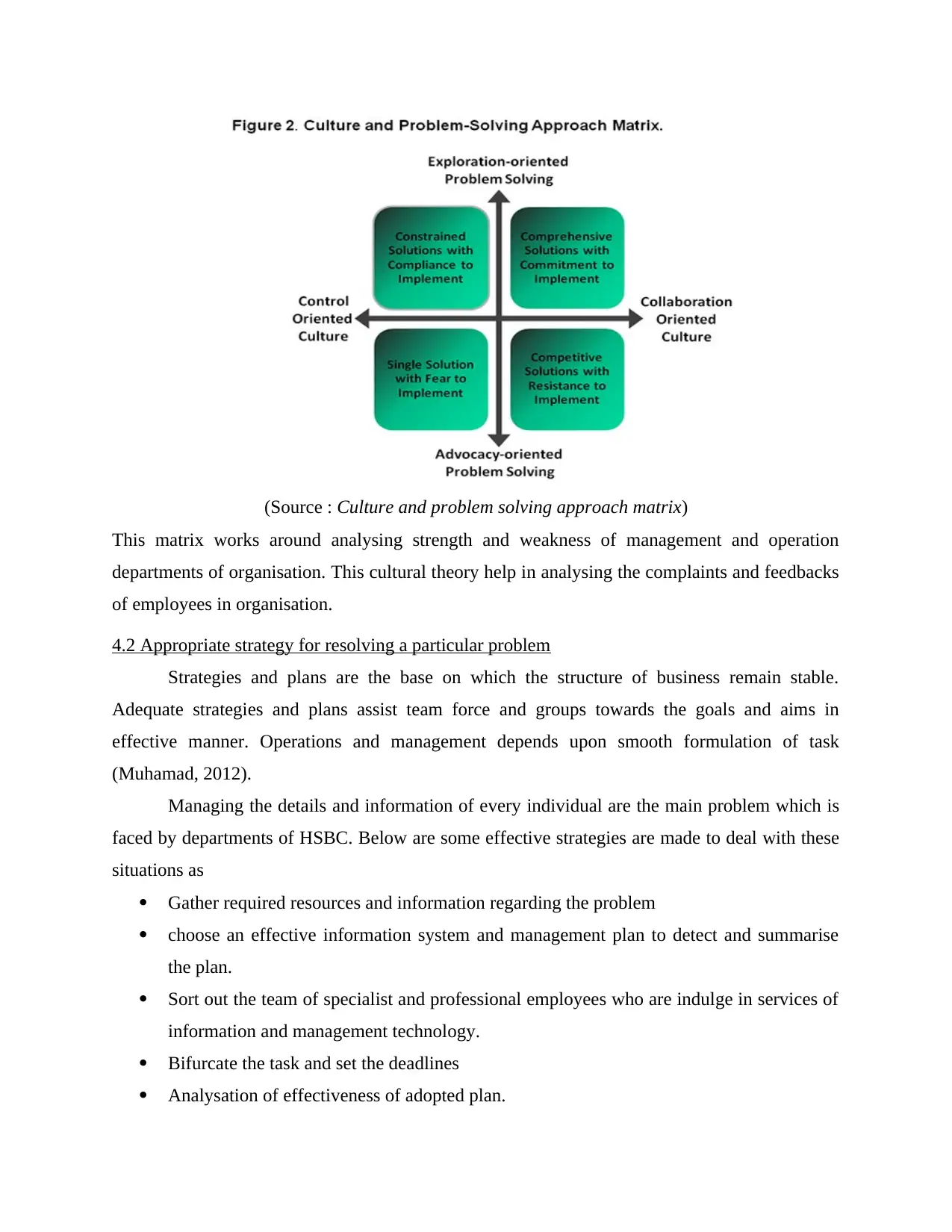
(Source : Culture and problem solving approach matrix)
This matrix works around analysing strength and weakness of management and operation
departments of organisation. This cultural theory help in analysing the complaints and feedbacks
of employees in organisation.
4.2 Appropriate strategy for resolving a particular problem
Strategies and plans are the base on which the structure of business remain stable.
Adequate strategies and plans assist team force and groups towards the goals and aims in
effective manner. Operations and management depends upon smooth formulation of task
(Muhamad, 2012).
Managing the details and information of every individual are the main problem which is
faced by departments of HSBC. Below are some effective strategies are made to deal with these
situations as
Gather required resources and information regarding the problem
choose an effective information system and management plan to detect and summarise
the plan.
Sort out the team of specialist and professional employees who are indulge in services of
information and management technology.
Bifurcate the task and set the deadlines
Analysation of effectiveness of adopted plan.
This matrix works around analysing strength and weakness of management and operation
departments of organisation. This cultural theory help in analysing the complaints and feedbacks
of employees in organisation.
4.2 Appropriate strategy for resolving a particular problem
Strategies and plans are the base on which the structure of business remain stable.
Adequate strategies and plans assist team force and groups towards the goals and aims in
effective manner. Operations and management depends upon smooth formulation of task
(Muhamad, 2012).
Managing the details and information of every individual are the main problem which is
faced by departments of HSBC. Below are some effective strategies are made to deal with these
situations as
Gather required resources and information regarding the problem
choose an effective information system and management plan to detect and summarise
the plan.
Sort out the team of specialist and professional employees who are indulge in services of
information and management technology.
Bifurcate the task and set the deadlines
Analysation of effectiveness of adopted plan.
Paraphrase This Document
Need a fresh take? Get an instant paraphrase of this document with our AI Paraphraser
4.3 Potential impact on the business of implementing the strategy
HSBC has gained uncountable achievements and milestones in banking and financial
services. It is one of the largest bank all over the world. It is a global bank which is operating its
functions and operations at multinational level. Appropriate strategies and plans are the major
factors which are responsible to growth and profitability of organisation.
As discussed above problem of information management system in HSBC, culture and
problem solving approach matrix is used to remove the conflicts and problem of organisation.
This strategy will help in various fields in organisation.
This strategy help in summarising the information according to divisions, types and
nature.
Managers would get selective and selected informations when required
It will reduce the time which consumed in getting the information from sub departments
of organisation.
CONCLUSION
Employability skills shows the capabilities of a person to work in organisation. This
report is designed to elaborate the dynamics of employability and skills and their importance in
organisational context. HSBC bank is opted organisation which in which different type of team
formulations and problem are discussed. How setting own roles and responsibilities help in
achieving the goals and aims of organisation are described in practical manner in this report.
Communication levels and effective communication styles are defined subject to management
reporting. How time management theory help in utilising the time effectively is discussed by
practical overview. A work base problem is discussed and appropriate strategy is applied to
remove the conflicts and challenges while performing the task.
HSBC has gained uncountable achievements and milestones in banking and financial
services. It is one of the largest bank all over the world. It is a global bank which is operating its
functions and operations at multinational level. Appropriate strategies and plans are the major
factors which are responsible to growth and profitability of organisation.
As discussed above problem of information management system in HSBC, culture and
problem solving approach matrix is used to remove the conflicts and problem of organisation.
This strategy will help in various fields in organisation.
This strategy help in summarising the information according to divisions, types and
nature.
Managers would get selective and selected informations when required
It will reduce the time which consumed in getting the information from sub departments
of organisation.
CONCLUSION
Employability skills shows the capabilities of a person to work in organisation. This
report is designed to elaborate the dynamics of employability and skills and their importance in
organisational context. HSBC bank is opted organisation which in which different type of team
formulations and problem are discussed. How setting own roles and responsibilities help in
achieving the goals and aims of organisation are described in practical manner in this report.
Communication levels and effective communication styles are defined subject to management
reporting. How time management theory help in utilising the time effectively is discussed by
practical overview. A work base problem is discussed and appropriate strategy is applied to
remove the conflicts and challenges while performing the task.
REFERENCES
Books and Journals
Aziz, Y., Safiah, S. and Zanariah, J., 2011. Critical thinking skills among final year students of
Malaysian Technical Universities.
Clark, A., 2011. Embedding transferable skills and enhancing student learning in a political
science research methods module: Evidence from the United Kingdom. PS: Political
Science & Politics. 44(1). pp.135-139.
De Cuyper, N., Van der Heijden, B.I. and De Witte, H., 2011. Associations between perceived
employability, employee well-being, and its contribution to organizational success: a
matter of psychological contracts?. The International Journal of Human Resource
Management. 22(07). pp.1486-1503.
Dhiman, M.C., 2012. Employers' perceptions about tourism management employability
skills. Anatolia. 23(3). pp.359-372.
James, N. and Field, R., 2013. The new lawyer. John Wiley and Sons Australia.
Ju, S., Zhang, D. and Pacha, J., 2012. Employability skills valued by employers as important for
entry-level employees with and without disabilities. Career Development and
Transition for Exceptional Individuals. 35(1). pp.29-38.
Misra, R.K. and Mishra, P., 2011. Employability skills: The conceptual framework & scale
development. Indian Journal of Industrial Relations. pp.650-660.
Muhamad, S., 2012. Graduate employability and transferable skills: A review. Advances in
Natural and Applied Sciences. 6(6). pp.882-886.
Riebe, L. and Jackson, D., 2014. The use of rubrics in benchmarking and assessing
employability skills. Journal of Management Education. 38(3). pp.319-344.
Taatila, V. P., 2010. Learning entrepreneurship in higher education. Education+ Training. 52(1).
pp.48-61.
Online
Culture and problem solving approach matrix, 2017. [Online] Available
through<http://www.onlineassignmenthelp.com.au/strategic-analysis-of-the-changan-
ford-joint-venture/>
Books and Journals
Aziz, Y., Safiah, S. and Zanariah, J., 2011. Critical thinking skills among final year students of
Malaysian Technical Universities.
Clark, A., 2011. Embedding transferable skills and enhancing student learning in a political
science research methods module: Evidence from the United Kingdom. PS: Political
Science & Politics. 44(1). pp.135-139.
De Cuyper, N., Van der Heijden, B.I. and De Witte, H., 2011. Associations between perceived
employability, employee well-being, and its contribution to organizational success: a
matter of psychological contracts?. The International Journal of Human Resource
Management. 22(07). pp.1486-1503.
Dhiman, M.C., 2012. Employers' perceptions about tourism management employability
skills. Anatolia. 23(3). pp.359-372.
James, N. and Field, R., 2013. The new lawyer. John Wiley and Sons Australia.
Ju, S., Zhang, D. and Pacha, J., 2012. Employability skills valued by employers as important for
entry-level employees with and without disabilities. Career Development and
Transition for Exceptional Individuals. 35(1). pp.29-38.
Misra, R.K. and Mishra, P., 2011. Employability skills: The conceptual framework & scale
development. Indian Journal of Industrial Relations. pp.650-660.
Muhamad, S., 2012. Graduate employability and transferable skills: A review. Advances in
Natural and Applied Sciences. 6(6). pp.882-886.
Riebe, L. and Jackson, D., 2014. The use of rubrics in benchmarking and assessing
employability skills. Journal of Management Education. 38(3). pp.319-344.
Taatila, V. P., 2010. Learning entrepreneurship in higher education. Education+ Training. 52(1).
pp.48-61.
Online
Culture and problem solving approach matrix, 2017. [Online] Available
through<http://www.onlineassignmenthelp.com.au/strategic-analysis-of-the-changan-
ford-joint-venture/>
⊘ This is a preview!⊘
Do you want full access?
Subscribe today to unlock all pages.
Trusted by 1+ million students worldwide

1 out of 13


Related Documents


Your All-in-One AI-Powered Toolkit for Academic Success.
+13062052269
info@desklib.com
Available 24*7 on WhatsApp / Email
![[object Object]](/_next/static/media/star-bottom.7253800d.svg)
Unlock your academic potential
Copyright © 2020–2026 A2Z Services. All Rights Reserved. Developed and managed by ZUCOL.