BMA6115 Leadership and Management: Leadership Theories and Analysis
VerifiedAdded on 2023/06/15
|12
|3864
|452
Report
AI Summary
This report provides an analysis of leadership and management, focusing on various leadership theories and their application in organizations like Unilever. It covers the Great Man Theory, Katz's Three-Skill Model, and Lewin's Leadership Styles, examining factors involved in being a successful leader. The report further explores how good leadership can be developed through models like Servant Leadership, Transformational Leadership, and Leader Member Exchange theory. It distinguishes between leadership and management, highlighting their different natures, focuses, required skills, and traits. The report also incorporates personal experiences to illustrate the practical aspects of leadership. Desklib provides access to similar solved assignments and study resources for students.
BMA6115 Leadership
and Management
and Management

Paraphrase This Document
Need a fresh take? Get an instant paraphrase of this document with our AI Paraphraser
Contents
INTRODUCTION...........................................................................................................................1
MAIN BODY...................................................................................................................................1
Analysing various factors that involved for being a successful leader........................................1
Analysing factors for developing good leadership......................................................................3
Analysing difference between leadership and management........................................................5
Analysing individual's experience for learning about leadership................................................7
CONCLUSION................................................................................................................................8
REFERENCES..............................................................................................................................10
INTRODUCTION...........................................................................................................................1
MAIN BODY...................................................................................................................................1
Analysing various factors that involved for being a successful leader........................................1
Analysing factors for developing good leadership......................................................................3
Analysing difference between leadership and management........................................................5
Analysing individual's experience for learning about leadership................................................7
CONCLUSION................................................................................................................................8
REFERENCES..............................................................................................................................10
INTRODUCTION
Leadership refers to an individual's ability in order to encourage, motivate and influence
other persons to work hard for achieving organisational goals in effective manner. Whereas
management refers to an activity of managing or controlling various functions and resources of
the company in effective manner (Beauvais, 2018). Leadership theories help individual in order
to develop and improve their quality and characteristics in order to become strong leader for the
future. For this report, selected company is Unilever which is a type of public limited company
and based in UK. It is founded in 1929 and its headquarters is in London, England. It provide
consumer goods in all over the world.
The report cover factors that involved in being a successful leader. It also analyse factors
for developing good leadership and difference between leadership and management. It also
describe individual's experiences for learning about leadership.
MAIN BODY
Analysing various factors that involved for being a successful leader
Leader is the one who to motivate and influence other employees in effective manner. It
analyse the things which is need to be improved in order to achieve future objectives in effective
manner. Different type of management theories are their which individual to become good
leaders for the future in effective manner (Bush, Bell and Middlewood, 2019). These theories are
basis on leadership traits, skills and styles. In context of Unilever, factors that needed by an
individual for being a successful leader in their company can be achieve by using various
leadership theories which are described below:
Great man theory-
The great man theory of leadership suggest that a great and successful leaders are born
and not made. It was given by historian Thomas Carlyle in 19th century. According to this theory,
some specific traits and qualities are not find in each people. It describes that a good leaders were
born in order to lead because of its natural qualities, abilities and talents. It makes its focus on its
two assumptions that is great and successful learn are born by containing some specific traits
which helps them to lead and rise in effective manner and the great leaders can be develop when
they required most. In respect of Unilever, according to this theory, it is important for the
1
Leadership refers to an individual's ability in order to encourage, motivate and influence
other persons to work hard for achieving organisational goals in effective manner. Whereas
management refers to an activity of managing or controlling various functions and resources of
the company in effective manner (Beauvais, 2018). Leadership theories help individual in order
to develop and improve their quality and characteristics in order to become strong leader for the
future. For this report, selected company is Unilever which is a type of public limited company
and based in UK. It is founded in 1929 and its headquarters is in London, England. It provide
consumer goods in all over the world.
The report cover factors that involved in being a successful leader. It also analyse factors
for developing good leadership and difference between leadership and management. It also
describe individual's experiences for learning about leadership.
MAIN BODY
Analysing various factors that involved for being a successful leader
Leader is the one who to motivate and influence other employees in effective manner. It
analyse the things which is need to be improved in order to achieve future objectives in effective
manner. Different type of management theories are their which individual to become good
leaders for the future in effective manner (Bush, Bell and Middlewood, 2019). These theories are
basis on leadership traits, skills and styles. In context of Unilever, factors that needed by an
individual for being a successful leader in their company can be achieve by using various
leadership theories which are described below:
Great man theory-
The great man theory of leadership suggest that a great and successful leaders are born
and not made. It was given by historian Thomas Carlyle in 19th century. According to this theory,
some specific traits and qualities are not find in each people. It describes that a good leaders were
born in order to lead because of its natural qualities, abilities and talents. It makes its focus on its
two assumptions that is great and successful learn are born by containing some specific traits
which helps them to lead and rise in effective manner and the great leaders can be develop when
they required most. In respect of Unilever, according to this theory, it is important for the
1
⊘ This is a preview!⊘
Do you want full access?
Subscribe today to unlock all pages.

Trusted by 1+ million students worldwide
individual to have certain natural ability and personality in order to to become a successful and
great leader for the organisation.
Katz's Three-Skill Model-
Katz's three skill model is focus on three skills that are technical skills, human skills and
conceptual skills, which is important for an individual in order to become good leader. It is
important for the leaders to focus on these three skills in order to perform or operate their
leadership in effective manner (Clark, 2017). This theory or model is given by Robert katz in
1955. In regards of Unilever, these skills are described below:
Technical Skills- It refers to an ability which makes an individual professional in order
to perform certain type of work or activity in effective manner. An individual become
professional when it have proper knowledge about work, analytical ability and ability and
knowledge about technical tools and techniques in order to perform task.
Human Skills- It refers to an ability which makes an individual effective in order to
communicate with other persons. It helps leaders in order to perform their duty effectively with
their subordinates and colleagues. This makes leaders most effective for interacting with other
employees and motivate them in order to work hard for achieving organisational goals in
effective manner.
Conceptual Skills- It refers to an ability which makes individual perform their work by
using various concepts and ideas. It helps leaders for making strategic plans, developing visions
and setting directions in order to perform effectively.
Lewin's Leadership Styles-
It is an oldest model given by Kurt Lewin in 1939 and described three leadership styles
which is important for the leaders in order to perform effectively within an organisation. This
styles help leaders in order to make an effective decisions for achieving goals in future
effectively (Cole, 2018). In case of Unilever, these leadership styles are described below:
Authoritarian Leadership- It makes leaders to enhance their goals, methods and
deadlines in order to make decisions with their own by little consulting with others. It is also
known as Autocratic leadership styles. It helps leaders in order to make creative decisions in
order to make other employees to follow their decisions in order to perform effectively. This
leadership styles can only be used when employees are inexperienced or in difficult situations.
2
great leader for the organisation.
Katz's Three-Skill Model-
Katz's three skill model is focus on three skills that are technical skills, human skills and
conceptual skills, which is important for an individual in order to become good leader. It is
important for the leaders to focus on these three skills in order to perform or operate their
leadership in effective manner (Clark, 2017). This theory or model is given by Robert katz in
1955. In regards of Unilever, these skills are described below:
Technical Skills- It refers to an ability which makes an individual professional in order
to perform certain type of work or activity in effective manner. An individual become
professional when it have proper knowledge about work, analytical ability and ability and
knowledge about technical tools and techniques in order to perform task.
Human Skills- It refers to an ability which makes an individual effective in order to
communicate with other persons. It helps leaders in order to perform their duty effectively with
their subordinates and colleagues. This makes leaders most effective for interacting with other
employees and motivate them in order to work hard for achieving organisational goals in
effective manner.
Conceptual Skills- It refers to an ability which makes individual perform their work by
using various concepts and ideas. It helps leaders for making strategic plans, developing visions
and setting directions in order to perform effectively.
Lewin's Leadership Styles-
It is an oldest model given by Kurt Lewin in 1939 and described three leadership styles
which is important for the leaders in order to perform effectively within an organisation. This
styles help leaders in order to make an effective decisions for achieving goals in future
effectively (Cole, 2018). In case of Unilever, these leadership styles are described below:
Authoritarian Leadership- It makes leaders to enhance their goals, methods and
deadlines in order to make decisions with their own by little consulting with others. It is also
known as Autocratic leadership styles. It helps leaders in order to make creative decisions in
order to make other employees to follow their decisions in order to perform effectively. This
leadership styles can only be used when employees are inexperienced or in difficult situations.
2
Paraphrase This Document
Need a fresh take? Get an instant paraphrase of this document with our AI Paraphraser
Participative Leadership- In this type of leadership, leaders involves other subordinates
in their decision making process in order to make them perform effectively in the organisation.
Final decisions are make by the leaders but it takes inputs or advices from other employees in
order to make effective and creative decisions for the organisation. It is also known as
democratic leadership style.
Delegative leadership- In this type of leadership styles it makes leaders to allow some
authority to other subordinates in order to make decisions for performing their duty in effective
manner. It is also known as Laissez-faire leadership styles (De Oliveira, Cavazotte and Alan
Dunzer, 2019). This styles can only be used when employees are highly motivated and skilled
that are able to plan, make decisions, solve issues and perform their duty without intervention of
management in it.
In respect of Unilever, participative leadership styles are to be important for its leaders in
order to take advices from other employees in order to make decisions effectively. This makes
other employees comfortable and influenced in order to perform effectively and achieve
organisational goals in effective manner.
Analysing factors for developing good leadership
Yes, leadership skills can be develop by the help of proper practices and models.
Leadership describes three things which is need to be performed by the leaders. This three things
helps leaders in order to develop leadership in effective manner. First one is leaders develop
visions which describes future reality which can be seen by others effectively. Second is leaders
build alliance in which it motivates other people in order to make them committed for the vision
and articulate the method to achieve it in effective manner (Golensky and Hager 2020). Third
one is leadership is deployment which makes leaders use proper and effective resources in order
to achieve their visions in effective manner. In context of Unilever, a good leadership can be
develop by the help of different leadership models that are described below:
Servant leadership model-
The servant leadership model was introduced by Robert K. Greenleaf in 1970. It
describes that a leader first focus on the needs of other persons of its persons before considering
about yourself. It is important for the leaders to acknowledge other members view, provide
proper support to them when they needed in order to achieve their personal goals, involve them
in decision and make effective communication within their team. This makes more trust, higher
3
in their decision making process in order to make them perform effectively in the organisation.
Final decisions are make by the leaders but it takes inputs or advices from other employees in
order to make effective and creative decisions for the organisation. It is also known as
democratic leadership style.
Delegative leadership- In this type of leadership styles it makes leaders to allow some
authority to other subordinates in order to make decisions for performing their duty in effective
manner. It is also known as Laissez-faire leadership styles (De Oliveira, Cavazotte and Alan
Dunzer, 2019). This styles can only be used when employees are highly motivated and skilled
that are able to plan, make decisions, solve issues and perform their duty without intervention of
management in it.
In respect of Unilever, participative leadership styles are to be important for its leaders in
order to take advices from other employees in order to make decisions effectively. This makes
other employees comfortable and influenced in order to perform effectively and achieve
organisational goals in effective manner.
Analysing factors for developing good leadership
Yes, leadership skills can be develop by the help of proper practices and models.
Leadership describes three things which is need to be performed by the leaders. This three things
helps leaders in order to develop leadership in effective manner. First one is leaders develop
visions which describes future reality which can be seen by others effectively. Second is leaders
build alliance in which it motivates other people in order to make them committed for the vision
and articulate the method to achieve it in effective manner (Golensky and Hager 2020). Third
one is leadership is deployment which makes leaders use proper and effective resources in order
to achieve their visions in effective manner. In context of Unilever, a good leadership can be
develop by the help of different leadership models that are described below:
Servant leadership model-
The servant leadership model was introduced by Robert K. Greenleaf in 1970. It
describes that a leader first focus on the needs of other persons of its persons before considering
about yourself. It is important for the leaders to acknowledge other members view, provide
proper support to them when they needed in order to achieve their personal goals, involve them
in decision and make effective communication within their team. This makes more trust, higher
3
engagement and strong relations with the team members and with other investors in effective
manner. In accordance with Unilever, this model helps their leaders in order to fulfil needs of
other employees of their team and make them comfortable for performing their duties in
effective manner. This helps them to develop leadership in their organisation in effective
manner.
Transformational Leadership theory-
Transformational leadership theory was given by James V. Downton in 1973 and it was
expanded by James Burns in 1978. It was further expanded by Bernard M. Bass in 1985
(Hallinger, 2019). It help leaders to motivate employees in order to create and innovate changes
for developing effective working environment in the company as well as make them more
productive in effective manner. It also helps them in order to increase organisational growth and
make them effective for achieving future success in effective manner. In account of Unilever,
this theory helps their leaders to encourage motivations with in a organisation in order to develop
other subordinates positively. It helps them to develop leadership in effective manner.
Leader member exchange theory-
Leader member Exchange theory was introduced in 1970 and it focus on developing
good relationship between leaders and other employees of the organisation (Karatepe,
Aboramadan and Dahleez, 2020). In context of Unilever, relationship between its leaders and
other employees are described in three stages which are described below:
Role-taking- In this stage, role taking occurs when employees are new in order to join
the organisation where leaders interact with them effectively in order to identify new employees
skills and abilities in effective manner.
Role-making- In this stage, new employees are start doing their work in the
organisation and leaders wants from new employees to work hard, being trustworthy and loyal in
order to make their role most effective.
Rountinization- This is the last stage of this theory which makes routines in between
leaders and other employees in the organisation. It makes other employees to work hard in order
to maintain good opinion for the leaders by showing respect, patience, trust, empathy and
persistence.
4
manner. In accordance with Unilever, this model helps their leaders in order to fulfil needs of
other employees of their team and make them comfortable for performing their duties in
effective manner. This helps them to develop leadership in their organisation in effective
manner.
Transformational Leadership theory-
Transformational leadership theory was given by James V. Downton in 1973 and it was
expanded by James Burns in 1978. It was further expanded by Bernard M. Bass in 1985
(Hallinger, 2019). It help leaders to motivate employees in order to create and innovate changes
for developing effective working environment in the company as well as make them more
productive in effective manner. It also helps them in order to increase organisational growth and
make them effective for achieving future success in effective manner. In account of Unilever,
this theory helps their leaders to encourage motivations with in a organisation in order to develop
other subordinates positively. It helps them to develop leadership in effective manner.
Leader member exchange theory-
Leader member Exchange theory was introduced in 1970 and it focus on developing
good relationship between leaders and other employees of the organisation (Karatepe,
Aboramadan and Dahleez, 2020). In context of Unilever, relationship between its leaders and
other employees are described in three stages which are described below:
Role-taking- In this stage, role taking occurs when employees are new in order to join
the organisation where leaders interact with them effectively in order to identify new employees
skills and abilities in effective manner.
Role-making- In this stage, new employees are start doing their work in the
organisation and leaders wants from new employees to work hard, being trustworthy and loyal in
order to make their role most effective.
Rountinization- This is the last stage of this theory which makes routines in between
leaders and other employees in the organisation. It makes other employees to work hard in order
to maintain good opinion for the leaders by showing respect, patience, trust, empathy and
persistence.
4
⊘ This is a preview!⊘
Do you want full access?
Subscribe today to unlock all pages.
Trusted by 1+ million students worldwide
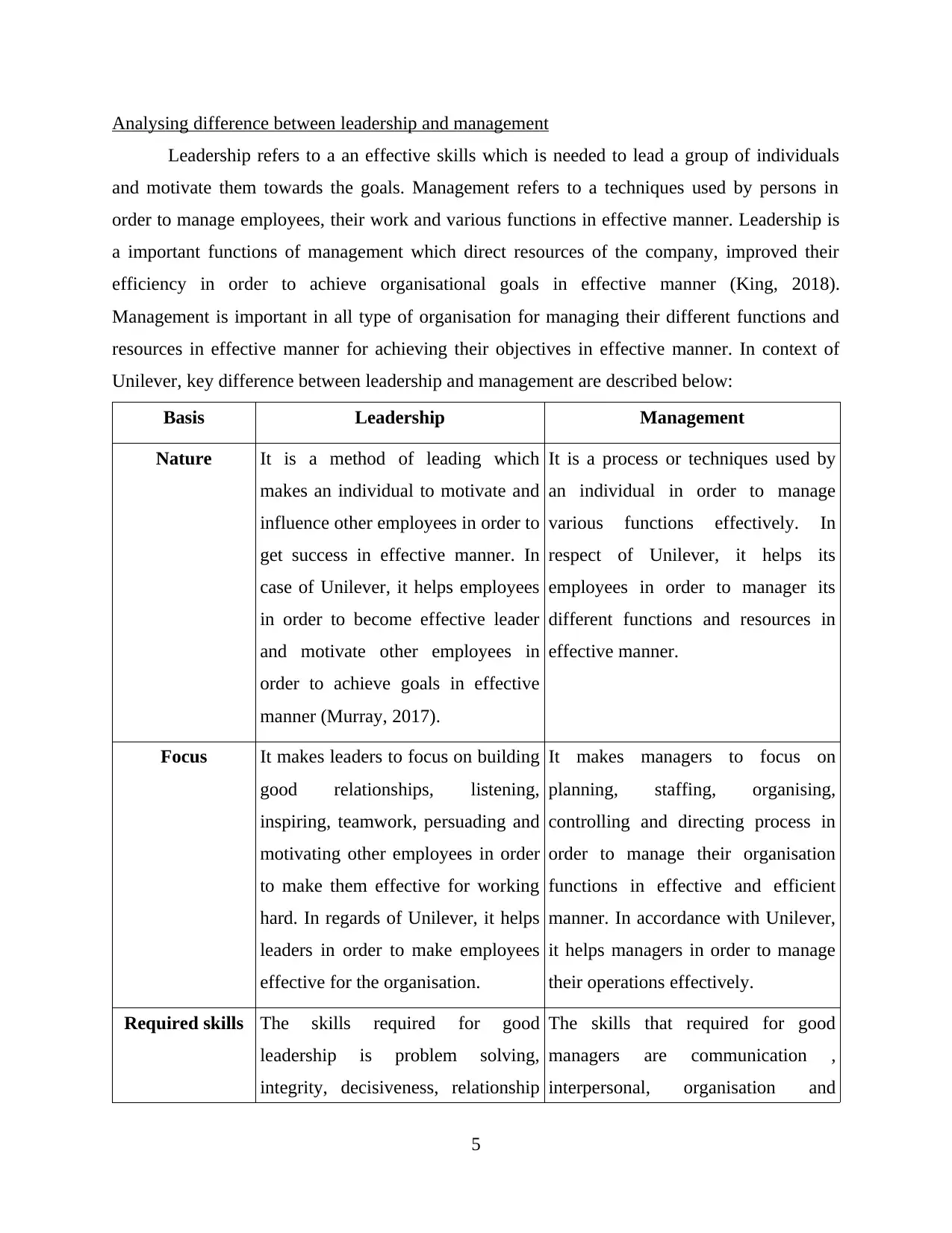
Analysing difference between leadership and management
Leadership refers to a an effective skills which is needed to lead a group of individuals
and motivate them towards the goals. Management refers to a techniques used by persons in
order to manage employees, their work and various functions in effective manner. Leadership is
a important functions of management which direct resources of the company, improved their
efficiency in order to achieve organisational goals in effective manner (King, 2018).
Management is important in all type of organisation for managing their different functions and
resources in effective manner for achieving their objectives in effective manner. In context of
Unilever, key difference between leadership and management are described below:
Basis Leadership Management
Nature It is a method of leading which
makes an individual to motivate and
influence other employees in order to
get success in effective manner. In
case of Unilever, it helps employees
in order to become effective leader
and motivate other employees in
order to achieve goals in effective
manner (Murray, 2017).
It is a process or techniques used by
an individual in order to manage
various functions effectively. In
respect of Unilever, it helps its
employees in order to manager its
different functions and resources in
effective manner.
Focus It makes leaders to focus on building
good relationships, listening,
inspiring, teamwork, persuading and
motivating other employees in order
to make them effective for working
hard. In regards of Unilever, it helps
leaders in order to make employees
effective for the organisation.
It makes managers to focus on
planning, staffing, organising,
controlling and directing process in
order to manage their organisation
functions in effective and efficient
manner. In accordance with Unilever,
it helps managers in order to manage
their operations effectively.
Required skills The skills required for good
leadership is problem solving,
integrity, decisiveness, relationship
The skills that required for good
managers are communication ,
interpersonal, organisation and
5
Leadership refers to a an effective skills which is needed to lead a group of individuals
and motivate them towards the goals. Management refers to a techniques used by persons in
order to manage employees, their work and various functions in effective manner. Leadership is
a important functions of management which direct resources of the company, improved their
efficiency in order to achieve organisational goals in effective manner (King, 2018).
Management is important in all type of organisation for managing their different functions and
resources in effective manner for achieving their objectives in effective manner. In context of
Unilever, key difference between leadership and management are described below:
Basis Leadership Management
Nature It is a method of leading which
makes an individual to motivate and
influence other employees in order to
get success in effective manner. In
case of Unilever, it helps employees
in order to become effective leader
and motivate other employees in
order to achieve goals in effective
manner (Murray, 2017).
It is a process or techniques used by
an individual in order to manage
various functions effectively. In
respect of Unilever, it helps its
employees in order to manager its
different functions and resources in
effective manner.
Focus It makes leaders to focus on building
good relationships, listening,
inspiring, teamwork, persuading and
motivating other employees in order
to make them effective for working
hard. In regards of Unilever, it helps
leaders in order to make employees
effective for the organisation.
It makes managers to focus on
planning, staffing, organising,
controlling and directing process in
order to manage their organisation
functions in effective and efficient
manner. In accordance with Unilever,
it helps managers in order to manage
their operations effectively.
Required skills The skills required for good
leadership is problem solving,
integrity, decisiveness, relationship
The skills that required for good
managers are communication ,
interpersonal, organisation and
5
Paraphrase This Document
Need a fresh take? Get an instant paraphrase of this document with our AI Paraphraser
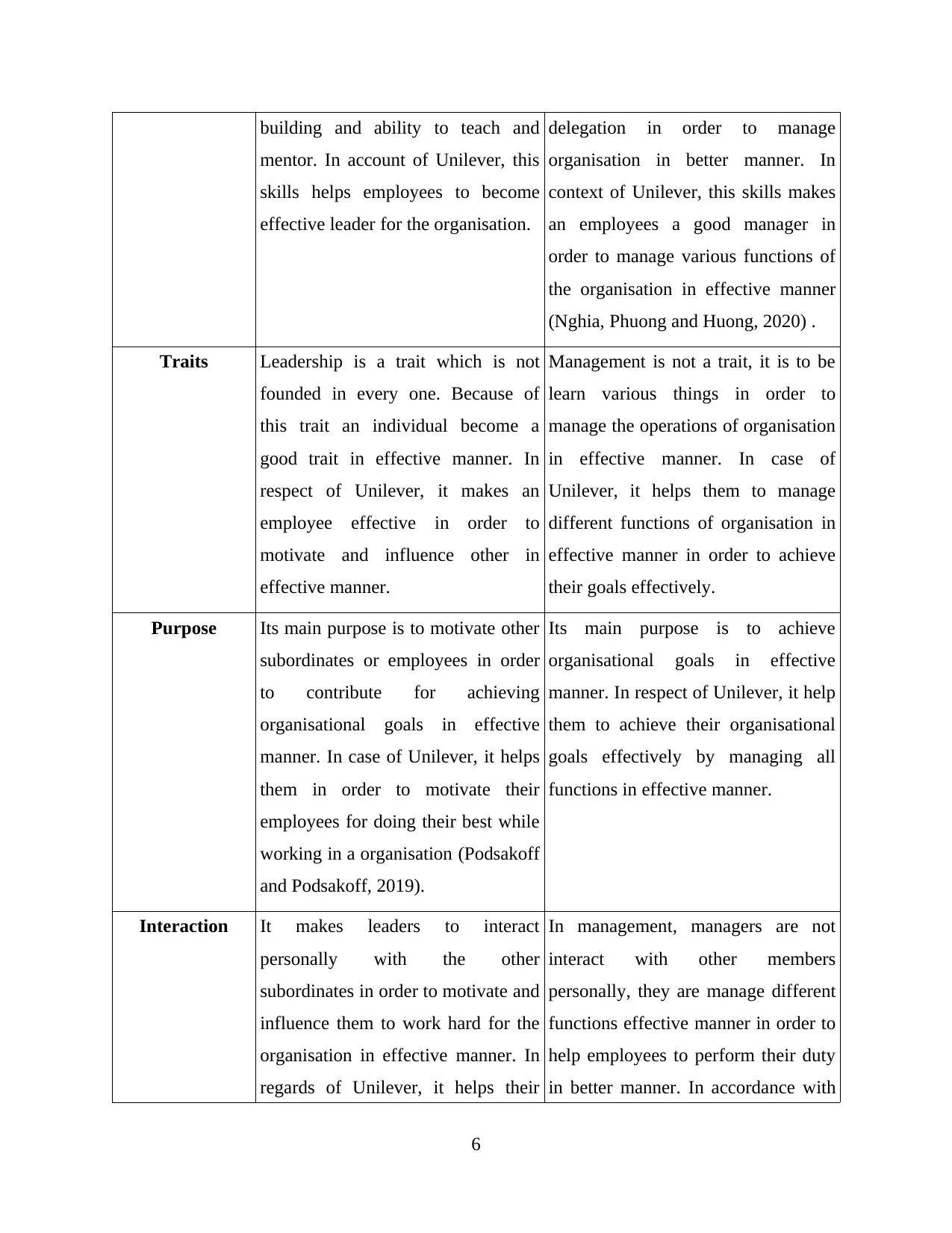
building and ability to teach and
mentor. In account of Unilever, this
skills helps employees to become
effective leader for the organisation.
delegation in order to manage
organisation in better manner. In
context of Unilever, this skills makes
an employees a good manager in
order to manage various functions of
the organisation in effective manner
(Nghia, Phuong and Huong, 2020) .
Traits Leadership is a trait which is not
founded in every one. Because of
this trait an individual become a
good trait in effective manner. In
respect of Unilever, it makes an
employee effective in order to
motivate and influence other in
effective manner.
Management is not a trait, it is to be
learn various things in order to
manage the operations of organisation
in effective manner. In case of
Unilever, it helps them to manage
different functions of organisation in
effective manner in order to achieve
their goals effectively.
Purpose Its main purpose is to motivate other
subordinates or employees in order
to contribute for achieving
organisational goals in effective
manner. In case of Unilever, it helps
them in order to motivate their
employees for doing their best while
working in a organisation (Podsakoff
and Podsakoff, 2019).
Its main purpose is to achieve
organisational goals in effective
manner. In respect of Unilever, it help
them to achieve their organisational
goals effectively by managing all
functions in effective manner.
Interaction It makes leaders to interact
personally with the other
subordinates in order to motivate and
influence them to work hard for the
organisation in effective manner. In
regards of Unilever, it helps their
In management, managers are not
interact with other members
personally, they are manage different
functions effective manner in order to
help employees to perform their duty
in better manner. In accordance with
6
mentor. In account of Unilever, this
skills helps employees to become
effective leader for the organisation.
delegation in order to manage
organisation in better manner. In
context of Unilever, this skills makes
an employees a good manager in
order to manage various functions of
the organisation in effective manner
(Nghia, Phuong and Huong, 2020) .
Traits Leadership is a trait which is not
founded in every one. Because of
this trait an individual become a
good trait in effective manner. In
respect of Unilever, it makes an
employee effective in order to
motivate and influence other in
effective manner.
Management is not a trait, it is to be
learn various things in order to
manage the operations of organisation
in effective manner. In case of
Unilever, it helps them to manage
different functions of organisation in
effective manner in order to achieve
their goals effectively.
Purpose Its main purpose is to motivate other
subordinates or employees in order
to contribute for achieving
organisational goals in effective
manner. In case of Unilever, it helps
them in order to motivate their
employees for doing their best while
working in a organisation (Podsakoff
and Podsakoff, 2019).
Its main purpose is to achieve
organisational goals in effective
manner. In respect of Unilever, it help
them to achieve their organisational
goals effectively by managing all
functions in effective manner.
Interaction It makes leaders to interact
personally with the other
subordinates in order to motivate and
influence them to work hard for the
organisation in effective manner. In
regards of Unilever, it helps their
In management, managers are not
interact with other members
personally, they are manage different
functions effective manner in order to
help employees to perform their duty
in better manner. In accordance with
6
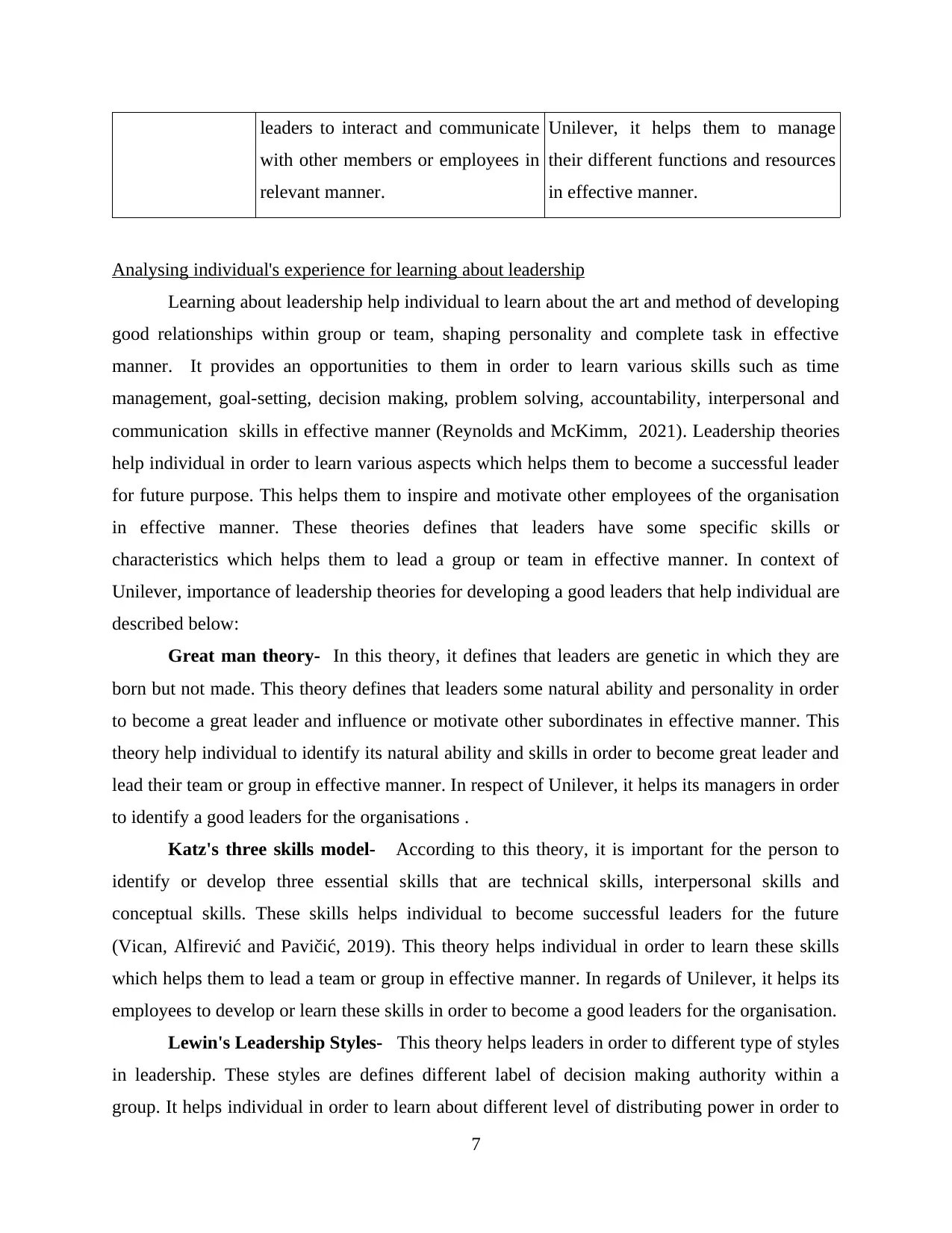
leaders to interact and communicate
with other members or employees in
relevant manner.
Unilever, it helps them to manage
their different functions and resources
in effective manner.
Analysing individual's experience for learning about leadership
Learning about leadership help individual to learn about the art and method of developing
good relationships within group or team, shaping personality and complete task in effective
manner. It provides an opportunities to them in order to learn various skills such as time
management, goal-setting, decision making, problem solving, accountability, interpersonal and
communication skills in effective manner (Reynolds and McKimm, 2021). Leadership theories
help individual in order to learn various aspects which helps them to become a successful leader
for future purpose. This helps them to inspire and motivate other employees of the organisation
in effective manner. These theories defines that leaders have some specific skills or
characteristics which helps them to lead a group or team in effective manner. In context of
Unilever, importance of leadership theories for developing a good leaders that help individual are
described below:
Great man theory- In this theory, it defines that leaders are genetic in which they are
born but not made. This theory defines that leaders some natural ability and personality in order
to become a great leader and influence or motivate other subordinates in effective manner. This
theory help individual to identify its natural ability and skills in order to become great leader and
lead their team or group in effective manner. In respect of Unilever, it helps its managers in order
to identify a good leaders for the organisations .
Katz's three skills model- According to this theory, it is important for the person to
identify or develop three essential skills that are technical skills, interpersonal skills and
conceptual skills. These skills helps individual to become successful leaders for the future
(Vican, Alfirević and Pavičić, 2019). This theory helps individual in order to learn these skills
which helps them to lead a team or group in effective manner. In regards of Unilever, it helps its
employees to develop or learn these skills in order to become a good leaders for the organisation.
Lewin's Leadership Styles- This theory helps leaders in order to different type of styles
in leadership. These styles are defines different label of decision making authority within a
group. It helps individual in order to learn about different level of distributing power in order to
7
with other members or employees in
relevant manner.
Unilever, it helps them to manage
their different functions and resources
in effective manner.
Analysing individual's experience for learning about leadership
Learning about leadership help individual to learn about the art and method of developing
good relationships within group or team, shaping personality and complete task in effective
manner. It provides an opportunities to them in order to learn various skills such as time
management, goal-setting, decision making, problem solving, accountability, interpersonal and
communication skills in effective manner (Reynolds and McKimm, 2021). Leadership theories
help individual in order to learn various aspects which helps them to become a successful leader
for future purpose. This helps them to inspire and motivate other employees of the organisation
in effective manner. These theories defines that leaders have some specific skills or
characteristics which helps them to lead a group or team in effective manner. In context of
Unilever, importance of leadership theories for developing a good leaders that help individual are
described below:
Great man theory- In this theory, it defines that leaders are genetic in which they are
born but not made. This theory defines that leaders some natural ability and personality in order
to become a great leader and influence or motivate other subordinates in effective manner. This
theory help individual to identify its natural ability and skills in order to become great leader and
lead their team or group in effective manner. In respect of Unilever, it helps its managers in order
to identify a good leaders for the organisations .
Katz's three skills model- According to this theory, it is important for the person to
identify or develop three essential skills that are technical skills, interpersonal skills and
conceptual skills. These skills helps individual to become successful leaders for the future
(Vican, Alfirević and Pavičić, 2019). This theory helps individual in order to learn these skills
which helps them to lead a team or group in effective manner. In regards of Unilever, it helps its
employees to develop or learn these skills in order to become a good leaders for the organisation.
Lewin's Leadership Styles- This theory helps leaders in order to different type of styles
in leadership. These styles are defines different label of decision making authority within a
group. It helps individual in order to learn about different level of distributing power in order to
7
⊘ This is a preview!⊘
Do you want full access?
Subscribe today to unlock all pages.
Trusted by 1+ million students worldwide
take decisions for performing functions in the organisation in effective manner. In case of
Unilever, it is important for the leaders to learn about these styles which helps them to manage
decision making process in effective manner.
Servant leadership model- This model is important in the organisation for making
nurturing environment in order to make employees to feel respected, appreciated and head for
performing their work in effective manner. This makes individual to learn how to develop a
strong working culture in the organisation in order to make other members engaged within it. In
accordance with Unilever, it helps them to make effective environment in the organisation for
the employees so, they perform their duties effectively.
Transformational leadership theory- This theory helps leaders to get knowledge about
how to inspire, encourage and motivate other members to work hard and contribute their best and
help their team in order to achieve their goals in effected manner (Weiss, Tappen and Grimley,
2019). This helps individual to learn and learn various aspects which helps them to get know
how to motivate other team members in effective manner. In account of Unilever, it helps its
leaders in order to motivate other employees in effective manner so, they give their best and
work hard for achieving goals in effective manner.
Leader member exchange theory- This theory defines that leaders and other members
of a team can create an unique and effective relationships by making social exchange. These
exchange helps organisation in order to influence employees and make them effective for
performing within an organisation. This theory helps individual for learning those things which
helps them to become a good leader in future. In context of Unilever, it helps leaders and
employees in order to maintain good relationships in the organisation which makes them
effective for performing their functions in effective manner.
CONCLUSION
From the above report, it is concluded that management helps organisations for managing
their different functions and resources and leadership is the ability in order to influence a team
towards the achievements of objectives. Leadership theories such as great man theory, Katz's
three skills theory and Lewin's leadership styles theory helps individual in order to learn various
aspects for becoming a successful leader in effective manner. These theories helps leaders to
develop an good leadership in its team in order to easily influence other team members to work
hard for achieving their goals in effective manner. Leadership theories such as servant leadership
8
Unilever, it is important for the leaders to learn about these styles which helps them to manage
decision making process in effective manner.
Servant leadership model- This model is important in the organisation for making
nurturing environment in order to make employees to feel respected, appreciated and head for
performing their work in effective manner. This makes individual to learn how to develop a
strong working culture in the organisation in order to make other members engaged within it. In
accordance with Unilever, it helps them to make effective environment in the organisation for
the employees so, they perform their duties effectively.
Transformational leadership theory- This theory helps leaders to get knowledge about
how to inspire, encourage and motivate other members to work hard and contribute their best and
help their team in order to achieve their goals in effected manner (Weiss, Tappen and Grimley,
2019). This helps individual to learn and learn various aspects which helps them to get know
how to motivate other team members in effective manner. In account of Unilever, it helps its
leaders in order to motivate other employees in effective manner so, they give their best and
work hard for achieving goals in effective manner.
Leader member exchange theory- This theory defines that leaders and other members
of a team can create an unique and effective relationships by making social exchange. These
exchange helps organisation in order to influence employees and make them effective for
performing within an organisation. This theory helps individual for learning those things which
helps them to become a good leader in future. In context of Unilever, it helps leaders and
employees in order to maintain good relationships in the organisation which makes them
effective for performing their functions in effective manner.
CONCLUSION
From the above report, it is concluded that management helps organisations for managing
their different functions and resources and leadership is the ability in order to influence a team
towards the achievements of objectives. Leadership theories such as great man theory, Katz's
three skills theory and Lewin's leadership styles theory helps individual in order to learn various
aspects for becoming a successful leader in effective manner. These theories helps leaders to
develop an good leadership in its team in order to easily influence other team members to work
hard for achieving their goals in effective manner. Leadership theories such as servant leadership
8
Paraphrase This Document
Need a fresh take? Get an instant paraphrase of this document with our AI Paraphraser
model, transformational leadership model and leader member exchange theories help leaders to
make an effective environment in the organisation for motivating other team member effectively.
Leadership is different from management it influence, motivate, encourage other people whereas
management manage them in effective manner. By learning about leadership, an individual can
develop various skills which helps them to become an effective leader in future.
9
make an effective environment in the organisation for motivating other team member effectively.
Leadership is different from management it influence, motivate, encourage other people whereas
management manage them in effective manner. By learning about leadership, an individual can
develop various skills which helps them to become an effective leader in future.
9
REFERENCES
Books and Journals:
Beauvais, A. M. ed., 2018. Leadership and Management Competence in Nursing Practice:
Competencies, Skills, Decision-making. Springer Publishing Company.
Bush, T., Bell, L. and Middlewood, D. eds., 2019. Principles of educational leadership &
management. Sage.
Clark, L., 2017. Implementing an institution-wide community-engaged learning program: The
leadership and management challenge. In Learning Through Community
Engagement (pp. 133-151). Springer, Singapore.
Cole, K., 2018. Leadership and Management: Theory and Practice. Cengage AU.
De Oliveira, L. B., Cavazotte, F. and Alan Dunzer, R., 2019. The interactive effects of
organizational and leadership career management support on job satisfaction and
turnover intention. The International Journal of Human Resource Management, 30(10),
pp.1583-1603.
Golensky, M. and Hager, M., 2020. Strategic leadership and management in nonprofit
organizations: Theory and practice. Oxford University Press.
Hallinger, P., 2019. A systematic review of research on educational leadership and management
in South Africa: Mapping knowledge production in a developing society. International
Journal of leadership in education, 22(3), pp.316-334.
Karatepe, O. M., Aboramadan, M. and Dahleez, K. A., 2020. Does climate for creativity mediate
the impact of servant leadership on management innovation and innovative behavior in
the hotel industry?. International Journal of Contemporary Hospitality Management.
King, M., 2018. The impact of LTA volunteerism on leadership and management development:
An autoethnographic reflection. In The Role of Language Teacher Associations in
Professional Development (pp. 283-294). Springer, Cham.
Murray, E., 2017. Nursing leadership and management: for patient safety and quality care. FA
Davis.
Nghia, T. L. H., Phuong, P. T .N. and Huong, T. L. K., 2020. Implementing the student-centred
teaching approach in Vietnamese universities: the influence of leadership and
management practices on teacher engagement. Educational Studies, 46(2), pp.188-204.
Podsakoff, P. M. and Podsakoff, N. P., 2019. Experimental designs in management and
leadership research: Strengths, limitations, and recommendations for improving
publishability. The Leadership Quarterly, 30(1), pp.11-33.
Reynolds, D. and McKimm, J., 2021. Educational management and leadership in Wales:
Promise, performance and potential. School Leadership & Management, 41(1-2), pp.54-
72.
Vican, D., Alfirević, N. and Pavičić, J., 2019. Croatian policy and experience in developing
educational leadership and management: Work in progress, or a failed experiment?.
In Educational Leadership in Policy (pp. 221-244). Palgrave Macmillan, Cham.
Weiss, S. A., Tappen, R. M. and Grimley, K., 2019. Essentials of nursing leadership &
management. FA Davis.
10
Books and Journals:
Beauvais, A. M. ed., 2018. Leadership and Management Competence in Nursing Practice:
Competencies, Skills, Decision-making. Springer Publishing Company.
Bush, T., Bell, L. and Middlewood, D. eds., 2019. Principles of educational leadership &
management. Sage.
Clark, L., 2017. Implementing an institution-wide community-engaged learning program: The
leadership and management challenge. In Learning Through Community
Engagement (pp. 133-151). Springer, Singapore.
Cole, K., 2018. Leadership and Management: Theory and Practice. Cengage AU.
De Oliveira, L. B., Cavazotte, F. and Alan Dunzer, R., 2019. The interactive effects of
organizational and leadership career management support on job satisfaction and
turnover intention. The International Journal of Human Resource Management, 30(10),
pp.1583-1603.
Golensky, M. and Hager, M., 2020. Strategic leadership and management in nonprofit
organizations: Theory and practice. Oxford University Press.
Hallinger, P., 2019. A systematic review of research on educational leadership and management
in South Africa: Mapping knowledge production in a developing society. International
Journal of leadership in education, 22(3), pp.316-334.
Karatepe, O. M., Aboramadan, M. and Dahleez, K. A., 2020. Does climate for creativity mediate
the impact of servant leadership on management innovation and innovative behavior in
the hotel industry?. International Journal of Contemporary Hospitality Management.
King, M., 2018. The impact of LTA volunteerism on leadership and management development:
An autoethnographic reflection. In The Role of Language Teacher Associations in
Professional Development (pp. 283-294). Springer, Cham.
Murray, E., 2017. Nursing leadership and management: for patient safety and quality care. FA
Davis.
Nghia, T. L. H., Phuong, P. T .N. and Huong, T. L. K., 2020. Implementing the student-centred
teaching approach in Vietnamese universities: the influence of leadership and
management practices on teacher engagement. Educational Studies, 46(2), pp.188-204.
Podsakoff, P. M. and Podsakoff, N. P., 2019. Experimental designs in management and
leadership research: Strengths, limitations, and recommendations for improving
publishability. The Leadership Quarterly, 30(1), pp.11-33.
Reynolds, D. and McKimm, J., 2021. Educational management and leadership in Wales:
Promise, performance and potential. School Leadership & Management, 41(1-2), pp.54-
72.
Vican, D., Alfirević, N. and Pavičić, J., 2019. Croatian policy and experience in developing
educational leadership and management: Work in progress, or a failed experiment?.
In Educational Leadership in Policy (pp. 221-244). Palgrave Macmillan, Cham.
Weiss, S. A., Tappen, R. M. and Grimley, K., 2019. Essentials of nursing leadership &
management. FA Davis.
10
⊘ This is a preview!⊘
Do you want full access?
Subscribe today to unlock all pages.
Trusted by 1+ million students worldwide

1 out of 12


Related Documents


Your All-in-One AI-Powered Toolkit for Academic Success.
+13062052269
info@desklib.com
Available 24*7 on WhatsApp / Email
![[object Object]](/_next/static/media/star-bottom.7253800d.svg)
Unlock your academic potential
Copyright © 2020–2026 A2Z Services. All Rights Reserved. Developed and managed by ZUCOL.