Leadership Theories Application to Bill Gates of Microsoft: A Case
VerifiedAdded on 2023/06/04
|25
|8060
|216
Case Study
AI Summary
This case study explores the application of leadership theories to Bill Gates, the founder of Microsoft, analyzing his leadership style and its impact on the company's success. It examines how Gates utilized a blend of leadership theories, including participative leadership, to drive Microsoft's growth and market dominance. The study highlights Gates' ability to foster hard work, enthusiasm, and employee involvement in decision-making, contributing to the company's long-term stability and economic appreciation. The case study also acknowledges the challenges faced by Microsoft and attributes the company's resilience to Gates' leadership approach, which emphasizes continuous learning, adaptability, and the cultivation of a motivated and engaged workforce.
Application of Leadership Theories 1
APPLICATION OF LEADERSHIP THEORIES TO A LEADER IN AN ORGANIZATION: A
CASE STUDY OF BILL GATES
Name
Institution
City/State
Professor
Date
1
APPLICATION OF LEADERSHIP THEORIES TO A LEADER IN AN ORGANIZATION: A
CASE STUDY OF BILL GATES
Name
Institution
City/State
Professor
Date
1

Paraphrase This Document
Need a fresh take? Get an instant paraphrase of this document with our AI Paraphraser
Application of Leadership Theories 2
Introduction
Leadership is the ability to lead a group of people in an organization or a society. Different
authors have given different definitions for the term leadership. According to Summerfield
(2014), some authors define leadership by what the leaders do while other focus on what
leadership is as a terminology. Among the definitions used by different authors include taking
people to places they have never been before. Some also use the term leader to bring out the
meaning of leadership. For instance, leaders rally people towards a better future. While the
definitions vary from one author to the other, all of them agree that on three basic parts of the
leadership concept. First that there must be an individual who is referred to as a leader, secondly,
that there must be a group of people or an organization that the leader is charged with the
responsibility of giving direction and lastly, that there must be a common goal for which the
leader steers the people they lead to achieve. The primary purpose of leadership is to produce
useful charge especially non- incremental charge (Summerfield 2014, p.257). Leadership
theories, on the other hand, are a system of ideologies that aim at explaining how leadership
works and the types of techniques that are applied in leadership. Due to the evolution of
organizations ’structures and change in time. The theories used for leadership styles and
techniques have changed over time. According to Offerman (2018), the past twenty years have
witnessed various changes in the leadership theories. The Author considers some of the changes
as naïve. However, we cannot write the theories off including those that Offerman (2018) refer to
as naïve. Some of the existing leadership theories include the great man (trait) theory, trait
theory, behavioral theory, participative leadership theory, situational leadership theory,
contingency theories, transactional leadership theory and transformational leadership theory each
of these theories look at leadership from a different and unique perspective.
2
Introduction
Leadership is the ability to lead a group of people in an organization or a society. Different
authors have given different definitions for the term leadership. According to Summerfield
(2014), some authors define leadership by what the leaders do while other focus on what
leadership is as a terminology. Among the definitions used by different authors include taking
people to places they have never been before. Some also use the term leader to bring out the
meaning of leadership. For instance, leaders rally people towards a better future. While the
definitions vary from one author to the other, all of them agree that on three basic parts of the
leadership concept. First that there must be an individual who is referred to as a leader, secondly,
that there must be a group of people or an organization that the leader is charged with the
responsibility of giving direction and lastly, that there must be a common goal for which the
leader steers the people they lead to achieve. The primary purpose of leadership is to produce
useful charge especially non- incremental charge (Summerfield 2014, p.257). Leadership
theories, on the other hand, are a system of ideologies that aim at explaining how leadership
works and the types of techniques that are applied in leadership. Due to the evolution of
organizations ’structures and change in time. The theories used for leadership styles and
techniques have changed over time. According to Offerman (2018), the past twenty years have
witnessed various changes in the leadership theories. The Author considers some of the changes
as naïve. However, we cannot write the theories off including those that Offerman (2018) refer to
as naïve. Some of the existing leadership theories include the great man (trait) theory, trait
theory, behavioral theory, participative leadership theory, situational leadership theory,
contingency theories, transactional leadership theory and transformational leadership theory each
of these theories look at leadership from a different and unique perspective.
2
Application of Leadership Theories 3
Organizations are entities comprising of multiple people driven by a common purpose such as
business or government departments (Cornwell, Howard-Grenville and Hampel 2018, p 772).
Organization structures require that there exist one person who acts as the leader of the
organization. Today very many successful organizations attribute their success to the leadership
style of their leaders. The leaders of these organization work on identified leadership framework
supported by a number of the leadership theories. While the different theories poi not too
different concepts on leadership, come of them are not applicable as standalone theories. They
need the support of the application of other theories to enable successful leadership. Some of the
globally successful organizations include Apple, Google, Amazon, Coca-cola and Microsoft
companies. This paper amylases the application of leadership and management theories today
with a focus on Bill Gates of Microsoft Company (Granshaw 2014, p. 77).
Bill Gates and Microsoft Company
Bill Gates is not only a business leader but also a philanthropist and a technologist. The founder
of technology giant was born and raised in Washington in a supporting family that gave him the
necessary support to pursue his love and desire to work with a computer. At 13 years old the
businessman was first introduced to computers in his Lakeside School where he learned
programming at a basic level (Lyons 2010, p. 21). The skills he gained enabled him to develop a
simple game known as “tic-tac-toe.” He later made arrangements to work with Computer Center
Corporation so that he could spend more time with computes of the organization. His main aim
during the time he worked for the company was to learn source code which included Lisp and
Fortran Machine code. He later enrolled at Harvard University to study Mathematics and
computer science (Kupfer and Gates 1996, p.103). The interest he has for pursuing his coding
saw him drop out of college to start his own company. In the Year 1976, the Microsoft Company
3
Organizations are entities comprising of multiple people driven by a common purpose such as
business or government departments (Cornwell, Howard-Grenville and Hampel 2018, p 772).
Organization structures require that there exist one person who acts as the leader of the
organization. Today very many successful organizations attribute their success to the leadership
style of their leaders. The leaders of these organization work on identified leadership framework
supported by a number of the leadership theories. While the different theories poi not too
different concepts on leadership, come of them are not applicable as standalone theories. They
need the support of the application of other theories to enable successful leadership. Some of the
globally successful organizations include Apple, Google, Amazon, Coca-cola and Microsoft
companies. This paper amylases the application of leadership and management theories today
with a focus on Bill Gates of Microsoft Company (Granshaw 2014, p. 77).
Bill Gates and Microsoft Company
Bill Gates is not only a business leader but also a philanthropist and a technologist. The founder
of technology giant was born and raised in Washington in a supporting family that gave him the
necessary support to pursue his love and desire to work with a computer. At 13 years old the
businessman was first introduced to computers in his Lakeside School where he learned
programming at a basic level (Lyons 2010, p. 21). The skills he gained enabled him to develop a
simple game known as “tic-tac-toe.” He later made arrangements to work with Computer Center
Corporation so that he could spend more time with computes of the organization. His main aim
during the time he worked for the company was to learn source code which included Lisp and
Fortran Machine code. He later enrolled at Harvard University to study Mathematics and
computer science (Kupfer and Gates 1996, p.103). The interest he has for pursuing his coding
saw him drop out of college to start his own company. In the Year 1976, the Microsoft Company
3
⊘ This is a preview!⊘
Do you want full access?
Subscribe today to unlock all pages.

Trusted by 1+ million students worldwide
Application of Leadership Theories 4
was officially founded, and one of the first contracts that the company ever signed was with
Micro Instrumentation and Telemetry Systems and involved the development of the simple
operating system. At the initial stages of the company, Bill would pack and send off orders as
part of his engagement in the Microsoft business. Other than that, he would also strive to review
every line of code. The turning point for the Microsoft Company was in the year 1980 when the
IBM, a leading PC manufacturer approached the company for new basic operating systems for
their computers (Stone 2002, p.37). Even though the company has tapped the attention of the
leading PC produce, other PC clones also started emerging, and Microsoft had to work had to
sell the software to them. Through these efforts, the company was able to attain market
dominance as most of the clones now come with Microsoft’s software as a default part of the
PCs. The 1990 Microsoft release become the best seller which replaced graphics interfaces and
text interfaces (Stone 2001,p. 1). Another version of Windows was released in the year 1995, and
it becomes the backbone of all another version of Windows including Windows 2000, Vista and
XP (Microsoft Corporation 2017, p.21). Thought the time Bill Gates has worked with Microsoft,
he has been able to diversify the software to ensure market domination. For instance, Internet
Explorer browser comes pre-installed in the computers to make sure that it commands and
reasonable percentage of the market share. However, the company has been battled out of the
game when it comes to search engines by Google.
The foundation and growth of Microsoft Company had taken the determination and leadership of
Bill Gates starting for the foundation when he dropped out of college to start his own company to
the first contract that the company ever signed. The company has grown to a world tech giant
over the years creating employment opportunities to some people all over the world. By the year
2018, Microsoft Company had an approximate of 141,000 employees all over the world. The
4
was officially founded, and one of the first contracts that the company ever signed was with
Micro Instrumentation and Telemetry Systems and involved the development of the simple
operating system. At the initial stages of the company, Bill would pack and send off orders as
part of his engagement in the Microsoft business. Other than that, he would also strive to review
every line of code. The turning point for the Microsoft Company was in the year 1980 when the
IBM, a leading PC manufacturer approached the company for new basic operating systems for
their computers (Stone 2002, p.37). Even though the company has tapped the attention of the
leading PC produce, other PC clones also started emerging, and Microsoft had to work had to
sell the software to them. Through these efforts, the company was able to attain market
dominance as most of the clones now come with Microsoft’s software as a default part of the
PCs. The 1990 Microsoft release become the best seller which replaced graphics interfaces and
text interfaces (Stone 2001,p. 1). Another version of Windows was released in the year 1995, and
it becomes the backbone of all another version of Windows including Windows 2000, Vista and
XP (Microsoft Corporation 2017, p.21). Thought the time Bill Gates has worked with Microsoft,
he has been able to diversify the software to ensure market domination. For instance, Internet
Explorer browser comes pre-installed in the computers to make sure that it commands and
reasonable percentage of the market share. However, the company has been battled out of the
game when it comes to search engines by Google.
The foundation and growth of Microsoft Company had taken the determination and leadership of
Bill Gates starting for the foundation when he dropped out of college to start his own company to
the first contract that the company ever signed. The company has grown to a world tech giant
over the years creating employment opportunities to some people all over the world. By the year
2018, Microsoft Company had an approximate of 141,000 employees all over the world. The
4
Paraphrase This Document
Need a fresh take? Get an instant paraphrase of this document with our AI Paraphraser
Application of Leadership Theories 5
company’s net worth in 2018 was recorded at $100 billion while Bill’s net worth was estimated
at $90 billion (Microsoft Corporation 2017, p.21). For Bill Gates to achieve this, he had to use
more than one leadership style in running the company. While the most outstanding leadership
style that is easily pointed out in Bills leadership is Authoritarian, he has to mix the style with of
their styles of leadership to propel his company to greater heights. Some authors have given the
various description of Bill’s business leadership style. Some of the attributes that have been
pointed out by other authors include, thinking big, putting passion, staying focus, following long-
term approach, simulating creativity and intellect, caring about other people and considering
learning as a continuous process that only ends only at death.
Application of Leadership theories
For Microsoft to come up, stabilize and become a world business giant, the CEO had to employ a
mix of leadership theories and styles. While Bill Gates developed his theories of leadership, he
still managed to intertwine his leadership theories and other leadership theories that already
existed and these that were developed by scholars and business leaders elsewhere (Chakravartula
2017, p 145). In the study of the Bill Gates approach of business leadership, the following
leadership theories application is acknowledged.
Participative Leadership theory
Participative leadership is leadership that involves all the members of the team in developing
strategies and procedures of attaining the goals of the organization.
While most corporate organizations do not embrace the democratic approach of participative
leadership, some find the autocratic participative leadership as a way of involving the employees
5
company’s net worth in 2018 was recorded at $100 billion while Bill’s net worth was estimated
at $90 billion (Microsoft Corporation 2017, p.21). For Bill Gates to achieve this, he had to use
more than one leadership style in running the company. While the most outstanding leadership
style that is easily pointed out in Bills leadership is Authoritarian, he has to mix the style with of
their styles of leadership to propel his company to greater heights. Some authors have given the
various description of Bill’s business leadership style. Some of the attributes that have been
pointed out by other authors include, thinking big, putting passion, staying focus, following long-
term approach, simulating creativity and intellect, caring about other people and considering
learning as a continuous process that only ends only at death.
Application of Leadership theories
For Microsoft to come up, stabilize and become a world business giant, the CEO had to employ a
mix of leadership theories and styles. While Bill Gates developed his theories of leadership, he
still managed to intertwine his leadership theories and other leadership theories that already
existed and these that were developed by scholars and business leaders elsewhere (Chakravartula
2017, p 145). In the study of the Bill Gates approach of business leadership, the following
leadership theories application is acknowledged.
Participative Leadership theory
Participative leadership is leadership that involves all the members of the team in developing
strategies and procedures of attaining the goals of the organization.
While most corporate organizations do not embrace the democratic approach of participative
leadership, some find the autocratic participative leadership as a way of involving the employees
5
Application of Leadership Theories 6
and staff in decision making. The autocratic participative leadership dictates that the leader
should allow the workers or the team to brainstorm on ideas and generate as many ideas as
possible (Chakravartula 2017, p.102). However, it is the leader who makes the final decision.
The decision is then communicated to the rest of the team. While both Democratic and autocratic
types of participative leadership approach are founded on the participation of the employees and
the team, autocratic participative leadership approach is more goals oriented and works best
when the team has deadlines to meet (Huang 2012, p.127). Bill Gates makes use of this rare
character in making some decisions on management of the company, and some timed on the new
products of the company. The CEO of Microsoft Company puts faith in his employees and has
value for the contribution that employees make for the overall prosperity of the company. In the
past, participative leadership was considered controversial. The practice of the leadership style
was not widespread among business and organization leaders. However, with time, and with the
changes in consumer behavior a wide range of products and service industries, corporate leaders
began to embrace the participative leadership style to the fine solution to the organizations and
business problems and to improve delivery to customer’s expectations (Dootson 2016, p.37).
Currently, participatory leadership style has become one of the most admired and most applied
among corporate and organization leaders today.
The experiments conducted by Henry. A. Landsbergis in the 1950s of the impact of participatory
leadership in employee performance found out that the productively of the employee improved
with the introduction of participative leadership styles (Van Wart 2013, p.561). The employees
are motivated when they know that they are part of the decisions made in the organization and
that their input has value in the determination of the outcome of the company’s services or
products. Organizations that practice participative leadership style have their employees deliver
6
and staff in decision making. The autocratic participative leadership dictates that the leader
should allow the workers or the team to brainstorm on ideas and generate as many ideas as
possible (Chakravartula 2017, p.102). However, it is the leader who makes the final decision.
The decision is then communicated to the rest of the team. While both Democratic and autocratic
types of participative leadership approach are founded on the participation of the employees and
the team, autocratic participative leadership approach is more goals oriented and works best
when the team has deadlines to meet (Huang 2012, p.127). Bill Gates makes use of this rare
character in making some decisions on management of the company, and some timed on the new
products of the company. The CEO of Microsoft Company puts faith in his employees and has
value for the contribution that employees make for the overall prosperity of the company. In the
past, participative leadership was considered controversial. The practice of the leadership style
was not widespread among business and organization leaders. However, with time, and with the
changes in consumer behavior a wide range of products and service industries, corporate leaders
began to embrace the participative leadership style to the fine solution to the organizations and
business problems and to improve delivery to customer’s expectations (Dootson 2016, p.37).
Currently, participatory leadership style has become one of the most admired and most applied
among corporate and organization leaders today.
The experiments conducted by Henry. A. Landsbergis in the 1950s of the impact of participatory
leadership in employee performance found out that the productively of the employee improved
with the introduction of participative leadership styles (Van Wart 2013, p.561). The employees
are motivated when they know that they are part of the decisions made in the organization and
that their input has value in the determination of the outcome of the company’s services or
products. Organizations that practice participative leadership style have their employees deliver
6
⊘ This is a preview!⊘
Do you want full access?
Subscribe today to unlock all pages.
Trusted by 1+ million students worldwide
Application of Leadership Theories 7
even in the absence of the leaders. Furthermore, the workers tend to be more committed to
achieving the organization’s goals and have constant group morale. Even though Microsoft is
one of the largest companies that exist in the world today, it does not mean that they don’t have
their share of problems. However, it is clear that the company has stood the test of time and that
is majorly attributed to the leadership style of the Bill Gates. The CEO has cultivated the attitude
of hard work and enthusiasm to succeed among the team members. The company was founded
on the fundamental principles that propel it even today (Schlender and Ballen 1995, p 35). Bill
Gates was so determined to start his own company that he could not Waite to finish his college
education. The self-motivation that he had when he founded the organization is the self-
motivation that he cultivates in his employees today through participative leadership. The leader
of Microsoft comprehends the need of involving his team members in key decision-making
processes in the business. He also understands that businesses have fluctuations and changes that
a corporate leader has to adapt to have a successful business.
The participative leadership style has been instrumental for the CEO as he does no find a hard
time delegating tasks either (Jones 2007, p.175). When the employees believe in the objective
they want to achieve and strive towards achieving them; it becomes easy to delegate tasks as the
duties will be handled adequately with or without the presence of the leader. The leadership style
ensures that the employees own the company and its objective creating room only for minimal
supervision and monitoring. The leader can have confidence in the employees to do the right
thing if not all the time then most of the times. Bill Gates has perfected in the practice of
participatory leadership and the practice, in combination with other leadership style has seen him
develop his company over the years through economic appreciations and depreciation (Boje and
Smith 2010, p. 351). The worth of the company keeps rising year in year out as the giant tech
7
even in the absence of the leaders. Furthermore, the workers tend to be more committed to
achieving the organization’s goals and have constant group morale. Even though Microsoft is
one of the largest companies that exist in the world today, it does not mean that they don’t have
their share of problems. However, it is clear that the company has stood the test of time and that
is majorly attributed to the leadership style of the Bill Gates. The CEO has cultivated the attitude
of hard work and enthusiasm to succeed among the team members. The company was founded
on the fundamental principles that propel it even today (Schlender and Ballen 1995, p 35). Bill
Gates was so determined to start his own company that he could not Waite to finish his college
education. The self-motivation that he had when he founded the organization is the self-
motivation that he cultivates in his employees today through participative leadership. The leader
of Microsoft comprehends the need of involving his team members in key decision-making
processes in the business. He also understands that businesses have fluctuations and changes that
a corporate leader has to adapt to have a successful business.
The participative leadership style has been instrumental for the CEO as he does no find a hard
time delegating tasks either (Jones 2007, p.175). When the employees believe in the objective
they want to achieve and strive towards achieving them; it becomes easy to delegate tasks as the
duties will be handled adequately with or without the presence of the leader. The leadership style
ensures that the employees own the company and its objective creating room only for minimal
supervision and monitoring. The leader can have confidence in the employees to do the right
thing if not all the time then most of the times. Bill Gates has perfected in the practice of
participatory leadership and the practice, in combination with other leadership style has seen him
develop his company over the years through economic appreciations and depreciation (Boje and
Smith 2010, p. 351). The worth of the company keeps rising year in year out as the giant tech
7
Paraphrase This Document
Need a fresh take? Get an instant paraphrase of this document with our AI Paraphraser
Application of Leadership Theories 8
company maintains its dominance of the computer software provision and as the number of
people who own personal computers increases all over the world as time goes. It is vital to note
that participative leadership is not a standalone means to achieve success in a business or
organization. It has to get support from other leadership styles to bridge the gap the gaps that
may exist when dealing with different types of employees and team members.
Trait Leadership theory
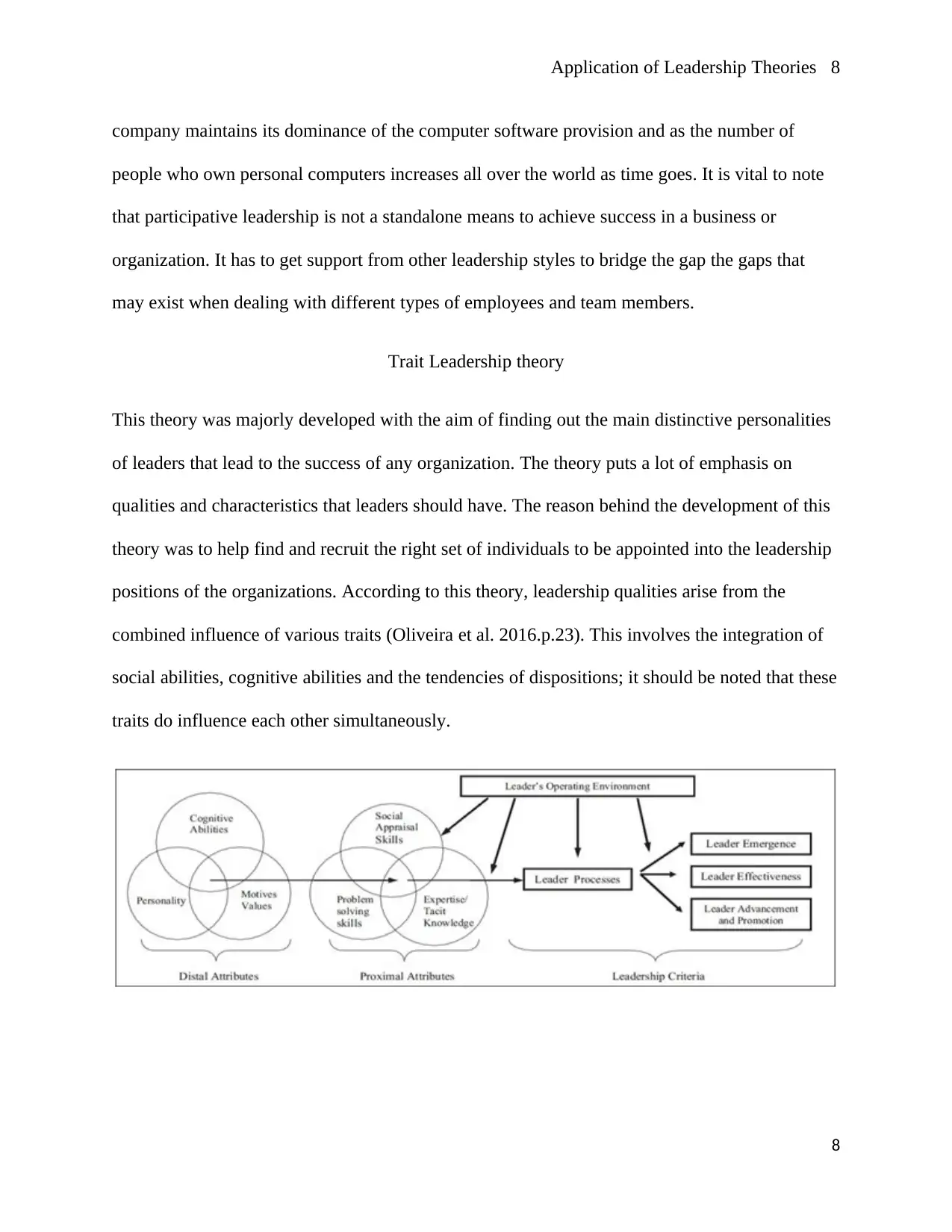
This theory was majorly developed with the aim of finding out the main distinctive personalities
of leaders that lead to the success of any organization. The theory puts a lot of emphasis on
qualities and characteristics that leaders should have. The reason behind the development of this
theory was to help find and recruit the right set of individuals to be appointed into the leadership
positions of the organizations. According to this theory, leadership qualities arise from the
combined influence of various traits (Oliveira et al. 2016.p.23). This involves the integration of
social abilities, cognitive abilities and the tendencies of dispositions; it should be noted that these
traits do influence each other simultaneously.
8
company maintains its dominance of the computer software provision and as the number of
people who own personal computers increases all over the world as time goes. It is vital to note
that participative leadership is not a standalone means to achieve success in a business or
organization. It has to get support from other leadership styles to bridge the gap the gaps that
may exist when dealing with different types of employees and team members.
Trait Leadership theory
This theory was majorly developed with the aim of finding out the main distinctive personalities
of leaders that lead to the success of any organization. The theory puts a lot of emphasis on
qualities and characteristics that leaders should have. The reason behind the development of this
theory was to help find and recruit the right set of individuals to be appointed into the leadership
positions of the organizations. According to this theory, leadership qualities arise from the
combined influence of various traits (Oliveira et al. 2016.p.23). This involves the integration of
social abilities, cognitive abilities and the tendencies of dispositions; it should be noted that these
traits do influence each other simultaneously.
8
Application of Leadership Theories 9
Even though traits such as cooperation, dependency, assertiveness adaptability and decisiveness
have been pointed out as part of the characteristics of leaders, there is no quantifiable technique
of identifying the leadership characteristics. This means therefore that there aren’t any consistent
set of attributes which may give a full explanation of true leadership.
To some extent, all prominent and gifted leaders in the world may possess a few similar
attributes nevertheless; it is a tall order for all leaders to have common sets of personalities. This,
therefore, means that the trait theory is incapable of supporting its momentum. The position of a
leader is not only influenced by traits, but there are also other factors to be considered (Oliveira
et al. 2016.p.23).
To become common knowledge among people that you cannot change somebody’s attributes
over a short timeline. According to Lewis (2018), it is believed that attributes of leaders don’t
have to change necessarily during harsh times as stated in theory. With this in mind, it has been
concluded that trait theory is simplistic and thus does not fully give account on leadership. It
only concerns itself with what people think about their leaders thus having law clarifications on
personal attributes and inappropriate prediction power over their job performance.
Despite its setbacks, trait theory of leadership has enabled contemporary entrepreneurs to adopt
strategies that they can use in identifying upcoming leaders. Most of these departments do use
personality traits to choose their prospective leaders. Individuals who are diligent, thoughtful and
extraversion are best fit for leadership positions. In this case, this theory should also be
considered as a selection tool. Bill Gates seems to understand the importance of this theory in
business. However, the approach is not limited to business corporations only but applicable to
9
Even though traits such as cooperation, dependency, assertiveness adaptability and decisiveness
have been pointed out as part of the characteristics of leaders, there is no quantifiable technique
of identifying the leadership characteristics. This means therefore that there aren’t any consistent
set of attributes which may give a full explanation of true leadership.
To some extent, all prominent and gifted leaders in the world may possess a few similar
attributes nevertheless; it is a tall order for all leaders to have common sets of personalities. This,
therefore, means that the trait theory is incapable of supporting its momentum. The position of a
leader is not only influenced by traits, but there are also other factors to be considered (Oliveira
et al. 2016.p.23).
To become common knowledge among people that you cannot change somebody’s attributes
over a short timeline. According to Lewis (2018), it is believed that attributes of leaders don’t
have to change necessarily during harsh times as stated in theory. With this in mind, it has been
concluded that trait theory is simplistic and thus does not fully give account on leadership. It
only concerns itself with what people think about their leaders thus having law clarifications on
personal attributes and inappropriate prediction power over their job performance.
Despite its setbacks, trait theory of leadership has enabled contemporary entrepreneurs to adopt
strategies that they can use in identifying upcoming leaders. Most of these departments do use
personality traits to choose their prospective leaders. Individuals who are diligent, thoughtful and
extraversion are best fit for leadership positions. In this case, this theory should also be
considered as a selection tool. Bill Gates seems to understand the importance of this theory in
business. However, the approach is not limited to business corporations only but applicable to
9
⊘ This is a preview!⊘
Do you want full access?
Subscribe today to unlock all pages.
Trusted by 1+ million students worldwide
Application of Leadership Theories 10
government and non-governmental organizations as well. There are particular traits that the CEO
of Microsoft Company looks at in his employees and business leaders who steer help him steer
toward achievement of the corporate goals. The attributes help on the allocation of duties and
areas of delegation. It is vital to know the habits and skill of your employees as a leader so that
you can know what to expect from them interim of delivery of assigned duties. Some of the traits
that the CEO focuses on include; adaptability adapt to various situations, assertiveness, level of
energy, ability or inability to corporate with others, level of self-confidence, diplomatic and
creative. The leader might also get interested in the conceptual skills, tolerance to stress,
dependability, willingness to take responsibility and fluency in speaking of the employees.
The character traits of the employees determine their ability to work under certain environments
(Suder 2005, p.147). It is essential that the leader knows the character traits of his employees or
followers to guide them in giving their best to the Corse of the company. The leadership concept
of trait theory has helped the CEO choose the kind of environment to subject-specific employees
to ensure that they give their best. The Microsoft Company has some employees distributed all
over the world as it is vital for the leadership to provide that the employees can deliver their best
in the environment in which they are at the moment. This means that an evaluation of the traits
of every employee is essential for the company to determine the roles that they play in attaining
the objective of the company.
Situational and Contingency theories
It should be noted that there are no particular theories that fully satisfies itself or is best in every
circumstance. To come up with practical and successful leaders, leaders ought to adapt to diverse
styles of leadership depending on the objectives, situations and the nature of the stock of
10
government and non-governmental organizations as well. There are particular traits that the CEO
of Microsoft Company looks at in his employees and business leaders who steer help him steer
toward achievement of the corporate goals. The attributes help on the allocation of duties and
areas of delegation. It is vital to know the habits and skill of your employees as a leader so that
you can know what to expect from them interim of delivery of assigned duties. Some of the traits
that the CEO focuses on include; adaptability adapt to various situations, assertiveness, level of
energy, ability or inability to corporate with others, level of self-confidence, diplomatic and
creative. The leader might also get interested in the conceptual skills, tolerance to stress,
dependability, willingness to take responsibility and fluency in speaking of the employees.
The character traits of the employees determine their ability to work under certain environments
(Suder 2005, p.147). It is essential that the leader knows the character traits of his employees or
followers to guide them in giving their best to the Corse of the company. The leadership concept
of trait theory has helped the CEO choose the kind of environment to subject-specific employees
to ensure that they give their best. The Microsoft Company has some employees distributed all
over the world as it is vital for the leadership to provide that the employees can deliver their best
in the environment in which they are at the moment. This means that an evaluation of the traits
of every employee is essential for the company to determine the roles that they play in attaining
the objective of the company.
Situational and Contingency theories
It should be noted that there are no particular theories that fully satisfies itself or is best in every
circumstance. To come up with practical and successful leaders, leaders ought to adapt to diverse
styles of leadership depending on the objectives, situations and the nature of the stock of
10
Paraphrase This Document
Need a fresh take? Get an instant paraphrase of this document with our AI Paraphraser
Application of Leadership Theories 11
competence. According to this theory, leaders ought to have more cognitive and psychomotor
abilities so that they can adapt and implement diverse leadership techniques (Burris et al.,
2013.p.9).
Due to globalization and continuously changing the environment of work, it, therefore, follows
that the styles of leadership also have to be flexible at every point and conform so that it can be
able to deal with the issues facing the organization it is operating for. This theory and model
which was developed by Fielder was formulated so that it could address the problems of the
workplace. This theory further tries to show that leaders become more active when their traits are
adequately matched with the right situation. This theory is based on three situational factors, i.e.,
leader-member relations, task structure, and position power. This involves developing a high
degree of confidence, trust, and loyalty while task structure entails the number of alternative
solutions and options. This theory allows the leader to manipulate the prevailing circumstances
to become successful (Schyns 2011. 59).
The Adair’s Action model characterizes leadership in three circle diagram. This elements, i.e.,
contingent and situational elements determine the responsiveness of the leader on how he/she
will address the issues of the organization to achieve its objectives.
This theory has also been subjected to a lot of criticism. There is no flexibility in it. The theory
tries to assert that flexible leaders may cause chaos to the organization and thus should be
changed. The LPC scale has only 50% reliable variance thus it I, not that reliable to be used as a
tool of measuring leaders’ capacities thus bringing unpleasant environment and confusion. Bill
Gates has used this theory right since the beginning of the company. He made decisions to start
the company based on the situation he was in at the moment. He had the desire to start his own
11
competence. According to this theory, leaders ought to have more cognitive and psychomotor
abilities so that they can adapt and implement diverse leadership techniques (Burris et al.,
2013.p.9).
Due to globalization and continuously changing the environment of work, it, therefore, follows
that the styles of leadership also have to be flexible at every point and conform so that it can be
able to deal with the issues facing the organization it is operating for. This theory and model
which was developed by Fielder was formulated so that it could address the problems of the
workplace. This theory further tries to show that leaders become more active when their traits are
adequately matched with the right situation. This theory is based on three situational factors, i.e.,
leader-member relations, task structure, and position power. This involves developing a high
degree of confidence, trust, and loyalty while task structure entails the number of alternative
solutions and options. This theory allows the leader to manipulate the prevailing circumstances
to become successful (Schyns 2011. 59).
The Adair’s Action model characterizes leadership in three circle diagram. This elements, i.e.,
contingent and situational elements determine the responsiveness of the leader on how he/she
will address the issues of the organization to achieve its objectives.
This theory has also been subjected to a lot of criticism. There is no flexibility in it. The theory
tries to assert that flexible leaders may cause chaos to the organization and thus should be
changed. The LPC scale has only 50% reliable variance thus it I, not that reliable to be used as a
tool of measuring leaders’ capacities thus bringing unpleasant environment and confusion. Bill
Gates has used this theory right since the beginning of the company. He made decisions to start
the company based on the situation he was in at the moment. He had the desire to start his own
11
Application of Leadership Theories 12
company, and he also had the skills to start the company. Based on these circumstances he made
up his mind to start his company.
Furthermore in the early stages of the development of Microsoft, when PC clones production had
started spreading out, the CEO had to make decisions to aim at supplying all the clones with the
company’s software (The Forbes 4001998, p.302). As much as that was a market opportunity for
the company, production of PC clones was not expected. However, Bill Gates made a decision
based on the market situation at that time, and the decisions gave the company a great market
share regarding the supply of computer software. As the computer market got comparative, the
CEO had to make arrangements to maintain the company’s market dominance. It is for this
reason that the company chose to diversify to maintain market dominance in the wake of
technological advancement (Suder 2005, P.146). To a great extent, Microsoft has succeeded with
this in exception of search engines where Google successfully specialized. Furthermore, the CEO
has to constantly make more decisions based on both the internal and external environment of
the company. There may be some external factors such as changes in government regulations
and the invention of more sophisticated PCs which the company has to keep in check and adjust
to comply with.
Behavioral theory
This theory is based on the specific behavior of leaders. It thus assumes that the behavior of
leaders can be used to assess whether they can be influential or not (Larsson, 2017,p. 59). This
will further show if either they will become successful or not. The behavioral theory was
developed due to high criticism of trait theory. This theory tries to assert the fact that the
qualities of leadership are not necessarily born inside an individual but can be learned (Oliveira
12
company, and he also had the skills to start the company. Based on these circumstances he made
up his mind to start his company.
Furthermore in the early stages of the development of Microsoft, when PC clones production had
started spreading out, the CEO had to make decisions to aim at supplying all the clones with the
company’s software (The Forbes 4001998, p.302). As much as that was a market opportunity for
the company, production of PC clones was not expected. However, Bill Gates made a decision
based on the market situation at that time, and the decisions gave the company a great market
share regarding the supply of computer software. As the computer market got comparative, the
CEO had to make arrangements to maintain the company’s market dominance. It is for this
reason that the company chose to diversify to maintain market dominance in the wake of
technological advancement (Suder 2005, P.146). To a great extent, Microsoft has succeeded with
this in exception of search engines where Google successfully specialized. Furthermore, the CEO
has to constantly make more decisions based on both the internal and external environment of
the company. There may be some external factors such as changes in government regulations
and the invention of more sophisticated PCs which the company has to keep in check and adjust
to comply with.
Behavioral theory
This theory is based on the specific behavior of leaders. It thus assumes that the behavior of
leaders can be used to assess whether they can be influential or not (Larsson, 2017,p. 59). This
will further show if either they will become successful or not. The behavioral theory was
developed due to high criticism of trait theory. This theory tries to assert the fact that the
qualities of leadership are not necessarily born inside an individual but can be learned (Oliveira
12
⊘ This is a preview!⊘
Do you want full access?
Subscribe today to unlock all pages.
Trusted by 1+ million students worldwide

1 out of 25


Related Documents


Your All-in-One AI-Powered Toolkit for Academic Success.
+13062052269
info@desklib.com
Available 24*7 on WhatsApp / Email
![[object Object]](/_next/static/media/star-bottom.7253800d.svg)
Unlock your academic potential
Copyright © 2020–2026 A2Z Services. All Rights Reserved. Developed and managed by ZUCOL.