Organizational Behavior Report: Leadership, Contracts, and Styles
VerifiedAdded on 2023/01/18
|12
|3304
|71
Report
AI Summary
This report delves into organizational behavior, examining leadership theories and their practical application, using Marks and Spencer as a case study. It explores the divergence between leadership theory and practice, highlighting the importance of both perspectives. The report critically analyzes psychological contracts, illustrating potential differences between employers and employees, and their impact on motivation and performance. Furthermore, it provides a detailed comparison of transformational and transactional leadership styles, outlining their characteristics and effectiveness in motivating employees and achieving organizational goals. The report emphasizes the importance of understanding these concepts for effective leadership and organizational success.
Organization
Behaviour
Behaviour

Paraphrase This Document
Need a fresh take? Get an instant paraphrase of this document with our AI Paraphraser

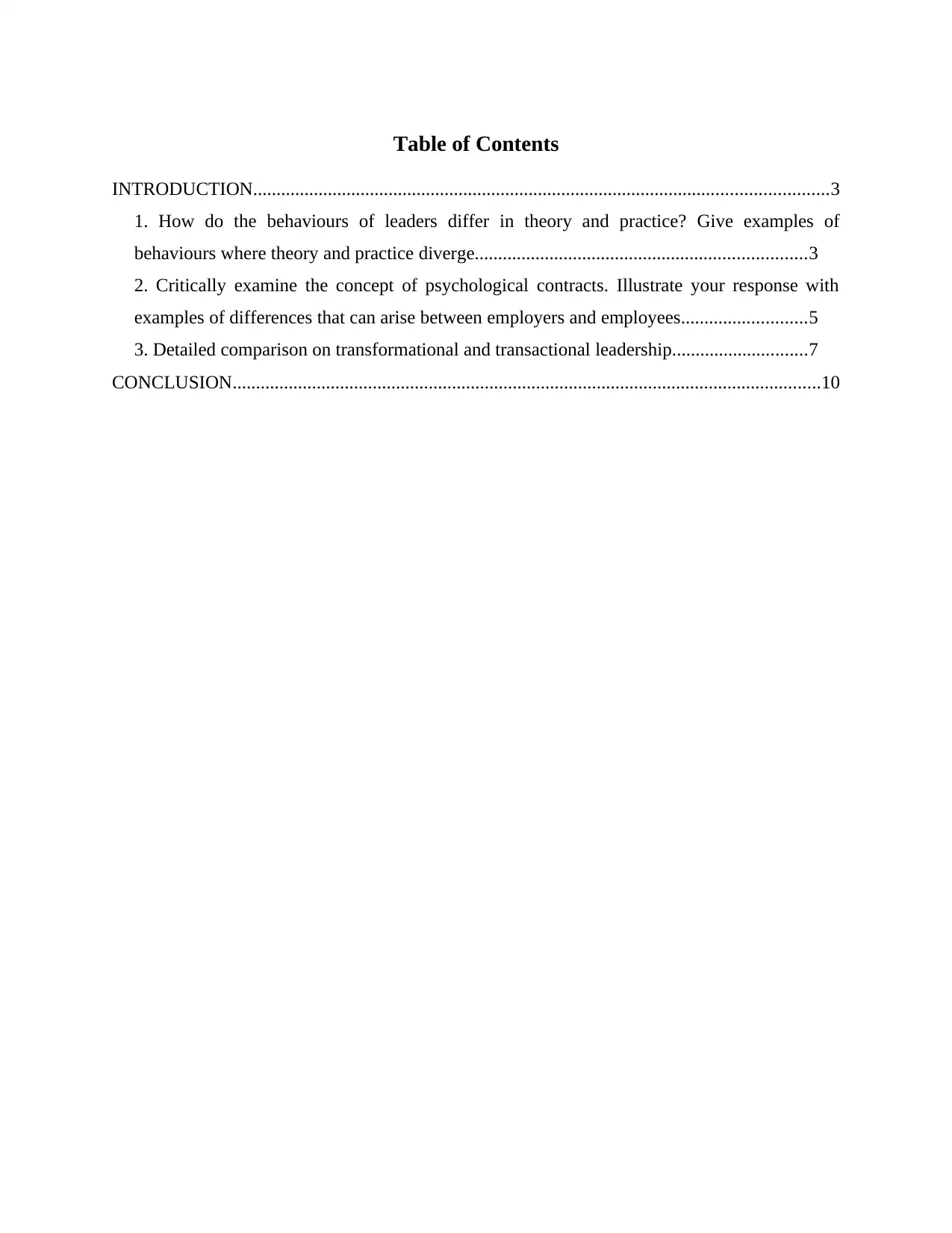
Table of Contents
INTRODUCTION...........................................................................................................................3
1. How do the behaviours of leaders differ in theory and practice? Give examples of
behaviours where theory and practice diverge.......................................................................3
2. Critically examine the concept of psychological contracts. Illustrate your response with
examples of differences that can arise between employers and employees...........................5
3. Detailed comparison on transformational and transactional leadership.............................7
CONCLUSION..............................................................................................................................10
INTRODUCTION...........................................................................................................................3
1. How do the behaviours of leaders differ in theory and practice? Give examples of
behaviours where theory and practice diverge.......................................................................3
2. Critically examine the concept of psychological contracts. Illustrate your response with
examples of differences that can arise between employers and employees...........................5
3. Detailed comparison on transformational and transactional leadership.............................7
CONCLUSION..............................................................................................................................10
⊘ This is a preview!⊘
Do you want full access?
Subscribe today to unlock all pages.

Trusted by 1+ million students worldwide
INTRODUCTION
Organizational behaviour is seen as the field of study where performance of individual
and whole group is evaluated as per their activities within the company. The respective zone of
study study mainly evaluates behaviour of individual at workplace and its impact over
organisational working practices, performance, job structure and business growth (Odom and et.
al., 2019J). The present project takes into account the example of Marks and Spencer, a
renowned UK based retail company that is headquartered in Westminster, London. The
company was incorporated in the year 1884 and offers its services to customers worldwide. Its
product range includes range of category such as clothing, food items, home products etc. This
report will provide detailed information on behaviour of leaders in different organisational
practices, along with divergent between theory and practices within different organisational
situations. It will also provide description on psychological contract. At last, detailed explanation
will be given on transactional and transformational leadership along with its difference.
1. How do the behaviours of leaders differ in theory and practice? Give examples of behaviours
where theory and practice diverge
One of the most apparent debates associated with leadership is regarding its focal point.
While some individuals believe that the emphasis should be upon theoretical constructs, others
consider that practical approach to leadership should be given due consideration. The
behavioural pattern of leader in both the contexts are divergent. It is essential to take into due
consideration both the perspectives with a view to gain in-depth comprehensibility and apply the
leadership in a manner such that the organisation can benefit as a whole. However, a reasonable
difference persists within both the perspectives. As per the practical perspective, the leaders are
keen on attaining knowledge about the situation deeply and a little bit regarding how as well as
why it took place (ohnson Jr and Kruse, 2019). On the contrary, the leaders while applying
theoretical perspective seek to dig deeper into the reason and the manner in which a business
situation takes place, with a bigger emphasis upon ascertaining whether there is any significant
impact of the situation over the company and its operations or not. Whereby a leader intends to
attain the goals as well as objectives of the corporation, they need to focus on practical as well as
theoretical knowledge as collaboratively they underpin the business condition in a
Organizational behaviour is seen as the field of study where performance of individual
and whole group is evaluated as per their activities within the company. The respective zone of
study study mainly evaluates behaviour of individual at workplace and its impact over
organisational working practices, performance, job structure and business growth (Odom and et.
al., 2019J). The present project takes into account the example of Marks and Spencer, a
renowned UK based retail company that is headquartered in Westminster, London. The
company was incorporated in the year 1884 and offers its services to customers worldwide. Its
product range includes range of category such as clothing, food items, home products etc. This
report will provide detailed information on behaviour of leaders in different organisational
practices, along with divergent between theory and practices within different organisational
situations. It will also provide description on psychological contract. At last, detailed explanation
will be given on transactional and transformational leadership along with its difference.
1. How do the behaviours of leaders differ in theory and practice? Give examples of behaviours
where theory and practice diverge
One of the most apparent debates associated with leadership is regarding its focal point.
While some individuals believe that the emphasis should be upon theoretical constructs, others
consider that practical approach to leadership should be given due consideration. The
behavioural pattern of leader in both the contexts are divergent. It is essential to take into due
consideration both the perspectives with a view to gain in-depth comprehensibility and apply the
leadership in a manner such that the organisation can benefit as a whole. However, a reasonable
difference persists within both the perspectives. As per the practical perspective, the leaders are
keen on attaining knowledge about the situation deeply and a little bit regarding how as well as
why it took place (ohnson Jr and Kruse, 2019). On the contrary, the leaders while applying
theoretical perspective seek to dig deeper into the reason and the manner in which a business
situation takes place, with a bigger emphasis upon ascertaining whether there is any significant
impact of the situation over the company and its operations or not. Whereby a leader intends to
attain the goals as well as objectives of the corporation, they need to focus on practical as well as
theoretical knowledge as collaboratively they underpin the business condition in a
Paraphrase This Document
Need a fresh take? Get an instant paraphrase of this document with our AI Paraphraser
comprehensive manner, simultaneously laying down the rationale behind its occurrence and the
ways through it can be improved.
Leadership in theory is focussed on certain traits as well as behaviours of leader.
However, with the efflux of time, such theories have started emphasizing more upon the
followers as well as contextual nature of leadership. For instance: The conventional theories like
The Great Man Theory and The Trait Theory emphasized upon inherent traits of a leader.
However, the later theories such as Behavioural, Situational and Contingency seek to shift the
focus on the doings of leaders as opposed to the traits possessed by them. The latest theories of
leadership, namely, Transformational as well as Transactional seeks to acknowledge the relation
between leaders and their followers. Thus, leadership in theory exhibit different types of
behavioural patterns in accordance with the theory adopted by the leader of an entity (Fenwick
and Johnston, 2019).
Leadership in practice can be bifurcated on the basis of the information one intends to dig
deeper into. For instance: An Marks and Spencer which is interested in gaining knowledge
about the manner in which decisions are made would define leader to be democratic or
autocratic. Yet another entity that intends to acknowledge the manner in which various business
situations are handled by leader may regard them as charismatic, situational, participative,
transactional or transformational. In this regard, it can be seen that the behaviour of leader in
practice changes as per the business situation prevailing within the confines of an organisation.
REFERENCES
Books and Journals
Odom, D. L. and et. al., 2019. The most influential family business articles from 2006 to 2013
using five theoretical perspectives. In The Palgrave Handbook of heterogeneity among
family firms (pp. 41-67). Palgrave Macmillan, Cham.
Johnson Jr, B. L. and Kruse, S. D. eds., 2019. Educational Leadership, Organizational Learning,
and the Ideas of Karl Weick: Perspectives on Theory and Practice. Routledge.
Fenwick, J. and Johnston, L., 2019. Public enterprise and local place: New perspectives on
theory and practice. Routledge.
ways through it can be improved.
Leadership in theory is focussed on certain traits as well as behaviours of leader.
However, with the efflux of time, such theories have started emphasizing more upon the
followers as well as contextual nature of leadership. For instance: The conventional theories like
The Great Man Theory and The Trait Theory emphasized upon inherent traits of a leader.
However, the later theories such as Behavioural, Situational and Contingency seek to shift the
focus on the doings of leaders as opposed to the traits possessed by them. The latest theories of
leadership, namely, Transformational as well as Transactional seeks to acknowledge the relation
between leaders and their followers. Thus, leadership in theory exhibit different types of
behavioural patterns in accordance with the theory adopted by the leader of an entity (Fenwick
and Johnston, 2019).
Leadership in practice can be bifurcated on the basis of the information one intends to dig
deeper into. For instance: An Marks and Spencer which is interested in gaining knowledge
about the manner in which decisions are made would define leader to be democratic or
autocratic. Yet another entity that intends to acknowledge the manner in which various business
situations are handled by leader may regard them as charismatic, situational, participative,
transactional or transformational. In this regard, it can be seen that the behaviour of leader in
practice changes as per the business situation prevailing within the confines of an organisation.
REFERENCES
Books and Journals
Odom, D. L. and et. al., 2019. The most influential family business articles from 2006 to 2013
using five theoretical perspectives. In The Palgrave Handbook of heterogeneity among
family firms (pp. 41-67). Palgrave Macmillan, Cham.
Johnson Jr, B. L. and Kruse, S. D. eds., 2019. Educational Leadership, Organizational Learning,
and the Ideas of Karl Weick: Perspectives on Theory and Practice. Routledge.
Fenwick, J. and Johnston, L., 2019. Public enterprise and local place: New perspectives on
theory and practice. Routledge.
2. Critically examine the concept of psychological contracts. Illustrate your response with
examples of differences that can arise between employers and employees
Psychological contracts are termed as the set of expectations as well as promises that are
interchanged between employer and employees at workplace. These promises and expectations
are assumed, non spoken, invisible, informal but might be partially vocalised. In order to explore
terms included into this contract it is essential for both the parties to put deep efforts so that they
can determine actual insight of the respective contract (Diehl and Coyle-Shapiro, 2019). This
mainly depends upon perception to perception of the person. Even though it is seen as the
unofficial assumptions of both employer and employee but still it has powerful impact over the
motivation level as well as performance of employees. It can be said that if these employees
found that company does not value their hard work or are not priorities their initiatives taken for
organisational growth then there are probable chances that they might found this psychological
contract broken. As a result, it could demotivate employees. This major influence of this can be
seen on employees’ performance as well as increasing employment rate of company (Baruch and
Rousseau, 2019). The respective term is also somewhat related to emotions and interpersonal
relationships among employee and employer. It can be said that if both the parties share positive
relationship then there are higher chances of organisational success and growth. At the same, if
any sort of disputes or issues occurs at the workplace then it will arise feeling of negativity
among employees that will definitely place negative influence over employees’ performance.
This contract can be well understood with the help of example. For instance: It is
unwritten but quite normal that employees could come little bit late to office after any big office
celebration like Christmas night or might be some other occasion. If single time any of the
employee is penalties or scolded for this then it could be become the major reason of breach of
psychological contract this could directly place impact over their devotion towards the company
as they feel dishonoured in this situation. From the perspective of employees, this act is
considered as breach of psychological contract as according to them coming late after Christmas
eve in non penalised or punishable act (Griep and Cooper, 2019). And if the company responses
negatively on this situation then it would definitely place negative impact over their relationship
with the company. It will also demotivate the respective employee and develop feeling of
dissatisfaction among them. As a result, impact of this can be seen in the decline in employee’s
performance.
examples of differences that can arise between employers and employees
Psychological contracts are termed as the set of expectations as well as promises that are
interchanged between employer and employees at workplace. These promises and expectations
are assumed, non spoken, invisible, informal but might be partially vocalised. In order to explore
terms included into this contract it is essential for both the parties to put deep efforts so that they
can determine actual insight of the respective contract (Diehl and Coyle-Shapiro, 2019). This
mainly depends upon perception to perception of the person. Even though it is seen as the
unofficial assumptions of both employer and employee but still it has powerful impact over the
motivation level as well as performance of employees. It can be said that if these employees
found that company does not value their hard work or are not priorities their initiatives taken for
organisational growth then there are probable chances that they might found this psychological
contract broken. As a result, it could demotivate employees. This major influence of this can be
seen on employees’ performance as well as increasing employment rate of company (Baruch and
Rousseau, 2019). The respective term is also somewhat related to emotions and interpersonal
relationships among employee and employer. It can be said that if both the parties share positive
relationship then there are higher chances of organisational success and growth. At the same, if
any sort of disputes or issues occurs at the workplace then it will arise feeling of negativity
among employees that will definitely place negative influence over employees’ performance.
This contract can be well understood with the help of example. For instance: It is
unwritten but quite normal that employees could come little bit late to office after any big office
celebration like Christmas night or might be some other occasion. If single time any of the
employee is penalties or scolded for this then it could be become the major reason of breach of
psychological contract this could directly place impact over their devotion towards the company
as they feel dishonoured in this situation. From the perspective of employees, this act is
considered as breach of psychological contract as according to them coming late after Christmas
eve in non penalised or punishable act (Griep and Cooper, 2019). And if the company responses
negatively on this situation then it would definitely place negative impact over their relationship
with the company. It will also demotivate the respective employee and develop feeling of
dissatisfaction among them. As a result, impact of this can be seen in the decline in employee’s
performance.
⊘ This is a preview!⊘
Do you want full access?
Subscribe today to unlock all pages.
Trusted by 1+ million students worldwide
On the contrary, while analysing perception of employer towards the same, it can be said
that they have not presented any kind of written or verbal commitment to employees for the same
situation. This simply means that according to them employees are expected to come to office at
their regular office timing (Duran, 2019). If in case employees are not following their working
hours or office timings then it is the right of the respective company to take strict actions towards
the same on the basis of their policies. This simply shows that company has not done anything
wrong towards the same.
REFERENCES
Books and Journals
Griep, Y. and Cooper, C., 2019. Introduction to the Handbook of Research on the Psychological
Contract at Work. Handbook of Research on the Psychological Contract at Work, p.1.
Baruch, Y. and Rousseau, D. M., 2019. Integrating psychological contracts and ecosystems in
career studies and management. Academy of Management Annals, 13(1), pp.84-111.
Diehl, M. R. and Coyle-Shapiro, J. A., 2019. Psychological contracts through the lens of
sensemaking. In Handbook of Research on the Psychological Contract at Work. Edward
Elgar Publishing.
Duran, F., 2019. Analysis of police officers' and firefighters' psychological contracts, and its
influence on their occupational stressors and well-being (Doctoral dissertation,
University of Birmingham).
that they have not presented any kind of written or verbal commitment to employees for the same
situation. This simply means that according to them employees are expected to come to office at
their regular office timing (Duran, 2019). If in case employees are not following their working
hours or office timings then it is the right of the respective company to take strict actions towards
the same on the basis of their policies. This simply shows that company has not done anything
wrong towards the same.
REFERENCES
Books and Journals
Griep, Y. and Cooper, C., 2019. Introduction to the Handbook of Research on the Psychological
Contract at Work. Handbook of Research on the Psychological Contract at Work, p.1.
Baruch, Y. and Rousseau, D. M., 2019. Integrating psychological contracts and ecosystems in
career studies and management. Academy of Management Annals, 13(1), pp.84-111.
Diehl, M. R. and Coyle-Shapiro, J. A., 2019. Psychological contracts through the lens of
sensemaking. In Handbook of Research on the Psychological Contract at Work. Edward
Elgar Publishing.
Duran, F., 2019. Analysis of police officers' and firefighters' psychological contracts, and its
influence on their occupational stressors and well-being (Doctoral dissertation,
University of Birmingham).
Paraphrase This Document
Need a fresh take? Get an instant paraphrase of this document with our AI Paraphraser
3. Detailed comparison on transformational and transactional leadership.
Leadership is mainly termed as the action under which leader holds power of influencing
whole group or team to perform work accordingly (Hassan and et. al., 2019). Every business
associations uses different leadership styles that in order to persuade employees or workers to
perform in their own expected manner. The main types of leadership styles that are mostly
adopted by business managers at workplace are transformational and transactional leadership
style.
Transactional leadership style mainly emphasises on performance of the employees as
well as organisational. As per this leadership, major focus of leaders is on providing motivating
employees so that they can perform effectively towards organisational goals. For this, they
prefers to adopt methods of rewards and punishment in order to influence workers to accomplish
the specific work within the provided time frame. The assumptions developed with this
leadership style are:
Workers obeys instructions and commands provided by leaders for accomplishing their
own as well as organisational goals.
Appropriate monitoring is done on employees performance in order to ensure that they
effectively meet their respective expectations (Attar, Jami and Kalfaoğlu, 2019).
On the contrary, Transformational leadership is mainly termed as the style under which
leaders emphasises on motivating and encouraging employees at regular basis for developing
positive feeling among them towards organisational work and its objectives. The main motive of
leaders in this style is to bring maximum number of innovation and changes within the company
so that they grow in rightful manner and attain success in quicker manner. Adoption of this
leadership style allows leaders in developing effective corporate culture in the company in which
employees are more devoted towards organisational work and independence at workplace
(Berkovich and Eyal, 2019). Some of the common characteristics of transformational leadership
style includes:
Main focus is on motivating employees in order to encourage them towards
organisational objectives and goals.
It fosters ethical working environment by having clear visions, standards, values,
priorities etc.
Leadership is mainly termed as the action under which leader holds power of influencing
whole group or team to perform work accordingly (Hassan and et. al., 2019). Every business
associations uses different leadership styles that in order to persuade employees or workers to
perform in their own expected manner. The main types of leadership styles that are mostly
adopted by business managers at workplace are transformational and transactional leadership
style.
Transactional leadership style mainly emphasises on performance of the employees as
well as organisational. As per this leadership, major focus of leaders is on providing motivating
employees so that they can perform effectively towards organisational goals. For this, they
prefers to adopt methods of rewards and punishment in order to influence workers to accomplish
the specific work within the provided time frame. The assumptions developed with this
leadership style are:
Workers obeys instructions and commands provided by leaders for accomplishing their
own as well as organisational goals.
Appropriate monitoring is done on employees performance in order to ensure that they
effectively meet their respective expectations (Attar, Jami and Kalfaoğlu, 2019).
On the contrary, Transformational leadership is mainly termed as the style under which
leaders emphasises on motivating and encouraging employees at regular basis for developing
positive feeling among them towards organisational work and its objectives. The main motive of
leaders in this style is to bring maximum number of innovation and changes within the company
so that they grow in rightful manner and attain success in quicker manner. Adoption of this
leadership style allows leaders in developing effective corporate culture in the company in which
employees are more devoted towards organisational work and independence at workplace
(Berkovich and Eyal, 2019). Some of the common characteristics of transformational leadership
style includes:
Main focus is on motivating employees in order to encourage them towards
organisational objectives and goals.
It fosters ethical working environment by having clear visions, standards, values,
priorities etc.
This leadership style also strong sense of attitude among employees according to which
they starts prioritising their self interest and also believes that they are not only working
for the company's growth but it also includes their own growth too (Arenas, 2019).
In this, respective leaders monitors and guides employees towards their work but at the
same time they also provides right to employees according to which they are allow to
take decisions at their own level without consulting superior authorities.
It also emphasises on open communications, authenticity and corporations.
With reference to the above specified explanation about transactional and
transformational leadership style along with their specific characteristic it can be said that both of
them are beneficial for business associations as it supports them in encouraging and motivating
their employees or workers with the help of punishments and rewards.
For instance: Contemporary manager of Marks and Spencer gives preferences to
transactional leadership style for encouraging its existing workforce. Leaders of the respective
company often makes use of different rewards system for motivating its existing workforce in
order to boost up their performance and develop their interest in organisational work in rightful
manner. These rewards are provided to employees on the basis of their performance and
behaviour with their respective team mates at workplace. In order to boost up the performance
of employees, the respective managers also ensures that information related to related to goals
and objective must be cleared workforce (Mufti and et. al., 2019). This directly helps employees
in concentrating on their respective goals as they have detailed information on it and also knows
how to accomplish it in quicker manner. Rewards system within the organisation also raises
recognition of employees at workplace. Apart from this, it can also be said that rewards can be
seen in the form of monetary benefits or other kind of benefits that can be obtained by employees
during their working practices.
While conducting evaluation on both of these leadership style, it can be said that
managers mainly gives main preference to transactional leadership style over transformational
form of leadership at workplace in order to support employees in attaining their organisational
objectives in appropriate manner (Pasamar, Diaz-Fernandez and de la Rosa-Navarro, 2019).
Here, the main reason behind using this leadership approach is to maintain strictness at
workplace in order to ensure that all employees will surely work at workplace according to
policies and they will also place their 100 percent effort in the respective organisational goals.
they starts prioritising their self interest and also believes that they are not only working
for the company's growth but it also includes their own growth too (Arenas, 2019).
In this, respective leaders monitors and guides employees towards their work but at the
same time they also provides right to employees according to which they are allow to
take decisions at their own level without consulting superior authorities.
It also emphasises on open communications, authenticity and corporations.
With reference to the above specified explanation about transactional and
transformational leadership style along with their specific characteristic it can be said that both of
them are beneficial for business associations as it supports them in encouraging and motivating
their employees or workers with the help of punishments and rewards.
For instance: Contemporary manager of Marks and Spencer gives preferences to
transactional leadership style for encouraging its existing workforce. Leaders of the respective
company often makes use of different rewards system for motivating its existing workforce in
order to boost up their performance and develop their interest in organisational work in rightful
manner. These rewards are provided to employees on the basis of their performance and
behaviour with their respective team mates at workplace. In order to boost up the performance
of employees, the respective managers also ensures that information related to related to goals
and objective must be cleared workforce (Mufti and et. al., 2019). This directly helps employees
in concentrating on their respective goals as they have detailed information on it and also knows
how to accomplish it in quicker manner. Rewards system within the organisation also raises
recognition of employees at workplace. Apart from this, it can also be said that rewards can be
seen in the form of monetary benefits or other kind of benefits that can be obtained by employees
during their working practices.
While conducting evaluation on both of these leadership style, it can be said that
managers mainly gives main preference to transactional leadership style over transformational
form of leadership at workplace in order to support employees in attaining their organisational
objectives in appropriate manner (Pasamar, Diaz-Fernandez and de la Rosa-Navarro, 2019).
Here, the main reason behind using this leadership approach is to maintain strictness at
workplace in order to ensure that all employees will surely work at workplace according to
policies and they will also place their 100 percent effort in the respective organisational goals.
⊘ This is a preview!⊘
Do you want full access?
Subscribe today to unlock all pages.
Trusted by 1+ million students worldwide
With the adoption of this leadership approach it is easier for the company to execute their
operational activities effectively at workplace without any sort of barrier or error. It also allows
business associations in developing their stronger image at workplace which works as the
supportive factor in towards productivity of the enterprise.
In addition to this, it can be said that rewards in the form of monetary terms motivates
employees a lot as it develops positive feeling among employees towards organisation because
they are getting financial support from their company. It also develops sense of responsibility
and accountability among employees towards the company. All these can be seen as the
performance booster factor for the same company that results in the higher business growth of
enterprise.
On the contrary, in transformational form of leadership, contemporary managers mainly
prioritises on developing effective working environment at workplace that will support and
influence employees to work effectively for the organisational growth. This is basically done
with effective team building, collaboration and motivation at workplace. Usage of this leadership
style allows manager or leaders of corporate world in boosting up employees performance at
different levels (Mokhtar and et. al., 2019). Also, this influences interest of employees towards
organisational work in rightful manner as they are getting regular based training and
performance booster sessions from employer which not only influences their interest towards
respective goals but it also develops their skills as well as knowledge towards the same. This
form of leadership also develops strong relationship of one employee with the another and their
employer too. Usage of this leadership can be understood with the help of example. For
instance: Contemporary manager of enterprise make use of regular based training and
development sessions for employees so that they can effectively develop skills of employees and
motivate them towards organisational work in effective manner. Positive support of employees
also allows company in implementing different kind of change at workplace as their workforce
will not resist the change. This will directly support them in higher growth of company as their
employee’s are highly devoted and productive towards organisational goals and objectives.
From the overall analysis, it can be said that both the form of leadership are supportive
for the company and helps them out in the effective execution of business objectives and goals.
On the basis of evaluation, it has been identified that transactional leadership is identified as the
best form of leadership as it align interest of employees towards organisational goal in systematic
operational activities effectively at workplace without any sort of barrier or error. It also allows
business associations in developing their stronger image at workplace which works as the
supportive factor in towards productivity of the enterprise.
In addition to this, it can be said that rewards in the form of monetary terms motivates
employees a lot as it develops positive feeling among employees towards organisation because
they are getting financial support from their company. It also develops sense of responsibility
and accountability among employees towards the company. All these can be seen as the
performance booster factor for the same company that results in the higher business growth of
enterprise.
On the contrary, in transformational form of leadership, contemporary managers mainly
prioritises on developing effective working environment at workplace that will support and
influence employees to work effectively for the organisational growth. This is basically done
with effective team building, collaboration and motivation at workplace. Usage of this leadership
style allows manager or leaders of corporate world in boosting up employees performance at
different levels (Mokhtar and et. al., 2019). Also, this influences interest of employees towards
organisational work in rightful manner as they are getting regular based training and
performance booster sessions from employer which not only influences their interest towards
respective goals but it also develops their skills as well as knowledge towards the same. This
form of leadership also develops strong relationship of one employee with the another and their
employer too. Usage of this leadership can be understood with the help of example. For
instance: Contemporary manager of enterprise make use of regular based training and
development sessions for employees so that they can effectively develop skills of employees and
motivate them towards organisational work in effective manner. Positive support of employees
also allows company in implementing different kind of change at workplace as their workforce
will not resist the change. This will directly support them in higher growth of company as their
employee’s are highly devoted and productive towards organisational goals and objectives.
From the overall analysis, it can be said that both the form of leadership are supportive
for the company and helps them out in the effective execution of business objectives and goals.
On the basis of evaluation, it has been identified that transactional leadership is identified as the
best form of leadership as it align interest of employees towards organisational goal in systematic
Paraphrase This Document
Need a fresh take? Get an instant paraphrase of this document with our AI Paraphraser
manner (Lockett and Palmer, 2019). The respective form of leadership mainly includes
compliance of laws and policies of company. It also takes use of rewards as well as punishments
for motivating employees in effective manner at workplace.
REFERENCES
Books and Journals
Hassan, H. and et. al., 2019. The Effect of Transformational Leadership Styles Towards
Managing Knowledge Assets. Asian Journal of Accounting and Governance, 11.
Arenas, F. J., 2019. A Casebook of Transformational and Transactional Leadership. Routledge.
Attar, M., Jami, M. S. and Kalfaoğlu, S., 2019. Effect of Cultural Intelligence on Transactional
and Transformational Leadership Styles: A Research in Charity Organizations in
Erbil. Selçuk Üniversitesi Sosyal Bilimler Enstitüsü Dergisi, (41), pp.148-160.
Berkovich, I. and Eyal, O., 2019. Transformational Leadership, Transactional Leadership, and
Moral Reasoning. Leadership and Policy in Schools, pp.1-18.
Lockett, A. W. and Palmer, R. T., 2019. 6 Servant and Transformational Leadership in the
Context of MSIs. A Primer on Minority Serving Institutions, p.60.
Mokhtar, A. R. M. and et. al., 2019. Improving reverse supply chain performance: The role of
supply chain leadership and governance mechanisms. Journal of cleaner
production, 216, pp.42-55.
Mufti, M. and et. al., 2019. Influence of leadership style on job satisfaction of NGO employee:
The mediating role of psychological empowerment. Journal of Public Affairs.
Pasamar, S., Diaz-Fernandez, M. and de la Rosa-Navarro, M. D., 2019. Human capital: the link
between leadership and organizational learning. European Journal of Management and
Business Economics, 28(1), pp.25-51.
CONCLUSION
From the above mentioned report, it has been analysed that success of every organisation
depends upon their employees efforts and devotion towards them. It is also required by
contemporary managers or leaders to adopt effective leadership approach or style in order to
influence interest of employees towards organisational work. This also supports them in the
higher attainment of organisational goals and objectives in quicker manner. From the report, it
has been further identified that transactional leadership is best among all as it motivates
employees effectively with the help of reward or punishment.
compliance of laws and policies of company. It also takes use of rewards as well as punishments
for motivating employees in effective manner at workplace.
REFERENCES
Books and Journals
Hassan, H. and et. al., 2019. The Effect of Transformational Leadership Styles Towards
Managing Knowledge Assets. Asian Journal of Accounting and Governance, 11.
Arenas, F. J., 2019. A Casebook of Transformational and Transactional Leadership. Routledge.
Attar, M., Jami, M. S. and Kalfaoğlu, S., 2019. Effect of Cultural Intelligence on Transactional
and Transformational Leadership Styles: A Research in Charity Organizations in
Erbil. Selçuk Üniversitesi Sosyal Bilimler Enstitüsü Dergisi, (41), pp.148-160.
Berkovich, I. and Eyal, O., 2019. Transformational Leadership, Transactional Leadership, and
Moral Reasoning. Leadership and Policy in Schools, pp.1-18.
Lockett, A. W. and Palmer, R. T., 2019. 6 Servant and Transformational Leadership in the
Context of MSIs. A Primer on Minority Serving Institutions, p.60.
Mokhtar, A. R. M. and et. al., 2019. Improving reverse supply chain performance: The role of
supply chain leadership and governance mechanisms. Journal of cleaner
production, 216, pp.42-55.
Mufti, M. and et. al., 2019. Influence of leadership style on job satisfaction of NGO employee:
The mediating role of psychological empowerment. Journal of Public Affairs.
Pasamar, S., Diaz-Fernandez, M. and de la Rosa-Navarro, M. D., 2019. Human capital: the link
between leadership and organizational learning. European Journal of Management and
Business Economics, 28(1), pp.25-51.
CONCLUSION
From the above mentioned report, it has been analysed that success of every organisation
depends upon their employees efforts and devotion towards them. It is also required by
contemporary managers or leaders to adopt effective leadership approach or style in order to
influence interest of employees towards organisational work. This also supports them in the
higher attainment of organisational goals and objectives in quicker manner. From the report, it
has been further identified that transactional leadership is best among all as it motivates
employees effectively with the help of reward or punishment.

⊘ This is a preview!⊘
Do you want full access?
Subscribe today to unlock all pages.
Trusted by 1+ million students worldwide

1 out of 12


Related Documents


Your All-in-One AI-Powered Toolkit for Academic Success.
+13062052269
info@desklib.com
Available 24*7 on WhatsApp / Email
![[object Object]](/_next/static/media/star-bottom.7253800d.svg)
Unlock your academic potential
Copyright © 2020–2026 A2Z Services. All Rights Reserved. Developed and managed by ZUCOL.