Managerial Skills and Leadership: A Self-Assessment Report

Verified

Added on  2020/02/24

|8
|1793
|136
Report
AI Summary
This report delves into the critical aspects of managerial skills and leadership, emphasizing their importance in achieving organizational excellence. The author, a student at the Australian Catholic University, conducts a self-assessment, highlighting the significance of managerial skills, time management, and team leadership. The report discusses the application of scientific management principles in an educational setting, focusing on streamlining processes and enhancing student learning through modern methods. It underscores the role of mentoring in developing these skills and stresses the importance of effective decision-making, communication, and conflict management. The report also explores how time management and team leadership contribute to revenue generation and organizational growth, providing insights into how aspiring managers can develop these essential skills through seminars, company visits, and continuous mentoring. The author's experience underscores the vital role of managers in driving organizational success, particularly in generating revenue and maintaining goodwill. This report provides a comprehensive understanding of the key skills required for effective management and leadership, offering practical insights into professional development.
Document Page
Running head: MANAGERIAL SKILLS AND LEADERSHIP
Managerial Skills and Leadership
Name of the Student
Student ID:
Name of University
Author Note
tabler-icon-diamond-filled.svg

Paraphrase This Document

Need a fresh take? Get an instant paraphrase of this document with our AI Paraphraser
Document Page
1
MANAGERIAL SKILLS AND LEADERSHIP
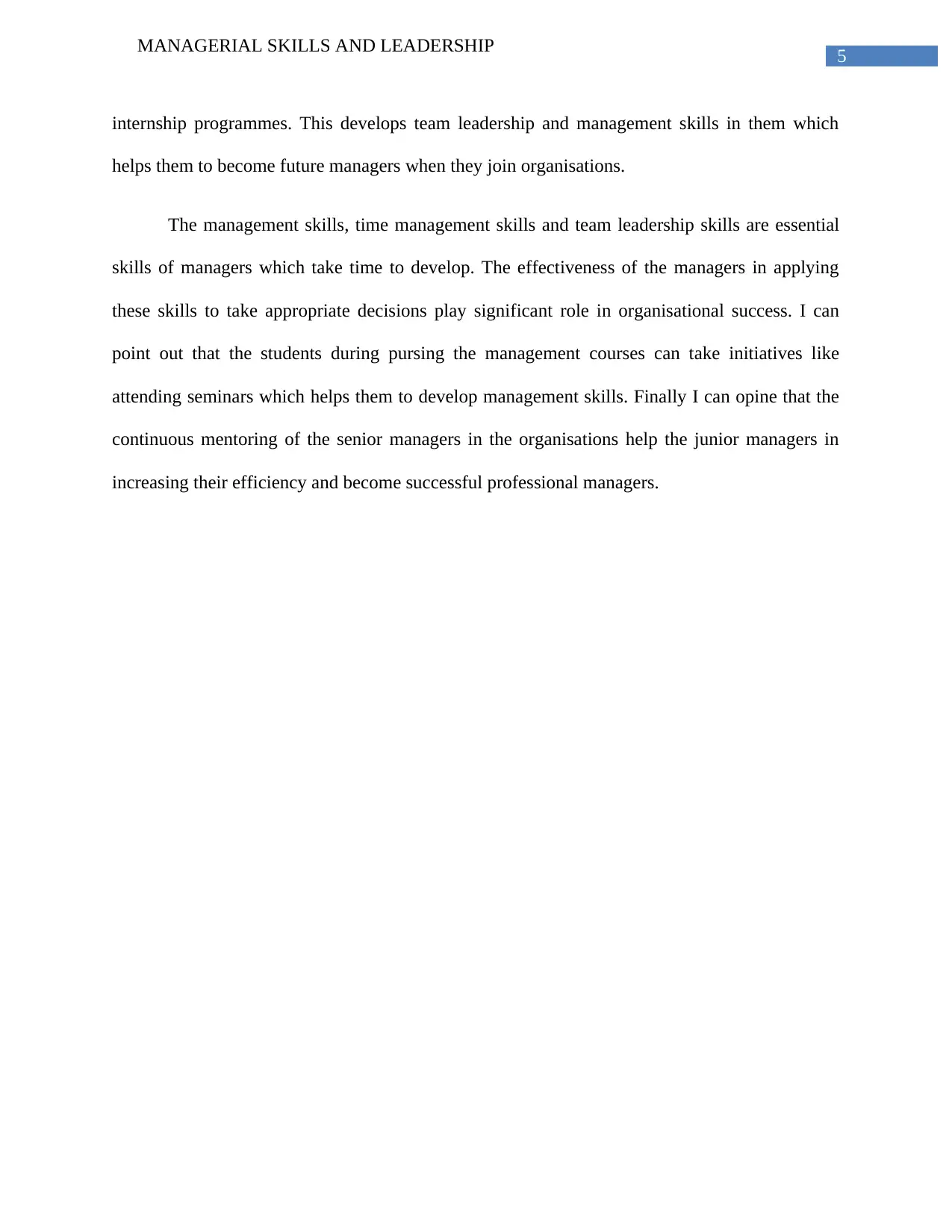
Management skills help professionals evolve into efficient organisational leaders and
managers in the future. Every manager including me on conducting a self assessment feel the
need to have three important qualities namely, managerial skills, time management skills and
team leadership skills. The managers are the actual business strategy and decision makers and
these three skills qualities help the carry out their functions effective which ultimately lead to
organisational excellence. That is why these skills of the managers hold great importance in the
organisations like Australian Catholic University and require continuous mentoring to develop
and enhance them(Acu.edu.au. 2017). The aspiring managers can start acquiring these skills by
taking their own initiatives like attending seminars held on these skills while pursuing their
management degrees. The knowledge gained from these initiatives proves helpful when they join
organisations are junior managers.
The skills of effective managers are important to the business organisations because the
managers make strategies and lead the organisational teams towards execution of those
strategies. I feel that their skills like decision making power, communication skills, analytical
power, leadership qualities, conflict management and motivational power play great role in
ensuring appropriate decision making process and execution of strategies. Upon self assessment
I can point that as a manager that I am good in all these skills other than conflict
management. Fredrick Taylor in his theory of scientific management points out
organisations should manage their resources including human resources and the production
processes in a scientific manner(Witzel and Warner 2015). As a manager at the Australian
Catholic University in North Sydney, Australia I can opine that application of scientific
management can be applied in all fields including education institute. The apex managers can
streamline the process of education (product) by aligning the curriculum according to the need of
Document Page
2
MANAGERIAL SKILLS AND LEADERSHIP
the professional world. The managers in these institutes can ensure that the professors provide
the students with education in the most modern ways like online method which would allow the
students to accede the materials at their convenience(Trivellas and Reklitis 2014). I as the
manager in charge of the management studies department motivate the professors to arrange for
seminars and company visits which promote better development of practical knowledge among
the students. This way I streamline class curriculum and practical training to ensure that the
students who aspire to become managers develop the basic qualities of managers. I can point that
the effectiveness of the departmental managers ensures that the university is able to serve a large
number of overseas and in-campus students. This ensures that Australian Catholic University
generates maximum revenue by catering to these two categories of students. Thus, the skills of
the managers in organisations to lead their teams under them are very crucial for their high
performance, revenue generation and goodwill(Trujillo 2014).
As a manager I can point that mentoring in the organisations plays a very important in
developing and enhancing managerial skills in managers. The human resource departments in the
organisations provide with training to junior managers about their job responsibilities,
expectation of the management from them and the line of authority which they have to follow.
Management skills cannot be gained within a short of time and the senior managers mentor the
junior managers on management skills. This continuous mentoring makes the managers expert in
managerial functions like decision making and conflict management. I can point that this
continuous mentoring and strengthening of managerial competencies help the managers to gain
promotions, appraisals, career development and job satisfaction(Menges 2016).
The aspiring managers can take initiatives to develop managerial skills during pursuing
management courses. They can take part in seminars and conferences to develop knowledge
Document Page
3
MANAGERIAL SKILLS AND LEADERSHIP
about management skills. I can opine that the aspiring managers can also take part in company
visits arranged by their colleges and speak to managers. This interaction would help to develop
practical idea about management which would help them to get through interviews for posts of
junior managers in the organisations( Black and Warhurst 2015).
Time management profile is a very significant managerial quality to the business because
it ensures achievement of targets within specified time period which leads to generation of
revenue. I can opine that time management is important because productivity achieved within the
predetermined time frame leads to generation of revenue. For example, as a manager of the
management education department at the Australian Catholic University I ensure that the total
management course content is streamlined to enable the students to cover it within three years.
This ensures that the university is able to serve a large number of students simultaneously and
generate huge revenue for its educational services. Thus, time management is crucial to the
business organisations to provide services and goods within specified time and generate profits
in return(Il-Hyun, Kim and Yoon 2015).
Time management is a managerial which can only be developed by continuous mentoring
by senior managers in organisations. As a manager I can point out that time management is a
managerial skill which requires a lot of time and effort to master. The senior managers mentor
their junior managers to manage multiple job responsibilities effectively within a short time.
Thus, mentoring of junior managers helps them to master time management which allows them
to execute multiple job responsibilities and enhance their efficiency(Boniwell and Zimbardo
2015).
tabler-icon-diamond-filled.svg

Paraphrase This Document

Need a fresh take? Get an instant paraphrase of this document with our AI Paraphraser
Document Page
4
MANAGERIAL SKILLS AND LEADERSHIP
The aspiring managers during pursuing management education can participate in
seminars and read books to develop the skill of time management. They can start learning time
management by distributing their various responsibilities like attending lectures and company
visits within specified time periods. These initiatives would improve their time management
skills which would help them become efficient managers(Rote and Smetana 2015).
Team leader skills are important to organisations because the organisational teams like
departments forms and execute the business strategies with a given time frame which leads to
revenue generation and organisational growth. Upon assessing my skills I feel that team
leadership skills of like strong communication skills and strategy help managers to lead teams of
subordinates like professors towards achievement of target which provision of quality education
to students. I can also point that team leadership skills like conflict management help me to
manage conflicts among professor and students and ensure smooth flow of education
services(Hoch and Kozlowski 2014).
Team leadership skills can be developed only with time and mentoring by seniors in the
organisations. The senior managers train and mentor the junior managers to lead the teas towards
achievement of specific targets within specified time limits. The seniors train their subordinates
with team leadership skills like forming strategies, allocating of job responsibilities among team
members, motivating and managing conflicts. This mentoring makes the junior managers more
efficient which help them to gain promotions and career development(Dinh et al. 2014).
The aspiring managers can obtain mentoring and training in developing team leadership
skills during pursuing their degrees. They can lead teams of students while doing researchers and
Document Page
5
MANAGERIAL SKILLS AND LEADERSHIP
internship programmes. This develops team leadership and management skills in them which
helps them to become future managers when they join organisations.
The management skills, time management skills and team leadership skills are essential
skills of managers which take time to develop. The effectiveness of the managers in applying
these skills to take appropriate decisions play significant role in organisational success. I can
point out that the students during pursing the management courses can take initiatives like
attending seminars which helps them to develop management skills. Finally I can opine that the
continuous mentoring of the senior managers in the organisations help the junior managers in
increasing their efficiency and become successful professional managers.
Document Page
6
MANAGERIAL SKILLS AND LEADERSHIP
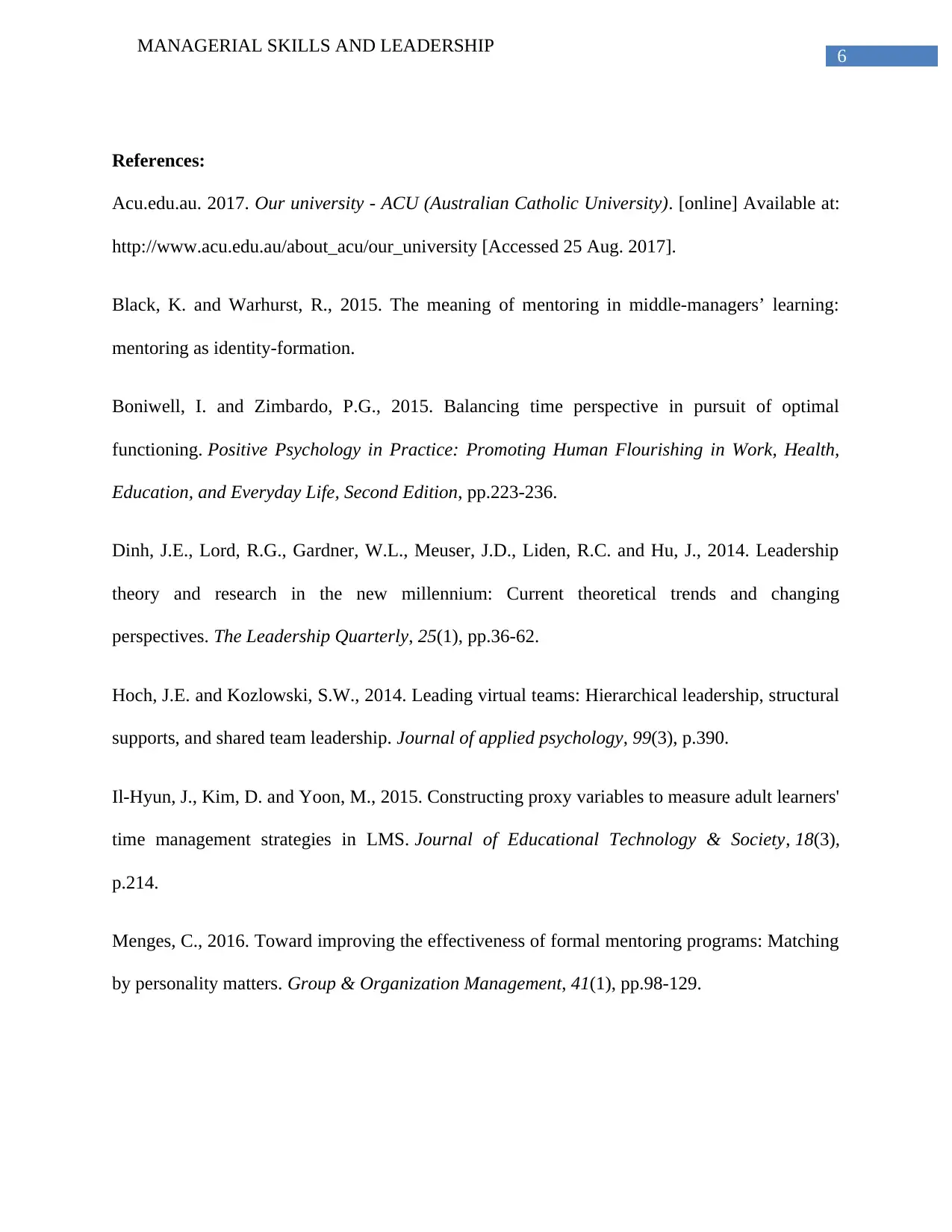
References:
Acu.edu.au. 2017. Our university - ACU (Australian Catholic University). [online] Available at:
http://www.acu.edu.au/about_acu/our_university [Accessed 25 Aug. 2017].
Black, K. and Warhurst, R., 2015. The meaning of mentoring in middle-managers’ learning:
mentoring as identity-formation.
Boniwell, I. and Zimbardo, P.G., 2015. Balancing time perspective in pursuit of optimal
functioning. Positive Psychology in Practice: Promoting Human Flourishing in Work, Health,
Education, and Everyday Life, Second Edition, pp.223-236.
Dinh, J.E., Lord, R.G., Gardner, W.L., Meuser, J.D., Liden, R.C. and Hu, J., 2014. Leadership
theory and research in the new millennium: Current theoretical trends and changing
perspectives. The Leadership Quarterly, 25(1), pp.36-62.
Hoch, J.E. and Kozlowski, S.W., 2014. Leading virtual teams: Hierarchical leadership, structural
supports, and shared team leadership. Journal of applied psychology, 99(3), p.390.
Il-Hyun, J., Kim, D. and Yoon, M., 2015. Constructing proxy variables to measure adult learners'
time management strategies in LMS. Journal of Educational Technology & Society, 18(3),
p.214.
Menges, C., 2016. Toward improving the effectiveness of formal mentoring programs: Matching
by personality matters. Group & Organization Management, 41(1), pp.98-129.
tabler-icon-diamond-filled.svg

Paraphrase This Document

Need a fresh take? Get an instant paraphrase of this document with our AI Paraphraser
Document Page
7
MANAGERIAL SKILLS AND LEADERSHIP
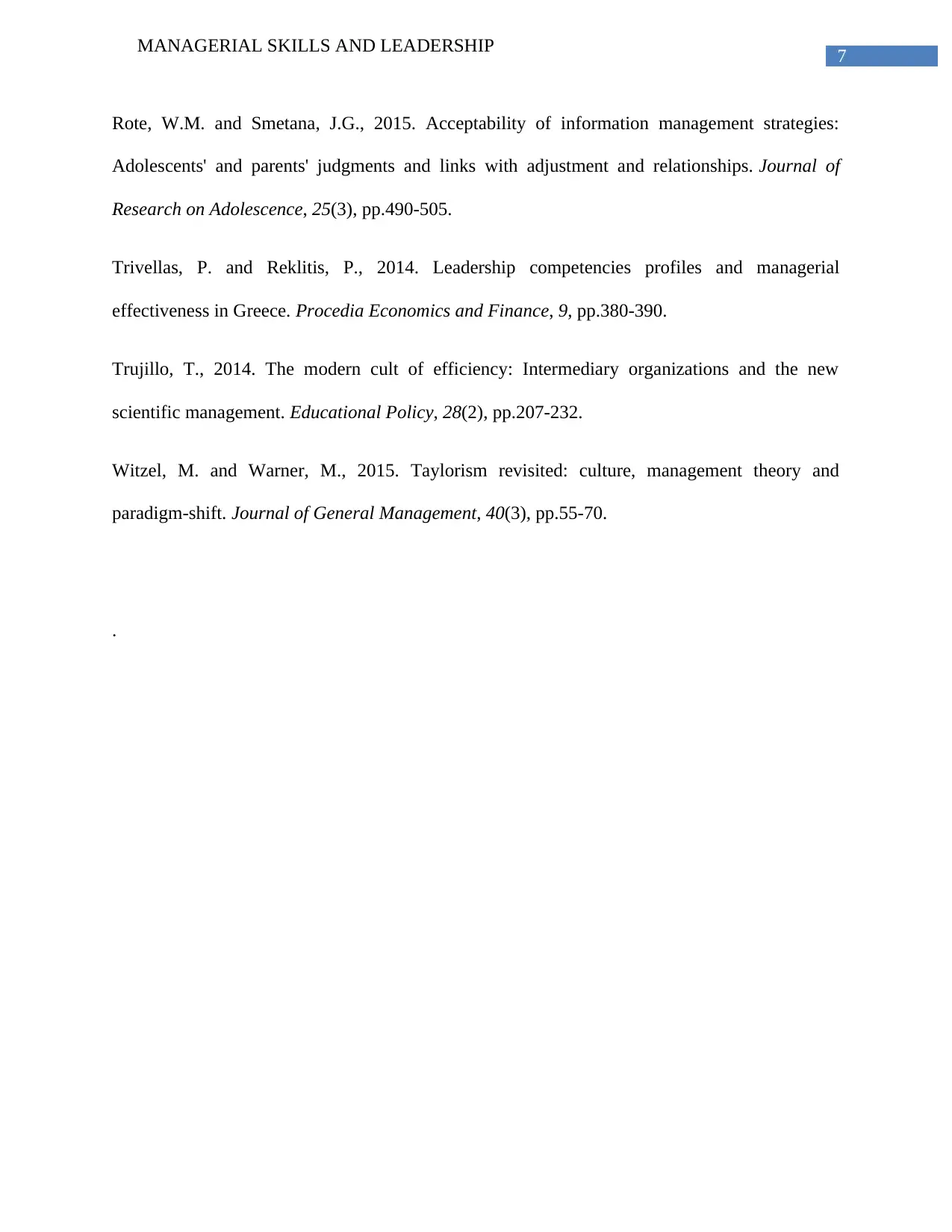
Rote, W.M. and Smetana, J.G., 2015. Acceptability of information management strategies:
Adolescents' and parents' judgments and links with adjustment and relationships. Journal of
Research on Adolescence, 25(3), pp.490-505.
Trivellas, P. and Reklitis, P., 2014. Leadership competencies profiles and managerial
effectiveness in Greece. Procedia Economics and Finance, 9, pp.380-390.
Trujillo, T., 2014. The modern cult of efficiency: Intermediary organizations and the new
scientific management. Educational Policy, 28(2), pp.207-232.
Witzel, M. and Warner, M., 2015. Taylorism revisited: culture, management theory and
paradigm-shift. Journal of General Management, 40(3), pp.55-70.
.
chevron_up_icon
1 out of 8
circle_padding
hide_on_mobile
zoom_out_icon
[object Object]