Leadership and Training Program Analysis: Rockdale Case Study
VerifiedAdded on 2019/09/30
|5
|1106
|387
Case Study
AI Summary
This assignment analyzes the Rockdale case study, focusing on the shortcomings of the training and development program implemented by Chris Parker. The analysis critiques Parker's needs assessment, highlighting the lack of organizational, task, and person analysis, and the failure to consider external factors. The solution proposes a more comprehensive approach, emphasizing the importance of defining organizational goals, assessing employee skills, conducting interactive training sessions, and utilizing the Kirkpatrick model for evaluation. The document also discusses outsourcing decisions and alternative training designs, such as andragogy vs. pedagogy, and strategies for transferring training effectively. The final part addresses the information needed for evaluating the training program, including employee dissatisfaction and training costs, and suggests using a simple design for assessing knowledge transfer and multiple baselines to understand the impact of the training and development sessions.

case analysis
[Document subtitle]
[Document subtitle]
Paraphrase This Document
Need a fresh take? Get an instant paraphrase of this document with our AI Paraphraser

1
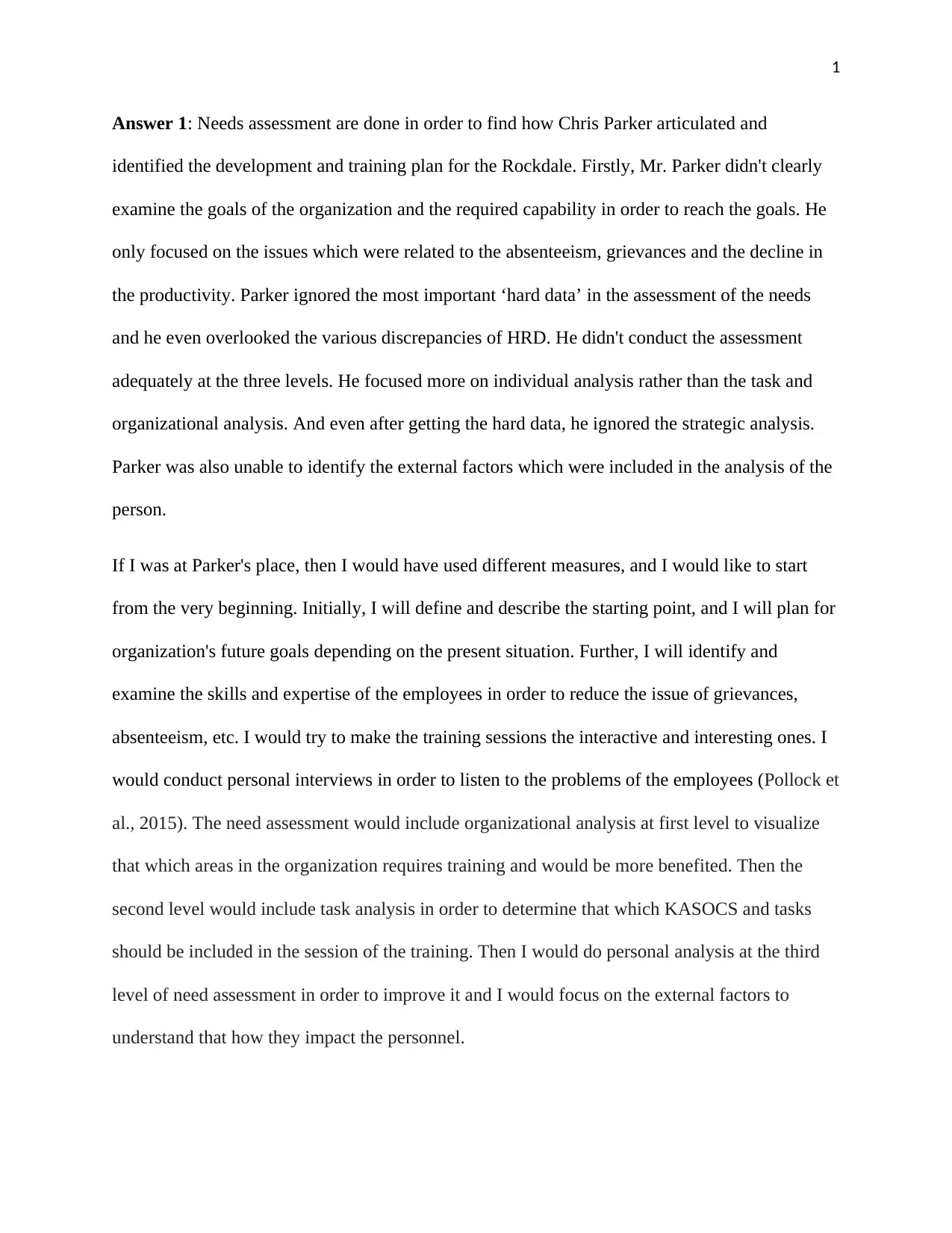
Answer 1: Needs assessment are done in order to find how Chris Parker articulated and
identified the development and training plan for the Rockdale. Firstly, Mr. Parker didn't clearly
examine the goals of the organization and the required capability in order to reach the goals. He
only focused on the issues which were related to the absenteeism, grievances and the decline in
the productivity. Parker ignored the most important ‘hard data’ in the assessment of the needs
and he even overlooked the various discrepancies of HRD. He didn't conduct the assessment
adequately at the three levels. He focused more on individual analysis rather than the task and
organizational analysis. And even after getting the hard data, he ignored the strategic analysis.
Parker was also unable to identify the external factors which were included in the analysis of the
person.
If I was at Parker's place, then I would have used different measures, and I would like to start
from the very beginning. Initially, I will define and describe the starting point, and I will plan for
organization's future goals depending on the present situation. Further, I will identify and
examine the skills and expertise of the employees in order to reduce the issue of grievances,
absenteeism, etc. I would try to make the training sessions the interactive and interesting ones. I
would conduct personal interviews in order to listen to the problems of the employees (Pollock et
al., 2015). The need assessment would include organizational analysis at first level to visualize
that which areas in the organization requires training and would be more benefited. Then the
second level would include task analysis in order to determine that which KASOCS and tasks
should be included in the session of the training. Then I would do personal analysis at the third
level of need assessment in order to improve it and I would focus on the external factors to
understand that how they impact the personnel.
Answer 1: Needs assessment are done in order to find how Chris Parker articulated and
identified the development and training plan for the Rockdale. Firstly, Mr. Parker didn't clearly
examine the goals of the organization and the required capability in order to reach the goals. He
only focused on the issues which were related to the absenteeism, grievances and the decline in
the productivity. Parker ignored the most important ‘hard data’ in the assessment of the needs
and he even overlooked the various discrepancies of HRD. He didn't conduct the assessment
adequately at the three levels. He focused more on individual analysis rather than the task and
organizational analysis. And even after getting the hard data, he ignored the strategic analysis.
Parker was also unable to identify the external factors which were included in the analysis of the
person.
If I was at Parker's place, then I would have used different measures, and I would like to start
from the very beginning. Initially, I will define and describe the starting point, and I will plan for
organization's future goals depending on the present situation. Further, I will identify and
examine the skills and expertise of the employees in order to reduce the issue of grievances,
absenteeism, etc. I would try to make the training sessions the interactive and interesting ones. I
would conduct personal interviews in order to listen to the problems of the employees (Pollock et
al., 2015). The need assessment would include organizational analysis at first level to visualize
that which areas in the organization requires training and would be more benefited. Then the
second level would include task analysis in order to determine that which KASOCS and tasks
should be included in the session of the training. Then I would do personal analysis at the third
level of need assessment in order to improve it and I would focus on the external factors to
understand that how they impact the personnel.

2
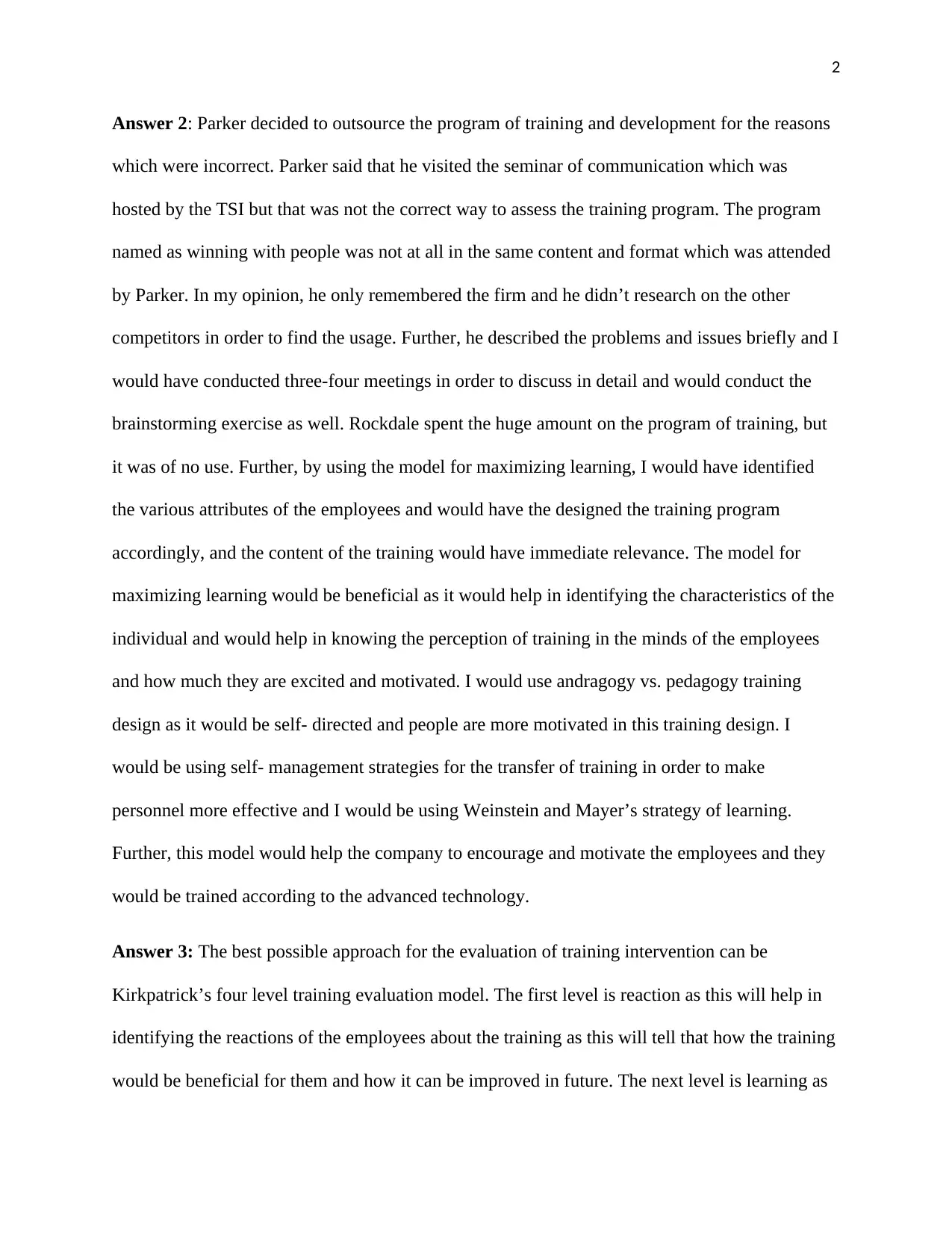
Answer 2: Parker decided to outsource the program of training and development for the reasons
which were incorrect. Parker said that he visited the seminar of communication which was
hosted by the TSI but that was not the correct way to assess the training program. The program
named as winning with people was not at all in the same content and format which was attended
by Parker. In my opinion, he only remembered the firm and he didn’t research on the other
competitors in order to find the usage. Further, he described the problems and issues briefly and I
would have conducted three-four meetings in order to discuss in detail and would conduct the
brainstorming exercise as well. Rockdale spent the huge amount on the program of training, but
it was of no use. Further, by using the model for maximizing learning, I would have identified
the various attributes of the employees and would have the designed the training program
accordingly, and the content of the training would have immediate relevance. The model for
maximizing learning would be beneficial as it would help in identifying the characteristics of the
individual and would help in knowing the perception of training in the minds of the employees
and how much they are excited and motivated. I would use andragogy vs. pedagogy training
design as it would be self- directed and people are more motivated in this training design. I
would be using self- management strategies for the transfer of training in order to make
personnel more effective and I would be using Weinstein and Mayer’s strategy of learning.
Further, this model would help the company to encourage and motivate the employees and they
would be trained according to the advanced technology.
Answer 3: The best possible approach for the evaluation of training intervention can be
Kirkpatrick’s four level training evaluation model. The first level is reaction as this will help in
identifying the reactions of the employees about the training as this will tell that how the training
would be beneficial for them and how it can be improved in future. The next level is learning as
Answer 2: Parker decided to outsource the program of training and development for the reasons
which were incorrect. Parker said that he visited the seminar of communication which was
hosted by the TSI but that was not the correct way to assess the training program. The program
named as winning with people was not at all in the same content and format which was attended
by Parker. In my opinion, he only remembered the firm and he didn’t research on the other
competitors in order to find the usage. Further, he described the problems and issues briefly and I
would have conducted three-four meetings in order to discuss in detail and would conduct the
brainstorming exercise as well. Rockdale spent the huge amount on the program of training, but
it was of no use. Further, by using the model for maximizing learning, I would have identified
the various attributes of the employees and would have the designed the training program
accordingly, and the content of the training would have immediate relevance. The model for
maximizing learning would be beneficial as it would help in identifying the characteristics of the
individual and would help in knowing the perception of training in the minds of the employees
and how much they are excited and motivated. I would use andragogy vs. pedagogy training
design as it would be self- directed and people are more motivated in this training design. I
would be using self- management strategies for the transfer of training in order to make
personnel more effective and I would be using Weinstein and Mayer’s strategy of learning.
Further, this model would help the company to encourage and motivate the employees and they
would be trained according to the advanced technology.
Answer 3: The best possible approach for the evaluation of training intervention can be
Kirkpatrick’s four level training evaluation model. The first level is reaction as this will help in
identifying the reactions of the employees about the training as this will tell that how the training
would be beneficial for them and how it can be improved in future. The next level is learning as
⊘ This is a preview!⊘
Do you want full access?
Subscribe today to unlock all pages.

Trusted by 1+ million students worldwide

3
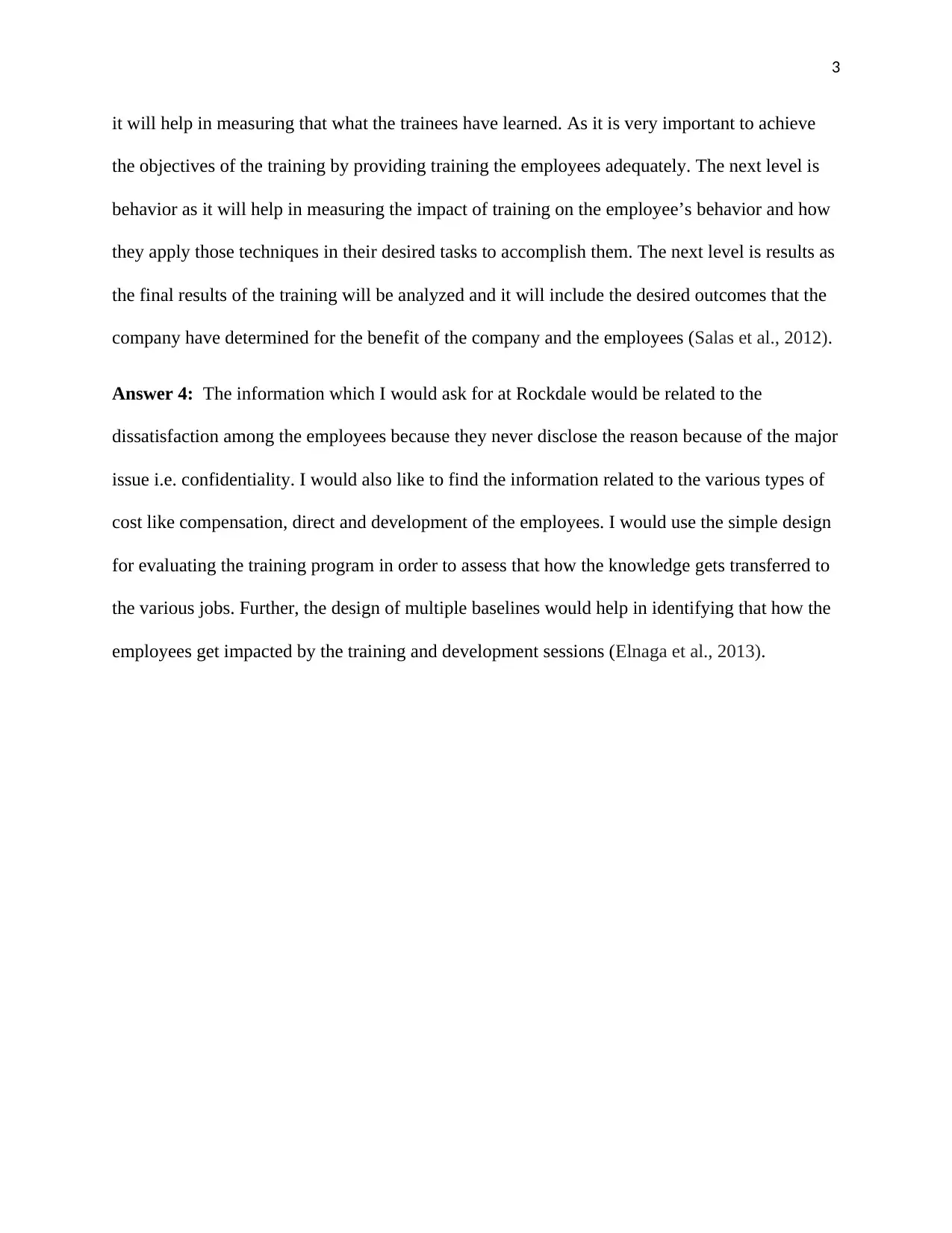
it will help in measuring that what the trainees have learned. As it is very important to achieve
the objectives of the training by providing training the employees adequately. The next level is
behavior as it will help in measuring the impact of training on the employee’s behavior and how
they apply those techniques in their desired tasks to accomplish them. The next level is results as
the final results of the training will be analyzed and it will include the desired outcomes that the
company have determined for the benefit of the company and the employees (Salas et al., 2012).
Answer 4: The information which I would ask for at Rockdale would be related to the
dissatisfaction among the employees because they never disclose the reason because of the major
issue i.e. confidentiality. I would also like to find the information related to the various types of
cost like compensation, direct and development of the employees. I would use the simple design
for evaluating the training program in order to assess that how the knowledge gets transferred to
the various jobs. Further, the design of multiple baselines would help in identifying that how the
employees get impacted by the training and development sessions (Elnaga et al., 2013).
it will help in measuring that what the trainees have learned. As it is very important to achieve
the objectives of the training by providing training the employees adequately. The next level is
behavior as it will help in measuring the impact of training on the employee’s behavior and how
they apply those techniques in their desired tasks to accomplish them. The next level is results as
the final results of the training will be analyzed and it will include the desired outcomes that the
company have determined for the benefit of the company and the employees (Salas et al., 2012).
Answer 4: The information which I would ask for at Rockdale would be related to the
dissatisfaction among the employees because they never disclose the reason because of the major
issue i.e. confidentiality. I would also like to find the information related to the various types of
cost like compensation, direct and development of the employees. I would use the simple design
for evaluating the training program in order to assess that how the knowledge gets transferred to
the various jobs. Further, the design of multiple baselines would help in identifying that how the
employees get impacted by the training and development sessions (Elnaga et al., 2013).
Paraphrase This Document
Need a fresh take? Get an instant paraphrase of this document with our AI Paraphraser

4
REFERENCES
Elnaga, A., & Imran, A. (2013). The effect of training on employee performance. European
Journal of Business and Management, 5(4), 137-147.
Pollock, R. V., Wick, C. W., & Jefferson, A. (2015). The six disciplines of breakthrough
learning: How to turn training and development into business results. John Wiley & Sons.
Salas, E., Tannenbaum, S. I., Kraiger, K., & Smith-Jentsch, K. A. (2012). The science of training
and development in organizations: What matters in practice. Psychological science in the public
interest, 13(2), 74-101.
REFERENCES
Elnaga, A., & Imran, A. (2013). The effect of training on employee performance. European
Journal of Business and Management, 5(4), 137-147.
Pollock, R. V., Wick, C. W., & Jefferson, A. (2015). The six disciplines of breakthrough
learning: How to turn training and development into business results. John Wiley & Sons.
Salas, E., Tannenbaum, S. I., Kraiger, K., & Smith-Jentsch, K. A. (2012). The science of training
and development in organizations: What matters in practice. Psychological science in the public
interest, 13(2), 74-101.
1 out of 5
Related Documents
Your All-in-One AI-Powered Toolkit for Academic Success.
+13062052269
info@desklib.com
Available 24*7 on WhatsApp / Email
Unlock your academic potential
Copyright © 2020–2025 A2Z Services. All Rights Reserved. Developed and managed by ZUCOL.