Evaluating Leadership, Virtual Groups, and Challenges in Healthcare
VerifiedAdded on 2023/06/03
|6
|1438
|162
Essay
AI Summary
This essay provides a critical analysis of leadership in the healthcare industry, focusing on the impact of virtual groups and the challenges faced by healthcare leaders. It reflects on the role of leaders in improving clinical practices and patient care quality, emphasizing the increasing demand for skilled professionals in a complex environment. The discussion covers the use of virtual groups by healthcare professionals for knowledge sharing and collaboration, evaluating their effectiveness in enhancing leadership skills and decision-making. Furthermore, the essay examines the challenges affecting the average life of leaders, highlighting the need for continuous development and adaptation to maintain effectiveness in the evolving healthcare landscape. It concludes that a leader's ability to manage complexities and leverage technology significantly influences their success and longevity in the industry.

Leadership in healthcare
Paraphrase This Document
Need a fresh take? Get an instant paraphrase of this document with our AI Paraphraser

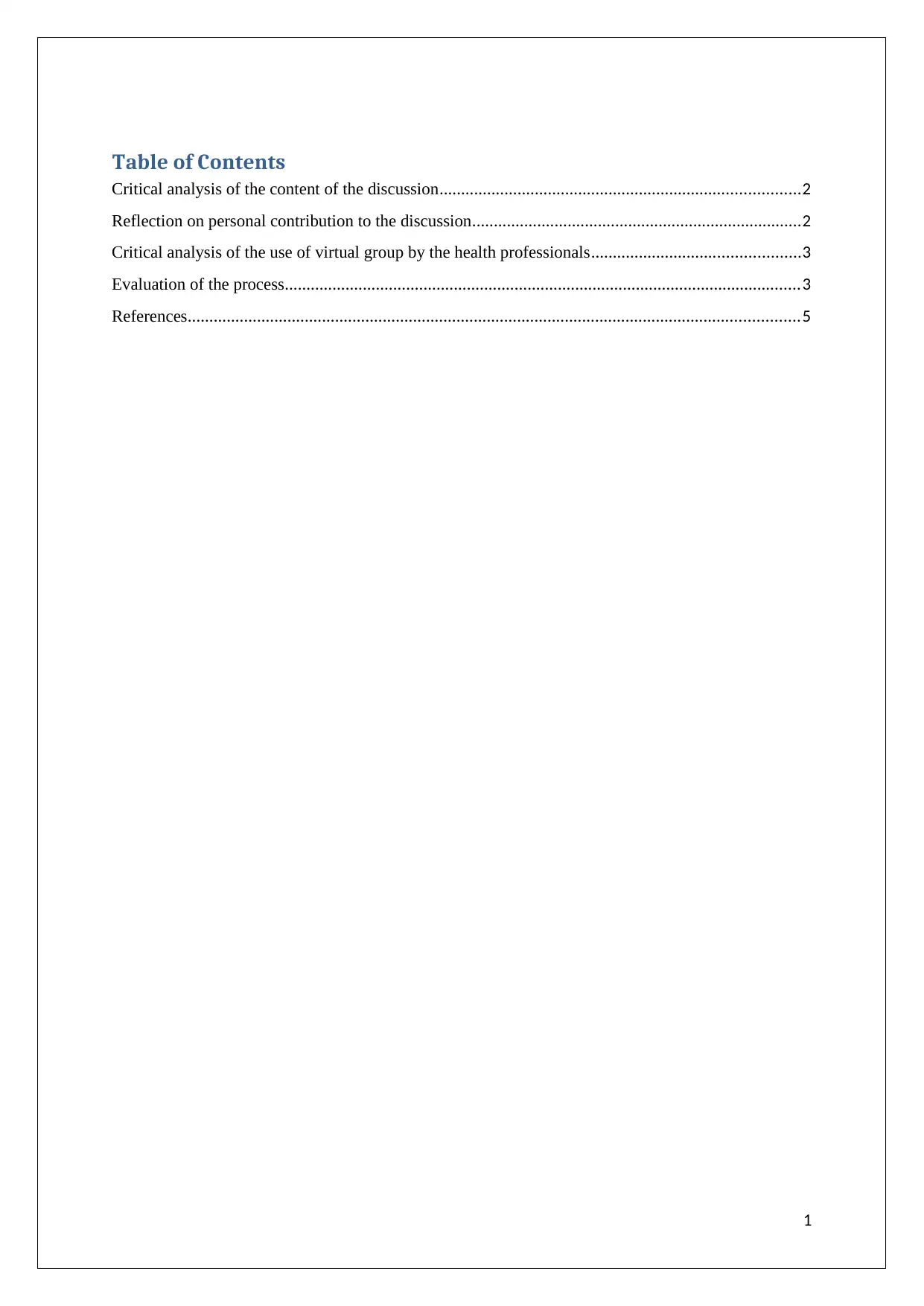
Table of Contents
Critical analysis of the content of the discussion...................................................................................2
Reflection on personal contribution to the discussion............................................................................2
Critical analysis of the use of virtual group by the health professionals................................................3
Evaluation of the process.......................................................................................................................3
References.............................................................................................................................................5
1
Critical analysis of the content of the discussion...................................................................................2
Reflection on personal contribution to the discussion............................................................................2
Critical analysis of the use of virtual group by the health professionals................................................3
Evaluation of the process.......................................................................................................................3
References.............................................................................................................................................5
1

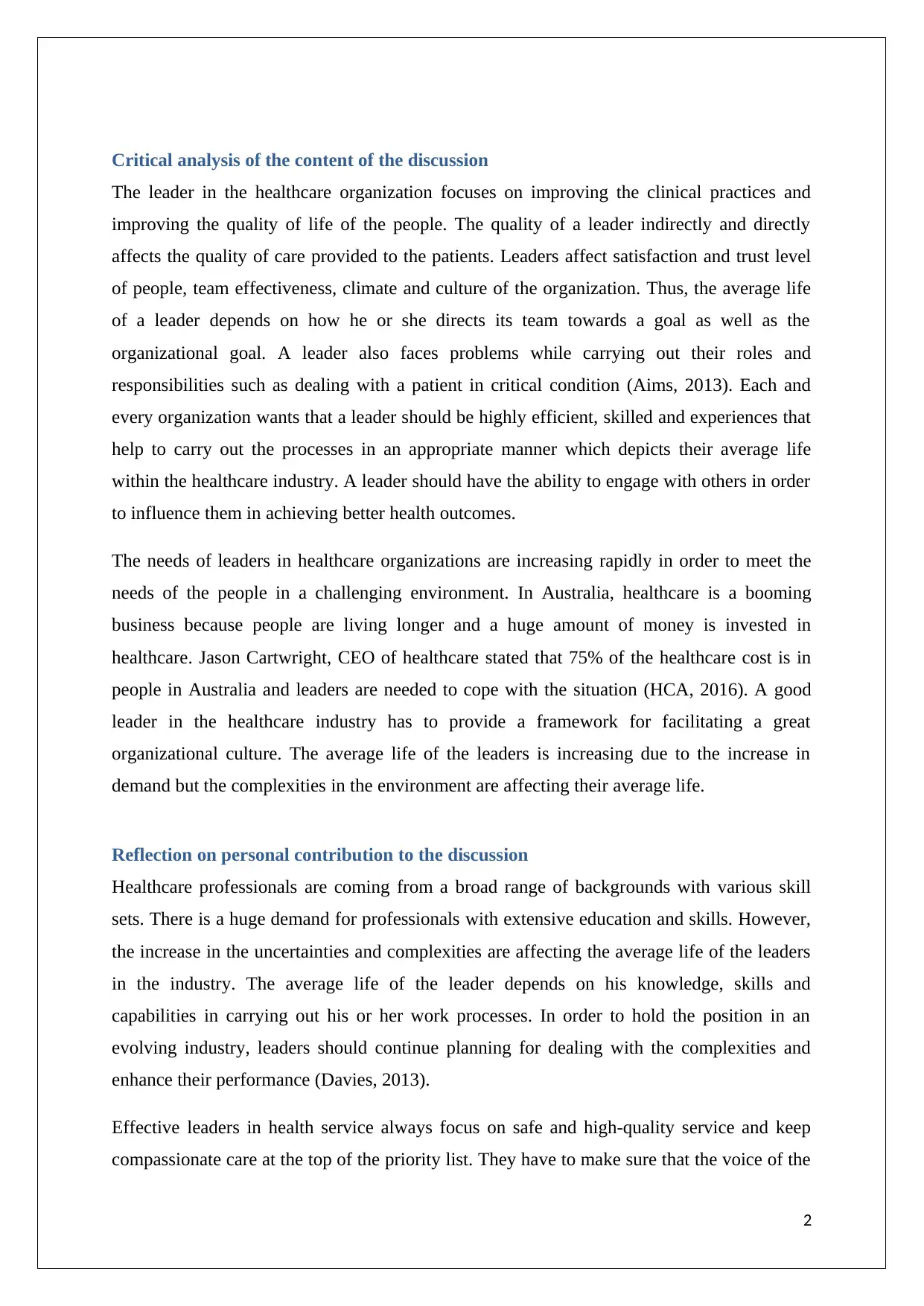
Critical analysis of the content of the discussion
The leader in the healthcare organization focuses on improving the clinical practices and
improving the quality of life of the people. The quality of a leader indirectly and directly
affects the quality of care provided to the patients. Leaders affect satisfaction and trust level
of people, team effectiveness, climate and culture of the organization. Thus, the average life
of a leader depends on how he or she directs its team towards a goal as well as the
organizational goal. A leader also faces problems while carrying out their roles and
responsibilities such as dealing with a patient in critical condition (Aims, 2013). Each and
every organization wants that a leader should be highly efficient, skilled and experiences that
help to carry out the processes in an appropriate manner which depicts their average life
within the healthcare industry. A leader should have the ability to engage with others in order
to influence them in achieving better health outcomes.
The needs of leaders in healthcare organizations are increasing rapidly in order to meet the
needs of the people in a challenging environment. In Australia, healthcare is a booming
business because people are living longer and a huge amount of money is invested in
healthcare. Jason Cartwright, CEO of healthcare stated that 75% of the healthcare cost is in
people in Australia and leaders are needed to cope with the situation (HCA, 2016). A good
leader in the healthcare industry has to provide a framework for facilitating a great
organizational culture. The average life of the leaders is increasing due to the increase in
demand but the complexities in the environment are affecting their average life.
Reflection on personal contribution to the discussion
Healthcare professionals are coming from a broad range of backgrounds with various skill
sets. There is a huge demand for professionals with extensive education and skills. However,
the increase in the uncertainties and complexities are affecting the average life of the leaders
in the industry. The average life of the leader depends on his knowledge, skills and
capabilities in carrying out his or her work processes. In order to hold the position in an
evolving industry, leaders should continue planning for dealing with the complexities and
enhance their performance (Davies, 2013).
Effective leaders in health service always focus on safe and high-quality service and keep
compassionate care at the top of the priority list. They have to make sure that the voice of the
2
The leader in the healthcare organization focuses on improving the clinical practices and
improving the quality of life of the people. The quality of a leader indirectly and directly
affects the quality of care provided to the patients. Leaders affect satisfaction and trust level
of people, team effectiveness, climate and culture of the organization. Thus, the average life
of a leader depends on how he or she directs its team towards a goal as well as the
organizational goal. A leader also faces problems while carrying out their roles and
responsibilities such as dealing with a patient in critical condition (Aims, 2013). Each and
every organization wants that a leader should be highly efficient, skilled and experiences that
help to carry out the processes in an appropriate manner which depicts their average life
within the healthcare industry. A leader should have the ability to engage with others in order
to influence them in achieving better health outcomes.
The needs of leaders in healthcare organizations are increasing rapidly in order to meet the
needs of the people in a challenging environment. In Australia, healthcare is a booming
business because people are living longer and a huge amount of money is invested in
healthcare. Jason Cartwright, CEO of healthcare stated that 75% of the healthcare cost is in
people in Australia and leaders are needed to cope with the situation (HCA, 2016). A good
leader in the healthcare industry has to provide a framework for facilitating a great
organizational culture. The average life of the leaders is increasing due to the increase in
demand but the complexities in the environment are affecting their average life.
Reflection on personal contribution to the discussion
Healthcare professionals are coming from a broad range of backgrounds with various skill
sets. There is a huge demand for professionals with extensive education and skills. However,
the increase in the uncertainties and complexities are affecting the average life of the leaders
in the industry. The average life of the leader depends on his knowledge, skills and
capabilities in carrying out his or her work processes. In order to hold the position in an
evolving industry, leaders should continue planning for dealing with the complexities and
enhance their performance (Davies, 2013).
Effective leaders in health service always focus on safe and high-quality service and keep
compassionate care at the top of the priority list. They have to make sure that the voice of the
2
⊘ This is a preview!⊘
Do you want full access?
Subscribe today to unlock all pages.

Trusted by 1+ million students worldwide

patients must be heard; experience, concerns, needs and feedback of the patient are must be
attended to. A leader should be supportive, empathic, respectful, fair, available,
compassionate and empowering in order to survive in the industry. They have to make sure
the voice of all the staff members must be encouraged, heard and an action shall be taken
accordingly to provide practical support for staff to create safe boundaries for them
(Campling, 2008). They have to follow transparency in relations to mistakes, complaints,
serious incidents and problems. The roles and responsibilities depict the efficiency of the
leader which is directly related to his or her average life of the leader within the healthcare
industry.
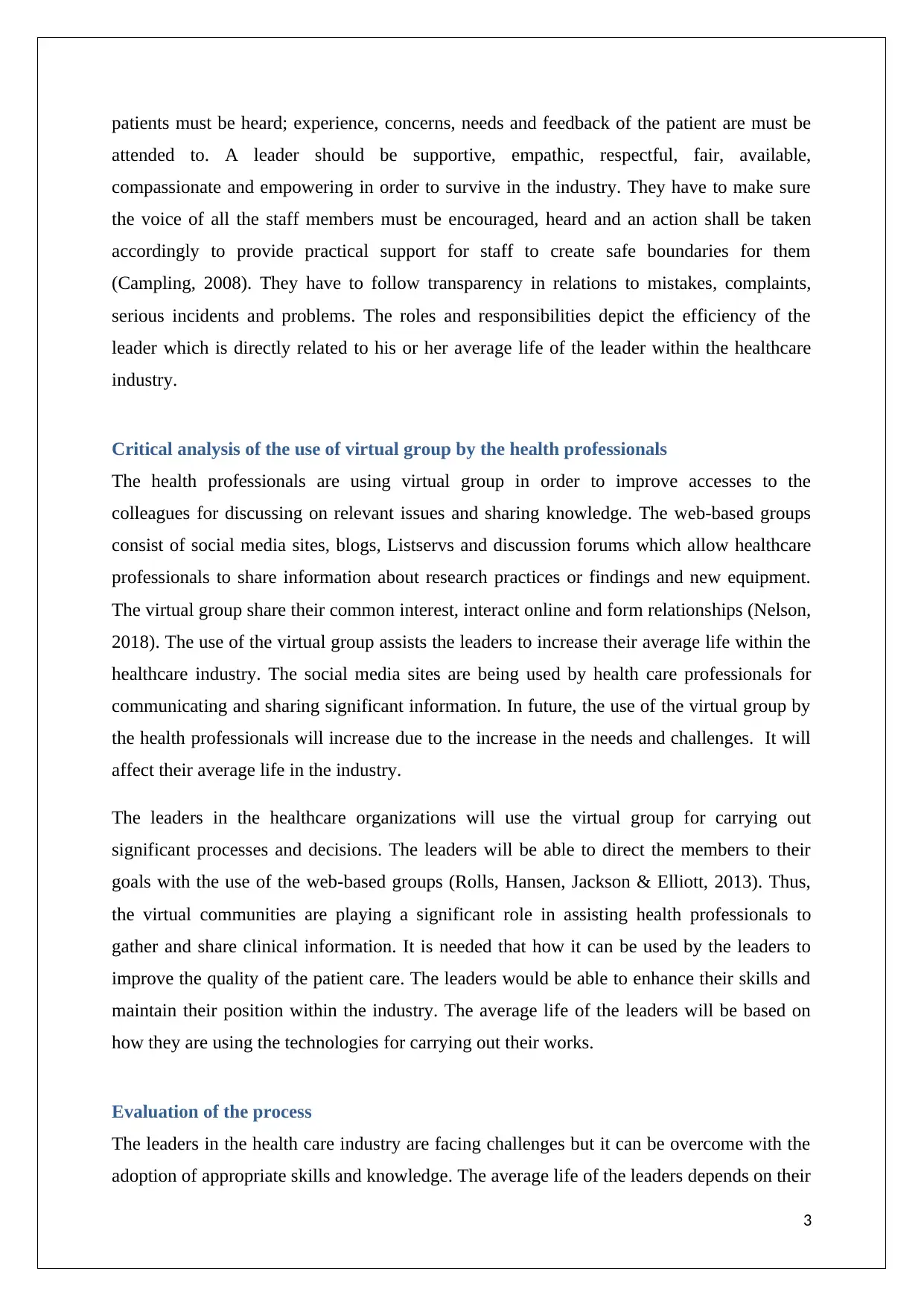
Critical analysis of the use of virtual group by the health professionals
The health professionals are using virtual group in order to improve accesses to the
colleagues for discussing on relevant issues and sharing knowledge. The web-based groups
consist of social media sites, blogs, Listservs and discussion forums which allow healthcare
professionals to share information about research practices or findings and new equipment.
The virtual group share their common interest, interact online and form relationships (Nelson,
2018). The use of the virtual group assists the leaders to increase their average life within the
healthcare industry. The social media sites are being used by health care professionals for
communicating and sharing significant information. In future, the use of the virtual group by
the health professionals will increase due to the increase in the needs and challenges. It will
affect their average life in the industry.
The leaders in the healthcare organizations will use the virtual group for carrying out
significant processes and decisions. The leaders will be able to direct the members to their
goals with the use of the web-based groups (Rolls, Hansen, Jackson & Elliott, 2013). Thus,
the virtual communities are playing a significant role in assisting health professionals to
gather and share clinical information. It is needed that how it can be used by the leaders to
improve the quality of the patient care. The leaders would be able to enhance their skills and
maintain their position within the industry. The average life of the leaders will be based on
how they are using the technologies for carrying out their works.
Evaluation of the process
The leaders in the health care industry are facing challenges but it can be overcome with the
adoption of appropriate skills and knowledge. The average life of the leaders depends on their
3
attended to. A leader should be supportive, empathic, respectful, fair, available,
compassionate and empowering in order to survive in the industry. They have to make sure
the voice of all the staff members must be encouraged, heard and an action shall be taken
accordingly to provide practical support for staff to create safe boundaries for them
(Campling, 2008). They have to follow transparency in relations to mistakes, complaints,
serious incidents and problems. The roles and responsibilities depict the efficiency of the
leader which is directly related to his or her average life of the leader within the healthcare
industry.
Critical analysis of the use of virtual group by the health professionals
The health professionals are using virtual group in order to improve accesses to the
colleagues for discussing on relevant issues and sharing knowledge. The web-based groups
consist of social media sites, blogs, Listservs and discussion forums which allow healthcare
professionals to share information about research practices or findings and new equipment.
The virtual group share their common interest, interact online and form relationships (Nelson,
2018). The use of the virtual group assists the leaders to increase their average life within the
healthcare industry. The social media sites are being used by health care professionals for
communicating and sharing significant information. In future, the use of the virtual group by
the health professionals will increase due to the increase in the needs and challenges. It will
affect their average life in the industry.
The leaders in the healthcare organizations will use the virtual group for carrying out
significant processes and decisions. The leaders will be able to direct the members to their
goals with the use of the web-based groups (Rolls, Hansen, Jackson & Elliott, 2013). Thus,
the virtual communities are playing a significant role in assisting health professionals to
gather and share clinical information. It is needed that how it can be used by the leaders to
improve the quality of the patient care. The leaders would be able to enhance their skills and
maintain their position within the industry. The average life of the leaders will be based on
how they are using the technologies for carrying out their works.
Evaluation of the process
The leaders in the health care industry are facing challenges but it can be overcome with the
adoption of appropriate skills and knowledge. The average life of the leaders depends on their
3
Paraphrase This Document
Need a fresh take? Get an instant paraphrase of this document with our AI Paraphraser

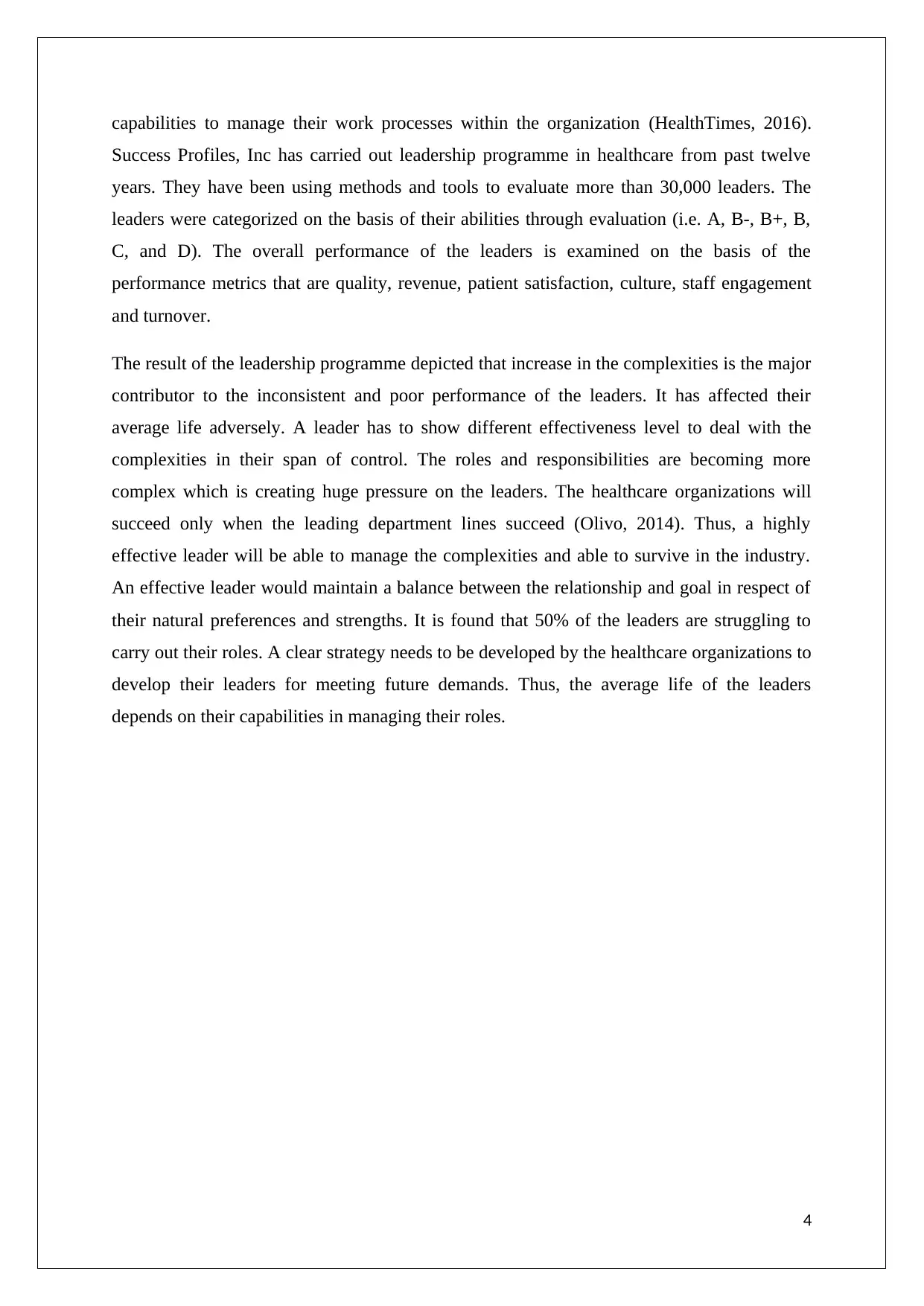
capabilities to manage their work processes within the organization (HealthTimes, 2016).
Success Profiles, Inc has carried out leadership programme in healthcare from past twelve
years. They have been using methods and tools to evaluate more than 30,000 leaders. The
leaders were categorized on the basis of their abilities through evaluation (i.e. A, B-, B+, B,
C, and D). The overall performance of the leaders is examined on the basis of the
performance metrics that are quality, revenue, patient satisfaction, culture, staff engagement
and turnover.
The result of the leadership programme depicted that increase in the complexities is the major
contributor to the inconsistent and poor performance of the leaders. It has affected their
average life adversely. A leader has to show different effectiveness level to deal with the
complexities in their span of control. The roles and responsibilities are becoming more
complex which is creating huge pressure on the leaders. The healthcare organizations will
succeed only when the leading department lines succeed (Olivo, 2014). Thus, a highly
effective leader will be able to manage the complexities and able to survive in the industry.
An effective leader would maintain a balance between the relationship and goal in respect of
their natural preferences and strengths. It is found that 50% of the leaders are struggling to
carry out their roles. A clear strategy needs to be developed by the healthcare organizations to
develop their leaders for meeting future demands. Thus, the average life of the leaders
depends on their capabilities in managing their roles.
4
Success Profiles, Inc has carried out leadership programme in healthcare from past twelve
years. They have been using methods and tools to evaluate more than 30,000 leaders. The
leaders were categorized on the basis of their abilities through evaluation (i.e. A, B-, B+, B,
C, and D). The overall performance of the leaders is examined on the basis of the
performance metrics that are quality, revenue, patient satisfaction, culture, staff engagement
and turnover.
The result of the leadership programme depicted that increase in the complexities is the major
contributor to the inconsistent and poor performance of the leaders. It has affected their
average life adversely. A leader has to show different effectiveness level to deal with the
complexities in their span of control. The roles and responsibilities are becoming more
complex which is creating huge pressure on the leaders. The healthcare organizations will
succeed only when the leading department lines succeed (Olivo, 2014). Thus, a highly
effective leader will be able to manage the complexities and able to survive in the industry.
An effective leader would maintain a balance between the relationship and goal in respect of
their natural preferences and strengths. It is found that 50% of the leaders are struggling to
carry out their roles. A clear strategy needs to be developed by the healthcare organizations to
develop their leaders for meeting future demands. Thus, the average life of the leaders
depends on their capabilities in managing their roles.
4

References
Aims. (2013). Health workforce. Retrieved from
https://www.aims.org.au/documents/item/352
Campling, J. (2008). Management (5th ed.). Milton, Qld.: John Wiley & Sons Australia.
Davies, F. (2013). The leader (4th ed.). Sandy: Authors Online.
HCA. (2016). The Heart of Healthcare - Healthcare Australia. Retrieved from
https://www.healthcareaustralia.com.au/the-heart-of-healthcare/
HealthTimes. (2016). Australia needs more healthcare leaders to cope with industry changes.
Retrieved from https://healthtimes.com.au/hub/leadership/35/news/nc1/australia-needs-
more-healthcare-leaders-to-cope-with-industry-changes/1747/
Nelson, C. (2018). A look into how healthcare professionals use virtual communities | Inprela
Communications. Retrieved from https://inprela.com/2017/07/11/look-healthcare-
professionals-use-virtual-communities/
Olivo, T. (2014). The Profile of an Effective Healthcare Leader. Retrieved from
https://www.beckershospitalreview.com/hospital-management-administration/the-
profile-of-an-effective-healthcare-leader.html
Rolls, K., Hansen, M., Jackson, D., & Elliott, D. (2013). Using online focus groups to explore
why healthcare professionals belong to a practice-focused virtual community. Retrieved
from https://www.aci.health.nsw.gov.au/__data/assets/pdf_file/0009/306738/
Kaye_Rolls_QM_2015_online_focus_groups_10042015.pdf
5
Aims. (2013). Health workforce. Retrieved from
https://www.aims.org.au/documents/item/352
Campling, J. (2008). Management (5th ed.). Milton, Qld.: John Wiley & Sons Australia.
Davies, F. (2013). The leader (4th ed.). Sandy: Authors Online.
HCA. (2016). The Heart of Healthcare - Healthcare Australia. Retrieved from
https://www.healthcareaustralia.com.au/the-heart-of-healthcare/
HealthTimes. (2016). Australia needs more healthcare leaders to cope with industry changes.
Retrieved from https://healthtimes.com.au/hub/leadership/35/news/nc1/australia-needs-
more-healthcare-leaders-to-cope-with-industry-changes/1747/
Nelson, C. (2018). A look into how healthcare professionals use virtual communities | Inprela
Communications. Retrieved from https://inprela.com/2017/07/11/look-healthcare-
professionals-use-virtual-communities/
Olivo, T. (2014). The Profile of an Effective Healthcare Leader. Retrieved from
https://www.beckershospitalreview.com/hospital-management-administration/the-
profile-of-an-effective-healthcare-leader.html
Rolls, K., Hansen, M., Jackson, D., & Elliott, D. (2013). Using online focus groups to explore
why healthcare professionals belong to a practice-focused virtual community. Retrieved
from https://www.aci.health.nsw.gov.au/__data/assets/pdf_file/0009/306738/
Kaye_Rolls_QM_2015_online_focus_groups_10042015.pdf
5
⊘ This is a preview!⊘
Do you want full access?
Subscribe today to unlock all pages.

Trusted by 1+ million students worldwide
1 out of 6
Related Documents
Your All-in-One AI-Powered Toolkit for Academic Success.
+13062052269
info@desklib.com
Available 24*7 on WhatsApp / Email
Unlock your academic potential
Copyright © 2020–2025 A2Z Services. All Rights Reserved. Developed and managed by ZUCOL.