MRO Facility Performance: Implementing Lean Six Sigma Framework

Verified

Added on  2023/01/05

|11
|1999
|38
Report
AI Summary
This report delves into the application of the Lean Six Sigma (LSS) framework to improve operational performance, particularly within a Maintenance, Repair, and Overhaul (MRO) facility. It examines how LSS, integrating lean principles for waste reduction and Six Sigma for defect elimination, enhances business processes. The report covers the LSS implementation cycle (Define, Measure, Analyze, Improve, Control) and its impact on key performance indicators like time, motion, and inventory. It highlights the benefits of LSS, including increased profit, improved efficiency, and enhanced customer satisfaction. The report also analyzes the organizational structure of LSS, the DMAIC cycle, and case studies like AMRO limited. The conclusion emphasizes the framework's effectiveness in reducing waste, improving service quality, and boosting overall business growth. The report references academic papers and online resources to support its findings, offering insights into the use of LSS in the aerospace industry and supply chain management.
Document Page
Running Head: Performance 0
Performance
Report
Student name
tabler-icon-diamond-filled.svg

Paraphrase This Document

Need a fresh take? Get an instant paraphrase of this document with our AI Paraphraser
Document Page
Performance 1
Table of Contents
Introduction......................................................................................................................................1
Impact of Lean Six Sigma framework.............................................................................................1
Conclusion.......................................................................................................................................6
References........................................................................................................................................7
Document Page
Performance 2
Introduction
An organization has faced various issues in their business process and it is a common problem in
most of the organization. There are various methods to improve the performance and accuracy of
the business functions, such as technologies and innovations. In addition, all the processes have
provided good feedback to the company. Therefore, some changes will change the quality of the
products and services1.
In this report, a paper has taken for analysis, which was based on the Lean Six Sigma analysis
technique in the aero industry for maintenance of the JETs. The authors have chosen case study
to provide proper description about the Lean Six Sigma concepts.
This research report will provide various techniques to improve the performance of business
functions. In addition, Lean Six Sigma (LSS) technique will use for waste control and improve
accuracy. This report will provide the use of LSS in the aero industry.
Impact of Lean Six Sigma framework
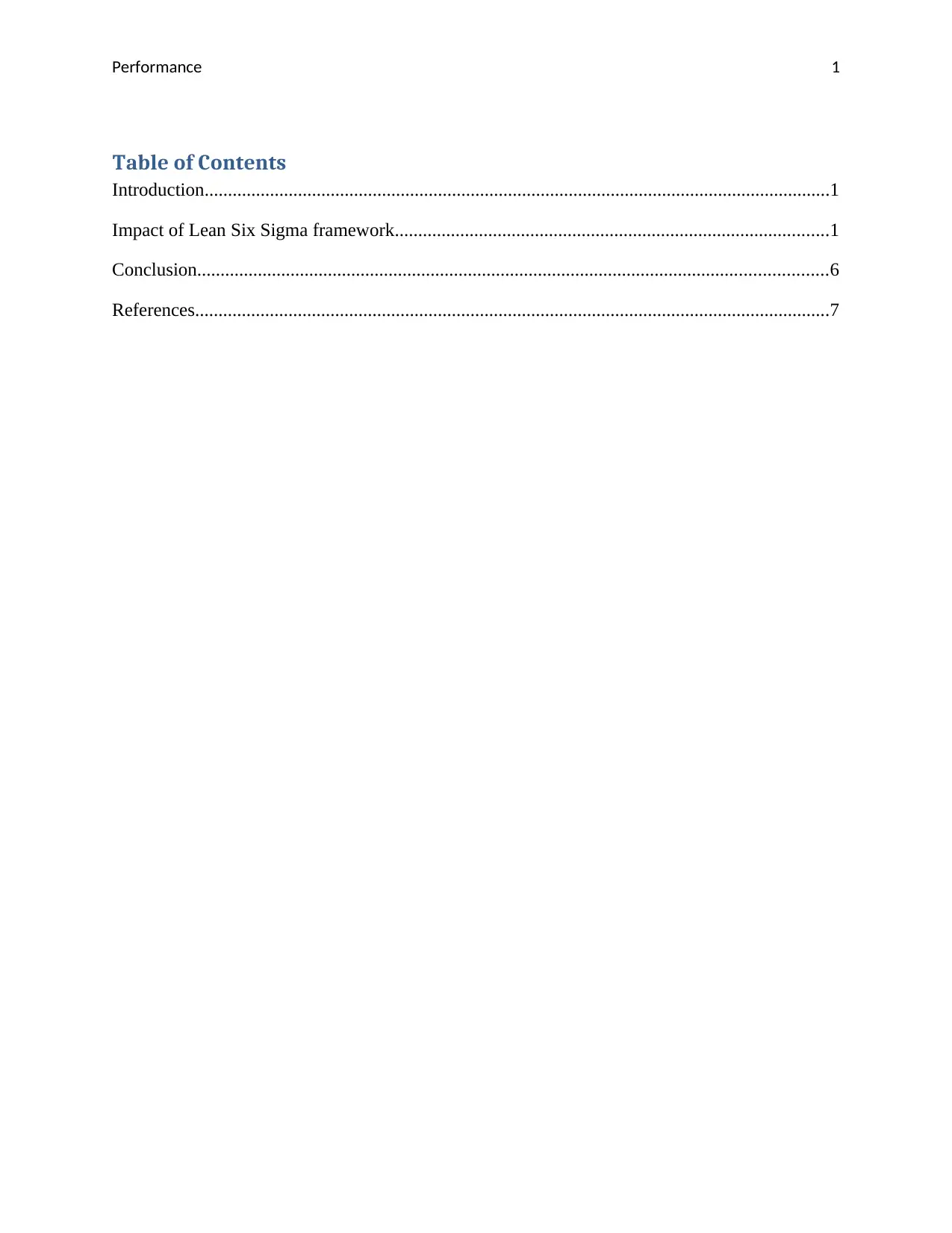
There are two concepts mix in this thing to improve the quality of products and services of an
organization. In addition, lean means minimizing waste, which creates value for customers.
Moreover, the six-sigma technique will reduce defects by effectively solving problems of that
particular product or service of an organization2.
Document Page
Performance 3
This whole concept will improve the quality of the products using six sigma processes. In
addition, the authors have provided deep knowledge about the LSS implementation in the aero
industry to reduce the waste of maintenance3.
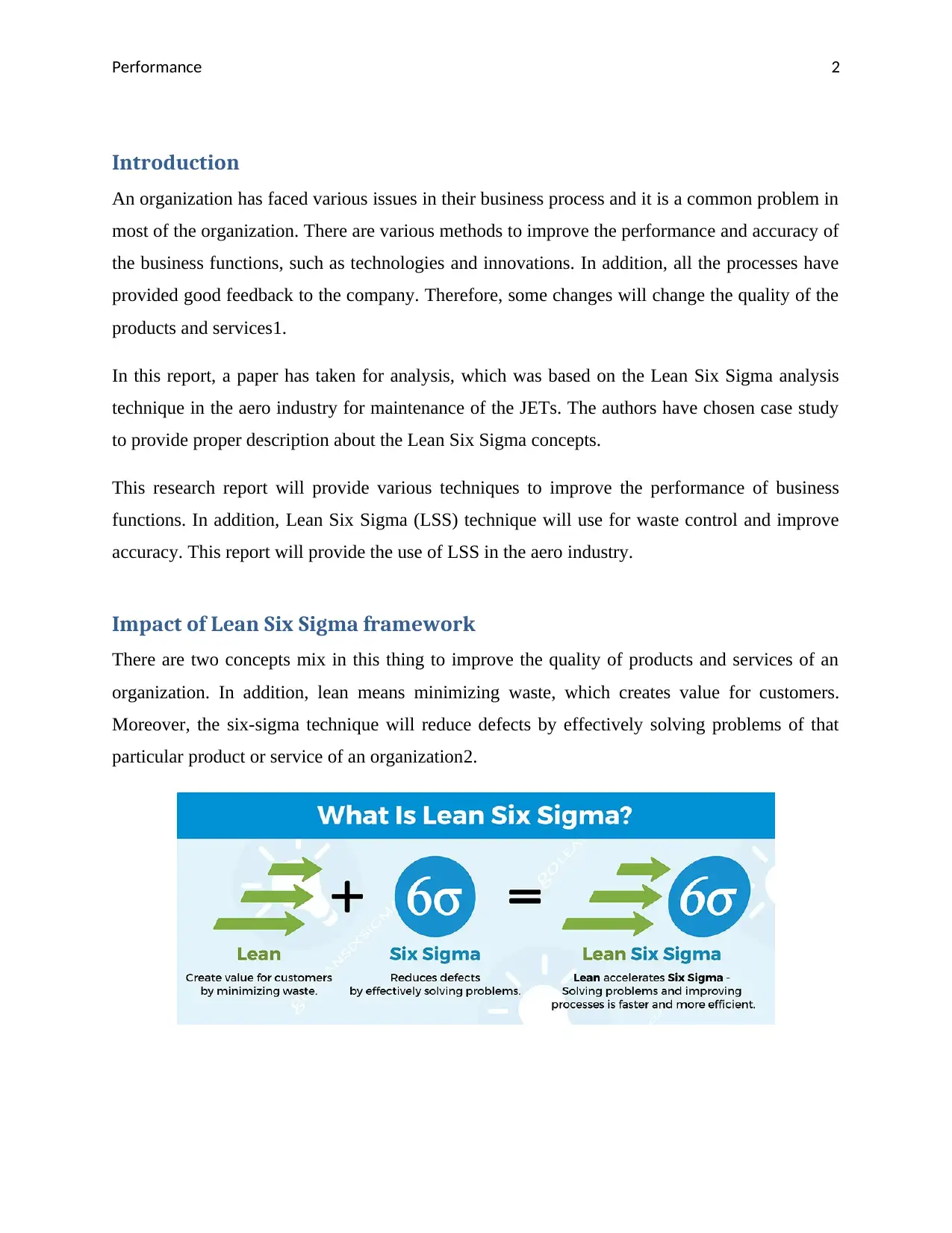
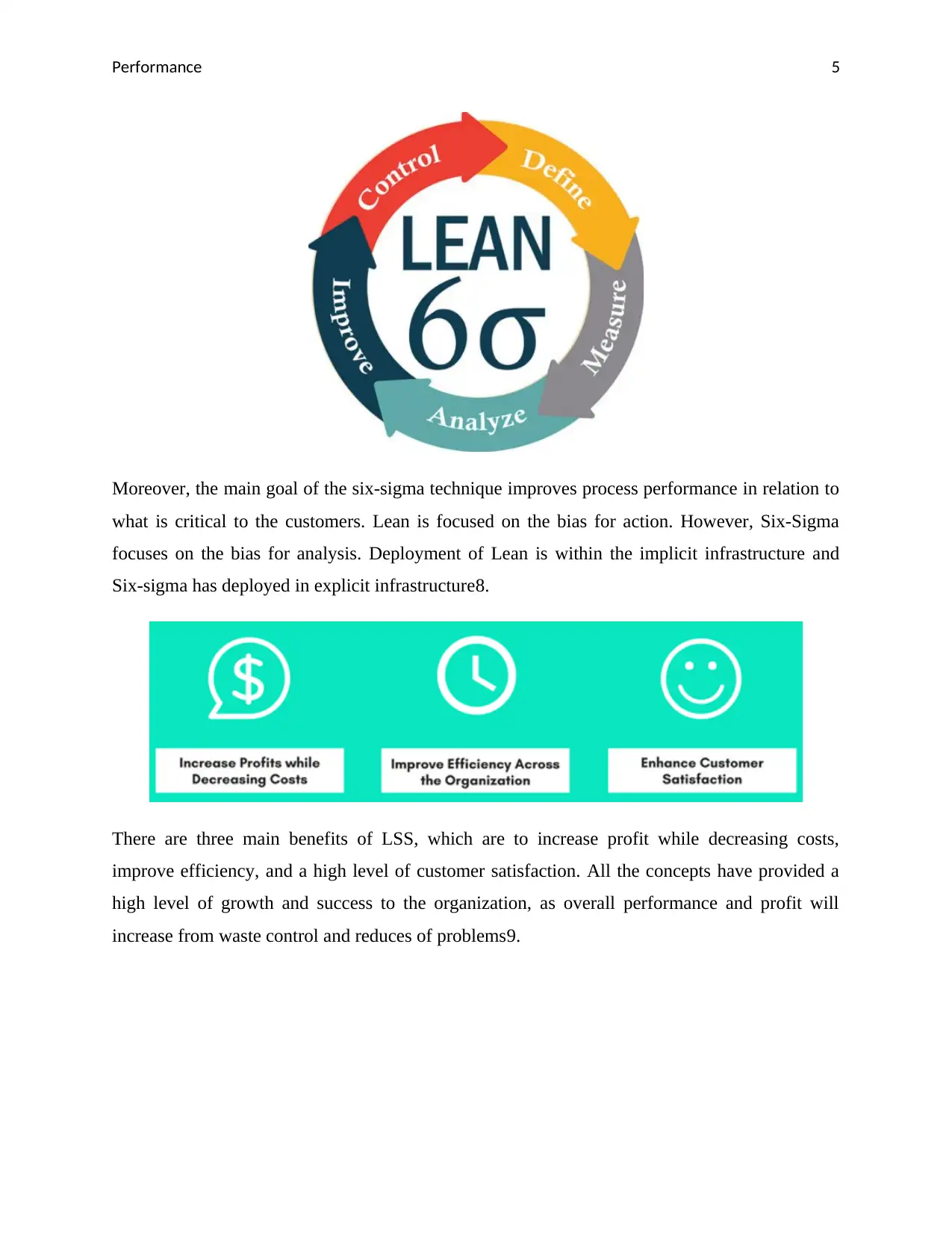
In addition, LSS has a cycle to complete the whole process. There are five parts of LSS, which
are defined, measure, analyze, improve, and control4.
Lean Six Sigma (LSS) is a technique to improve the performance of the company using waste
control and reduce various bad impacts from those processes. In addition, the first stage is
defined in which problems to be has defined, which have some issues in high performance. The
second step in the measure in which the problem can be quantified. After that identification of
different causes of the problems has done. In addition, after identification of causes of the
problem, the systems will implement and verify the solutions to those problems. Based on the
verification all those solutions have maintained to improve the performance5.
tabler-icon-diamond-filled.svg

Paraphrase This Document

Need a fresh take? Get an instant paraphrase of this document with our AI Paraphraser
Document Page
Performance 4
The main objective of the article is to control different process of Maintenance Repair and
Overhaul (MRO) facility using LSS implementation. The LSS technique has improved various
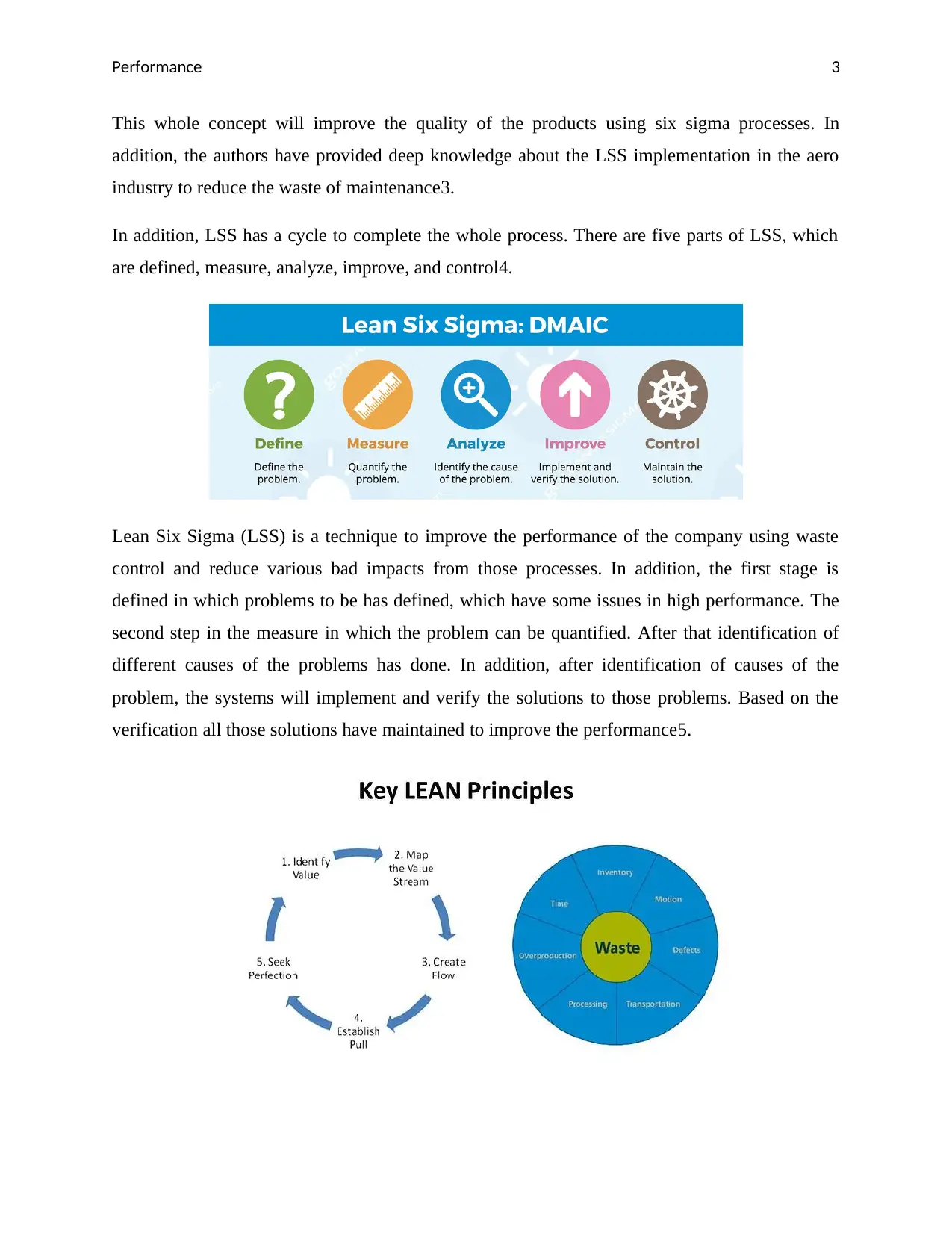
things, which are time, motions, inventory, processing, and many others. There are various
important things in the LSS, which can improve the business process using various solutions to
particular problems6.
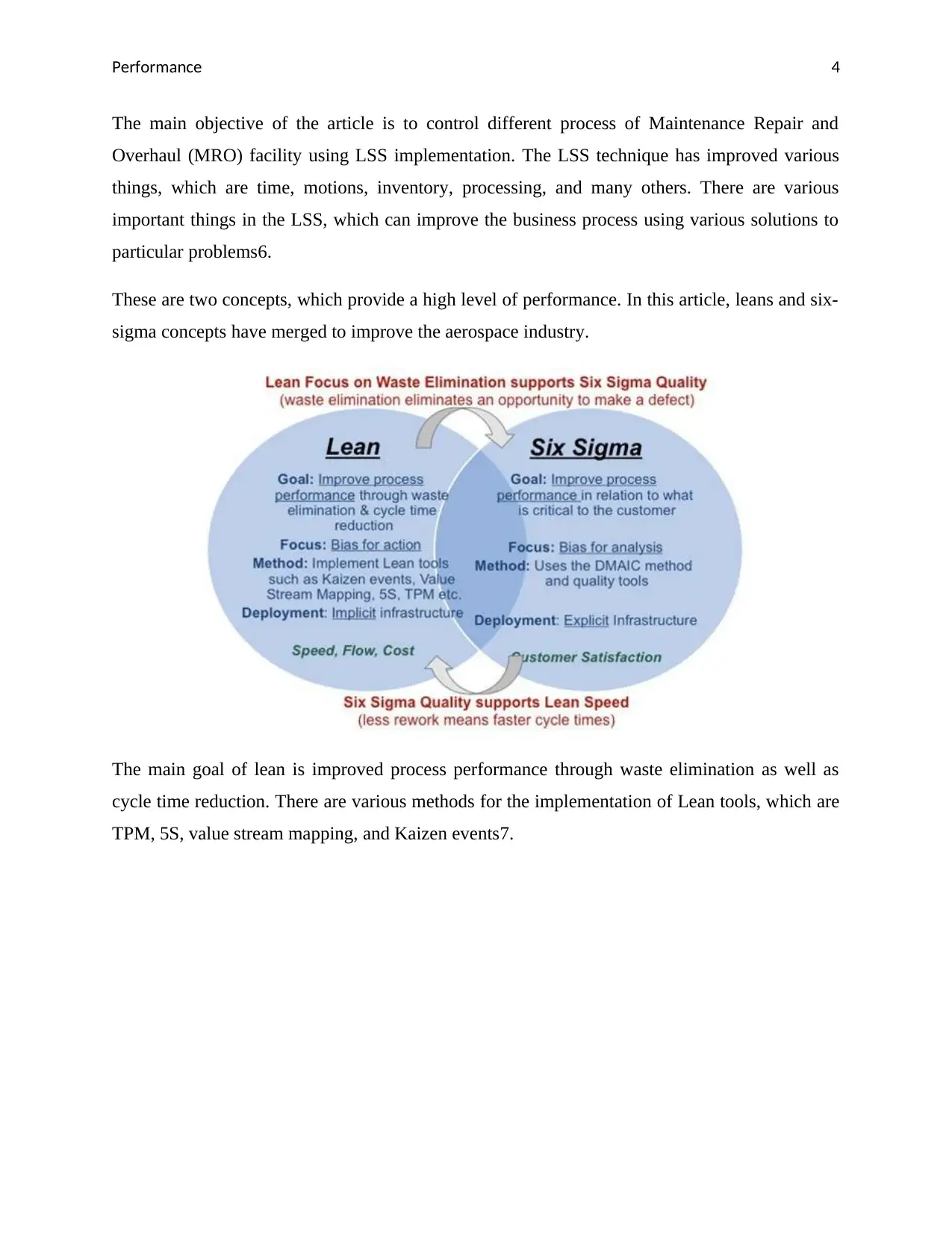
These are two concepts, which provide a high level of performance. In this article, leans and six-
sigma concepts have merged to improve the aerospace industry.
The main goal of lean is improved process performance through waste elimination as well as
cycle time reduction. There are various methods for the implementation of Lean tools, which are
TPM, 5S, value stream mapping, and Kaizen events7.
Document Page
Performance 5
Moreover, the main goal of the six-sigma technique improves process performance in relation to
what is critical to the customers. Lean is focused on the bias for action. However, Six-Sigma
focuses on the bias for analysis. Deployment of Lean is within the implicit infrastructure and
Six-sigma has deployed in explicit infrastructure8.
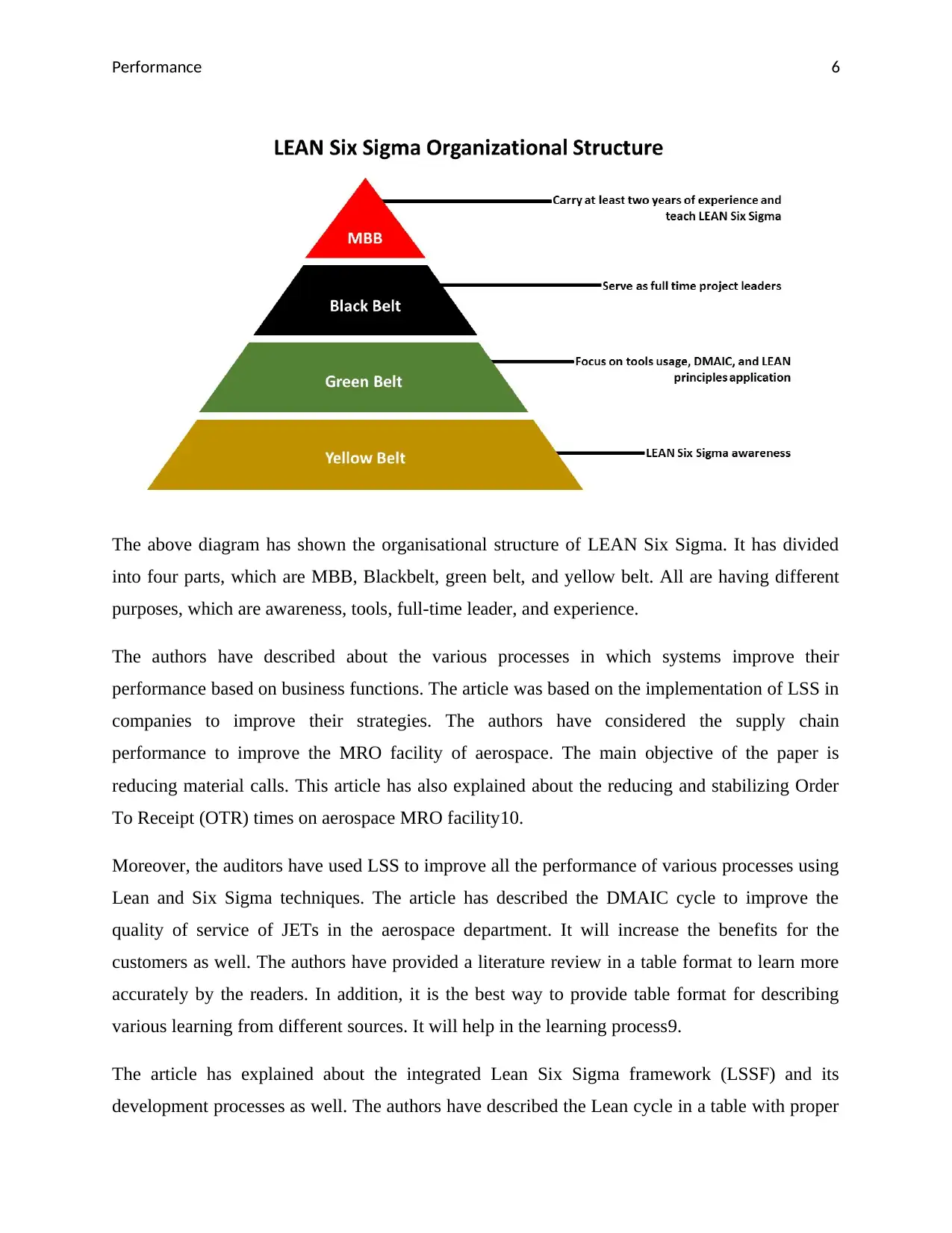
There are three main benefits of LSS, which are to increase profit while decreasing costs,
improve efficiency, and a high level of customer satisfaction. All the concepts have provided a
high level of growth and success to the organization, as overall performance and profit will
increase from waste control and reduces of problems9.
Document Page
Performance 6
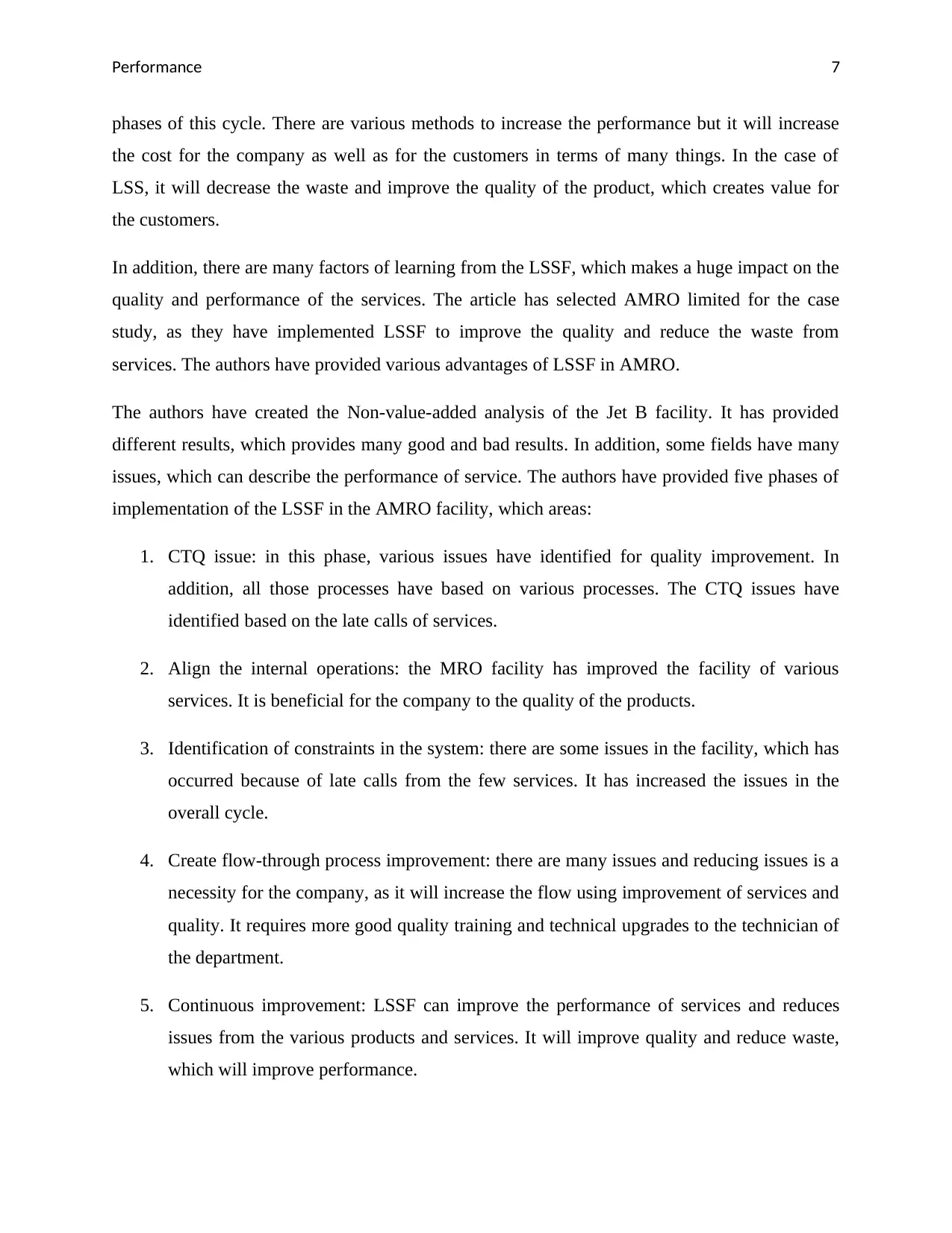
The above diagram has shown the organisational structure of LEAN Six Sigma. It has divided
into four parts, which are MBB, Blackbelt, green belt, and yellow belt. All are having different
purposes, which are awareness, tools, full-time leader, and experience.
The authors have described about the various processes in which systems improve their
performance based on business functions. The article was based on the implementation of LSS in
companies to improve their strategies. The authors have considered the supply chain
performance to improve the MRO facility of aerospace. The main objective of the paper is
reducing material calls. This article has also explained about the reducing and stabilizing Order
To Receipt (OTR) times on aerospace MRO facility10.
Moreover, the auditors have used LSS to improve all the performance of various processes using
Lean and Six Sigma techniques. The article has described the DMAIC cycle to improve the
quality of service of JETs in the aerospace department. It will increase the benefits for the
customers as well. The authors have provided a literature review in a table format to learn more
accurately by the readers. In addition, it is the best way to provide table format for describing
various learning from different sources. It will help in the learning process9.
The article has explained about the integrated Lean Six Sigma framework (LSSF) and its
development processes as well. The authors have described the Lean cycle in a table with proper
tabler-icon-diamond-filled.svg

Paraphrase This Document

Need a fresh take? Get an instant paraphrase of this document with our AI Paraphraser
Document Page
Performance 7
phases of this cycle. There are various methods to increase the performance but it will increase
the cost for the company as well as for the customers in terms of many things. In the case of
LSS, it will decrease the waste and improve the quality of the product, which creates value for
the customers.
In addition, there are many factors of learning from the LSSF, which makes a huge impact on the
quality and performance of the services. The article has selected AMRO limited for the case
study, as they have implemented LSSF to improve the quality and reduce the waste from
services. The authors have provided various advantages of LSSF in AMRO.
The authors have created the Non-value-added analysis of the Jet B facility. It has provided
different results, which provides many good and bad results. In addition, some fields have many
issues, which can describe the performance of service. The authors have provided five phases of
implementation of the LSSF in the AMRO facility, which areas:
1. CTQ issue: in this phase, various issues have identified for quality improvement. In
addition, all those processes have based on various processes. The CTQ issues have
identified based on the late calls of services.
2. Align the internal operations: the MRO facility has improved the facility of various
services. It is beneficial for the company to the quality of the products.
3. Identification of constraints in the system: there are some issues in the facility, which has
occurred because of late calls from the few services. It has increased the issues in the
overall cycle.
4. Create flow-through process improvement: there are many issues and reducing issues is a
necessity for the company, as it will increase the flow using improvement of services and
quality. It requires more good quality training and technical upgrades to the technician of
the department.
5. Continuous improvement: LSSF can improve the performance of services and reduces
issues from the various products and services. It will improve quality and reduce waste,
which will improve performance.
Document Page
Performance 8
The authors have provided results of all the actions using LSS, which reduces the waste and
increase the value for the customers. Waste management is the best way to reduce the cost and
improve the quality of the products. In addition, it will provide benefits to the customers as well
as company. All those things matter a lot for the company to manage the services of the business
processes. Moreover, the company can provide more quality improvement using proper changes
in the business processes using innovation and technologies.
Conclusion
In conclusion, there are various issues in the services, which reduces the quality of the products
and services. LSS has provides solutions to those issues and improve the quality and
performance of the products.
This report has provided details about the LSS and different phases of the LSSF implementation
process. It will increase the quality of services and provide various values to the customers. In
addition, it will manage all the things in a proper way.
Finally, this report has explained about the use of LSS in the improvement of quality and
performance. It will improve business growth and success in less time.
References
x
[1] Michael Cousins. (2017) What is Lean Six Sigma? Tools for Process Improvement.
[Online]. https://blog.triaster.co.uk/blog/what-is-lean-six-sigma-tools-for-process-
improvement
[2] Tara Duggan. (2018) How to Leverage Six Sigma With Lean Manufacturing to Accelerate
Business Performance. [Online]. https://smallbusiness.chron.com/leverage-six-sigma-lean-
manufacturing-accelerate-business-performance-721.html
Document Page
Performance 9
[3] E. V. Gijo, Johny Scaria, and Jiju Antony, "Application of Six Sigma methodology to
reduce defects of a grinding process," Quality and Reliability Engineering International,
vol. 27, no. 8, pp. 1221-1234, 2011.
[4] Jemma Hill, Andrew J. Thomas, R. K. Mason-Jones, and Sherien El-Kateb, "The
implementation of a Lean Six Sigma framework to enhance operational performance in an
MRO facility," Production & Manufacturing Research, vol. 6, no. 1, pp. 26-48, 2018.
[5] David Meza, "Measuring the efficiency of a lean six sigma program in a us government
agency using data envelopment analysis," 2012.
[6] David Meza and Ki-Young Jeong, "Measuring efficiency of lean six sigma project
implementation using data envelopment analysis at NASA," Journal of Industrial
Engineering and Management (JIEM), vol. 6, no. 2, pp. 401-422, 2013.
[7] PURDUE. (2019) Improve Your Supply Chain with Lean Six Sigma. [Online].
https://www.purdue.edu/leansixsigmaonline/blog/improve-supply-chain-with-lean-six-
sigma/
[8] Gerhard Plenert and Tom Cluley, Driving strategy to execution using lean six sigma: a
framework for creating high performance organizations, 1st ed.: CRC Press, 2012.
[9] Rania AM Shamah, "A model for applying lean thinking to value creation," International
Journal of Lean Six Sigma, vol. 4, no. 2, pp. 204-224, 2013.
[10] Sarah K. White. (2018) What is Six Sigma? Streamlining quality management. [Online].
https://www.cio.com/article/3237692/six-sigma-quality-management-methodology.html
[11] Mahendiran Prasanna and Sekar Vinodh, "Lean Six Sigma in SMEs: an exploration through
literature review," Journal of Engineering, Design and Technology, vol. 11, no. 3, pp. 224-
250, 2013.
x
tabler-icon-diamond-filled.svg

Paraphrase This Document

Need a fresh take? Get an instant paraphrase of this document with our AI Paraphraser
Document Page
Performance 10
chevron_up_icon
1 out of 11
circle_padding
hide_on_mobile
zoom_out_icon
[object Object]