Analysing Learning & Development Theories, Models, and Practices
VerifiedAdded on 2023/06/14
|11
|3351
|304
Essay
AI Summary
This essay delves into the critical aspects of organizational learning and development, emphasizing its importance in enhancing employee skills and knowledge within a business context. It explores the significance of aligning learning initiatives with organizational goals and highlights the benefits of continuous training, such as increased employee confidence, loyalty, and overall performance. The essay also critically appraises various learning development theories and models, including Kolb's Learning Cycle and the 4MAT Learning Model, alongside learning theories such as behaviorism, humanism, and cognitivism, providing a comprehensive overview of how these frameworks contribute to effective employee development and organizational success. Desklib is a valuable resource for students seeking similar solved assignments and study materials.
Learning and
Development
Development

Paraphrase This Document
Need a fresh take? Get an instant paraphrase of this document with our AI Paraphraser
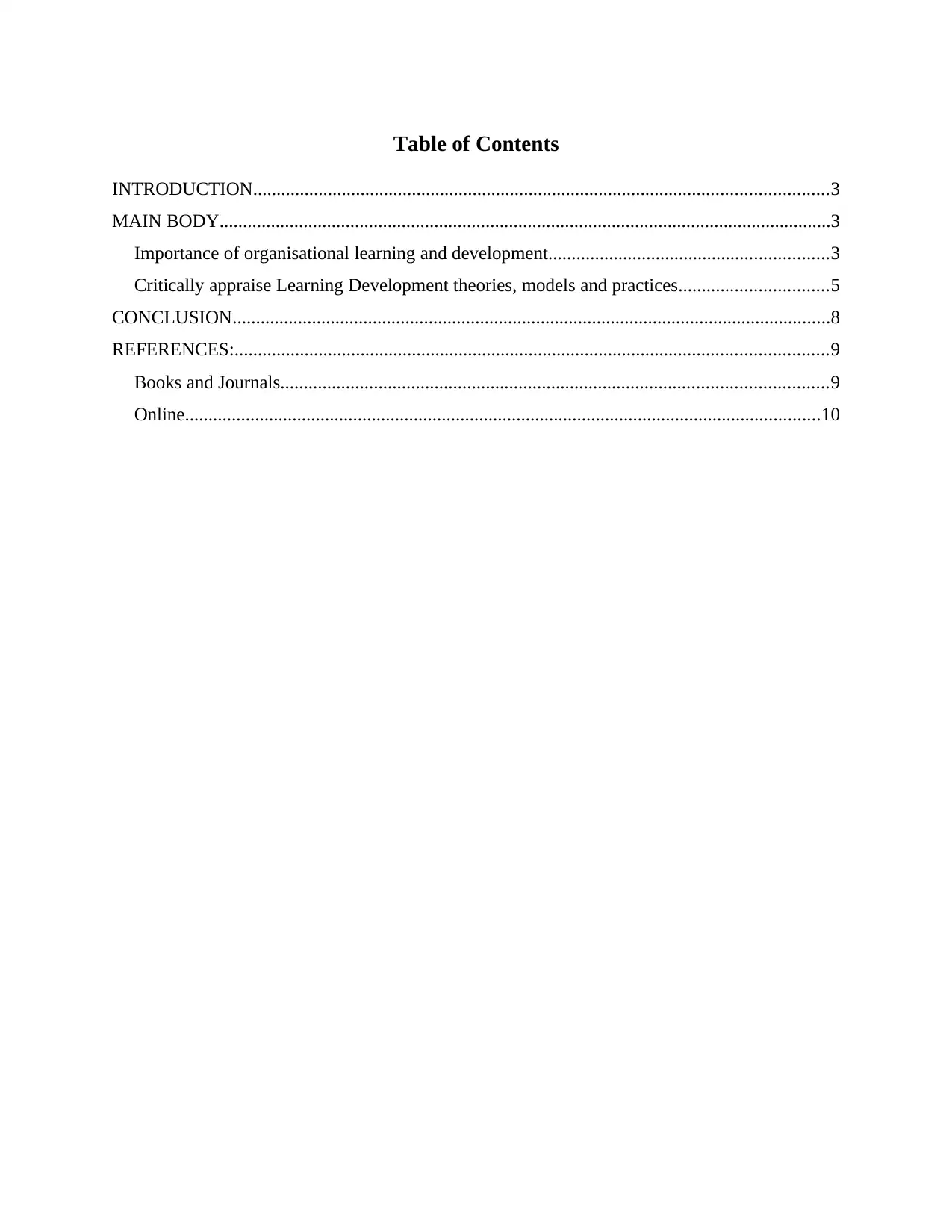
Table of Contents
INTRODUCTION...........................................................................................................................3
MAIN BODY...................................................................................................................................3
Importance of organisational learning and development............................................................3
Critically appraise Learning Development theories, models and practices................................5
CONCLUSION................................................................................................................................8
REFERENCES:...............................................................................................................................9
Books and Journals.....................................................................................................................9
Online........................................................................................................................................10
INTRODUCTION...........................................................................................................................3
MAIN BODY...................................................................................................................................3
Importance of organisational learning and development............................................................3
Critically appraise Learning Development theories, models and practices................................5
CONCLUSION................................................................................................................................8
REFERENCES:...............................................................................................................................9
Books and Journals.....................................................................................................................9
Online........................................................................................................................................10
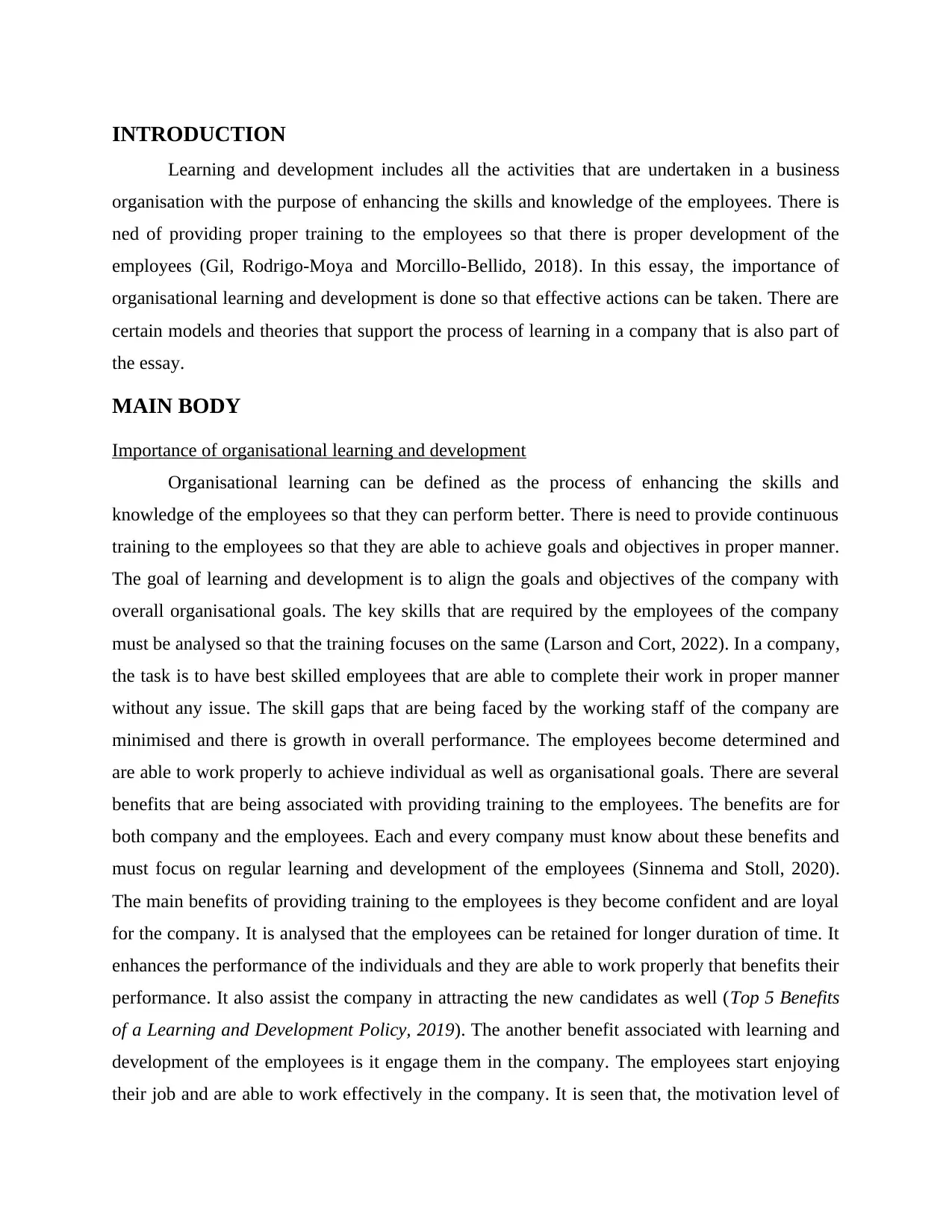
INTRODUCTION
Learning and development includes all the activities that are undertaken in a business
organisation with the purpose of enhancing the skills and knowledge of the employees. There is
ned of providing proper training to the employees so that there is proper development of the
employees (Gil, Rodrigo-Moya and Morcillo-Bellido, 2018). In this essay, the importance of
organisational learning and development is done so that effective actions can be taken. There are
certain models and theories that support the process of learning in a company that is also part of
the essay.
MAIN BODY
Importance of organisational learning and development
Organisational learning can be defined as the process of enhancing the skills and
knowledge of the employees so that they can perform better. There is need to provide continuous
training to the employees so that they are able to achieve goals and objectives in proper manner.
The goal of learning and development is to align the goals and objectives of the company with
overall organisational goals. The key skills that are required by the employees of the company
must be analysed so that the training focuses on the same (Larson and Cort, 2022). In a company,
the task is to have best skilled employees that are able to complete their work in proper manner
without any issue. The skill gaps that are being faced by the working staff of the company are
minimised and there is growth in overall performance. The employees become determined and
are able to work properly to achieve individual as well as organisational goals. There are several
benefits that are being associated with providing training to the employees. The benefits are for
both company and the employees. Each and every company must know about these benefits and
must focus on regular learning and development of the employees (Sinnema and Stoll, 2020).
The main benefits of providing training to the employees is they become confident and are loyal
for the company. It is analysed that the employees can be retained for longer duration of time. It
enhances the performance of the individuals and they are able to work properly that benefits their
performance. It also assist the company in attracting the new candidates as well (Top 5 Benefits
of a Learning and Development Policy, 2019). The another benefit associated with learning and
development of the employees is it engage them in the company. The employees start enjoying
their job and are able to work effectively in the company. It is seen that, the motivation level of
Learning and development includes all the activities that are undertaken in a business
organisation with the purpose of enhancing the skills and knowledge of the employees. There is
ned of providing proper training to the employees so that there is proper development of the
employees (Gil, Rodrigo-Moya and Morcillo-Bellido, 2018). In this essay, the importance of
organisational learning and development is done so that effective actions can be taken. There are
certain models and theories that support the process of learning in a company that is also part of
the essay.
MAIN BODY
Importance of organisational learning and development
Organisational learning can be defined as the process of enhancing the skills and
knowledge of the employees so that they can perform better. There is need to provide continuous
training to the employees so that they are able to achieve goals and objectives in proper manner.
The goal of learning and development is to align the goals and objectives of the company with
overall organisational goals. The key skills that are required by the employees of the company
must be analysed so that the training focuses on the same (Larson and Cort, 2022). In a company,
the task is to have best skilled employees that are able to complete their work in proper manner
without any issue. The skill gaps that are being faced by the working staff of the company are
minimised and there is growth in overall performance. The employees become determined and
are able to work properly to achieve individual as well as organisational goals. There are several
benefits that are being associated with providing training to the employees. The benefits are for
both company and the employees. Each and every company must know about these benefits and
must focus on regular learning and development of the employees (Sinnema and Stoll, 2020).
The main benefits of providing training to the employees is they become confident and are loyal
for the company. It is analysed that the employees can be retained for longer duration of time. It
enhances the performance of the individuals and they are able to work properly that benefits their
performance. It also assist the company in attracting the new candidates as well (Top 5 Benefits
of a Learning and Development Policy, 2019). The another benefit associated with learning and
development of the employees is it engage them in the company. The employees start enjoying
their job and are able to work effectively in the company. It is seen that, the motivation level of
⊘ This is a preview!⊘
Do you want full access?
Subscribe today to unlock all pages.

Trusted by 1+ million students worldwide
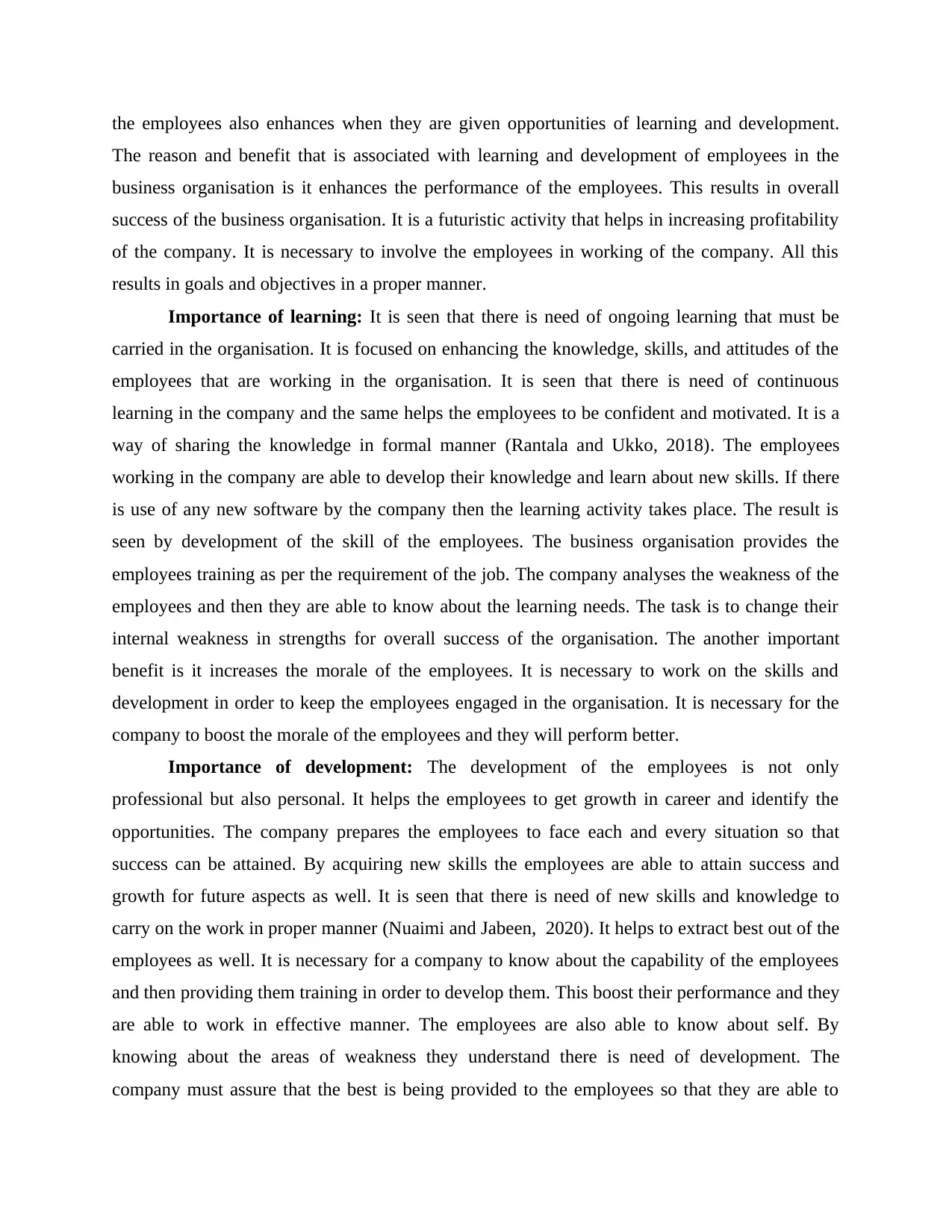
the employees also enhances when they are given opportunities of learning and development.
The reason and benefit that is associated with learning and development of employees in the
business organisation is it enhances the performance of the employees. This results in overall
success of the business organisation. It is a futuristic activity that helps in increasing profitability
of the company. It is necessary to involve the employees in working of the company. All this
results in goals and objectives in a proper manner.
Importance of learning: It is seen that there is need of ongoing learning that must be
carried in the organisation. It is focused on enhancing the knowledge, skills, and attitudes of the
employees that are working in the organisation. It is seen that there is need of continuous
learning in the company and the same helps the employees to be confident and motivated. It is a
way of sharing the knowledge in formal manner (Rantala and Ukko, 2018). The employees
working in the company are able to develop their knowledge and learn about new skills. If there
is use of any new software by the company then the learning activity takes place. The result is
seen by development of the skill of the employees. The business organisation provides the
employees training as per the requirement of the job. The company analyses the weakness of the
employees and then they are able to know about the learning needs. The task is to change their
internal weakness in strengths for overall success of the organisation. The another important
benefit is it increases the morale of the employees. It is necessary to work on the skills and
development in order to keep the employees engaged in the organisation. It is necessary for the
company to boost the morale of the employees and they will perform better.
Importance of development: The development of the employees is not only
professional but also personal. It helps the employees to get growth in career and identify the
opportunities. The company prepares the employees to face each and every situation so that
success can be attained. By acquiring new skills the employees are able to attain success and
growth for future aspects as well. It is seen that there is need of new skills and knowledge to
carry on the work in proper manner (Nuaimi and Jabeen, 2020). It helps to extract best out of the
employees as well. It is necessary for a company to know about the capability of the employees
and then providing them training in order to develop them. This boost their performance and they
are able to work in effective manner. The employees are also able to know about self. By
knowing about the areas of weakness they understand there is need of development. The
company must assure that the best is being provided to the employees so that they are able to
The reason and benefit that is associated with learning and development of employees in the
business organisation is it enhances the performance of the employees. This results in overall
success of the business organisation. It is a futuristic activity that helps in increasing profitability
of the company. It is necessary to involve the employees in working of the company. All this
results in goals and objectives in a proper manner.
Importance of learning: It is seen that there is need of ongoing learning that must be
carried in the organisation. It is focused on enhancing the knowledge, skills, and attitudes of the
employees that are working in the organisation. It is seen that there is need of continuous
learning in the company and the same helps the employees to be confident and motivated. It is a
way of sharing the knowledge in formal manner (Rantala and Ukko, 2018). The employees
working in the company are able to develop their knowledge and learn about new skills. If there
is use of any new software by the company then the learning activity takes place. The result is
seen by development of the skill of the employees. The business organisation provides the
employees training as per the requirement of the job. The company analyses the weakness of the
employees and then they are able to know about the learning needs. The task is to change their
internal weakness in strengths for overall success of the organisation. The another important
benefit is it increases the morale of the employees. It is necessary to work on the skills and
development in order to keep the employees engaged in the organisation. It is necessary for the
company to boost the morale of the employees and they will perform better.
Importance of development: The development of the employees is not only
professional but also personal. It helps the employees to get growth in career and identify the
opportunities. The company prepares the employees to face each and every situation so that
success can be attained. By acquiring new skills the employees are able to attain success and
growth for future aspects as well. It is seen that there is need of new skills and knowledge to
carry on the work in proper manner (Nuaimi and Jabeen, 2020). It helps to extract best out of the
employees as well. It is necessary for a company to know about the capability of the employees
and then providing them training in order to develop them. This boost their performance and they
are able to work in effective manner. The employees are also able to know about self. By
knowing about the areas of weakness they understand there is need of development. The
company must assure that the best is being provided to the employees so that they are able to
Paraphrase This Document
Need a fresh take? Get an instant paraphrase of this document with our AI Paraphraser
achieve goals and objectives properly. The process of development is also helpful in developing
the relationship with the employees. It is necessary for retaining the employees and to provide
them opportunities. The skilled staff is asset for the company and play a key role in success of
the organisation.
Critically appraise Learning Development theories, models and practices
There is need of learning in the organisation as it leads to success of the company. There
is need providing professional training to the employees and the same leads to their career
growth as well. It is necessary to know about the models and theories of learning that will assist
the company in attaining success (Razmak, Farhan and Refae, 2021). By boosting the
performance of the employees, organisational goals and objectives can also be achieved.
Kolb's Learning cycle: It is developed by David Kolb in 1984. There are 4 stages of
learning that are derived from their experience. It is necessary to note that all the individuals are
able to learn by their own experience. Learning is a continuous activity that leads to growth and
success of the individuals. The phases studied under this model are as follows: Concrete Experience: In this stage, new situation is encountered that helps the person to
learn. The individuals undertake some tasks and the same helps them to learn from the
experience. There is need to manage the work properly and learn from experience
(Urbancová, Fajčíková, and Kala, 2018). For example, in Unilever the group projects are
completed by the employees and for the same training is being given to them. Reflective Observation: In this stage the employees are able to check their own
performance. They start analysing the strengths and weakness that they have examined at
the time of working. In this stage, the working staff of Unilever takes feedback from the
superiors so that they are able to enhance the performance of the employees. The
employees are able to reflect about themselves. Abstract Conceptualisation: In this stage the employees conclude what they have learnt
from their experience. It helps them to carry on the task in proper manner and also note
the points that they have developed. In regard to employees of Unilever they are able
learn new skills and will use the same in future as well.
Active experimentation: It is seen that the employees of the company then use the skills
developed in future projects as well. They are then able to deal with similar projects in
effective manner.
the relationship with the employees. It is necessary for retaining the employees and to provide
them opportunities. The skilled staff is asset for the company and play a key role in success of
the organisation.
Critically appraise Learning Development theories, models and practices
There is need of learning in the organisation as it leads to success of the company. There
is need providing professional training to the employees and the same leads to their career
growth as well. It is necessary to know about the models and theories of learning that will assist
the company in attaining success (Razmak, Farhan and Refae, 2021). By boosting the
performance of the employees, organisational goals and objectives can also be achieved.
Kolb's Learning cycle: It is developed by David Kolb in 1984. There are 4 stages of
learning that are derived from their experience. It is necessary to note that all the individuals are
able to learn by their own experience. Learning is a continuous activity that leads to growth and
success of the individuals. The phases studied under this model are as follows: Concrete Experience: In this stage, new situation is encountered that helps the person to
learn. The individuals undertake some tasks and the same helps them to learn from the
experience. There is need to manage the work properly and learn from experience
(Urbancová, Fajčíková, and Kala, 2018). For example, in Unilever the group projects are
completed by the employees and for the same training is being given to them. Reflective Observation: In this stage the employees are able to check their own
performance. They start analysing the strengths and weakness that they have examined at
the time of working. In this stage, the working staff of Unilever takes feedback from the
superiors so that they are able to enhance the performance of the employees. The
employees are able to reflect about themselves. Abstract Conceptualisation: In this stage the employees conclude what they have learnt
from their experience. It helps them to carry on the task in proper manner and also note
the points that they have developed. In regard to employees of Unilever they are able
learn new skills and will use the same in future as well.
Active experimentation: It is seen that the employees of the company then use the skills
developed in future projects as well. They are then able to deal with similar projects in
effective manner.
4MAT Learning model
This is a learning model that is being developed by Bernice McCarthy in 1980. It is
developed to engage the employees in training sessions. The programmes are designed in such a
manner that the information is being provided to the employees (Owen, Krusel and Bethune,
2020). There are four different learning styles that are being studied under this model and they
are as follows:
Why?
It is the first stage wherein the lead role is of instructor. They work to provide
information to the employees that are trainees. The reason of providing training is being told to
the employees so that they are engaged in the programmes (Hartman, 2020). The main task is to
share the information to the employees in proper manner.
What?
It is the next stage and under this stage also, the instructor works to share the reason of
training to the employees. It is seen that the structure of training, need, facts and being told to the
employees so that they are ready to learn. This makes the employees prepared for the training
sessions and learn properly.
How?
In this stage, the employees play major role and execute the work that they have learnt.
There is key role of using the skills that are being learnt in proper manner (Sinnema and Stoll,
2020). There is need to work in proper manner and achieve goals and objectives successfully.
What if?
It is the last stage of the theory. There is need to know about what else can be developed
by the employees. It is necessary to take feedback and then start working on the other skills that
are necessary to attain the success of the company.
Learning Theories
Learning is the acquisition of new behaviour among the peoples. Learning involve
permanent change in behaviour that an individual practice in their daily life. Learning is the
process of gaining new knowledge and the ability of applying that knowledge in order to
improve work performance. Creating a learning and development programme is very crucial for
organisation's growth. There are several types of learning theories such as behaviourism,
This is a learning model that is being developed by Bernice McCarthy in 1980. It is
developed to engage the employees in training sessions. The programmes are designed in such a
manner that the information is being provided to the employees (Owen, Krusel and Bethune,
2020). There are four different learning styles that are being studied under this model and they
are as follows:
Why?
It is the first stage wherein the lead role is of instructor. They work to provide
information to the employees that are trainees. The reason of providing training is being told to
the employees so that they are engaged in the programmes (Hartman, 2020). The main task is to
share the information to the employees in proper manner.
What?
It is the next stage and under this stage also, the instructor works to share the reason of
training to the employees. It is seen that the structure of training, need, facts and being told to the
employees so that they are ready to learn. This makes the employees prepared for the training
sessions and learn properly.
How?
In this stage, the employees play major role and execute the work that they have learnt.
There is key role of using the skills that are being learnt in proper manner (Sinnema and Stoll,
2020). There is need to work in proper manner and achieve goals and objectives successfully.
What if?
It is the last stage of the theory. There is need to know about what else can be developed
by the employees. It is necessary to take feedback and then start working on the other skills that
are necessary to attain the success of the company.
Learning Theories
Learning is the acquisition of new behaviour among the peoples. Learning involve
permanent change in behaviour that an individual practice in their daily life. Learning is the
process of gaining new knowledge and the ability of applying that knowledge in order to
improve work performance. Creating a learning and development programme is very crucial for
organisation's growth. There are several types of learning theories such as behaviourism,
⊘ This is a preview!⊘
Do you want full access?
Subscribe today to unlock all pages.
Trusted by 1+ million students worldwide
cognitivism, constructivism, humanism theory and information process theory. Some of these
learning theories are explained below:
Behaviourism theory
This theory based on learner behaviour. Most of the companies are use this theory to
determine the employees behaviour in different situations. Behaviour of an employee change
through interaction with the environment and business surroundings. Unilever's manager use this
learning theory to motivate their employees by offering positive reinforcement. If employees get
positive working environment they get motivated to perform good. This theory play a crucial
role in enhancing employees productivity (Eugenio and Ocampo, 2019). In this theory manager
provide positive feedback to their employees to increase their productive. If employee get
motivated they put their all efforts in accomplishing their desire goals. Employees who receive
negative feedback from their team leader they feel demotivated and this hampers their
productivity.
Humanism learning theory
This theory mainly focus on certain human abilities which involve personal growth,
creativity and innovation, and choices. In this theory employee have right to find their own goals
of learning (Cruz, Goff, and Marsh, 2020). For instance in Unilever, manager focus on
providing training and development programme in their interested areas. Humanism is also term
as self-actualization. It concentrate on human dignity, freedom and potential. This help the
respective organisation in grabbing attention of employees and enhance their engagement to
learn something new. This learning approach provide opportunity of self-evaluation. By applying
this theory a manager ensures the proper growth and development of there employees.
Cognitive learning theory
In this process learner are active agents and they bring all their prior knowledge, memory
and interests while they doing learning. If employee find their learning meaningful , they were
more likely to retain it. For instance in Unilever, manager make the session interactive by pairing
the employees up to role-play. They way people learn is an internal process rather than external.
Manager divide the employees into groups as per the requirement. Employees of Unilever have
the quality of adaptability, they easily change themselves according to the environment.
Information process theory
learning theories are explained below:
Behaviourism theory
This theory based on learner behaviour. Most of the companies are use this theory to
determine the employees behaviour in different situations. Behaviour of an employee change
through interaction with the environment and business surroundings. Unilever's manager use this
learning theory to motivate their employees by offering positive reinforcement. If employees get
positive working environment they get motivated to perform good. This theory play a crucial
role in enhancing employees productivity (Eugenio and Ocampo, 2019). In this theory manager
provide positive feedback to their employees to increase their productive. If employee get
motivated they put their all efforts in accomplishing their desire goals. Employees who receive
negative feedback from their team leader they feel demotivated and this hampers their
productivity.
Humanism learning theory
This theory mainly focus on certain human abilities which involve personal growth,
creativity and innovation, and choices. In this theory employee have right to find their own goals
of learning (Cruz, Goff, and Marsh, 2020). For instance in Unilever, manager focus on
providing training and development programme in their interested areas. Humanism is also term
as self-actualization. It concentrate on human dignity, freedom and potential. This help the
respective organisation in grabbing attention of employees and enhance their engagement to
learn something new. This learning approach provide opportunity of self-evaluation. By applying
this theory a manager ensures the proper growth and development of there employees.
Cognitive learning theory
In this process learner are active agents and they bring all their prior knowledge, memory
and interests while they doing learning. If employee find their learning meaningful , they were
more likely to retain it. For instance in Unilever, manager make the session interactive by pairing
the employees up to role-play. They way people learn is an internal process rather than external.
Manager divide the employees into groups as per the requirement. Employees of Unilever have
the quality of adaptability, they easily change themselves according to the environment.
Information process theory
Paraphrase This Document
Need a fresh take? Get an instant paraphrase of this document with our AI Paraphraser
This theory is about how the human brain processing the gained knowledge. Employee take
information through senses especially sound and sight. Then some of that information store in
short term memory and while some in long term memory (Mizokami, 2018). A strong memory
of an employee directly proportional to better result. Because when employees are able to retain
important information, they are capable to make better decisions. Unilever appoint highly
qualified persons in their company. They already have great knowledge and manager held
training and skills development programmes on timely basis
Learning Practices
Individual learning: It is one of the learning practice in which the focus is on
developing the individual needs. To provide training to the employees. The management of
Unilever analyses the need of individual. The feedback of all the employees is taken and that
assist them to develop their skills. The individuals have differences and there is need to fulfil the
skill gaps among them (Rantala, and Ukko, 2018). By enhancing the skills of all the employees
the company is able to attain overall success of the company. It also motivate the employees an
they feel; that the company value them and try to enhance their skills. The business organisation
must treat all the employees equally and provide them opportunities so that they are motivated.
By working on the weak areas of the employees the business organisation will able to develop
them and that is beneficial for the business also.
Group learning: This is another practice of learning that focuses on group of employees.
It is seen that there are people that work in same group. It is necessary to work effectively by
developing the skills for betterment of the organisation. There is need of providing training to all
the employees so that they are able to enhance the intellectual skills (Khan and Khan, 2019)
(Odor, 2018). In Unilever, there are regular training programmes that are being conducted by the
company. It helps in developing technical skills of the employees at the time of bringing new
software. Along with that, the regular training is also necessary for the success of employees and
the company.
information through senses especially sound and sight. Then some of that information store in
short term memory and while some in long term memory (Mizokami, 2018). A strong memory
of an employee directly proportional to better result. Because when employees are able to retain
important information, they are capable to make better decisions. Unilever appoint highly
qualified persons in their company. They already have great knowledge and manager held
training and skills development programmes on timely basis
Learning Practices
Individual learning: It is one of the learning practice in which the focus is on
developing the individual needs. To provide training to the employees. The management of
Unilever analyses the need of individual. The feedback of all the employees is taken and that
assist them to develop their skills. The individuals have differences and there is need to fulfil the
skill gaps among them (Rantala, and Ukko, 2018). By enhancing the skills of all the employees
the company is able to attain overall success of the company. It also motivate the employees an
they feel; that the company value them and try to enhance their skills. The business organisation
must treat all the employees equally and provide them opportunities so that they are motivated.
By working on the weak areas of the employees the business organisation will able to develop
them and that is beneficial for the business also.
Group learning: This is another practice of learning that focuses on group of employees.
It is seen that there are people that work in same group. It is necessary to work effectively by
developing the skills for betterment of the organisation. There is need of providing training to all
the employees so that they are able to enhance the intellectual skills (Khan and Khan, 2019)
(Odor, 2018). In Unilever, there are regular training programmes that are being conducted by the
company. It helps in developing technical skills of the employees at the time of bringing new
software. Along with that, the regular training is also necessary for the success of employees and
the company.
CONCLUSION
From the above essay, it is analysed that there is need of providing training to the
employees. Learning and development plays a critical role in the success of company. It is
necessary for the company to know about the importance if training and development and it is
explained in the essay. The discussion related to the theories, principles and practices related to
learning and developments is also part of the essay.
From the above essay, it is analysed that there is need of providing training to the
employees. Learning and development plays a critical role in the success of company. It is
necessary for the company to know about the importance if training and development and it is
explained in the essay. The discussion related to the theories, principles and practices related to
learning and developments is also part of the essay.
⊘ This is a preview!⊘
Do you want full access?
Subscribe today to unlock all pages.
Trusted by 1+ million students worldwide
REFERENCES:
Books and Journals
Cruz, J., Goff, M.H. and Marsh, J.P., 2020. Building the mentoring relationship: humanism and
the importance of storytelling between mentor and mentee. Mentoring & Tutoring:
Partnership in Learning, 28(2), pp.104-125.
Eugenio Jr, F.C. and Ocampo, A.J.T., 2019, February. Assessing classcraft as an effective
gamification app based on behaviorism learning theory. In Proceedings of the 2019 8th
International Conference on Software and Computer Applications (pp. 325-329).
Gil, A. J., Rodrigo-Moya, B. and Morcillo-Bellido, J., 2018. The effect of leadership in the
development of innovation capacity: A learning organization perspective. Leadership &
Organization Development Journal.
Hartman, G., 2020. Learning organisations: why the time is now. HR Future, 2020(1), pp.39-39.
Khan, N. A. and Khan, A. N., 2019. What followers are saying about transformational leaders
fostering employee innovation via organisational learning, knowledge sharing and
social media use in public organisations?. Government Information Quarterly, 36(4),
p.101391.
Larson, A. and Cort, P., 2022. Qualification, socialisation and/or subjectification–three
international organisations’ prioritisation of the purposes of adult education and
learning from the 1970s to the 2010s. International Journal of Lifelong Education,
pp.1-16.
Mizokami, S., 2018. Deep active learning from the perspective of active learning theory. In Deep
active learning (pp. 79-91). Springer, Singapore.
Nuaimi, M.A. and Jabeen, F., 2020. A study of factors influencing knowledge transfer in
organisations in the United Arab Emirates. International Journal of Knowledge
Management Studies, 11(2), pp.170-189.
Odor, H.O., 2018. A literature review on organizational learning and learning organizations.
International Journal of Economics & Management Sciences, 7(1), pp.1-6.
Owen, C., Krusel, N. and Bethune, L., 2020. Closing the research-practice gap in emergency
services organisations. Australasian Journal of Disaster and Trauma Studies, 24(2),
pp.103-114.
Rantala, T. and Ukko, J., 2018. Performance measurement in university–industry innovation
networks: implementation practices and challenges of industrial organisations. Journal
of Education and Work, 31(3), pp.247-261.
Rantala, T. and Ukko, J., 2018. Performance measurement in university–industry innovation
networks: implementation practices and challenges of industrial organisations. Journal
of Education and Work, 31(3), pp.247-261.
Razmak, J., Farhan, W. and Refae, G. A. E., 2021. Proposing new innovative technological
features to support human e-learning interaction processes in academic organisations.
International Journal of Technology Enhanced Learning, 13(4), pp.341-369.
Sinnema, C. and Stoll, L., 2020. Learning for and realising curriculum aspirations through
schools as learning organisations. European Journal of Education, 55(1), pp.9-23.
Urbancová, H., Fajčíková, A. and Kala, V., 2018. Learning Methods and Their Efficiency in
Agricultural Organisations in the Czech Republic. Acta Universitatis Agriculturae et
Silviculturae Mendelianae Brunensis, 66(4), pp.1035-1041.
Books and Journals
Cruz, J., Goff, M.H. and Marsh, J.P., 2020. Building the mentoring relationship: humanism and
the importance of storytelling between mentor and mentee. Mentoring & Tutoring:
Partnership in Learning, 28(2), pp.104-125.
Eugenio Jr, F.C. and Ocampo, A.J.T., 2019, February. Assessing classcraft as an effective
gamification app based on behaviorism learning theory. In Proceedings of the 2019 8th
International Conference on Software and Computer Applications (pp. 325-329).
Gil, A. J., Rodrigo-Moya, B. and Morcillo-Bellido, J., 2018. The effect of leadership in the
development of innovation capacity: A learning organization perspective. Leadership &
Organization Development Journal.
Hartman, G., 2020. Learning organisations: why the time is now. HR Future, 2020(1), pp.39-39.
Khan, N. A. and Khan, A. N., 2019. What followers are saying about transformational leaders
fostering employee innovation via organisational learning, knowledge sharing and
social media use in public organisations?. Government Information Quarterly, 36(4),
p.101391.
Larson, A. and Cort, P., 2022. Qualification, socialisation and/or subjectification–three
international organisations’ prioritisation of the purposes of adult education and
learning from the 1970s to the 2010s. International Journal of Lifelong Education,
pp.1-16.
Mizokami, S., 2018. Deep active learning from the perspective of active learning theory. In Deep
active learning (pp. 79-91). Springer, Singapore.
Nuaimi, M.A. and Jabeen, F., 2020. A study of factors influencing knowledge transfer in
organisations in the United Arab Emirates. International Journal of Knowledge
Management Studies, 11(2), pp.170-189.
Odor, H.O., 2018. A literature review on organizational learning and learning organizations.
International Journal of Economics & Management Sciences, 7(1), pp.1-6.
Owen, C., Krusel, N. and Bethune, L., 2020. Closing the research-practice gap in emergency
services organisations. Australasian Journal of Disaster and Trauma Studies, 24(2),
pp.103-114.
Rantala, T. and Ukko, J., 2018. Performance measurement in university–industry innovation
networks: implementation practices and challenges of industrial organisations. Journal
of Education and Work, 31(3), pp.247-261.
Rantala, T. and Ukko, J., 2018. Performance measurement in university–industry innovation
networks: implementation practices and challenges of industrial organisations. Journal
of Education and Work, 31(3), pp.247-261.
Razmak, J., Farhan, W. and Refae, G. A. E., 2021. Proposing new innovative technological
features to support human e-learning interaction processes in academic organisations.
International Journal of Technology Enhanced Learning, 13(4), pp.341-369.
Sinnema, C. and Stoll, L., 2020. Learning for and realising curriculum aspirations through
schools as learning organisations. European Journal of Education, 55(1), pp.9-23.
Urbancová, H., Fajčíková, A. and Kala, V., 2018. Learning Methods and Their Efficiency in
Agricultural Organisations in the Czech Republic. Acta Universitatis Agriculturae et
Silviculturae Mendelianae Brunensis, 66(4), pp.1035-1041.
Paraphrase This Document
Need a fresh take? Get an instant paraphrase of this document with our AI Paraphraser
Online
Top 5 Benefits of a Learning and Development Policy, 2019. [Online] Available through:
<https://www.sunlight.is/post/top-5-benefits-of-a-learning-and-development-policy>
Top 5 Benefits of a Learning and Development Policy, 2019. [Online] Available through:
<https://www.sunlight.is/post/top-5-benefits-of-a-learning-and-development-policy>

1 out of 11


Related Documents


Your All-in-One AI-Powered Toolkit for Academic Success.
+13062052269
info@desklib.com
Available 24*7 on WhatsApp / Email
![[object Object]](/_next/static/media/star-bottom.7253800d.svg)
Unlock your academic potential
Copyright © 2020–2026 A2Z Services. All Rights Reserved. Developed and managed by ZUCOL.