Reflection on Learning: Skills for Effective Business Management

Verified

Added on  2021/11/19

|5
|1175
|107
Report
AI Summary
This report is a reflection on learning, focusing on the development of essential management skills. The student utilizes the Gibbs reflective model to analyze their experiences and progress throughout a management module. The report details the skills learned, including communication, problem-solving, and teamwork, and how these skills were applied and developed. The student reflects on their initial challenges, feelings of frustration, and eventual satisfaction with their progress. The evaluation section highlights the relevance of the module topics and areas for improvement, while the analysis explores the student's strategies for enhancing their skills, such as increased concentration and collaborative activities. The conclusion emphasizes the importance of effective communication and critical thinking in management, including the application of the Belbin team roles model. Finally, the report outlines an action plan for continued skill development, aiming for personal and professional growth, and concludes with a summary of the skills required for effective business management and how the Toyota case study exemplifies these principles, emphasizing the importance of strategic planning and corporate social responsibility.
Document Page
REFLECTION ON LEARNING
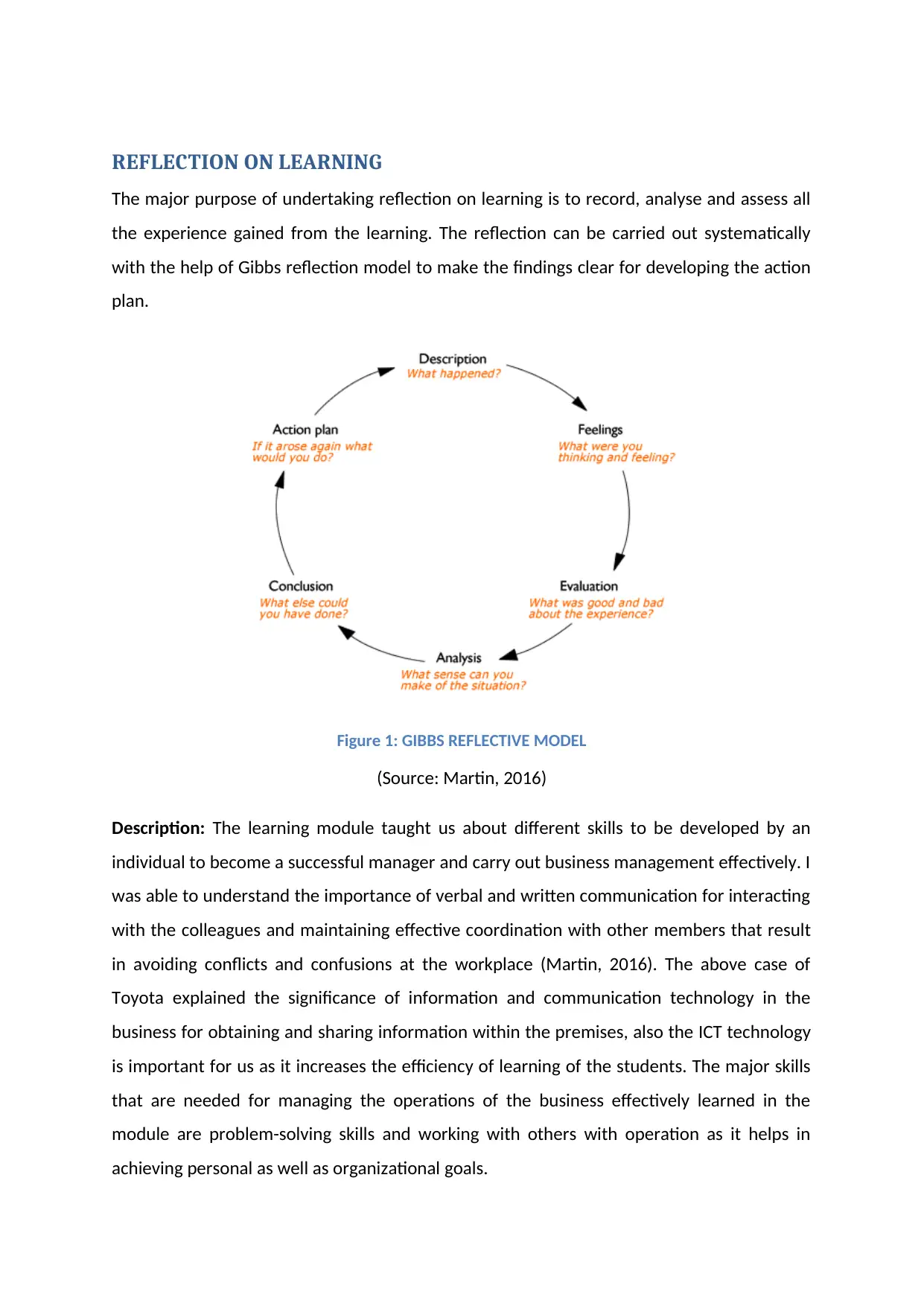
The major purpose of undertaking reflection on learning is to record, analyse and assess all
the experience gained from the learning. The reflection can be carried out systematically
with the help of Gibbs reflection model to make the findings clear for developing the action
plan.
Figure 1: GIBBS REFLECTIVE MODEL
(Source: Martin, 2016)
Description: The learning module taught us about different skills to be developed by an
individual to become a successful manager and carry out business management effectively. I
was able to understand the importance of verbal and written communication for interacting
with the colleagues and maintaining effective coordination with other members that result
in avoiding conflicts and confusions at the workplace (Martin, 2016). The above case of
Toyota explained the significance of information and communication technology in the
business for obtaining and sharing information within the premises, also the ICT technology
is important for us as it increases the efficiency of learning of the students. The major skills
that are needed for managing the operations of the business effectively learned in the
module are problem-solving skills and working with others with operation as it helps in
achieving personal as well as organizational goals.
tabler-icon-diamond-filled.svg

Paraphrase This Document

Need a fresh take? Get an instant paraphrase of this document with our AI Paraphraser
Document Page
Feelings: Initially, I found it very difficult to understand and learn the importance of verbal
and written communication and interpersonal skills and concentrating on learning to
develop those skills as a student as they are necessary for future growth and progress in the
career. My concepts were not clear and I used to get frustrated due to this, but gradually,
with the passing weeks, I started taking notes and giving myself time even at home to
understand the concepts to make myself clear about the skills and abilities and their
importance, why they must be possessed by an individual, how are they helpful and how
the lack of skills affects the performance, etc. (Martin, 2016) I felt happy with my progress
until the end of the module as I was able to gain interpersonal skills and learned to work
with others for accomplishing the assigned tasks and now I feel satisfied that these topics
were added in our course.
Evaluation: The topics chosen in the module were quite relevant and necessary to be
undertaken as gaining knowledge about the communication skills, ICT, problem-solving
skills, working with teams, etc. is significant for the students that aspire to become
managers in the future. We got to learn the importance of each skill and also developed
them with the help of activities carried out in the class. The things that do not go well or as
expected was that in the initial days of the learning, due to lack of concentration, I missed
few topics and their clarification which led to frustration and improper understanding
(Goldingay et al. 2016).
Analysis: The things started going well in the module after some time as I understood my
mistake and increased my concentration level, started studying more about the skills and
their development through internet and other sources whenever I found time. I started
playing an activity with my friends where we divided ourselves in groups and gave a target
to be accomplished to enhance our team working skills. Also, with the help of the case of
Toyota, I was able to learn about the importance of critical thinking skills needed for making
decisions in the business to improve the existing practices and manage the operations
effectively (Goldingay et al. 2016). Therefore, I laid more emphasis on reading more case
studies and solving problems given in the cases to enhance my analytical and thinking
abilities that would be helpful for me in the future.
Document Page
Conclusion: I learned the importance of both verbal and written communication while
interacting with other students and teachers in the class and understood what roles the
gestures and words play while carrying conversations with people. Moreover, I learned the
management of tasks by understanding each activity from different perspectives and
learning to think out of the box and critically by evaluating the pros and cons of each
decision while solving the problems (Jacobs, 2016). Lastly, I used the ‘Belbin team roles’
model while working in team and undertaking the activities as this framework was helpful in
assigning the roles according to the capabilities of the members and performing the roles
with the best of our efficiencies to achieve the desired outcomes.
Action plan: With the help of this reflection, the things that were learned in the module are
discussed and the problems that were faced are identified and also the changes that were
made to solve the problems and increase efficiency of the learning were determined in the
reflection. Also, I described about the feelings experienced in the whole process and now
the action plan is prepared in detail for developing the required skills and abilities such as
interpersonal skills, communication skills, problems-solving skills, critical thinking abilities,
etc. that would be helpful for me in the future and lead to my growth and development on a
personal and professional level (Jacobs, 2016).
Document Page
CONCLUSION
Thus, it can be concluded that the managers must possess effective skills and abilities that
are required for managing all the activities of the business efficiently and gaining success.
The business manager of Toyota focuses on fulfilling the corporate social responsibilities of
the organization to achieve sustainability in the business and maximize the satisfaction of
the whole community. Therefore, the above assignment helped in understanding the
applications used by the managers in Toyota to manage the business sustainably with the
help of strategic planning process considering all the corporate social responsibilities of the
business by using new and updated technology and achieving the desired objectives of the
business. The second part of the report focuses on self-reflection on learning and
development of the key skills required and developing an action plan for making
improvements in the identified areas to enhance the skills and abilities and therefore,
increase efficiency in performance.
tabler-icon-diamond-filled.svg

Paraphrase This Document

Need a fresh take? Get an instant paraphrase of this document with our AI Paraphraser
Document Page
References
Martin, M., 2016. A reflection on using play to facilitate learning. International Practice
Development Journal, 6(1).
Goldingay, S., Hitch, D., Carrington, A., Nipperess, S. and Rosario, V., 2016. Transforming
roles to support student development of academic literacies: a reflection on one team’s
experience. Reflective Practice, 17(3), pp.334-346.
Jacobs, S., 2016. Reflective learning, reflective practice. Nursing2019, 46(5), pp.62-64.
chevron_up_icon
1 out of 5
circle_padding
hide_on_mobile
zoom_out_icon
[object Object]