Learning Theories & Their Application in Health & Social Care Work
VerifiedAdded on 2024/05/14
|30
|6856
|261
Essay
AI Summary
This assignment provides a comprehensive overview of the learning process within health and social care settings, encompassing various learning theories, domains, and styles. It delves into Bloom's Taxonomy, analyzing cognitive, affective, and psychomotor domains, and examines behaviorist, Gestalt, cognitive, and humanistic learning theories. The assignment also utilizes Kolb's Learning Cycle to illustrate learning in the workplace, using a case study of a care worker interacting with a patient. Furthermore, it explores VAK and Honey and Mumford learning styles, assessing personal learning preferences and factors influencing effective learning development. The assignment concludes with a discussion of workplace learning plans, teaching strategies, assessment methods, and barriers to learning for staff and service users, along with approaches to support individual learning needs in health and social care environments; it is available for students to study on Desklib.

UNDERSTANDING THE LEARNING PROCESS

Paraphrase This Document
Need a fresh take? Get an instant paraphrase of this document with our AI Paraphraser
Table of Contents
INTRODUCTION..........................................................................................................................2
TASK 1- ESSAY.............................................................................................................................3
1.1 EXPLAIN HOW DIFFERENT DOMAINS OF LEARNING APPLY TO LEARNING IN HEALTH
AND SOCIAL CARE..................................................................................................................3
1.3 ANALYSE HOW THEORIES OF LEARNING RELATE TO THE DEVELOPMENT OF
UNDERSTANDING AND SKILLS IN HEALTH AND SOCIAL CARE...............................................5
TASK 2- CASE STUDY...................................................................................................................7
1.2 EXPLAIN DIFFERENT WAYS IN WHICH LEARNING CAN OCCUR IN HEALTH AND SOCIAL
CARE WORKPLACES................................................................................................................7
TASK 3- ESSAY WRITING.............................................................................................................9
PART 1....................................................................................................................................9
2.2 EXPLAIN THE CONCEPTS OF LEARNING STYLES...............................................................9
2.1 EXPLAIN FACTORS THAT INFLUENCE EFFECTIVE LEARNING DEVELOPMENT................12
PART 2..................................................................................................................................13
2.3 USE THE VARK SYSTEM OR HONEY AND MUMFORD TEST TO ASSESS YOUR OWN
LEARNING STYLE...................................................................................................................13
2.4 ANALYSE THE VARIOUS INFLUENCES THAT AFFECT YOUR OWN LEARNING IN
RELATION TO THE LEARNING THEORY.................................................................................14
TASK 4- CASE SCENARIO- WORKPLACE LEARNING PLAN.........................................................15
3.1 DESCRIBE THE FACTORS THAT YOU NEED TO CONSIDER IN YOUR WORKPLACE
LEARNING PLAN...................................................................................................................15
3.2 PRESENT RELEVANT TEACHING STRATEGIES TO SUPPORT THE LEARNING OF OTHERS
FOR A HEALTH AND SOCIAL CARE WORKPLACE..................................................................17
3.3 SUGGEST A STRATEGY FOR DELIVERING AND ASSESSING LEARNING IN A HEALTH AND
SOCIAL CARE WORKPLACE...................................................................................................18
1
INTRODUCTION..........................................................................................................................2
TASK 1- ESSAY.............................................................................................................................3
1.1 EXPLAIN HOW DIFFERENT DOMAINS OF LEARNING APPLY TO LEARNING IN HEALTH
AND SOCIAL CARE..................................................................................................................3
1.3 ANALYSE HOW THEORIES OF LEARNING RELATE TO THE DEVELOPMENT OF
UNDERSTANDING AND SKILLS IN HEALTH AND SOCIAL CARE...............................................5
TASK 2- CASE STUDY...................................................................................................................7
1.2 EXPLAIN DIFFERENT WAYS IN WHICH LEARNING CAN OCCUR IN HEALTH AND SOCIAL
CARE WORKPLACES................................................................................................................7
TASK 3- ESSAY WRITING.............................................................................................................9
PART 1....................................................................................................................................9
2.2 EXPLAIN THE CONCEPTS OF LEARNING STYLES...............................................................9
2.1 EXPLAIN FACTORS THAT INFLUENCE EFFECTIVE LEARNING DEVELOPMENT................12
PART 2..................................................................................................................................13
2.3 USE THE VARK SYSTEM OR HONEY AND MUMFORD TEST TO ASSESS YOUR OWN
LEARNING STYLE...................................................................................................................13
2.4 ANALYSE THE VARIOUS INFLUENCES THAT AFFECT YOUR OWN LEARNING IN
RELATION TO THE LEARNING THEORY.................................................................................14
TASK 4- CASE SCENARIO- WORKPLACE LEARNING PLAN.........................................................15
3.1 DESCRIBE THE FACTORS THAT YOU NEED TO CONSIDER IN YOUR WORKPLACE
LEARNING PLAN...................................................................................................................15
3.2 PRESENT RELEVANT TEACHING STRATEGIES TO SUPPORT THE LEARNING OF OTHERS
FOR A HEALTH AND SOCIAL CARE WORKPLACE..................................................................17
3.3 SUGGEST A STRATEGY FOR DELIVERING AND ASSESSING LEARNING IN A HEALTH AND
SOCIAL CARE WORKPLACE...................................................................................................18
1
4.1 EXPLAIN THE BARRIERS TO LEARNING BY YOUR STAFF AND THE SERVICE USERS IN THE
CARE HOME THAT MAYBE EXPERIENCED AT WORK............................................................19
4.2 DESCRIBE THE DIFFERENT METHODS YOU MAY USE TO IDENTIFY THE LEARNING
NEEDS OF YOUR STAFF OR SERVICE USERS.........................................................................20
4.3 EVALUATE DIFFERENT APPROACHES THAT COULD BE ADOPTED TO SUPPORT THE
INDIVIDUAL LEARNING NEEDS OF HEALTH AND SOCIAL CARE WORKERS..........................21
CONCLUSION............................................................................................................................22
REFERENCES.............................................................................................................................23
APPENDIX1...............................................................................................................................24
Learning Styles - General Descriptions..................................................30
Activists..........................................................................................................................30
Summary of strengths.........................................................................................................32
2
CARE HOME THAT MAYBE EXPERIENCED AT WORK............................................................19
4.2 DESCRIBE THE DIFFERENT METHODS YOU MAY USE TO IDENTIFY THE LEARNING
NEEDS OF YOUR STAFF OR SERVICE USERS.........................................................................20
4.3 EVALUATE DIFFERENT APPROACHES THAT COULD BE ADOPTED TO SUPPORT THE
INDIVIDUAL LEARNING NEEDS OF HEALTH AND SOCIAL CARE WORKERS..........................21
CONCLUSION............................................................................................................................22
REFERENCES.............................................................................................................................23
APPENDIX1...............................................................................................................................24
Learning Styles - General Descriptions..................................................30
Activists..........................................................................................................................30
Summary of strengths.........................................................................................................32
2
⊘ This is a preview!⊘
Do you want full access?
Subscribe today to unlock all pages.

Trusted by 1+ million students worldwide
INTRODUCTION
Learning is referred to that process leading to changes occurring due to gaining experiences
and increasing the potential to improve performance and future learning (Siemens, 2014).
This assignment focuses on learning process comprised of different theories and learning
styles that are applied to the learning strategies in the health and social care workplace. It
illustrates the different theories of learning to develop the practices at health and social
care workplace.
It also explains the influences of the different learning styles of learning by people and also
determines and implements the strategies for effective delivery and assesses the learning in
health and social care workplace. At last, various measures or approaches will be identified
in order to adopt for supporting the learning needs of individual health and social care
settings. Comprehension on the learning process in health and social care settings will help
in handling the patients in an effective manner by managing the situations thereby leading
to increase in learning and personal development in health and social care settings.
3
Learning is referred to that process leading to changes occurring due to gaining experiences
and increasing the potential to improve performance and future learning (Siemens, 2014).
This assignment focuses on learning process comprised of different theories and learning
styles that are applied to the learning strategies in the health and social care workplace. It
illustrates the different theories of learning to develop the practices at health and social
care workplace.
It also explains the influences of the different learning styles of learning by people and also
determines and implements the strategies for effective delivery and assesses the learning in
health and social care workplace. At last, various measures or approaches will be identified
in order to adopt for supporting the learning needs of individual health and social care
settings. Comprehension on the learning process in health and social care settings will help
in handling the patients in an effective manner by managing the situations thereby leading
to increase in learning and personal development in health and social care settings.
3
Paraphrase This Document
Need a fresh take? Get an instant paraphrase of this document with our AI Paraphraser
TASK 1- ESSAY
INTRODUCTION
The essay comprises of general understanding of the domains of learning using Bloom's
Taxonomy of learning and theories of learning were analyse while relating to the
understanding and skills development in healthcare settings.
1.1 EXPLAIN HOW DIFFERENT DOMAINS OF LEARNING APPLY TO
LEARNING IN HEALTH AND SOCIAL CARE
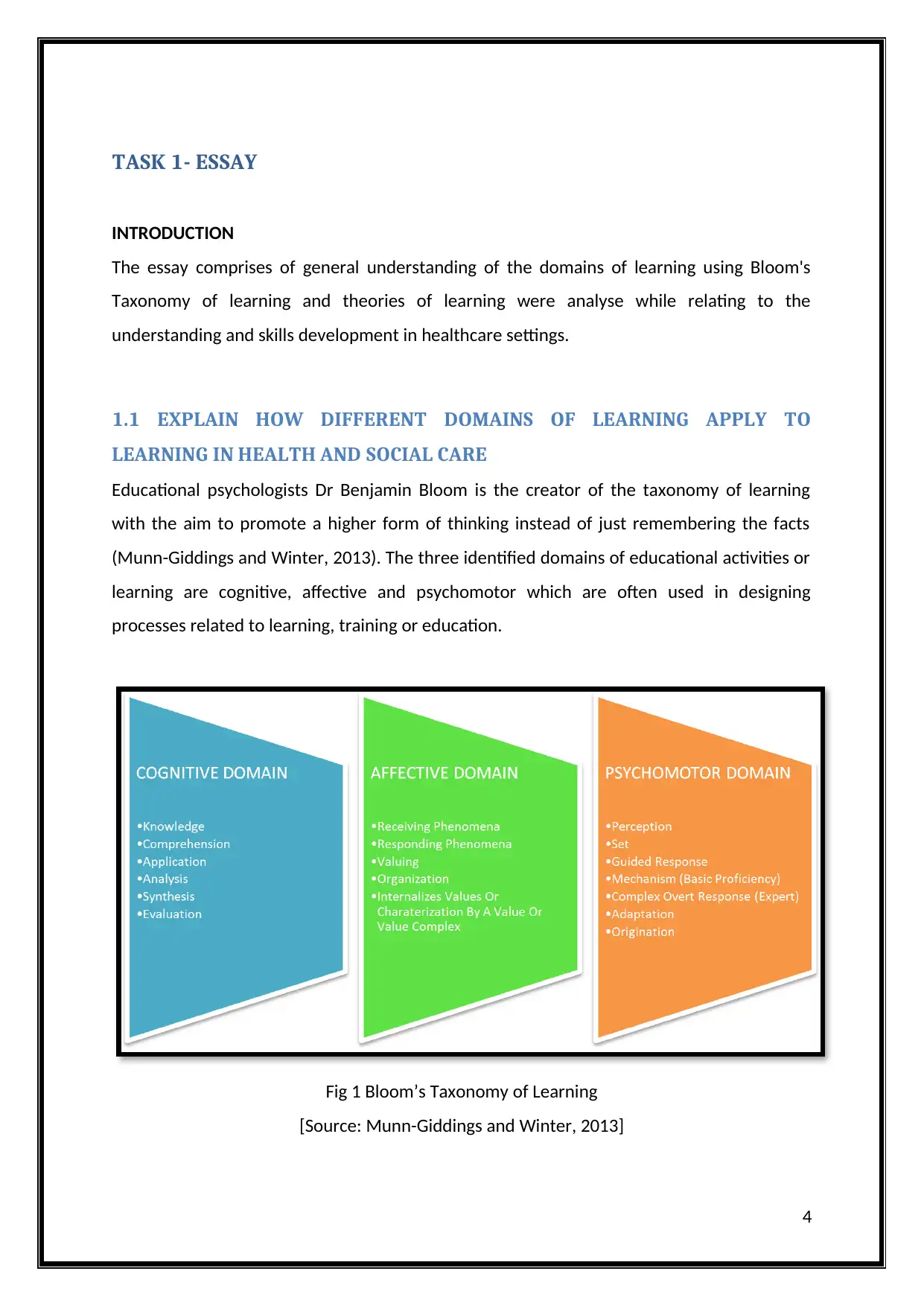
Educational psychologists Dr Benjamin Bloom is the creator of the taxonomy of learning
with the aim to promote a higher form of thinking instead of just remembering the facts
(Munn-Giddings and Winter, 2013). The three identified domains of educational activities or
learning are cognitive, affective and psychomotor which are often used in designing
processes related to learning, training or education.
Fig 1 Bloom’s Taxonomy of Learning
[Source: Munn-Giddings and Winter, 2013]
4
INTRODUCTION
The essay comprises of general understanding of the domains of learning using Bloom's
Taxonomy of learning and theories of learning were analyse while relating to the
understanding and skills development in healthcare settings.
1.1 EXPLAIN HOW DIFFERENT DOMAINS OF LEARNING APPLY TO
LEARNING IN HEALTH AND SOCIAL CARE
Educational psychologists Dr Benjamin Bloom is the creator of the taxonomy of learning
with the aim to promote a higher form of thinking instead of just remembering the facts
(Munn-Giddings and Winter, 2013). The three identified domains of educational activities or
learning are cognitive, affective and psychomotor which are often used in designing
processes related to learning, training or education.
Fig 1 Bloom’s Taxonomy of Learning
[Source: Munn-Giddings and Winter, 2013]
4
COGNITIVE: it is related to mental skills (knowledge) and encompasses the knowledge as
well as the development of intellectual skills such as recalling the specific facts, concepts
serving the development in intellectual abilities and skills, procedural patterns (ten Cate, et
al. 2011). There are six major categories of cognitive process ranging from simplest to most
complex ones. It can be considered as degrees of difficulties as it is essential to master one
category before reaching to the next one.
AFFECTIVE: it is related with the growth in feelings or other emotional areas (attitude, self)
and includes the manners of individual to deal with the things in an emotional way such as
feelings, motivations, enthusiasm, appreciation and attitudes (Petty, et al. 2012). It also
comprises five major categories of behaviour ranging from simplest to most complex.
PSYCHOMOTOR: it is related to the manual or physical skills (skills) and encompasses the
coordination, physical movement and utilization of motor-skill areas. Practice is needed to
develop these skills (Thistlethwaite, et al. 2010). It is measured with regards to speed,
distance, procedures, precision or techniques in execution. It comprises 7 major categories
ranging from simplest to most complex behaviour.
5
well as the development of intellectual skills such as recalling the specific facts, concepts
serving the development in intellectual abilities and skills, procedural patterns (ten Cate, et
al. 2011). There are six major categories of cognitive process ranging from simplest to most
complex ones. It can be considered as degrees of difficulties as it is essential to master one
category before reaching to the next one.
AFFECTIVE: it is related with the growth in feelings or other emotional areas (attitude, self)
and includes the manners of individual to deal with the things in an emotional way such as
feelings, motivations, enthusiasm, appreciation and attitudes (Petty, et al. 2012). It also
comprises five major categories of behaviour ranging from simplest to most complex.
PSYCHOMOTOR: it is related to the manual or physical skills (skills) and encompasses the
coordination, physical movement and utilization of motor-skill areas. Practice is needed to
develop these skills (Thistlethwaite, et al. 2010). It is measured with regards to speed,
distance, procedures, precision or techniques in execution. It comprises 7 major categories
ranging from simplest to most complex behaviour.
5
⊘ This is a preview!⊘
Do you want full access?
Subscribe today to unlock all pages.
Trusted by 1+ million students worldwide
1.3 ANALYSE HOW THEORIES OF LEARNING RELATE TO THE
DEVELOPMENT OF UNDERSTANDING AND SKILLS IN HEALTH AND SOCIAL
CARE
The theories of learning are given below:
BEHAVIOURIST THEORY: the behaviourism is confined to the observable and measurable
behaviour. The basis of the learning process in behaviour is through objectively observable
changes. It is believed by the behaviourists that the occurrence of learning as the
association between stimuli and responses result in acquiring new behaviours or changes in
behaviours (Thistlethwaite, et al. 2010). However the drawback is that it does not prepare
the learner for solving problems or thinking creative.
GESTALT THEORY: Gestalt psychology was introduced as a revolt to the stimulus approach
of learning. A learner takes into account of the total situation in learning which is viewed as
a purposive, imaginative, exploratory and creative enterprise. It was suggested in this theory
that laws of perception are equally related to learning (Petty, et al. 2012). The experiments
conducted on chimpanzees shows that learning is the result of insight or ability to see the
relationship between varied factors involved in a circumstance and not the result of trial and
error. The learner needs to see the learning situation as problem situation in order to find its
solution by insight.
COGNITIVE THEORY: it is believed by theorists that learning occurs by internal processing of
information. Contradict to behaviourism, processing of cognitive information is
administered by internal process instead of external circumstances. This theory focuses on
the mental process as compared to observable behaviour by focusing on the mental
activities of the individual (Thistlethwaite, et al. 2010). Observable changes in behaviours
can be considered as behaviour to understand the internal process of the learner. It results
in reorganization of experiences that includes the change not only in behaviour but also in
the knowledge stored in memory.
6
DEVELOPMENT OF UNDERSTANDING AND SKILLS IN HEALTH AND SOCIAL
CARE
The theories of learning are given below:
BEHAVIOURIST THEORY: the behaviourism is confined to the observable and measurable
behaviour. The basis of the learning process in behaviour is through objectively observable
changes. It is believed by the behaviourists that the occurrence of learning as the
association between stimuli and responses result in acquiring new behaviours or changes in
behaviours (Thistlethwaite, et al. 2010). However the drawback is that it does not prepare
the learner for solving problems or thinking creative.
GESTALT THEORY: Gestalt psychology was introduced as a revolt to the stimulus approach
of learning. A learner takes into account of the total situation in learning which is viewed as
a purposive, imaginative, exploratory and creative enterprise. It was suggested in this theory
that laws of perception are equally related to learning (Petty, et al. 2012). The experiments
conducted on chimpanzees shows that learning is the result of insight or ability to see the
relationship between varied factors involved in a circumstance and not the result of trial and
error. The learner needs to see the learning situation as problem situation in order to find its
solution by insight.
COGNITIVE THEORY: it is believed by theorists that learning occurs by internal processing of
information. Contradict to behaviourism, processing of cognitive information is
administered by internal process instead of external circumstances. This theory focuses on
the mental process as compared to observable behaviour by focusing on the mental
activities of the individual (Thistlethwaite, et al. 2010). Observable changes in behaviours
can be considered as behaviour to understand the internal process of the learner. It results
in reorganization of experiences that includes the change not only in behaviour but also in
the knowledge stored in memory.
6
Paraphrase This Document
Need a fresh take? Get an instant paraphrase of this document with our AI Paraphraser
HUMANISTIC THEORY: this theory addresses the personal development of the learner. The
role played by the educator in humanism is that of facilitator where the learning is centred
and personalised to each student (Bachmann, et al. 2013). Learning is referred to
developing the unique way of controlling the environment by an individual in order to attain
the best potential. It is also believed that the basis of learning should be need or experience.
It believes in co-existence and better learning can be the result of self-motivation.
CONCLUSION
It is observed that Bloom’s Taxonomy of learning can help in understanding different
domains of learning and learning theories helps in effective developing the understanding
and learning in healthcare settings.
7
role played by the educator in humanism is that of facilitator where the learning is centred
and personalised to each student (Bachmann, et al. 2013). Learning is referred to
developing the unique way of controlling the environment by an individual in order to attain
the best potential. It is also believed that the basis of learning should be need or experience.
It believes in co-existence and better learning can be the result of self-motivation.
CONCLUSION
It is observed that Bloom’s Taxonomy of learning can help in understanding different
domains of learning and learning theories helps in effective developing the understanding
and learning in healthcare settings.
7
TASK 2- CASE STUDY
1.2 EXPLAIN DIFFERENT WAYS IN WHICH LEARNING CAN OCCUR IN
HEALTH AND SOCIAL CARE WORKPLACES
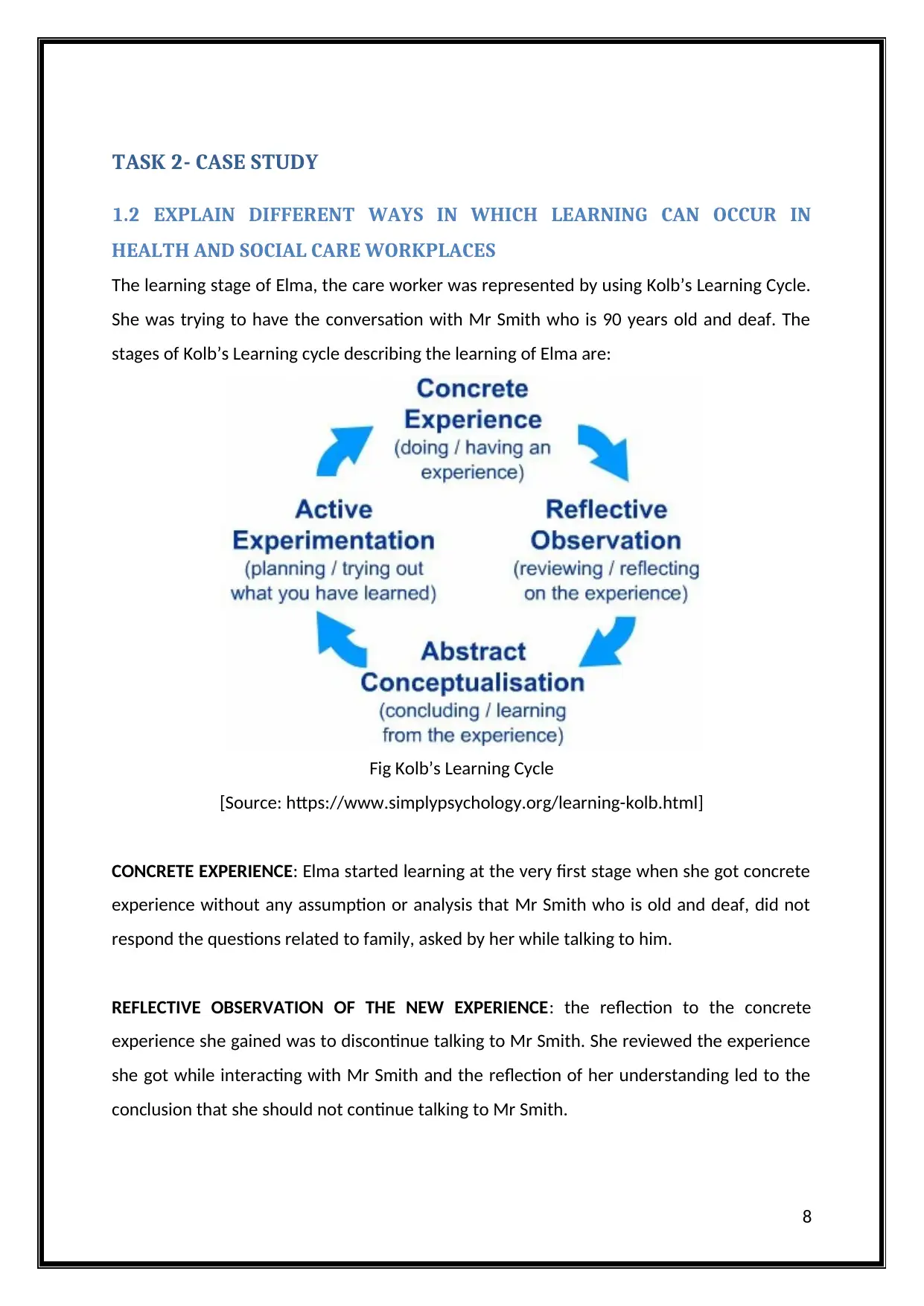
The learning stage of Elma, the care worker was represented by using Kolb’s Learning Cycle.
She was trying to have the conversation with Mr Smith who is 90 years old and deaf. The
stages of Kolb’s Learning cycle describing the learning of Elma are:
Fig Kolb’s Learning Cycle
[Source: https://www.simplypsychology.org/learning-kolb.html]
CONCRETE EXPERIENCE: Elma started learning at the very first stage when she got concrete
experience without any assumption or analysis that Mr Smith who is old and deaf, did not
respond the questions related to family, asked by her while talking to him.
REFLECTIVE OBSERVATION OF THE NEW EXPERIENCE: the reflection to the concrete
experience she gained was to discontinue talking to Mr Smith. She reviewed the experience
she got while interacting with Mr Smith and the reflection of her understanding led to the
conclusion that she should not continue talking to Mr Smith.
8
1.2 EXPLAIN DIFFERENT WAYS IN WHICH LEARNING CAN OCCUR IN
HEALTH AND SOCIAL CARE WORKPLACES
The learning stage of Elma, the care worker was represented by using Kolb’s Learning Cycle.
She was trying to have the conversation with Mr Smith who is 90 years old and deaf. The
stages of Kolb’s Learning cycle describing the learning of Elma are:
Fig Kolb’s Learning Cycle
[Source: https://www.simplypsychology.org/learning-kolb.html]
CONCRETE EXPERIENCE: Elma started learning at the very first stage when she got concrete
experience without any assumption or analysis that Mr Smith who is old and deaf, did not
respond the questions related to family, asked by her while talking to him.
REFLECTIVE OBSERVATION OF THE NEW EXPERIENCE: the reflection to the concrete
experience she gained was to discontinue talking to Mr Smith. She reviewed the experience
she got while interacting with Mr Smith and the reflection of her understanding led to the
conclusion that she should not continue talking to Mr Smith.
8
⊘ This is a preview!⊘
Do you want full access?
Subscribe today to unlock all pages.
Trusted by 1+ million students worldwide
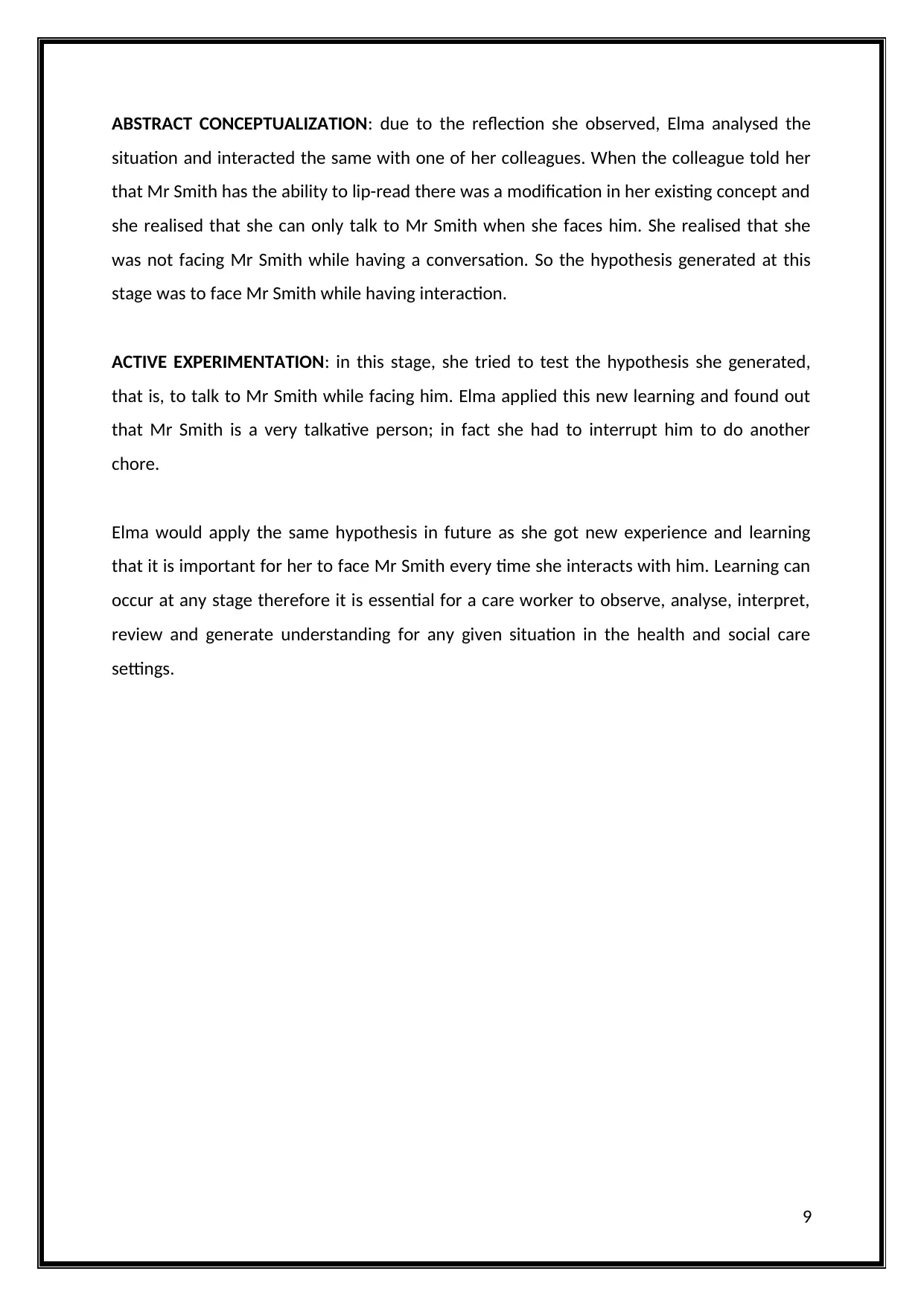
ABSTRACT CONCEPTUALIZATION: due to the reflection she observed, Elma analysed the
situation and interacted the same with one of her colleagues. When the colleague told her
that Mr Smith has the ability to lip-read there was a modification in her existing concept and
she realised that she can only talk to Mr Smith when she faces him. She realised that she
was not facing Mr Smith while having a conversation. So the hypothesis generated at this
stage was to face Mr Smith while having interaction.
ACTIVE EXPERIMENTATION: in this stage, she tried to test the hypothesis she generated,
that is, to talk to Mr Smith while facing him. Elma applied this new learning and found out
that Mr Smith is a very talkative person; in fact she had to interrupt him to do another
chore.
Elma would apply the same hypothesis in future as she got new experience and learning
that it is important for her to face Mr Smith every time she interacts with him. Learning can
occur at any stage therefore it is essential for a care worker to observe, analyse, interpret,
review and generate understanding for any given situation in the health and social care
settings.
9
situation and interacted the same with one of her colleagues. When the colleague told her
that Mr Smith has the ability to lip-read there was a modification in her existing concept and
she realised that she can only talk to Mr Smith when she faces him. She realised that she
was not facing Mr Smith while having a conversation. So the hypothesis generated at this
stage was to face Mr Smith while having interaction.
ACTIVE EXPERIMENTATION: in this stage, she tried to test the hypothesis she generated,
that is, to talk to Mr Smith while facing him. Elma applied this new learning and found out
that Mr Smith is a very talkative person; in fact she had to interrupt him to do another
chore.
Elma would apply the same hypothesis in future as she got new experience and learning
that it is important for her to face Mr Smith every time she interacts with him. Learning can
occur at any stage therefore it is essential for a care worker to observe, analyse, interpret,
review and generate understanding for any given situation in the health and social care
settings.
9
Paraphrase This Document
Need a fresh take? Get an instant paraphrase of this document with our AI Paraphraser
TASK 3- ESSAY WRITING
INTRODUCTION
This essay comprises of the concepts of learning style and explains the factors that impact
the effective learning development and also a VAK assessment is conducted and assessed.
PART 1
2.2 EXPLAIN THE CONCEPTS OF LEARNING STYLES
VAK learning style and Honey and Mumford learning styles can be used to understand the
effectiveness of different learning styles used by different people.
VARK LEARNING STYLE
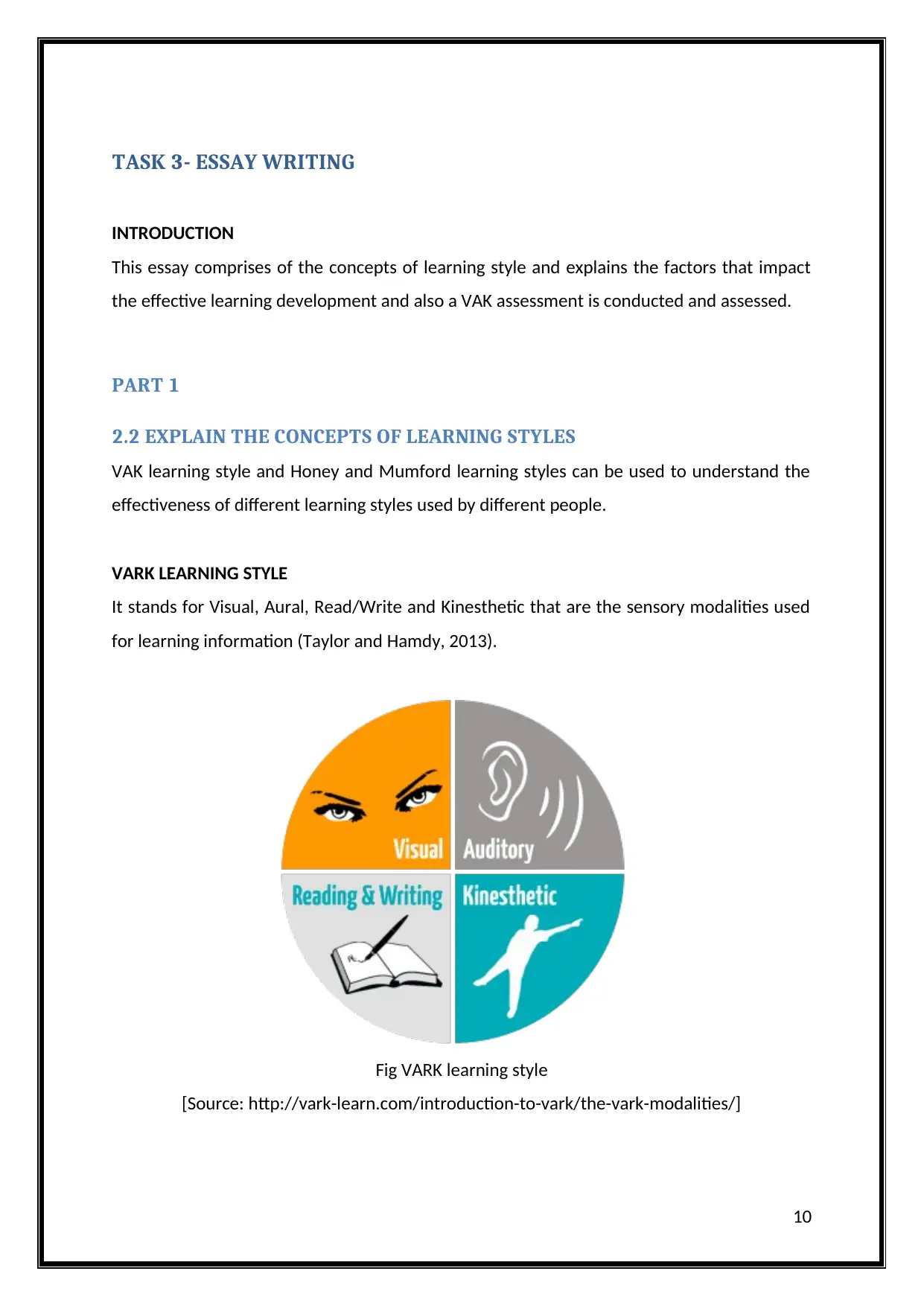
It stands for Visual, Aural, Read/Write and Kinesthetic that are the sensory modalities used
for learning information (Taylor and Hamdy, 2013).
Fig VARK learning style
[Source: http://vark-learn.com/introduction-to-vark/the-vark-modalities/]
10
INTRODUCTION
This essay comprises of the concepts of learning style and explains the factors that impact
the effective learning development and also a VAK assessment is conducted and assessed.
PART 1
2.2 EXPLAIN THE CONCEPTS OF LEARNING STYLES
VAK learning style and Honey and Mumford learning styles can be used to understand the
effectiveness of different learning styles used by different people.
VARK LEARNING STYLE
It stands for Visual, Aural, Read/Write and Kinesthetic that are the sensory modalities used
for learning information (Taylor and Hamdy, 2013).
Fig VARK learning style
[Source: http://vark-learn.com/introduction-to-vark/the-vark-modalities/]
10
Visual: learners can learn by seeing the information through a visual form such as maps,
diagrams, flowcharts, graphs and so on.
Aural/Auditory: learning can be achieved by hearing or listening to the information through
an audio form such as attending lectures, group discussion, phone calls, web-chat, email and
radio etc (Baid and Lambert, 2010).
Read/Write: this is the most preferred form of learning by reading and writing that is the
text-based input and output such as manuals, scripts, notes, assignments and essays (El-
Gilany and Abusaad, 2013).
Kinesthetic: it referred to the learning preference by having hands-on experience and
practices. Learning can be best done by touching and doing.
HONEY AND MUMFORD LEARNING STYLE
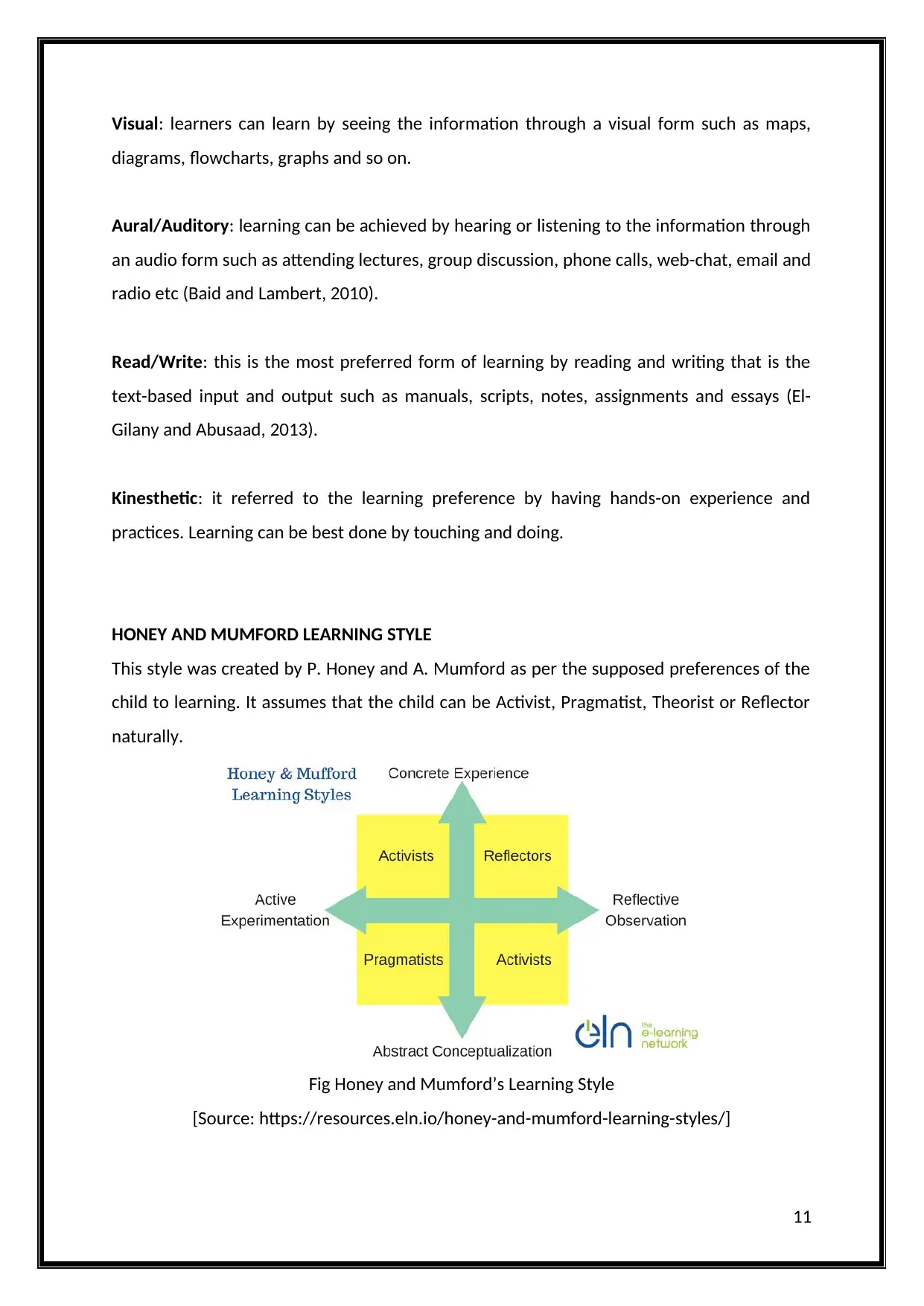
This style was created by P. Honey and A. Mumford as per the supposed preferences of the
child to learning. It assumes that the child can be Activist, Pragmatist, Theorist or Reflector
naturally.
Fig Honey and Mumford’s Learning Style
[Source: https://resources.eln.io/honey-and-mumford-learning-styles/]
11
diagrams, flowcharts, graphs and so on.
Aural/Auditory: learning can be achieved by hearing or listening to the information through
an audio form such as attending lectures, group discussion, phone calls, web-chat, email and
radio etc (Baid and Lambert, 2010).
Read/Write: this is the most preferred form of learning by reading and writing that is the
text-based input and output such as manuals, scripts, notes, assignments and essays (El-
Gilany and Abusaad, 2013).
Kinesthetic: it referred to the learning preference by having hands-on experience and
practices. Learning can be best done by touching and doing.
HONEY AND MUMFORD LEARNING STYLE
This style was created by P. Honey and A. Mumford as per the supposed preferences of the
child to learning. It assumes that the child can be Activist, Pragmatist, Theorist or Reflector
naturally.
Fig Honey and Mumford’s Learning Style
[Source: https://resources.eln.io/honey-and-mumford-learning-styles/]
11
⊘ This is a preview!⊘
Do you want full access?
Subscribe today to unlock all pages.
Trusted by 1+ million students worldwide

1 out of 30


Related Documents


Your All-in-One AI-Powered Toolkit for Academic Success.
+13062052269
info@desklib.com
Available 24*7 on WhatsApp / Email
![[object Object]](/_next/static/media/star-bottom.7253800d.svg)
Unlock your academic potential
Copyright © 2020–2026 A2Z Services. All Rights Reserved. Developed and managed by ZUCOL.