University of Sydney: Tort Law - Defence Strategy Analysis

Verified

Added on  2020/03/16

|3
|600
|35
Case Study
AI Summary
This assignment presents a detailed analysis of a tort law case, focusing on the defence strategy employed by the defendant. The case involves two plaintiffs, Officer Thomson and Ms. Hua, and the defendant, Ms. Jones. The defence strategy hinges on several key arguments. Firstly, the defence challenges the claims of Plaintiff-1 by arguing that the defendant's intoxication was not the sole cause of the accident and that contributory negligence could be established. Secondly, the defence highlights Plaintiff-2's pre-existing medical condition (Stress Disorder) and her failure to adhere to safety recommendations, thereby establishing contributory negligence. Finally, the defence uses the principle of causation to argue that the defendant's actions did not directly cause the harm suffered by Plaintiff-2. The assignment references relevant legal precedents and statutory requirements, including the Motor Accidents Compensation Act 1999 (NSW), and provides a bibliography of relevant legal texts.
Document Page
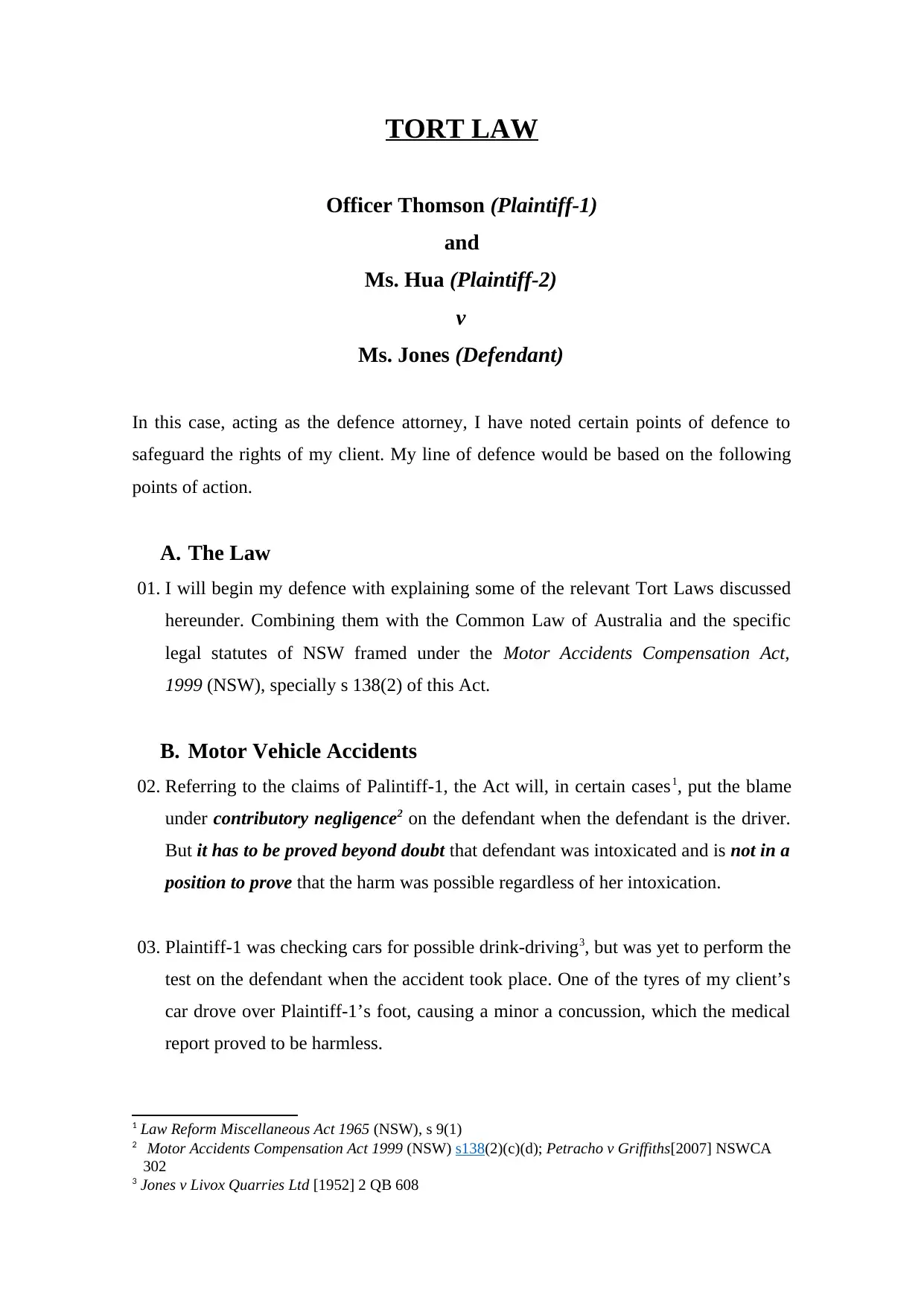
TORT LAW
Officer Thomson (Plaintiff-1)
and
Ms. Hua (Plaintiff-2)
v
Ms. Jones (Defendant)
In this case, acting as the defence attorney, I have noted certain points of defence to
safeguard the rights of my client. My line of defence would be based on the following
points of action.
A. The Law
01. I will begin my defence with explaining some of the relevant Tort Laws discussed
hereunder. Combining them with the Common Law of Australia and the specific
legal statutes of NSW framed under the Motor Accidents Compensation Act,
1999 (NSW), specially s 138(2) of this Act.
B. Motor Vehicle Accidents
02. Referring to the claims of Palintiff-1, the Act will, in certain cases1, put the blame
under contributory negligence2 on the defendant when the defendant is the driver.
But it has to be proved beyond doubt that defendant was intoxicated and is not in a
position to prove that the harm was possible regardless of her intoxication.
03. Plaintiff-1 was checking cars for possible drink-driving3, but was yet to perform the
test on the defendant when the accident took place. One of the tyres of my client’s
car drove over Plaintiff-1’s foot, causing a minor a concussion, which the medical
report proved to be harmless.
1 Law Reform Miscellaneous Act 1965 (NSW), s 9(1)
2 Motor Accidents Compensation Act 1999 (NSW) s138(2)(c)(d); Petracho v Griffiths[2007] NSWCA
302
3 Jones v Livox Quarries Ltd [1952] 2 QB 608
tabler-icon-diamond-filled.svg

Paraphrase This Document

Need a fresh take? Get an instant paraphrase of this document with our AI Paraphraser
Document Page
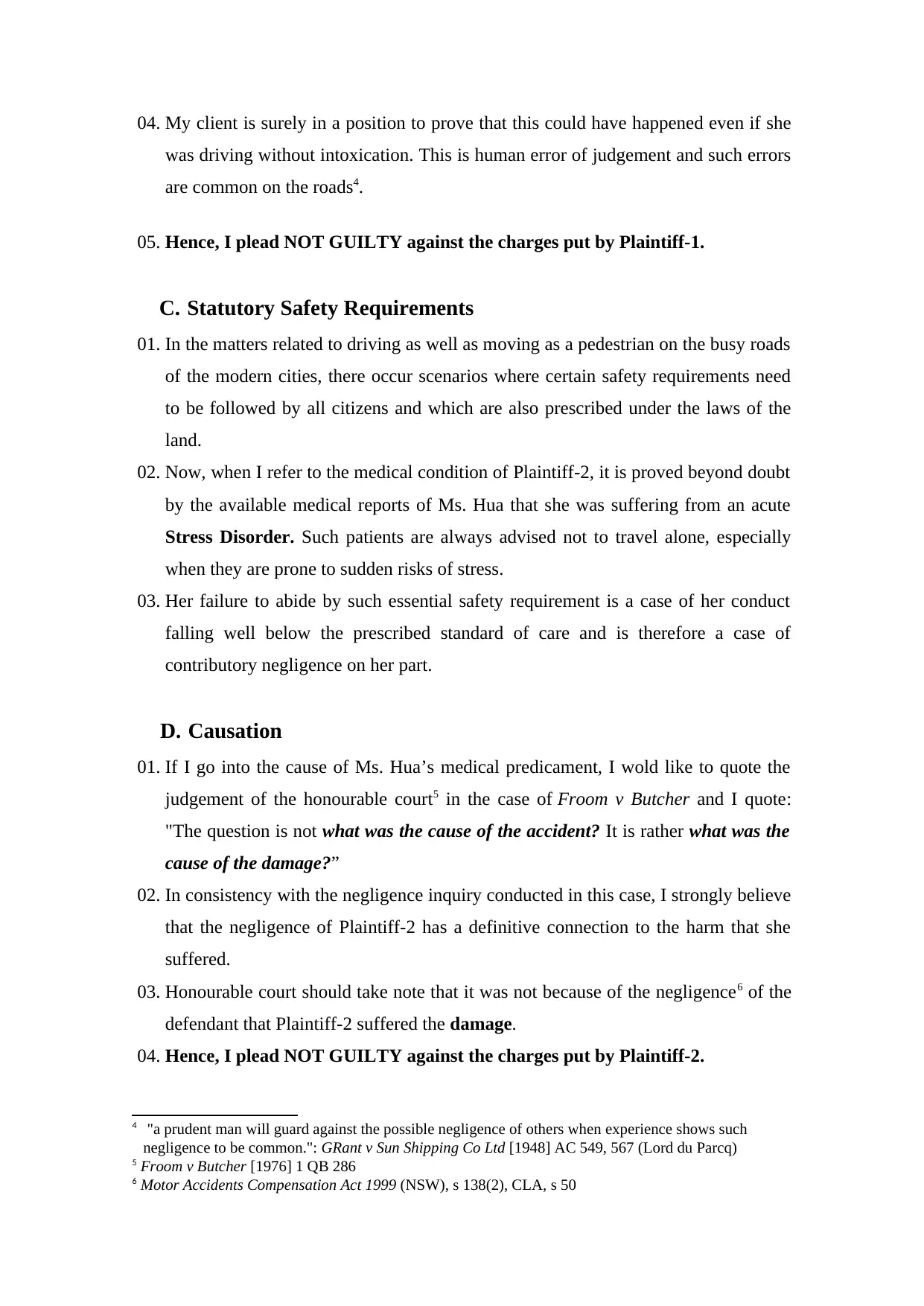
04. My client is surely in a position to prove that this could have happened even if she
was driving without intoxication. This is human error of judgement and such errors
are common on the roads4.
05. Hence, I plead NOT GUILTY against the charges put by Plaintiff-1.
C. Statutory Safety Requirements
01. In the matters related to driving as well as moving as a pedestrian on the busy roads
of the modern cities, there occur scenarios where certain safety requirements need
to be followed by all citizens and which are also prescribed under the laws of the
land.
02. Now, when I refer to the medical condition of Plaintiff-2, it is proved beyond doubt
by the available medical reports of Ms. Hua that she was suffering from an acute
Stress Disorder. Such patients are always advised not to travel alone, especially
when they are prone to sudden risks of stress.
03. Her failure to abide by such essential safety requirement is a case of her conduct
falling well below the prescribed standard of care and is therefore a case of
contributory negligence on her part.
D. Causation
01. If I go into the cause of Ms. Hua’s medical predicament, I wold like to quote the
judgement of the honourable court5 in the case of Froom v Butcher and I quote:
"The question is not what was the cause of the accident? It is rather what was the
cause of the damage?
02. In consistency with the negligence inquiry conducted in this case, I strongly believe
that the negligence of Plaintiff-2 has a definitive connection to the harm that she
suffered.
03. Honourable court should take note that it was not because of the negligence6 of the
defendant that Plaintiff-2 suffered the damage.
04. Hence, I plead NOT GUILTY against the charges put by Plaintiff-2.
4 "a prudent man will guard against the possible negligence of others when experience shows such
negligence to be common.": GRant v Sun Shipping Co Ltd [1948] AC 549, 567 (Lord du Parcq)
5 Froom v Butcher [1976] 1 QB 286
6 Motor Accidents Compensation Act 1999 (NSW), s 138(2), CLA, s 50
Document Page
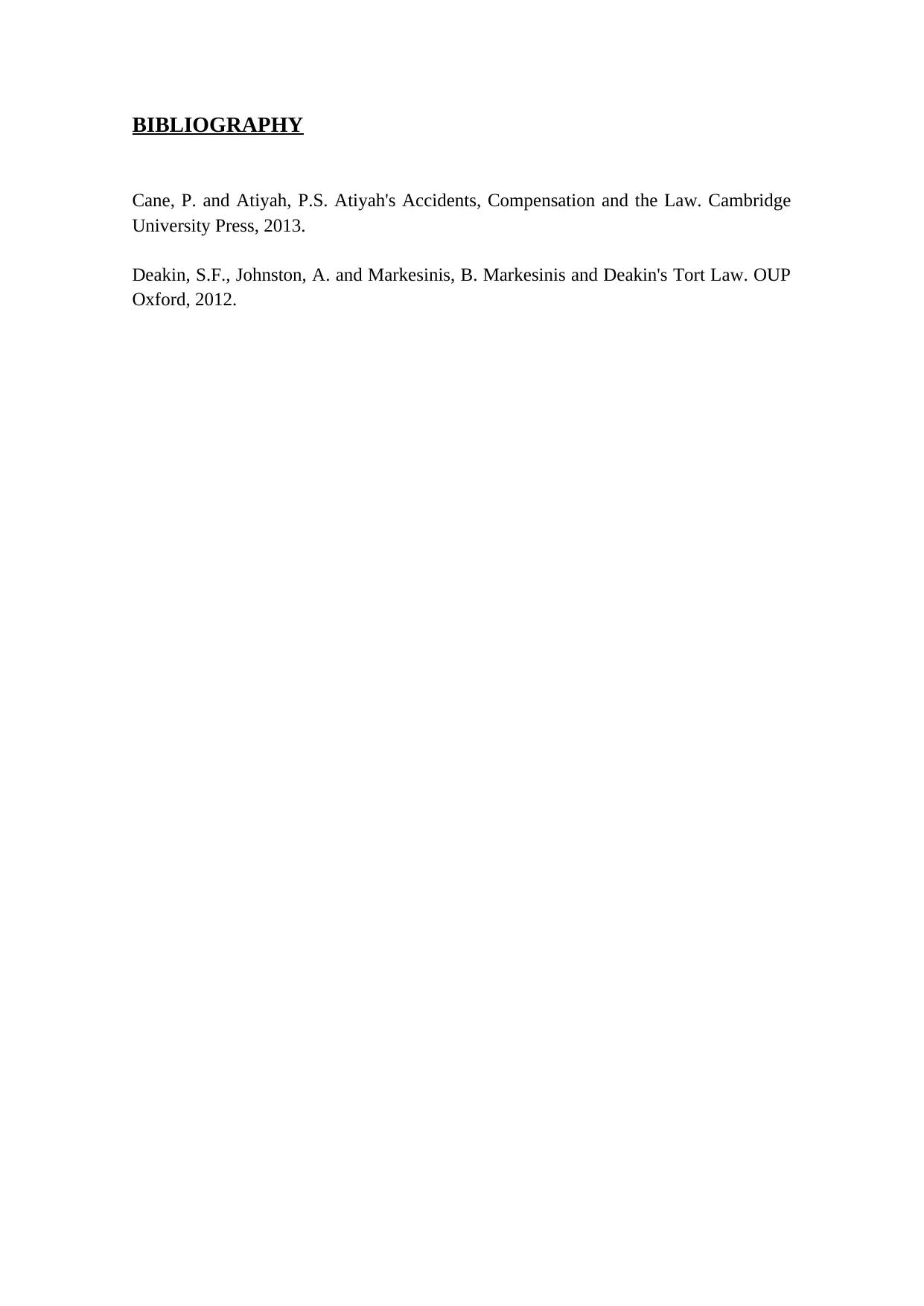
BIBLIOGRAPHY
Cane, P. and Atiyah, P.S. Atiyah's Accidents, Compensation and the Law. Cambridge
University Press, 2013.
Deakin, S.F., Johnston, A. and Markesinis, B. Markesinis and Deakin's Tort Law. OUP
Oxford, 2012.
chevron_up_icon
1 out of 3
circle_padding
hide_on_mobile
zoom_out_icon
[object Object]