Legal Ethics: Confidentiality, Privilege and Crime-Fraud Exception

Verified

Added on  2023/05/26

|5
|578
|444
Homework Assignment
AI Summary
This assignment examines key aspects of legal ethics, specifically focusing on attorney-client privilege and the crime-fraud exception. The assignment presents various scenarios where ethical dilemmas arise, such as when a client confesses to a crime or plans to commit one. The student analyzes each situation, determining whether the attorney is obligated to reveal confidential information based on the crime-fraud exception. The assignment covers scenarios involving murder, theft, and potential harm to others, requiring the student to apply ethical principles to real-world situations. Furthermore, the assignment considers the ethical obligations of a paralegal in situations involving client confidentiality and potential conflicts of interest. The student also evaluates the paralegal's responsibility to disclose information observed in a social setting relevant to a divorce case. The analysis emphasizes the importance of maintaining client confidentiality while adhering to legal and ethical standards.

Document Page
Intro to paralegal
tabler-icon-diamond-filled.svg

Paraphrase This Document

Need a fresh take? Get an instant paraphrase of this document with our AI Paraphraser
Document Page
Table of Contents
Question 1.............................................................................................................................................2
Question 2.............................................................................................................................................2
Question 3.............................................................................................................................................2
Question 4.............................................................................................................................................2
Question 5.............................................................................................................................................2
References.............................................................................................................................................4
1
Document Page
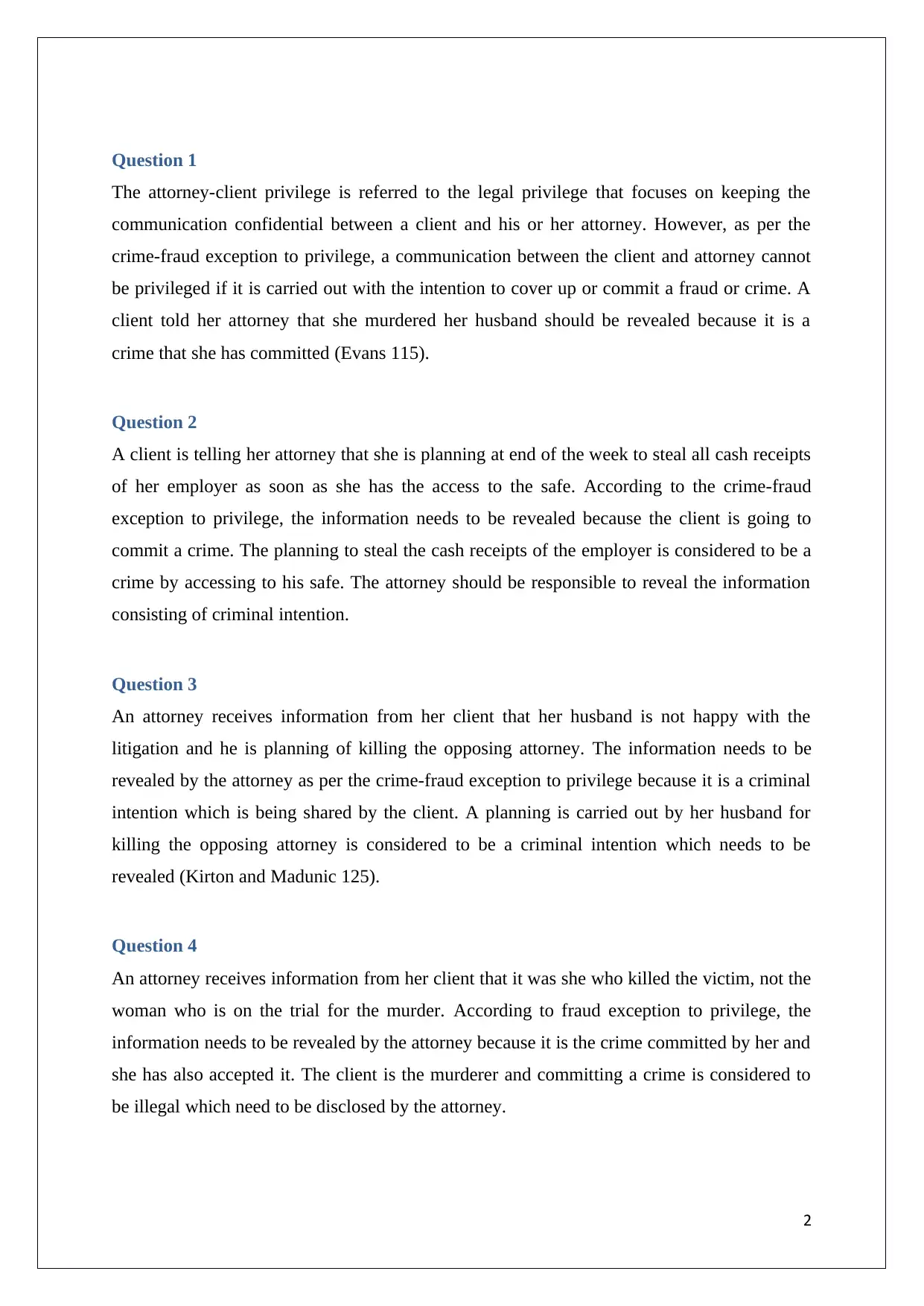
Question 1
The attorney-client privilege is referred to the legal privilege that focuses on keeping the
communication confidential between a client and his or her attorney. However, as per the
crime-fraud exception to privilege, a communication between the client and attorney cannot
be privileged if it is carried out with the intention to cover up or commit a fraud or crime. A
client told her attorney that she murdered her husband should be revealed because it is a
crime that she has committed (Evans 115).
Question 2
A client is telling her attorney that she is planning at end of the week to steal all cash receipts
of her employer as soon as she has the access to the safe. According to the crime-fraud
exception to privilege, the information needs to be revealed because the client is going to
commit a crime. The planning to steal the cash receipts of the employer is considered to be a
crime by accessing to his safe. The attorney should be responsible to reveal the information
consisting of criminal intention.
Question 3
An attorney receives information from her client that her husband is not happy with the
litigation and he is planning of killing the opposing attorney. The information needs to be
revealed by the attorney as per the crime-fraud exception to privilege because it is a criminal
intention which is being shared by the client. A planning is carried out by her husband for
killing the opposing attorney is considered to be a criminal intention which needs to be
revealed (Kirton and Madunic 125).
Question 4
An attorney receives information from her client that it was she who killed the victim, not the
woman who is on the trial for the murder. According to fraud exception to privilege, the
information needs to be revealed by the attorney because it is the crime committed by her and
she has also accepted it. The client is the murderer and committing a crime is considered to
be illegal which need to be disclosed by the attorney.
2
Document Page
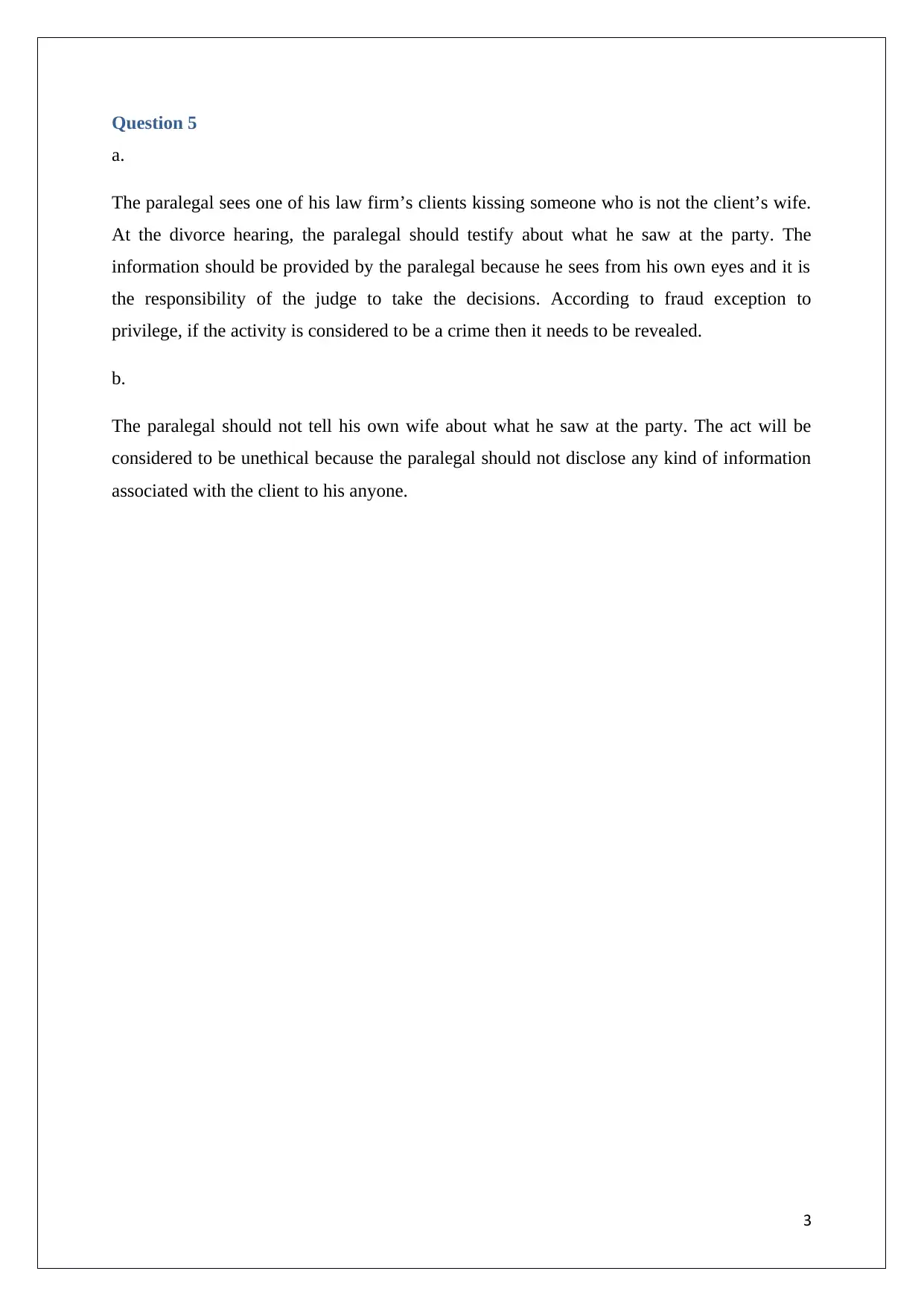
Question 5
a.
The paralegal sees one of his law firm’s clients kissing someone who is not the client’s wife.
At the divorce hearing, the paralegal should testify about what he saw at the party. The
information should be provided by the paralegal because he sees from his own eyes and it is
the responsibility of the judge to take the decisions. According to fraud exception to
privilege, if the activity is considered to be a crime then it needs to be revealed.
b.
The paralegal should not tell his own wife about what he saw at the party. The act will be
considered to be unethical because the paralegal should not disclose any kind of information
associated with the client to his anyone.
3
tabler-icon-diamond-filled.svg

Paraphrase This Document

Need a fresh take? Get an instant paraphrase of this document with our AI Paraphraser
Document Page
References
Evans, Malcolm D. International Law. 9th ed. Oxford: Oxford University Press, 2018. Print.
Kirton, John J, and Jelena Madunic. Global Law. 8th ed. Farnham: Ashgate, 2009. Print.
4
chevron_up_icon
1 out of 5
circle_padding
hide_on_mobile
zoom_out_icon
[object Object]