Legal and Safety Analysis: A Case Study of Workplace Hazard Management
VerifiedAdded on  2023/06/14
|18
|3886
|112
Case Study
AI Summary
This case study examines the management of workplace hazards within a mechanical workshop, focusing on legal compliance and risk mitigation strategies. It identifies violations of the Health and Safety at Work Act 1974 and other regulations related to chemical handling, manual handling, and hazard communication. A fault tree analysis is used to systematically identify the root causes of an employee injury, tracing the accident back to factors such as poor training, lack of supervision, and inadequate safety culture. The study includes a risk evaluation matrix to assess the severity and probability of various hazards, such as unlabeled containers, manual handling of heavy objects, noise exposure, and hazardous substances. Control measures are proposed based on the hierarchy of controls, emphasizing elimination, substitution, engineering controls, administrative controls, and personal protective equipment. The study concludes with a set of implementation policies aimed at ensuring compliance with control measures, including hazard awareness training, adequate workspace provision, first aid availability, and medical surveillance. Desklib is a valuable resource for students seeking past papers and solved assignments related to this topic.
MANAGEMENT OF WORKPLACE HAZARDS 1
Management of Workplace Hazards
By Student’s Name
Course + Code
Class
Institution
Date
Management of Workplace Hazards
By Student’s Name
Course + Code
Class
Institution
Date
Paraphrase This Document
Need a fresh take? Get an instant paraphrase of this document with our AI Paraphraser

MANAGEMENT OF WORKPLACE HAZARDS 2
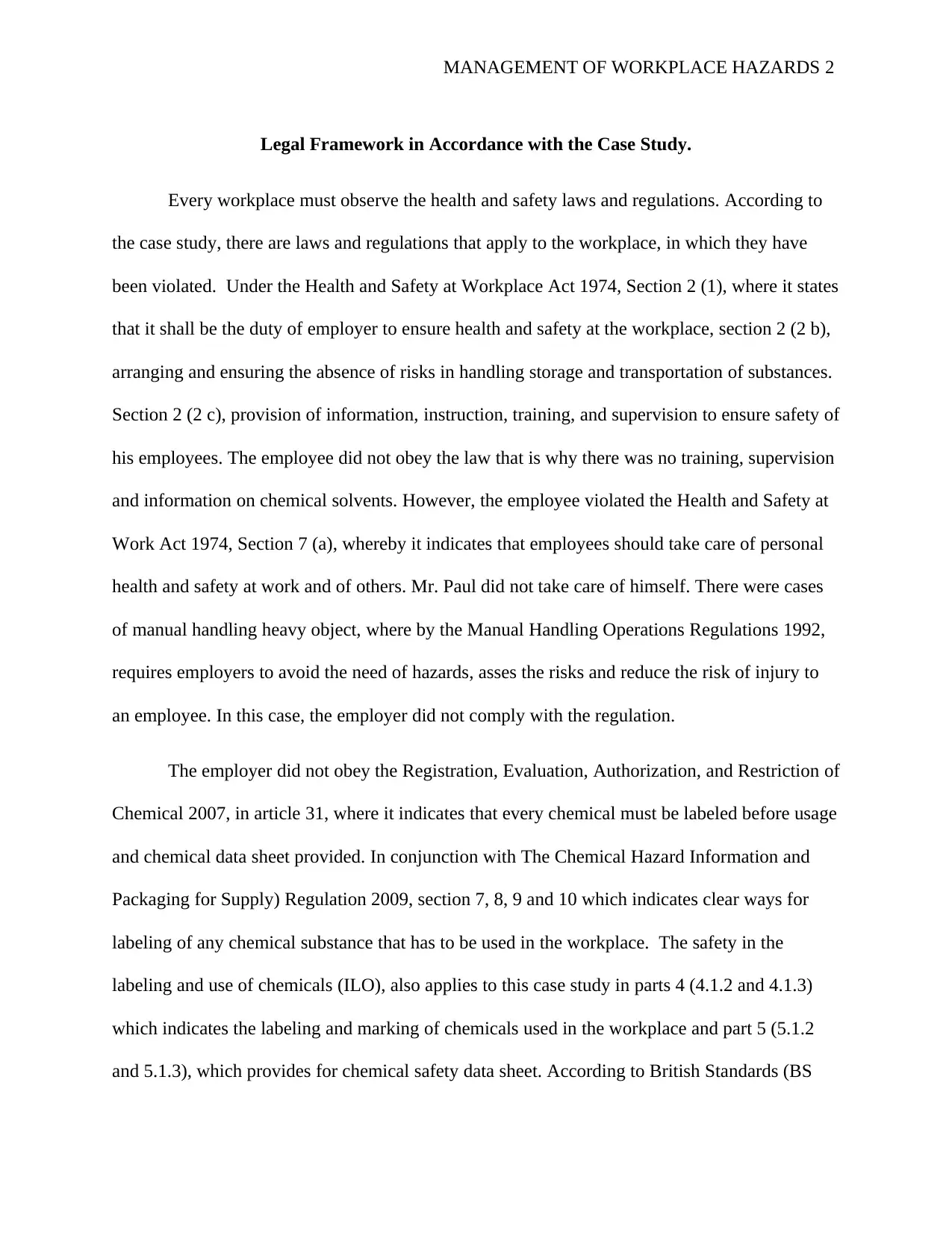
Legal Framework in Accordance with the Case Study.
Every workplace must observe the health and safety laws and regulations. According to
the case study, there are laws and regulations that apply to the workplace, in which they have
been violated. Under the Health and Safety at Workplace Act 1974, Section 2 (1), where it states
that it shall be the duty of employer to ensure health and safety at the workplace, section 2 (2 b),
arranging and ensuring the absence of risks in handling storage and transportation of substances.
Section 2 (2 c), provision of information, instruction, training, and supervision to ensure safety of
his employees. The employee did not obey the law that is why there was no training, supervision
and information on chemical solvents. However, the employee violated the Health and Safety at
Work Act 1974, Section 7 (a), whereby it indicates that employees should take care of personal
health and safety at work and of others. Mr. Paul did not take care of himself. There were cases
of manual handling heavy object, where by the Manual Handling Operations Regulations 1992,
requires employers to avoid the need of hazards, asses the risks and reduce the risk of injury to
an employee. In this case, the employer did not comply with the regulation.
The employer did not obey the Registration, Evaluation, Authorization, and Restriction of
Chemical 2007, in article 31, where it indicates that every chemical must be labeled before usage
and chemical data sheet provided. In conjunction with The Chemical Hazard Information and
Packaging for Supply) Regulation 2009, section 7, 8, 9 and 10 which indicates clear ways for
labeling of any chemical substance that has to be used in the workplace. The safety in the
labeling and use of chemicals (ILO), also applies to this case study in parts 4 (4.1.2 and 4.1.3)
which indicates the labeling and marking of chemicals used in the workplace and part 5 (5.1.2
and 5.1.3), which provides for chemical safety data sheet. According to British Standards (BS
Legal Framework in Accordance with the Case Study.
Every workplace must observe the health and safety laws and regulations. According to
the case study, there are laws and regulations that apply to the workplace, in which they have
been violated. Under the Health and Safety at Workplace Act 1974, Section 2 (1), where it states
that it shall be the duty of employer to ensure health and safety at the workplace, section 2 (2 b),
arranging and ensuring the absence of risks in handling storage and transportation of substances.
Section 2 (2 c), provision of information, instruction, training, and supervision to ensure safety of
his employees. The employee did not obey the law that is why there was no training, supervision
and information on chemical solvents. However, the employee violated the Health and Safety at
Work Act 1974, Section 7 (a), whereby it indicates that employees should take care of personal
health and safety at work and of others. Mr. Paul did not take care of himself. There were cases
of manual handling heavy object, where by the Manual Handling Operations Regulations 1992,
requires employers to avoid the need of hazards, asses the risks and reduce the risk of injury to
an employee. In this case, the employer did not comply with the regulation.
The employer did not obey the Registration, Evaluation, Authorization, and Restriction of
Chemical 2007, in article 31, where it indicates that every chemical must be labeled before usage
and chemical data sheet provided. In conjunction with The Chemical Hazard Information and
Packaging for Supply) Regulation 2009, section 7, 8, 9 and 10 which indicates clear ways for
labeling of any chemical substance that has to be used in the workplace. The safety in the
labeling and use of chemicals (ILO), also applies to this case study in parts 4 (4.1.2 and 4.1.3)
which indicates the labeling and marking of chemicals used in the workplace and part 5 (5.1.2
and 5.1.3), which provides for chemical safety data sheet. According to British Standards (BS

MANAGEMENT OF WORKPLACE HAZARDS 3
EN 482:2012+A1:2015, 689:1996 and 6069-3.7:1996), all chemicals used in the workplace must
be tested in order to identify their effects to a person, (Shop.bsigroup.com, 2018). Generally, the
workplace did not comply with the laws and regulations that govern workplaces.
Hazards and Risks Present in the Mechanical Workshop
Mechanical workshops just like any other workplace pose serious hazards and risks to
employees due to work activities are undertaken in the workshop (Dale 2016, p. 68). Some of the
activities are welding, drilling, cutting and use of a lathe. A hazard is any possible source that
can lead to injury or cause adversative health effects to a person (Hilton, 2016). A risk is a
likelihood or the probability that an individual may be harmed or undergo adverse health effects
when exposed to a hazard (Pesce 2015, p. 347). Hazards can be categorized as physical,
chemical, biological, ergonomics, psychosocial or safety hazards (Lopes, 2015). Basing on the
case study on an accident that happened at the mechanical workshop, the following are potential
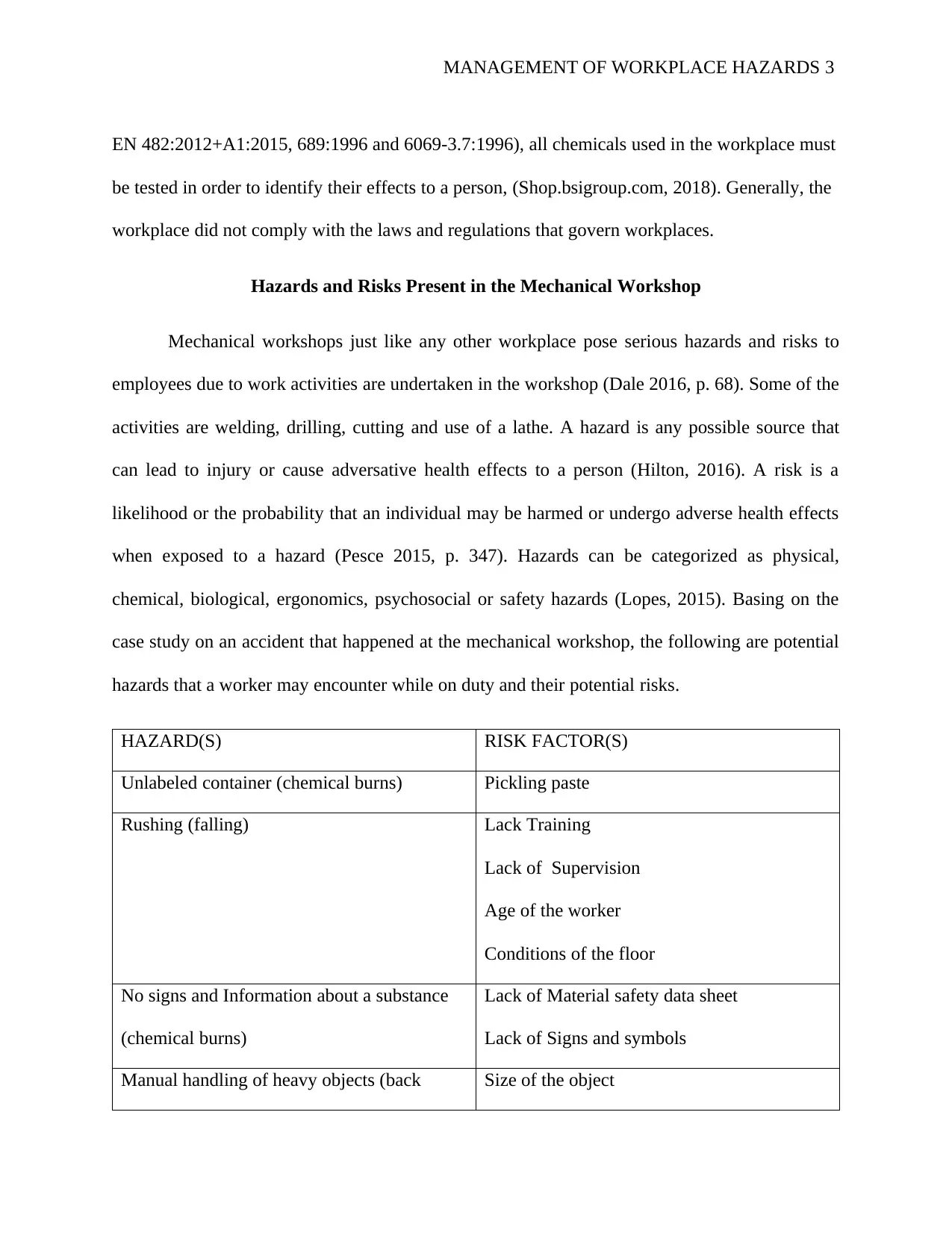
hazards that a worker may encounter while on duty and their potential risks.
HAZARD(S) RISK FACTOR(S)
Unlabeled container (chemical burns) Pickling paste
Rushing (falling) Lack Training
Lack of Supervision
Age of the worker
Conditions of the floor
No signs and Information about a substance
(chemical burns)
Lack of Material safety data sheet
Lack of Signs and symbols
Manual handling of heavy objects (back Size of the object
EN 482:2012+A1:2015, 689:1996 and 6069-3.7:1996), all chemicals used in the workplace must
be tested in order to identify their effects to a person, (Shop.bsigroup.com, 2018). Generally, the
workplace did not comply with the laws and regulations that govern workplaces.
Hazards and Risks Present in the Mechanical Workshop
Mechanical workshops just like any other workplace pose serious hazards and risks to
employees due to work activities are undertaken in the workshop (Dale 2016, p. 68). Some of the
activities are welding, drilling, cutting and use of a lathe. A hazard is any possible source that
can lead to injury or cause adversative health effects to a person (Hilton, 2016). A risk is a
likelihood or the probability that an individual may be harmed or undergo adverse health effects
when exposed to a hazard (Pesce 2015, p. 347). Hazards can be categorized as physical,
chemical, biological, ergonomics, psychosocial or safety hazards (Lopes, 2015). Basing on the
case study on an accident that happened at the mechanical workshop, the following are potential
hazards that a worker may encounter while on duty and their potential risks.
HAZARD(S) RISK FACTOR(S)
Unlabeled container (chemical burns) Pickling paste
Rushing (falling) Lack Training
Lack of Supervision
Age of the worker
Conditions of the floor
No signs and Information about a substance
(chemical burns)
Lack of Material safety data sheet
Lack of Signs and symbols
Manual handling of heavy objects (back Size of the object
⊘ This is a preview!⊘
Do you want full access?
Subscribe today to unlock all pages.

Trusted by 1+ million students worldwide

MANAGEMENT OF WORKPLACE HAZARDS 4
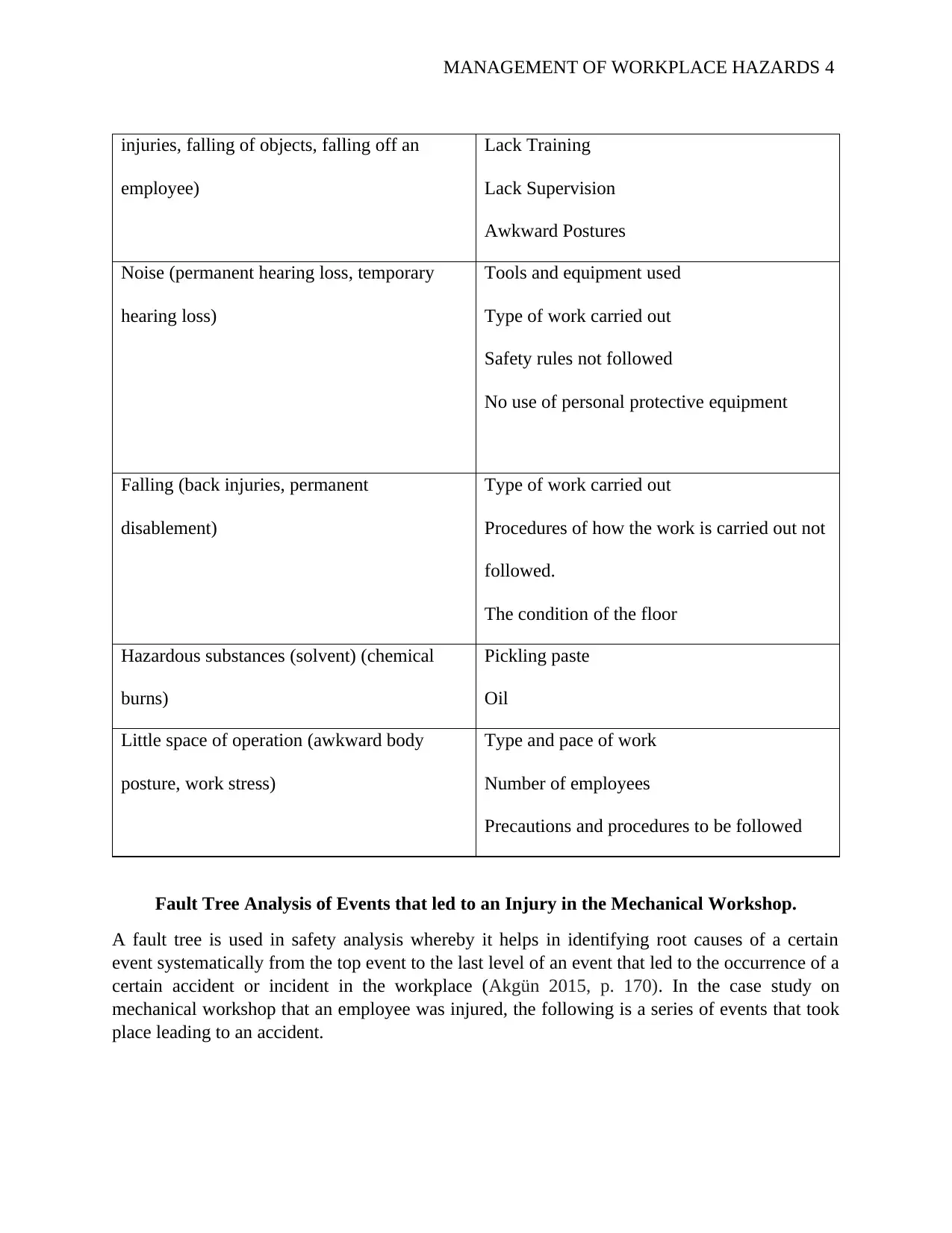
injuries, falling of objects, falling off an
employee)
Lack Training
Lack Supervision
Awkward Postures
Noise (permanent hearing loss, temporary
hearing loss)
Tools and equipment used
Type of work carried out
Safety rules not followed
No use of personal protective equipment
Falling (back injuries, permanent
disablement)
Type of work carried out
Procedures of how the work is carried out not
followed.
The condition of the floor
Hazardous substances (solvent) (chemical
burns)
Pickling paste
Oil
Little space of operation (awkward body
posture, work stress)
Type and pace of work
Number of employees
Precautions and procedures to be followed
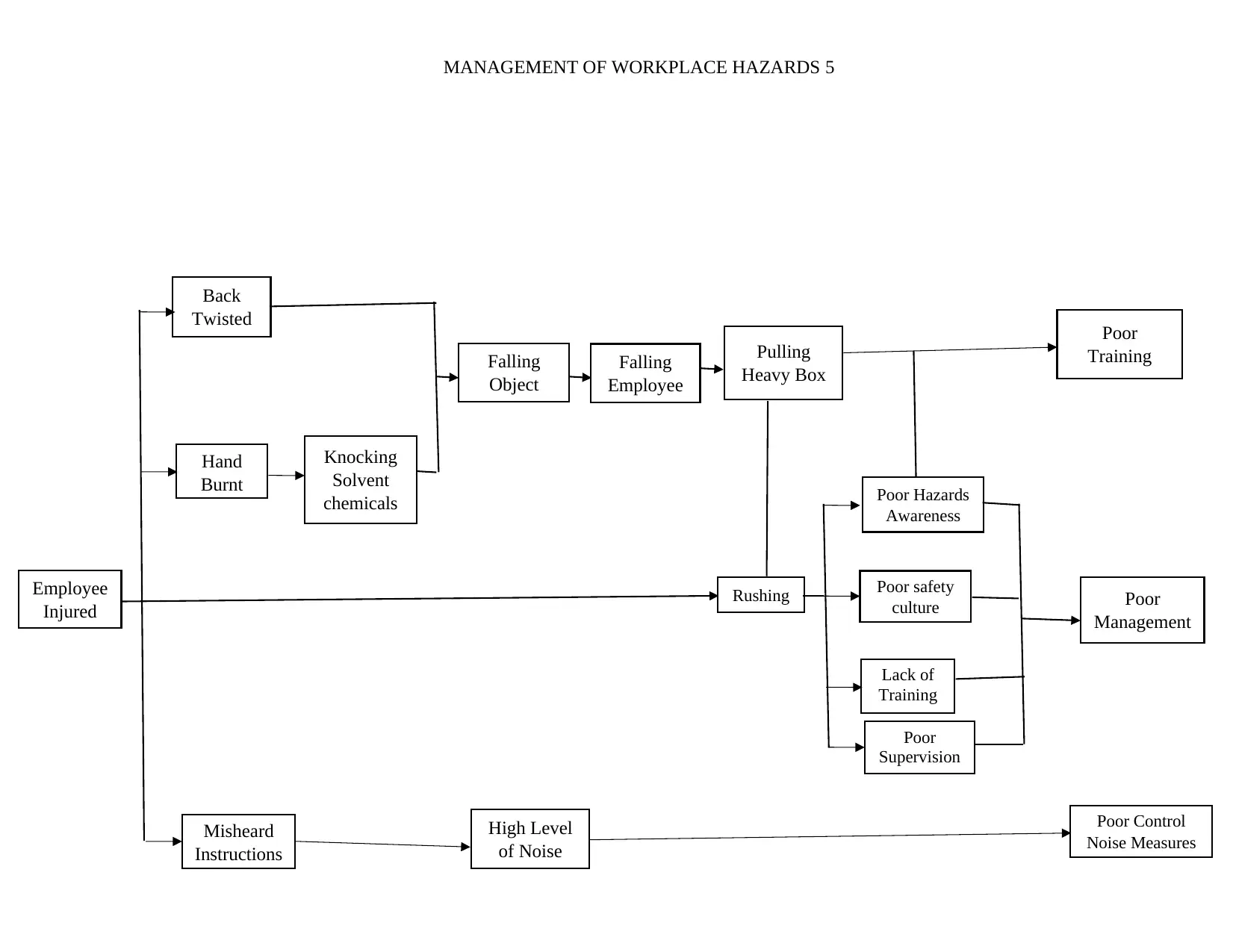
Fault Tree Analysis of Events that led to an Injury in the Mechanical Workshop.
A fault tree is used in safety analysis whereby it helps in identifying root causes of a certain
event systematically from the top event to the last level of an event that led to the occurrence of a
certain accident or incident in the workplace (Akgün 2015, p. 170). In the case study on
mechanical workshop that an employee was injured, the following is a series of events that took
place leading to an accident.
injuries, falling of objects, falling off an
employee)
Lack Training
Lack Supervision
Awkward Postures
Noise (permanent hearing loss, temporary
hearing loss)
Tools and equipment used
Type of work carried out
Safety rules not followed
No use of personal protective equipment
Falling (back injuries, permanent
disablement)
Type of work carried out
Procedures of how the work is carried out not
followed.
The condition of the floor
Hazardous substances (solvent) (chemical
burns)
Pickling paste
Oil
Little space of operation (awkward body
posture, work stress)
Type and pace of work
Number of employees
Precautions and procedures to be followed
Fault Tree Analysis of Events that led to an Injury in the Mechanical Workshop.
A fault tree is used in safety analysis whereby it helps in identifying root causes of a certain
event systematically from the top event to the last level of an event that led to the occurrence of a
certain accident or incident in the workplace (Akgün 2015, p. 170). In the case study on
mechanical workshop that an employee was injured, the following is a series of events that took
place leading to an accident.
Paraphrase This Document
Need a fresh take? Get an instant paraphrase of this document with our AI Paraphraser

MANAGEMENT OF WORKPLACE HAZARDS 5
Back
Twisted
Rushing
Hand
Burnt
Falling
Object
Falling
Employee
Pulling
Heavy Box
Lack of
Training
Knocking
Solvent
chemicals
Poor Control
Noise Measures
High Level
of Noise
Misheard
Instructions
Employee
Injured
Poor
Training
Poor
Management
Poor
Supervision
Poor Hazards
Awareness
Poor safety
culture
Back
Twisted
Rushing
Hand
Burnt
Falling
Object
Falling
Employee
Pulling
Heavy Box
Lack of
Training
Knocking
Solvent
chemicals
Poor Control
Noise Measures
High Level
of Noise
Misheard
Instructions
Employee
Injured
Poor
Training
Poor
Management
Poor
Supervision
Poor Hazards
Awareness
Poor safety
culture

MANAGEMENT OF WORKPLACE HAZARDS 6
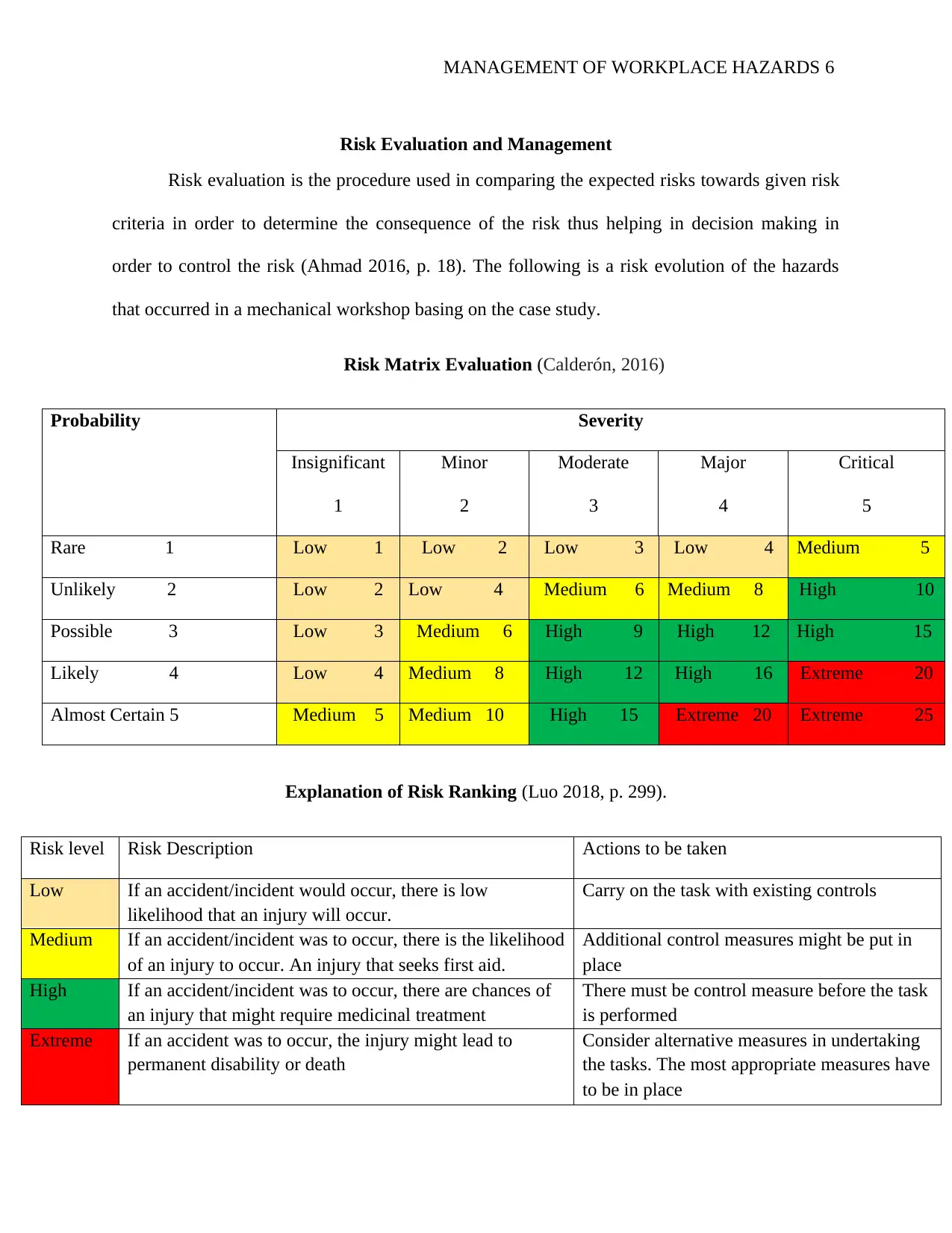
Risk Evaluation and Management
Risk evaluation is the procedure used in comparing the expected risks towards given risk
criteria in order to determine the consequence of the risk thus helping in decision making in
order to control the risk (Ahmad 2016, p. 18). The following is a risk evolution of the hazards
that occurred in a mechanical workshop basing on the case study.
Risk Matrix Evaluation (Calderón, 2016)
Probability Severity
Insignificant
1
Minor
2
Moderate
3
Major
4
Critical
5
Rare 1 Low 1 Low 2 Low 3 Low 4 Medium 5
Unlikely 2 Low 2 Low 4 Medium 6 Medium 8 High 10
Possible 3 Low 3 Medium 6 High 9 High 12 High 15
Likely 4 Low 4 Medium 8 High 12 High 16 Extreme 20
Almost Certain 5 Medium 5 Medium 10 High 15 Extreme 20 Extreme 25
Explanation of Risk Ranking (Luo 2018, p. 299).
Risk level Risk Description Actions to be taken
Low If an accident/incident would occur, there is low
likelihood that an injury will occur.
Carry on the task with existing controls
Medium If an accident/incident was to occur, there is the likelihood
of an injury to occur. An injury that seeks first aid.
Additional control measures might be put in
place
High If an accident/incident was to occur, there are chances of
an injury that might require medicinal treatment
There must be control measure before the task
is performed
Extreme If an accident was to occur, the injury might lead to
permanent disability or death
Consider alternative measures in undertaking
the tasks. The most appropriate measures have
to be in place
Risk Evaluation and Management
Risk evaluation is the procedure used in comparing the expected risks towards given risk
criteria in order to determine the consequence of the risk thus helping in decision making in
order to control the risk (Ahmad 2016, p. 18). The following is a risk evolution of the hazards
that occurred in a mechanical workshop basing on the case study.
Risk Matrix Evaluation (Calderón, 2016)
Probability Severity
Insignificant
1
Minor
2
Moderate
3
Major
4
Critical
5
Rare 1 Low 1 Low 2 Low 3 Low 4 Medium 5
Unlikely 2 Low 2 Low 4 Medium 6 Medium 8 High 10
Possible 3 Low 3 Medium 6 High 9 High 12 High 15
Likely 4 Low 4 Medium 8 High 12 High 16 Extreme 20
Almost Certain 5 Medium 5 Medium 10 High 15 Extreme 20 Extreme 25
Explanation of Risk Ranking (Luo 2018, p. 299).
Risk level Risk Description Actions to be taken
Low If an accident/incident would occur, there is low
likelihood that an injury will occur.
Carry on the task with existing controls
Medium If an accident/incident was to occur, there is the likelihood
of an injury to occur. An injury that seeks first aid.
Additional control measures might be put in
place
High If an accident/incident was to occur, there are chances of
an injury that might require medicinal treatment
There must be control measure before the task
is performed
Extreme If an accident was to occur, the injury might lead to
permanent disability or death
Consider alternative measures in undertaking
the tasks. The most appropriate measures have
to be in place
⊘ This is a preview!⊘
Do you want full access?
Subscribe today to unlock all pages.

Trusted by 1+ million students worldwide

MANAGEMENT OF WORKPLACE HAZARDS 7
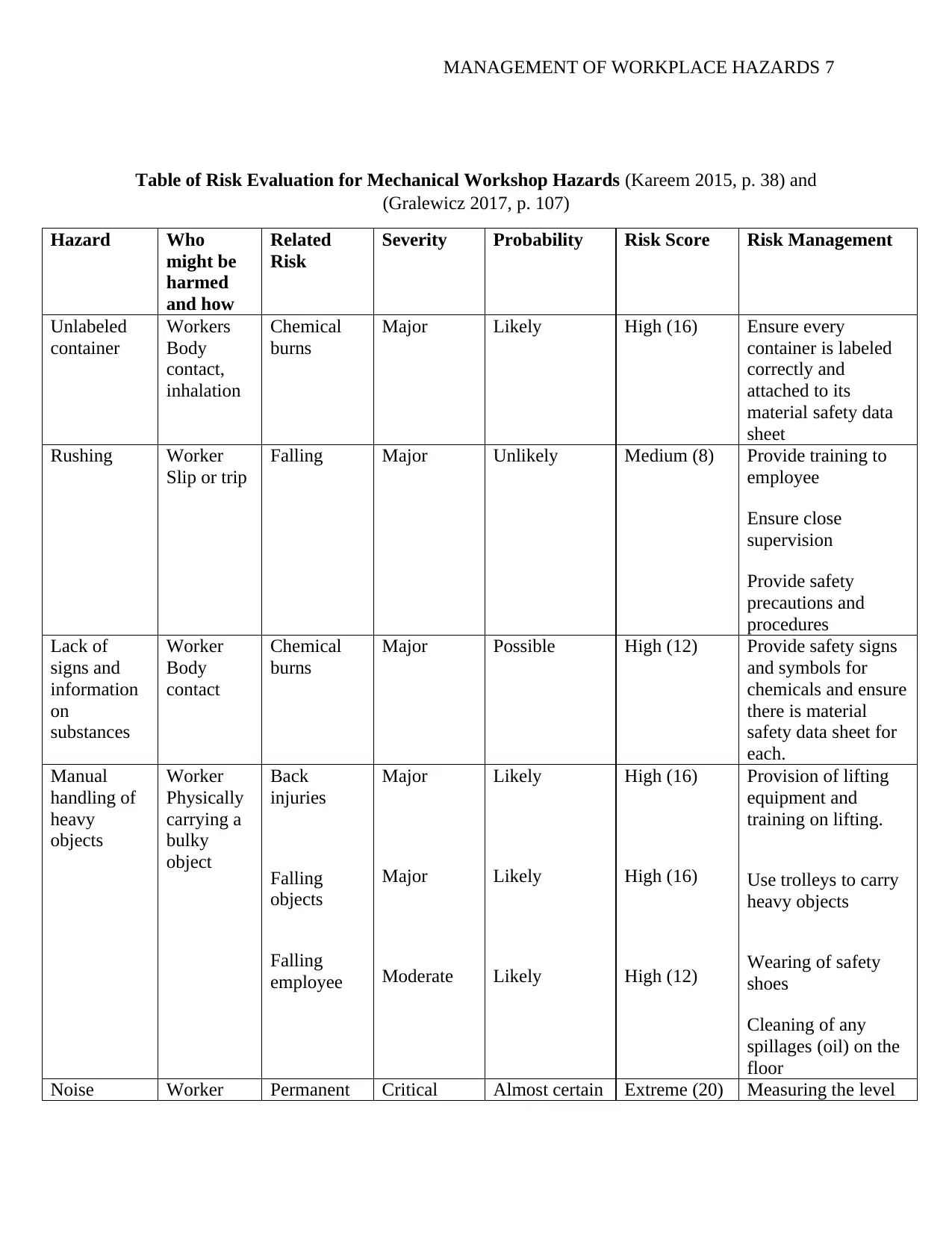
Table of Risk Evaluation for Mechanical Workshop Hazards (Kareem 2015, p. 38) and
(Gralewicz 2017, p. 107)
Hazard Who
might be
harmed
and how
Related
Risk
Severity Probability Risk Score Risk Management
Unlabeled
container
Workers
Body
contact,
inhalation
Chemical
burns
Major Likely High (16) Ensure every
container is labeled
correctly and
attached to its
material safety data
sheet
Rushing Worker
Slip or trip
Falling Major Unlikely Medium (8) Provide training to
employee
Ensure close
supervision
Provide safety
precautions and
procedures
Lack of
signs and
information
on
substances
Worker
Body
contact
Chemical
burns
Major Possible High (12) Provide safety signs
and symbols for
chemicals and ensure
there is material
safety data sheet for
each.
Manual
handling of
heavy
objects
Worker
Physically
carrying a
bulky
object
Back
injuries
Falling
objects
Falling
employee
Major
Major
Moderate
Likely
Likely
Likely
High (16)
High (16)
High (12)
Provision of lifting
equipment and
training on lifting.
Use trolleys to carry
heavy objects
Wearing of safety
shoes
Cleaning of any
spillages (oil) on the
floor
Noise Worker Permanent Critical Almost certain Extreme (20) Measuring the level
Table of Risk Evaluation for Mechanical Workshop Hazards (Kareem 2015, p. 38) and
(Gralewicz 2017, p. 107)
Hazard Who
might be
harmed
and how
Related
Risk
Severity Probability Risk Score Risk Management
Unlabeled
container
Workers
Body
contact,
inhalation
Chemical
burns
Major Likely High (16) Ensure every
container is labeled
correctly and
attached to its
material safety data
sheet
Rushing Worker
Slip or trip
Falling Major Unlikely Medium (8) Provide training to
employee
Ensure close
supervision
Provide safety
precautions and
procedures
Lack of
signs and
information
on
substances
Worker
Body
contact
Chemical
burns
Major Possible High (12) Provide safety signs
and symbols for
chemicals and ensure
there is material
safety data sheet for
each.
Manual
handling of
heavy
objects
Worker
Physically
carrying a
bulky
object
Back
injuries
Falling
objects
Falling
employee
Major
Major
Moderate
Likely
Likely
Likely
High (16)
High (16)
High (12)
Provision of lifting
equipment and
training on lifting.
Use trolleys to carry
heavy objects
Wearing of safety
shoes
Cleaning of any
spillages (oil) on the
floor
Noise Worker Permanent Critical Almost certain Extreme (20) Measuring the level
Paraphrase This Document
Need a fresh take? Get an instant paraphrase of this document with our AI Paraphraser

MANAGEMENT OF WORKPLACE HAZARDS 8
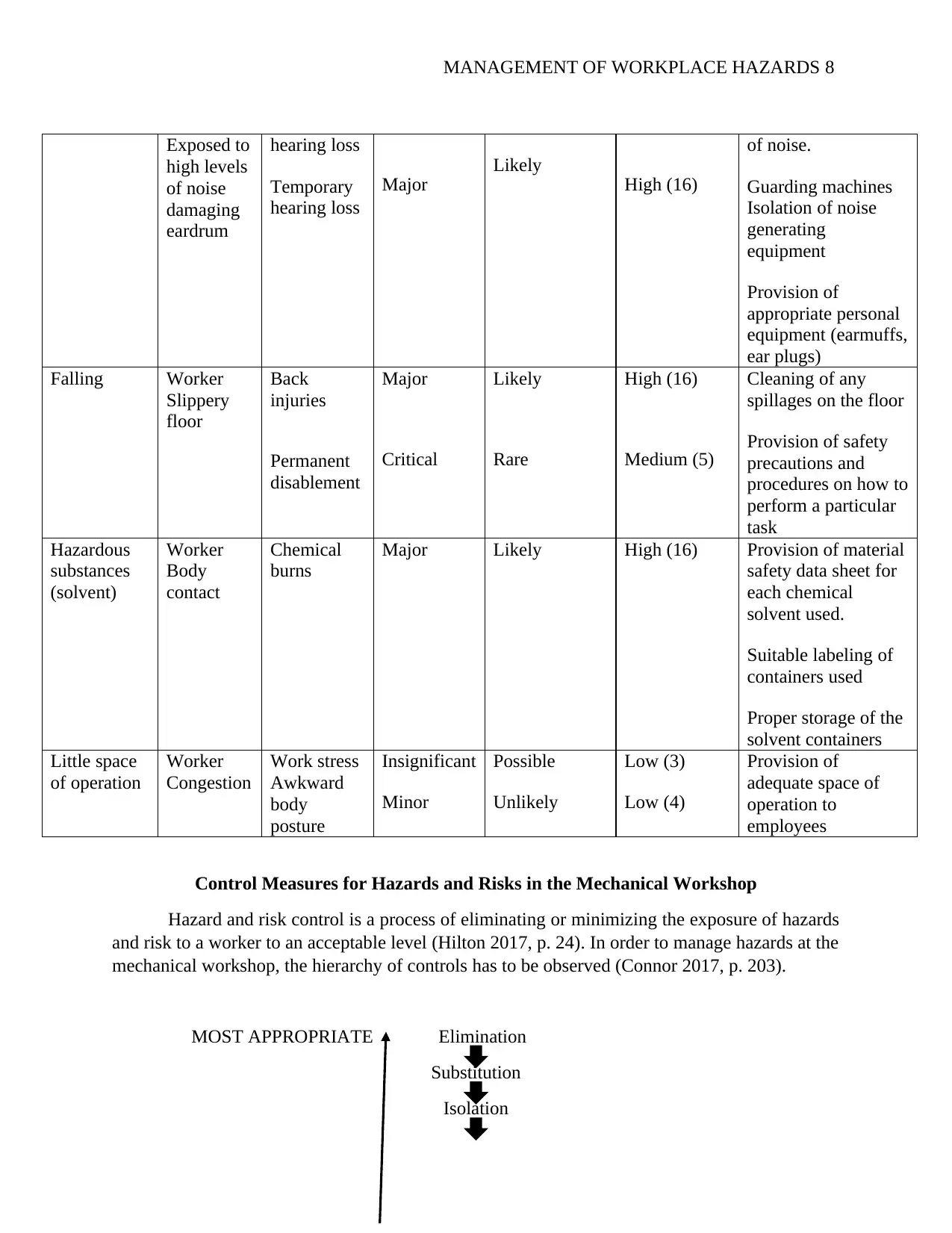
Exposed to
high levels
of noise
damaging
eardrum
hearing loss
Temporary
hearing loss
Major
Likely
High (16)
of noise.
Guarding machines
Isolation of noise
generating
equipment
Provision of
appropriate personal
equipment (earmuffs,
ear plugs)
Falling Worker
Slippery
floor
Back
injuries
Permanent
disablement
Major
Critical
Likely
Rare
High (16)
Medium (5)
Cleaning of any
spillages on the floor
Provision of safety
precautions and
procedures on how to
perform a particular
task
Hazardous
substances
(solvent)
Worker
Body
contact
Chemical
burns
Major Likely High (16) Provision of material
safety data sheet for
each chemical
solvent used.
Suitable labeling of
containers used
Proper storage of the
solvent containers
Little space
of operation
Worker
Congestion
Work stress
Awkward
body
posture
Insignificant
Minor
Possible
Unlikely
Low (3)
Low (4)
Provision of
adequate space of
operation to
employees
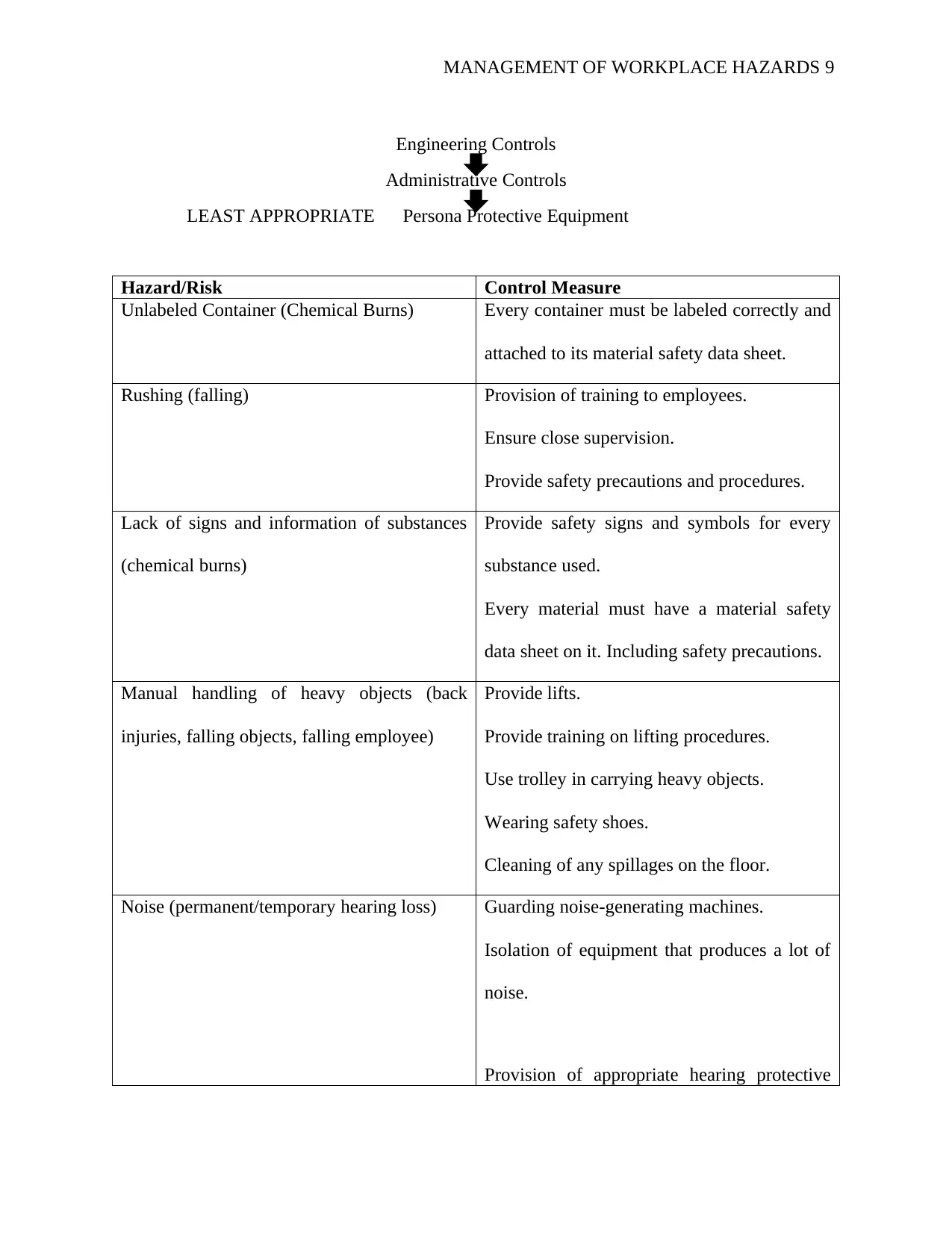
Control Measures for Hazards and Risks in the Mechanical Workshop
Hazard and risk control is a process of eliminating or minimizing the exposure of hazards
and risk to a worker to an acceptable level (Hilton 2017, p. 24). In order to manage hazards at the
mechanical workshop, the hierarchy of controls has to be observed (Connor 2017, p. 203).
MOST APPROPRIATE Elimination
Substitution
Isolation
Exposed to
high levels
of noise
damaging
eardrum
hearing loss
Temporary
hearing loss
Major
Likely
High (16)
of noise.
Guarding machines
Isolation of noise
generating
equipment
Provision of
appropriate personal
equipment (earmuffs,
ear plugs)
Falling Worker
Slippery
floor
Back
injuries
Permanent
disablement
Major
Critical
Likely
Rare
High (16)
Medium (5)
Cleaning of any
spillages on the floor
Provision of safety
precautions and
procedures on how to
perform a particular
task
Hazardous
substances
(solvent)
Worker
Body
contact
Chemical
burns
Major Likely High (16) Provision of material
safety data sheet for
each chemical
solvent used.
Suitable labeling of
containers used
Proper storage of the
solvent containers
Little space
of operation
Worker
Congestion
Work stress
Awkward
body
posture
Insignificant
Minor
Possible
Unlikely
Low (3)
Low (4)
Provision of
adequate space of
operation to
employees
Control Measures for Hazards and Risks in the Mechanical Workshop
Hazard and risk control is a process of eliminating or minimizing the exposure of hazards
and risk to a worker to an acceptable level (Hilton 2017, p. 24). In order to manage hazards at the
mechanical workshop, the hierarchy of controls has to be observed (Connor 2017, p. 203).
MOST APPROPRIATE Elimination
Substitution
Isolation

MANAGEMENT OF WORKPLACE HAZARDS 9
Engineering Controls
Administrative Controls
LEAST APPROPRIATE Persona Protective Equipment
Hazard/Risk Control Measure
Unlabeled Container (Chemical Burns) Every container must be labeled correctly and
attached to its material safety data sheet.
Rushing (falling) Provision of training to employees.
Ensure close supervision.
Provide safety precautions and procedures.
Lack of signs and information of substances
(chemical burns)
Provide safety signs and symbols for every
substance used.
Every material must have a material safety
data sheet on it. Including safety precautions.
Manual handling of heavy objects (back
injuries, falling objects, falling employee)
Provide lifts.
Provide training on lifting procedures.
Use trolley in carrying heavy objects.
Wearing safety shoes.
Cleaning of any spillages on the floor.
Noise (permanent/temporary hearing loss) Guarding noise-generating machines.
Isolation of equipment that produces a lot of
noise.
Provision of appropriate hearing protective
Engineering Controls
Administrative Controls
LEAST APPROPRIATE Persona Protective Equipment
Hazard/Risk Control Measure
Unlabeled Container (Chemical Burns) Every container must be labeled correctly and
attached to its material safety data sheet.
Rushing (falling) Provision of training to employees.
Ensure close supervision.
Provide safety precautions and procedures.
Lack of signs and information of substances
(chemical burns)
Provide safety signs and symbols for every
substance used.
Every material must have a material safety
data sheet on it. Including safety precautions.
Manual handling of heavy objects (back
injuries, falling objects, falling employee)
Provide lifts.
Provide training on lifting procedures.
Use trolley in carrying heavy objects.
Wearing safety shoes.
Cleaning of any spillages on the floor.
Noise (permanent/temporary hearing loss) Guarding noise-generating machines.
Isolation of equipment that produces a lot of
noise.
Provision of appropriate hearing protective
⊘ This is a preview!⊘
Do you want full access?
Subscribe today to unlock all pages.

Trusted by 1+ million students worldwide

MANAGEMENT OF WORKPLACE HAZARDS
10
equipment to workers such as earmuffs, canal
plugs.
Contacting health surveillance to workers
within the stipulated period.
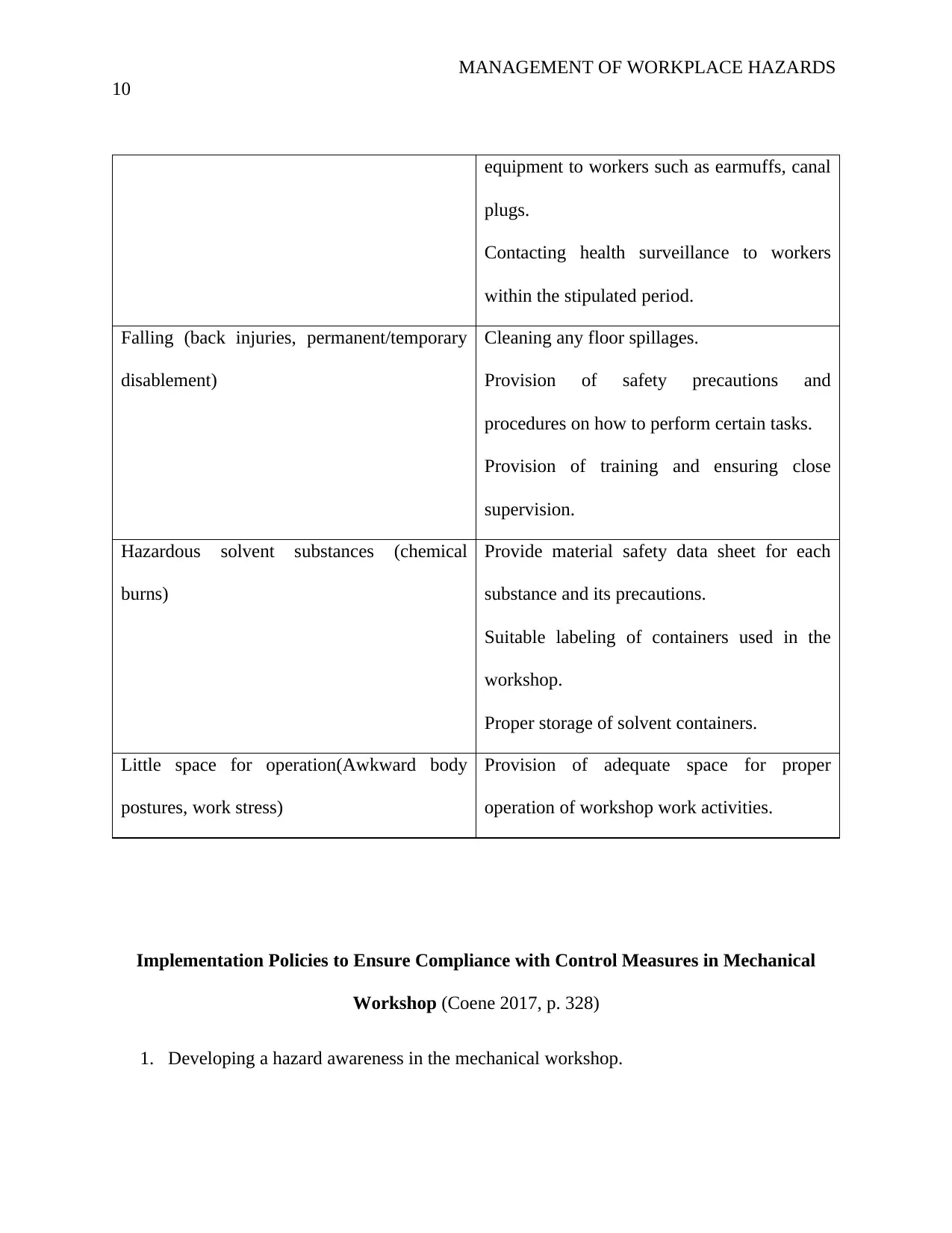
Falling (back injuries, permanent/temporary
disablement)
Cleaning any floor spillages.
Provision of safety precautions and
procedures on how to perform certain tasks.
Provision of training and ensuring close
supervision.
Hazardous solvent substances (chemical
burns)
Provide material safety data sheet for each
substance and its precautions.
Suitable labeling of containers used in the
workshop.
Proper storage of solvent containers.
Little space for operation(Awkward body
postures, work stress)
Provision of adequate space for proper
operation of workshop work activities.
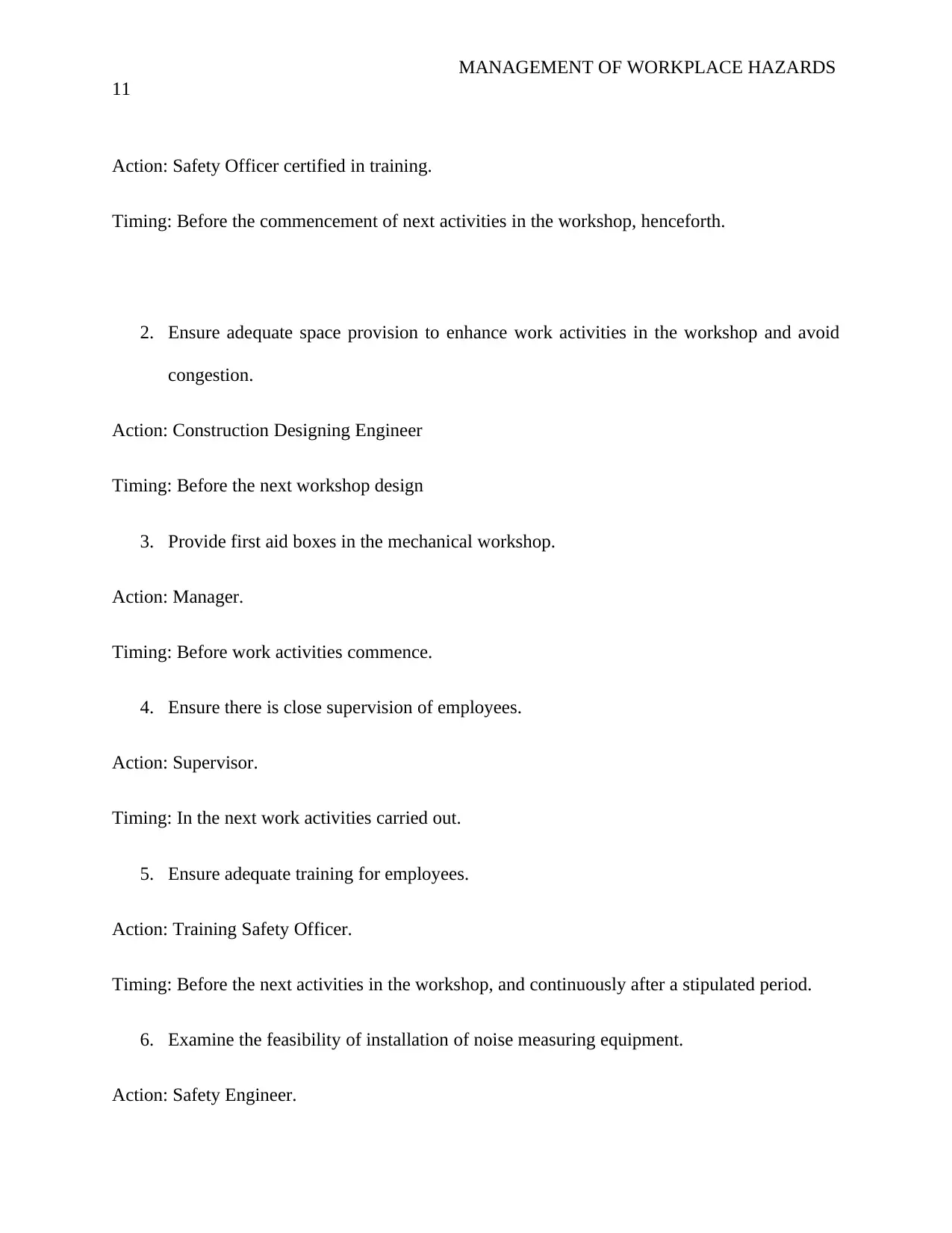
Implementation Policies to Ensure Compliance with Control Measures in Mechanical
Workshop (Coene 2017, p. 328)
1. Developing a hazard awareness in the mechanical workshop.
10
equipment to workers such as earmuffs, canal
plugs.
Contacting health surveillance to workers
within the stipulated period.
Falling (back injuries, permanent/temporary
disablement)
Cleaning any floor spillages.
Provision of safety precautions and
procedures on how to perform certain tasks.
Provision of training and ensuring close
supervision.
Hazardous solvent substances (chemical
burns)
Provide material safety data sheet for each
substance and its precautions.
Suitable labeling of containers used in the
workshop.
Proper storage of solvent containers.
Little space for operation(Awkward body
postures, work stress)
Provision of adequate space for proper
operation of workshop work activities.
Implementation Policies to Ensure Compliance with Control Measures in Mechanical
Workshop (Coene 2017, p. 328)
1. Developing a hazard awareness in the mechanical workshop.
Paraphrase This Document
Need a fresh take? Get an instant paraphrase of this document with our AI Paraphraser

MANAGEMENT OF WORKPLACE HAZARDS
11
Action: Safety Officer certified in training.
Timing: Before the commencement of next activities in the workshop, henceforth.
2. Ensure adequate space provision to enhance work activities in the workshop and avoid
congestion.
Action: Construction Designing Engineer
Timing: Before the next workshop design
3. Provide first aid boxes in the mechanical workshop.
Action: Manager.
Timing: Before work activities commence.
4. Ensure there is close supervision of employees.
Action: Supervisor.
Timing: In the next work activities carried out.
5. Ensure adequate training for employees.
Action: Training Safety Officer.
Timing: Before the next activities in the workshop, and continuously after a stipulated period.
6. Examine the feasibility of installation of noise measuring equipment.
Action: Safety Engineer.
11
Action: Safety Officer certified in training.
Timing: Before the commencement of next activities in the workshop, henceforth.
2. Ensure adequate space provision to enhance work activities in the workshop and avoid
congestion.
Action: Construction Designing Engineer
Timing: Before the next workshop design
3. Provide first aid boxes in the mechanical workshop.
Action: Manager.
Timing: Before work activities commence.
4. Ensure there is close supervision of employees.
Action: Supervisor.
Timing: In the next work activities carried out.
5. Ensure adequate training for employees.
Action: Training Safety Officer.
Timing: Before the next activities in the workshop, and continuously after a stipulated period.
6. Examine the feasibility of installation of noise measuring equipment.
Action: Safety Engineer.

MANAGEMENT OF WORKPLACE HAZARDS
12
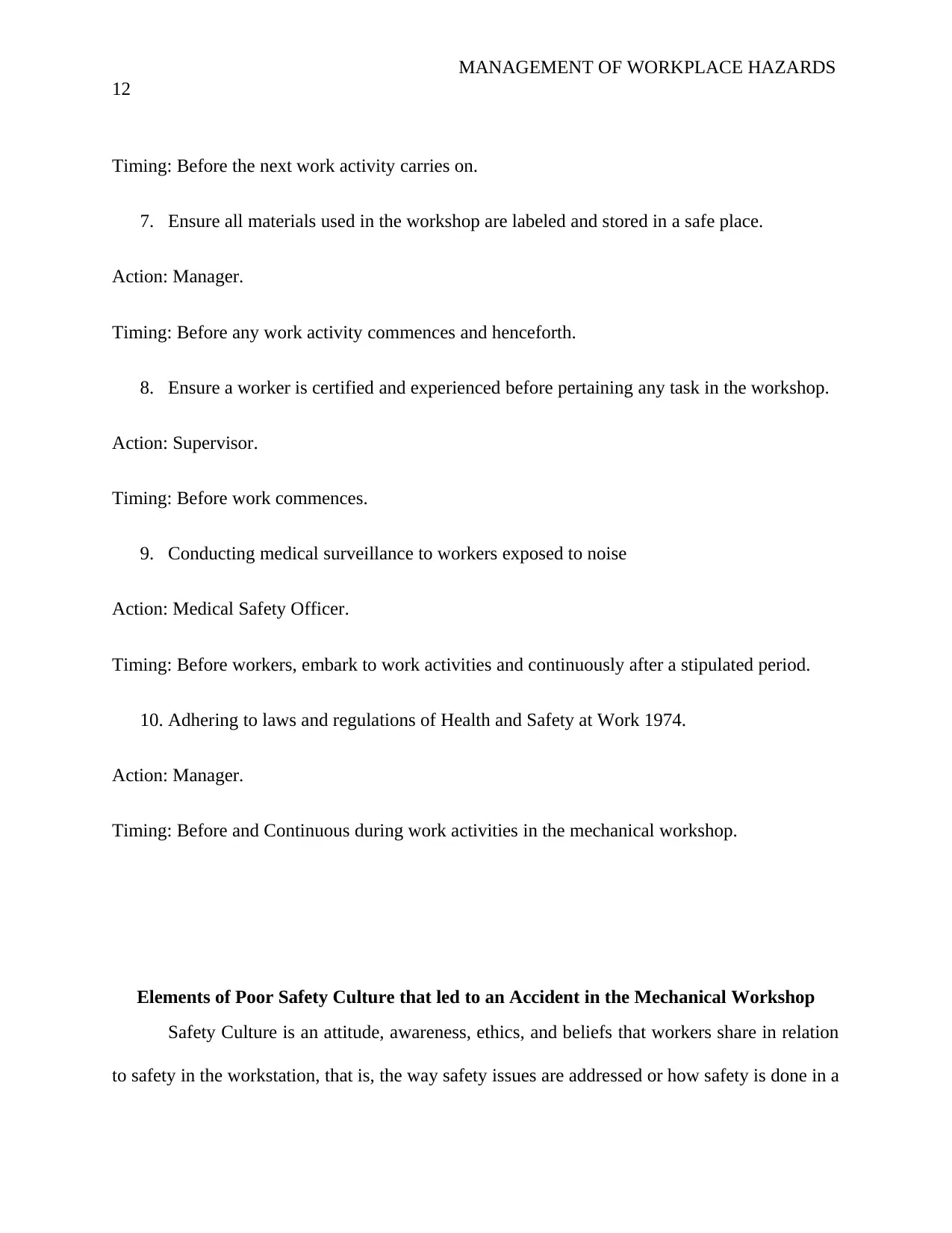
Timing: Before the next work activity carries on.
7. Ensure all materials used in the workshop are labeled and stored in a safe place.
Action: Manager.
Timing: Before any work activity commences and henceforth.
8. Ensure a worker is certified and experienced before pertaining any task in the workshop.
Action: Supervisor.
Timing: Before work commences.
9. Conducting medical surveillance to workers exposed to noise
Action: Medical Safety Officer.
Timing: Before workers, embark to work activities and continuously after a stipulated period.
10. Adhering to laws and regulations of Health and Safety at Work 1974.
Action: Manager.
Timing: Before and Continuous during work activities in the mechanical workshop.
Elements of Poor Safety Culture that led to an Accident in the Mechanical Workshop
Safety Culture is an attitude, awareness, ethics, and beliefs that workers share in relation
to safety in the workstation, that is, the way safety issues are addressed or how safety is done in a
12
Timing: Before the next work activity carries on.
7. Ensure all materials used in the workshop are labeled and stored in a safe place.
Action: Manager.
Timing: Before any work activity commences and henceforth.
8. Ensure a worker is certified and experienced before pertaining any task in the workshop.
Action: Supervisor.
Timing: Before work commences.
9. Conducting medical surveillance to workers exposed to noise
Action: Medical Safety Officer.
Timing: Before workers, embark to work activities and continuously after a stipulated period.
10. Adhering to laws and regulations of Health and Safety at Work 1974.
Action: Manager.
Timing: Before and Continuous during work activities in the mechanical workshop.
Elements of Poor Safety Culture that led to an Accident in the Mechanical Workshop
Safety Culture is an attitude, awareness, ethics, and beliefs that workers share in relation
to safety in the workstation, that is, the way safety issues are addressed or how safety is done in a
⊘ This is a preview!⊘
Do you want full access?
Subscribe today to unlock all pages.

Trusted by 1+ million students worldwide
1 out of 18
Related Documents
Your All-in-One AI-Powered Toolkit for Academic Success.
 +13062052269
info@desklib.com
Available 24*7 on WhatsApp / Email
Unlock your academic potential
Copyright © 2020–2026 A2Z Services. All Rights Reserved. Developed and managed by ZUCOL.