Legal Responsibilities and Medical Malpractice in Palliative Care

Verified

Added on  2022/12/12

|5
|1567
|228
Report
AI Summary
This report provides a critical analysis of medical malpractice as a significant legal issue within the context of palliative care. The paper begins by defining medical malpractice and its implications, particularly the failure to provide adequate care, misdiagnosis, and lack of informed consent, and how these issues negatively impact patient safety and well-being. It explores the impact of such malpractice on patients, including psychological trauma, physical suffering, and the erosion of trust between patients and medical professionals. The report then discusses the scope of practice and the financial implications, such as increased healthcare costs. Furthermore, the report emphasizes the legal responsibilities of nurses in palliative care, specifically highlighting the importance of adhering to the Nursing and Midwifery Board of Australia (NMBA) standards. It underscores that nurses must practice within their competency, maintain up-to-date knowledge, and provide reasonable and competent care to prevent malpractice. The conclusion reinforces the necessity of understanding and applying NMBA standards to ensure patient safety and quality of care, thereby mitigating the risks associated with medical malpractice in palliative care.
Document Page
Legal responsibility in
Palliative care
Student's Name:
Student's ID:
Module:
Topic: Medical malpractice a legal issue in Palliative care
Specialty area: Palliative care
Number of words: 1000
tabler-icon-diamond-filled.svg

Paraphrase This Document

Need a fresh take? Get an instant paraphrase of this document with our AI Paraphraser
Document Page
1
Introduction
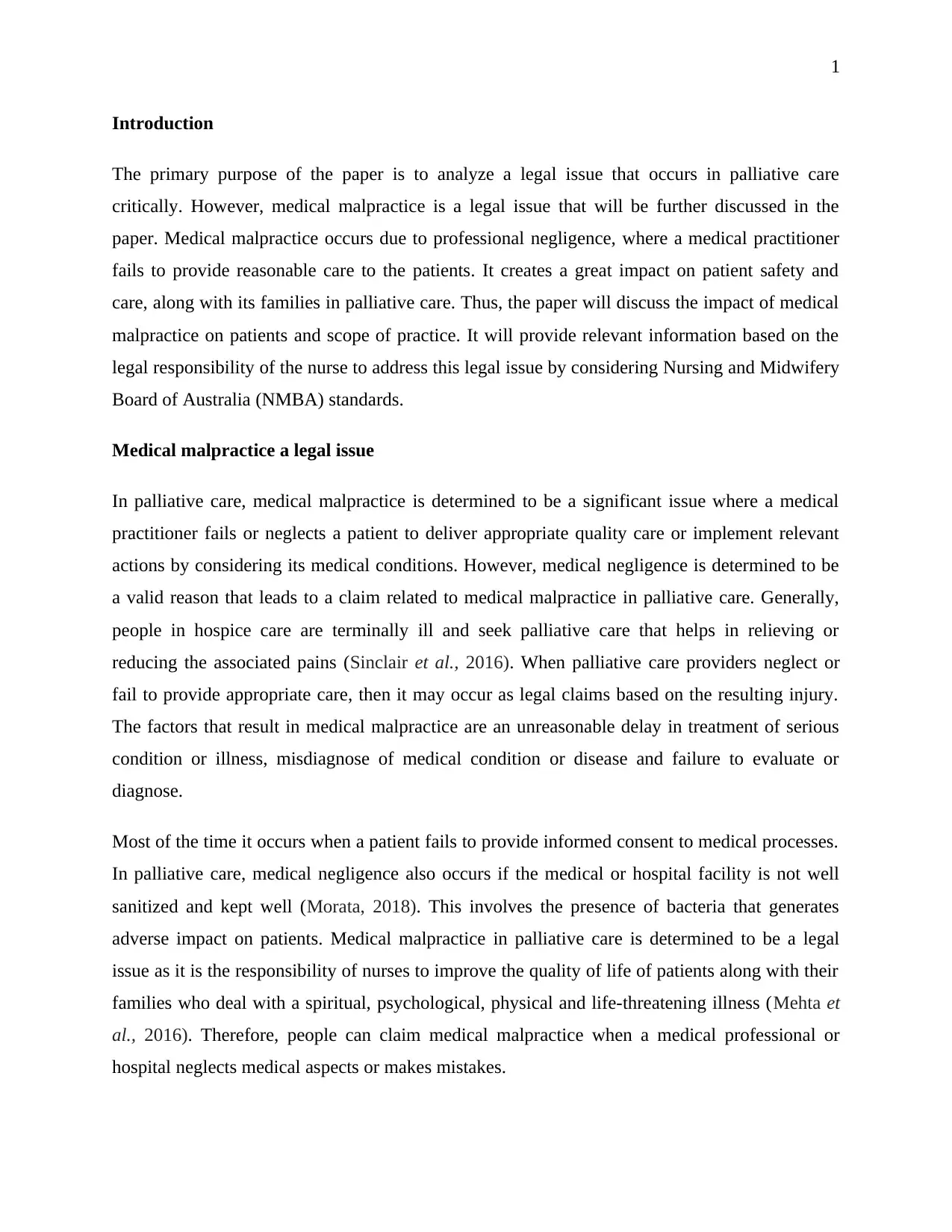
The primary purpose of the paper is to analyze a legal issue that occurs in palliative care
critically. However, medical malpractice is a legal issue that will be further discussed in the
paper. Medical malpractice occurs due to professional negligence, where a medical practitioner
fails to provide reasonable care to the patients. It creates a great impact on patient safety and
care, along with its families in palliative care. Thus, the paper will discuss the impact of medical
malpractice on patients and scope of practice. It will provide relevant information based on the
legal responsibility of the nurse to address this legal issue by considering Nursing and Midwifery
Board of Australia (NMBA) standards.
Medical malpractice a legal issue
In palliative care, medical malpractice is determined to be a significant issue where a medical
practitioner fails or neglects a patient to deliver appropriate quality care or implement relevant
actions by considering its medical conditions. However, medical negligence is determined to be
a valid reason that leads to a claim related to medical malpractice in palliative care. Generally,
people in hospice care are terminally ill and seek palliative care that helps in relieving or
reducing the associated pains (Sinclair et al., 2016). When palliative care providers neglect or
fail to provide appropriate care, then it may occur as legal claims based on the resulting injury.
The factors that result in medical malpractice are an unreasonable delay in treatment of serious
condition or illness, misdiagnose of medical condition or disease and failure to evaluate or
diagnose.
Most of the time it occurs when a patient fails to provide informed consent to medical processes.
In palliative care, medical negligence also occurs if the medical or hospital facility is not well
sanitized and kept well (Morata, 2018). This involves the presence of bacteria that generates
adverse impact on patients. Medical malpractice in palliative care is determined to be a legal
issue as it is the responsibility of nurses to improve the quality of life of patients along with their
families who deal with a spiritual, psychological, physical and life-threatening illness (Mehta et
al., 2016). Therefore, people can claim medical malpractice when a medical professional or
hospital neglects medical aspects or makes mistakes.
Document Page
2
Impact of medical malpractice on patients and the scope of practice
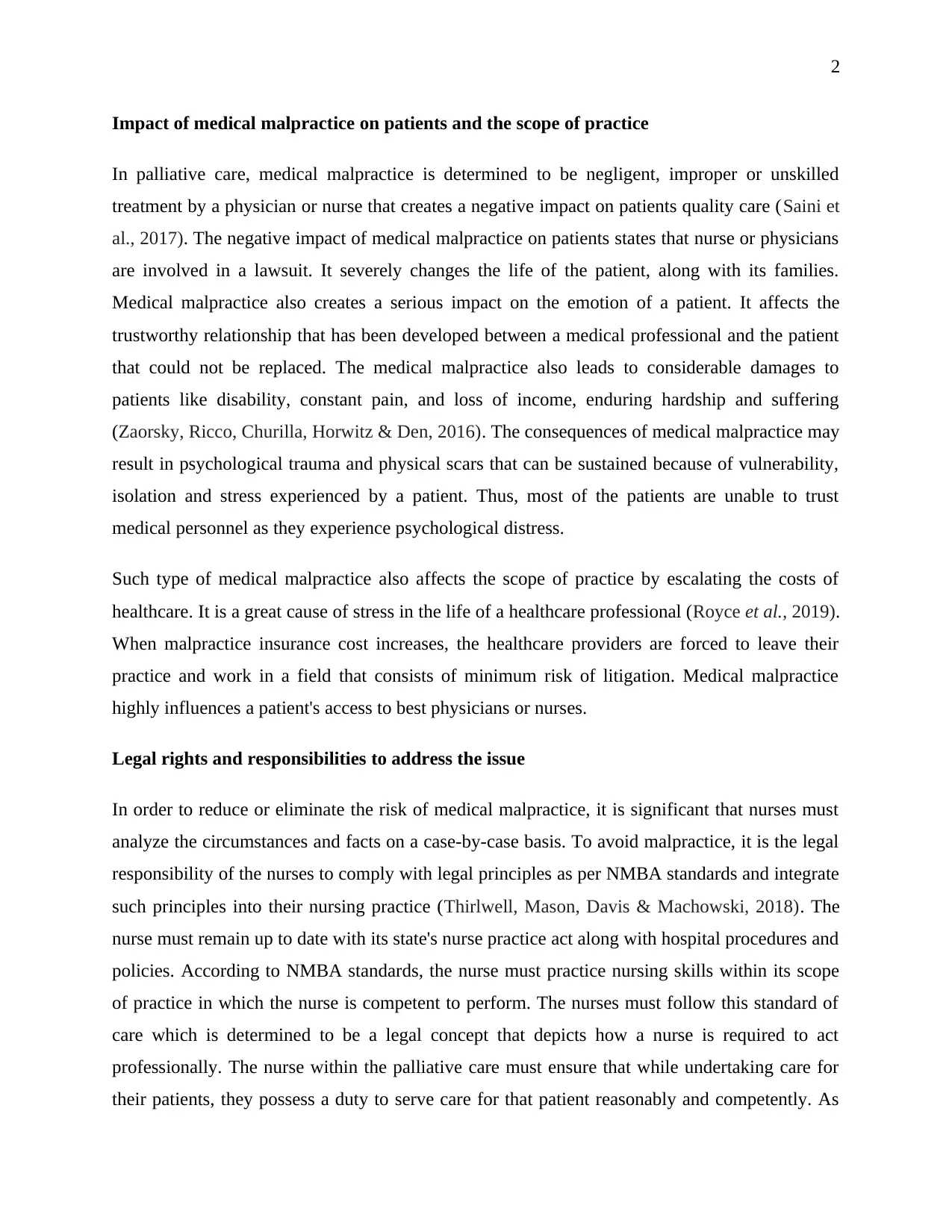
In palliative care, medical malpractice is determined to be negligent, improper or unskilled
treatment by a physician or nurse that creates a negative impact on patients quality care (Saini et
al., 2017). The negative impact of medical malpractice on patients states that nurse or physicians
are involved in a lawsuit. It severely changes the life of the patient, along with its families.
Medical malpractice also creates a serious impact on the emotion of a patient. It affects the
trustworthy relationship that has been developed between a medical professional and the patient
that could not be replaced. The medical malpractice also leads to considerable damages to
patients like disability, constant pain, and loss of income, enduring hardship and suffering
(Zaorsky, Ricco, Churilla, Horwitz & Den, 2016). The consequences of medical malpractice may
result in psychological trauma and physical scars that can be sustained because of vulnerability,
isolation and stress experienced by a patient. Thus, most of the patients are unable to trust
medical personnel as they experience psychological distress.
Such type of medical malpractice also affects the scope of practice by escalating the costs of
healthcare. It is a great cause of stress in the life of a healthcare professional (Royce et al., 2019).
When malpractice insurance cost increases, the healthcare providers are forced to leave their
practice and work in a field that consists of minimum risk of litigation. Medical malpractice
highly influences a patient's access to best physicians or nurses.
Legal rights and responsibilities to address the issue
In order to reduce or eliminate the risk of medical malpractice, it is significant that nurses must
analyze the circumstances and facts on a case-by-case basis. To avoid malpractice, it is the legal
responsibility of the nurses to comply with legal principles as per NMBA standards and integrate
such principles into their nursing practice (Thirlwell, Mason, Davis & Machowski, 2018). The
nurse must remain up to date with its state's nurse practice act along with hospital procedures and
policies. According to NMBA standards, the nurse must practice nursing skills within its scope
of practice in which the nurse is competent to perform. The nurses must follow this standard of
care which is determined to be a legal concept that depicts how a nurse is required to act
professionally. The nurse within the palliative care must ensure that while undertaking care for
their patients, they possess a duty to serve care for that patient reasonably and competently. As
Document Page
3
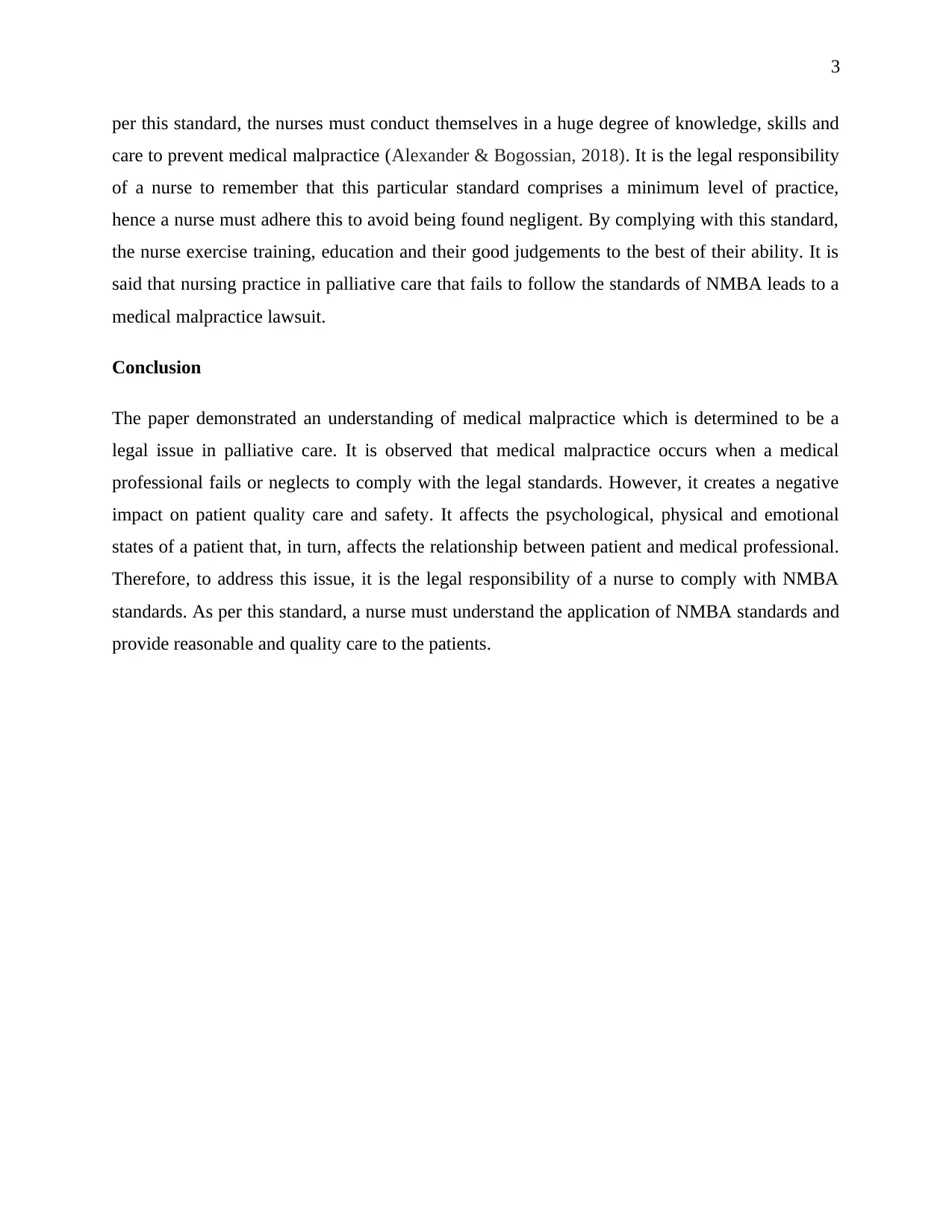
per this standard, the nurses must conduct themselves in a huge degree of knowledge, skills and
care to prevent medical malpractice (Alexander & Bogossian, 2018). It is the legal responsibility
of a nurse to remember that this particular standard comprises a minimum level of practice,
hence a nurse must adhere this to avoid being found negligent. By complying with this standard,
the nurse exercise training, education and their good judgements to the best of their ability. It is
said that nursing practice in palliative care that fails to follow the standards of NMBA leads to a
medical malpractice lawsuit.
Conclusion
The paper demonstrated an understanding of medical malpractice which is determined to be a
legal issue in palliative care. It is observed that medical malpractice occurs when a medical
professional fails or neglects to comply with the legal standards. However, it creates a negative
impact on patient quality care and safety. It affects the psychological, physical and emotional
states of a patient that, in turn, affects the relationship between patient and medical professional.
Therefore, to address this issue, it is the legal responsibility of a nurse to comply with NMBA
standards. As per this standard, a nurse must understand the application of NMBA standards and
provide reasonable and quality care to the patients.
tabler-icon-diamond-filled.svg

Paraphrase This Document

Need a fresh take? Get an instant paraphrase of this document with our AI Paraphraser
Document Page
4
References
Alexander, C. R., & Bogossian, F. (2018). Midwives and clinical investigation: A review of the
literature. Women and Birth, 31(6), 442-452.
Mehta, D. H., Perez, G. K., Traeger, L., Park, E. R., Goldman, R. E., Haime, V., ... & Jackson,
V. A. (2016). Building resiliency in a palliative care team: a pilot study. Journal of pain
and symptom management, 51(3), 604-608.
Morata, L. (2018). An evolutionary concept analysis of futility in health care. Journal of
advanced nursing, 74(6), 1289-1300.
Royce, T. J., Dwyer, K., Yu-Moe, C. W., DeRoo, C., Jacobson, J. O., & Tishler, R. B. (2019).
Medical Malpractice Analysis in Radiation Oncology: A Decade of Results From a
National Comparative Benchmarking System. International Journal of Radiation
Oncology* Biology* Physics, 103(4), 801-808.
Saini, V., Garcia-Armesto, S., Klemperer, D., Paris, V., Elshaug, A. G., Brownlee, S., ... &
Fisher, E. S. (2017). Drivers of poor medical care. The Lancet, 390(10090), 178-190.
Sinclair, S., McClement, S., Raffin-Bouchal, S., Hack, T. F., Hagen, N. A., McConnell, S., &
Chochinov, H. M. (2016). Compassion in health care: an empirical model. Journal of
pain and symptom management, 51(2), 193-203.
Thirlwell, S., Mason, T. M., Davis, D., & Machowski, T. P. (2018). Integrating Palliative Care at
the Point of Care: Development of Electronic Interdisciplinary Plans of Care for
Oncology Inpatients. Journal of Hospice & Palliative Nursing, 20(2), 129-136.
Zaorsky, N. G., Ricco, A. G., Churilla, T. M., Horwitz, E. M., & Den, R. B. (2016). ASTRO
APEx® and RO-ILS™ are applicable to medical malpractice in radiation
oncology. Future Oncology, 12(22), 2643-2657.
chevron_up_icon
1 out of 5
circle_padding
hide_on_mobile
zoom_out_icon
[object Object]