Report on Managing Responsible Selling: Sales Function Requirements
VerifiedAdded on 2019/09/30
|7
|2444
|438
Report
AI Summary
This report comprehensively examines the multifaceted aspects of managing responsible selling, encompassing legal, regulatory, and social requirements. It begins by outlining fundamental consumer laws, including those pertaining to deceptive advertising and pricing, and emphasizes the significance of ethical codes of practice, such as confidentiality, duty of care, and conflict of interest. The report delves into contract law, misrepresentation, and the ethical responsibilities of sales personnel, highlighting the potential consequences of non-compliance. It further explores the ethical and social dimensions of business, underscoring the importance of codes of ethics, ethical decision-making, and ethical culture. The report then details the parameters for ethical sales practices, including professional conduct, fair competition, transparent pricing, and product promotion. It emphasizes the need for ethics programs, employee training, and a culture of ethical behavior. Finally, the report provides a framework for ensuring compliance, including inspection, monitoring, and addressing customer complaints, offering practical steps for handling non-compliance and resolving issues effectively.
Task 1: Report on Managing Responsible Selling
1. The Legal, Regulatory and Social Requirements Pertaining sales Functions
(A) The fundamental consumer laws that affect sales and marketing of our organization are
essentially based on broad prohibition of unfair or deceptive practices. So, in light of these laws,
our organization follows the appropriate business practices. These laws and statutes are as
follows:
a) Deceptive Advertising: according to the federal and state law, any such advertisement is
considered to be unlawful if it misleads the consumers. The companies could get into a legal
trouble if the overall impression created by their advertisement deceives the consumers. So,
under state protection laws, consumers have right to sue for false and deceptive Ads (Meyerson,
n.d.).
b) Deceptive Pricing: it refers to the incorrect price comparisons with other businesses. It
also includes price reductions and less than free offers.
c) Punitive Damages: as per the consumer protection laws, there is a potent statute that is
very helpful for the consumers – punitive damages.
The code of practices are helpful for the businesses to meet the ethical selling obligations. They
help earn the trust and loyalty of the customers. The important elements of sales code of practice
that is used for the organizations are:
i. Confidentiality
ii. Ethics
iii. Duty of Care
iv. Conflict of Interest
v. Contracts
vi. Fees
vii. Payment
viii. Intellectual Property and Moral Rights
ix. Quality Assurance
x. Professional Conduct
xi. Equality and Discrimination
1. The Legal, Regulatory and Social Requirements Pertaining sales Functions
(A) The fundamental consumer laws that affect sales and marketing of our organization are
essentially based on broad prohibition of unfair or deceptive practices. So, in light of these laws,
our organization follows the appropriate business practices. These laws and statutes are as
follows:
a) Deceptive Advertising: according to the federal and state law, any such advertisement is
considered to be unlawful if it misleads the consumers. The companies could get into a legal
trouble if the overall impression created by their advertisement deceives the consumers. So,
under state protection laws, consumers have right to sue for false and deceptive Ads (Meyerson,
n.d.).
b) Deceptive Pricing: it refers to the incorrect price comparisons with other businesses. It
also includes price reductions and less than free offers.
c) Punitive Damages: as per the consumer protection laws, there is a potent statute that is
very helpful for the consumers – punitive damages.
The code of practices are helpful for the businesses to meet the ethical selling obligations. They
help earn the trust and loyalty of the customers. The important elements of sales code of practice
that is used for the organizations are:
i. Confidentiality
ii. Ethics
iii. Duty of Care
iv. Conflict of Interest
v. Contracts
vi. Fees
vii. Payment
viii. Intellectual Property and Moral Rights
ix. Quality Assurance
x. Professional Conduct
xi. Equality and Discrimination
Paraphrase This Document
Need a fresh take? Get an instant paraphrase of this document with our AI Paraphraser

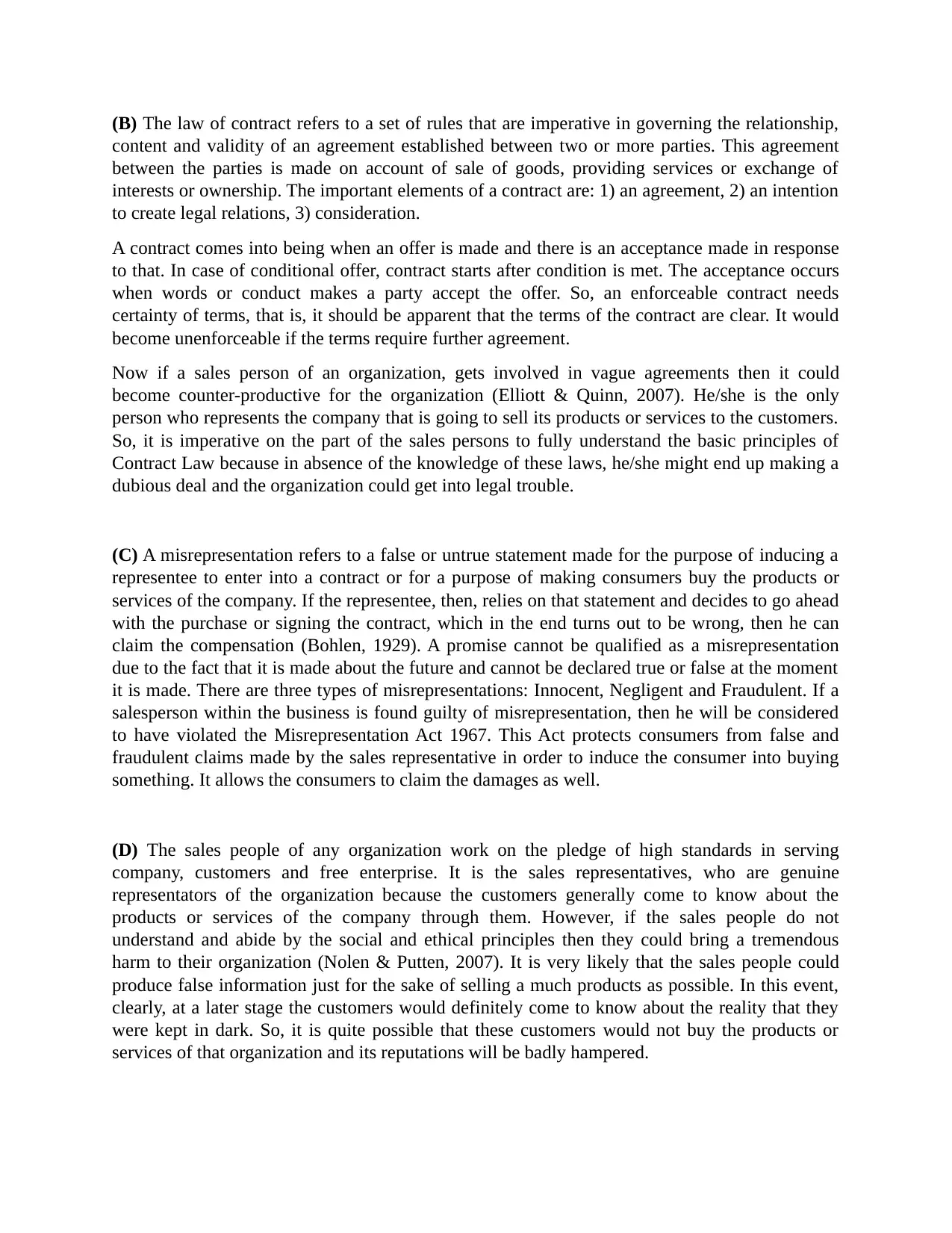
(B) The law of contract refers to a set of rules that are imperative in governing the relationship,
content and validity of an agreement established between two or more parties. This agreement
between the parties is made on account of sale of goods, providing services or exchange of
interests or ownership. The important elements of a contract are: 1) an agreement, 2) an intention
to create legal relations, 3) consideration.
A contract comes into being when an offer is made and there is an acceptance made in response
to that. In case of conditional offer, contract starts after condition is met. The acceptance occurs
when words or conduct makes a party accept the offer. So, an enforceable contract needs
certainty of terms, that is, it should be apparent that the terms of the contract are clear. It would
become unenforceable if the terms require further agreement.
Now if a sales person of an organization, gets involved in vague agreements then it could
become counter-productive for the organization (Elliott & Quinn, 2007). He/she is the only
person who represents the company that is going to sell its products or services to the customers.
So, it is imperative on the part of the sales persons to fully understand the basic principles of
Contract Law because in absence of the knowledge of these laws, he/she might end up making a
dubious deal and the organization could get into legal trouble.
(C) A misrepresentation refers to a false or untrue statement made for the purpose of inducing a
representee to enter into a contract or for a purpose of making consumers buy the products or
services of the company. If the representee, then, relies on that statement and decides to go ahead
with the purchase or signing the contract, which in the end turns out to be wrong, then he can
claim the compensation (Bohlen, 1929). A promise cannot be qualified as a misrepresentation
due to the fact that it is made about the future and cannot be declared true or false at the moment
it is made. There are three types of misrepresentations: Innocent, Negligent and Fraudulent. If a
salesperson within the business is found guilty of misrepresentation, then he will be considered
to have violated the Misrepresentation Act 1967. This Act protects consumers from false and
fraudulent claims made by the sales representative in order to induce the consumer into buying
something. It allows the consumers to claim the damages as well.
(D) The sales people of any organization work on the pledge of high standards in serving
company, customers and free enterprise. It is the sales representatives, who are genuine
representators of the organization because the customers generally come to know about the
products or services of the company through them. However, if the sales people do not
understand and abide by the social and ethical principles then they could bring a tremendous
harm to their organization (Nolen & Putten, 2007). It is very likely that the sales people could
produce false information just for the sake of selling a much products as possible. In this event,
clearly, at a later stage the customers would definitely come to know about the reality that they
were kept in dark. So, it is quite possible that these customers would not buy the products or
services of that organization and its reputations will be badly hampered.
content and validity of an agreement established between two or more parties. This agreement
between the parties is made on account of sale of goods, providing services or exchange of
interests or ownership. The important elements of a contract are: 1) an agreement, 2) an intention
to create legal relations, 3) consideration.
A contract comes into being when an offer is made and there is an acceptance made in response
to that. In case of conditional offer, contract starts after condition is met. The acceptance occurs
when words or conduct makes a party accept the offer. So, an enforceable contract needs
certainty of terms, that is, it should be apparent that the terms of the contract are clear. It would
become unenforceable if the terms require further agreement.
Now if a sales person of an organization, gets involved in vague agreements then it could
become counter-productive for the organization (Elliott & Quinn, 2007). He/she is the only
person who represents the company that is going to sell its products or services to the customers.
So, it is imperative on the part of the sales persons to fully understand the basic principles of
Contract Law because in absence of the knowledge of these laws, he/she might end up making a
dubious deal and the organization could get into legal trouble.
(C) A misrepresentation refers to a false or untrue statement made for the purpose of inducing a
representee to enter into a contract or for a purpose of making consumers buy the products or
services of the company. If the representee, then, relies on that statement and decides to go ahead
with the purchase or signing the contract, which in the end turns out to be wrong, then he can
claim the compensation (Bohlen, 1929). A promise cannot be qualified as a misrepresentation
due to the fact that it is made about the future and cannot be declared true or false at the moment
it is made. There are three types of misrepresentations: Innocent, Negligent and Fraudulent. If a
salesperson within the business is found guilty of misrepresentation, then he will be considered
to have violated the Misrepresentation Act 1967. This Act protects consumers from false and
fraudulent claims made by the sales representative in order to induce the consumer into buying
something. It allows the consumers to claim the damages as well.
(D) The sales people of any organization work on the pledge of high standards in serving
company, customers and free enterprise. It is the sales representatives, who are genuine
representators of the organization because the customers generally come to know about the
products or services of the company through them. However, if the sales people do not
understand and abide by the social and ethical principles then they could bring a tremendous
harm to their organization (Nolen & Putten, 2007). It is very likely that the sales people could
produce false information just for the sake of selling a much products as possible. In this event,
clearly, at a later stage the customers would definitely come to know about the reality that they
were kept in dark. So, it is quite possible that these customers would not buy the products or
services of that organization and its reputations will be badly hampered.

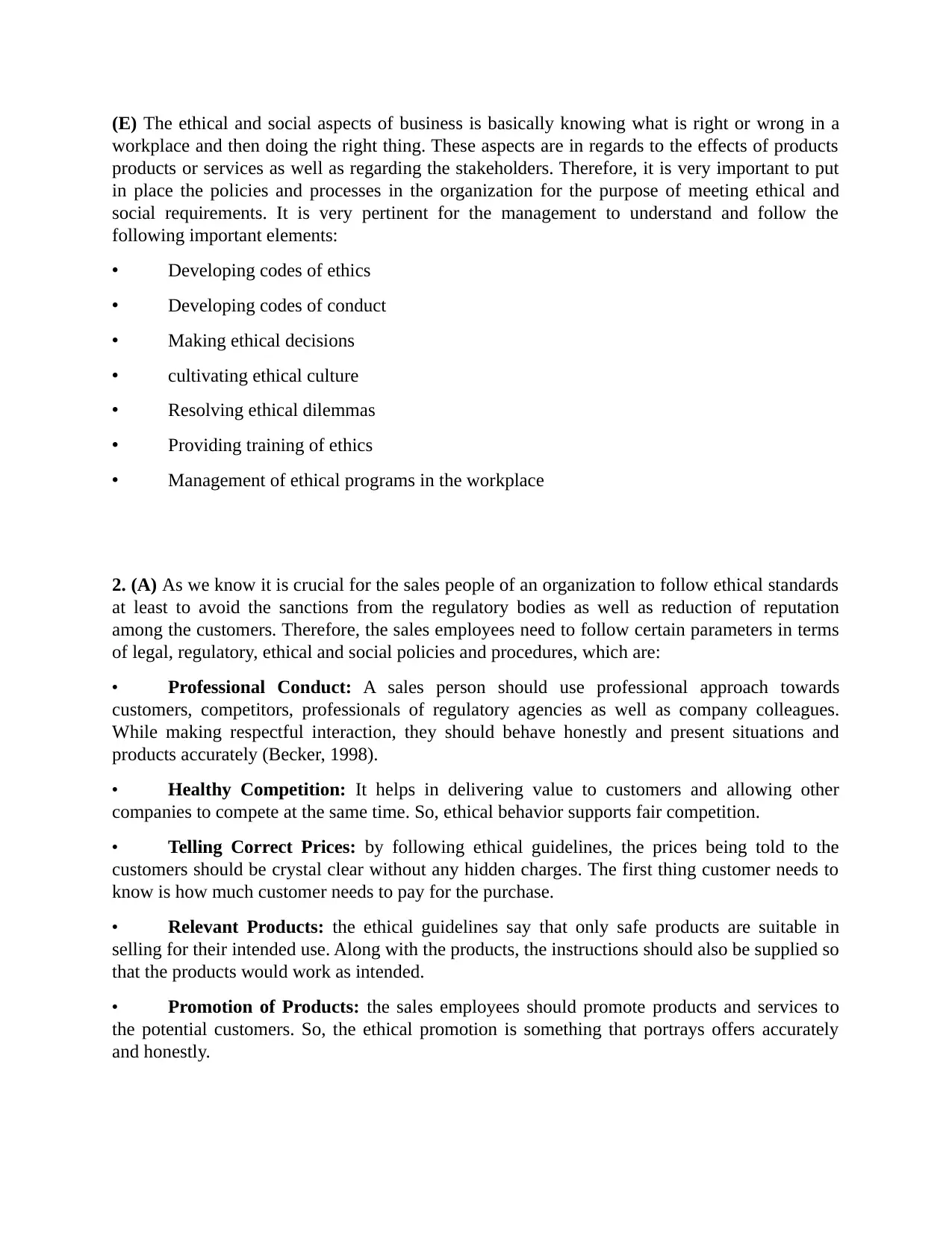
(E) The ethical and social aspects of business is basically knowing what is right or wrong in a
workplace and then doing the right thing. These aspects are in regards to the effects of products
products or services as well as regarding the stakeholders. Therefore, it is very important to put
in place the policies and processes in the organization for the purpose of meeting ethical and
social requirements. It is very pertinent for the management to understand and follow the
following important elements:
• Developing codes of ethics
• Developing codes of conduct
• Making ethical decisions
• cultivating ethical culture
• Resolving ethical dilemmas
• Providing training of ethics
• Management of ethical programs in the workplace
2. (A) As we know it is crucial for the sales people of an organization to follow ethical standards
at least to avoid the sanctions from the regulatory bodies as well as reduction of reputation
among the customers. Therefore, the sales employees need to follow certain parameters in terms
of legal, regulatory, ethical and social policies and procedures, which are:
• Professional Conduct: A sales person should use professional approach towards
customers, competitors, professionals of regulatory agencies as well as company colleagues.
While making respectful interaction, they should behave honestly and present situations and
products accurately (Becker, 1998).
• Healthy Competition: It helps in delivering value to customers and allowing other
companies to compete at the same time. So, ethical behavior supports fair competition.
• Telling Correct Prices: by following ethical guidelines, the prices being told to the
customers should be crystal clear without any hidden charges. The first thing customer needs to
know is how much customer needs to pay for the purchase.
• Relevant Products: the ethical guidelines say that only safe products are suitable in
selling for their intended use. Along with the products, the instructions should also be supplied so
that the products would work as intended.
• Promotion of Products: the sales employees should promote products and services to
the potential customers. So, the ethical promotion is something that portrays offers accurately
and honestly.
workplace and then doing the right thing. These aspects are in regards to the effects of products
products or services as well as regarding the stakeholders. Therefore, it is very important to put
in place the policies and processes in the organization for the purpose of meeting ethical and
social requirements. It is very pertinent for the management to understand and follow the
following important elements:
• Developing codes of ethics
• Developing codes of conduct
• Making ethical decisions
• cultivating ethical culture
• Resolving ethical dilemmas
• Providing training of ethics
• Management of ethical programs in the workplace
2. (A) As we know it is crucial for the sales people of an organization to follow ethical standards
at least to avoid the sanctions from the regulatory bodies as well as reduction of reputation
among the customers. Therefore, the sales employees need to follow certain parameters in terms
of legal, regulatory, ethical and social policies and procedures, which are:
• Professional Conduct: A sales person should use professional approach towards
customers, competitors, professionals of regulatory agencies as well as company colleagues.
While making respectful interaction, they should behave honestly and present situations and
products accurately (Becker, 1998).
• Healthy Competition: It helps in delivering value to customers and allowing other
companies to compete at the same time. So, ethical behavior supports fair competition.
• Telling Correct Prices: by following ethical guidelines, the prices being told to the
customers should be crystal clear without any hidden charges. The first thing customer needs to
know is how much customer needs to pay for the purchase.
• Relevant Products: the ethical guidelines say that only safe products are suitable in
selling for their intended use. Along with the products, the instructions should also be supplied so
that the products would work as intended.
• Promotion of Products: the sales employees should promote products and services to
the potential customers. So, the ethical promotion is something that portrays offers accurately
and honestly.
⊘ This is a preview!⊘
Do you want full access?
Subscribe today to unlock all pages.

Trusted by 1+ million students worldwide

(B) As far as the sales people's compliance with legal, regulatory and ethical policies is
concerned, there has to be a proper management of ethics program in the workplace. These
programs are very important in conveying corporate values, codes and policies in order to guide
decisions and behaviors of the sales people. There should be a provision of extensive training
and evaluation. The employees should be taught code of ethics that specify the ethical rules of
operation. The codes of ethics and conduct are generally rendered insufficient if they are
intended only to ensure that the policies are legal (Jones, 1991). So, all the employees of the
organization should see that the ethics program are driven by the top management. Finally, a
culture needs to be cultivated that is comprised of values, norms, folkways and behaviors of the
organization.
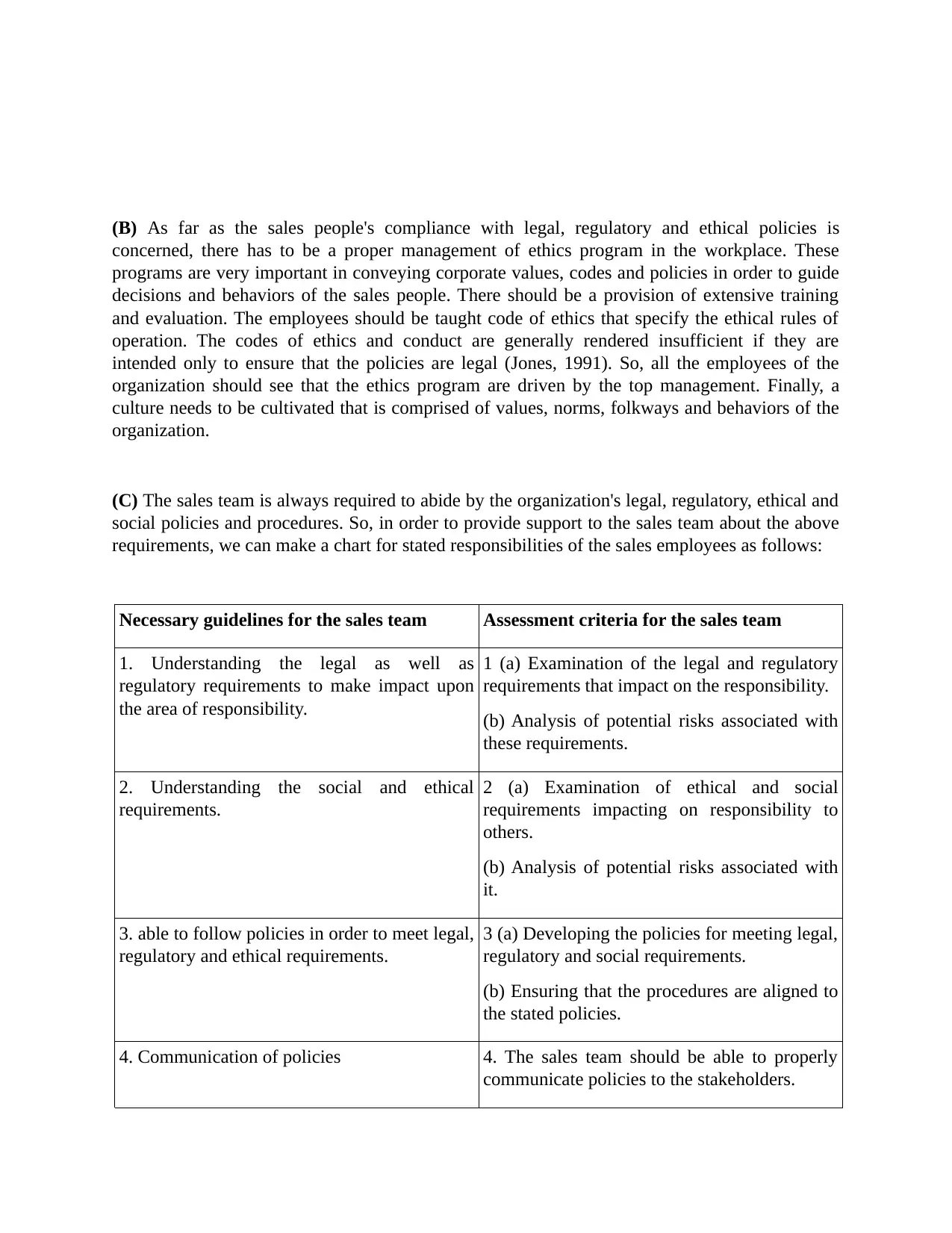
(C) The sales team is always required to abide by the organization's legal, regulatory, ethical and
social policies and procedures. So, in order to provide support to the sales team about the above
requirements, we can make a chart for stated responsibilities of the sales employees as follows:
Necessary guidelines for the sales team Assessment criteria for the sales team
1. Understanding the legal as well as
regulatory requirements to make impact upon
the area of responsibility.
1 (a) Examination of the legal and regulatory
requirements that impact on the responsibility.
(b) Analysis of potential risks associated with
these requirements.
2. Understanding the social and ethical
requirements.
2 (a) Examination of ethical and social
requirements impacting on responsibility to
others.
(b) Analysis of potential risks associated with
it.
3. able to follow policies in order to meet legal,
regulatory and ethical requirements.
3 (a) Developing the policies for meeting legal,
regulatory and social requirements.
(b) Ensuring that the procedures are aligned to
the stated policies.
4. Communication of policies 4. The sales team should be able to properly
communicate policies to the stakeholders.
concerned, there has to be a proper management of ethics program in the workplace. These
programs are very important in conveying corporate values, codes and policies in order to guide
decisions and behaviors of the sales people. There should be a provision of extensive training
and evaluation. The employees should be taught code of ethics that specify the ethical rules of
operation. The codes of ethics and conduct are generally rendered insufficient if they are
intended only to ensure that the policies are legal (Jones, 1991). So, all the employees of the
organization should see that the ethics program are driven by the top management. Finally, a
culture needs to be cultivated that is comprised of values, norms, folkways and behaviors of the
organization.
(C) The sales team is always required to abide by the organization's legal, regulatory, ethical and
social policies and procedures. So, in order to provide support to the sales team about the above
requirements, we can make a chart for stated responsibilities of the sales employees as follows:
Necessary guidelines for the sales team Assessment criteria for the sales team
1. Understanding the legal as well as
regulatory requirements to make impact upon
the area of responsibility.
1 (a) Examination of the legal and regulatory
requirements that impact on the responsibility.
(b) Analysis of potential risks associated with
these requirements.
2. Understanding the social and ethical
requirements.
2 (a) Examination of ethical and social
requirements impacting on responsibility to
others.
(b) Analysis of potential risks associated with
it.
3. able to follow policies in order to meet legal,
regulatory and ethical requirements.
3 (a) Developing the policies for meeting legal,
regulatory and social requirements.
(b) Ensuring that the procedures are aligned to
the stated policies.
4. Communication of policies 4. The sales team should be able to properly
communicate policies to the stakeholders.
Paraphrase This Document
Need a fresh take? Get an instant paraphrase of this document with our AI Paraphraser

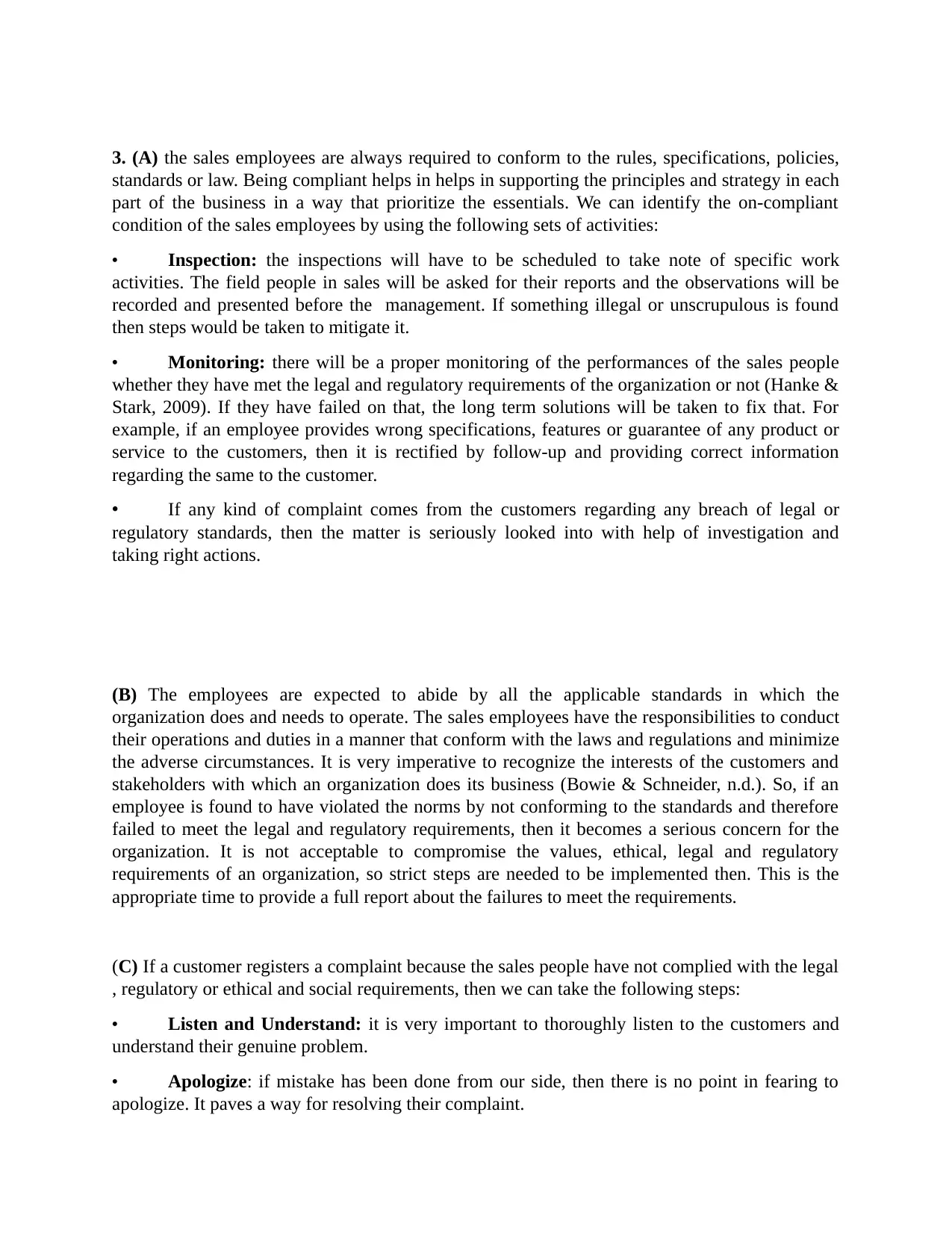
3. (A) the sales employees are always required to conform to the rules, specifications, policies,
standards or law. Being compliant helps in helps in supporting the principles and strategy in each
part of the business in a way that prioritize the essentials. We can identify the on-compliant
condition of the sales employees by using the following sets of activities:
• Inspection: the inspections will have to be scheduled to take note of specific work
activities. The field people in sales will be asked for their reports and the observations will be
recorded and presented before the management. If something illegal or unscrupulous is found
then steps would be taken to mitigate it.
• Monitoring: there will be a proper monitoring of the performances of the sales people
whether they have met the legal and regulatory requirements of the organization or not (Hanke &
Stark, 2009). If they have failed on that, the long term solutions will be taken to fix that. For
example, if an employee provides wrong specifications, features or guarantee of any product or
service to the customers, then it is rectified by follow-up and providing correct information
regarding the same to the customer.
• If any kind of complaint comes from the customers regarding any breach of legal or
regulatory standards, then the matter is seriously looked into with help of investigation and
taking right actions.
(B) The employees are expected to abide by all the applicable standards in which the
organization does and needs to operate. The sales employees have the responsibilities to conduct
their operations and duties in a manner that conform with the laws and regulations and minimize
the adverse circumstances. It is very imperative to recognize the interests of the customers and
stakeholders with which an organization does its business (Bowie & Schneider, n.d.). So, if an
employee is found to have violated the norms by not conforming to the standards and therefore
failed to meet the legal and regulatory requirements, then it becomes a serious concern for the
organization. It is not acceptable to compromise the values, ethical, legal and regulatory
requirements of an organization, so strict steps are needed to be implemented then. This is the
appropriate time to provide a full report about the failures to meet the requirements.
(C) If a customer registers a complaint because the sales people have not complied with the legal
, regulatory or ethical and social requirements, then we can take the following steps:
• Listen and Understand: it is very important to thoroughly listen to the customers and
understand their genuine problem.
• Apologize: if mistake has been done from our side, then there is no point in fearing to
apologize. It paves a way for resolving their complaint.
standards or law. Being compliant helps in helps in supporting the principles and strategy in each
part of the business in a way that prioritize the essentials. We can identify the on-compliant
condition of the sales employees by using the following sets of activities:
• Inspection: the inspections will have to be scheduled to take note of specific work
activities. The field people in sales will be asked for their reports and the observations will be
recorded and presented before the management. If something illegal or unscrupulous is found
then steps would be taken to mitigate it.
• Monitoring: there will be a proper monitoring of the performances of the sales people
whether they have met the legal and regulatory requirements of the organization or not (Hanke &
Stark, 2009). If they have failed on that, the long term solutions will be taken to fix that. For
example, if an employee provides wrong specifications, features or guarantee of any product or
service to the customers, then it is rectified by follow-up and providing correct information
regarding the same to the customer.
• If any kind of complaint comes from the customers regarding any breach of legal or
regulatory standards, then the matter is seriously looked into with help of investigation and
taking right actions.
(B) The employees are expected to abide by all the applicable standards in which the
organization does and needs to operate. The sales employees have the responsibilities to conduct
their operations and duties in a manner that conform with the laws and regulations and minimize
the adverse circumstances. It is very imperative to recognize the interests of the customers and
stakeholders with which an organization does its business (Bowie & Schneider, n.d.). So, if an
employee is found to have violated the norms by not conforming to the standards and therefore
failed to meet the legal and regulatory requirements, then it becomes a serious concern for the
organization. It is not acceptable to compromise the values, ethical, legal and regulatory
requirements of an organization, so strict steps are needed to be implemented then. This is the
appropriate time to provide a full report about the failures to meet the requirements.
(C) If a customer registers a complaint because the sales people have not complied with the legal
, regulatory or ethical and social requirements, then we can take the following steps:
• Listen and Understand: it is very important to thoroughly listen to the customers and
understand their genuine problem.
• Apologize: if mistake has been done from our side, then there is no point in fearing to
apologize. It paves a way for resolving their complaint.

• Finding proper solution: we should utilize every resource to come up with a relevant
solution regarding the complaint. The necessary changes should be made so that the mistake
would not be repeated.
• Follow up with the customer: the customer can only be satisfied after the complaint if
he is followed up properly. As per the statistics, around 70% customers abandons the company
because they think that it does not care about them.
solution regarding the complaint. The necessary changes should be made so that the mistake
would not be repeated.
• Follow up with the customer: the customer can only be satisfied after the complaint if
he is followed up properly. As per the statistics, around 70% customers abandons the company
because they think that it does not care about them.
⊘ This is a preview!⊘
Do you want full access?
Subscribe today to unlock all pages.

Trusted by 1+ million students worldwide

References
Becker, T. (1998). INTEGRITY IN ORGANIZATIONS: BEYOND HONESTY AND
CONSCIENTIOUSNESS. Academy Of Management Review, 23(1), 154-161.
http://dx.doi.org/10.5465/amr.1998.192969
Bohlen, F. (1929). Misrepresentation as Deceit, Negligence, or Warranty. Harvard Law Review,
42(6), 733. http://dx.doi.org/10.2307/1330846
Bowie, N. & Schneider, M. Business ethics for dummies.
Elliott, C. & Quinn, F. (2007). Contract law. Harlow: Pearson Longman.
Hanke, T. & Stark, W. (2009). Strategy Development: Conceptual Framework on Corporate
Social Responsibility. J Bus Ethics, 85(S3), 507-516. http://dx.doi.org/10.1007/s10551-009-
0215-9
Jones, T. (1991). ETHICAL DECISION MAKING BY INDIVIDUALS IN ORGANIZATIONS:
AN ISSUE-CONTINGENT MODEL. Academy Of Management Review, 16(2), 366-395.
http://dx.doi.org/10.5465/amr.1991.4278958
Meyerson, M. The Efficient Consumer Form Contract: Law and Economics Meets the Real
World. SSRN Electronic Journal. http://dx.doi.org/10.2139/ssrn.1601337
Nolen, A. & Putten, J. (2007). Action Research in Education: Addressing Gaps in Ethical
Principles and Practices. Educational Researcher, 36(7), 401-407.
http://dx.doi.org/10.3102/0013189x07309629
Becker, T. (1998). INTEGRITY IN ORGANIZATIONS: BEYOND HONESTY AND
CONSCIENTIOUSNESS. Academy Of Management Review, 23(1), 154-161.
http://dx.doi.org/10.5465/amr.1998.192969
Bohlen, F. (1929). Misrepresentation as Deceit, Negligence, or Warranty. Harvard Law Review,
42(6), 733. http://dx.doi.org/10.2307/1330846
Bowie, N. & Schneider, M. Business ethics for dummies.
Elliott, C. & Quinn, F. (2007). Contract law. Harlow: Pearson Longman.
Hanke, T. & Stark, W. (2009). Strategy Development: Conceptual Framework on Corporate
Social Responsibility. J Bus Ethics, 85(S3), 507-516. http://dx.doi.org/10.1007/s10551-009-
0215-9
Jones, T. (1991). ETHICAL DECISION MAKING BY INDIVIDUALS IN ORGANIZATIONS:
AN ISSUE-CONTINGENT MODEL. Academy Of Management Review, 16(2), 366-395.
http://dx.doi.org/10.5465/amr.1991.4278958
Meyerson, M. The Efficient Consumer Form Contract: Law and Economics Meets the Real
World. SSRN Electronic Journal. http://dx.doi.org/10.2139/ssrn.1601337
Nolen, A. & Putten, J. (2007). Action Research in Education: Addressing Gaps in Ethical
Principles and Practices. Educational Researcher, 36(7), 401-407.
http://dx.doi.org/10.3102/0013189x07309629
1 out of 7
Related Documents
Your All-in-One AI-Powered Toolkit for Academic Success.
+13062052269
info@desklib.com
Available 24*7 on WhatsApp / Email
Unlock your academic potential
Copyright © 2020–2025 A2Z Services. All Rights Reserved. Developed and managed by ZUCOL.