Case Analysis: Carlill v Carbolic Smoke Ball & Statutory Law
VerifiedAdded on 2023/06/15
|8
|2212
|172
Case Study
AI Summary
This assignment focuses on developing legal skills through a case study analysis of Carlill v Carbolic Smoke Ball Company and the interpretation of statutory provisions, specifically related to the Dangerous Dogs Act 1991. The Carlill v Carbolic Smoke Ball case examines contract law principles, including offer, acceptance, and intention to create legal relations, identifying the ratio decidendi and orbiter dictum within the judgment. The statutory interpretation section paraphrases key sections of the Dangerous Dogs Act 1991, including provisions related to 'householder cases,' police powers to seize dogs, and guidelines for the destruction of dogs, emphasizing public safety and responsible dog ownership. The overall aim is to enhance legal understanding and analytical skills through practical application and critical evaluation of legal materials.
Legal Skills and
context
context

Paraphrase This Document
Need a fresh take? Get an instant paraphrase of this document with our AI Paraphraser
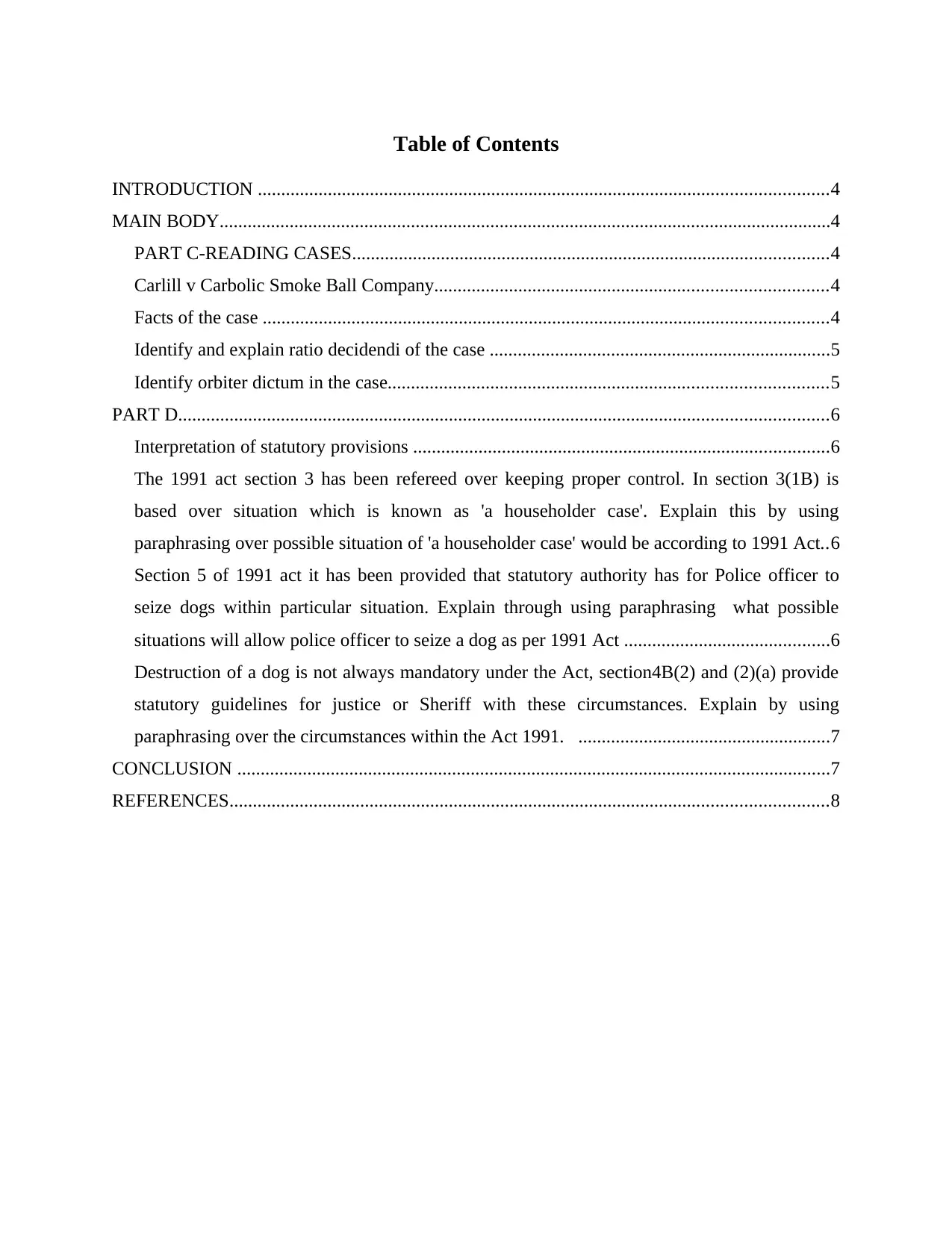
Table of Contents
INTRODUCTION ..........................................................................................................................4
MAIN BODY...................................................................................................................................4
PART C-READING CASES......................................................................................................4
Carlill v Carbolic Smoke Ball Company....................................................................................4
Facts of the case .........................................................................................................................4
Identify and explain ratio decidendi of the case .........................................................................5
Identify orbiter dictum in the case..............................................................................................5
PART D...........................................................................................................................................6
Interpretation of statutory provisions .........................................................................................6
The 1991 act section 3 has been refereed over keeping proper control. In section 3(1B) is
based over situation which is known as 'a householder case'. Explain this by using
paraphrasing over possible situation of 'a householder case' would be according to 1991 Act..6
Section 5 of 1991 act it has been provided that statutory authority has for Police officer to
seize dogs within particular situation. Explain through using paraphrasing what possible
situations will allow police officer to seize a dog as per 1991 Act ............................................6
Destruction of a dog is not always mandatory under the Act, section4B(2) and (2)(a) provide
statutory guidelines for justice or Sheriff with these circumstances. Explain by using
paraphrasing over the circumstances within the Act 1991. ......................................................7
CONCLUSION ...............................................................................................................................7
REFERENCES................................................................................................................................8
INTRODUCTION ..........................................................................................................................4
MAIN BODY...................................................................................................................................4
PART C-READING CASES......................................................................................................4
Carlill v Carbolic Smoke Ball Company....................................................................................4
Facts of the case .........................................................................................................................4
Identify and explain ratio decidendi of the case .........................................................................5
Identify orbiter dictum in the case..............................................................................................5
PART D...........................................................................................................................................6
Interpretation of statutory provisions .........................................................................................6
The 1991 act section 3 has been refereed over keeping proper control. In section 3(1B) is
based over situation which is known as 'a householder case'. Explain this by using
paraphrasing over possible situation of 'a householder case' would be according to 1991 Act..6
Section 5 of 1991 act it has been provided that statutory authority has for Police officer to
seize dogs within particular situation. Explain through using paraphrasing what possible
situations will allow police officer to seize a dog as per 1991 Act ............................................6
Destruction of a dog is not always mandatory under the Act, section4B(2) and (2)(a) provide
statutory guidelines for justice or Sheriff with these circumstances. Explain by using
paraphrasing over the circumstances within the Act 1991. ......................................................7
CONCLUSION ...............................................................................................................................7
REFERENCES................................................................................................................................8

⊘ This is a preview!⊘
Do you want full access?
Subscribe today to unlock all pages.

Trusted by 1+ million students worldwide
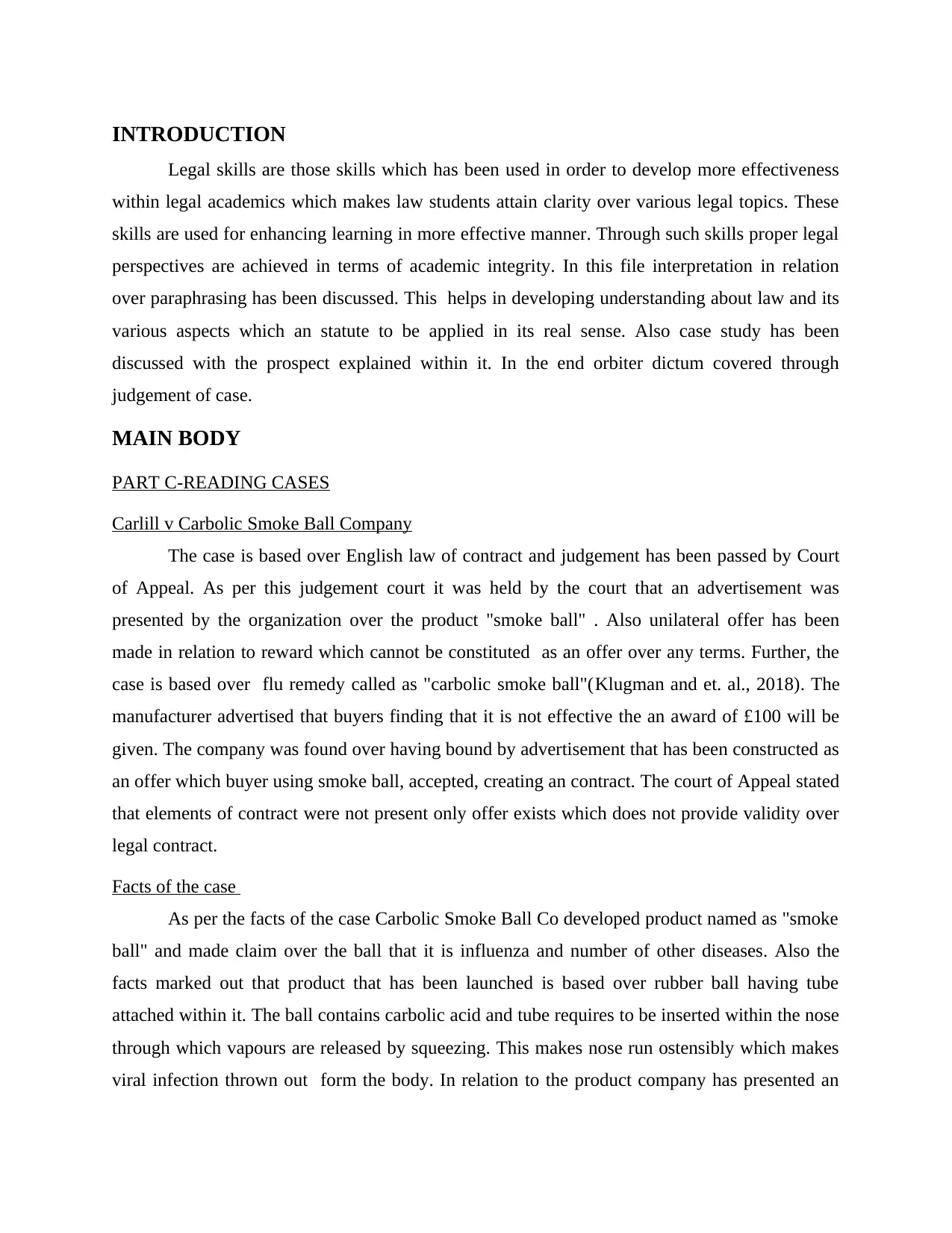
INTRODUCTION
Legal skills are those skills which has been used in order to develop more effectiveness
within legal academics which makes law students attain clarity over various legal topics. These
skills are used for enhancing learning in more effective manner. Through such skills proper legal
perspectives are achieved in terms of academic integrity. In this file interpretation in relation
over paraphrasing has been discussed. This helps in developing understanding about law and its
various aspects which an statute to be applied in its real sense. Also case study has been
discussed with the prospect explained within it. In the end orbiter dictum covered through
judgement of case.
MAIN BODY
PART C-READING CASES
Carlill v Carbolic Smoke Ball Company
The case is based over English law of contract and judgement has been passed by Court
of Appeal. As per this judgement court it was held by the court that an advertisement was
presented by the organization over the product "smoke ball" . Also unilateral offer has been
made in relation to reward which cannot be constituted as an offer over any terms. Further, the
case is based over flu remedy called as "carbolic smoke ball"(Klugman and et. al., 2018). The
manufacturer advertised that buyers finding that it is not effective the an award of £100 will be
given. The company was found over having bound by advertisement that has been constructed as
an offer which buyer using smoke ball, accepted, creating an contract. The court of Appeal stated
that elements of contract were not present only offer exists which does not provide validity over
legal contract.
Facts of the case
As per the facts of the case Carbolic Smoke Ball Co developed product named as "smoke
ball" and made claim over the ball that it is influenza and number of other diseases. Also the
facts marked out that product that has been launched is based over rubber ball having tube
attached within it. The ball contains carbolic acid and tube requires to be inserted within the nose
through which vapours are released by squeezing. This makes nose run ostensibly which makes
viral infection thrown out form the body. In relation to the product company has presented an
Legal skills are those skills which has been used in order to develop more effectiveness
within legal academics which makes law students attain clarity over various legal topics. These
skills are used for enhancing learning in more effective manner. Through such skills proper legal
perspectives are achieved in terms of academic integrity. In this file interpretation in relation
over paraphrasing has been discussed. This helps in developing understanding about law and its
various aspects which an statute to be applied in its real sense. Also case study has been
discussed with the prospect explained within it. In the end orbiter dictum covered through
judgement of case.
MAIN BODY
PART C-READING CASES
Carlill v Carbolic Smoke Ball Company
The case is based over English law of contract and judgement has been passed by Court
of Appeal. As per this judgement court it was held by the court that an advertisement was
presented by the organization over the product "smoke ball" . Also unilateral offer has been
made in relation to reward which cannot be constituted as an offer over any terms. Further, the
case is based over flu remedy called as "carbolic smoke ball"(Klugman and et. al., 2018). The
manufacturer advertised that buyers finding that it is not effective the an award of £100 will be
given. The company was found over having bound by advertisement that has been constructed as
an offer which buyer using smoke ball, accepted, creating an contract. The court of Appeal stated
that elements of contract were not present only offer exists which does not provide validity over
legal contract.
Facts of the case
As per the facts of the case Carbolic Smoke Ball Co developed product named as "smoke
ball" and made claim over the ball that it is influenza and number of other diseases. Also the
facts marked out that product that has been launched is based over rubber ball having tube
attached within it. The ball contains carbolic acid and tube requires to be inserted within the nose
through which vapours are released by squeezing. This makes nose run ostensibly which makes
viral infection thrown out form the body. In relation to the product company has presented an
Paraphrase This Document
Need a fresh take? Get an instant paraphrase of this document with our AI Paraphraser
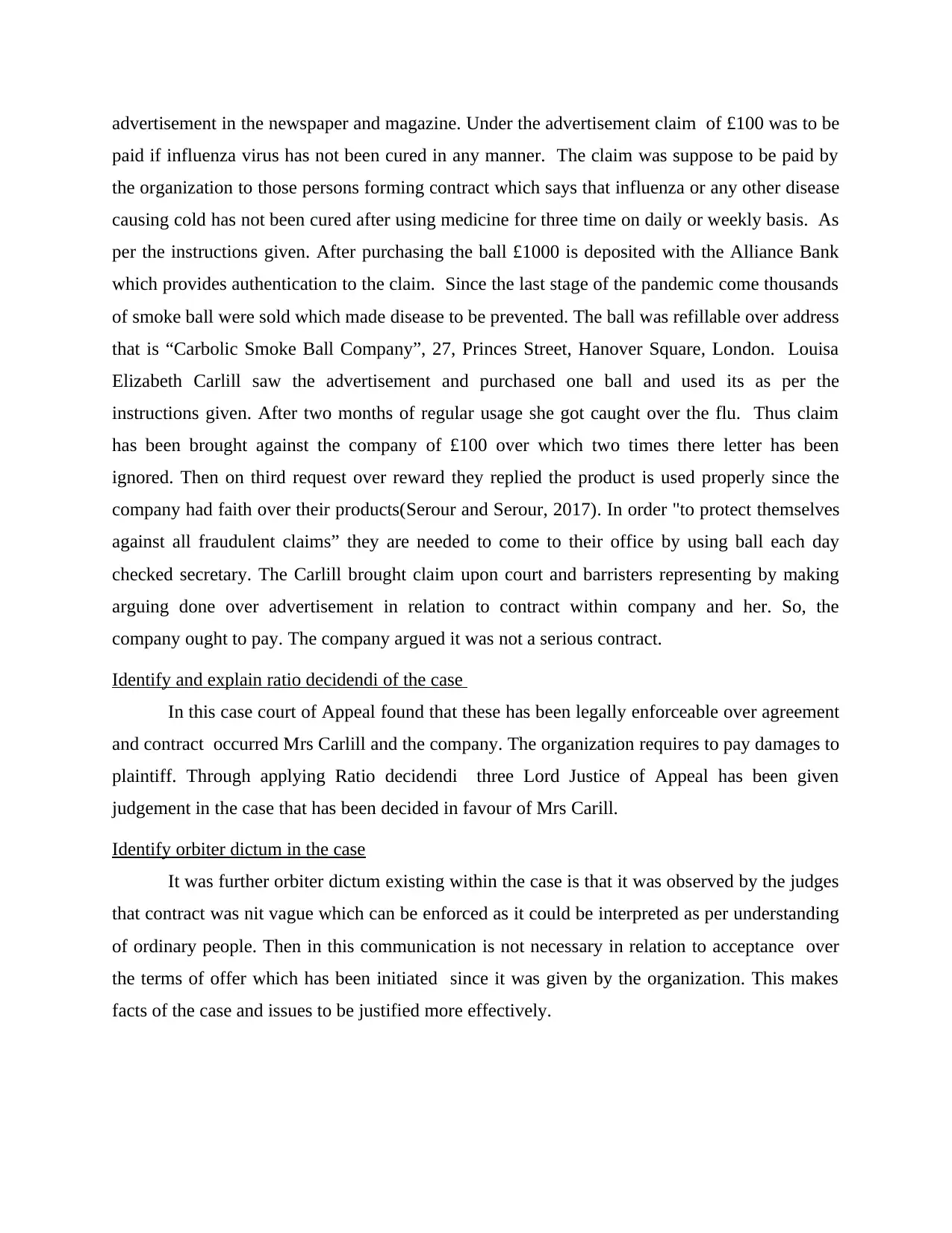
advertisement in the newspaper and magazine. Under the advertisement claim of £100 was to be
paid if influenza virus has not been cured in any manner. The claim was suppose to be paid by
the organization to those persons forming contract which says that influenza or any other disease
causing cold has not been cured after using medicine for three time on daily or weekly basis. As
per the instructions given. After purchasing the ball £1000 is deposited with the Alliance Bank
which provides authentication to the claim. Since the last stage of the pandemic come thousands
of smoke ball were sold which made disease to be prevented. The ball was refillable over address
that is “Carbolic Smoke Ball Company”, 27, Princes Street, Hanover Square, London. Louisa
Elizabeth Carlill saw the advertisement and purchased one ball and used its as per the
instructions given. After two months of regular usage she got caught over the flu. Thus claim
has been brought against the company of £100 over which two times there letter has been
ignored. Then on third request over reward they replied the product is used properly since the
company had faith over their products(Serour and Serour, 2017). In order "to protect themselves
against all fraudulent claims” they are needed to come to their office by using ball each day
checked secretary. The Carlill brought claim upon court and barristers representing by making
arguing done over advertisement in relation to contract within company and her. So, the
company ought to pay. The company argued it was not a serious contract.
Identify and explain ratio decidendi of the case
In this case court of Appeal found that these has been legally enforceable over agreement
and contract occurred Mrs Carlill and the company. The organization requires to pay damages to
plaintiff. Through applying Ratio decidendi three Lord Justice of Appeal has been given
judgement in the case that has been decided in favour of Mrs Carill.
Identify orbiter dictum in the case
It was further orbiter dictum existing within the case is that it was observed by the judges
that contract was nit vague which can be enforced as it could be interpreted as per understanding
of ordinary people. Then in this communication is not necessary in relation to acceptance over
the terms of offer which has been initiated since it was given by the organization. This makes
facts of the case and issues to be justified more effectively.
paid if influenza virus has not been cured in any manner. The claim was suppose to be paid by
the organization to those persons forming contract which says that influenza or any other disease
causing cold has not been cured after using medicine for three time on daily or weekly basis. As
per the instructions given. After purchasing the ball £1000 is deposited with the Alliance Bank
which provides authentication to the claim. Since the last stage of the pandemic come thousands
of smoke ball were sold which made disease to be prevented. The ball was refillable over address
that is “Carbolic Smoke Ball Company”, 27, Princes Street, Hanover Square, London. Louisa
Elizabeth Carlill saw the advertisement and purchased one ball and used its as per the
instructions given. After two months of regular usage she got caught over the flu. Thus claim
has been brought against the company of £100 over which two times there letter has been
ignored. Then on third request over reward they replied the product is used properly since the
company had faith over their products(Serour and Serour, 2017). In order "to protect themselves
against all fraudulent claims” they are needed to come to their office by using ball each day
checked secretary. The Carlill brought claim upon court and barristers representing by making
arguing done over advertisement in relation to contract within company and her. So, the
company ought to pay. The company argued it was not a serious contract.
Identify and explain ratio decidendi of the case
In this case court of Appeal found that these has been legally enforceable over agreement
and contract occurred Mrs Carlill and the company. The organization requires to pay damages to
plaintiff. Through applying Ratio decidendi three Lord Justice of Appeal has been given
judgement in the case that has been decided in favour of Mrs Carill.
Identify orbiter dictum in the case
It was further orbiter dictum existing within the case is that it was observed by the judges
that contract was nit vague which can be enforced as it could be interpreted as per understanding
of ordinary people. Then in this communication is not necessary in relation to acceptance over
the terms of offer which has been initiated since it was given by the organization. This makes
facts of the case and issues to be justified more effectively.
PART D
Interpretation of statutory provisions
The 1991 act section 3 has been refereed over keeping proper control. In section 3(1B) is based
over situation which is known as 'a householder case'. Explain this by using paraphrasing
over possible situation of 'a householder case' would be according to 1991 Act.
The act covering about these sections is the dangerous dig act 1991 is an act that has been
made over dealing with provisions which has been formed for making prohibition which is
restricted over various types dogs which are dangerous for public. This is an criminal offence for
the owner or person charge over the dogs allowing dog that has made 'dangerously out of control'
are not permitted within public place(Schönberger, 2019). The major section of the acts are
based over providing restrictions upon controlling dogs as per there aggressive nature. It has
been applied only to certain dogs that are harmful to other human beings. Section 3 of the
Dangerous Dogs Act 1991 keeping dangerous dogs is an criminal offence and charge has been
brought against the owner of the dog. The police is required to investigate the matter before
seizing the dog.
Section 5 of 1991 act it has been provided that statutory authority has for Police officer to seize
dogs within particular situation. Explain through using paraphrasing what possible
situations will allow police officer to seize a dog as per 1991 Act
Section 5 of the act entry of premises and evidence that makes constable over an officer
of local authority having authorised by the exercise over power conferred by subsection may
seize. Any dog which appears him to be harmful as section 1 has been applied within public
place(Siau and Wang, 2020). The after time of possession or custody it has become unlawful
through virtue of section public place. After the time when possession over custody has become
unlawful through virtue of the section. The time has been muzzled over lead. Any dog within
public place has been appearing to him which has been ordering within section 2 having applied
in respect over offence against over making commitment done effectively. Any dog within
public place and if justice over peace has satisfied by information on oath and justice of peace is
satisfied by evidence on oath, that there are reasonable grounds for believing: That an offence
within provision of this Act which has been mentioned within section2 that has been committed.
Through evidence of commission over offence which has to be founded. Through this only
Interpretation of statutory provisions
The 1991 act section 3 has been refereed over keeping proper control. In section 3(1B) is based
over situation which is known as 'a householder case'. Explain this by using paraphrasing
over possible situation of 'a householder case' would be according to 1991 Act.
The act covering about these sections is the dangerous dig act 1991 is an act that has been
made over dealing with provisions which has been formed for making prohibition which is
restricted over various types dogs which are dangerous for public. This is an criminal offence for
the owner or person charge over the dogs allowing dog that has made 'dangerously out of control'
are not permitted within public place(Schönberger, 2019). The major section of the acts are
based over providing restrictions upon controlling dogs as per there aggressive nature. It has
been applied only to certain dogs that are harmful to other human beings. Section 3 of the
Dangerous Dogs Act 1991 keeping dangerous dogs is an criminal offence and charge has been
brought against the owner of the dog. The police is required to investigate the matter before
seizing the dog.
Section 5 of 1991 act it has been provided that statutory authority has for Police officer to seize
dogs within particular situation. Explain through using paraphrasing what possible
situations will allow police officer to seize a dog as per 1991 Act
Section 5 of the act entry of premises and evidence that makes constable over an officer
of local authority having authorised by the exercise over power conferred by subsection may
seize. Any dog which appears him to be harmful as section 1 has been applied within public
place(Siau and Wang, 2020). The after time of possession or custody it has become unlawful
through virtue of section public place. After the time when possession over custody has become
unlawful through virtue of the section. The time has been muzzled over lead. Any dog within
public place has been appearing to him which has been ordering within section 2 having applied
in respect over offence against over making commitment done effectively. Any dog within
public place and if justice over peace has satisfied by information on oath and justice of peace is
satisfied by evidence on oath, that there are reasonable grounds for believing: That an offence
within provision of this Act which has been mentioned within section2 that has been committed.
Through evidence of commission over offence which has to be founded. Through this only
⊘ This is a preview!⊘
Do you want full access?
Subscribe today to unlock all pages.
Trusted by 1+ million students worldwide
premises over the issue has been authorizing constable for entering within premises and to search
or seize any dog or thing which is part of evidence(Asad, 2020). The warrant has been issues
within the section which has been authorized over opening lock fast places over authorising
person that has been named in the warrant over accompany constable executing. As per the act
the dog seized within subsection (1) or (2) dig can be seized only when the owner has not been
found. The act makes proceedings alleged over prosecution that dog is based over section 1 and
within section 2 applied makes presumption done in relation to dog unless innocence has been
proved regarding the offence. This made prosecution noticed for making intention shown over
fourteenth day before abducting the offence. The accused shall not be permitted to adduce such
evidence unless he has given the prosecution notice of his intention to do so not later than the
fourteenth day before that on which the evidence is to be adduced.
Destruction of a dog is not always mandatory under the Act, section4B(2) and (2)(a) provide
statutory guidelines for justice or Sheriff with these circumstances. Explain by using
paraphrasing over the circumstances within the Act 1991.
If an dog has been found to be dangerous and cannot be kept under proper control by
owners and destruction order conditions for ensuring public safety through disqualifying the
owner form keeping dog.
CONCLUSION
From the above discussion it can be concluded that legal skills has been developed in
order to make development of legal integrity within students. Also it holds responsibility for
improving quality of work which makes students work in more effective manner. In this file
things covered is based over case study and interpretation of status in relation to dangerous dog
has been explained. Then various aspects regarding the act has been covered within it.
or seize any dog or thing which is part of evidence(Asad, 2020). The warrant has been issues
within the section which has been authorized over opening lock fast places over authorising
person that has been named in the warrant over accompany constable executing. As per the act
the dog seized within subsection (1) or (2) dig can be seized only when the owner has not been
found. The act makes proceedings alleged over prosecution that dog is based over section 1 and
within section 2 applied makes presumption done in relation to dog unless innocence has been
proved regarding the offence. This made prosecution noticed for making intention shown over
fourteenth day before abducting the offence. The accused shall not be permitted to adduce such
evidence unless he has given the prosecution notice of his intention to do so not later than the
fourteenth day before that on which the evidence is to be adduced.
Destruction of a dog is not always mandatory under the Act, section4B(2) and (2)(a) provide
statutory guidelines for justice or Sheriff with these circumstances. Explain by using
paraphrasing over the circumstances within the Act 1991.
If an dog has been found to be dangerous and cannot be kept under proper control by
owners and destruction order conditions for ensuring public safety through disqualifying the
owner form keeping dog.
CONCLUSION
From the above discussion it can be concluded that legal skills has been developed in
order to make development of legal integrity within students. Also it holds responsibility for
improving quality of work which makes students work in more effective manner. In this file
things covered is based over case study and interpretation of status in relation to dangerous dog
has been explained. Then various aspects regarding the act has been covered within it.
Paraphrase This Document
Need a fresh take? Get an instant paraphrase of this document with our AI Paraphraser
REFERENCES
Books and Journals
Asad, T., 2020. 7 Reconfigurations of Law and Ethics in Colonial Egypt. In Formations of the
Secular (pp. 205-256). Stanford University Press.
Siau, K. and Wang, W., 2020. Artificial intelligence (AI) ethics: ethics of AI and ethical AI.
Journal of Database Management (JDM), 31(2), pp.74-87.
Serour, G.I. and Serour, A.G., 2017. Ethical issues in infertility. Best practice & research
Clinical obstetrics & gynaecology, 43, pp.21-31.
Schönberger, D., 2019. Artificial intelligence in healthcare: a critical analysis of the legal and
ethical implications. International Journal of Law and Information Technology, 27(2),
pp.171-203.
Klugman, C.M and et. al., 2018. The ethics of smart pills and self-acting devices: Autonomy,
truth-telling, and trust at the dawn of digital medicine. The American Journal of
Bioethics. 18(9). pp.38-47.
de los Reyes Jr, G and et. al, 2017. Beyond the “Win-Win” creating shared value requires ethical
frameworks. California Management Review. 59(2). pp.142-167.
Brenkert, G.G., 2019. Mind the gap! The challenges and limits of (Global) business ethics.
Journal of Business Ethics, 155(4), pp.917-930.
Aydin, N., 2020. Paradigmatic foundation and moral axioms of ihsan ethics in Islamic
economics and business. Journal of Islamic Accounting and Business Research.
Reifner, U., 2019. Social Banking and New Poverty-Towards a New Approach in Law and
Economics. In Banking for People (pp. 23-42). De Gruyter.
Coppersmith, G and et. al., 2017, February. Scalable mental health analysis in the clinical
whitespace via natural language processing. In 2017 IEEE EMBS International
Conference on Biomedical & Health Informatics (BHI) (pp. 393-396). IEEE.
Books and Journals
Asad, T., 2020. 7 Reconfigurations of Law and Ethics in Colonial Egypt. In Formations of the
Secular (pp. 205-256). Stanford University Press.
Siau, K. and Wang, W., 2020. Artificial intelligence (AI) ethics: ethics of AI and ethical AI.
Journal of Database Management (JDM), 31(2), pp.74-87.
Serour, G.I. and Serour, A.G., 2017. Ethical issues in infertility. Best practice & research
Clinical obstetrics & gynaecology, 43, pp.21-31.
Schönberger, D., 2019. Artificial intelligence in healthcare: a critical analysis of the legal and
ethical implications. International Journal of Law and Information Technology, 27(2),
pp.171-203.
Klugman, C.M and et. al., 2018. The ethics of smart pills and self-acting devices: Autonomy,
truth-telling, and trust at the dawn of digital medicine. The American Journal of
Bioethics. 18(9). pp.38-47.
de los Reyes Jr, G and et. al, 2017. Beyond the “Win-Win” creating shared value requires ethical
frameworks. California Management Review. 59(2). pp.142-167.
Brenkert, G.G., 2019. Mind the gap! The challenges and limits of (Global) business ethics.
Journal of Business Ethics, 155(4), pp.917-930.
Aydin, N., 2020. Paradigmatic foundation and moral axioms of ihsan ethics in Islamic
economics and business. Journal of Islamic Accounting and Business Research.
Reifner, U., 2019. Social Banking and New Poverty-Towards a New Approach in Law and
Economics. In Banking for People (pp. 23-42). De Gruyter.
Coppersmith, G and et. al., 2017, February. Scalable mental health analysis in the clinical
whitespace via natural language processing. In 2017 IEEE EMBS International
Conference on Biomedical & Health Informatics (BHI) (pp. 393-396). IEEE.

1 out of 8


Related Documents


Your All-in-One AI-Powered Toolkit for Academic Success.
+13062052269
info@desklib.com
Available 24*7 on WhatsApp / Email
![[object Object]](/_next/static/media/star-bottom.7253800d.svg)
Unlock your academic potential
Copyright © 2020–2026 A2Z Services. All Rights Reserved. Developed and managed by ZUCOL.