Analysis of Law, Legal Systems, and Business Organizations: A Report
VerifiedAdded on 2021/02/20
|9
|2709
|62
Report
AI Summary
This report provides a comprehensive overview of the English legal system, detailing various sources of law such as customs, common law, European law, and parliamentary law. It explores the role of the government in law-making, emphasizing the application of statutory and common law in justice courts. The report further examines the potential impact of company, employment, and contract law on businesses, illustrated with a case study. It also defines different types of legally formed business organizations, including sole proprietorships, partnerships, and limited liability companies, analyzing how they are managed and funded. Finally, the report recommends legal solutions for resolving business disputes, using case studies to demonstrate practical applications. This report is designed to provide students with a thorough understanding of the legal landscape and its implications for business operations.
LAW AND THE LEGAL
SYSTEM
SYSTEM

Paraphrase This Document
Need a fresh take? Get an instant paraphrase of this document with our AI Paraphraser
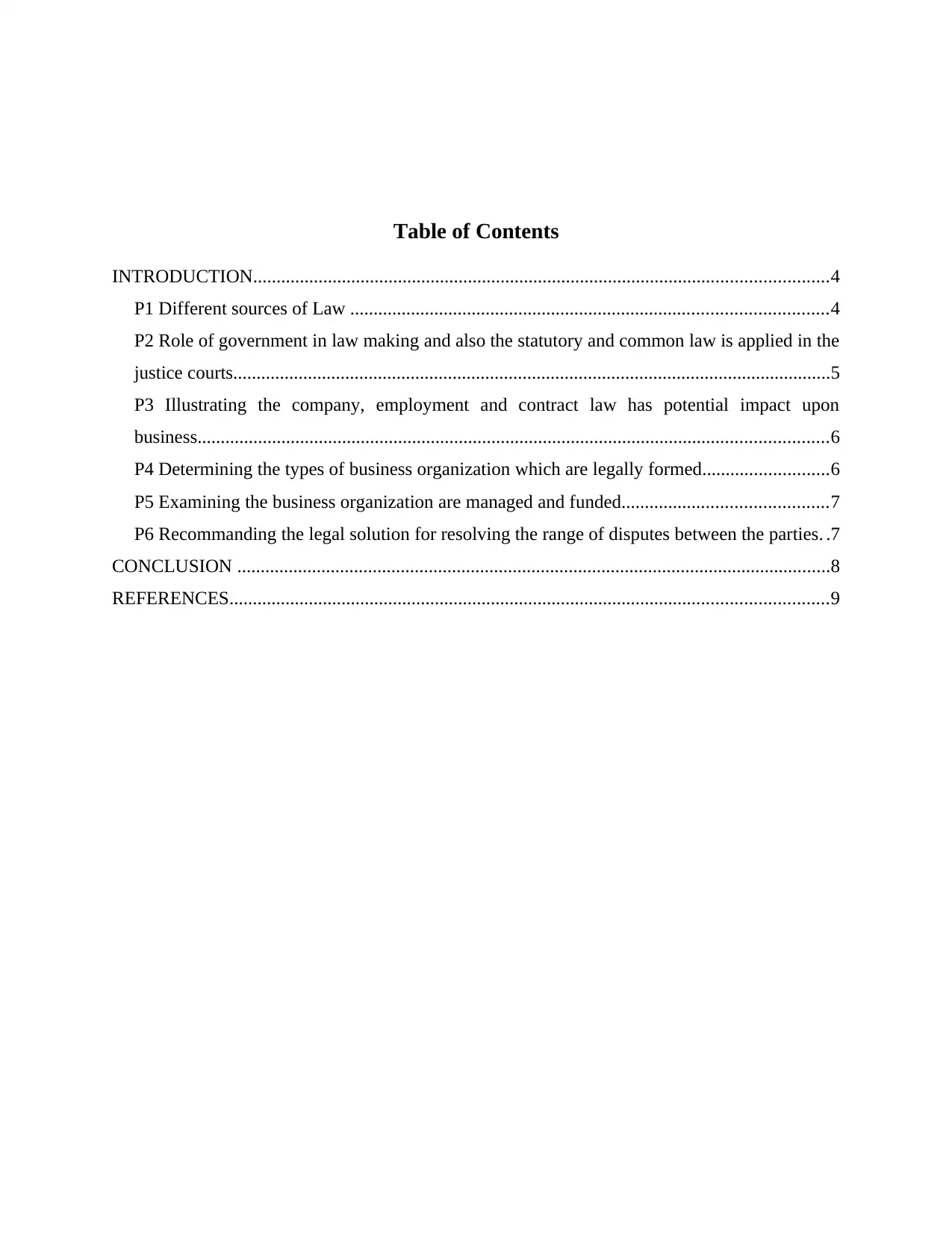
Table of Contents
INTRODUCTION...........................................................................................................................4
P1 Different sources of Law ......................................................................................................4
P2 Role of government in law making and also the statutory and common law is applied in the
justice courts................................................................................................................................5
P3 Illustrating the company, employment and contract law has potential impact upon
business.......................................................................................................................................6
P4 Determining the types of business organization which are legally formed...........................6
P5 Examining the business organization are managed and funded............................................7
P6 Recommanding the legal solution for resolving the range of disputes between the parties. .7
CONCLUSION ...............................................................................................................................8
REFERENCES................................................................................................................................9
INTRODUCTION...........................................................................................................................4
P1 Different sources of Law ......................................................................................................4
P2 Role of government in law making and also the statutory and common law is applied in the
justice courts................................................................................................................................5
P3 Illustrating the company, employment and contract law has potential impact upon
business.......................................................................................................................................6
P4 Determining the types of business organization which are legally formed...........................6
P5 Examining the business organization are managed and funded............................................7
P6 Recommanding the legal solution for resolving the range of disputes between the parties. .7
CONCLUSION ...............................................................................................................................8
REFERENCES................................................................................................................................9
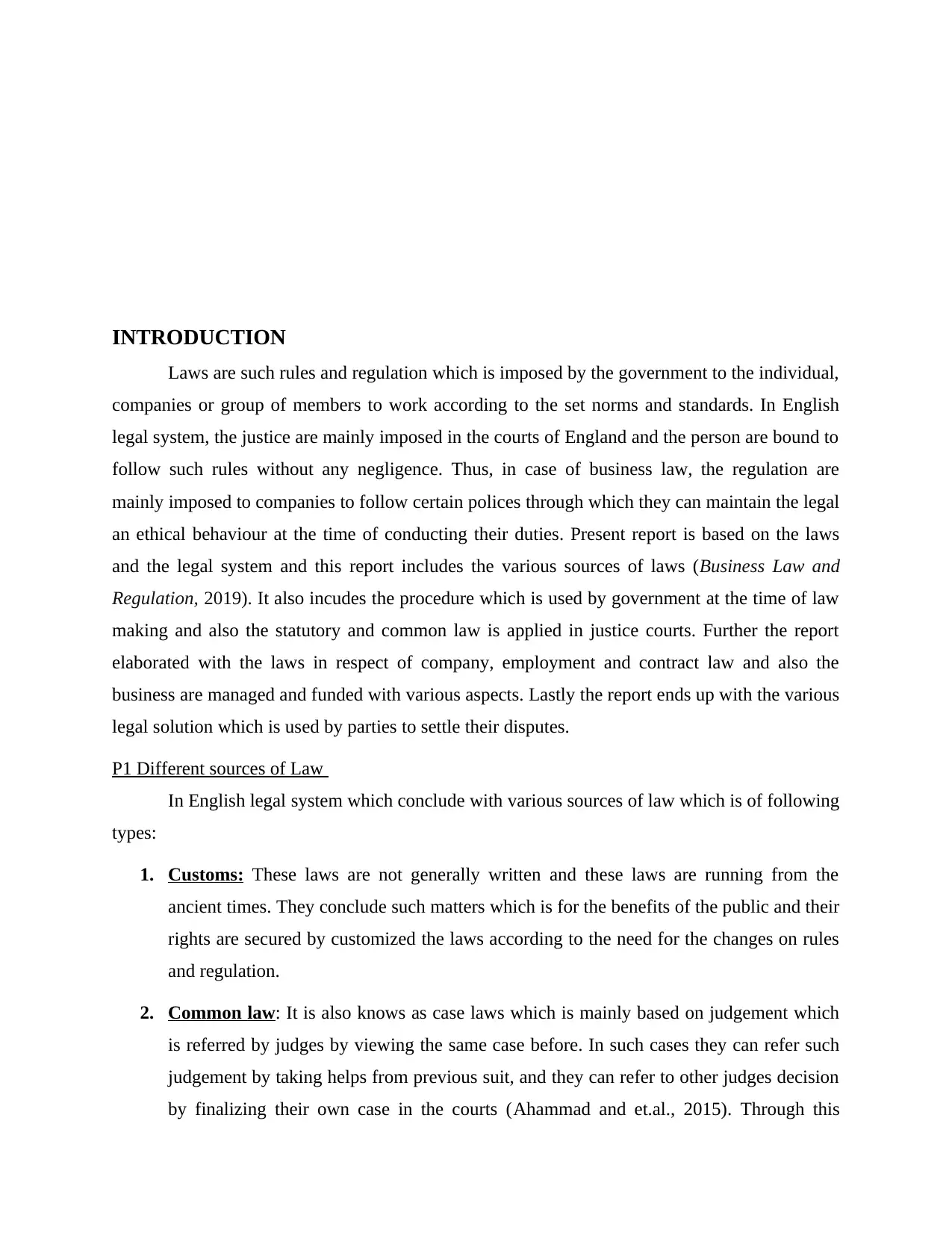
INTRODUCTION
Laws are such rules and regulation which is imposed by the government to the individual,
companies or group of members to work according to the set norms and standards. In English
legal system, the justice are mainly imposed in the courts of England and the person are bound to
follow such rules without any negligence. Thus, in case of business law, the regulation are
mainly imposed to companies to follow certain polices through which they can maintain the legal
an ethical behaviour at the time of conducting their duties. Present report is based on the laws
and the legal system and this report includes the various sources of laws (Business Law and
Regulation, 2019). It also incudes the procedure which is used by government at the time of law
making and also the statutory and common law is applied in justice courts. Further the report
elaborated with the laws in respect of company, employment and contract law and also the
business are managed and funded with various aspects. Lastly the report ends up with the various
legal solution which is used by parties to settle their disputes.
P1 Different sources of Law
In English legal system which conclude with various sources of law which is of following
types:
1. Customs: These laws are not generally written and these laws are running from the
ancient times. They conclude such matters which is for the benefits of the public and their
rights are secured by customized the laws according to the need for the changes on rules
and regulation.
2. Common law: It is also knows as case laws which is mainly based on judgement which
is referred by judges by viewing the same case before. In such cases they can refer such
judgement by taking helps from previous suit, and they can refer to other judges decision
by finalizing their own case in the courts (Ahammad and et.al., 2015). Through this
Laws are such rules and regulation which is imposed by the government to the individual,
companies or group of members to work according to the set norms and standards. In English
legal system, the justice are mainly imposed in the courts of England and the person are bound to
follow such rules without any negligence. Thus, in case of business law, the regulation are
mainly imposed to companies to follow certain polices through which they can maintain the legal
an ethical behaviour at the time of conducting their duties. Present report is based on the laws
and the legal system and this report includes the various sources of laws (Business Law and
Regulation, 2019). It also incudes the procedure which is used by government at the time of law
making and also the statutory and common law is applied in justice courts. Further the report
elaborated with the laws in respect of company, employment and contract law and also the
business are managed and funded with various aspects. Lastly the report ends up with the various
legal solution which is used by parties to settle their disputes.
P1 Different sources of Law
In English legal system which conclude with various sources of law which is of following
types:
1. Customs: These laws are not generally written and these laws are running from the
ancient times. They conclude such matters which is for the benefits of the public and their
rights are secured by customized the laws according to the need for the changes on rules
and regulation.
2. Common law: It is also knows as case laws which is mainly based on judgement which
is referred by judges by viewing the same case before. In such cases they can refer such
judgement by taking helps from previous suit, and they can refer to other judges decision
by finalizing their own case in the courts (Ahammad and et.al., 2015). Through this
⊘ This is a preview!⊘
Do you want full access?
Subscribe today to unlock all pages.

Trusted by 1+ million students worldwide
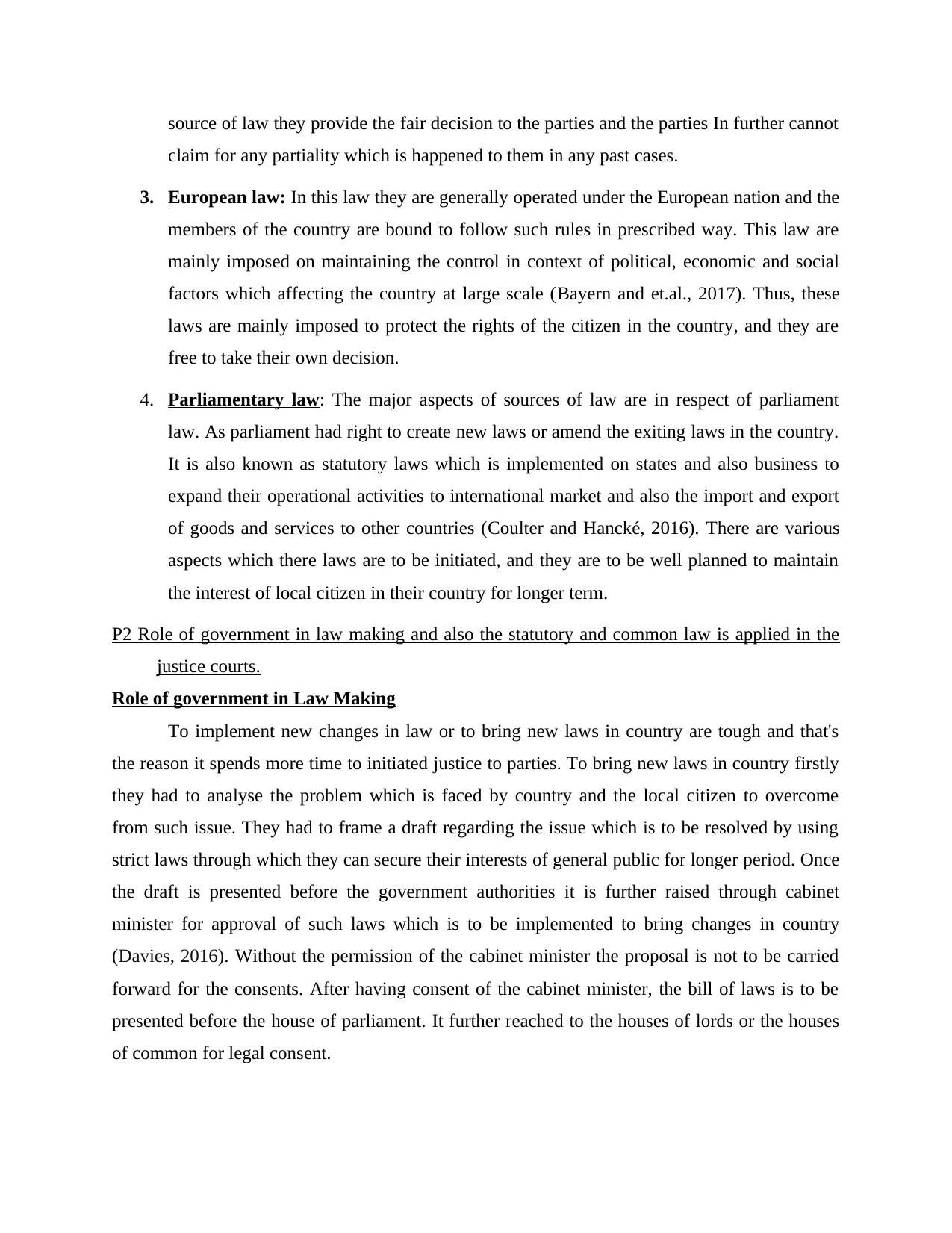
source of law they provide the fair decision to the parties and the parties In further cannot
claim for any partiality which is happened to them in any past cases.
3. European law: In this law they are generally operated under the European nation and the
members of the country are bound to follow such rules in prescribed way. This law are
mainly imposed on maintaining the control in context of political, economic and social
factors which affecting the country at large scale (Bayern and et.al., 2017). Thus, these
laws are mainly imposed to protect the rights of the citizen in the country, and they are
free to take their own decision.
4. Parliamentary law: The major aspects of sources of law are in respect of parliament
law. As parliament had right to create new laws or amend the exiting laws in the country.
It is also known as statutory laws which is implemented on states and also business to
expand their operational activities to international market and also the import and export
of goods and services to other countries (Coulter and Hancké, 2016). There are various
aspects which there laws are to be initiated, and they are to be well planned to maintain
the interest of local citizen in their country for longer term.
P2 Role of government in law making and also the statutory and common law is applied in the
justice courts.
Role of government in Law Making
To implement new changes in law or to bring new laws in country are tough and that's
the reason it spends more time to initiated justice to parties. To bring new laws in country firstly
they had to analyse the problem which is faced by country and the local citizen to overcome
from such issue. They had to frame a draft regarding the issue which is to be resolved by using
strict laws through which they can secure their interests of general public for longer period. Once
the draft is presented before the government authorities it is further raised through cabinet
minister for approval of such laws which is to be implemented to bring changes in country
(Davies, 2016). Without the permission of the cabinet minister the proposal is not to be carried
forward for the consents. After having consent of the cabinet minister, the bill of laws is to be
presented before the house of parliament. It further reached to the houses of lords or the houses
of common for legal consent.
claim for any partiality which is happened to them in any past cases.
3. European law: In this law they are generally operated under the European nation and the
members of the country are bound to follow such rules in prescribed way. This law are
mainly imposed on maintaining the control in context of political, economic and social
factors which affecting the country at large scale (Bayern and et.al., 2017). Thus, these
laws are mainly imposed to protect the rights of the citizen in the country, and they are
free to take their own decision.
4. Parliamentary law: The major aspects of sources of law are in respect of parliament
law. As parliament had right to create new laws or amend the exiting laws in the country.
It is also known as statutory laws which is implemented on states and also business to
expand their operational activities to international market and also the import and export
of goods and services to other countries (Coulter and Hancké, 2016). There are various
aspects which there laws are to be initiated, and they are to be well planned to maintain
the interest of local citizen in their country for longer term.
P2 Role of government in law making and also the statutory and common law is applied in the
justice courts.
Role of government in Law Making
To implement new changes in law or to bring new laws in country are tough and that's
the reason it spends more time to initiated justice to parties. To bring new laws in country firstly
they had to analyse the problem which is faced by country and the local citizen to overcome
from such issue. They had to frame a draft regarding the issue which is to be resolved by using
strict laws through which they can secure their interests of general public for longer period. Once
the draft is presented before the government authorities it is further raised through cabinet
minister for approval of such laws which is to be implemented to bring changes in country
(Davies, 2016). Without the permission of the cabinet minister the proposal is not to be carried
forward for the consents. After having consent of the cabinet minister, the bill of laws is to be
presented before the house of parliament. It further reached to the houses of lords or the houses
of common for legal consent.
Paraphrase This Document
Need a fresh take? Get an instant paraphrase of this document with our AI Paraphraser
In such case after having the first reading of the bill is completed, the next stage is
resultant to second reading Is that bill which can be done by voting. Thus, it depends upon the
voting right that the laws must be further initiated or rejected by not having major effects of
changes in country. After having the modification or changes in country, this bill is presented to
the Monarch for their signature and approval, Thus after having consent of that bill it is
proceeded with new changes and amendment in laws.
Statutory and Common law in justice courts:
Statutory Laws: In these laws, the rules and regulation are created by bringing the changes in
the country and then accordingly the right are secured at the time of dispute arises. Usually
statutory laws are generally written in the legislation and the courts are bound to follow such
rules without any changes until it resultant to major affects to parties to get fair decision (Hedley,
2017).
Common law: In respect of getting justice in courts, common law usually plays an important
law, as in this case they give judgement to such case by reviewing the old cases and then
accordingly the decision is passed. This mainly carry such procedure as the decision given by the
superior court are bound to be followed by the subordinate courts.
P3 Illustrating the company, employment and contract law has potential impact upon business.
In case of company law, the major potential impact on business is relating to taxation
laws. Due to having changes in government norms regarding paying taxes it results in causing
major impact on company to carry their operational activities smoothly. In case of employment
law, employer duty is to maintain ethical behaviour in the business and also they had to carry the
safety kit at the time of working in hazardous placers (Kraakman, 2017). In case of contract law
which can be oral or written must b based on fair judgement. As parties enter into an agreement
to carry their business for future profits. Thus, resultant in breach in any term causes impact on
business.
In case of Pimlico Plumber V Smith case, Mr. Smith is working as plumber in Pimlico
company. In January 201, Mr. Smith suffer with minor heath attack which results in causing half
paralyse to body. The effect is that he cannot work full day as his body is not responding to work
in critical situation. Thus, Mr. Smith demand company to reduce their work timings. Instead of
reducing the work timing, the company send him the termination letter. Thus, the resultant is that
Mr. Smith file a suit against company by not terminating him on such grounds which they
resultant to second reading Is that bill which can be done by voting. Thus, it depends upon the
voting right that the laws must be further initiated or rejected by not having major effects of
changes in country. After having the modification or changes in country, this bill is presented to
the Monarch for their signature and approval, Thus after having consent of that bill it is
proceeded with new changes and amendment in laws.
Statutory and Common law in justice courts:
Statutory Laws: In these laws, the rules and regulation are created by bringing the changes in
the country and then accordingly the right are secured at the time of dispute arises. Usually
statutory laws are generally written in the legislation and the courts are bound to follow such
rules without any changes until it resultant to major affects to parties to get fair decision (Hedley,
2017).
Common law: In respect of getting justice in courts, common law usually plays an important
law, as in this case they give judgement to such case by reviewing the old cases and then
accordingly the decision is passed. This mainly carry such procedure as the decision given by the
superior court are bound to be followed by the subordinate courts.
P3 Illustrating the company, employment and contract law has potential impact upon business.
In case of company law, the major potential impact on business is relating to taxation
laws. Due to having changes in government norms regarding paying taxes it results in causing
major impact on company to carry their operational activities smoothly. In case of employment
law, employer duty is to maintain ethical behaviour in the business and also they had to carry the
safety kit at the time of working in hazardous placers (Kraakman, 2017). In case of contract law
which can be oral or written must b based on fair judgement. As parties enter into an agreement
to carry their business for future profits. Thus, resultant in breach in any term causes impact on
business.
In case of Pimlico Plumber V Smith case, Mr. Smith is working as plumber in Pimlico
company. In January 201, Mr. Smith suffer with minor heath attack which results in causing half
paralyse to body. The effect is that he cannot work full day as his body is not responding to work
in critical situation. Thus, Mr. Smith demand company to reduce their work timings. Instead of
reducing the work timing, the company send him the termination letter. Thus, the resultant is that
Mr. Smith file a suit against company by not terminating him on such grounds which they
mentioned him at the time of termination. Thus, the decision is further given by Court of lords of
not terminating him on such grounds.
P4 Determining the types of business organization which are legally formed
There are various types of business which are legally formed such as:
Sole proprietorship: It refers to such business which is run by individual person and also
they are liable for all such risk which is to be faced by that individual alone. The main
advantages of engaging the business as sole trader is in respective of enjoying the profits
all alone and there is no such share in the company to distribute such profits (Lowe and
et.al., 2016). The major disadvantage is that to run the business successfully is the biggest
task as due to having small scale of business as they get less chances of investor or banks
to invest funds in their business.
Partnership: In this business it incudes two or more person to bring share in the
company either in the form of profits or loss. All partners enter into the partnership
agreement to start their firm as per the terms and condition in partnership business. The
advantages of partnership business is that if there is loss occurs in the business, it is to be
distributed equally (Lee, 2017). The disadvantage of entering into the partnership
business is that if there is death of any partner results in dissolution of partnership
business and also the work done by single partner result in profit sharing of all partner
equally.
Limited Liability Company: Under the companies Act 2006, if the company represents
its strong position in the market, they can easily get the large investors to invests in their
projects. The company can be limited by guarantees and limited by shares and also the
company is not affected by death of any members.
P5 Examining the business organization are managed and funded
In case of sole proprietorship the business are managed by the individual person, and they
are funded by himself only. They can take help from family and friends to invest in their
business but there is the least expectation from banks to invest in their business. In case of
partnership business, the business Is managed by the partners and also they are liable to carry all
the activities which bring profits to them (Rodger, 2017). In respective of funding the business,
they are to be funded by partner as each partner bring some amount of capital to run their
business successfully. In case of limited liability partnership they are to be managed by the
not terminating him on such grounds.
P4 Determining the types of business organization which are legally formed
There are various types of business which are legally formed such as:
Sole proprietorship: It refers to such business which is run by individual person and also
they are liable for all such risk which is to be faced by that individual alone. The main
advantages of engaging the business as sole trader is in respective of enjoying the profits
all alone and there is no such share in the company to distribute such profits (Lowe and
et.al., 2016). The major disadvantage is that to run the business successfully is the biggest
task as due to having small scale of business as they get less chances of investor or banks
to invest funds in their business.
Partnership: In this business it incudes two or more person to bring share in the
company either in the form of profits or loss. All partners enter into the partnership
agreement to start their firm as per the terms and condition in partnership business. The
advantages of partnership business is that if there is loss occurs in the business, it is to be
distributed equally (Lee, 2017). The disadvantage of entering into the partnership
business is that if there is death of any partner results in dissolution of partnership
business and also the work done by single partner result in profit sharing of all partner
equally.
Limited Liability Company: Under the companies Act 2006, if the company represents
its strong position in the market, they can easily get the large investors to invests in their
projects. The company can be limited by guarantees and limited by shares and also the
company is not affected by death of any members.
P5 Examining the business organization are managed and funded
In case of sole proprietorship the business are managed by the individual person, and they
are funded by himself only. They can take help from family and friends to invest in their
business but there is the least expectation from banks to invest in their business. In case of
partnership business, the business Is managed by the partners and also they are liable to carry all
the activities which bring profits to them (Rodger, 2017). In respective of funding the business,
they are to be funded by partner as each partner bring some amount of capital to run their
business successfully. In case of limited liability partnership they are to be managed by the
⊘ This is a preview!⊘
Do you want full access?
Subscribe today to unlock all pages.
Trusted by 1+ million students worldwide
owners of the company and also they can raise funding through banks and investors and also
they issue the share for public to bring funds in the company.
P6 Recommanding the legal solution for resolving the range of disputes between the parties
Case 1: As in the case study of Salomon V Solomon & Co. Ltd, Salomon is engaged with the
large scale of business which is related to making leather shoes and his 5 children also wants to
be become the part of their business. Thus, be seeing their interest of their children in their
business they buy that business by investing £39,000 which in further deal with £10,000
debentures and £20,000 in fully paid up share in the company and the remaining amount is for
funds which is the balanced in cash. After certain time period the company goes into liquidation
and then its insolvency procedure is started to dispose of its assets to pay certain debts to its
stakeholders.
Solution: It is the duty of the Salomon to pay certain amount of money to the stakeholder so that
there payment are secured in company. Also, is such case the directors are not liable to dispose
of money to which is mentioned under the corporate veil. (Tilba, 2017). Under the companies
Act, 2006 Salomon is the owner of the company and also they carry all the power in case of
company goes into liquidation.
Case 2: The another case study is in respect of Foley V Classique Coaches in which Foley
makes an agreement with the coaches that the prices of petrol is fixed and it is not changed
according to the changes in time. As per the time passed petrol prices are increase which results
in facing huge looses to Foley. After having a deep discussion between both the parties regrading
the prices changed, they both decided to settle the matter through out of courts.
Solution: If the parties decided to settle their disputes through out of court settlement they
mainly prefer to appoint and arbitrator which settle their matters by hearing both the parties and
also both the parties to discuss their matter personally (Tombs, 2016). After hearing both the
parties' arbitrator disclosed their judgement and decision which the parties are bound to follow it
and cannot reach to court after they agree with the judgement of arbitrator.
CONCLUSION
From the above study it is to be concluded that business law usually imposes on company
to work and carry their business activities according to the set norms which is imposed by
government. They had to maintain certain ethical norms at the time of dealing with other parties
and employees working in the premises so that they cannot neglect the rules which is bound on
they issue the share for public to bring funds in the company.
P6 Recommanding the legal solution for resolving the range of disputes between the parties
Case 1: As in the case study of Salomon V Solomon & Co. Ltd, Salomon is engaged with the
large scale of business which is related to making leather shoes and his 5 children also wants to
be become the part of their business. Thus, be seeing their interest of their children in their
business they buy that business by investing £39,000 which in further deal with £10,000
debentures and £20,000 in fully paid up share in the company and the remaining amount is for
funds which is the balanced in cash. After certain time period the company goes into liquidation
and then its insolvency procedure is started to dispose of its assets to pay certain debts to its
stakeholders.
Solution: It is the duty of the Salomon to pay certain amount of money to the stakeholder so that
there payment are secured in company. Also, is such case the directors are not liable to dispose
of money to which is mentioned under the corporate veil. (Tilba, 2017). Under the companies
Act, 2006 Salomon is the owner of the company and also they carry all the power in case of
company goes into liquidation.
Case 2: The another case study is in respect of Foley V Classique Coaches in which Foley
makes an agreement with the coaches that the prices of petrol is fixed and it is not changed
according to the changes in time. As per the time passed petrol prices are increase which results
in facing huge looses to Foley. After having a deep discussion between both the parties regrading
the prices changed, they both decided to settle the matter through out of courts.
Solution: If the parties decided to settle their disputes through out of court settlement they
mainly prefer to appoint and arbitrator which settle their matters by hearing both the parties and
also both the parties to discuss their matter personally (Tombs, 2016). After hearing both the
parties' arbitrator disclosed their judgement and decision which the parties are bound to follow it
and cannot reach to court after they agree with the judgement of arbitrator.
CONCLUSION
From the above study it is to be concluded that business law usually imposes on company
to work and carry their business activities according to the set norms which is imposed by
government. They had to maintain certain ethical norms at the time of dealing with other parties
and employees working in the premises so that they cannot neglect the rules which is bound on
Paraphrase This Document
Need a fresh take? Get an instant paraphrase of this document with our AI Paraphraser

companies to follow it. It is to be concluded that government make such norms by keeping in
mind the right of parties and also there rights are not affected and the judgement is fair and
honest to secure the interests of parties in courts for longer time period.
mind the right of parties and also there rights are not affected and the judgement is fair and
honest to secure the interests of parties in courts for longer time period.
REFERENCES
Books and journals
Ahammad, M. F. and et.al., 2015, September. Factors influenceing the share of ownership
sought in cross-border acquisitions-UK perspectives. EuroMed Research Business
Institute.
Bayern, S. and et.al., 2017. Company law and autonomous systems: a blueprint for lawyers,
entrepreneurs, and regulators. Hastings Sci. & Tech. LJ. 9. p.135.
Coulter, S. and Hancké, B., 2016. A bonfire of the regulations, or business as usual? The UK
labour market and the political economy of Brexit. The Political Quarterly. 87(2). pp.148-
156.
Davies, P. W., 2016. Current issues in business ethics. Routledge.
Hedley, S., 2017. The Law of Electronic Commerce and the Internet in the UK and Ireland.
Routledge-Cavendish.
Kraakman, R., 2017. The anatomy of corporate law: A comparative and functional approach.
Oxford University Press.
Lee, J., 2017. Striking a Fair Balance in UK Takeover Law: Market Interests, Power of
Regulation, and Enforcement. European Business Law Review. 28(6). pp.829-846.
Lowe, J. and et.al., 2016. Access to Financial Services in the UK.
Rodger, B., 2017. Competition law private enforcement in the UK courts: case-law
developments 2013-2016. Global Competition Litigation Review.
Tilba, A., 2017. Evolution of UK corporate ownership and control: codification, governance,
transition and context. Routledge.
Tombs, S., 2016. Regulating Business ‘After’the Crisis: some observations from the UK.
Online
Business Law and Regulation. 2019. [Online]. Available through:
<https://www.icaew.com/library/subject-gateways/law/business-law-and-regulation>.
Books and journals
Ahammad, M. F. and et.al., 2015, September. Factors influenceing the share of ownership
sought in cross-border acquisitions-UK perspectives. EuroMed Research Business
Institute.
Bayern, S. and et.al., 2017. Company law and autonomous systems: a blueprint for lawyers,
entrepreneurs, and regulators. Hastings Sci. & Tech. LJ. 9. p.135.
Coulter, S. and Hancké, B., 2016. A bonfire of the regulations, or business as usual? The UK
labour market and the political economy of Brexit. The Political Quarterly. 87(2). pp.148-
156.
Davies, P. W., 2016. Current issues in business ethics. Routledge.
Hedley, S., 2017. The Law of Electronic Commerce and the Internet in the UK and Ireland.
Routledge-Cavendish.
Kraakman, R., 2017. The anatomy of corporate law: A comparative and functional approach.
Oxford University Press.
Lee, J., 2017. Striking a Fair Balance in UK Takeover Law: Market Interests, Power of
Regulation, and Enforcement. European Business Law Review. 28(6). pp.829-846.
Lowe, J. and et.al., 2016. Access to Financial Services in the UK.
Rodger, B., 2017. Competition law private enforcement in the UK courts: case-law
developments 2013-2016. Global Competition Litigation Review.
Tilba, A., 2017. Evolution of UK corporate ownership and control: codification, governance,
transition and context. Routledge.
Tombs, S., 2016. Regulating Business ‘After’the Crisis: some observations from the UK.
Online
Business Law and Regulation. 2019. [Online]. Available through:
<https://www.icaew.com/library/subject-gateways/law/business-law-and-regulation>.
⊘ This is a preview!⊘
Do you want full access?
Subscribe today to unlock all pages.
Trusted by 1+ million students worldwide

1 out of 9


Related Documents


Your All-in-One AI-Powered Toolkit for Academic Success.
+13062052269
info@desklib.com
Available 24*7 on WhatsApp / Email
![[object Object]](/_next/static/media/star-bottom.7253800d.svg)
Unlock your academic potential
Copyright © 2020–2026 A2Z Services. All Rights Reserved. Developed and managed by ZUCOL.