Legal Implications of Virtual Money in South Africa: An Overview
VerifiedAdded on 2020/05/08
|12
|3236
|45
Report
AI Summary
This report provides a detailed analysis of the legal implications of virtual money, with a specific focus on the South African context. The report begins by introducing Bitcoin as a prominent example of virtual currency and its decentralized nature. It then explores the legal profession's ethics and regulations in South Africa, emphasizing the strict adherence to professional standards. The report examines the South African legal framework's approach to virtual currencies, highlighting the challenges and risks associated with financial technology and blockchain. It delves into the risks related to credit, liquidity, price stability, money laundering, and customer protection. The research explores the research hypothesis and methodology used, including the Financial Action Task Force (FATF) report, which identifies the emergence of virtual currencies and their impact on payment infrastructure, money laundering, and terrorist financing. The report emphasizes the importance of legal provisions regarding virtual money, addressing its legality based on usage and owner actions. It highlights concerns regarding money laundering and the distinction between decentralized digital currencies and virtual money. Finally, the report discusses the use of virtual currencies in illegal activities and calls for regulations to control their use and availability. Overall, the report offers a comprehensive overview of the legal challenges and considerations surrounding virtual money in South Africa.
LEGAL IMPLICATIONS OF VIRTUAL MONEY [AN OVERVIEW AS PER THE
LEGAL REGULATIONS IN SOUTH AFRICA]
1 | P a g e
LEGAL REGULATIONS IN SOUTH AFRICA]
1 | P a g e

Paraphrase This Document
Need a fresh take? Get an instant paraphrase of this document with our AI Paraphraser
ABSTRACT
With reference to the aspect and issue of virtual money and the terms associated with it is the
term ‘Bit coin’ which is acutely related to the entire panorama of virtual money. The term holds
a particular and important position in South Africa but is equally specific globally. Bit coin is
basically a virtual crypto currency whose existence can be essentially figured out in electronic
form. Satoshi Nakamoto was the first individual who launched Bit coin in 2009. Bit coin acts as
through either an individual programmer or a group of programmers. The definition of Bit coin
can be essentially given as a currency which is digital, partially anonymous in its nature and also
decentralised as to its existence. It is neither backed nor supported by any government authority
or any legal entity or any regulation or provision as provided by law. Another feature of Bit coin
is that, it cannot be redeemed for gold or any other form of currency. It is visible on a large scale
in South Africa, particularly in Cape Town. Although the use of Bitcoin is not widespread in
Cape Town or other parts of South Africa, it has been mentioned by various sources that the
industry is successful in creating an impact widely and the rate at which it is spreading is literally
fast and swift. In this aspect, it is thus important to make a detailed study of this entire process so
that it can be broadly analysed as to how the matter can be comparatively explored and classified
from the perspective of tax collection. Therefore, a comparative and related study was performed
in this aspect which, however, had various limitations. The limitation in this study or research
work was that, it did not give emphasis and importance to certain issues such as evasion of cross
border taxes, tax collection, establishment of permanent rules and regulations and the subject to
enforce sufficient taxes on Bit coin transactions.
2 | P a g e
With reference to the aspect and issue of virtual money and the terms associated with it is the
term ‘Bit coin’ which is acutely related to the entire panorama of virtual money. The term holds
a particular and important position in South Africa but is equally specific globally. Bit coin is
basically a virtual crypto currency whose existence can be essentially figured out in electronic
form. Satoshi Nakamoto was the first individual who launched Bit coin in 2009. Bit coin acts as
through either an individual programmer or a group of programmers. The definition of Bit coin
can be essentially given as a currency which is digital, partially anonymous in its nature and also
decentralised as to its existence. It is neither backed nor supported by any government authority
or any legal entity or any regulation or provision as provided by law. Another feature of Bit coin
is that, it cannot be redeemed for gold or any other form of currency. It is visible on a large scale
in South Africa, particularly in Cape Town. Although the use of Bitcoin is not widespread in
Cape Town or other parts of South Africa, it has been mentioned by various sources that the
industry is successful in creating an impact widely and the rate at which it is spreading is literally
fast and swift. In this aspect, it is thus important to make a detailed study of this entire process so
that it can be broadly analysed as to how the matter can be comparatively explored and classified
from the perspective of tax collection. Therefore, a comparative and related study was performed
in this aspect which, however, had various limitations. The limitation in this study or research
work was that, it did not give emphasis and importance to certain issues such as evasion of cross
border taxes, tax collection, establishment of permanent rules and regulations and the subject to
enforce sufficient taxes on Bit coin transactions.
2 | P a g e
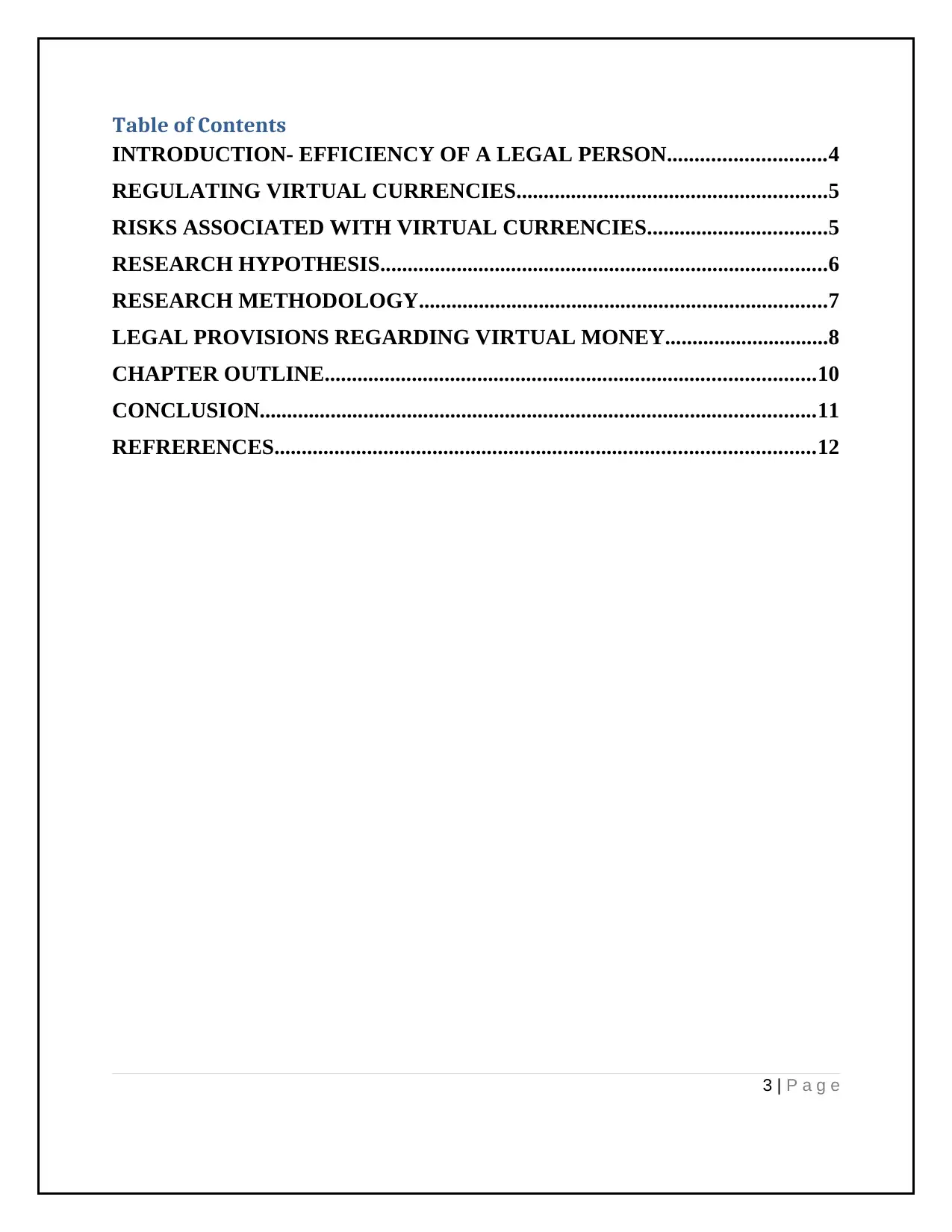
Table of Contents
INTRODUCTION- EFFICIENCY OF A LEGAL PERSON.............................4
REGULATING VIRTUAL CURRENCIES.........................................................5
RISKS ASSOCIATED WITH VIRTUAL CURRENCIES.................................5
RESEARCH HYPOTHESIS..................................................................................6
RESEARCH METHODOLOGY...........................................................................7
LEGAL PROVISIONS REGARDING VIRTUAL MONEY..............................8
CHAPTER OUTLINE..........................................................................................10
CONCLUSION......................................................................................................11
REFRERENCES...................................................................................................12
3 | P a g e
INTRODUCTION- EFFICIENCY OF A LEGAL PERSON.............................4
REGULATING VIRTUAL CURRENCIES.........................................................5
RISKS ASSOCIATED WITH VIRTUAL CURRENCIES.................................5
RESEARCH HYPOTHESIS..................................................................................6
RESEARCH METHODOLOGY...........................................................................7
LEGAL PROVISIONS REGARDING VIRTUAL MONEY..............................8
CHAPTER OUTLINE..........................................................................................10
CONCLUSION......................................................................................................11
REFRERENCES...................................................................................................12
3 | P a g e
⊘ This is a preview!⊘
Do you want full access?
Subscribe today to unlock all pages.

Trusted by 1+ million students worldwide
INTRODUCTION- EFFICIENCY OF A LEGAL PERSON
Among every other profession, the legal profession is considered as a pious and noble profession
and the people practicing it are said to hold a strong dogma of ethics and morals in order to put
and give an honest and service to the society through the role played by them in their profession1.
Over time, strict rules regarding the profession have been developed throughout the world.
However, in this case, special reference is made regarding the legal norms and ethics which
prevail in South Africa, which like those in any other part of the world, are very strict and severe
as to their implication and violation respectively. Breach of any professional ethics may even
dismiss the practicing licence of the concerned legal practitioner and stuck his name out of the
enrolment of names of legal practitioners2. One important feature of the rules and ethics of the
profession is that they are not mentioned in any legislation and are hence identified on the basis
of the ideologies and principles of the senior practicing professionals and guided as per their
perspective and outlook.
Coming down to the issue of virtual money in South Africa, there is one important aspect which
requires to be mentioned giving due importance and mention. The tax legislation in South Africa
covers a very vast extent as to its application, and therefore, analysis of every aspect of it would
be difficult due to its extensive nature3. The current legislation of South Africa although does not
make any distinctive and particular provision regarding Bit coin, it has suggested a provision as
to the issue stating that the concerned authorities of South Africa have the privilege to to make
amendments and alterations in the country’s legislation as they consider it to be convenient and
essential4.
1 Belloc, H. (1967). On. Freeport, N.Y.: Books for Libraries Press.
2 Bento, A. and Aggarwal, A. (2013). Cloud computing service and deployment models. Hershey, PA:
Business Science Reference.
3 Dasgupta, S. (2012). Technical, social, and legal issues in virtual communities. Hershey, Pa.: IGI
Global.
4 Hughes, K. (2009). The PLA reader for public library directors and managers. New York: Neal-
Schuman Publishers.
4 | P a g e
Among every other profession, the legal profession is considered as a pious and noble profession
and the people practicing it are said to hold a strong dogma of ethics and morals in order to put
and give an honest and service to the society through the role played by them in their profession1.
Over time, strict rules regarding the profession have been developed throughout the world.
However, in this case, special reference is made regarding the legal norms and ethics which
prevail in South Africa, which like those in any other part of the world, are very strict and severe
as to their implication and violation respectively. Breach of any professional ethics may even
dismiss the practicing licence of the concerned legal practitioner and stuck his name out of the
enrolment of names of legal practitioners2. One important feature of the rules and ethics of the
profession is that they are not mentioned in any legislation and are hence identified on the basis
of the ideologies and principles of the senior practicing professionals and guided as per their
perspective and outlook.
Coming down to the issue of virtual money in South Africa, there is one important aspect which
requires to be mentioned giving due importance and mention. The tax legislation in South Africa
covers a very vast extent as to its application, and therefore, analysis of every aspect of it would
be difficult due to its extensive nature3. The current legislation of South Africa although does not
make any distinctive and particular provision regarding Bit coin, it has suggested a provision as
to the issue stating that the concerned authorities of South Africa have the privilege to to make
amendments and alterations in the country’s legislation as they consider it to be convenient and
essential4.
1 Belloc, H. (1967). On. Freeport, N.Y.: Books for Libraries Press.
2 Bento, A. and Aggarwal, A. (2013). Cloud computing service and deployment models. Hershey, PA:
Business Science Reference.
3 Dasgupta, S. (2012). Technical, social, and legal issues in virtual communities. Hershey, Pa.: IGI
Global.
4 Hughes, K. (2009). The PLA reader for public library directors and managers. New York: Neal-
Schuman Publishers.
4 | P a g e
Paraphrase This Document
Need a fresh take? Get an instant paraphrase of this document with our AI Paraphraser
REGULATING VIRTUAL CURRENCIES
Every related provision regarding the banking services and the financial services in South Africa
include a series of activities which are highly regulated. In this aspect, financial technology has
done a great deal in making a significant and distinct challenge to the existing framework5. This
challenge has been however, accepted by the South African Reserve Bank and initiatives are
duly taken to figure them out and meet them. In this aspect it is important to mention that
financial technology has a great potential to alter and frame down the existing model of financial
and banking working structure, which essentially follows the traditional way of working.
Financial technology has a related aspect known as Block Chain which gives a provision to the
concerned people according to which the working of the middleman and the associated cost as to
his service can be cut short or eliminated from the whole range of activities in this aspect. This
system can be disruptive as it has the users have the ability to record the transactions of any
person with any other person6. As a result of all these aspects, the traditional provisions relating
to financial and banking services have become greatly irrelevant and the financial technologies
which are based on solutions which are framed upon self service framework which have gained
prevalence.
RISKS ASSOCIATED WITH VIRTUAL CURRENCIES
Certain risks have been associated with virtual currencies which are figured out by the South
African Reserve Bank, and some of them are claimed to be related with the Block Chain
technologies. Certain risks associated with this system include risks related to credit and
5 Roth, M., Snell, J. and Blum, P. (n.d.). TechLaw institute, 2015.
6 Ströh, J. (2017). The esports market and esports sponsoring. Baden-Baden: Tectum Verlag.
5 | P a g e
Every related provision regarding the banking services and the financial services in South Africa
include a series of activities which are highly regulated. In this aspect, financial technology has
done a great deal in making a significant and distinct challenge to the existing framework5. This
challenge has been however, accepted by the South African Reserve Bank and initiatives are
duly taken to figure them out and meet them. In this aspect it is important to mention that
financial technology has a great potential to alter and frame down the existing model of financial
and banking working structure, which essentially follows the traditional way of working.
Financial technology has a related aspect known as Block Chain which gives a provision to the
concerned people according to which the working of the middleman and the associated cost as to
his service can be cut short or eliminated from the whole range of activities in this aspect. This
system can be disruptive as it has the users have the ability to record the transactions of any
person with any other person6. As a result of all these aspects, the traditional provisions relating
to financial and banking services have become greatly irrelevant and the financial technologies
which are based on solutions which are framed upon self service framework which have gained
prevalence.
RISKS ASSOCIATED WITH VIRTUAL CURRENCIES
Certain risks have been associated with virtual currencies which are figured out by the South
African Reserve Bank, and some of them are claimed to be related with the Block Chain
technologies. Certain risks associated with this system include risks related to credit and
5 Roth, M., Snell, J. and Blum, P. (n.d.). TechLaw institute, 2015.
6 Ströh, J. (2017). The esports market and esports sponsoring. Baden-Baden: Tectum Verlag.
5 | P a g e
liquidity, stability of price, money laundering risks and customer risks7. An important aspect
regarding Block Chain system is that, it is not regulated and controlled by a single person and
hence, the entire system lacks in a well defined provider of centralised services who could be
inquired by any regulator in case of any supervision. An effective study of the entire process
gives an assumption that the regulating framework regarding payment can be easily
accommodated with the use of the Block Chain services8. Some hold the assumptions that similar
regulating framework regarding payment processes can be easily synchronised with the use of
Block Chain services. Another set of intermediary ideas have been brought by many researchers
which state that the same regulatory framework as followed by the concerned financial
technologies are adopted in the Block Chain services. As a consequence to all these factors, if
the regulating framework intends to the entire system with the help of a central figure or a well
defined management body, such services or programmes shall prove to be insufficient and
inadequate, which means that due consideration and analysis is required for the fundamental and
philosophical planning’s in the system of payment regulation9.
RESEARCH HYPOTHESIS
The various researches regarding the affect and extended popularity of virtual currency has given
rise to several hypothesis or ideologies which are needed to be discussed along with the other
aspects related to the concept. Virtual currency does not exactly fall under the definition of
money or currency in general terms under the ascertained legal perspective. It is more
appropriately considered as digital money which is not issued by banks or by any credit
insurance, or by any e-commerce institution. The emerging business models are an important
7 VanHoose, D. (2011). E-comerce economics. London: Routledge.
8 Mackenzie, R. (1998). Virtual Money, Vanishing Law: Dematerialisation in Electronic Funds Transfer,
Financial Wrongs and Doctrinal Makeshifts in English Legal Structures. Journal of Money Laundering
Control, 2(1), pp.22-32.
9 Morris, E. (2010). Biosafety regulations in South Africa. African Crop Science Journal, 3(3).
6 | P a g e
regarding Block Chain system is that, it is not regulated and controlled by a single person and
hence, the entire system lacks in a well defined provider of centralised services who could be
inquired by any regulator in case of any supervision. An effective study of the entire process
gives an assumption that the regulating framework regarding payment can be easily
accommodated with the use of the Block Chain services8. Some hold the assumptions that similar
regulating framework regarding payment processes can be easily synchronised with the use of
Block Chain services. Another set of intermediary ideas have been brought by many researchers
which state that the same regulatory framework as followed by the concerned financial
technologies are adopted in the Block Chain services. As a consequence to all these factors, if
the regulating framework intends to the entire system with the help of a central figure or a well
defined management body, such services or programmes shall prove to be insufficient and
inadequate, which means that due consideration and analysis is required for the fundamental and
philosophical planning’s in the system of payment regulation9.
RESEARCH HYPOTHESIS
The various researches regarding the affect and extended popularity of virtual currency has given
rise to several hypothesis or ideologies which are needed to be discussed along with the other
aspects related to the concept. Virtual currency does not exactly fall under the definition of
money or currency in general terms under the ascertained legal perspective. It is more
appropriately considered as digital money which is not issued by banks or by any credit
insurance, or by any e-commerce institution. The emerging business models are an important
7 VanHoose, D. (2011). E-comerce economics. London: Routledge.
8 Mackenzie, R. (1998). Virtual Money, Vanishing Law: Dematerialisation in Electronic Funds Transfer,
Financial Wrongs and Doctrinal Makeshifts in English Legal Structures. Journal of Money Laundering
Control, 2(1), pp.22-32.
9 Morris, E. (2010). Biosafety regulations in South Africa. African Crop Science Journal, 3(3).
6 | P a g e
⊘ This is a preview!⊘
Do you want full access?
Subscribe today to unlock all pages.
Trusted by 1+ million students worldwide
factor in making any kind of research analysis regarding virtual currencies. They assess, store
and transfer the units of virtual currency. Some of the researches are designed with an entirely
different and new technical characteristic with the aim to improve the functioning and working
of certain essential ingredients in the ecosystem dealing with virtual currencies. Apart from all
these factors, there is a unit called VCS which have grabbed the attention of a number of
international institutions. The research works as made in accordance with VCS bring out the
various disadvantages associated with the entire process which include lack of factors like
transparency, clarity, and an attitude to continue, highly volatile character and excessive
dependency on information technology. However, the international institutions supporting VCS,
after making sufficient research on such related issue have stated that all the researches have
brought positive aspects regarding financial innovations and also by providing extra and
additional means of providing payment alternatives to the customers.
RESEARCH METHODOLOGY
The Financial Action Task Force (FATF) has issued a report which states that the coming of the
issue of virtual currencies have not only emerged as a completely new dimension, but has also
attracted the idea of investing in payment infrastructure which is entirely build on their particular
working protocols. The main intention behind the working of these new payment mechanisms is
providing new methods for transferring transaction and related data over the internet. FATF has
brought with it a new aspect of financial innovations; while on the other hand, concepts and
services like virtual currency programmes have initiated the matters of money laundering and
terrorist financing, giving rise to several money risks and crime risks. The researches have thus,
confined the approach regarding virtual currency to only payment, excluding products and
services, thus limiting the entire discussions to only payments.
7 | P a g e
and transfer the units of virtual currency. Some of the researches are designed with an entirely
different and new technical characteristic with the aim to improve the functioning and working
of certain essential ingredients in the ecosystem dealing with virtual currencies. Apart from all
these factors, there is a unit called VCS which have grabbed the attention of a number of
international institutions. The research works as made in accordance with VCS bring out the
various disadvantages associated with the entire process which include lack of factors like
transparency, clarity, and an attitude to continue, highly volatile character and excessive
dependency on information technology. However, the international institutions supporting VCS,
after making sufficient research on such related issue have stated that all the researches have
brought positive aspects regarding financial innovations and also by providing extra and
additional means of providing payment alternatives to the customers.
RESEARCH METHODOLOGY
The Financial Action Task Force (FATF) has issued a report which states that the coming of the
issue of virtual currencies have not only emerged as a completely new dimension, but has also
attracted the idea of investing in payment infrastructure which is entirely build on their particular
working protocols. The main intention behind the working of these new payment mechanisms is
providing new methods for transferring transaction and related data over the internet. FATF has
brought with it a new aspect of financial innovations; while on the other hand, concepts and
services like virtual currency programmes have initiated the matters of money laundering and
terrorist financing, giving rise to several money risks and crime risks. The researches have thus,
confined the approach regarding virtual currency to only payment, excluding products and
services, thus limiting the entire discussions to only payments.
7 | P a g e
Paraphrase This Document
Need a fresh take? Get an instant paraphrase of this document with our AI Paraphraser
LEGAL PROVISIONS REGARDING VIRTUAL MONEY
He matters regarding virtual money is important in several areas and fields which include those
of enforcement of law, tax authorities and regulators of law or legal regulators. They all
emphasise the ways and the related methods in which the aspect of virtual money fits into the
framework of the above mentioned issues. The legality of virtual money would depend upon the
identity of the person and the acts of the particular person regarding the work so done in order to
gain of formulate the virtual money. The way to control the use of virtual money and the means
to bring their circulation under control has made many legal practitioners and people working in
the legal perspective conscious and alert. Also the means to control this issue of virtual money
has been put in the forefront of the legal arena with sufficient interest and emphasis given to it.
Whether virtual money is legal or not has been answered by many eminent legal practitioners in
the most efficient way10.
Virtual money can acquire the status of legal money and be considered to be legal based on the
point and depending upon what its owner is doing with it, or how the owner of the virtual money
is utilising it. Virtual money has been ever since the cause of money laundering and law
professionals are always concerned about the fact that, currency has a feature of been
decentralised. The law authorities of South Africa have made a distinction between decentralised
digital currencies like web money, gold, etc and virtual money. Such authorities expressed their
concerns that due to the improper regulation of off shore services, an opportunity may be given
to the criminals in which they can use the acquired virtual money without been able to be traced.
Such use of virtual money can be curbed essentially for fulfilling illegal and illicit initiatives11.
10 Brodbeck, S. (2007). Virtual Money: A New Form of Privately Issued Money in the Money
Market. SSRN Electronic Journal.
11 Carre, D. (2009). Virtual Goods Transfers in Virtual Worlds: Legal and Economic Stakes. SSRN
Electronic Journal.
8 | P a g e
He matters regarding virtual money is important in several areas and fields which include those
of enforcement of law, tax authorities and regulators of law or legal regulators. They all
emphasise the ways and the related methods in which the aspect of virtual money fits into the
framework of the above mentioned issues. The legality of virtual money would depend upon the
identity of the person and the acts of the particular person regarding the work so done in order to
gain of formulate the virtual money. The way to control the use of virtual money and the means
to bring their circulation under control has made many legal practitioners and people working in
the legal perspective conscious and alert. Also the means to control this issue of virtual money
has been put in the forefront of the legal arena with sufficient interest and emphasis given to it.
Whether virtual money is legal or not has been answered by many eminent legal practitioners in
the most efficient way10.
Virtual money can acquire the status of legal money and be considered to be legal based on the
point and depending upon what its owner is doing with it, or how the owner of the virtual money
is utilising it. Virtual money has been ever since the cause of money laundering and law
professionals are always concerned about the fact that, currency has a feature of been
decentralised. The law authorities of South Africa have made a distinction between decentralised
digital currencies like web money, gold, etc and virtual money. Such authorities expressed their
concerns that due to the improper regulation of off shore services, an opportunity may be given
to the criminals in which they can use the acquired virtual money without been able to be traced.
Such use of virtual money can be curbed essentially for fulfilling illegal and illicit initiatives11.
10 Brodbeck, S. (2007). Virtual Money: A New Form of Privately Issued Money in the Money
Market. SSRN Electronic Journal.
11 Carre, D. (2009). Virtual Goods Transfers in Virtual Worlds: Legal and Economic Stakes. SSRN
Electronic Journal.
8 | P a g e
The virtual money so acquired is largely used for as a popular form of currency while trading in
Silk Roads. Silk Roads are anonymous markets access to which can be attained only by browsing
networks. The Silk Roads are primarily used for buying and selling of certain goods which are
otherwise illegal throughout the world or globally, but are legal in many countries. Such goods
include drugs like narcotics. Virtual currency has been named as ‘surrogate currency’ and a
demand or call has been made to curb down its use and its availability as well and bring it in the
category of ‘controlled substance’12.
The regulations so put up may be on a nationalised basis or on the sub country level and they
vary accordingly. Regulators and law practitioners work both at national and sub country level in
order to draw a control over the possession and use of the virtual money. They allot guidelines
regarding the way virtual currencies should be actually used and utilised on a welfare motive.
Further, under these provisions, the transactions made with virtual currencies are classified as
money service business or money transmitting business. In such cases, a distinctive feature
called Anti Money Laundering Service is required to be undertaken along with another feature
called Know Your Client measures in order to trace the business line and getting to know the
people with whom the holders of virtual money are conducting business with13.
A virtual stockholder is basically of three types. Each holder of virtual money can fall in more
than one category and each such category has its own distinct features and its own individual
legal considerations. Owners or holders of virtual money either spend them by investing in
several businesses, or may hoard the virtual currency. As per the legal provisions dealing with
virtual currency, those holders who hold them only for the sale and purchase of goods and
services are using it legally. In this aspect, mention is to be given to the finCEN concept or
guidance which deals with this issue which says that, any owner of virtual currency who creates
a convertible unit of virtual currency which is essentially used for the purpose of buying and
purchasing real goods and services, is not exposed to the rules and regulations as a money
12 Kinicki, A. and Fugate, M. (2016). Organizational behavior. New York, NY: McGraw-Hill Education.
13 Roth, M., Snell, J. and Blum, P. (n.d.). TechLaw institute, 2015.
9 | P a g e
Silk Roads. Silk Roads are anonymous markets access to which can be attained only by browsing
networks. The Silk Roads are primarily used for buying and selling of certain goods which are
otherwise illegal throughout the world or globally, but are legal in many countries. Such goods
include drugs like narcotics. Virtual currency has been named as ‘surrogate currency’ and a
demand or call has been made to curb down its use and its availability as well and bring it in the
category of ‘controlled substance’12.
The regulations so put up may be on a nationalised basis or on the sub country level and they
vary accordingly. Regulators and law practitioners work both at national and sub country level in
order to draw a control over the possession and use of the virtual money. They allot guidelines
regarding the way virtual currencies should be actually used and utilised on a welfare motive.
Further, under these provisions, the transactions made with virtual currencies are classified as
money service business or money transmitting business. In such cases, a distinctive feature
called Anti Money Laundering Service is required to be undertaken along with another feature
called Know Your Client measures in order to trace the business line and getting to know the
people with whom the holders of virtual money are conducting business with13.
A virtual stockholder is basically of three types. Each holder of virtual money can fall in more
than one category and each such category has its own distinct features and its own individual
legal considerations. Owners or holders of virtual money either spend them by investing in
several businesses, or may hoard the virtual currency. As per the legal provisions dealing with
virtual currency, those holders who hold them only for the sale and purchase of goods and
services are using it legally. In this aspect, mention is to be given to the finCEN concept or
guidance which deals with this issue which says that, any owner of virtual currency who creates
a convertible unit of virtual currency which is essentially used for the purpose of buying and
purchasing real goods and services, is not exposed to the rules and regulations as a money
12 Kinicki, A. and Fugate, M. (2016). Organizational behavior. New York, NY: McGraw-Hill Education.
13 Roth, M., Snell, J. and Blum, P. (n.d.). TechLaw institute, 2015.
9 | P a g e
⊘ This is a preview!⊘
Do you want full access?
Subscribe today to unlock all pages.
Trusted by 1+ million students worldwide
transmitter, rather, is the one who is the user of convertible virtual currency. However, as per the
same concept, those owners or holders of virtual currency are actually the ones who create such
currency and exchange them for flat notes, are the ones who can be termed as the danger or
threat to the entire system or procedure, and are not considered to be safe. This concept further
says that a person who owns virtual currency and uses it to make convertible units of such
currency, so as to sale those created units of currency to people in exchange of real currency, so
as to transmit the money to another location, are termed as money transmitters and pose a serious
threat. The miners are considered to fall under this particular category, and they have asked for a
real clarification for putting them under such category, which has been duly provided.
The third category includes those persons who work as an exchange and accepts the convertible
currency which is decentralised, from one person and passes it to another, as a part of the
exchange or transfer of the currency in the form of funds, or any other value, which can be
substituted in the place of currency14.
CHAPTER OUTLINE
The entire study and analysis made in this project have clearly brought down all the related,
virtual and direct aspects of virtual currency. Its main element of Bit coin has elaborately
discussed by giving due emphasis on every term and issue related to it. The various ways in
which the harmful effects of virtual currency can be duly regulated have also been discussed
accordingly. The risks which are associated with regulating and efficiently dealing and
regulating virtual currency gave been clearly chalked out. The research hypothesis and the
research methodologies so associated have been keenly illuminated giving a spotlight on every
research made on this upcoming topic of virtual currency. Lastly, the legal provisions associated
with the limitation and control along with the analysis of the concept has been elaborately
discussed.
14 Петрофанова, К. (2016). Features of the legal regulation of of electronic money in Ukraine; civil legal
aspect. Theory and practice of jurisprudence, 2(10), p.4.
10 | P a g e
same concept, those owners or holders of virtual currency are actually the ones who create such
currency and exchange them for flat notes, are the ones who can be termed as the danger or
threat to the entire system or procedure, and are not considered to be safe. This concept further
says that a person who owns virtual currency and uses it to make convertible units of such
currency, so as to sale those created units of currency to people in exchange of real currency, so
as to transmit the money to another location, are termed as money transmitters and pose a serious
threat. The miners are considered to fall under this particular category, and they have asked for a
real clarification for putting them under such category, which has been duly provided.
The third category includes those persons who work as an exchange and accepts the convertible
currency which is decentralised, from one person and passes it to another, as a part of the
exchange or transfer of the currency in the form of funds, or any other value, which can be
substituted in the place of currency14.
CHAPTER OUTLINE
The entire study and analysis made in this project have clearly brought down all the related,
virtual and direct aspects of virtual currency. Its main element of Bit coin has elaborately
discussed by giving due emphasis on every term and issue related to it. The various ways in
which the harmful effects of virtual currency can be duly regulated have also been discussed
accordingly. The risks which are associated with regulating and efficiently dealing and
regulating virtual currency gave been clearly chalked out. The research hypothesis and the
research methodologies so associated have been keenly illuminated giving a spotlight on every
research made on this upcoming topic of virtual currency. Lastly, the legal provisions associated
with the limitation and control along with the analysis of the concept has been elaborately
discussed.
14 Петрофанова, К. (2016). Features of the legal regulation of of electronic money in Ukraine; civil legal
aspect. Theory and practice of jurisprudence, 2(10), p.4.
10 | P a g e
Paraphrase This Document
Need a fresh take? Get an instant paraphrase of this document with our AI Paraphraser
CONCLUSION
The reports so made by the legal authorities of South Africa have been evaluated by the
jurisdiction of several other countries and held to be apt and appropriate. The prescribed
regulations and the given statements have been considered by several government offices who
deal with the issues regarding virtual currencies and also by government offices who deal with
virtual currency handling in business transactions15. The various impacts and consequences are
studied and appropriate measures are also reached and further innovations are planned to be
achieved with progress of time.
15 Mackenzie, R. (1998). Virtual Money, Vanishing Law: Dematerialisation in Electronic Funds Transfer,
Financial Wrongs and Doctrinal Makeshifts in English Legal Structures. Journal of Money Laundering
Control, 2(1), pp.22-32.
11 | P a g e
The reports so made by the legal authorities of South Africa have been evaluated by the
jurisdiction of several other countries and held to be apt and appropriate. The prescribed
regulations and the given statements have been considered by several government offices who
deal with the issues regarding virtual currencies and also by government offices who deal with
virtual currency handling in business transactions15. The various impacts and consequences are
studied and appropriate measures are also reached and further innovations are planned to be
achieved with progress of time.
15 Mackenzie, R. (1998). Virtual Money, Vanishing Law: Dematerialisation in Electronic Funds Transfer,
Financial Wrongs and Doctrinal Makeshifts in English Legal Structures. Journal of Money Laundering
Control, 2(1), pp.22-32.
11 | P a g e
REFRERENCES
1. Belloc, H. (1967). On. Freeport, N.Y.: Books for Libraries Press.
2. Bento, A. and Aggarwal, A. (2013). Cloud computing service and deployment models.
Hershey, PA: Business Science Reference.
3. Dasgupta, S. (2012). Technical, social, and legal issues in virtual communities. Hershey, Pa.:
IGI Global.
4. Hughes, K. (2009). The PLA reader for public library directors and managers. New York:
Neal-Schuman Publishers.
5. Roth, M., Snell, J. and Blum, P. (n.d.). TechLaw institute, 2015.
6. Ströh, J. (2017). The esports market and esports sponsoring. Baden-Baden: Tectum Verlag.
7. VanHoose, D. (2011). E-comerce economics. London: Routledge.
8. Mackenzie, R. (1998). Virtual Money, Vanishing Law: Dematerialisation in Electronic Funds
Transfer, Financial Wrongs and Doctrinal Makeshifts in English Legal Structures. Journal of
Money Laundering Control, 2(1), pp.22-32.
9. Morris, E. (2010). Biosafety regulations in South Africa. African Crop Science Journal, 3(3).
10. Brodbeck, S. (2007). Virtual Money: A New Form of Privately Issued Money in the Money
Market. SSRN Electronic Journal.
11. Carre, D. (2009). Virtual Goods Transfers in Virtual Worlds: Legal and Economic
Stakes. SSRN Electronic Journal.
12. Kinicki, A. and Fugate, M. (2016). Organizational behavior. New York, NY: McGraw-Hill
Education.
13. Roth, M., Snell, J. and Blum, P. (n.d.). TechLaw institute, 2015.
14. Петрофанова, К. (2016). Features of the legal regulation of of electronic money in Ukraine;
civil legal aspect. Theory and practice of jurisprudence, 2(10), p.4.
12 | P a g e
1. Belloc, H. (1967). On. Freeport, N.Y.: Books for Libraries Press.
2. Bento, A. and Aggarwal, A. (2013). Cloud computing service and deployment models.
Hershey, PA: Business Science Reference.
3. Dasgupta, S. (2012). Technical, social, and legal issues in virtual communities. Hershey, Pa.:
IGI Global.
4. Hughes, K. (2009). The PLA reader for public library directors and managers. New York:
Neal-Schuman Publishers.
5. Roth, M., Snell, J. and Blum, P. (n.d.). TechLaw institute, 2015.
6. Ströh, J. (2017). The esports market and esports sponsoring. Baden-Baden: Tectum Verlag.
7. VanHoose, D. (2011). E-comerce economics. London: Routledge.
8. Mackenzie, R. (1998). Virtual Money, Vanishing Law: Dematerialisation in Electronic Funds
Transfer, Financial Wrongs and Doctrinal Makeshifts in English Legal Structures. Journal of
Money Laundering Control, 2(1), pp.22-32.
9. Morris, E. (2010). Biosafety regulations in South Africa. African Crop Science Journal, 3(3).
10. Brodbeck, S. (2007). Virtual Money: A New Form of Privately Issued Money in the Money
Market. SSRN Electronic Journal.
11. Carre, D. (2009). Virtual Goods Transfers in Virtual Worlds: Legal and Economic
Stakes. SSRN Electronic Journal.
12. Kinicki, A. and Fugate, M. (2016). Organizational behavior. New York, NY: McGraw-Hill
Education.
13. Roth, M., Snell, J. and Blum, P. (n.d.). TechLaw institute, 2015.
14. Петрофанова, К. (2016). Features of the legal regulation of of electronic money in Ukraine;
civil legal aspect. Theory and practice of jurisprudence, 2(10), p.4.
12 | P a g e
⊘ This is a preview!⊘
Do you want full access?
Subscribe today to unlock all pages.
Trusted by 1+ million students worldwide

1 out of 12


Your All-in-One AI-Powered Toolkit for Academic Success.
+13062052269
info@desklib.com
Available 24*7 on WhatsApp / Email
![[object Object]](/_next/static/media/star-bottom.7253800d.svg)
Unlock your academic potential
Copyright © 2020–2026 A2Z Services. All Rights Reserved. Developed and managed by ZUCOL.