AS406 Essay: Analyzing the Benefits of Euthanasia in Canada
VerifiedAdded on 2023/04/08
|9
|1858
|457
Essay
AI Summary
This essay delves into the contentious issue of euthanasia, specifically examining its potential benefits within the Canadian context. The author argues in favor of legalizing euthanasia, contending that the advantages outweigh the disadvantages. The essay begins by defining euthanasia and outlining the ethical judgments relevant to the debate. It then presents several key benefits, including respecting patient autonomy, alleviating suffering for terminally ill individuals and their families, and improving healthcare resource allocation. The essay also considers the societal implications of legalizing euthanasia, addressing concerns about potential misuse and the changing values of society. The author supports the arguments with references to the experiences of European nations where euthanasia is legal and emphasizes the importance of implementing robust policies and procedures to prevent abuse. The essay concludes by reiterating the need to legalize euthanasia to alleviate the suffering of terminally ill patients, while acknowledging the complex ethical considerations involved.
Running head: EUTHANASIA 1
Euthanasia
Students Name
Institutional affiliation
Euthanasia
Students Name
Institutional affiliation
Paraphrase This Document
Need a fresh take? Get an instant paraphrase of this document with our AI Paraphraser

EUTHANASIA 2
Introduction
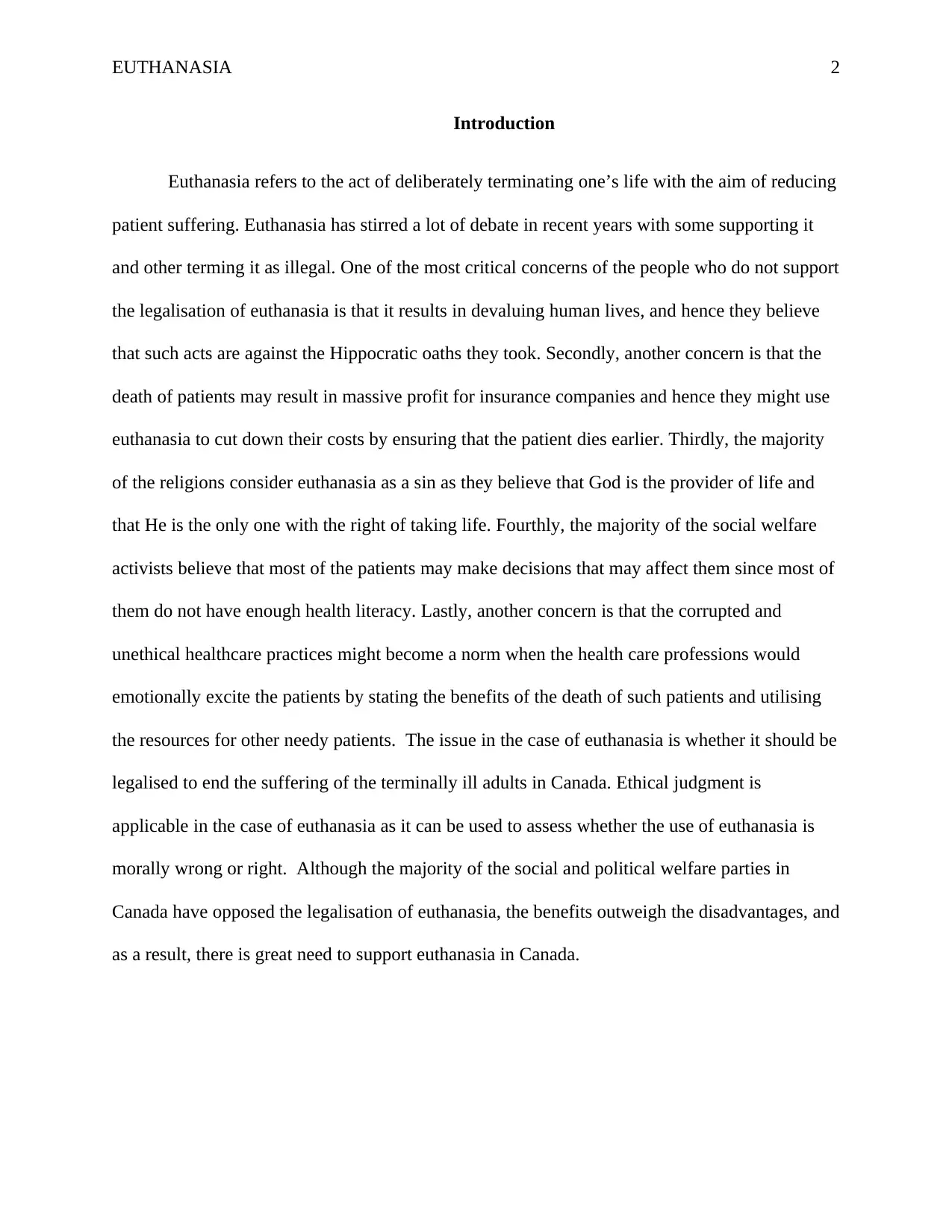
Euthanasia refers to the act of deliberately terminating one’s life with the aim of reducing
patient suffering. Euthanasia has stirred a lot of debate in recent years with some supporting it
and other terming it as illegal. One of the most critical concerns of the people who do not support
the legalisation of euthanasia is that it results in devaluing human lives, and hence they believe
that such acts are against the Hippocratic oaths they took. Secondly, another concern is that the
death of patients may result in massive profit for insurance companies and hence they might use
euthanasia to cut down their costs by ensuring that the patient dies earlier. Thirdly, the majority
of the religions consider euthanasia as a sin as they believe that God is the provider of life and
that He is the only one with the right of taking life. Fourthly, the majority of the social welfare
activists believe that most of the patients may make decisions that may affect them since most of
them do not have enough health literacy. Lastly, another concern is that the corrupted and
unethical healthcare practices might become a norm when the health care professions would
emotionally excite the patients by stating the benefits of the death of such patients and utilising
the resources for other needy patients. The issue in the case of euthanasia is whether it should be
legalised to end the suffering of the terminally ill adults in Canada. Ethical judgment is
applicable in the case of euthanasia as it can be used to assess whether the use of euthanasia is
morally wrong or right. Although the majority of the social and political welfare parties in
Canada have opposed the legalisation of euthanasia, the benefits outweigh the disadvantages, and
as a result, there is great need to support euthanasia in Canada.
Introduction
Euthanasia refers to the act of deliberately terminating one’s life with the aim of reducing
patient suffering. Euthanasia has stirred a lot of debate in recent years with some supporting it
and other terming it as illegal. One of the most critical concerns of the people who do not support
the legalisation of euthanasia is that it results in devaluing human lives, and hence they believe
that such acts are against the Hippocratic oaths they took. Secondly, another concern is that the
death of patients may result in massive profit for insurance companies and hence they might use
euthanasia to cut down their costs by ensuring that the patient dies earlier. Thirdly, the majority
of the religions consider euthanasia as a sin as they believe that God is the provider of life and
that He is the only one with the right of taking life. Fourthly, the majority of the social welfare
activists believe that most of the patients may make decisions that may affect them since most of
them do not have enough health literacy. Lastly, another concern is that the corrupted and
unethical healthcare practices might become a norm when the health care professions would
emotionally excite the patients by stating the benefits of the death of such patients and utilising
the resources for other needy patients. The issue in the case of euthanasia is whether it should be
legalised to end the suffering of the terminally ill adults in Canada. Ethical judgment is
applicable in the case of euthanasia as it can be used to assess whether the use of euthanasia is
morally wrong or right. Although the majority of the social and political welfare parties in
Canada have opposed the legalisation of euthanasia, the benefits outweigh the disadvantages, and
as a result, there is great need to support euthanasia in Canada.

EUTHANASIA 3
Benefits of Euthanasia
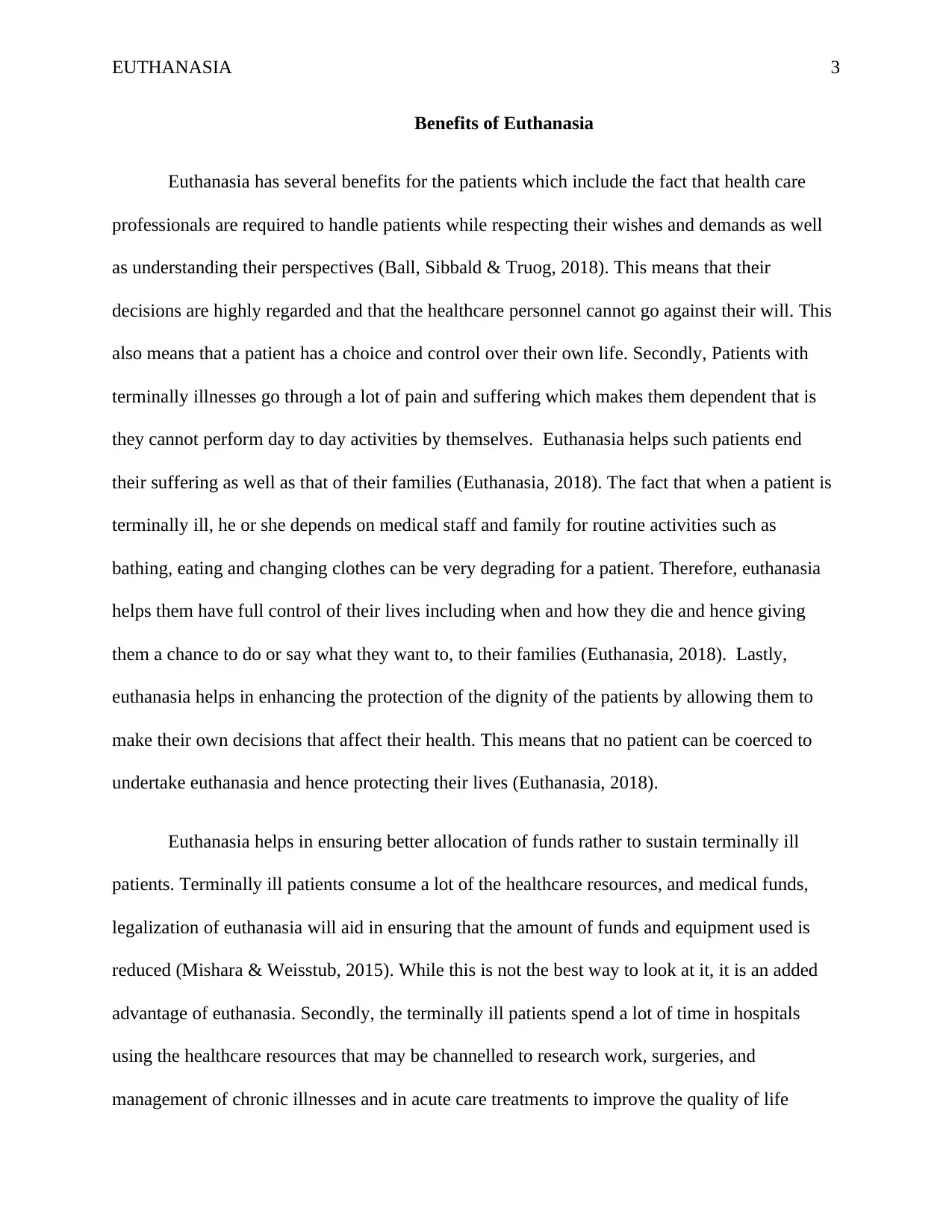
Euthanasia has several benefits for the patients which include the fact that health care
professionals are required to handle patients while respecting their wishes and demands as well
as understanding their perspectives (Ball, Sibbald & Truog, 2018). This means that their
decisions are highly regarded and that the healthcare personnel cannot go against their will. This
also means that a patient has a choice and control over their own life. Secondly, Patients with
terminally illnesses go through a lot of pain and suffering which makes them dependent that is
they cannot perform day to day activities by themselves. Euthanasia helps such patients end
their suffering as well as that of their families (Euthanasia, 2018). The fact that when a patient is
terminally ill, he or she depends on medical staff and family for routine activities such as
bathing, eating and changing clothes can be very degrading for a patient. Therefore, euthanasia
helps them have full control of their lives including when and how they die and hence giving
them a chance to do or say what they want to, to their families (Euthanasia, 2018). Lastly,
euthanasia helps in enhancing the protection of the dignity of the patients by allowing them to
make their own decisions that affect their health. This means that no patient can be coerced to
undertake euthanasia and hence protecting their lives (Euthanasia, 2018).
Euthanasia helps in ensuring better allocation of funds rather to sustain terminally ill
patients. Terminally ill patients consume a lot of the healthcare resources, and medical funds,
legalization of euthanasia will aid in ensuring that the amount of funds and equipment used is
reduced (Mishara & Weisstub, 2015). While this is not the best way to look at it, it is an added
advantage of euthanasia. Secondly, the terminally ill patients spend a lot of time in hospitals
using the healthcare resources that may be channelled to research work, surgeries, and
management of chronic illnesses and in acute care treatments to improve the quality of life
Benefits of Euthanasia
Euthanasia has several benefits for the patients which include the fact that health care
professionals are required to handle patients while respecting their wishes and demands as well
as understanding their perspectives (Ball, Sibbald & Truog, 2018). This means that their
decisions are highly regarded and that the healthcare personnel cannot go against their will. This
also means that a patient has a choice and control over their own life. Secondly, Patients with
terminally illnesses go through a lot of pain and suffering which makes them dependent that is
they cannot perform day to day activities by themselves. Euthanasia helps such patients end
their suffering as well as that of their families (Euthanasia, 2018). The fact that when a patient is
terminally ill, he or she depends on medical staff and family for routine activities such as
bathing, eating and changing clothes can be very degrading for a patient. Therefore, euthanasia
helps them have full control of their lives including when and how they die and hence giving
them a chance to do or say what they want to, to their families (Euthanasia, 2018). Lastly,
euthanasia helps in enhancing the protection of the dignity of the patients by allowing them to
make their own decisions that affect their health. This means that no patient can be coerced to
undertake euthanasia and hence protecting their lives (Euthanasia, 2018).
Euthanasia helps in ensuring better allocation of funds rather to sustain terminally ill
patients. Terminally ill patients consume a lot of the healthcare resources, and medical funds,
legalization of euthanasia will aid in ensuring that the amount of funds and equipment used is
reduced (Mishara & Weisstub, 2015). While this is not the best way to look at it, it is an added
advantage of euthanasia. Secondly, the terminally ill patients spend a lot of time in hospitals
using the healthcare resources that may be channelled to research work, surgeries, and
management of chronic illnesses and in acute care treatments to improve the quality of life
⊘ This is a preview!⊘
Do you want full access?
Subscribe today to unlock all pages.

Trusted by 1+ million students worldwide

EUTHANASIA 4
(Mishara & Weisstub, 2015). Instead of spending weeks, months and years consuming the
healthcare resources, patients with terminal illness and irreversible commas can die in peace
while saving the space in the hospitals and the resources. Lastly, the establishment of a robust
monitoring and evaluating committee who can develop laws and policies that can oversee the
funds go towards new research can aid in the legalisation of euthanasia (Pereira, 2011).
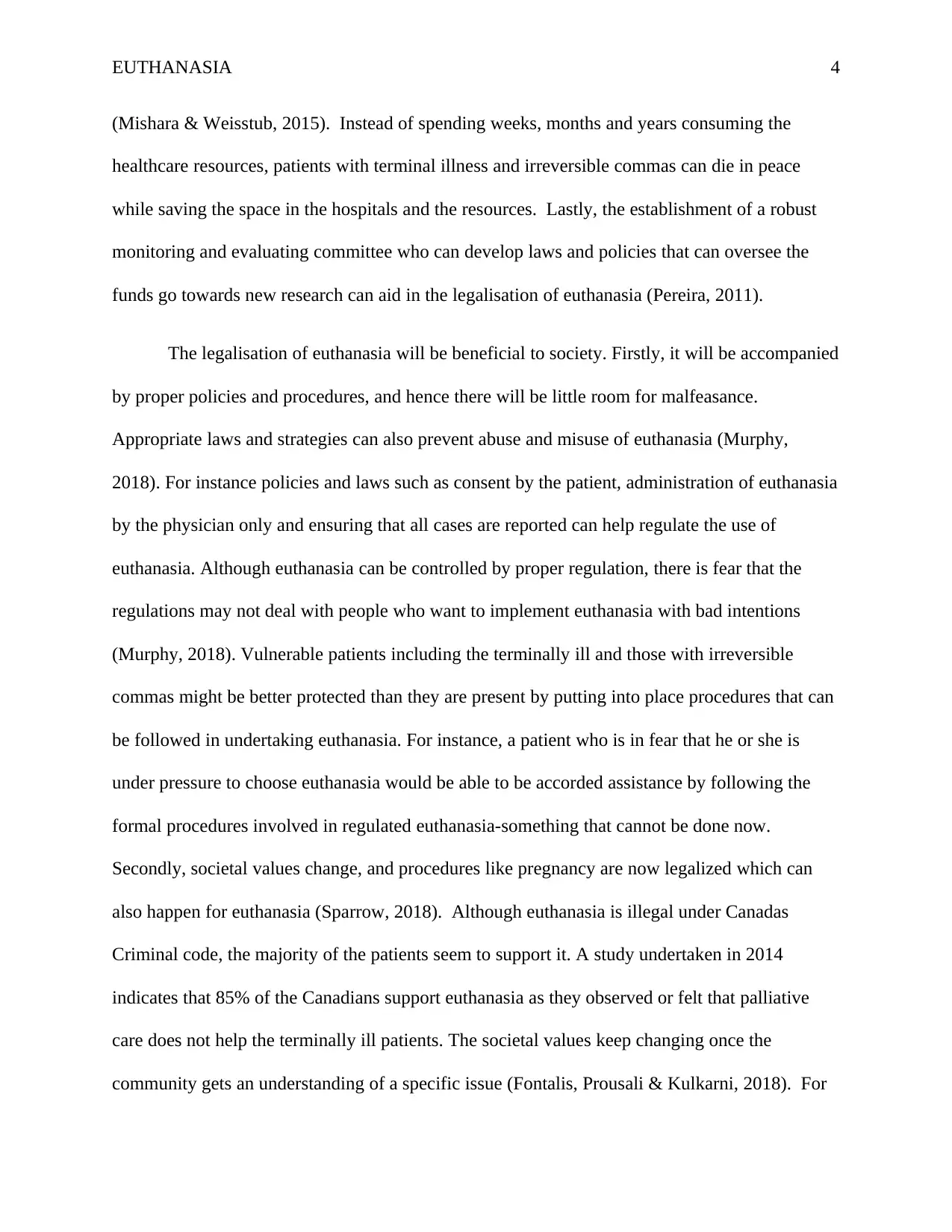
The legalisation of euthanasia will be beneficial to society. Firstly, it will be accompanied
by proper policies and procedures, and hence there will be little room for malfeasance.
Appropriate laws and strategies can also prevent abuse and misuse of euthanasia (Murphy,
2018). For instance policies and laws such as consent by the patient, administration of euthanasia
by the physician only and ensuring that all cases are reported can help regulate the use of
euthanasia. Although euthanasia can be controlled by proper regulation, there is fear that the
regulations may not deal with people who want to implement euthanasia with bad intentions
(Murphy, 2018). Vulnerable patients including the terminally ill and those with irreversible
commas might be better protected than they are present by putting into place procedures that can
be followed in undertaking euthanasia. For instance, a patient who is in fear that he or she is
under pressure to choose euthanasia would be able to be accorded assistance by following the
formal procedures involved in regulated euthanasia-something that cannot be done now.
Secondly, societal values change, and procedures like pregnancy are now legalized which can
also happen for euthanasia (Sparrow, 2018). Although euthanasia is illegal under Canadas
Criminal code, the majority of the patients seem to support it. A study undertaken in 2014
indicates that 85% of the Canadians support euthanasia as they observed or felt that palliative
care does not help the terminally ill patients. The societal values keep changing once the
community gets an understanding of a specific issue (Fontalis, Prousali & Kulkarni, 2018). For
(Mishara & Weisstub, 2015). Instead of spending weeks, months and years consuming the
healthcare resources, patients with terminal illness and irreversible commas can die in peace
while saving the space in the hospitals and the resources. Lastly, the establishment of a robust
monitoring and evaluating committee who can develop laws and policies that can oversee the
funds go towards new research can aid in the legalisation of euthanasia (Pereira, 2011).
The legalisation of euthanasia will be beneficial to society. Firstly, it will be accompanied
by proper policies and procedures, and hence there will be little room for malfeasance.
Appropriate laws and strategies can also prevent abuse and misuse of euthanasia (Murphy,
2018). For instance policies and laws such as consent by the patient, administration of euthanasia
by the physician only and ensuring that all cases are reported can help regulate the use of
euthanasia. Although euthanasia can be controlled by proper regulation, there is fear that the
regulations may not deal with people who want to implement euthanasia with bad intentions
(Murphy, 2018). Vulnerable patients including the terminally ill and those with irreversible
commas might be better protected than they are present by putting into place procedures that can
be followed in undertaking euthanasia. For instance, a patient who is in fear that he or she is
under pressure to choose euthanasia would be able to be accorded assistance by following the
formal procedures involved in regulated euthanasia-something that cannot be done now.
Secondly, societal values change, and procedures like pregnancy are now legalized which can
also happen for euthanasia (Sparrow, 2018). Although euthanasia is illegal under Canadas
Criminal code, the majority of the patients seem to support it. A study undertaken in 2014
indicates that 85% of the Canadians support euthanasia as they observed or felt that palliative
care does not help the terminally ill patients. The societal values keep changing once the
community gets an understanding of a specific issue (Fontalis, Prousali & Kulkarni, 2018). For
Paraphrase This Document
Need a fresh take? Get an instant paraphrase of this document with our AI Paraphraser

EUTHANASIA 5
instance, when society gets to understand about euthanasia and the benefits, they are likely to
accept the procedure. Lastly, medical science does not concern itself with the concept of afterlife
or hell; thus religion should not be a precursor for opposing euthanasia. (Barry et al., 2018).
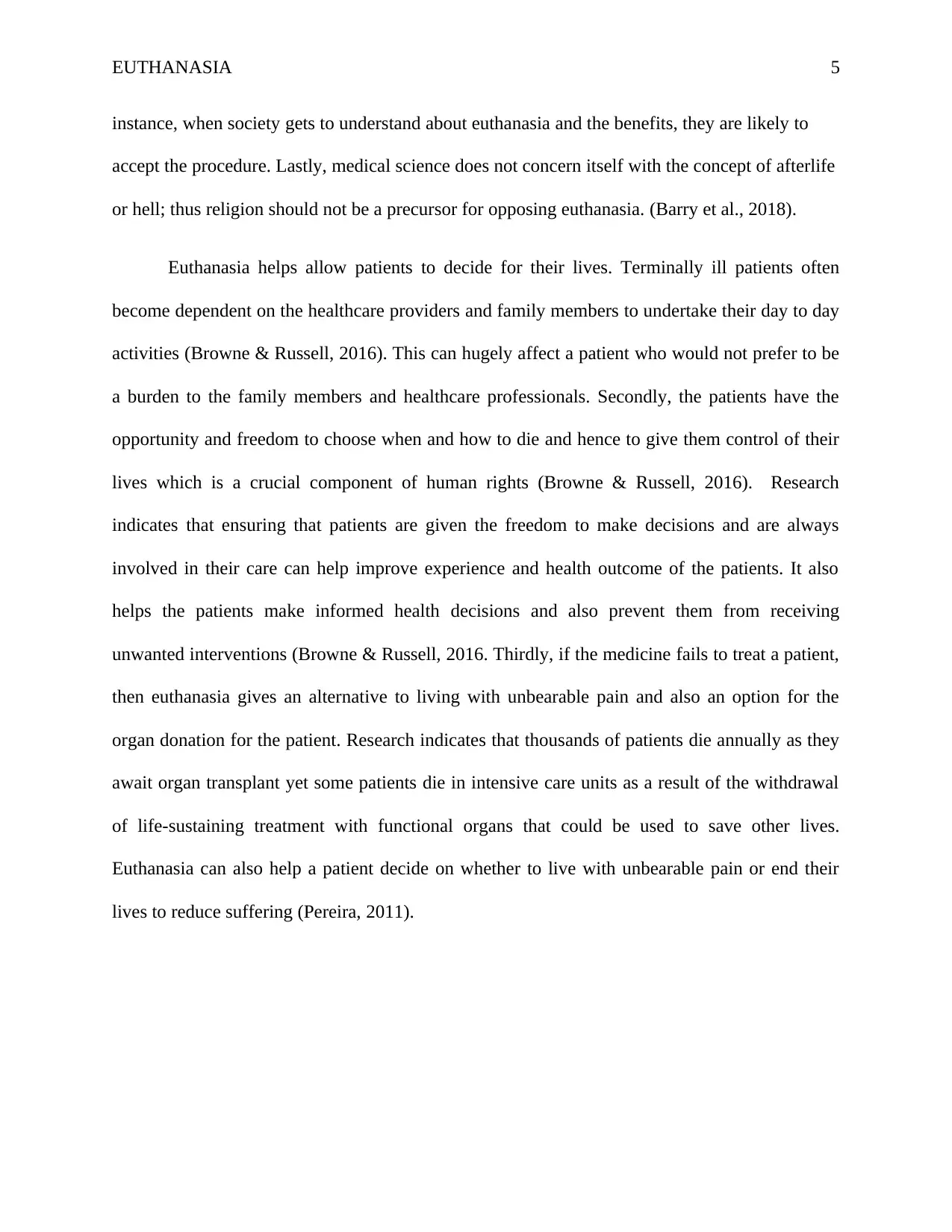
Euthanasia helps allow patients to decide for their lives. Terminally ill patients often
become dependent on the healthcare providers and family members to undertake their day to day
activities (Browne & Russell, 2016). This can hugely affect a patient who would not prefer to be
a burden to the family members and healthcare professionals. Secondly, the patients have the
opportunity and freedom to choose when and how to die and hence to give them control of their
lives which is a crucial component of human rights (Browne & Russell, 2016). Research
indicates that ensuring that patients are given the freedom to make decisions and are always
involved in their care can help improve experience and health outcome of the patients. It also
helps the patients make informed health decisions and also prevent them from receiving
unwanted interventions (Browne & Russell, 2016. Thirdly, if the medicine fails to treat a patient,
then euthanasia gives an alternative to living with unbearable pain and also an option for the
organ donation for the patient. Research indicates that thousands of patients die annually as they
await organ transplant yet some patients die in intensive care units as a result of the withdrawal
of life-sustaining treatment with functional organs that could be used to save other lives.
Euthanasia can also help a patient decide on whether to live with unbearable pain or end their
lives to reduce suffering (Pereira, 2011).
instance, when society gets to understand about euthanasia and the benefits, they are likely to
accept the procedure. Lastly, medical science does not concern itself with the concept of afterlife
or hell; thus religion should not be a precursor for opposing euthanasia. (Barry et al., 2018).
Euthanasia helps allow patients to decide for their lives. Terminally ill patients often
become dependent on the healthcare providers and family members to undertake their day to day
activities (Browne & Russell, 2016). This can hugely affect a patient who would not prefer to be
a burden to the family members and healthcare professionals. Secondly, the patients have the
opportunity and freedom to choose when and how to die and hence to give them control of their
lives which is a crucial component of human rights (Browne & Russell, 2016). Research
indicates that ensuring that patients are given the freedom to make decisions and are always
involved in their care can help improve experience and health outcome of the patients. It also
helps the patients make informed health decisions and also prevent them from receiving
unwanted interventions (Browne & Russell, 2016. Thirdly, if the medicine fails to treat a patient,
then euthanasia gives an alternative to living with unbearable pain and also an option for the
organ donation for the patient. Research indicates that thousands of patients die annually as they
await organ transplant yet some patients die in intensive care units as a result of the withdrawal
of life-sustaining treatment with functional organs that could be used to save other lives.
Euthanasia can also help a patient decide on whether to live with unbearable pain or end their
lives to reduce suffering (Pereira, 2011).

EUTHANASIA 6
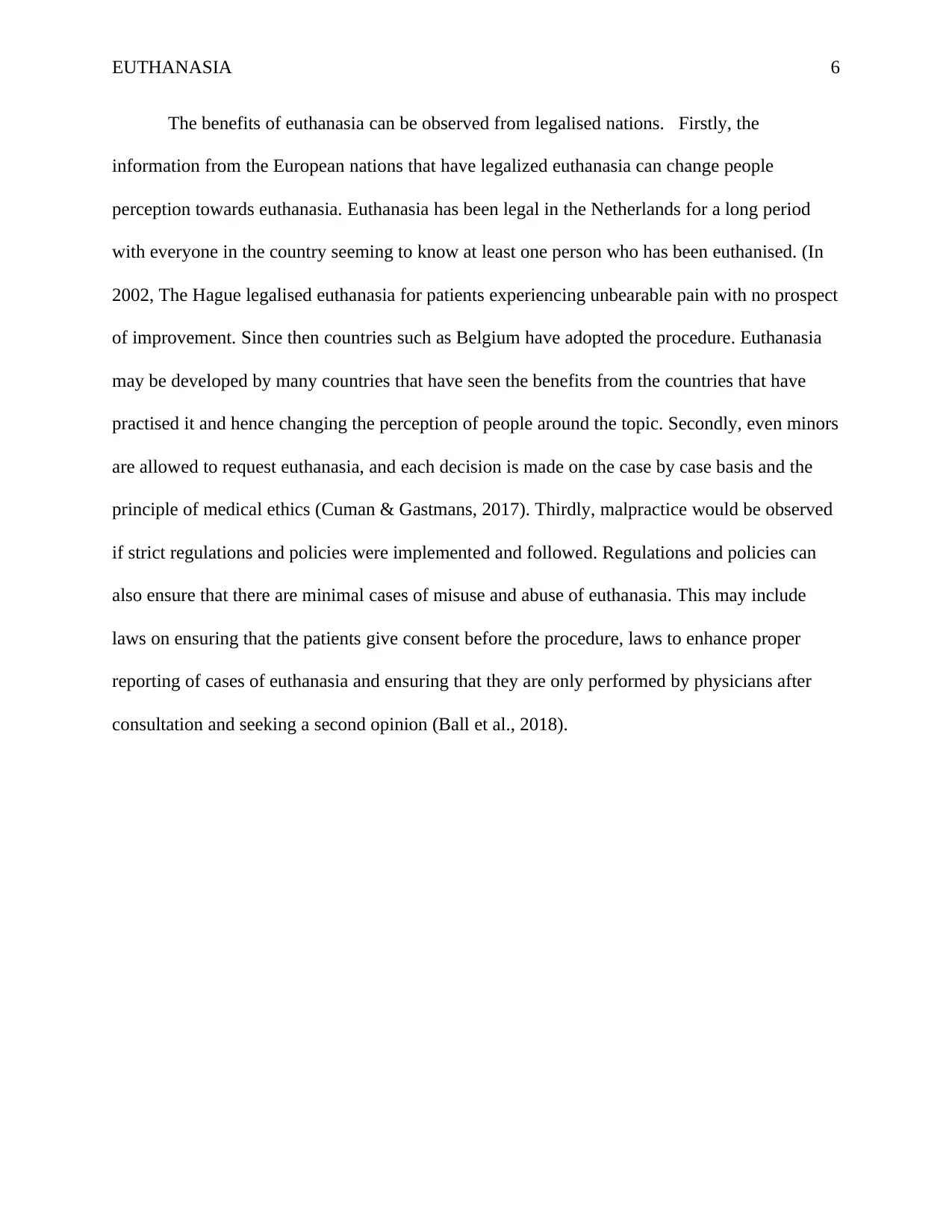
The benefits of euthanasia can be observed from legalised nations. Firstly, the
information from the European nations that have legalized euthanasia can change people
perception towards euthanasia. Euthanasia has been legal in the Netherlands for a long period
with everyone in the country seeming to know at least one person who has been euthanised. (In
2002, The Hague legalised euthanasia for patients experiencing unbearable pain with no prospect
of improvement. Since then countries such as Belgium have adopted the procedure. Euthanasia
may be developed by many countries that have seen the benefits from the countries that have
practised it and hence changing the perception of people around the topic. Secondly, even minors
are allowed to request euthanasia, and each decision is made on the case by case basis and the
principle of medical ethics (Cuman & Gastmans, 2017). Thirdly, malpractice would be observed
if strict regulations and policies were implemented and followed. Regulations and policies can
also ensure that there are minimal cases of misuse and abuse of euthanasia. This may include
laws on ensuring that the patients give consent before the procedure, laws to enhance proper
reporting of cases of euthanasia and ensuring that they are only performed by physicians after
consultation and seeking a second opinion (Ball et al., 2018).
The benefits of euthanasia can be observed from legalised nations. Firstly, the
information from the European nations that have legalized euthanasia can change people
perception towards euthanasia. Euthanasia has been legal in the Netherlands for a long period
with everyone in the country seeming to know at least one person who has been euthanised. (In
2002, The Hague legalised euthanasia for patients experiencing unbearable pain with no prospect
of improvement. Since then countries such as Belgium have adopted the procedure. Euthanasia
may be developed by many countries that have seen the benefits from the countries that have
practised it and hence changing the perception of people around the topic. Secondly, even minors
are allowed to request euthanasia, and each decision is made on the case by case basis and the
principle of medical ethics (Cuman & Gastmans, 2017). Thirdly, malpractice would be observed
if strict regulations and policies were implemented and followed. Regulations and policies can
also ensure that there are minimal cases of misuse and abuse of euthanasia. This may include
laws on ensuring that the patients give consent before the procedure, laws to enhance proper
reporting of cases of euthanasia and ensuring that they are only performed by physicians after
consultation and seeking a second opinion (Ball et al., 2018).
⊘ This is a preview!⊘
Do you want full access?
Subscribe today to unlock all pages.

Trusted by 1+ million students worldwide

EUTHANASIA 7
Conclusion
In conclusion, terminal illnesses and diseases are harrowing experiences especially when
one is almost passing on. Those who support euthanasia argue out that uncertainty, unimaginable
pain and loss of control are things patients should go through nearing their death. Those who
oppose it believe that death should come naturally and that no one has the authority of taking
some else's life. Research suggests that the benefits of Euthanasia are more significant than the
losses if proper policies and procedures are adopted. This explains the need to legalise it to end
the suffering in terminally ill patients.
Conclusion
In conclusion, terminal illnesses and diseases are harrowing experiences especially when
one is almost passing on. Those who support euthanasia argue out that uncertainty, unimaginable
pain and loss of control are things patients should go through nearing their death. Those who
oppose it believe that death should come naturally and that no one has the authority of taking
some else's life. Research suggests that the benefits of Euthanasia are more significant than the
losses if proper policies and procedures are adopted. This explains the need to legalise it to end
the suffering in terminally ill patients.
Paraphrase This Document
Need a fresh take? Get an instant paraphrase of this document with our AI Paraphraser

EUTHANASIA 8
References
Ball, I. M., Sibbald, R., & Truog, R. D. (2018). Voluntary euthanasia — implications for organ
donation. The New England Journal of Medicine, 379(10), 909-911.
doi:http://dx.doi.org.ezproxy.mohawkcollege.ca/10.1056/NEJMp1804276
Barry, L., Hobbins, A., Kelleher, D., Shah, K., Devlin, N., Goni, J. M. R., & O’Neill, C. (2018).
Euthanasia, religiosity and the valuation of health states: results from an Irish EQ5D5L
valuation study and their implications for anchor values. Health And Quality Of Life
Outcomes, 16(1), 152. https://doi-org.ezproxy.mohawkcollege.ca/10.1186/s12955-018-
0985-9
Browne, A., & Russell, J. S. (2016). Physician-assisted death in Canada. Cambridge Quarterly
of Healthcare Ethics, 25(3), 377-383.
Cuman, G., & Gastmans, C. (2017). Minors and euthanasia: a systematic review of argument-
based ethics literature. European Journal of Pediatrics, 176(7), 837–847. https://doi-
org.ezproxy.mohawkcollege.ca/10.1007/s00431-017-2934-8
Euthanasia. (2018). Funk & Wagnalls New World Encyclopedia, 1; Retrieved from
https://ezproxy.mohawkcollege.ca/login?url=https://search.ebscohost.com/login.aspx?
direct=true&AuthType=ip,cpid&custid=mohawk&db=funk&AN=eu069800&site=eds-
live&scope=site
Fontalis, A., Prousali, E., & Kulkarni, K. (2018). Euthanasia and assisted dying: what is the
current position and what are the key arguments informing the debate?. Journal of the
Royal Society of Medicine, 111(11), 407-413.
References
Ball, I. M., Sibbald, R., & Truog, R. D. (2018). Voluntary euthanasia — implications for organ
donation. The New England Journal of Medicine, 379(10), 909-911.
doi:http://dx.doi.org.ezproxy.mohawkcollege.ca/10.1056/NEJMp1804276
Barry, L., Hobbins, A., Kelleher, D., Shah, K., Devlin, N., Goni, J. M. R., & O’Neill, C. (2018).
Euthanasia, religiosity and the valuation of health states: results from an Irish EQ5D5L
valuation study and their implications for anchor values. Health And Quality Of Life
Outcomes, 16(1), 152. https://doi-org.ezproxy.mohawkcollege.ca/10.1186/s12955-018-
0985-9
Browne, A., & Russell, J. S. (2016). Physician-assisted death in Canada. Cambridge Quarterly
of Healthcare Ethics, 25(3), 377-383.
Cuman, G., & Gastmans, C. (2017). Minors and euthanasia: a systematic review of argument-
based ethics literature. European Journal of Pediatrics, 176(7), 837–847. https://doi-
org.ezproxy.mohawkcollege.ca/10.1007/s00431-017-2934-8
Euthanasia. (2018). Funk & Wagnalls New World Encyclopedia, 1; Retrieved from
https://ezproxy.mohawkcollege.ca/login?url=https://search.ebscohost.com/login.aspx?
direct=true&AuthType=ip,cpid&custid=mohawk&db=funk&AN=eu069800&site=eds-
live&scope=site
Fontalis, A., Prousali, E., & Kulkarni, K. (2018). Euthanasia and assisted dying: what is the
current position and what are the key arguments informing the debate?. Journal of the
Royal Society of Medicine, 111(11), 407-413.

EUTHANASIA 9
Mishara, B. L., & Weisstub, D. N. (2015). Legalization of euthanasia in Quebec, Canada as “medical aid
in dying”: A case study in social marketing, changing mores and legal maneuvering. Ethics,
Medicine and Public Health, 1(4), 450-455.
Murphy, S. T. (2018). Canadian Medical Association and Euthanasia and Assisted Suicide in Canada:
Critical Review of CMA Approach to Changes in Policy and Law. Available at SSRN 3255699
Pereira, J. (2011). Legalizing euthanasia or assisted suicide: the illusion of safeguards and controls.
Current Oncology (Toronto, Ont.), 18(2), e38–e45. Retrieved from
https://ezproxy.mohawkcollege.ca/login?url=https://search.ebscohost.com/login.aspx?
direct=true&AuthType=ip,cpid&custid=mohawk&db=cmedm&AN=21505588&site=eds-
live&scope=site
Sparrow, M. J. (2018). Euthanasia and abortion. The New Zealand Medical Journal, 131(1468), 94.
Retrieved from https://ezproxy.mohawkcollege.ca/login?url=https://search.ebscohost.com/
login.aspx?
direct=true&AuthType=ip,cpid&custid=mohawk&db=cmedm&AN=29346363&site=eds-
live&scope=site
Mishara, B. L., & Weisstub, D. N. (2015). Legalization of euthanasia in Quebec, Canada as “medical aid
in dying”: A case study in social marketing, changing mores and legal maneuvering. Ethics,
Medicine and Public Health, 1(4), 450-455.
Murphy, S. T. (2018). Canadian Medical Association and Euthanasia and Assisted Suicide in Canada:
Critical Review of CMA Approach to Changes in Policy and Law. Available at SSRN 3255699
Pereira, J. (2011). Legalizing euthanasia or assisted suicide: the illusion of safeguards and controls.
Current Oncology (Toronto, Ont.), 18(2), e38–e45. Retrieved from
https://ezproxy.mohawkcollege.ca/login?url=https://search.ebscohost.com/login.aspx?
direct=true&AuthType=ip,cpid&custid=mohawk&db=cmedm&AN=21505588&site=eds-
live&scope=site
Sparrow, M. J. (2018). Euthanasia and abortion. The New Zealand Medical Journal, 131(1468), 94.
Retrieved from https://ezproxy.mohawkcollege.ca/login?url=https://search.ebscohost.com/
login.aspx?
direct=true&AuthType=ip,cpid&custid=mohawk&db=cmedm&AN=29346363&site=eds-
live&scope=site
⊘ This is a preview!⊘
Do you want full access?
Subscribe today to unlock all pages.

Trusted by 1+ million students worldwide
1 out of 9
Related Documents
Your All-in-One AI-Powered Toolkit for Academic Success.
+13062052269
info@desklib.com
Available 24*7 on WhatsApp / Email
Unlock your academic potential
Copyright © 2020–2025 A2Z Services. All Rights Reserved. Developed and managed by ZUCOL.