Comprehensive Report: Legislation, Ethics in Travel and Tourism Sector
VerifiedAdded on 2023/05/31
|35
|11217
|224
Report
AI Summary
This report provides a comprehensive overview of legislation and ethics within the travel and tourism industry. It begins with an introduction to the sector and its regulatory framework, including the roles of ABTA, the Tourism Act 1969, and various transport acts. The report then delves into the legal and regulatory aspects of the travel and hospitality sector, analyzing surface, sea, and air transport laws concerning passenger carriage, health, safety, and security legislation. It also examines consumer protection legislation and contract law related to travel and tourism customers. Furthermore, the report explores the role of business ethics, including ethical dilemmas and corporate social responsibility, using Carnival Cruise Lines as a case study. The conclusion summarizes the key findings and implications of the report, highlighting the importance of legal compliance and ethical practices in the travel and tourism industry.
Running head: LEGISLATION AND ETHICS IN TRAVEL AND TOURISM INDUSTRY
Legislation and Ethics in Travel and Tourism Industry
Name of the Student
Name of the University
Authors Note
Course ID
Legislation and Ethics in Travel and Tourism Industry
Name of the Student
Name of the University
Authors Note
Course ID

Paraphrase This Document
Need a fresh take? Get an instant paraphrase of this document with our AI Paraphraser
1LEGISLATION AND ETHICS IN TRAVEL AND TOURISM INDUSTRY
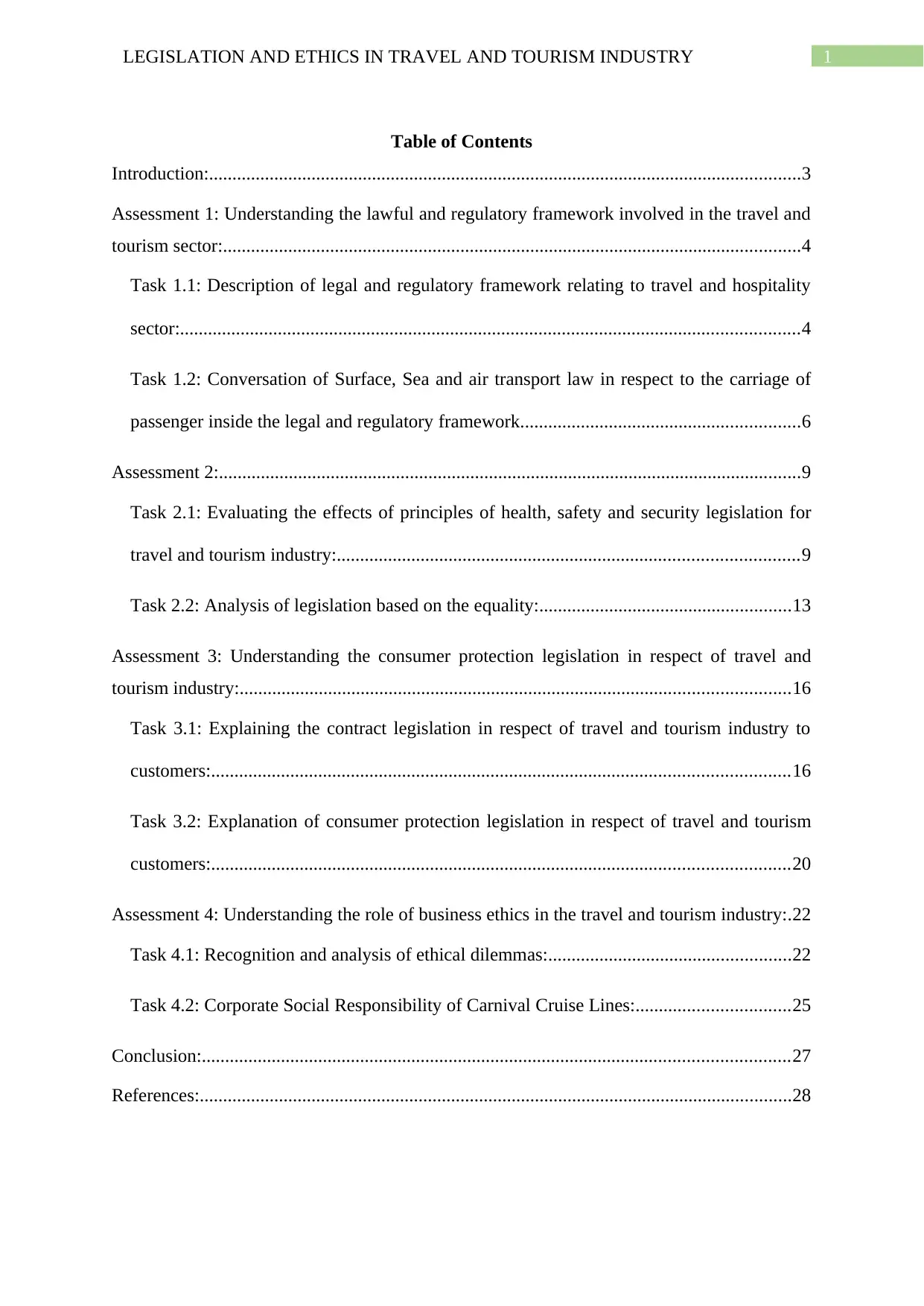
Table of Contents
Introduction:...............................................................................................................................3
Assessment 1: Understanding the lawful and regulatory framework involved in the travel and
tourism sector:............................................................................................................................4
Task 1.1: Description of legal and regulatory framework relating to travel and hospitality
sector:.....................................................................................................................................4
Task 1.2: Conversation of Surface, Sea and air transport law in respect to the carriage of
passenger inside the legal and regulatory framework............................................................6
Assessment 2:.............................................................................................................................9
Task 2.1: Evaluating the effects of principles of health, safety and security legislation for
travel and tourism industry:...................................................................................................9
Task 2.2: Analysis of legislation based on the equality:......................................................13
Assessment 3: Understanding the consumer protection legislation in respect of travel and
tourism industry:......................................................................................................................16
Task 3.1: Explaining the contract legislation in respect of travel and tourism industry to
customers:............................................................................................................................16
Task 3.2: Explanation of consumer protection legislation in respect of travel and tourism
customers:............................................................................................................................20
Assessment 4: Understanding the role of business ethics in the travel and tourism industry:.22
Task 4.1: Recognition and analysis of ethical dilemmas:....................................................22
Task 4.2: Corporate Social Responsibility of Carnival Cruise Lines:.................................25
Conclusion:..............................................................................................................................27
References:...............................................................................................................................28
Table of Contents
Introduction:...............................................................................................................................3
Assessment 1: Understanding the lawful and regulatory framework involved in the travel and
tourism sector:............................................................................................................................4
Task 1.1: Description of legal and regulatory framework relating to travel and hospitality
sector:.....................................................................................................................................4
Task 1.2: Conversation of Surface, Sea and air transport law in respect to the carriage of
passenger inside the legal and regulatory framework............................................................6
Assessment 2:.............................................................................................................................9
Task 2.1: Evaluating the effects of principles of health, safety and security legislation for
travel and tourism industry:...................................................................................................9
Task 2.2: Analysis of legislation based on the equality:......................................................13
Assessment 3: Understanding the consumer protection legislation in respect of travel and
tourism industry:......................................................................................................................16
Task 3.1: Explaining the contract legislation in respect of travel and tourism industry to
customers:............................................................................................................................16
Task 3.2: Explanation of consumer protection legislation in respect of travel and tourism
customers:............................................................................................................................20
Assessment 4: Understanding the role of business ethics in the travel and tourism industry:.22
Task 4.1: Recognition and analysis of ethical dilemmas:....................................................22
Task 4.2: Corporate Social Responsibility of Carnival Cruise Lines:.................................25
Conclusion:..............................................................................................................................27
References:...............................................................................................................................28
2LEGISLATION AND ETHICS IN TRAVEL AND TOURISM INDUSTRY
Introduction:
The tours and travel industry is associated to each other at every stage. The tours and
travel industry is customer centric which is aims in offering the best customer experience to
the tourists that undertakes services for brief period. The travels may be both the domestic or
international (Boniface et al., 2016). There are many bodies that operates at the regulatory
and service level. The lawful and regulatory framework concerning travel and tourism covers
numerous aspects of the industry based on the involvement of different parties in the
industry. The industry falls under the preview of Tourism Act 1969, Package Tour
Regulations 1992 and Travel Act 1985.
There is an existence of surface law, air law and sea law in respect of the carriage of
passengers inside the lawful and regulatory framework. Furthermore, there is an impact on
the effects of principles on the health, security and safety legislation on the tourism and travel
industry (Becker, 2016). The industry falls within the purview of legislation that is associated
to equality and legislation of contract in respect to tours and travel customers. The customers
are further safeguarded under the summer protection legislation so that the interest of the
customer are safeguarded. The business of tours and travels simply cannot operate in search
of making profit. The legislation and ethics of tours and travel companies have certain
corporate social responsibilities with the purpose of contributing towards the improvement of
the general public.
The existing reading is based on understanding the numerous of tours and travel
industry along with the companies that are operating in the industry (Xiang et al., 2015). The
significance of corporate social responsibility is to drive the engagement of the company
towards the welfare of the society in order to make sure that the resources are used and
provided for exchange in service.
Introduction:
The tours and travel industry is associated to each other at every stage. The tours and
travel industry is customer centric which is aims in offering the best customer experience to
the tourists that undertakes services for brief period. The travels may be both the domestic or
international (Boniface et al., 2016). There are many bodies that operates at the regulatory
and service level. The lawful and regulatory framework concerning travel and tourism covers
numerous aspects of the industry based on the involvement of different parties in the
industry. The industry falls under the preview of Tourism Act 1969, Package Tour
Regulations 1992 and Travel Act 1985.
There is an existence of surface law, air law and sea law in respect of the carriage of
passengers inside the lawful and regulatory framework. Furthermore, there is an impact on
the effects of principles on the health, security and safety legislation on the tourism and travel
industry (Becker, 2016). The industry falls within the purview of legislation that is associated
to equality and legislation of contract in respect to tours and travel customers. The customers
are further safeguarded under the summer protection legislation so that the interest of the
customer are safeguarded. The business of tours and travels simply cannot operate in search
of making profit. The legislation and ethics of tours and travel companies have certain
corporate social responsibilities with the purpose of contributing towards the improvement of
the general public.
The existing reading is based on understanding the numerous of tours and travel
industry along with the companies that are operating in the industry (Xiang et al., 2015). The
significance of corporate social responsibility is to drive the engagement of the company
towards the welfare of the society in order to make sure that the resources are used and
provided for exchange in service.
⊘ This is a preview!⊘
Do you want full access?
Subscribe today to unlock all pages.

Trusted by 1+ million students worldwide
3LEGISLATION AND ETHICS IN TRAVEL AND TOURISM INDUSTRY
Assessment 1: Understanding the lawful and regulatory framework involved in the
travel and tourism sector:
Task 1.1: Description of legal and regulatory framework relating to travel and
hospitality sector:
The travel and hospitality industry of UK is controlled by Association of British
Travel Agents. The regulatory body oversees certain problems and solves them which is
commonly prevailing in the industry (Vellas, 2016). Certain issues that are controlled by the
regulatory bodies relates to insurance and bookings. The association controls the process of
bookings, travelling procedure and code of travel. The rights are regulated under the British
Tourism Industry. The primary objective of the sector is monitory the safety of tourist and
perspective customers. The health and safety measures plays a vital role in offering protection
to the tourists. The welfare of the employees is also looked upon in the industry. With the
growth of the tours and hospitality industry, below listed are the following regulations that
regulates the sector are as follows;
The ABTA: The tours and hospitality sector under the Wales, Britain and Scotland is
regulated by the ABTA. The main objective relating to the creation of ABTA is to make sure
that the bookings relating to travel and permits is determined as per the legislations (Coles &
Timothy, 2014). The ABTA aims to regulate the numerous offers that is offered to the
tourists by different companies. The ABTA is accountable for the provisional bookings,
facilities relating to departure and insurance.
Tourism Act 1969: The act emphasis on the tourism companies and their management as
mentioned by the “British Tourist Authority” (Buhalis & Foerste, 2015).
Transport Act, 1980 & 1985: This Acts implement control and implements regulation on
the private bus transference businesses together with their roads.
Assessment 1: Understanding the lawful and regulatory framework involved in the
travel and tourism sector:
Task 1.1: Description of legal and regulatory framework relating to travel and
hospitality sector:
The travel and hospitality industry of UK is controlled by Association of British
Travel Agents. The regulatory body oversees certain problems and solves them which is
commonly prevailing in the industry (Vellas, 2016). Certain issues that are controlled by the
regulatory bodies relates to insurance and bookings. The association controls the process of
bookings, travelling procedure and code of travel. The rights are regulated under the British
Tourism Industry. The primary objective of the sector is monitory the safety of tourist and
perspective customers. The health and safety measures plays a vital role in offering protection
to the tourists. The welfare of the employees is also looked upon in the industry. With the
growth of the tours and hospitality industry, below listed are the following regulations that
regulates the sector are as follows;
The ABTA: The tours and hospitality sector under the Wales, Britain and Scotland is
regulated by the ABTA. The main objective relating to the creation of ABTA is to make sure
that the bookings relating to travel and permits is determined as per the legislations (Coles &
Timothy, 2014). The ABTA aims to regulate the numerous offers that is offered to the
tourists by different companies. The ABTA is accountable for the provisional bookings,
facilities relating to departure and insurance.
Tourism Act 1969: The act emphasis on the tourism companies and their management as
mentioned by the “British Tourist Authority” (Buhalis & Foerste, 2015).
Transport Act, 1980 & 1985: This Acts implement control and implements regulation on
the private bus transference businesses together with their roads.
Paraphrase This Document
Need a fresh take? Get an instant paraphrase of this document with our AI Paraphraser
4LEGISLATION AND ETHICS IN TRAVEL AND TOURISM INDUSTRY
Package Travel & Tour Regulations, 1982: The regulations implements controls on
delivering the accountabilities of the tour operators for their customers. The purpose of this
regulation is to make sure that the standard process is legalize in the tourism industry that
defines the rights and obligations of the parties in the industry (Crotti & Misrahi, 2015). The
laws relating to tourism is impacted by the “Health and Safety Commission”,
“International Air Transport Association”, Strategic Rail Authority and “Civil Aviation
Authority”.
Strategic Rail Authority (SRA): It aims to manage the services and rules that are set under
the “Transport Act 2000”. It is intended to enable the transportation and strategies carried
out by the British railways.
Health and Safety Commission: The commission targets to provide safety to the civic and
the workforces that are employed in the tourism and hospitality industry. The “Act of 1974”
is applied on the situation where it enables the occupier to maintain the premises in a way so
that the security of the employees is maintained (Standing et al., 2014). The employers on the
other hand are anticipated to offer hospitable environment so that it can maintain the
cleanliness of the premises. Therefore, the regulations relating to health and safety should be
regulated accordingly.
Air Travel Organizer’s Licensing (ATOL): This organization aims in maintaining the
license and support that is offered to service providers in respect of offering of holiday
packages under the UK tourism Industry.
CAA: The main objective of Civil Aviation Authority is to strategize and apply the UK
aviation industry rules and regulations (Schegg & Stangl, 2017). The CAA is the regulative
of British Air travel Industry and not at the international level at IATA.
Package Travel & Tour Regulations, 1982: The regulations implements controls on
delivering the accountabilities of the tour operators for their customers. The purpose of this
regulation is to make sure that the standard process is legalize in the tourism industry that
defines the rights and obligations of the parties in the industry (Crotti & Misrahi, 2015). The
laws relating to tourism is impacted by the “Health and Safety Commission”,
“International Air Transport Association”, Strategic Rail Authority and “Civil Aviation
Authority”.
Strategic Rail Authority (SRA): It aims to manage the services and rules that are set under
the “Transport Act 2000”. It is intended to enable the transportation and strategies carried
out by the British railways.
Health and Safety Commission: The commission targets to provide safety to the civic and
the workforces that are employed in the tourism and hospitality industry. The “Act of 1974”
is applied on the situation where it enables the occupier to maintain the premises in a way so
that the security of the employees is maintained (Standing et al., 2014). The employers on the
other hand are anticipated to offer hospitable environment so that it can maintain the
cleanliness of the premises. Therefore, the regulations relating to health and safety should be
regulated accordingly.
Air Travel Organizer’s Licensing (ATOL): This organization aims in maintaining the
license and support that is offered to service providers in respect of offering of holiday
packages under the UK tourism Industry.
CAA: The main objective of Civil Aviation Authority is to strategize and apply the UK
aviation industry rules and regulations (Schegg & Stangl, 2017). The CAA is the regulative
of British Air travel Industry and not at the international level at IATA.
5LEGISLATION AND ETHICS IN TRAVEL AND TOURISM INDUSTRY
Criminal Law: The criminal law is the legislative body for UK air travel industry emphasis
on maintaining the structure of the travel industry and society. It emphasis on shielding the
rights and obligations of the tour operators. If there is a breach in law and regulations, then
the unfair comportment might be penalised and charged under the criminal law.
Civil Law: The civil law under the UK Tourism Industry emphasis on obtaining the parity
under the society for both the tourists and non-tourists (Khan et al., 2017). The civil law
implements the regulations on the operators of numerous contracts that is entered in by the
parties under the tourism industry and decompensate if there is a breach of contract. The
parties that are impacted have the right of approaching the courts for restoring the rights that
is suffered following the breach of rules.
Courts:
a. The magistrate’s courts that deals with the civil and criminal case.
b. Country court that is associated with the case that is linked to land
c. House of lords that is dealing with both the civil and criminal cases
d. Crown courts that is associated with the illegal suits.
Task 1.2: Conversation of Surface, Sea and air transport law in respect to the carriage
of passenger inside the legal and regulatory framework.
The mode of transportation that is used at the time of carrying on the tourist from one
place to another place then the accountabilities of the carries is strict in respect of the safety
and injuries that is caused during the transport (Crotti & Misrahi, 2015). The mode of
transportation might change depending upon the mode of transportation. Relating to the land,
sea and air the mode of transportation is either different in nature. The different modes of
transportation is stated below;
Criminal Law: The criminal law is the legislative body for UK air travel industry emphasis
on maintaining the structure of the travel industry and society. It emphasis on shielding the
rights and obligations of the tour operators. If there is a breach in law and regulations, then
the unfair comportment might be penalised and charged under the criminal law.
Civil Law: The civil law under the UK Tourism Industry emphasis on obtaining the parity
under the society for both the tourists and non-tourists (Khan et al., 2017). The civil law
implements the regulations on the operators of numerous contracts that is entered in by the
parties under the tourism industry and decompensate if there is a breach of contract. The
parties that are impacted have the right of approaching the courts for restoring the rights that
is suffered following the breach of rules.
Courts:
a. The magistrate’s courts that deals with the civil and criminal case.
b. Country court that is associated with the case that is linked to land
c. House of lords that is dealing with both the civil and criminal cases
d. Crown courts that is associated with the illegal suits.
Task 1.2: Conversation of Surface, Sea and air transport law in respect to the carriage
of passenger inside the legal and regulatory framework.
The mode of transportation that is used at the time of carrying on the tourist from one
place to another place then the accountabilities of the carries is strict in respect of the safety
and injuries that is caused during the transport (Crotti & Misrahi, 2015). The mode of
transportation might change depending upon the mode of transportation. Relating to the land,
sea and air the mode of transportation is either different in nature. The different modes of
transportation is stated below;
⊘ This is a preview!⊘
Do you want full access?
Subscribe today to unlock all pages.
Trusted by 1+ million students worldwide
6LEGISLATION AND ETHICS IN TRAVEL AND TOURISM INDUSTRY
The Air and Road Act of 1979: This carrier is under the obligation of making sure that the
tourists that are on board at the time of journey are safe and secure from any kind of damage.
The carrier is under the obligation of maintain the safety of the tourists. The measures of
safety make sure that each and every passenger are treated in an equal manner and avoid any
kind of situation of damage or death or loss of language (Prebensen et al., 2018). The
convention of Athens during the year 1974 ascertained that the international carriage all
through the sea must be regulated for ships, cargos and vessels. At the time of travel through
sea, it should be assured that the passengers safety and luggage is safeguarded from any kind
of physical or mental damage which may result in loss while loading or unloading. The vessel
owner or the servicemen at ship would be accountable for the safety.
The Air and Road Act necessitates that the carrier on the roadways to recognize the
rights and claims relating to the passengers so that they can avoid any form of physical harm
originating from the boarding or de boarding. The domestic carriage order of 1987 safeguards
the domestic carriage travel and safety as well as the Athens convention Act 1974 that
regulates the international carriage (Webster & Ivanov, 2014). The rules relating to the safety
and security are regulated under the three forms of travel under the British Tourism Industry.
The losses or damage that is covered under the regulations constitute the accountability of the
carrier that carries the passengers.
The air, surface and sea transport that is lying inside the legal and regulatory
framework is governed by the surface law, sea law and air law. The law is stated below;
a. Surface Law: The law is regulated by the “The International Carriage of
Passengers by the Road Act, 1979”. The law helps in protecting the rights of
travellers on board. All the rights associated to the physical damages or psychological
ailments of passengers are considered under this law (Sreejesh & Abhilash, 2017).
The Air and Road Act of 1979: This carrier is under the obligation of making sure that the
tourists that are on board at the time of journey are safe and secure from any kind of damage.
The carrier is under the obligation of maintain the safety of the tourists. The measures of
safety make sure that each and every passenger are treated in an equal manner and avoid any
kind of situation of damage or death or loss of language (Prebensen et al., 2018). The
convention of Athens during the year 1974 ascertained that the international carriage all
through the sea must be regulated for ships, cargos and vessels. At the time of travel through
sea, it should be assured that the passengers safety and luggage is safeguarded from any kind
of physical or mental damage which may result in loss while loading or unloading. The vessel
owner or the servicemen at ship would be accountable for the safety.
The Air and Road Act necessitates that the carrier on the roadways to recognize the
rights and claims relating to the passengers so that they can avoid any form of physical harm
originating from the boarding or de boarding. The domestic carriage order of 1987 safeguards
the domestic carriage travel and safety as well as the Athens convention Act 1974 that
regulates the international carriage (Webster & Ivanov, 2014). The rules relating to the safety
and security are regulated under the three forms of travel under the British Tourism Industry.
The losses or damage that is covered under the regulations constitute the accountability of the
carrier that carries the passengers.
The air, surface and sea transport that is lying inside the legal and regulatory
framework is governed by the surface law, sea law and air law. The law is stated below;
a. Surface Law: The law is regulated by the “The International Carriage of
Passengers by the Road Act, 1979”. The law helps in protecting the rights of
travellers on board. All the rights associated to the physical damages or psychological
ailments of passengers are considered under this law (Sreejesh & Abhilash, 2017).
Paraphrase This Document
Need a fresh take? Get an instant paraphrase of this document with our AI Paraphraser
7LEGISLATION AND ETHICS IN TRAVEL AND TOURISM INDUSTRY
Loss of baggage relating to the travellers is also administered by “Carriage Railway
Act, 1972”. The above stated laws regulate the transportation of passengers and
goods. The interest relating to the disabled passengers is also safeguarded under this
law.
b. Sea Law: The shipping of shipping and security is regulated by this contract. The
environmental factors are additionally controlled by this rule. Sea craft with a
minimum of 12 numbers associated to the security of the fire and life protecting gears
is covered under the international convention for safety of Life Sea (Glover et al.,
2016). The liability of the ships or ferry relating to the damages suffered is also
administered by the Athens Conventions, 1974.
c. Air Law: The rules relating to international carriage and its documentation is defined
by “The Warsaw Convention of 1929”. The compensation relating to the death of
passengers and right of claiming against the personal injury is covered under this law
(Leung et al., 2015). The five freedom Agreement of 1944 takes into the account the
guidelines and principles that is associated to the landing across the region for traffic,
non-traffic, passengers landing and cargo by identifying its territory.
d. Warsaw Convention 1929: The international carriage is explained under this
convention. Under the Warsaw Convention 1929, the passengers are safeguarded
while traveling through air transport (Crotti & Misrahi, 2017). When a person suffers
any personal injury, damage or death then a claim relating to such damage can be
claimed for the losses suffered.
e. Denied Boarding compensation schemes 1997: The boarding compensation scheme
have the duty of protecting the passengers and simultaneously increasing the standard
of passengers that uses the air transport (Lowry et al., 2015). The board protects the
Loss of baggage relating to the travellers is also administered by “Carriage Railway
Act, 1972”. The above stated laws regulate the transportation of passengers and
goods. The interest relating to the disabled passengers is also safeguarded under this
law.
b. Sea Law: The shipping of shipping and security is regulated by this contract. The
environmental factors are additionally controlled by this rule. Sea craft with a
minimum of 12 numbers associated to the security of the fire and life protecting gears
is covered under the international convention for safety of Life Sea (Glover et al.,
2016). The liability of the ships or ferry relating to the damages suffered is also
administered by the Athens Conventions, 1974.
c. Air Law: The rules relating to international carriage and its documentation is defined
by “The Warsaw Convention of 1929”. The compensation relating to the death of
passengers and right of claiming against the personal injury is covered under this law
(Leung et al., 2015). The five freedom Agreement of 1944 takes into the account the
guidelines and principles that is associated to the landing across the region for traffic,
non-traffic, passengers landing and cargo by identifying its territory.
d. Warsaw Convention 1929: The international carriage is explained under this
convention. Under the Warsaw Convention 1929, the passengers are safeguarded
while traveling through air transport (Crotti & Misrahi, 2017). When a person suffers
any personal injury, damage or death then a claim relating to such damage can be
claimed for the losses suffered.
e. Denied Boarding compensation schemes 1997: The boarding compensation scheme
have the duty of protecting the passengers and simultaneously increasing the standard
of passengers that uses the air transport (Lowry et al., 2015). The board protects the
8LEGISLATION AND ETHICS IN TRAVEL AND TOURISM INDUSTRY
passengers in the event of any delay in flight or cancellation arising from any
unforeseen circumstances.
f. Carriage by Air and Road Act 1976: This act provides the passengers with
protection that are travelling through road. The carriage is liable for protecting the
passengers. In the event of any injury or loss experienced by the passengers, the
carriage would be accountable for paying the compensation to the passengers for the
injuries suffered.
Assessment 2:
Task 2.1: Evaluating the effects of principles of health, safety and security legislation for
travel and tourism industry:
As stated under the health and safety at “Work Act, 1974”, the employers in UK are
to offer its employees with the health and safety protection along with the other person that
are present on the premises (Adams et al., 2015). This implies that the employees, visitors
and the service providers that are applying the tourism procedure must be regularly
monitored by the employer. In addition to this, the employer is under the obligation of
assuring that the operational setting and security provision must be conserved on the premises
with the security protocols. Similarly, it is challenging for the air travel industry where the air
travel workforces and clienteles are faced with problematic state given the safety regulations
are not complied with. It is necessary for the consumers, staffs and the crewmembers to back
the safety legislatures as well as regulations at the corporation (Paris & Pietschnig, 2015).
The safety of the people at the time of travelling is prioritized mainly. The assistance is
provided for facilities which is difficult to understand the welfare of the travel industry or the
group.
passengers in the event of any delay in flight or cancellation arising from any
unforeseen circumstances.
f. Carriage by Air and Road Act 1976: This act provides the passengers with
protection that are travelling through road. The carriage is liable for protecting the
passengers. In the event of any injury or loss experienced by the passengers, the
carriage would be accountable for paying the compensation to the passengers for the
injuries suffered.
Assessment 2:
Task 2.1: Evaluating the effects of principles of health, safety and security legislation for
travel and tourism industry:
As stated under the health and safety at “Work Act, 1974”, the employers in UK are
to offer its employees with the health and safety protection along with the other person that
are present on the premises (Adams et al., 2015). This implies that the employees, visitors
and the service providers that are applying the tourism procedure must be regularly
monitored by the employer. In addition to this, the employer is under the obligation of
assuring that the operational setting and security provision must be conserved on the premises
with the security protocols. Similarly, it is challenging for the air travel industry where the air
travel workforces and clienteles are faced with problematic state given the safety regulations
are not complied with. It is necessary for the consumers, staffs and the crewmembers to back
the safety legislatures as well as regulations at the corporation (Paris & Pietschnig, 2015).
The safety of the people at the time of travelling is prioritized mainly. The assistance is
provided for facilities which is difficult to understand the welfare of the travel industry or the
group.
⊘ This is a preview!⊘
Do you want full access?
Subscribe today to unlock all pages.
Trusted by 1+ million students worldwide
9LEGISLATION AND ETHICS IN TRAVEL AND TOURISM INDUSTRY
Sufficient training must be provided to the workforces in the travel industry to make
sure that the security of the tourists is maintained at the time of journey. The accountability is
to make sure that security is spread throughout the hierarchies, executives and team members.
This may contain the administration as well as the law-making bodies (Sigala, 2017). For that
reason, the health and security regulation that the rights and accountabilities of the
administration is to deal with the emergency that are unambiguous.
Working under the tourism industry, the employees has the right of being insured
relating to safety at work. There is numerous legislation that is outlined for the individuals,
safety, health and security. In the tours and travel industry the health of the individual is
safeguarded through the “Health and Safety at Work Act 1974”. The act regulates with the
health of the individuals and security at the workplace (Mulet-Forteza et al., 2018). Under
this act, the employer is usually accountable for the acts performed by the employees.
However, the employer is accountable if any kind of act that is performed by the member of
staff with the consent of employer. Both the employer and the employee have their respective
duty. There are certain steps that are taken at the business premises that are follows;
a. The workplace must be safe and sufficiently maintained.
b. Employees are trained for their health and safety.
c. There must be entry and exit at the workplace.
d. Measures relating to safeguard should be undertaken at workplace.
The act is controlled by the health and safety commission when the regulation is not
maintained by the health and safety commission (Council & Green, 2017). The act can either
issue the approval codes of practice and regulations. The act laid down numerous duties for
the employers and employees as well.
Employer Duties:
Sufficient training must be provided to the workforces in the travel industry to make
sure that the security of the tourists is maintained at the time of journey. The accountability is
to make sure that security is spread throughout the hierarchies, executives and team members.
This may contain the administration as well as the law-making bodies (Sigala, 2017). For that
reason, the health and security regulation that the rights and accountabilities of the
administration is to deal with the emergency that are unambiguous.
Working under the tourism industry, the employees has the right of being insured
relating to safety at work. There is numerous legislation that is outlined for the individuals,
safety, health and security. In the tours and travel industry the health of the individual is
safeguarded through the “Health and Safety at Work Act 1974”. The act regulates with the
health of the individuals and security at the workplace (Mulet-Forteza et al., 2018). Under
this act, the employer is usually accountable for the acts performed by the employees.
However, the employer is accountable if any kind of act that is performed by the member of
staff with the consent of employer. Both the employer and the employee have their respective
duty. There are certain steps that are taken at the business premises that are follows;
a. The workplace must be safe and sufficiently maintained.
b. Employees are trained for their health and safety.
c. There must be entry and exit at the workplace.
d. Measures relating to safeguard should be undertaken at workplace.
The act is controlled by the health and safety commission when the regulation is not
maintained by the health and safety commission (Council & Green, 2017). The act can either
issue the approval codes of practice and regulations. The act laid down numerous duties for
the employers and employees as well.
Employer Duties:
Paraphrase This Document
Need a fresh take? Get an instant paraphrase of this document with our AI Paraphraser
10LEGISLATION AND ETHICS IN TRAVEL AND TOURISM INDUSTRY
a. The duty of the employer is provide protection to the employees in their premises.
b. It is the duty of the employer to offer the first aid facility to the employee.
c. Appropriate lightning of the workplace.
d. The employers should provide appropriate training to the employee for their safety.
e. The employer also provides information associated to the safety of the employees at
the place of work.
Duty of employees:
a. The employee has the duty of using and safeguarding the measures that is used at the
workplace.
b. Employee should make use of safety equipment.
c. Making use of protective clothing at work where work involves higher risks.
Duty care and vicarious liability: -
Duty of Care: Under the duty of Care the manufacturer is accountable for the interest of the
consumer’s liability where the superior is accountable for the work of subordinate (Morgan et
al., 2017). The example of vicarious liability is that the employer is accountable for the act of
employees or the principle is accountable for the acts of agents.
Occupiers Liability Act 1957 and 1984:
Occupier Liability 1957: Under this act the owner has the responsibility against the person
that visit their premises (Prebensen et al., 2018). This implies that the occupier is under the
obligation for their visitors that are legal in nature.
Occupier Liability 1984: The occupier is responsible for safety of the visitors that are
visiting their premises.
a. The duty of the employer is provide protection to the employees in their premises.
b. It is the duty of the employer to offer the first aid facility to the employee.
c. Appropriate lightning of the workplace.
d. The employers should provide appropriate training to the employee for their safety.
e. The employer also provides information associated to the safety of the employees at
the place of work.
Duty of employees:
a. The employee has the duty of using and safeguarding the measures that is used at the
workplace.
b. Employee should make use of safety equipment.
c. Making use of protective clothing at work where work involves higher risks.
Duty care and vicarious liability: -
Duty of Care: Under the duty of Care the manufacturer is accountable for the interest of the
consumer’s liability where the superior is accountable for the work of subordinate (Morgan et
al., 2017). The example of vicarious liability is that the employer is accountable for the act of
employees or the principle is accountable for the acts of agents.
Occupiers Liability Act 1957 and 1984:
Occupier Liability 1957: Under this act the owner has the responsibility against the person
that visit their premises (Prebensen et al., 2018). This implies that the occupier is under the
obligation for their visitors that are legal in nature.
Occupier Liability 1984: The occupier is responsible for safety of the visitors that are
visiting their premises.
11LEGISLATION AND ETHICS IN TRAVEL AND TOURISM INDUSTRY
Data Protection Act 1988: The act applies on the rights of the individual for the protection
of personal data applicable from March 2001 onwards (Tan et al., 2017). The company is
under the obligation of protecting every individual personal information including the address
details and any other information that is essential for the company.
Apart from the above stated law, the Health, Safety and security legislation has
emphasised largely on the probable hazards in the tours and travel sector to make sure that
the risk of accident is reduced. The main purpose is to maintain the safety in every aspect of
working environment. Furthermore, the employers also have the responsibility together with
the employees to recognize in advance if there are any probabilities of hazard surrounding the
workplace and reporting the overall hazard as quick as possible.
The “Health and Safety at Work (HSWA 1974)” specified the regulations that are
directed towards employees while executing their duties (Martín et al., 2017). To make sure
that sufficient functioning has stated three options below:
Guidelines: The Health and Safety guidance tries to discover whether the individuals have
proper understanding regarding the available legislation. They also provide assistance to the
people in complying with the legislation as well as technical aid for the provision.
Approved Code of Practices (ACOP): The code is related to the construction of Approved
Code of Practice relating to the hazardous work practice together with the hazardous
materials (Crotti & Misrahi, 2017). The breach in code would ultimately make the employer
legally responsible. According to the ACOP, the employee’s duties includes the following;
a. Taking preventive actions to prevent hazards
b. Reporting quickly regarding the hazards that are both actual and probable.
c. Attending the training programs associated to the effective dealing with customers.
Data Protection Act 1988: The act applies on the rights of the individual for the protection
of personal data applicable from March 2001 onwards (Tan et al., 2017). The company is
under the obligation of protecting every individual personal information including the address
details and any other information that is essential for the company.
Apart from the above stated law, the Health, Safety and security legislation has
emphasised largely on the probable hazards in the tours and travel sector to make sure that
the risk of accident is reduced. The main purpose is to maintain the safety in every aspect of
working environment. Furthermore, the employers also have the responsibility together with
the employees to recognize in advance if there are any probabilities of hazard surrounding the
workplace and reporting the overall hazard as quick as possible.
The “Health and Safety at Work (HSWA 1974)” specified the regulations that are
directed towards employees while executing their duties (Martín et al., 2017). To make sure
that sufficient functioning has stated three options below:
Guidelines: The Health and Safety guidance tries to discover whether the individuals have
proper understanding regarding the available legislation. They also provide assistance to the
people in complying with the legislation as well as technical aid for the provision.
Approved Code of Practices (ACOP): The code is related to the construction of Approved
Code of Practice relating to the hazardous work practice together with the hazardous
materials (Crotti & Misrahi, 2017). The breach in code would ultimately make the employer
legally responsible. According to the ACOP, the employee’s duties includes the following;
a. Taking preventive actions to prevent hazards
b. Reporting quickly regarding the hazards that are both actual and probable.
c. Attending the training programs associated to the effective dealing with customers.
⊘ This is a preview!⊘
Do you want full access?
Subscribe today to unlock all pages.
Trusted by 1+ million students worldwide

1 out of 35


Related Documents


Your All-in-One AI-Powered Toolkit for Academic Success.
+13062052269
info@desklib.com
Available 24*7 on WhatsApp / Email
![[object Object]](/_next/static/media/star-bottom.7253800d.svg)
Unlock your academic potential
Copyright © 2020–2026 A2Z Services. All Rights Reserved. Developed and managed by ZUCOL.