BTEC Unit 6 (Managing Projects) Report: Leon Restaurant Project
VerifiedAdded on 2022/09/28
|27
|11397
|30
Report
AI Summary
This report analyzes a project undertaken by the manager of a UK-based Leon restaurant, focusing on adapting to the challenges posed by the COVID-19 pandemic. The report details the project's aims and objectives, including the implementation of safety measures and strategies to mitigate financial losses. It covers project management aspects such as costs, scope, time, quality, communication, risks, resources, and milestone schedules. Key sections include a work breakdown structure, Gantt chart, small-scale research, and workforce transformation strategies. The report also includes an interview with the manager, research and data analysis, and reflections on the project's outcomes and the decision-making process. The analysis provides insights into effective project management practices within the context of the fast-food industry during a crisis.
Unit: 6 (Managing a successful business project).
Assignment: 1
Report by Muqqadas Mazhar
Tutor: Dr. Muhammad Bilal
(BTECH)
Contents
Section: 1. Introduction, project aims, and objectives............................................................3
Section: 2. Project management, costs, scope, time, quality, communication, risks
and resources, milestone schedule for monitoring and completing the aims and
objectives of the project.....................................................................................................................5
Section: 3. work breakdown structure and a Ghantt Chart:..................................................9
Section: 4. Small-scale research:..................................................................................................14
Section: 5. Workforce transformation:......................................................................................................15
Section: 6. project and communication tools and techniques............................................17
Section: 7. Interview with the manager of Leon Restaurant.....................................................................18
Section: 8. Research and data analysis......................................................................................19
Section: 9. Reflection on the value of the project management process and use of quality research
support own learning and performance....................................................................................................20
Section: 10. Reflection on the project outcomes, the decision-making process, and changes or
development.............................................................................................................................................20
Section: 11. Conclusion:............................................................................................................................22
Assignment: 1
Report by Muqqadas Mazhar
Tutor: Dr. Muhammad Bilal
(BTECH)
Contents
Section: 1. Introduction, project aims, and objectives............................................................3
Section: 2. Project management, costs, scope, time, quality, communication, risks
and resources, milestone schedule for monitoring and completing the aims and
objectives of the project.....................................................................................................................5
Section: 3. work breakdown structure and a Ghantt Chart:..................................................9
Section: 4. Small-scale research:..................................................................................................14
Section: 5. Workforce transformation:......................................................................................................15
Section: 6. project and communication tools and techniques............................................17
Section: 7. Interview with the manager of Leon Restaurant.....................................................................18
Section: 8. Research and data analysis......................................................................................19
Section: 9. Reflection on the value of the project management process and use of quality research
support own learning and performance....................................................................................................20
Section: 10. Reflection on the project outcomes, the decision-making process, and changes or
development.............................................................................................................................................20
Section: 11. Conclusion:............................................................................................................................22

Paraphrase This Document
Need a fresh take? Get an instant paraphrase of this document with our AI Paraphraser
Section: 12. References:............................................................................................................................23
Section: 1. Introduction, project aims, and objectives
Introduction:
Findings from this study show that there were a variety of business models
that were adapted in reply to COVID-19's prohibitions on dining. Some
themes emerged from these strategies, which resulted in revealing some
ideas, including developing contingency plans, being creative and flexible,
eradicating menu items and investing in a communication platform, and
getting active in local authorities. Aside from that, selling gift cards and
starting a crowdfund are both things that operators should be aware of.
Twenty-one hundred business-to-consumer articles were analyzed, with the
results divided into three main categories: expanding takeout or delivery,
adopting innovative practices, and involving the community/corporations in
social responsibility efforts. Personal interviews with industry experts round
out the systematic review.
One of the most critical facets of management is the ability to effectively
oversee projects from start to finish. The process or combination of
processes used to accomplish a management goal within a predetermined
time frame is known as project management. To put it another way, project
management refers to the use of a specified timeframe for accomplishing an
organization's goal that is achieved through a combination of various
methodologies, skills, and knowledge, as well as various tools. The manager
of a project has a significant impact on the project's success. As a result, the
project manager is responsible for assigning the tasks to be completed and
providing all necessary instructions to the project's employees to achieve the
project's goals. So many things must be learned by the manager during the
project so that he can better serve the company after a pandemic and can
give formalized instructions to his supervisors and coworkers on how to
complete the project. Time, resources, communication methods, risk, and
difficulties are all considered by a project manager. As a result, for a project
to be successful, the project manager must be both competitive and
competent. Here, I'll describe a project undertaken by the manager of a UK-
based Leon restaurant (Norris, C.L).
To finish a project, a project manager must first establish the project's goals
and objectives. This will allow the manager to gain a better understanding of
the post-pandemic project's goals and objectives, which will allow him to
Section: 1. Introduction, project aims, and objectives
Introduction:
Findings from this study show that there were a variety of business models
that were adapted in reply to COVID-19's prohibitions on dining. Some
themes emerged from these strategies, which resulted in revealing some
ideas, including developing contingency plans, being creative and flexible,
eradicating menu items and investing in a communication platform, and
getting active in local authorities. Aside from that, selling gift cards and
starting a crowdfund are both things that operators should be aware of.
Twenty-one hundred business-to-consumer articles were analyzed, with the
results divided into three main categories: expanding takeout or delivery,
adopting innovative practices, and involving the community/corporations in
social responsibility efforts. Personal interviews with industry experts round
out the systematic review.
One of the most critical facets of management is the ability to effectively
oversee projects from start to finish. The process or combination of
processes used to accomplish a management goal within a predetermined
time frame is known as project management. To put it another way, project
management refers to the use of a specified timeframe for accomplishing an
organization's goal that is achieved through a combination of various
methodologies, skills, and knowledge, as well as various tools. The manager
of a project has a significant impact on the project's success. As a result, the
project manager is responsible for assigning the tasks to be completed and
providing all necessary instructions to the project's employees to achieve the
project's goals. So many things must be learned by the manager during the
project so that he can better serve the company after a pandemic and can
give formalized instructions to his supervisors and coworkers on how to
complete the project. Time, resources, communication methods, risk, and
difficulties are all considered by a project manager. As a result, for a project
to be successful, the project manager must be both competitive and
competent. Here, I'll describe a project undertaken by the manager of a UK-
based Leon restaurant (Norris, C.L).
To finish a project, a project manager must first establish the project's goals
and objectives. This will allow the manager to gain a better understanding of
the post-pandemic project's goals and objectives, which will allow him to
better plan the project's implementation. A goal and a target have been
established by Leon restaurant's manager. The project's goals and objectives
are outlined as follows (Hamouche, 2019).
1.2 Project Aims:
Fast food restaurant Leon is popular in the United Kingdom. There is a new project
being worked on by the restaurant manager. We must ensure a safe and renewable
environment in the UK by providing masks and sanitizers on each table and packing
food with safety seals to achieve our goal. Due to the lockdown in the pandemic,
Leon's restaurant business has been losing money for quite some time. A project to
promote environmental sustainability in the pandemic has been taken on by the
company manager. So, the manager wants to implement the Covid-19 restrictions
to recover that loss to run their restaurant more effectively in this pandemic
situation. As part of the project, the manager hopes to gain some benefits over the
current competition in the market by implementing Covid-19 initiatives.
1.3 Project Objectives:
The objective of the project has been set by the management of the
restaurant. Sustainable competitive benefits and hygienic environments over
their competitors are seeking to gain entry into new markets, as well as
preventative safety measures in the event of a pandemic. The manager also
hopes to gain the support of their competitors through Covid-19
measurements. The management of the company must make sure that the
company has the financial resources to meet the project's costs and other
requirements. If you want to be successful in that market, you'll need to
make sure your project is on track, as well as keep an eye out for your
competitors' actions and the needs of your customers. As a result, the
manager must first conduct a chance analysis of the project before
beginning corporate socially responsible activities.
Section: 2. Project management, costs, scope, time,
quality, communication, risks and resources, milestone
schedule for monitoring and completing the aims and
objectives of the project.
1.1 Planning of project management:
The manager of a project must devise a strategy for completing it. To
accomplish the project's goal aims, or objectives the manager needs a better
plan for keeping the restaurant clean and building social distance. To put it
another way, a project management plan is a plan for how the project's
management will carry it out. Planned and predetermined methods for
project management are called project management plans.
For a project plan to be effective, the manager must first create a Project
management plan that details the steps needed to achieve its goals. The
document provides an overview of the Leon restaurant's project
management strategy:(Leither, 2019).
1.2 Cost of project:
established by Leon restaurant's manager. The project's goals and objectives
are outlined as follows (Hamouche, 2019).
1.2 Project Aims:
Fast food restaurant Leon is popular in the United Kingdom. There is a new project
being worked on by the restaurant manager. We must ensure a safe and renewable
environment in the UK by providing masks and sanitizers on each table and packing
food with safety seals to achieve our goal. Due to the lockdown in the pandemic,
Leon's restaurant business has been losing money for quite some time. A project to
promote environmental sustainability in the pandemic has been taken on by the
company manager. So, the manager wants to implement the Covid-19 restrictions
to recover that loss to run their restaurant more effectively in this pandemic
situation. As part of the project, the manager hopes to gain some benefits over the
current competition in the market by implementing Covid-19 initiatives.
1.3 Project Objectives:
The objective of the project has been set by the management of the
restaurant. Sustainable competitive benefits and hygienic environments over
their competitors are seeking to gain entry into new markets, as well as
preventative safety measures in the event of a pandemic. The manager also
hopes to gain the support of their competitors through Covid-19
measurements. The management of the company must make sure that the
company has the financial resources to meet the project's costs and other
requirements. If you want to be successful in that market, you'll need to
make sure your project is on track, as well as keep an eye out for your
competitors' actions and the needs of your customers. As a result, the
manager must first conduct a chance analysis of the project before
beginning corporate socially responsible activities.
Section: 2. Project management, costs, scope, time,
quality, communication, risks and resources, milestone
schedule for monitoring and completing the aims and
objectives of the project.
1.1 Planning of project management:
The manager of a project must devise a strategy for completing it. To
accomplish the project's goal aims, or objectives the manager needs a better
plan for keeping the restaurant clean and building social distance. To put it
another way, a project management plan is a plan for how the project's
management will carry it out. Planned and predetermined methods for
project management are called project management plans.
For a project plan to be effective, the manager must first create a Project
management plan that details the steps needed to achieve its goals. The
document provides an overview of the Leon restaurant's project
management strategy:(Leither, 2019).
1.2 Cost of project:
⊘ This is a preview!⊘
Do you want full access?
Subscribe today to unlock all pages.

Trusted by 1+ million students worldwide
The management of the Leon restaurant has to take into account the
project's cost when taking on and completing it. Cost can be broken down
into the following categories:
The project manager's prime consideration is the project's estimated cost, so
we've estimated the project's cost. The project's total cost is listed as goes:
Numbers Factors € UK
01 Advertising hygienic
actions
6,000
02 Inducements 22,000
03 Rent 4,000
04 Cost of equipment and
machinery.
8,000
05 Teaching and other
materials
7,500
Total outcome 47,500
1.3 Scope of project:
The project managers must take into account the project's scope to
effectively finish it. For this project, several important facets must be taken
into consideration. This adds up the creation of digital thermometers to
check the temperature of customers before they enter the restaurant and
the establishment of an application that can be used to check vaccinations
and health conditions of customers to have a safer environment. The success
of a project also takes into account the drawbacks of the project, which can
be detrimental to the project. Evolving the target market, trying to make a
new plan, and so forth, should be avoided at Leon restaurant. (Chang, 2020).
1.4 Timeframe of the project:
Setting a deadline is essential when working on a business project. Unless
the project manager sets a particular start and end date, he or she won't be
able to complete the project's tasks, so we have set the crucial way of the
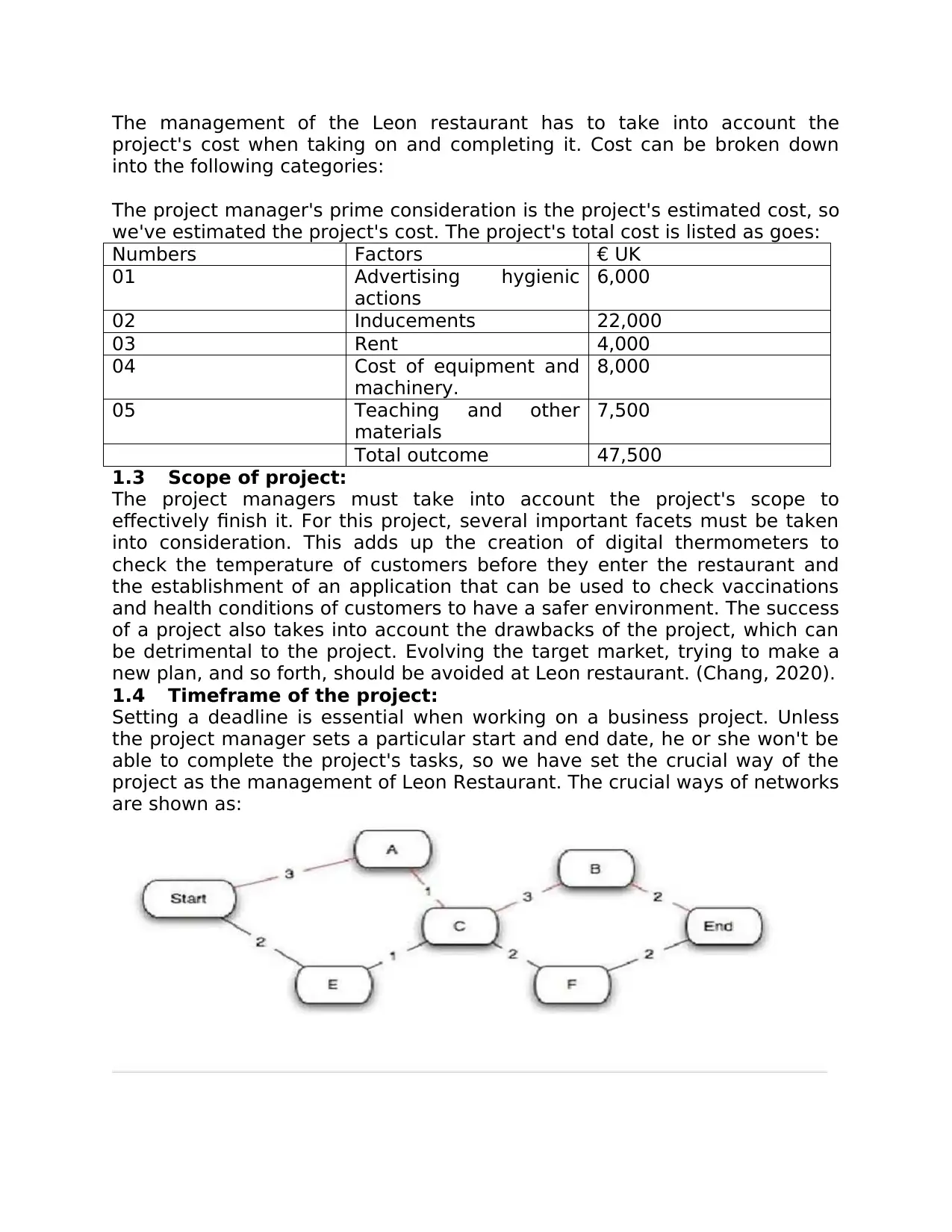
project as the management of Leon Restaurant. The crucial ways of networks
are shown as:
project's cost when taking on and completing it. Cost can be broken down
into the following categories:
The project manager's prime consideration is the project's estimated cost, so
we've estimated the project's cost. The project's total cost is listed as goes:
Numbers Factors € UK
01 Advertising hygienic
actions
6,000
02 Inducements 22,000
03 Rent 4,000
04 Cost of equipment and
machinery.
8,000
05 Teaching and other
materials
7,500
Total outcome 47,500
1.3 Scope of project:
The project managers must take into account the project's scope to
effectively finish it. For this project, several important facets must be taken
into consideration. This adds up the creation of digital thermometers to
check the temperature of customers before they enter the restaurant and
the establishment of an application that can be used to check vaccinations
and health conditions of customers to have a safer environment. The success
of a project also takes into account the drawbacks of the project, which can
be detrimental to the project. Evolving the target market, trying to make a
new plan, and so forth, should be avoided at Leon restaurant. (Chang, 2020).
1.4 Timeframe of the project:
Setting a deadline is essential when working on a business project. Unless
the project manager sets a particular start and end date, he or she won't be
able to complete the project's tasks, so we have set the crucial way of the
project as the management of Leon Restaurant. The crucial ways of networks
are shown as:
Paraphrase This Document
Need a fresh take? Get an instant paraphrase of this document with our AI Paraphraser
When the project's crucial way or network is start=S+E+C+F+END is equal
to 7 days the project will be successfully achieved within a week or up to 7
days. (Shin, 2020).
1.5 Quality of project:
A manager needs to keep the project's quality in mind, as failure to do so
could jeopardize its completion. The manager of Leon Restaurant, should
take into account the project's time constraints and resources and maximize
optimum decisions for the company.
1.6 Communication:
Communication is the most crucial component of a project. The project
manager must keep regular contact with all of the project's stakeholders. In
his ability to talk with the company's stakeholders, the project manager
devised a plan of action. The management of Leon restaurant has to be in
regular contact with the stakeholders and other people who have an impact
on the project's success.
1.7 Risks and Resources:
The risks and resources involved in any business project can't be ignored.
The plan to achieve a competitive edge by engaging in safety precautions is
not without its own set of challenges, risks, and constraints. Covid19
pandemic and limited resources are some of the project's risks. In addition,
the project's resources include highly trained workers, an experienced
project manager, adequate funding, and the favorable feelings of the
company's top executives. So the Leon Company manager can guarantee
that the project will be completed on time because the project has more
resources than the risks. (Gates, 2020).
1.8 Milestone schedule:
An approximate timetable for the project's life is provided by the milestone
schedule the project's execution should be evaluated and reported on at
various stages of the planning, growth, fabrication, and execution of the
schedule.
Let's take a look at a few real-world examples of project milestones from
various stages of the process.
2 Acceptance of the plan
3 Project phases are initiated and completed at these points.
4 Getting the constitution for your project approved
5 Obtaining resources, such as money or equipment.
6 Setting up a project crew.
7 Getting the go-ahead for your project plan
8 A gathering to begin work on the project
9 Completing the most important work.
10 The creation of crucial entire project
11 Achieving the project's objectives and goals
to 7 days the project will be successfully achieved within a week or up to 7
days. (Shin, 2020).
1.5 Quality of project:
A manager needs to keep the project's quality in mind, as failure to do so
could jeopardize its completion. The manager of Leon Restaurant, should
take into account the project's time constraints and resources and maximize
optimum decisions for the company.
1.6 Communication:
Communication is the most crucial component of a project. The project
manager must keep regular contact with all of the project's stakeholders. In
his ability to talk with the company's stakeholders, the project manager
devised a plan of action. The management of Leon restaurant has to be in
regular contact with the stakeholders and other people who have an impact
on the project's success.
1.7 Risks and Resources:
The risks and resources involved in any business project can't be ignored.
The plan to achieve a competitive edge by engaging in safety precautions is
not without its own set of challenges, risks, and constraints. Covid19
pandemic and limited resources are some of the project's risks. In addition,
the project's resources include highly trained workers, an experienced
project manager, adequate funding, and the favorable feelings of the
company's top executives. So the Leon Company manager can guarantee
that the project will be completed on time because the project has more
resources than the risks. (Gates, 2020).
1.8 Milestone schedule:
An approximate timetable for the project's life is provided by the milestone
schedule the project's execution should be evaluated and reported on at
various stages of the planning, growth, fabrication, and execution of the
schedule.
Let's take a look at a few real-world examples of project milestones from
various stages of the process.
2 Acceptance of the plan
3 Project phases are initiated and completed at these points.
4 Getting the constitution for your project approved
5 Obtaining resources, such as money or equipment.
6 Setting up a project crew.
7 Getting the go-ahead for your project plan
8 A gathering to begin work on the project
9 Completing the most important work.
10 The creation of crucial entire project
11 Achieving the project's objectives and goals
12 Finalization of the undertaking
Examples of milestones can be used for any project, irrespective of its
industry. However, the role of the project manager, have the authority to set
their project milestones to better plan, execute, and monitor the progress of
your project. (Rita Tamiate, 2018)
Leon Restaurant milestone:
A drive-thru restaurant in Leeds could open the path for Leon to open more
streetside locations across the United Kingdom, the healthy fast-food chain
thinks.
Located on the A650 Wakefield Road near Morley, the Gildersome unit will
feature a regular menu as well as "Leon firsts" and other limited-time
offerings.
For the first time, Leon will be capable of offering Karma Soda on draft, which
will be the first clean, additive-free, and ethical draft soda option.
"This is a major accomplishment for Leon," said Glenn Edwards, managing
director of Leon Restaurants. This will be our first-ever drive-thru restaurant
in West Yorkshire, where we already have a loyal following.
As a result of the new drive-thru, "Yorkshire will have even more
opportunities to try innately fast food while generating 30 new jobs for
skilled local people," the company said in a statement.
1.9 The project schedule for monitoring and completing:
A project schedule is a method for determining what work should be done,
who should do it, and when it should be done. The amount of work required
to complete the project on time should be included in the project schedule.
The project manager will be unable to interact about the project's costs and
resources without a complete schedule.
Real-time tracking of schedules, resources, budget, and project-related
investments is possible with some software. The project schedule can be
modified and regarded by colleagues who are directly involved in the task,
keeping everyone informed on the project's progress and keeping everyone
aware.
This is how we can establish a project schedule:
What to do? How to do it?
Make a list of the tasks that should
be included in the calendar.
Refer to the tasks listed in the form
of WBS.
Identify the connections between
the various responsibilities.
Make a list of all of the things that
must be done before we can begin
other tasks. We should
recognize tasks that can be
completed while other tasks are
being carried out.
Decide who will be in charge of each
task.
This sets up the task's responsibility.
One of the most important factors in
a project's success is attributing the
right person to the right job.
Examples of milestones can be used for any project, irrespective of its
industry. However, the role of the project manager, have the authority to set
their project milestones to better plan, execute, and monitor the progress of
your project. (Rita Tamiate, 2018)
Leon Restaurant milestone:
A drive-thru restaurant in Leeds could open the path for Leon to open more
streetside locations across the United Kingdom, the healthy fast-food chain
thinks.
Located on the A650 Wakefield Road near Morley, the Gildersome unit will
feature a regular menu as well as "Leon firsts" and other limited-time
offerings.
For the first time, Leon will be capable of offering Karma Soda on draft, which
will be the first clean, additive-free, and ethical draft soda option.
"This is a major accomplishment for Leon," said Glenn Edwards, managing
director of Leon Restaurants. This will be our first-ever drive-thru restaurant
in West Yorkshire, where we already have a loyal following.
As a result of the new drive-thru, "Yorkshire will have even more
opportunities to try innately fast food while generating 30 new jobs for
skilled local people," the company said in a statement.
1.9 The project schedule for monitoring and completing:
A project schedule is a method for determining what work should be done,
who should do it, and when it should be done. The amount of work required
to complete the project on time should be included in the project schedule.
The project manager will be unable to interact about the project's costs and
resources without a complete schedule.
Real-time tracking of schedules, resources, budget, and project-related
investments is possible with some software. The project schedule can be
modified and regarded by colleagues who are directly involved in the task,
keeping everyone informed on the project's progress and keeping everyone
aware.
This is how we can establish a project schedule:
What to do? How to do it?
Make a list of the tasks that should
be included in the calendar.
Refer to the tasks listed in the form
of WBS.
Identify the connections between
the various responsibilities.
Make a list of all of the things that
must be done before we can begin
other tasks. We should
recognize tasks that can be
completed while other tasks are
being carried out.
Decide who will be in charge of each
task.
This sets up the task's responsibility.
One of the most important factors in
a project's success is attributing the
right person to the right job.
⊘ This is a preview!⊘
Do you want full access?
Subscribe today to unlock all pages.
Trusted by 1+ million students worldwide
Predict how much time it will take to
complete each task.
Consult with members of your team
or others who have previously
worked on similar projects. Assume
that the person is competent. Make
a list of all of the presumptions that
went into the estimation process.
Make sure to take into account the
other factors that go into making the
schedule.
Consider the following variables:
1. Constrictions on the project
2. There are some
presuppositions
3. Materials have a lead and a
lag time (postponement).
4. When, where, and how the
task must be carried out
5. There are risks associated with
a project.
Create a buffer for unexpected
events and contingencies.
In scheduling, a contingency is a
particular provision for components
that are not anticipated and may
cause a delay.
How much time to be able for
contingency can vary depending on
factors like:
1. The appropriate level of delay
risk.
2. Insight into the scope of the
project
3. How well the project will be
handled is the third factor.
However, this is just a general
guideline, and a project may need
more or less depending on the
above factors.
Recognize the crucial paths of the
project.
As a project management tool, the
"critical path" determines the length
of the project by identifying the
operations with the lowest number
of scheduling wiggle room (i.e.,
those that are most important).
The entire project's completion time
will be pushed back if any of the
tasks on the critical path are
postponed.
If the critical path is taking longer
than expected, look into ways to
speed up the critical path.
complete each task.
Consult with members of your team
or others who have previously
worked on similar projects. Assume
that the person is competent. Make
a list of all of the presumptions that
went into the estimation process.
Make sure to take into account the
other factors that go into making the
schedule.
Consider the following variables:
1. Constrictions on the project
2. There are some
presuppositions
3. Materials have a lead and a
lag time (postponement).
4. When, where, and how the
task must be carried out
5. There are risks associated with
a project.
Create a buffer for unexpected
events and contingencies.
In scheduling, a contingency is a
particular provision for components
that are not anticipated and may
cause a delay.
How much time to be able for
contingency can vary depending on
factors like:
1. The appropriate level of delay
risk.
2. Insight into the scope of the
project
3. How well the project will be
handled is the third factor.
However, this is just a general
guideline, and a project may need
more or less depending on the
above factors.
Recognize the crucial paths of the
project.
As a project management tool, the
"critical path" determines the length
of the project by identifying the
operations with the lowest number
of scheduling wiggle room (i.e.,
those that are most important).
The entire project's completion time
will be pushed back if any of the
tasks on the critical path are
postponed.
If the critical path is taking longer
than expected, look into ways to
speed up the critical path.
Paraphrase This Document
Need a fresh take? Get an instant paraphrase of this document with our AI Paraphraser
Create a Gantt chart with the
schedule information.
Use a Gantt chart to depict the
project's precise timeline, including
all tasks, milestones, relationships,
and personnel assignments.
In a Gantt chart, each task is
represented by a horizontal bar
whose length corresponds to the
amount of time it takes to complete
the task.
These charts can be generated by
different project management tools.
Depending on the customer's
interests and requirements, we can
showcase the schedule information
in several genres.
Section: 3. work breakdown structure and a Ghantt Chart:
Work breakdown structure:
Five phases are required for managing a project by a management plan's
five stages of work. So, the manager of the Leon restaurant has taken the
opportunity to break down the project into five stages, each of which will be
completed within the timeframe. The project will be a success for the
company if all of the given work is completed on time, so the project tasks
breakdown is as follows:(Vlad Z).
Task no. Stages of tasks. Days required. Employees.
01 Projects
formation and
beginning.
2 3
02 Projects visibility
or strategy on
the clear
environment.
1 2
03 Project
introduction and
implementation.
3 20
04 Projects activity
and productivity
management.
2 4
05 Project closing. 1 2
- Total 9 31
schedule information.
Use a Gantt chart to depict the
project's precise timeline, including
all tasks, milestones, relationships,
and personnel assignments.
In a Gantt chart, each task is
represented by a horizontal bar
whose length corresponds to the
amount of time it takes to complete
the task.
These charts can be generated by
different project management tools.
Depending on the customer's
interests and requirements, we can
showcase the schedule information
in several genres.
Section: 3. work breakdown structure and a Ghantt Chart:
Work breakdown structure:
Five phases are required for managing a project by a management plan's
five stages of work. So, the manager of the Leon restaurant has taken the
opportunity to break down the project into five stages, each of which will be
completed within the timeframe. The project will be a success for the
company if all of the given work is completed on time, so the project tasks
breakdown is as follows:(Vlad Z).
Task no. Stages of tasks. Days required. Employees.
01 Projects
formation and
beginning.
2 3
02 Projects visibility
or strategy on
the clear
environment.
1 2
03 Project
introduction and
implementation.
3 20
04 Projects activity
and productivity
management.
2 4
05 Project closing. 1 2
- Total 9 31
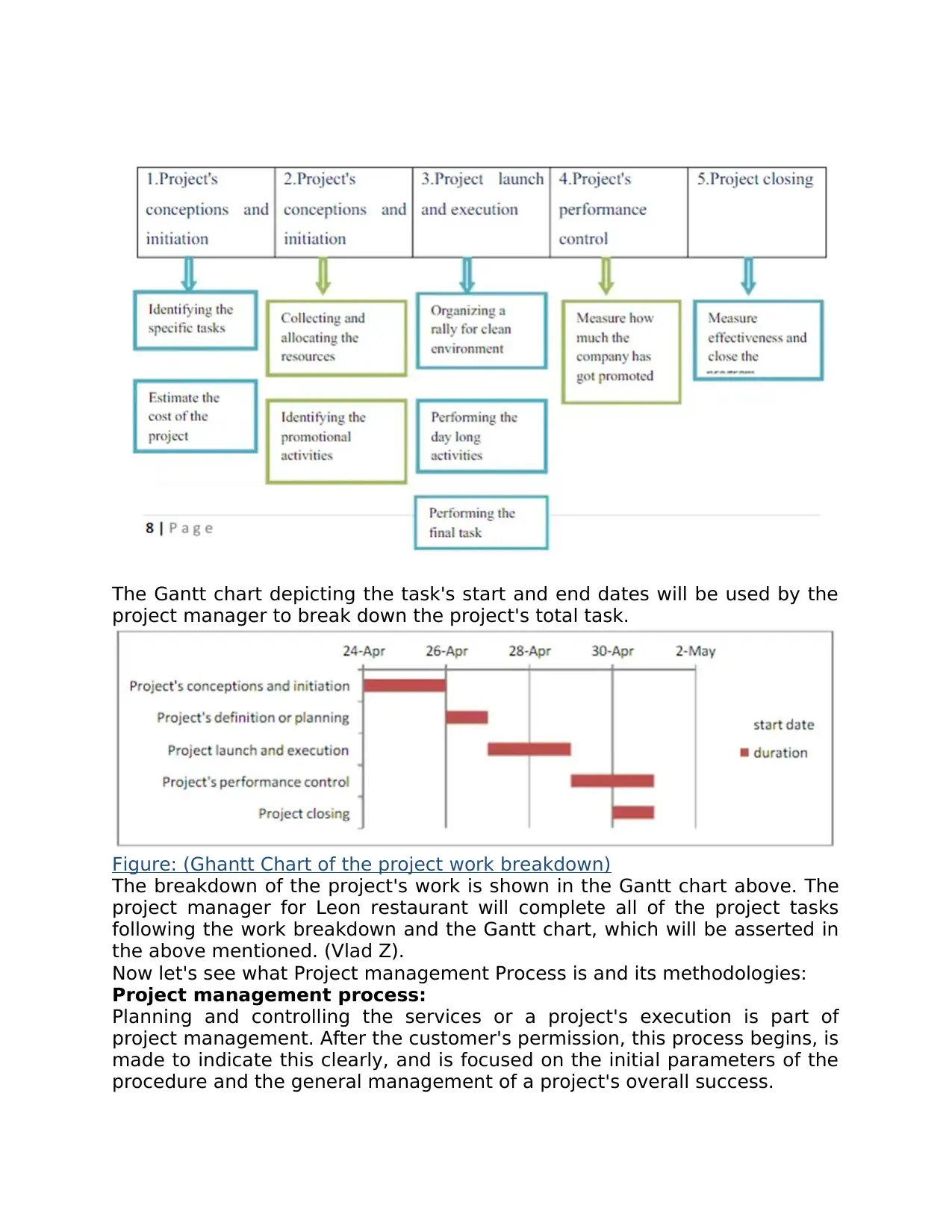
The Gantt chart depicting the task's start and end dates will be used by the
project manager to break down the project's total task.
Figure: (Ghantt Chart of the project work breakdown)
The breakdown of the project's work is shown in the Gantt chart above. The
project manager for Leon restaurant will complete all of the project tasks
following the work breakdown and the Gantt chart, which will be asserted in
the above mentioned. (Vlad Z).
Now let's see what Project management Process is and its methodologies:
Project management process:
Planning and controlling the services or a project's execution is part of
project management. After the customer's permission, this process begins, is
made to indicate this clearly, and is focused on the initial parameters of the
procedure and the general management of a project's overall success.
project manager to break down the project's total task.
Figure: (Ghantt Chart of the project work breakdown)
The breakdown of the project's work is shown in the Gantt chart above. The
project manager for Leon restaurant will complete all of the project tasks
following the work breakdown and the Gantt chart, which will be asserted in
the above mentioned. (Vlad Z).
Now let's see what Project management Process is and its methodologies:
Project management process:
Planning and controlling the services or a project's execution is part of
project management. After the customer's permission, this process begins, is
made to indicate this clearly, and is focused on the initial parameters of the
procedure and the general management of a project's overall success.
⊘ This is a preview!⊘
Do you want full access?
Subscribe today to unlock all pages.
Trusted by 1+ million students worldwide
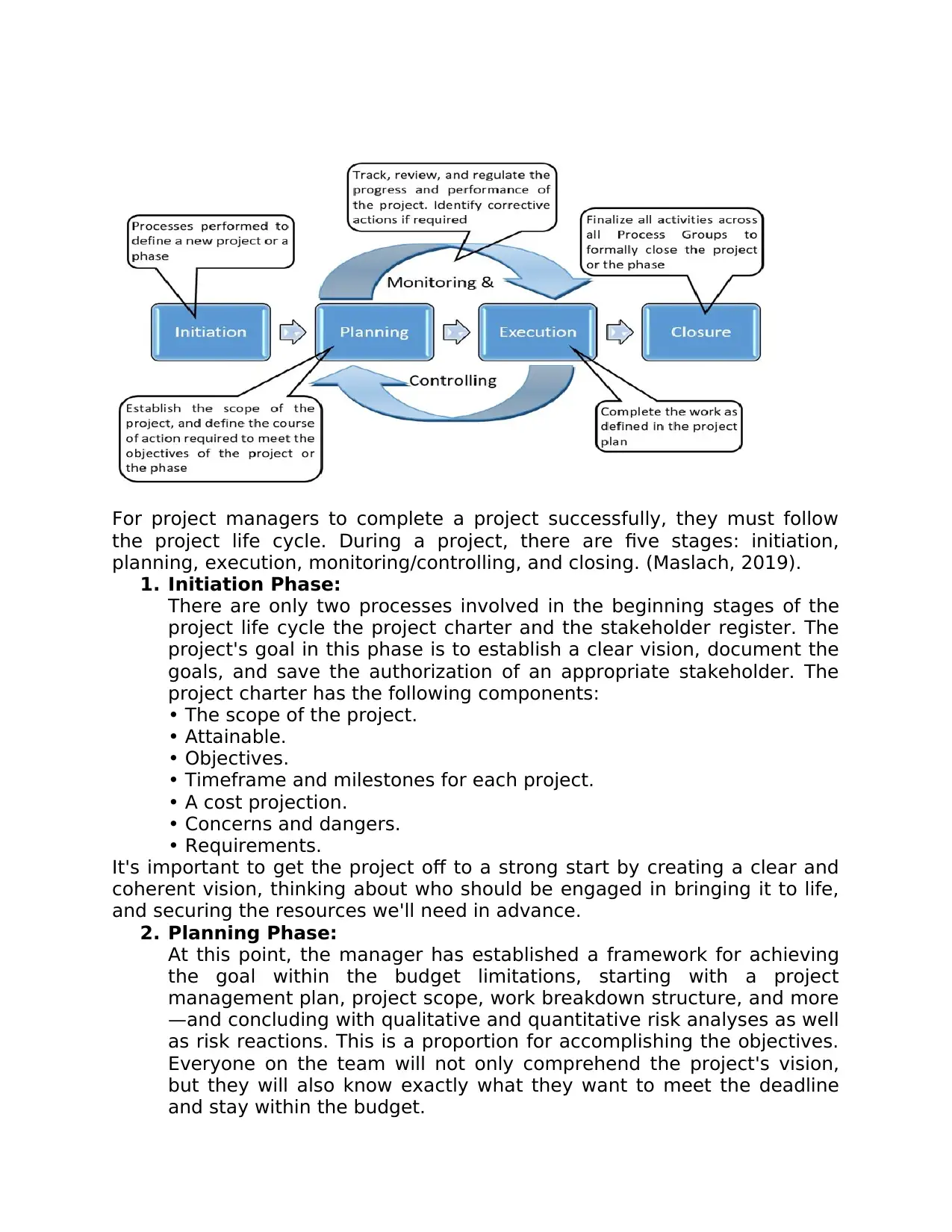
For project managers to complete a project successfully, they must follow
the project life cycle. During a project, there are five stages: initiation,
planning, execution, monitoring/controlling, and closing. (Maslach, 2019).
1. Initiation Phase:
There are only two processes involved in the beginning stages of the
project life cycle the project charter and the stakeholder register. The
project's goal in this phase is to establish a clear vision, document the
goals, and save the authorization of an appropriate stakeholder. The
project charter has the following components:
• The scope of the project.
• Attainable.
• Objectives.
• Timeframe and milestones for each project.
• A cost projection.
• Concerns and dangers.
• Requirements.
It's important to get the project off to a strong start by creating a clear and
coherent vision, thinking about who should be engaged in bringing it to life,
and securing the resources we'll need in advance.
2. Planning Phase:
At this point, the manager has established a framework for achieving
the goal within the budget limitations, starting with a project
management plan, project scope, work breakdown structure, and more
—and concluding with qualitative and quantitative risk analyses as well
as risk reactions. This is a proportion for accomplishing the objectives.
Everyone on the team will not only comprehend the project's vision,
but they will also know exactly what they want to meet the deadline
and stay within the budget.
the project life cycle. During a project, there are five stages: initiation,
planning, execution, monitoring/controlling, and closing. (Maslach, 2019).
1. Initiation Phase:
There are only two processes involved in the beginning stages of the
project life cycle the project charter and the stakeholder register. The
project's goal in this phase is to establish a clear vision, document the
goals, and save the authorization of an appropriate stakeholder. The
project charter has the following components:
• The scope of the project.
• Attainable.
• Objectives.
• Timeframe and milestones for each project.
• A cost projection.
• Concerns and dangers.
• Requirements.
It's important to get the project off to a strong start by creating a clear and
coherent vision, thinking about who should be engaged in bringing it to life,
and securing the resources we'll need in advance.
2. Planning Phase:
At this point, the manager has established a framework for achieving
the goal within the budget limitations, starting with a project
management plan, project scope, work breakdown structure, and more
—and concluding with qualitative and quantitative risk analyses as well
as risk reactions. This is a proportion for accomplishing the objectives.
Everyone on the team will not only comprehend the project's vision,
but they will also know exactly what they want to meet the deadline
and stay within the budget.
Paraphrase This Document
Need a fresh take? Get an instant paraphrase of this document with our AI Paraphraser
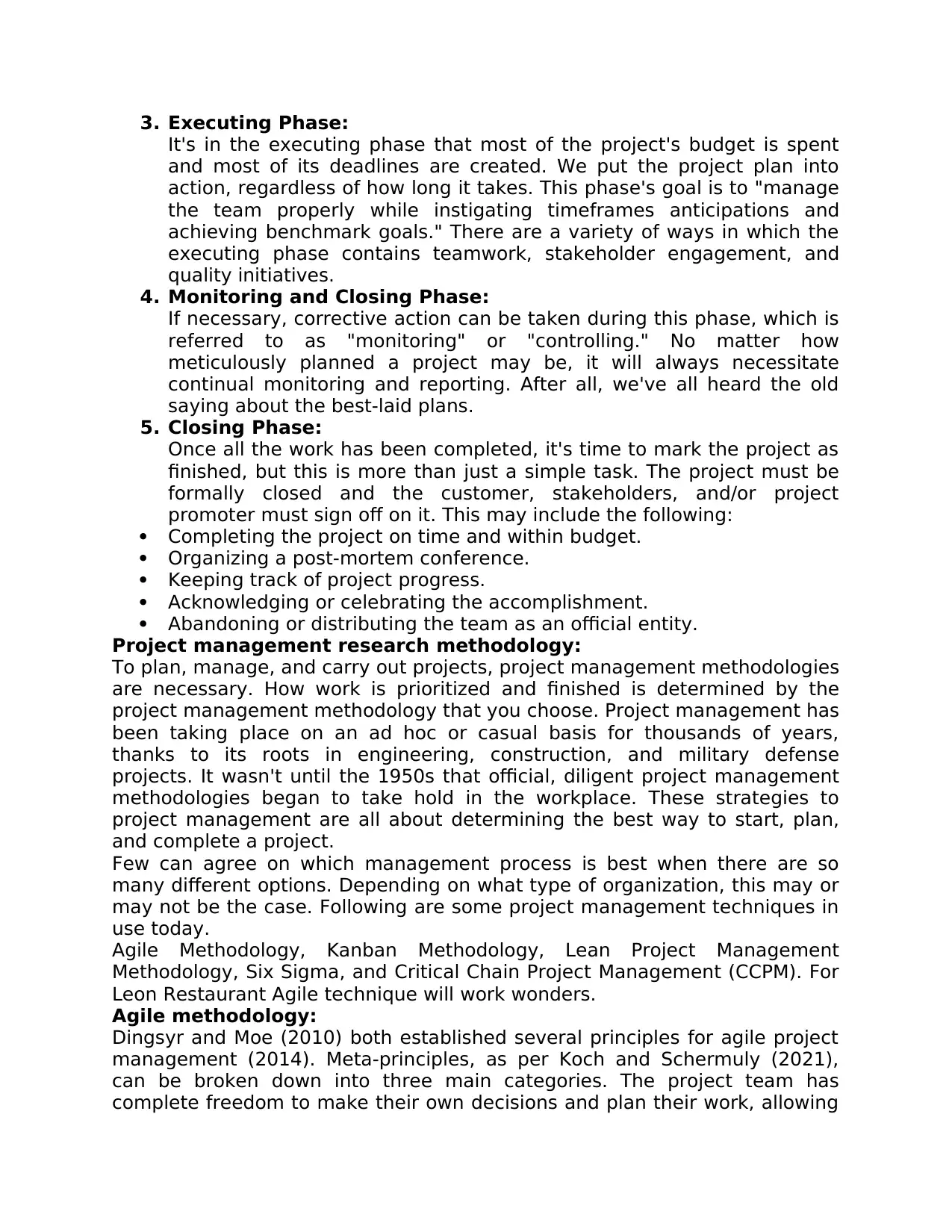
3. Executing Phase:
It's in the executing phase that most of the project's budget is spent
and most of its deadlines are created. We put the project plan into
action, regardless of how long it takes. This phase's goal is to "manage
the team properly while instigating timeframes anticipations and
achieving benchmark goals." There are a variety of ways in which the
executing phase contains teamwork, stakeholder engagement, and
quality initiatives.
4. Monitoring and Closing Phase:
If necessary, corrective action can be taken during this phase, which is
referred to as "monitoring" or "controlling." No matter how
meticulously planned a project may be, it will always necessitate
continual monitoring and reporting. After all, we've all heard the old
saying about the best-laid plans.
5. Closing Phase:
Once all the work has been completed, it's time to mark the project as
finished, but this is more than just a simple task. The project must be
formally closed and the customer, stakeholders, and/or project
promoter must sign off on it. This may include the following:
Completing the project on time and within budget.
Organizing a post-mortem conference.
Keeping track of project progress.
Acknowledging or celebrating the accomplishment.
Abandoning or distributing the team as an official entity.
Project management research methodology:
To plan, manage, and carry out projects, project management methodologies
are necessary. How work is prioritized and finished is determined by the
project management methodology that you choose. Project management has
been taking place on an ad hoc or casual basis for thousands of years,
thanks to its roots in engineering, construction, and military defense
projects. It wasn't until the 1950s that official, diligent project management
methodologies began to take hold in the workplace. These strategies to
project management are all about determining the best way to start, plan,
and complete a project.
Few can agree on which management process is best when there are so
many different options. Depending on what type of organization, this may or
may not be the case. Following are some project management techniques in
use today.
Agile Methodology, Kanban Methodology, Lean Project Management
Methodology, Six Sigma, and Critical Chain Project Management (CCPM). For
Leon Restaurant Agile technique will work wonders.
Agile methodology:
Dingsyr and Moe (2010) both established several principles for agile project
management (2014). Meta-principles, as per Koch and Schermuly (2021),
can be broken down into three main categories. The project team has
complete freedom to make their own decisions and plan their work, allowing
It's in the executing phase that most of the project's budget is spent
and most of its deadlines are created. We put the project plan into
action, regardless of how long it takes. This phase's goal is to "manage
the team properly while instigating timeframes anticipations and
achieving benchmark goals." There are a variety of ways in which the
executing phase contains teamwork, stakeholder engagement, and
quality initiatives.
4. Monitoring and Closing Phase:
If necessary, corrective action can be taken during this phase, which is
referred to as "monitoring" or "controlling." No matter how
meticulously planned a project may be, it will always necessitate
continual monitoring and reporting. After all, we've all heard the old
saying about the best-laid plans.
5. Closing Phase:
Once all the work has been completed, it's time to mark the project as
finished, but this is more than just a simple task. The project must be
formally closed and the customer, stakeholders, and/or project
promoter must sign off on it. This may include the following:
Completing the project on time and within budget.
Organizing a post-mortem conference.
Keeping track of project progress.
Acknowledging or celebrating the accomplishment.
Abandoning or distributing the team as an official entity.
Project management research methodology:
To plan, manage, and carry out projects, project management methodologies
are necessary. How work is prioritized and finished is determined by the
project management methodology that you choose. Project management has
been taking place on an ad hoc or casual basis for thousands of years,
thanks to its roots in engineering, construction, and military defense
projects. It wasn't until the 1950s that official, diligent project management
methodologies began to take hold in the workplace. These strategies to
project management are all about determining the best way to start, plan,
and complete a project.
Few can agree on which management process is best when there are so
many different options. Depending on what type of organization, this may or
may not be the case. Following are some project management techniques in
use today.
Agile Methodology, Kanban Methodology, Lean Project Management
Methodology, Six Sigma, and Critical Chain Project Management (CCPM). For
Leon Restaurant Agile technique will work wonders.
Agile methodology:
Dingsyr and Moe (2010) both established several principles for agile project
management (2014). Meta-principles, as per Koch and Schermuly (2021),
can be broken down into three main categories. The project team has
complete freedom to make their own decisions and plan their work, allowing
for a high degree of autonomy. Equality: all members of the team are treated
equally. There are no pre-determined goals at the outset and instead short
project intervals (i.e. iterations) are used to analyze and assess the project's
incomplete aims (i.e. goals). Concerning the requirements (i.e. completing
duties amidst COVID-19 requirements), job resources may be useful because
they may limit the effects of proximal work requirements on proximal work
demands. There are three ways to support this idea for agile project
management, defined on the basis above.
Autonomy:
Proximal incomplete duties can be mitigated by a team's autonomous work
environment (Handke, 2020), according to cohesive team design literature
(Handke, 2020). The idea of team autonomy can be broken down into
decision control (i.e. how much impact teammates have on the overall
decisions) and control systems (i.e. the degree of influence that teammate's
suggestions have on the process; Handke, 2020). Determined by the number
of deadlines that the team can control in a given iteration and the difficulty
of the tasks, the project team manages the distribution of responsibilities
among teammates and thus independently balances each person's workload
(Lin, 2014). Unfinished tasks and COVID-19 requirements have a weaker
relationship in agile teams that have a high degree of cohesive decision-
making autonomy. Agile teams, on the other hand, maybe best prepared to
adapt rapidly systems and processes (i.e. process control) in light of COVID-
19 needs because they are used to reflecting on their combined efforts and
autonomously adapting to changes needed.
Equality:
The "routine check" of agile project management is an example of how social
interactions are institutionalized in regular, consist of members. Equal
speaking time is given to all attendees in those meetings. Teammates
communicate with each other about their past and current projects, allowing
the rest of the team to learn about what they're up to (Stray, Moe, and
Sjoberg, 2020). Meetings that focus on status progress and prestige reports
to the leader can be replaced by agile stand-up conferences that allow all
team members to recognize and resolve COVID-19 demands. COVID-19
demands may be alleviated by allowing employees to take advantage of
these opportunities, we believe.
Iterative delivery:
Projects are broken down into iterations, which can last anywhere from one
to four weeks, in agile project management methodologies (Grapenthin,
2015). During the first phase of each iteration, the project team decides
which technical specifications of the final product (often referred to as
backlog items) should be put in place, and then defines all the tasks to be
done to design and test this chosen functionality (Grapenthin, 2015). The
customer receives a working product after each iteration (hence the term
"iterative delivery"). Because of the COVID-19 pandemic, this iterative
approach to completing tasks is especially beneficial. A behavioral goal's
equally. There are no pre-determined goals at the outset and instead short
project intervals (i.e. iterations) are used to analyze and assess the project's
incomplete aims (i.e. goals). Concerning the requirements (i.e. completing
duties amidst COVID-19 requirements), job resources may be useful because
they may limit the effects of proximal work requirements on proximal work
demands. There are three ways to support this idea for agile project
management, defined on the basis above.
Autonomy:
Proximal incomplete duties can be mitigated by a team's autonomous work
environment (Handke, 2020), according to cohesive team design literature
(Handke, 2020). The idea of team autonomy can be broken down into
decision control (i.e. how much impact teammates have on the overall
decisions) and control systems (i.e. the degree of influence that teammate's
suggestions have on the process; Handke, 2020). Determined by the number
of deadlines that the team can control in a given iteration and the difficulty
of the tasks, the project team manages the distribution of responsibilities
among teammates and thus independently balances each person's workload
(Lin, 2014). Unfinished tasks and COVID-19 requirements have a weaker
relationship in agile teams that have a high degree of cohesive decision-
making autonomy. Agile teams, on the other hand, maybe best prepared to
adapt rapidly systems and processes (i.e. process control) in light of COVID-
19 needs because they are used to reflecting on their combined efforts and
autonomously adapting to changes needed.
Equality:
The "routine check" of agile project management is an example of how social
interactions are institutionalized in regular, consist of members. Equal
speaking time is given to all attendees in those meetings. Teammates
communicate with each other about their past and current projects, allowing
the rest of the team to learn about what they're up to (Stray, Moe, and
Sjoberg, 2020). Meetings that focus on status progress and prestige reports
to the leader can be replaced by agile stand-up conferences that allow all
team members to recognize and resolve COVID-19 demands. COVID-19
demands may be alleviated by allowing employees to take advantage of
these opportunities, we believe.
Iterative delivery:
Projects are broken down into iterations, which can last anywhere from one
to four weeks, in agile project management methodologies (Grapenthin,
2015). During the first phase of each iteration, the project team decides
which technical specifications of the final product (often referred to as
backlog items) should be put in place, and then defines all the tasks to be
done to design and test this chosen functionality (Grapenthin, 2015). The
customer receives a working product after each iteration (hence the term
"iterative delivery"). Because of the COVID-19 pandemic, this iterative
approach to completing tasks is especially beneficial. A behavioral goal's
⊘ This is a preview!⊘
Do you want full access?
Subscribe today to unlock all pages.
Trusted by 1+ million students worldwide

1 out of 27


Related Documents


Your All-in-One AI-Powered Toolkit for Academic Success.
+13062052269
info@desklib.com
Available 24*7 on WhatsApp / Email
![[object Object]](/_next/static/media/star-bottom.7253800d.svg)
Unlock your academic potential
Copyright © 2020–2026 A2Z Services. All Rights Reserved. Developed and managed by ZUCOL.