Lesson Planning: Inclusive Teaching, Learning, and Assessment Methods
VerifiedAdded on 2023/06/14
|23
|5519
|234
Report
AI Summary
This report provides a comprehensive overview of lesson planning, emphasizing the importance of effective teaching strategies, incorporating diverse learning styles, and utilizing appropriate assessment methods. It explores the aims and characteristics of effective lesson plans, including how to design them to meet the goals and needs of learners. The report discusses the integration of learning styles and taxonomies, such as Bloom's Taxonomy, into lesson plans to enhance engagement and inclusivity. It also highlights the need for flexibility and adaptability in lesson plan design and examines how lesson plan design affects the delivery of inclusive teaching and learning. Furthermore, the report defines various methods of assessment and evaluation, emphasizing the use of differentiated assessments to cater to individual learner needs and the analysis of assessment results to inform future lesson planning. The importance of providing feedback and monitoring student progress is also discussed, with a focus on creating inclusive and engaging learning environments.
LESSON PLANNING

Paraphrase This Document
Need a fresh take? Get an instant paraphrase of this document with our AI Paraphraser
TABLE OF CONTENT
INTRODUCTION..............................................................................................................................
TASK 1................................................................................................................................................
Aim of lesson planning............................................................................................................................3
Characteristics of effective lesson plan....................................................................................................3
Designing lesson plans that incorporate goals and needs of learners.......................................................4
Learning styles and learning taxonomies to be included when planning lessons.....................................4
Lesson plans incorporating learning styles and taxonomies....................................................................5
Ensuring lesson plans are inclusive.........................................................................................................5
Preparation of effective lesson plan.........................................................................................................5
The need for flexibility and adaptability in the adaptability in the designing of lesson plan....................6
How lesson plan design effects the delivery of inclusive teaching and learning......................................6
TASK 2.......................................................................................................................................................8
Lesson plan..............................................................................................................................................8
TASK 3..............................................................................................................................................
INTRODUCTION..............................................................................................................................
TASK 1................................................................................................................................................
Aim of lesson planning............................................................................................................................3
Characteristics of effective lesson plan....................................................................................................3
Designing lesson plans that incorporate goals and needs of learners.......................................................4
Learning styles and learning taxonomies to be included when planning lessons.....................................4
Lesson plans incorporating learning styles and taxonomies....................................................................5
Ensuring lesson plans are inclusive.........................................................................................................5
Preparation of effective lesson plan.........................................................................................................5
The need for flexibility and adaptability in the adaptability in the designing of lesson plan....................6
How lesson plan design effects the delivery of inclusive teaching and learning......................................6
TASK 2.......................................................................................................................................................8
Lesson plan..............................................................................................................................................8
TASK 3..............................................................................................................................................
Define....................................................................................................................................................13
Methods of assessment and evaluation..................................................................................................14
Use of differentiated assessments to incorporate the individual needs of learners.................................15
The way analysis of assessment and evaluation results can be used to inform lesson planning.............16
CONCLUSION.................................................................................................................................
REFRENCES....................................................................................................................................
INTRODUCTION
Lesson planning can be analyzed as highly essential for more dynamic learning in
students, which enhances developed learning engagement proactively for extended new optimum
growth diversely. Importance of lesson planning, is also correlated to primitively develop
optimum expertise and evolve on for gaining innovative learning practiced. The recent report
will determine aim of lesson planning, incorporate learning style and inclusive teaching within
learning procedures. Further study will analyze importance of individual needs for learners,
monitoring achievements and progressive working growth rapidly. There is further extended
focus evolved on toward enabling leaders to provide feedback for informing lesson planning.
Also report will analyze importance of assessment, evaluation and usage of various methods in
Methods of assessment and evaluation..................................................................................................14
Use of differentiated assessments to incorporate the individual needs of learners.................................15
The way analysis of assessment and evaluation results can be used to inform lesson planning.............16
CONCLUSION.................................................................................................................................
REFRENCES....................................................................................................................................
INTRODUCTION
Lesson planning can be analyzed as highly essential for more dynamic learning in
students, which enhances developed learning engagement proactively for extended new optimum
growth diversely. Importance of lesson planning, is also correlated to primitively develop
optimum expertise and evolve on for gaining innovative learning practiced. The recent report
will determine aim of lesson planning, incorporate learning style and inclusive teaching within
learning procedures. Further study will analyze importance of individual needs for learners,
monitoring achievements and progressive working growth rapidly. There is further extended
focus evolved on toward enabling leaders to provide feedback for informing lesson planning.
Also report will analyze importance of assessment, evaluation and usage of various methods in
⊘ This is a preview!⊘
Do you want full access?
Subscribe today to unlock all pages.

Trusted by 1+ million students worldwide
evaluation for incorporating individual need learners. The assessment and evaluation results also
enhances informative lesson planning fundamentally, which keenly brings on wider fundamental
vision.
TASK 1
Aim of lesson planning
Aim behind developing lesson planning, is to further critically develop effective lesson
plans where teacher main goal is to develop learnings among children. Lesson planning also
inculcates proper competent learning, goals for new creative activities and generate optimum
diversity paradigms functionally. Role of lesson planning, is also to develop new learning styles
and set new criteria for understanding among students. Teachers adhere to lesson planning, for
inclusively generating new study oriented activities and determining key optimistic paradigms
diversely within longer time run. Aim behind lesson planning synchronizes new strengthened
working imperatives, which shapes wider students learning activities and develops optimum
interest variedly for new learning. Also, academics further aims to develop effective timely
learning and builds new learning goals among students for improvised functional abilities within
timely manner (Sharofovna and Qahhorovna, 2022).
Characteristics of effective lesson plan
The characteristic of effective lesson plan is that there should be clear objectives,
productive background knowledge and directive instructions based on student’s practices.
Effective lesson plans need to be also framed for proper demonstration of new learning
parameters, which further builds up student’s interest and adds more flexibility diversely.
Clarifies transitions and allot time for student’s involvement, and also effective lesson plans
prompts teachers to reflect effectively on extended academic platforms. This can be also
analyzed that effective lesson plan enhances interest of students, in studying and also primitively
diversifies wider scale proactive competitive performance. An effective lesson plan, further adds
creative functional engagement on profound learning scenarios for improvised study delivery
which leverages optimum new profound creative synergies.
enhances informative lesson planning fundamentally, which keenly brings on wider fundamental
vision.
TASK 1
Aim of lesson planning
Aim behind developing lesson planning, is to further critically develop effective lesson
plans where teacher main goal is to develop learnings among children. Lesson planning also
inculcates proper competent learning, goals for new creative activities and generate optimum
diversity paradigms functionally. Role of lesson planning, is also to develop new learning styles
and set new criteria for understanding among students. Teachers adhere to lesson planning, for
inclusively generating new study oriented activities and determining key optimistic paradigms
diversely within longer time run. Aim behind lesson planning synchronizes new strengthened
working imperatives, which shapes wider students learning activities and develops optimum
interest variedly for new learning. Also, academics further aims to develop effective timely
learning and builds new learning goals among students for improvised functional abilities within
timely manner (Sharofovna and Qahhorovna, 2022).
Characteristics of effective lesson plan
The characteristic of effective lesson plan is that there should be clear objectives,
productive background knowledge and directive instructions based on student’s practices.
Effective lesson plans need to be also framed for proper demonstration of new learning
parameters, which further builds up student’s interest and adds more flexibility diversely.
Clarifies transitions and allot time for student’s involvement, and also effective lesson plans
prompts teachers to reflect effectively on extended academic platforms. This can be also
analyzed that effective lesson plan enhances interest of students, in studying and also primitively
diversifies wider scale proactive competitive performance. An effective lesson plan, further adds
creative functional engagement on profound learning scenarios for improvised study delivery
which leverages optimum new profound creative synergies.
Paraphrase This Document
Need a fresh take? Get an instant paraphrase of this document with our AI Paraphraser
Designing lesson plans that incorporate goals and needs of learners
The designing of lesson plans that incorporate goals and needs of learners, is highly
essential for improvising new functional creative working synergies dynamically. By working on
lesson plans some factors such as including diverse teaching methods, application of VARK
model and adaption to meet individuals (Wong and Shih, 2022). Collaboration, peer work and
inclusive, differentiated approach further develops optimum engagement for improved learning
goals as it synchronizes stringent competitive growth proactively. For incorporating goals and
needs of learners, inclusive and differentiated approaches shall be there along with strong
learning outcome focused should be focused on. Designing lesson plans, incorporates goals and
needs of learners for improvising new academic learning abilities based on optimum productive
expansion fundamentally. Needs of learners have to be integrated, for strengthening practical
competencies rapidly and improvise further engagement towards new paradigms. Lesson plans
incorporated, by extending new technical growth goals and improvising extended knowledge
among students within lesson plans.
Learning styles and learning taxonomies to be included when planning lessons
The learning styles can be analyzed as visual, auditory, reading and writing which
enables students to creatively engage on learning plans within classrooms for more dynamic
working progression. Visual, auditory and reading, writing styles enable new extended
knowledge to be operatively expanded based on proactive scenarios. It enables to prepare
specific learning goals, organized as per innovative determined pace for strengthened planning
lessons engagement.
The blooms taxonomy is set of three hierarchical models used to further classify
educational learning objective into levels of complexity and specificity, for cognitive and
psychomotor domains. Bloom taxonomy has provided six categories that describes cognitive
procedures in learning where knowledge, comprehension and synthesis, evaluation are specific
paradigms. There is three domains, that can be analyzed within learning where cognitive domain
expresses importance of thinking and experiencing, affective domain signifies emotions and
feeling significantly. Also, psychomotor domain signifies practical and physical work
competencies development for gaining untapped knowledge worked on productively (Nafsi and
Maryanti, 2022).
The designing of lesson plans that incorporate goals and needs of learners, is highly
essential for improvising new functional creative working synergies dynamically. By working on
lesson plans some factors such as including diverse teaching methods, application of VARK
model and adaption to meet individuals (Wong and Shih, 2022). Collaboration, peer work and
inclusive, differentiated approach further develops optimum engagement for improved learning
goals as it synchronizes stringent competitive growth proactively. For incorporating goals and
needs of learners, inclusive and differentiated approaches shall be there along with strong
learning outcome focused should be focused on. Designing lesson plans, incorporates goals and
needs of learners for improvising new academic learning abilities based on optimum productive
expansion fundamentally. Needs of learners have to be integrated, for strengthening practical
competencies rapidly and improvise further engagement towards new paradigms. Lesson plans
incorporated, by extending new technical growth goals and improvising extended knowledge
among students within lesson plans.
Learning styles and learning taxonomies to be included when planning lessons
The learning styles can be analyzed as visual, auditory, reading and writing which
enables students to creatively engage on learning plans within classrooms for more dynamic
working progression. Visual, auditory and reading, writing styles enable new extended
knowledge to be operatively expanded based on proactive scenarios. It enables to prepare
specific learning goals, organized as per innovative determined pace for strengthened planning
lessons engagement.
The blooms taxonomy is set of three hierarchical models used to further classify
educational learning objective into levels of complexity and specificity, for cognitive and
psychomotor domains. Bloom taxonomy has provided six categories that describes cognitive
procedures in learning where knowledge, comprehension and synthesis, evaluation are specific
paradigms. There is three domains, that can be analyzed within learning where cognitive domain
expresses importance of thinking and experiencing, affective domain signifies emotions and
feeling significantly. Also, psychomotor domain signifies practical and physical work
competencies development for gaining untapped knowledge worked on productively (Nafsi and
Maryanti, 2022).
Lesson plans incorporating learning styles and taxonomies
The lesson plans must be integrated with incorporation of best learning styles and
taxonomies, where this signifies best scale competent vision for gaining untapped vision
significantly worked on. Blooms taxonomy consists of three domains, where integrated
structural vision in learning levels among students learning can be worked on imperatively. The
lesson plan integration must be done with cognitive awareness, affective domain and
psychomotor domains where practical new diversity must be integrated for extended new
learning styles. Children must be given teaching based on visual sessions, and new learning
scenarios where engaging towards new optimum abilities further diversifies learning style
(Winborg and Hägg, 2022). By integrating Blooms taxonomy in learning plan, lessons will be
more interactive for students within lesson plan and also more attention can be given for
untapped new learning goals for gaining higher confident learning.
Ensuring lesson plans are inclusive
To ensure lesson plans inclusive, teachers must develop relevant aspects within children
education in lesson planning delivery and give equal learning opportunities for equal learning
among children. Inclusive lesson plans can be also integrated, by developing group interactive
sessions and activities for more competent engaged diversity and larger learning innovation
profoundly. Also teachers must makes sure that students learning is being given by proper
synchronized enhancement towards equal learning sessions delivery, and adherence to major
scenarios within learning sessions. Child directed plays and instructional purposes, must be
adhered for strengthening inclusive lesson plans for improved lesson plans abilities profoundly
within longer time frame. Ensuring lesson plans are inclusive, where this further adds more
versatile learning plans and synchronizes wider scale vision among teaching parameters.
Preparation of effective lesson plan
To prepare effective lesson plan, teacher should adhere to various aspects and factors for
strengthening productive diversity within learning and also primitive untapped growth towards
new abilities. Outlining learning objectives, developing interactive introduction and planning
down new learning activities and checking for specific understanding are some of the major
parameters to be adhered within effective lesson plan. Preparation of effective lesson plan, is
highly essential for strengthening practical functional abilities and enhancing new fundamental
The lesson plans must be integrated with incorporation of best learning styles and
taxonomies, where this signifies best scale competent vision for gaining untapped vision
significantly worked on. Blooms taxonomy consists of three domains, where integrated
structural vision in learning levels among students learning can be worked on imperatively. The
lesson plan integration must be done with cognitive awareness, affective domain and
psychomotor domains where practical new diversity must be integrated for extended new
learning styles. Children must be given teaching based on visual sessions, and new learning
scenarios where engaging towards new optimum abilities further diversifies learning style
(Winborg and Hägg, 2022). By integrating Blooms taxonomy in learning plan, lessons will be
more interactive for students within lesson plan and also more attention can be given for
untapped new learning goals for gaining higher confident learning.
Ensuring lesson plans are inclusive
To ensure lesson plans inclusive, teachers must develop relevant aspects within children
education in lesson planning delivery and give equal learning opportunities for equal learning
among children. Inclusive lesson plans can be also integrated, by developing group interactive
sessions and activities for more competent engaged diversity and larger learning innovation
profoundly. Also teachers must makes sure that students learning is being given by proper
synchronized enhancement towards equal learning sessions delivery, and adherence to major
scenarios within learning sessions. Child directed plays and instructional purposes, must be
adhered for strengthening inclusive lesson plans for improved lesson plans abilities profoundly
within longer time frame. Ensuring lesson plans are inclusive, where this further adds more
versatile learning plans and synchronizes wider scale vision among teaching parameters.
Preparation of effective lesson plan
To prepare effective lesson plan, teacher should adhere to various aspects and factors for
strengthening productive diversity within learning and also primitive untapped growth towards
new abilities. Outlining learning objectives, developing interactive introduction and planning
down new learning activities and checking for specific understanding are some of the major
parameters to be adhered within effective lesson plan. Preparation of effective lesson plan, is
highly essential for strengthening practical functional abilities and enhancing new fundamental
⊘ This is a preview!⊘
Do you want full access?
Subscribe today to unlock all pages.
Trusted by 1+ million students worldwide
extended growth rapidly. Effective lesson plan will be integrated to develop extended vision, and
leverage higher end determined abilities for extended improved functional abilities preparation
of effective lesson plan (Rashidovna and Norboevna, 2022).
The need for flexibility and adaptability in the adaptability in the designing of lesson plan
Flexibility and adaptability are the two must significant qualities which a teacher must
possess. Adaptability refers to the ability of lessons to adopt the change. Flexibility refers to the
idea that a lesson or plan can change quickly which can be noticed and sometimes not.
Flexibility in the lesson planning helps the assessor in changing the up what is used for doing.
Flexibility in the lesson planning means will means adapting feedback will be easy. Adaptability
will allow the teachers to acclimate themselves as per the changing roles and job responsibilities
as well as schedules too (Hatch and Clark, 2021). Effective lesson planning needs to be flexible
which means they can balance multiple responsibilities in one time as well as make the learners
feel appreciated. Flexibility also lets the personalised lessons for meeting to the individual leaner
needs. Adaptability helps the leaners to exercise better control on the environment and resources.
It helps in avoiding the dynamics which can be lead towards anxiety, procrastination, failure and
the anxiety.
How lesson plan design effects the delivery of inclusive teaching and learning
An effective lesson plan have to include inclusive practices of teaching and learning. An
effective lesson plan deigning helps the teachers to use the teaching methods and ways which are
more appropriate for the leaners. It involves the learning preferences of individual leaners so that
they are able to understand everything more. If the lesson plan designs are not suitable for the
leaners as well as does not related appropriately to the learner’s needs and preferences, it will
affect their understanding and knowledge on the particular lesson (Janssen, Knoef and Lazonder,
2019). An effective lesson plan design must involve the methods of inclusive programs such as
co-teaching in which some other educators co-teachers with general teachers and teaming in
which a support person such a mentor is provide to leaner which makes the leaner more engaged
in the learning. It will also promote parallel teaching through which a special educator is
assigned with the learner that works with a sub group of students in general teaching. Apart from
leverage higher end determined abilities for extended improved functional abilities preparation
of effective lesson plan (Rashidovna and Norboevna, 2022).
The need for flexibility and adaptability in the adaptability in the designing of lesson plan
Flexibility and adaptability are the two must significant qualities which a teacher must
possess. Adaptability refers to the ability of lessons to adopt the change. Flexibility refers to the
idea that a lesson or plan can change quickly which can be noticed and sometimes not.
Flexibility in the lesson planning helps the assessor in changing the up what is used for doing.
Flexibility in the lesson planning means will means adapting feedback will be easy. Adaptability
will allow the teachers to acclimate themselves as per the changing roles and job responsibilities
as well as schedules too (Hatch and Clark, 2021). Effective lesson planning needs to be flexible
which means they can balance multiple responsibilities in one time as well as make the learners
feel appreciated. Flexibility also lets the personalised lessons for meeting to the individual leaner
needs. Adaptability helps the leaners to exercise better control on the environment and resources.
It helps in avoiding the dynamics which can be lead towards anxiety, procrastination, failure and
the anxiety.
How lesson plan design effects the delivery of inclusive teaching and learning
An effective lesson plan have to include inclusive practices of teaching and learning. An
effective lesson plan deigning helps the teachers to use the teaching methods and ways which are
more appropriate for the leaners. It involves the learning preferences of individual leaners so that
they are able to understand everything more. If the lesson plan designs are not suitable for the
leaners as well as does not related appropriately to the learner’s needs and preferences, it will
affect their understanding and knowledge on the particular lesson (Janssen, Knoef and Lazonder,
2019). An effective lesson plan design must involve the methods of inclusive programs such as
co-teaching in which some other educators co-teachers with general teachers and teaming in
which a support person such a mentor is provide to leaner which makes the leaner more engaged
in the learning. It will also promote parallel teaching through which a special educator is
assigned with the learner that works with a sub group of students in general teaching. Apart from
Paraphrase This Document
Need a fresh take? Get an instant paraphrase of this document with our AI Paraphraser
this consultation is also provided which is a very effective model. In this model of inclusive
teaching and learning, a special educator and a support person works along with general teacher
teaching and learning, a special educator and a support person works along with general teacher
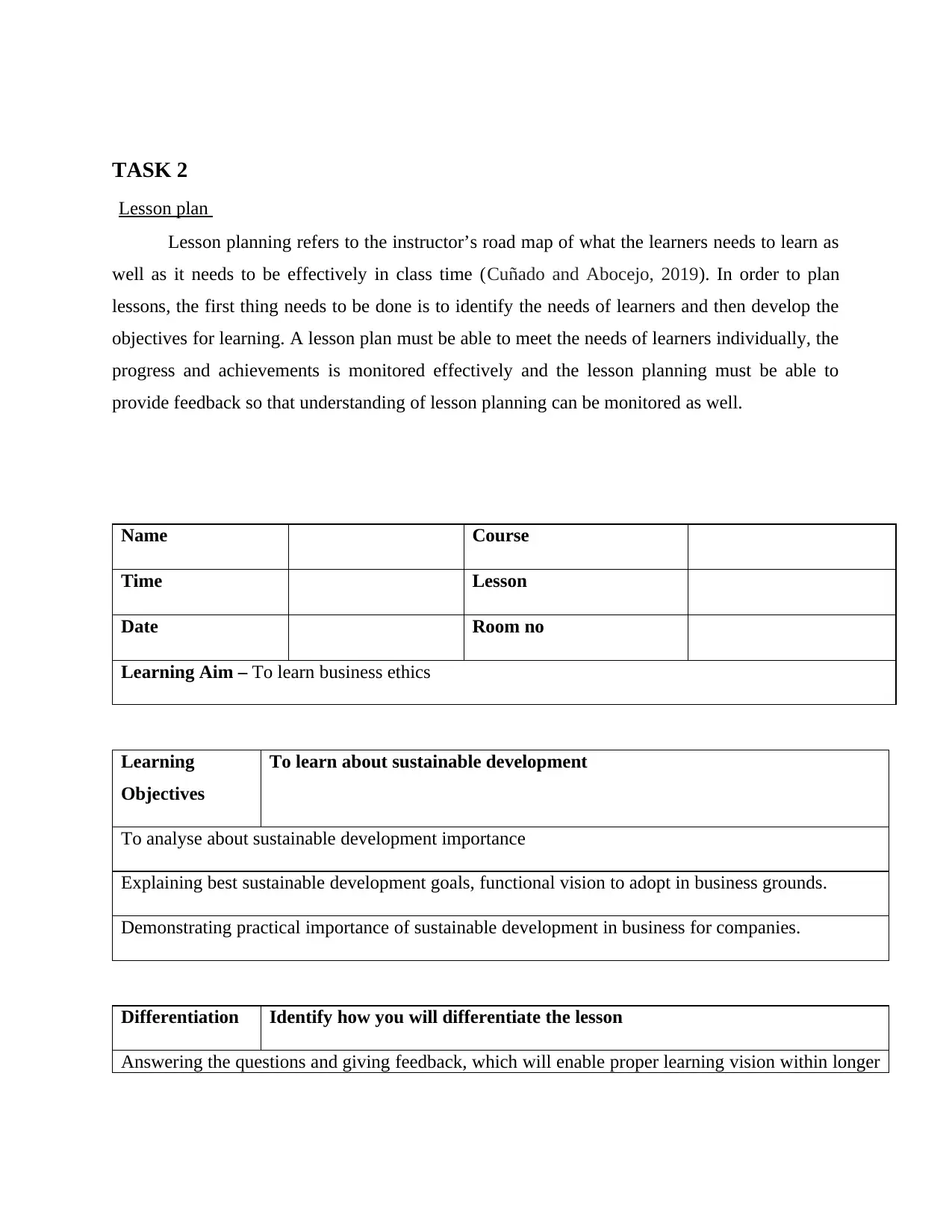
TASK 2
Lesson plan
Lesson planning refers to the instructor’s road map of what the learners needs to learn as
well as it needs to be effectively in class time (Cuñado and Abocejo, 2019). In order to plan
lessons, the first thing needs to be done is to identify the needs of learners and then develop the
objectives for learning. A lesson plan must be able to meet the needs of learners individually, the
progress and achievements is monitored effectively and the lesson planning must be able to
provide feedback so that understanding of lesson planning can be monitored as well.
Name Course
Time Lesson
Date Room no
Learning Aim – To learn business ethics
Learning
Objectives
To learn about sustainable development
To analyse about sustainable development importance
Explaining best sustainable development goals, functional vision to adopt in business grounds.
Demonstrating practical importance of sustainable development in business for companies.
Differentiation Identify how you will differentiate the lesson
Answering the questions and giving feedback, which will enable proper learning vision within longer
Lesson plan
Lesson planning refers to the instructor’s road map of what the learners needs to learn as
well as it needs to be effectively in class time (Cuñado and Abocejo, 2019). In order to plan
lessons, the first thing needs to be done is to identify the needs of learners and then develop the
objectives for learning. A lesson plan must be able to meet the needs of learners individually, the
progress and achievements is monitored effectively and the lesson planning must be able to
provide feedback so that understanding of lesson planning can be monitored as well.
Name Course
Time Lesson
Date Room no
Learning Aim – To learn business ethics
Learning
Objectives
To learn about sustainable development
To analyse about sustainable development importance
Explaining best sustainable development goals, functional vision to adopt in business grounds.
Demonstrating practical importance of sustainable development in business for companies.
Differentiation Identify how you will differentiate the lesson
Answering the questions and giving feedback, which will enable proper learning vision within longer
⊘ This is a preview!⊘
Do you want full access?
Subscribe today to unlock all pages.
Trusted by 1+ million students worldwide
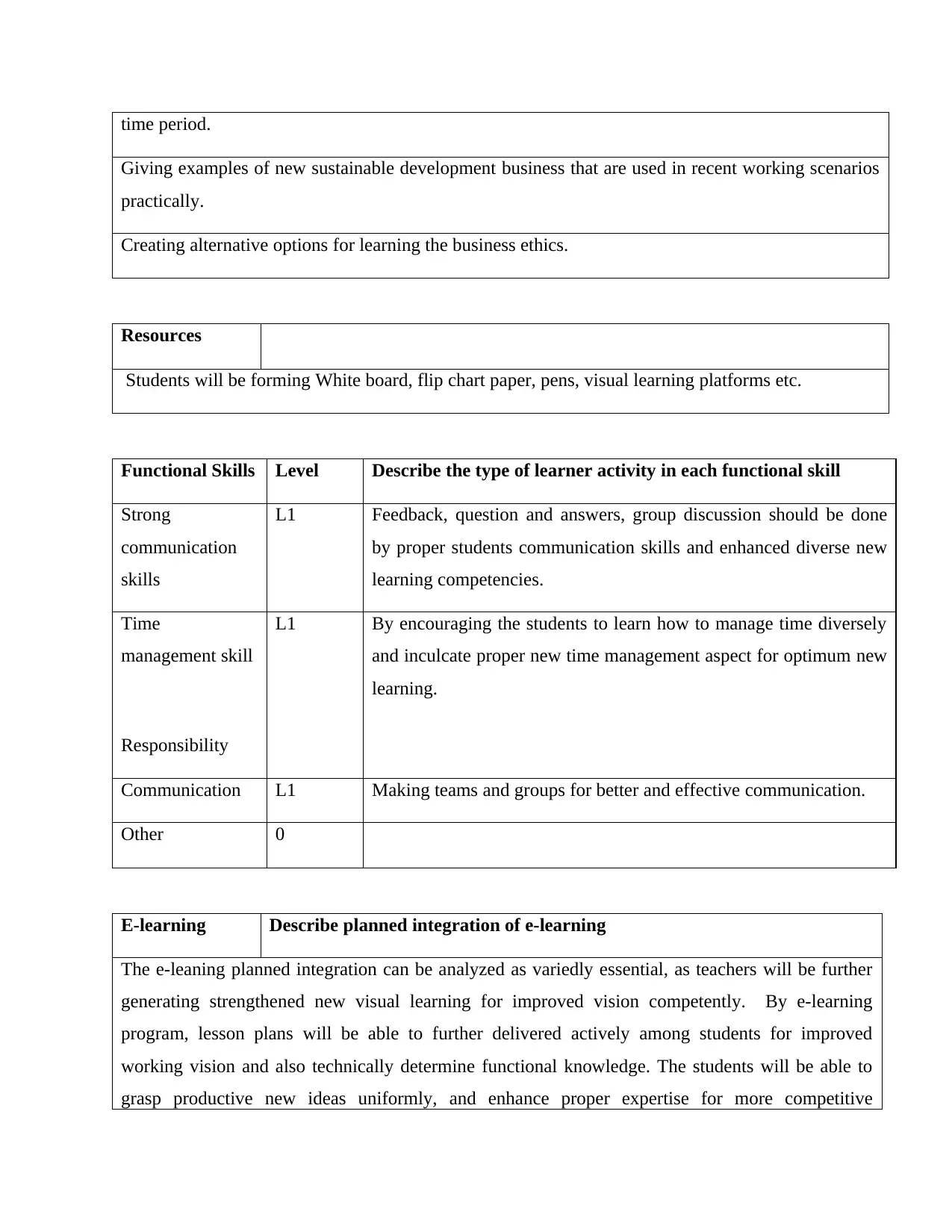
time period.
Giving examples of new sustainable development business that are used in recent working scenarios
practically.
Creating alternative options for learning the business ethics.
Resources
Students will be forming White board, flip chart paper, pens, visual learning platforms etc.
Functional Skills Level Describe the type of learner activity in each functional skill
Strong
communication
skills
L1 Feedback, question and answers, group discussion should be done
by proper students communication skills and enhanced diverse new
learning competencies.
Time
management skill
Responsibility
L1 By encouraging the students to learn how to manage time diversely
and inculcate proper new time management aspect for optimum new
learning.
Communication L1 Making teams and groups for better and effective communication.
Other 0
E-learning Describe planned integration of e-learning
The e-leaning planned integration can be analyzed as variedly essential, as teachers will be further
generating strengthened new visual learning for improved vision competently. By e-learning
program, lesson plans will be able to further delivered actively among students for improved
working vision and also technically determine functional knowledge. The students will be able to
grasp productive new ideas uniformly, and enhance proper expertise for more competitive
Giving examples of new sustainable development business that are used in recent working scenarios
practically.
Creating alternative options for learning the business ethics.
Resources
Students will be forming White board, flip chart paper, pens, visual learning platforms etc.
Functional Skills Level Describe the type of learner activity in each functional skill
Strong
communication
skills
L1 Feedback, question and answers, group discussion should be done
by proper students communication skills and enhanced diverse new
learning competencies.
Time
management skill
Responsibility
L1 By encouraging the students to learn how to manage time diversely
and inculcate proper new time management aspect for optimum new
learning.
Communication L1 Making teams and groups for better and effective communication.
Other 0
E-learning Describe planned integration of e-learning
The e-leaning planned integration can be analyzed as variedly essential, as teachers will be further
generating strengthened new visual learning for improved vision competently. By e-learning
program, lesson plans will be able to further delivered actively among students for improved
working vision and also technically determine functional knowledge. The students will be able to
grasp productive new ideas uniformly, and enhance proper expertise for more competitive
Paraphrase This Document
Need a fresh take? Get an instant paraphrase of this document with our AI Paraphraser
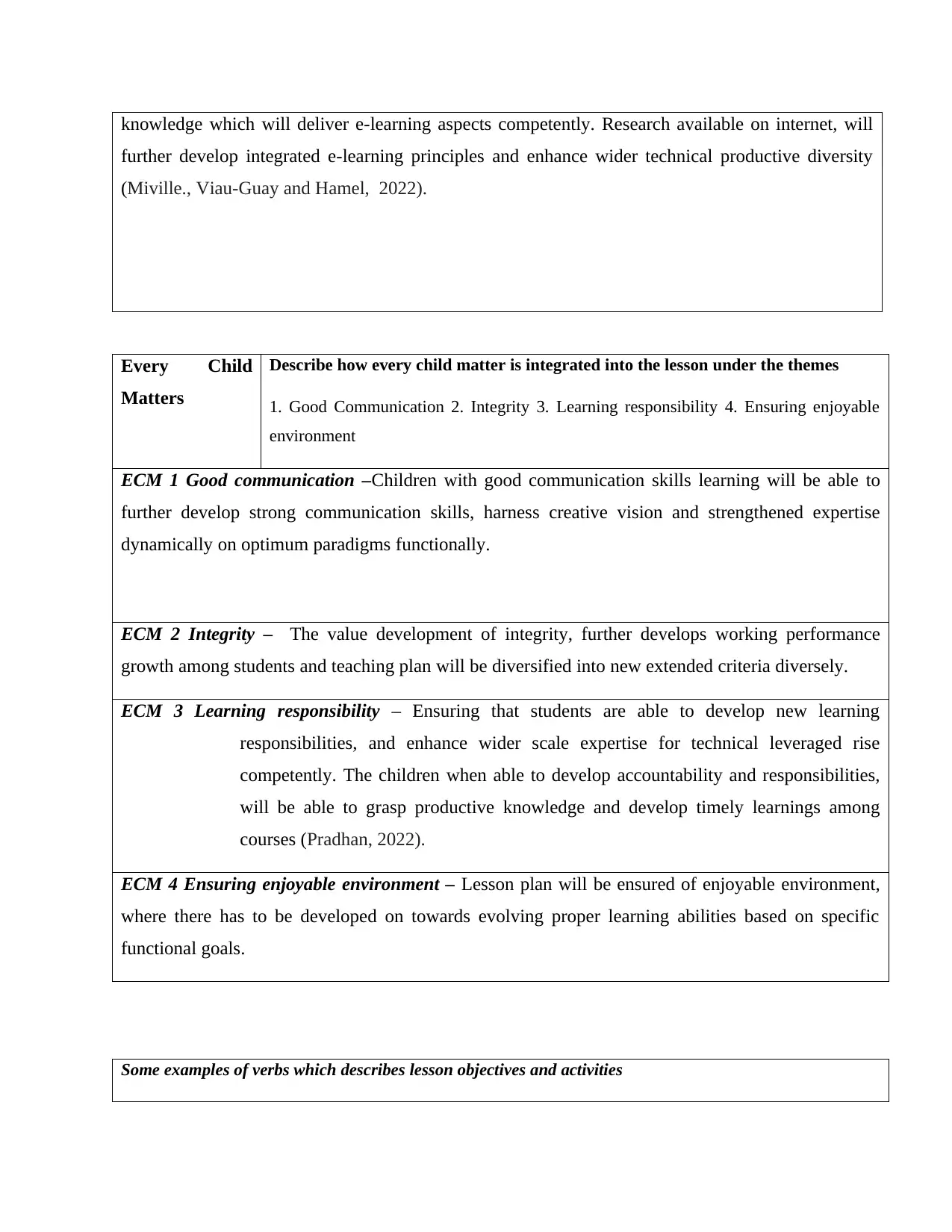
knowledge which will deliver e-learning aspects competently. Research available on internet, will
further develop integrated e-learning principles and enhance wider technical productive diversity
(Miville., Viau-Guay and Hamel, 2022).
Every Child
Matters
Describe how every child matter is integrated into the lesson under the themes
1. Good Communication 2. Integrity 3. Learning responsibility 4. Ensuring enjoyable
environment
ECM 1 Good communication –Children with good communication skills learning will be able to
further develop strong communication skills, harness creative vision and strengthened expertise
dynamically on optimum paradigms functionally.
ECM 2 Integrity – The value development of integrity, further develops working performance
growth among students and teaching plan will be diversified into new extended criteria diversely.
ECM 3 Learning responsibility – Ensuring that students are able to develop new learning
responsibilities, and enhance wider scale expertise for technical leveraged rise
competently. The children when able to develop accountability and responsibilities,
will be able to grasp productive knowledge and develop timely learnings among
courses (Pradhan, 2022).
ECM 4 Ensuring enjoyable environment – Lesson plan will be ensured of enjoyable environment,
where there has to be developed on towards evolving proper learning abilities based on specific
functional goals.
Some examples of verbs which describes lesson objectives and activities
further develop integrated e-learning principles and enhance wider technical productive diversity
(Miville., Viau-Guay and Hamel, 2022).
Every Child
Matters
Describe how every child matter is integrated into the lesson under the themes
1. Good Communication 2. Integrity 3. Learning responsibility 4. Ensuring enjoyable
environment
ECM 1 Good communication –Children with good communication skills learning will be able to
further develop strong communication skills, harness creative vision and strengthened expertise
dynamically on optimum paradigms functionally.
ECM 2 Integrity – The value development of integrity, further develops working performance
growth among students and teaching plan will be diversified into new extended criteria diversely.
ECM 3 Learning responsibility – Ensuring that students are able to develop new learning
responsibilities, and enhance wider scale expertise for technical leveraged rise
competently. The children when able to develop accountability and responsibilities,
will be able to grasp productive knowledge and develop timely learnings among
courses (Pradhan, 2022).
ECM 4 Ensuring enjoyable environment – Lesson plan will be ensured of enjoyable environment,
where there has to be developed on towards evolving proper learning abilities based on specific
functional goals.
Some examples of verbs which describes lesson objectives and activities
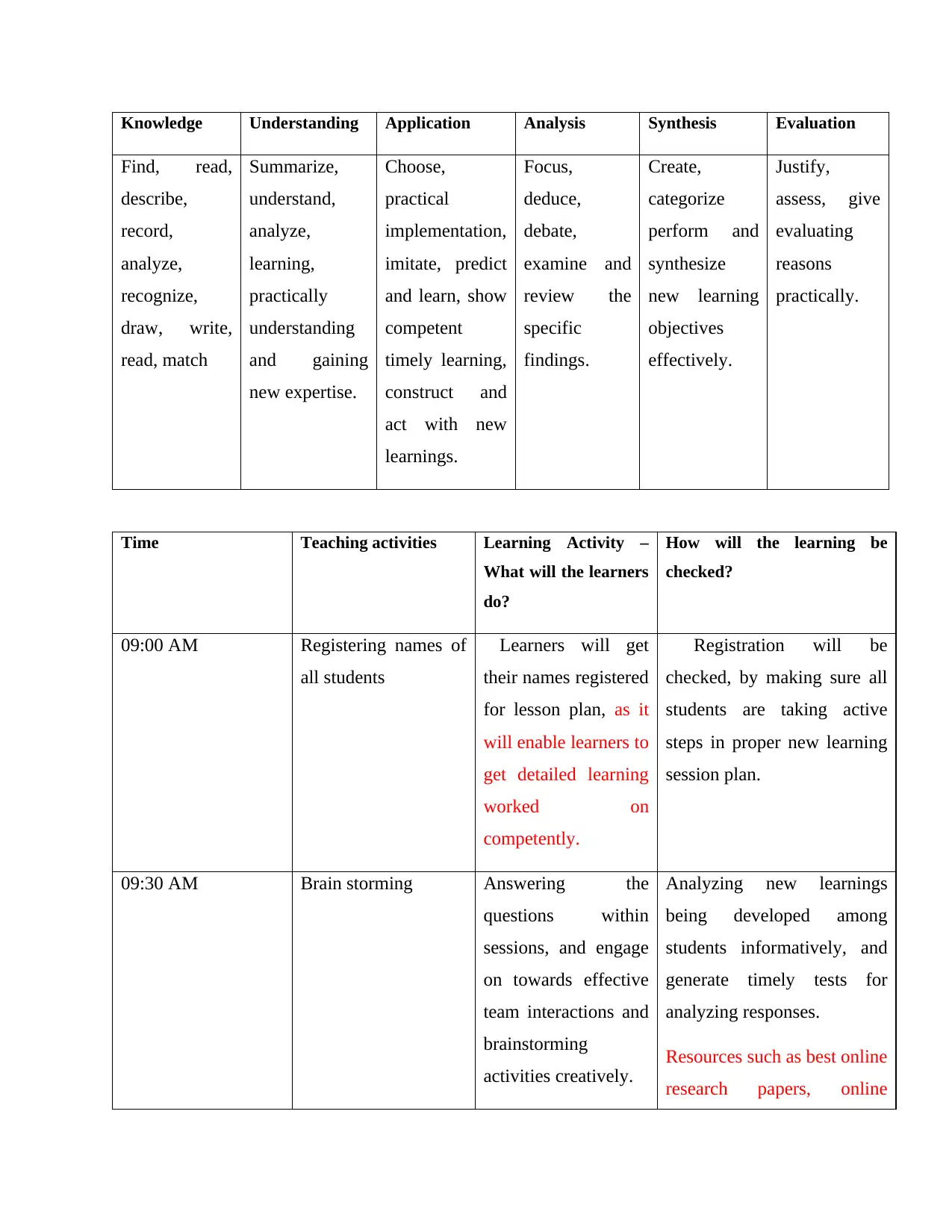
Knowledge Understanding Application Analysis Synthesis Evaluation
Find, read,
describe,
record,
analyze,
recognize,
draw, write,
read, match
Summarize,
understand,
analyze,
learning,
practically
understanding
and gaining
new expertise.
Choose,
practical
implementation,
imitate, predict
and learn, show
competent
timely learning,
construct and
act with new
learnings.
Focus,
deduce,
debate,
examine and
review the
specific
findings.
Create,
categorize
perform and
synthesize
new learning
objectives
effectively.
Justify,
assess, give
evaluating
reasons
practically.
Time Teaching activities Learning Activity –
What will the learners
do?
How will the learning be
checked?
09:00 AM Registering names of
all students
Learners will get
their names registered
for lesson plan, as it
will enable learners to
get detailed learning
worked on
competently.
Registration will be
checked, by making sure all
students are taking active
steps in proper new learning
session plan.
09:30 AM Brain storming Answering the
questions within
sessions, and engage
on towards effective
team interactions and
brainstorming
activities creatively.
Analyzing new learnings
being developed among
students informatively, and
generate timely tests for
analyzing responses.
Resources such as best online
research papers, online
Find, read,
describe,
record,
analyze,
recognize,
draw, write,
read, match
Summarize,
understand,
analyze,
learning,
practically
understanding
and gaining
new expertise.
Choose,
practical
implementation,
imitate, predict
and learn, show
competent
timely learning,
construct and
act with new
learnings.
Focus,
deduce,
debate,
examine and
review the
specific
findings.
Create,
categorize
perform and
synthesize
new learning
objectives
effectively.
Justify,
assess, give
evaluating
reasons
practically.
Time Teaching activities Learning Activity –
What will the learners
do?
How will the learning be
checked?
09:00 AM Registering names of
all students
Learners will get
their names registered
for lesson plan, as it
will enable learners to
get detailed learning
worked on
competently.
Registration will be
checked, by making sure all
students are taking active
steps in proper new learning
session plan.
09:30 AM Brain storming Answering the
questions within
sessions, and engage
on towards effective
team interactions and
brainstorming
activities creatively.
Analyzing new learnings
being developed among
students informatively, and
generate timely tests for
analyzing responses.
Resources such as best online
research papers, online
⊘ This is a preview!⊘
Do you want full access?
Subscribe today to unlock all pages.
Trusted by 1+ million students worldwide

1 out of 23


Related Documents


Your All-in-One AI-Powered Toolkit for Academic Success.
+13062052269
info@desklib.com
Available 24*7 on WhatsApp / Email
![[object Object]](/_next/static/media/star-bottom.7253800d.svg)
Unlock your academic potential
Copyright © 2020–2026 A2Z Services. All Rights Reserved. Developed and managed by ZUCOL.