Levendary Cafe's Expansion into China: Decision Making & Challenges
VerifiedAdded on 2023/06/15
|11
|3326
|106
Report
AI Summary
This report examines the challenges and decision-making processes involved in Levendary Cafe's attempt to expand its business into China. It begins by outlining the international startup opportunities available to Levendary Cafe in the Chinese market, considering factors such as rising pollution and foreign investment policies. The report then delves into the key problems faced by CEO Mia Foster, including management issues, cross-cultural challenges, resistance to change, and the rapidly evolving marketplace in China. It also analyzes the startup process in China, covering aspects like location selection, licensing, and risk assessment. The performance of Louis Chen, who played a significant role in the expansion, is evaluated, along with the deployment of restaurants in China considering the impact of the COVID-19 pandemic. Relevant theories, such as the Bartlett & Ghoshal matrix, are applied to understand Levendary Cafe's global integration and local responsiveness strategies. The report concludes with recommendations for overcoming the identified challenges and ensuring successful expansion in the Chinese market.
Decision making and challenges
in global business
in global business

Paraphrase This Document
Need a fresh take? Get an instant paraphrase of this document with our AI Paraphraser
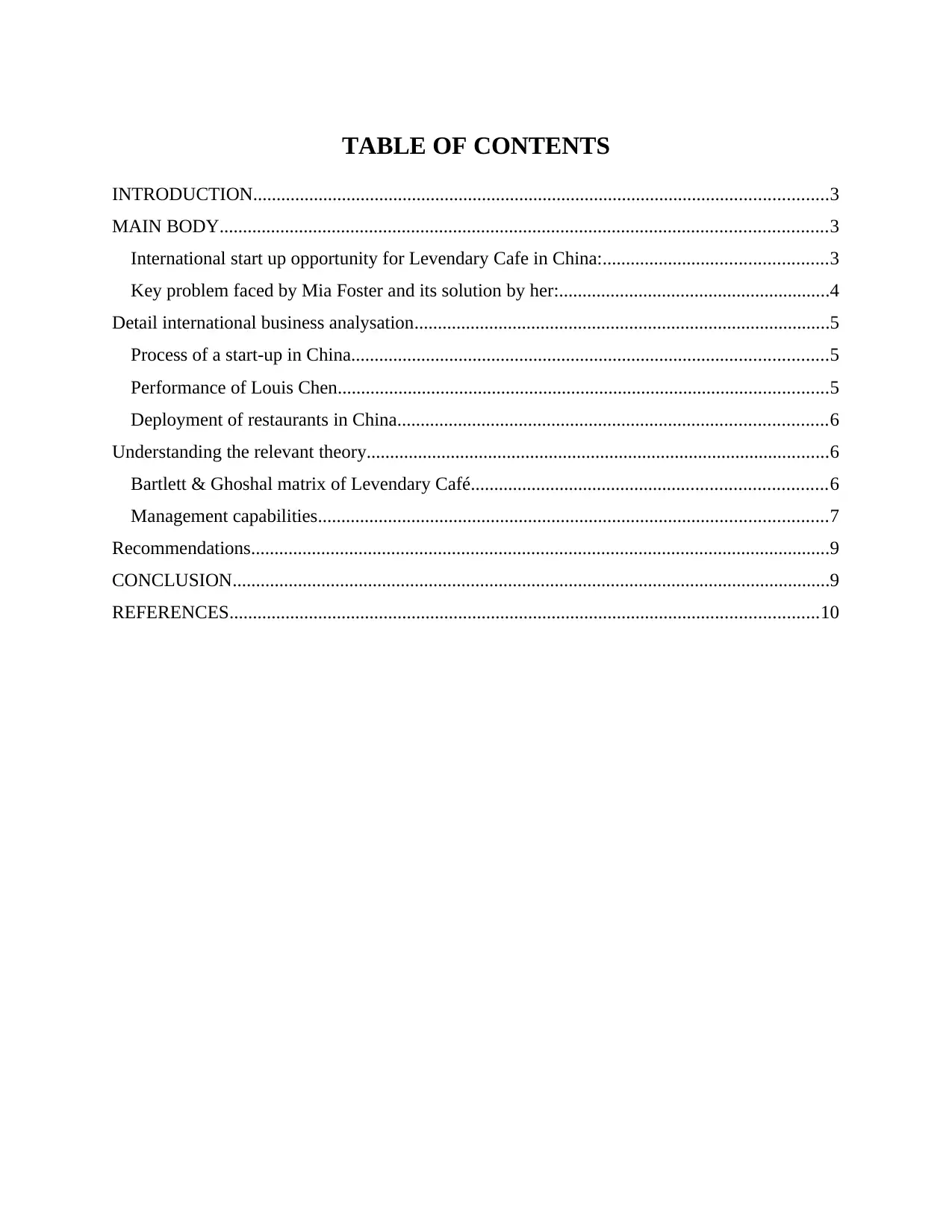
TABLE OF CONTENTS
INTRODUCTION...........................................................................................................................3
MAIN BODY..................................................................................................................................3
International start up opportunity for Levendary Cafe in China:................................................3
Key problem faced by Mia Foster and its solution by her:..........................................................4
Detail international business analysation.........................................................................................5
Process of a start-up in China......................................................................................................5
Performance of Louis Chen.........................................................................................................5
Deployment of restaurants in China............................................................................................6
Understanding the relevant theory...................................................................................................6
Bartlett & Ghoshal matrix of Levendary Café............................................................................6
Management capabilities.............................................................................................................7
Recommendations............................................................................................................................9
CONCLUSION................................................................................................................................9
REFERENCES..............................................................................................................................10
INTRODUCTION...........................................................................................................................3
MAIN BODY..................................................................................................................................3
International start up opportunity for Levendary Cafe in China:................................................3
Key problem faced by Mia Foster and its solution by her:..........................................................4
Detail international business analysation.........................................................................................5
Process of a start-up in China......................................................................................................5
Performance of Louis Chen.........................................................................................................5
Deployment of restaurants in China............................................................................................6
Understanding the relevant theory...................................................................................................6
Bartlett & Ghoshal matrix of Levendary Café............................................................................6
Management capabilities.............................................................................................................7
Recommendations............................................................................................................................9
CONCLUSION................................................................................................................................9
REFERENCES..............................................................................................................................10
INTRODUCTION
Every business organization plan to expand in foreign market, they want to enjoy benefits
of different market. Expanding into foreign market is one of the most challenging process,
business may fail in their local market too if this process failed. This study is based on
Levendary Cafe, this restaurant chain want to enter into China (Baláž, Zábojník and Harvánek,
2019). This report will discuss international start up opportunities held by Levendary Cafe in
China. Later this report will discuss process of the business start up in China including
performance of Louis Chen and deployment of cafe and restaurant. Later this report will discuss
relevant theories such as Bartlett & Ghoshal matrix and management capabilities. At last this
report will discuss key problem and challenges faced by CEO Mia Foster and understand how
they will manage these problems in the China.
MAIN BODY
International start up opportunity for Levendary Cafe in China:
With the rising pollution of China, it is the best opportunity for Levendary Cafe to
expand their branches in borders of Chines market. China is among those country who always
look for foreign investment to better their infrastructure, this country allow many foreign
investor to invest in every sector of the economy (Sekliuckiene, Vaitkiene and Vainauskiene,
2018). With rapid change in infrastructure of China, there are the best opportunities for
Levendary cafe, these are some:
More attraction: foreign fast food companies tend to rule over hospitality industry of China,
many successful fast food enterprise like KFC, McDonald's and Pizza Hut. Tend to have great
market share in restaurant market of China. While people are demand more taste from foreign
countries, it is the best opportunity to enter into these market. Levendary Cafe can target youth of
China with their wide range of dishes, rising demand of youth attracting more foreign company
to base their restaurant in the market.
Improved lifestyle: people of China have quality life which means their spending capacity is
quite impressive, per capita income of middle class family rose to 6282 RMB to 17175 RMB.
RMB means (Ren Min Bi) which means people's money. With an improved lifestyle and
spending capacity, it is very clear that Levendary Cafe have opportunity to start up their business
enterprise in restaurant market of China.
Every business organization plan to expand in foreign market, they want to enjoy benefits
of different market. Expanding into foreign market is one of the most challenging process,
business may fail in their local market too if this process failed. This study is based on
Levendary Cafe, this restaurant chain want to enter into China (Baláž, Zábojník and Harvánek,
2019). This report will discuss international start up opportunities held by Levendary Cafe in
China. Later this report will discuss process of the business start up in China including
performance of Louis Chen and deployment of cafe and restaurant. Later this report will discuss
relevant theories such as Bartlett & Ghoshal matrix and management capabilities. At last this
report will discuss key problem and challenges faced by CEO Mia Foster and understand how
they will manage these problems in the China.
MAIN BODY
International start up opportunity for Levendary Cafe in China:
With the rising pollution of China, it is the best opportunity for Levendary Cafe to
expand their branches in borders of Chines market. China is among those country who always
look for foreign investment to better their infrastructure, this country allow many foreign
investor to invest in every sector of the economy (Sekliuckiene, Vaitkiene and Vainauskiene,
2018). With rapid change in infrastructure of China, there are the best opportunities for
Levendary cafe, these are some:
More attraction: foreign fast food companies tend to rule over hospitality industry of China,
many successful fast food enterprise like KFC, McDonald's and Pizza Hut. Tend to have great
market share in restaurant market of China. While people are demand more taste from foreign
countries, it is the best opportunity to enter into these market. Levendary Cafe can target youth of
China with their wide range of dishes, rising demand of youth attracting more foreign company
to base their restaurant in the market.
Improved lifestyle: people of China have quality life which means their spending capacity is
quite impressive, per capita income of middle class family rose to 6282 RMB to 17175 RMB.
RMB means (Ren Min Bi) which means people's money. With an improved lifestyle and
spending capacity, it is very clear that Levendary Cafe have opportunity to start up their business
enterprise in restaurant market of China.
⊘ This is a preview!⊘
Do you want full access?
Subscribe today to unlock all pages.

Trusted by 1+ million students worldwide
Key problem faced by Mia Foster and its solution by her:
Management problem: Levendary Cafe faced many problems in Chines market, after the
departure of previous CEO Howard Leventhal, new CEO Mia Foster took control of the
organization. It is very clear that when CEO of company change then their management become
unstable, same happened with Levendary Cafe, this cafe faced management issue. However Mia
had experience in managing organization, Mia faced challenges when management was in the
hand of Mr. Chen. He had responsibility to manage enter of Levendary Cafe into Chinese
market, Mia was not aware about management capabilities of Mr. Chen which leads to become
issue in the expansion process (Mathieu, 2016). She was frustrated by attitude and unwillingness
of Mr. Chen towards him, management of this operation was turning less effective as certain
issue was increasing. Mia Foster faced Cross culture issue in the Chines market.
Change management: Mia Foster has faced challenges from resistance of change in the
workplace, Mr. Chen took Levendary Cafe to China which means he have great role in
expansion planning and strategies of the organization. Mia Foster was unaware about the
changes Chen have made in the management, he made certain changes in management process
which leads to issue and problem in the workplace (Subramanyam and Hagstrum, 2018).
Managers of Levendary Cafe was not ready to adopt strategy of Chen which created conflict in
the management process, Mia Foster took certain step to overcome change resistance issue in
business organization. She manages to convince manager to break down from traditional process.
Chen was continuously resistance the change because management power of Chen was
entrusted.
Market place: China's market place was changing rapidly which need to be taken into
consideration by Mia Foster and Levendary Cafe, hospitality industry keep shifting their balance
and demand of food and beverage business was increasing. Mia knows that market place of
China is quite competitive which means each and every step should be carefully taken, Mia faced
changing buying behaviour of customer (Savitch and Kantor, 2018). Youth who demand fast
food tend to push market into increasing demand. Mia Foster know that these market can be very
challenging for the cafe because China can change their foreign investment policy any time
which lead to failure of this operation.
Management problem: Levendary Cafe faced many problems in Chines market, after the
departure of previous CEO Howard Leventhal, new CEO Mia Foster took control of the
organization. It is very clear that when CEO of company change then their management become
unstable, same happened with Levendary Cafe, this cafe faced management issue. However Mia
had experience in managing organization, Mia faced challenges when management was in the
hand of Mr. Chen. He had responsibility to manage enter of Levendary Cafe into Chinese
market, Mia was not aware about management capabilities of Mr. Chen which leads to become
issue in the expansion process (Mathieu, 2016). She was frustrated by attitude and unwillingness
of Mr. Chen towards him, management of this operation was turning less effective as certain
issue was increasing. Mia Foster faced Cross culture issue in the Chines market.
Change management: Mia Foster has faced challenges from resistance of change in the
workplace, Mr. Chen took Levendary Cafe to China which means he have great role in
expansion planning and strategies of the organization. Mia Foster was unaware about the
changes Chen have made in the management, he made certain changes in management process
which leads to issue and problem in the workplace (Subramanyam and Hagstrum, 2018).
Managers of Levendary Cafe was not ready to adopt strategy of Chen which created conflict in
the management process, Mia Foster took certain step to overcome change resistance issue in
business organization. She manages to convince manager to break down from traditional process.
Chen was continuously resistance the change because management power of Chen was
entrusted.
Market place: China's market place was changing rapidly which need to be taken into
consideration by Mia Foster and Levendary Cafe, hospitality industry keep shifting their balance
and demand of food and beverage business was increasing. Mia knows that market place of
China is quite competitive which means each and every step should be carefully taken, Mia faced
changing buying behaviour of customer (Savitch and Kantor, 2018). Youth who demand fast
food tend to push market into increasing demand. Mia Foster know that these market can be very
challenging for the cafe because China can change their foreign investment policy any time
which lead to failure of this operation.
Paraphrase This Document
Need a fresh take? Get an instant paraphrase of this document with our AI Paraphraser
Detail international business analysation
Process of a start-up in China
The process of setting the start-up in China determine the few steps which should be involved
while setting up the business of cafe in China.
Finding the perfect location: this is the first step for Levendary cafe to establish their business
in China and implement. Cafe wants to set up a friendly environment by providing its customers
with high-quality ingredients food and the best services (Nevalainen, 2020).
Licensing and registration of business: In the food business company name and registration is
majorly required in China. Levendary cafe should also implement health and food hygiene
license and catering license as well as food production, and distribution licence these all licence
is necessary for the implement food business in China and as per the recent scenario of pandemic
these all measurements have been strictly measured by the government of China.
Environment protection approval: catering services of businesses before starting should take
approval from the environmental protection bureau. This approval will approve by measuring
indoor and outdoor appearance and health and hygiene factors of the organization.
Establishing WFOE: this step involves the organization being registered on what type of
business. Like, Levendary cafe is fully owned by a foreign enterprise, and they want to establish
their business in China (Irangani, 2021).
Measuring risk and challenges: risk and challenges should also be measured by the
organization before implementation and during the start-up process. Levendary cafe faces many
issues like, management, change resistance by the member of the organization and marketplace.
Performance of Louis Chen
Evaluating the survey and measuring every aspect Levendary organization decided to enter into
China and their marketplace to establish a food business in China. The decision was hastened by
Louis Chen as a viable candidate. Chen heard about the news that Levendary wants to expand
their business in China through Sandford MBA classmate as private equity. Chen earns the
confidence of the CEO of the Levendary cafe therefore, they agree to set their business up in
China. When all things are set up Chen's formal contract provided two-year terms which started
in September 2009 for annual renewal. Chen becomes a rotational intern in every major
department in Levendary cafe and their headquarter even though he also handles the stores. The
board of the company was convenient from the Chen that he is an experienced and
Process of a start-up in China
The process of setting the start-up in China determine the few steps which should be involved
while setting up the business of cafe in China.
Finding the perfect location: this is the first step for Levendary cafe to establish their business
in China and implement. Cafe wants to set up a friendly environment by providing its customers
with high-quality ingredients food and the best services (Nevalainen, 2020).
Licensing and registration of business: In the food business company name and registration is
majorly required in China. Levendary cafe should also implement health and food hygiene
license and catering license as well as food production, and distribution licence these all licence
is necessary for the implement food business in China and as per the recent scenario of pandemic
these all measurements have been strictly measured by the government of China.
Environment protection approval: catering services of businesses before starting should take
approval from the environmental protection bureau. This approval will approve by measuring
indoor and outdoor appearance and health and hygiene factors of the organization.
Establishing WFOE: this step involves the organization being registered on what type of
business. Like, Levendary cafe is fully owned by a foreign enterprise, and they want to establish
their business in China (Irangani, 2021).
Measuring risk and challenges: risk and challenges should also be measured by the
organization before implementation and during the start-up process. Levendary cafe faces many
issues like, management, change resistance by the member of the organization and marketplace.
Performance of Louis Chen
Evaluating the survey and measuring every aspect Levendary organization decided to enter into
China and their marketplace to establish a food business in China. The decision was hastened by
Louis Chen as a viable candidate. Chen heard about the news that Levendary wants to expand
their business in China through Sandford MBA classmate as private equity. Chen earns the
confidence of the CEO of the Levendary cafe therefore, they agree to set their business up in
China. When all things are set up Chen's formal contract provided two-year terms which started
in September 2009 for annual renewal. Chen becomes a rotational intern in every major
department in Levendary cafe and their headquarter even though he also handles the stores. The
board of the company was convenient from the Chen that he is an experienced and
knowledgeable person as he is in retail developer and familiar with the business operation. Chen
took many liberties with the name of the cafe. In Pu dong largely confirmed the design and menu
standard of the organization. They have also decided that the second-largest location of the cafe
in shanghai yu garden was only of take away and there is another location as well.
Deployment of restaurants in China
Economic development is one of the measure factors occur in the globe, that indicates various
industry and one for the sector included is food sector. Industry competition is brought many
challenges in the organization and this is cost-cutting, shortening the time of the market survey.
Nowadays, the company looking forward to the economic situation and less risky situation for
the market. In china COVID-19 pandemic has effect the country majorly therefore, deploying to
minimize human to human contact also decreases. For this many organizations and businesses
develop and innovate strategies in the organization like robotics and contactless payments
methods. After the pandemic, many people prefer to take away or order other food online for this
Levendary cafe also develop its location and set their business online as well (Terziev, and
Klimuk, 2021).
Understanding the relevant theory.
Bartlett & Ghoshal matrix of Levendary Café
The increase in globalization expansion of business across the national borders increases rapidly.
Bartlett & Ghoshal matrix focus on the two criteria of business global integration and local
responsiveness. Highly globally integrated objective used in reduce costs as much by creating
economies of scale. Locally responsive have objected to adapting products and services of the
organization. These two factors involve four types that include multi-domestic, global,
transnational and international strategy which uses in the company (Kesler,
Kates, and Kesler, 2019).
Multi domestic: low integration and high response
Multi domestic strategy in Levendary cafe has the aim to meet the needs and requirements of the
local market globally. In international expansion, the company have little pressure in their global
integration because of the environmental change and many more aspects. Levendary cafe is
operated from their main headquarters which is based in the US, and they also use unique
marketing and sales approach for each of the markets where they establish their business. The
organization also adapts their products according to the local taste and preferences in China.
took many liberties with the name of the cafe. In Pu dong largely confirmed the design and menu
standard of the organization. They have also decided that the second-largest location of the cafe
in shanghai yu garden was only of take away and there is another location as well.
Deployment of restaurants in China
Economic development is one of the measure factors occur in the globe, that indicates various
industry and one for the sector included is food sector. Industry competition is brought many
challenges in the organization and this is cost-cutting, shortening the time of the market survey.
Nowadays, the company looking forward to the economic situation and less risky situation for
the market. In china COVID-19 pandemic has effect the country majorly therefore, deploying to
minimize human to human contact also decreases. For this many organizations and businesses
develop and innovate strategies in the organization like robotics and contactless payments
methods. After the pandemic, many people prefer to take away or order other food online for this
Levendary cafe also develop its location and set their business online as well (Terziev, and
Klimuk, 2021).
Understanding the relevant theory.
Bartlett & Ghoshal matrix of Levendary Café
The increase in globalization expansion of business across the national borders increases rapidly.
Bartlett & Ghoshal matrix focus on the two criteria of business global integration and local
responsiveness. Highly globally integrated objective used in reduce costs as much by creating
economies of scale. Locally responsive have objected to adapting products and services of the
organization. These two factors involve four types that include multi-domestic, global,
transnational and international strategy which uses in the company (Kesler,
Kates, and Kesler, 2019).
Multi domestic: low integration and high response
Multi domestic strategy in Levendary cafe has the aim to meet the needs and requirements of the
local market globally. In international expansion, the company have little pressure in their global
integration because of the environmental change and many more aspects. Levendary cafe is
operated from their main headquarters which is based in the US, and they also use unique
marketing and sales approach for each of the markets where they establish their business. The
organization also adapts their products according to the local taste and preferences in China.
⊘ This is a preview!⊘
Do you want full access?
Subscribe today to unlock all pages.
Trusted by 1+ million students worldwide
Global: high integration and low response
Global companies are just opposite from multi-domestic. This step includes the standardized
product across the globe and maximizes the efficiency of the company in order to decrease the
cost of
Global companies are the opposite of multi-domestic companies. The main role is to implement
the parent company decision and another one is to follow them accordingly. This model is also
known as the hub-and-spoke model. Levendary cafe is also considered a high integration
company.
Transnational: high integration and high responsiveness
The transactional company includes both global and multi-domestic organizations which
Levendary cafe is. This steps main aim is to maximize the local response regarding the benefits
and global integration. The transactional company always try to create economies of scale ad
Levendary cafe is trying in China. They try to upscale the value chain and make it more flexible
and locally adaptive downstream. The company should have to implement efficient knowledge
and expertise to expand its business in China. The company is evaluated this by evaluating both
strategic objectives.
International: low integration and low response
Bartlett and Ghoshal matrix does not include the type typology. . As a result, a worldwide
corporation has less need for local adaptation and increasing globalization. The headquarters will
continue to house the majority of the value chain activities. This technique is also known as an
exporting strategy. Products are manufactured in the company's native country and sent to clients
worldwide. Companies, if any, serve more like local networks via which the items are marketed
to the end-consumer in this situation.
Management capabilities
Management capabilities of Lavendary café indicate the
Global companies are just opposite from multi-domestic. This step includes the standardized
product across the globe and maximizes the efficiency of the company in order to decrease the
cost of
Global companies are the opposite of multi-domestic companies. The main role is to implement
the parent company decision and another one is to follow them accordingly. This model is also
known as the hub-and-spoke model. Levendary cafe is also considered a high integration
company.
Transnational: high integration and high responsiveness
The transactional company includes both global and multi-domestic organizations which
Levendary cafe is. This steps main aim is to maximize the local response regarding the benefits
and global integration. The transactional company always try to create economies of scale ad
Levendary cafe is trying in China. They try to upscale the value chain and make it more flexible
and locally adaptive downstream. The company should have to implement efficient knowledge
and expertise to expand its business in China. The company is evaluated this by evaluating both
strategic objectives.
International: low integration and low response
Bartlett and Ghoshal matrix does not include the type typology. . As a result, a worldwide
corporation has less need for local adaptation and increasing globalization. The headquarters will
continue to house the majority of the value chain activities. This technique is also known as an
exporting strategy. Products are manufactured in the company's native country and sent to clients
worldwide. Companies, if any, serve more like local networks via which the items are marketed
to the end-consumer in this situation.
Management capabilities
Management capabilities of Lavendary café indicate the
Paraphrase This Document
Need a fresh take? Get an instant paraphrase of this document with our AI Paraphraser
• Service that is prompt Restaurant chains, or so-called "quick food" concepts, such as McD's,
Taco Bell, offered countertop or take the car service with typical ticket prices ranging from $4 to
$10 (Rubin, Lednev, and Mozhzhukhin, 2018).
• Casual Restaurant included names such as Olive Garden, Applebee's, and provided fine dining
for supper meals ranging from $8 to $20. In this category, fine dining chains such as Ruth's Chris
and Capital Grille offered dinners starting at $40.
Although some ideas have crossed both classifications for years, numerous ideas had recently
been grouped around an emerging category known as "Quick Casual." Panda Express, for
instance, was a fast response Chinese casual eating concept. Levendary, like other fast-casual
restaurants, promises more healthful options than its quick service casual self-serve eating
experience than its casual dining relatives. Inspections in quick casual eateries were frequently in
the $8 to $12 range (Asamoah, and et.al 2021).
Marketing: The CCO was in charge of the Marketing department. Its design department
collaborated with external advertising firms to communicate the concept through advertising
language and graphics. A palette of earth tones was employed in the logo, retail design, and
media imagery to emphasise natural, healthy deliciousness. The distributing team ensured that
banners, table tents, window decals, and menu boards were correctly positioned in all 3,500
corporate and franchised shops and that they were adequately changed to account for variances
in store size and layout. Menu item changes to adapt to local market preferences and pricing
disparities to satisfy local competition complicated the preparation of menus and menu boards.
However, the businesses' cosy, friendly, and homey "look and feel" remained unchanged.
This division controlled the day-to-day restaurant operations and was led by Chief Operational
Officer (COO) Nick White, who had 30 years of operating expertise in U.S. licensed restaurant
firms. Store managers at the 1,200 company-owned cafés worked to districting managers, who
reported to area directors, who in turn reported to market vice presidents. This framework
allowed for strict control of store-level spending as well as close monitoring of operations in
relation to the company's extensive and stringent industry norms, rules, and procedures. It also
forwarded any suggestions for menu changes or changes to the store's "look and feel" to the
Concept group for assessment and approval.
Business Development: This section, staffed by former strategy consultants, sought new income
prospects such as Levendary branded supermarket goods such as coffee, cold cuts, and soups.
Taco Bell, offered countertop or take the car service with typical ticket prices ranging from $4 to
$10 (Rubin, Lednev, and Mozhzhukhin, 2018).
• Casual Restaurant included names such as Olive Garden, Applebee's, and provided fine dining
for supper meals ranging from $8 to $20. In this category, fine dining chains such as Ruth's Chris
and Capital Grille offered dinners starting at $40.
Although some ideas have crossed both classifications for years, numerous ideas had recently
been grouped around an emerging category known as "Quick Casual." Panda Express, for
instance, was a fast response Chinese casual eating concept. Levendary, like other fast-casual
restaurants, promises more healthful options than its quick service casual self-serve eating
experience than its casual dining relatives. Inspections in quick casual eateries were frequently in
the $8 to $12 range (Asamoah, and et.al 2021).
Marketing: The CCO was in charge of the Marketing department. Its design department
collaborated with external advertising firms to communicate the concept through advertising
language and graphics. A palette of earth tones was employed in the logo, retail design, and
media imagery to emphasise natural, healthy deliciousness. The distributing team ensured that
banners, table tents, window decals, and menu boards were correctly positioned in all 3,500
corporate and franchised shops and that they were adequately changed to account for variances
in store size and layout. Menu item changes to adapt to local market preferences and pricing
disparities to satisfy local competition complicated the preparation of menus and menu boards.
However, the businesses' cosy, friendly, and homey "look and feel" remained unchanged.
This division controlled the day-to-day restaurant operations and was led by Chief Operational
Officer (COO) Nick White, who had 30 years of operating expertise in U.S. licensed restaurant
firms. Store managers at the 1,200 company-owned cafés worked to districting managers, who
reported to area directors, who in turn reported to market vice presidents. This framework
allowed for strict control of store-level spending as well as close monitoring of operations in
relation to the company's extensive and stringent industry norms, rules, and procedures. It also
forwarded any suggestions for menu changes or changes to the store's "look and feel" to the
Concept group for assessment and approval.
Business Development: This section, staffed by former strategy consultants, sought new income
prospects such as Levendary branded supermarket goods such as coffee, cold cuts, and soups.
This department also oversaw research for the company's fledgling foreign development and was
in charge of an experimental licence agreement in Dubai. This opportunist business, launched in
2009, was handled by a Saudi Arabian restaurant firm owned by an old acquaintance of
Leventhal's. Aside from China (Kwak, Seo, and Mason, 2018).
Recommendations
Business model: it is recommended for Mia Foster to change their business strategy while
entering into market of China, Levendary Cafe can not survide the market of China if they
follow traditional way of management and with their old strategies. It is recommended for
Levendary Cafe to adopt transnational strategy with aim to localization strategy, Mia Foster have
to follow some strategy of Mr. Chen because he have more experience of market of China,
listening to Chen will allow them to develop effective approach to enter into these market.
Menu designing: it is very clear that every restaurant have to keep a unique menu to win
customer satisfaction level, without proper menu, all decoration, establishment and budget will
be waste for the restaurant. It is recommended for Mia Foster and Levendary Cafe to first
improve their menu which meet the demand of Chines customer. Carefully designing menu and
including famous dishes of China will provide Levendary Cafe a competitive edge. It is
recommended for Mr. Chen to use their cultural experience in menu planning because Mr Chen
is the one who have tasted every famous dishes of China and can provide experience in
designing menu.
CONCLUSION
This report have discussed expansion process which allow company to expand in foreign
market. Later this report have discussed international start up opportunities for Levendary Cafe
in the China. Later this report have discussed process of business start up in China including
performance of Louis Chen and process of deployment of restaurant in China. Later this report
have discussed relevant theories such as Bartlett & Ghoshal and provide understanding on
management capabilities of Levendary Cafe. At last this report have discussed key problem
faced by Mia Foster and understood how she addressed problem with Mr. Chen in China.
in charge of an experimental licence agreement in Dubai. This opportunist business, launched in
2009, was handled by a Saudi Arabian restaurant firm owned by an old acquaintance of
Leventhal's. Aside from China (Kwak, Seo, and Mason, 2018).
Recommendations
Business model: it is recommended for Mia Foster to change their business strategy while
entering into market of China, Levendary Cafe can not survide the market of China if they
follow traditional way of management and with their old strategies. It is recommended for
Levendary Cafe to adopt transnational strategy with aim to localization strategy, Mia Foster have
to follow some strategy of Mr. Chen because he have more experience of market of China,
listening to Chen will allow them to develop effective approach to enter into these market.
Menu designing: it is very clear that every restaurant have to keep a unique menu to win
customer satisfaction level, without proper menu, all decoration, establishment and budget will
be waste for the restaurant. It is recommended for Mia Foster and Levendary Cafe to first
improve their menu which meet the demand of Chines customer. Carefully designing menu and
including famous dishes of China will provide Levendary Cafe a competitive edge. It is
recommended for Mr. Chen to use their cultural experience in menu planning because Mr Chen
is the one who have tasted every famous dishes of China and can provide experience in
designing menu.
CONCLUSION
This report have discussed expansion process which allow company to expand in foreign
market. Later this report have discussed international start up opportunities for Levendary Cafe
in the China. Later this report have discussed process of business start up in China including
performance of Louis Chen and process of deployment of restaurant in China. Later this report
have discussed relevant theories such as Bartlett & Ghoshal and provide understanding on
management capabilities of Levendary Cafe. At last this report have discussed key problem
faced by Mia Foster and understood how she addressed problem with Mr. Chen in China.
⊘ This is a preview!⊘
Do you want full access?
Subscribe today to unlock all pages.
Trusted by 1+ million students worldwide
REFERENCES
Books and Journals
Baláž, P., Zábojník, S. and Harvánek, L., 2019. China's Expansion in International Business: The
Geopolitical Impact on the World Economy. Springer Nature.
Mathieu, J.E., 2016. The problem with [in] management theory. Journal of Organizational
Behavior, 37(8), pp.1132-1141.
Savitch, H.V. and Kantor, P., 2018. Cities in the international marketplace. Princeton University
Press.
Sekliuckiene, J., Vaitkiene, R. and Vainauskiene, V., 2018. Organisational learning in startup
development and international growth. Entrepreneurial business and economics
review, 6(4), p.125.
Subramanyam, B. and Hagstrum, D.W., 2018. Resistance measurement and management.
In Integrated management of insects in stored products (pp. 331-397). CRC Press.
Nevalainen, I., 2020. Digital marketing development in a B2B context.
Irangani, S., 2021. Impact of Global Value Chain on the Performance of SME. Asian
Development Bank Economics Working Paper Series, Forthcoming.
Terziev, V. and Klimuk, V., 2021. Development of R&D and innovation infrastructure of China
and Belarus. Available at SSRN 3948606.
Kesler, G., Kates, A. and Kesler, K., 2019. Designing the Global Organization.
Rubin, Y., Lednev, M. and Mozhzhukhin, D., 2018. Entrepreneurship education in action: a
matrix of competencies for a bachelor’s degree program. In Annals of Entrepreneurship
Education and Pedagogy–2018. Edward Elgar Publishing.
Asamoah, D., Agyei-Owusu, B., Andoh-Baidoo, F.K. and Ayaburi, E., 2021. Inter-
organizational systems use and supply chain performance: Mediating role of supply
chain management capabilities. International journal of information management. 58.
p.102195.
Books and Journals
Baláž, P., Zábojník, S. and Harvánek, L., 2019. China's Expansion in International Business: The
Geopolitical Impact on the World Economy. Springer Nature.
Mathieu, J.E., 2016. The problem with [in] management theory. Journal of Organizational
Behavior, 37(8), pp.1132-1141.
Savitch, H.V. and Kantor, P., 2018. Cities in the international marketplace. Princeton University
Press.
Sekliuckiene, J., Vaitkiene, R. and Vainauskiene, V., 2018. Organisational learning in startup
development and international growth. Entrepreneurial business and economics
review, 6(4), p.125.
Subramanyam, B. and Hagstrum, D.W., 2018. Resistance measurement and management.
In Integrated management of insects in stored products (pp. 331-397). CRC Press.
Nevalainen, I., 2020. Digital marketing development in a B2B context.
Irangani, S., 2021. Impact of Global Value Chain on the Performance of SME. Asian
Development Bank Economics Working Paper Series, Forthcoming.
Terziev, V. and Klimuk, V., 2021. Development of R&D and innovation infrastructure of China
and Belarus. Available at SSRN 3948606.
Kesler, G., Kates, A. and Kesler, K., 2019. Designing the Global Organization.
Rubin, Y., Lednev, M. and Mozhzhukhin, D., 2018. Entrepreneurship education in action: a
matrix of competencies for a bachelor’s degree program. In Annals of Entrepreneurship
Education and Pedagogy–2018. Edward Elgar Publishing.
Asamoah, D., Agyei-Owusu, B., Andoh-Baidoo, F.K. and Ayaburi, E., 2021. Inter-
organizational systems use and supply chain performance: Mediating role of supply
chain management capabilities. International journal of information management. 58.
p.102195.
Paraphrase This Document
Need a fresh take? Get an instant paraphrase of this document with our AI Paraphraser

Kwak, D.W., Seo, Y.J. and Mason, R., 2018. Investigating the relationship between supply chain
innovation, risk management capabilities and competitive advantage in global supply
chains. International Journal of Operations & Production Management.
innovation, risk management capabilities and competitive advantage in global supply
chains. International Journal of Operations & Production Management.

1 out of 11


Your All-in-One AI-Powered Toolkit for Academic Success.
+13062052269
info@desklib.com
Available 24*7 on WhatsApp / Email
![[object Object]](/_next/static/media/star-bottom.7253800d.svg)
Unlock your academic potential
Copyright © 2020–2025 A2Z Services. All Rights Reserved. Developed and managed by ZUCOL.