Licensed Premises: Regulations, Applications, and Consumer Protection
VerifiedAdded on 2020/07/22
|14
|4574
|68
Report
AI Summary
This report provides a comprehensive analysis of licensed premises, encompassing various aspects such as different license types (personal and premise), application procedures, and the associated regulations. The report delves into the responsibilities of licensed premises concerning consumer protection, including the consequences of providing misleading information and the extent of employer liability. It also examines the implementation of weight and measure legislation and the key elements of various regulations, including food safety and hygiene. Furthermore, the report discusses the duties and responsibilities associated with managing licensed premises, along with a detailed risk assessment. Finally, it explores the impact of food safety and hygiene legislation and the key aspects of discrimination legislation within the context of licensed premises management. The report aims to provide a thorough understanding of the legal and operational requirements for running a licensed business.

Licensed premises

Paraphrase This Document
Need a fresh take? Get an instant paraphrase of this document with our AI Paraphraser
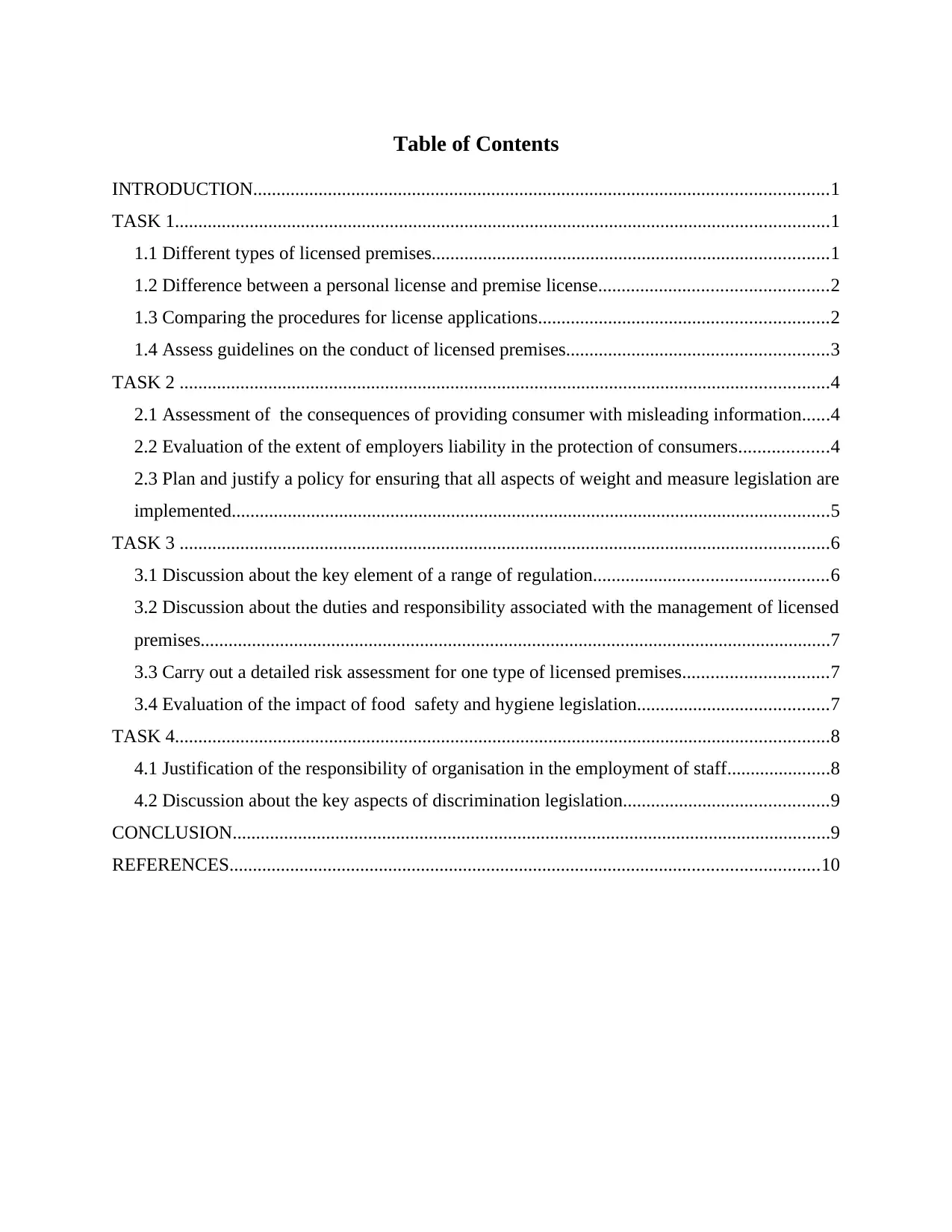
Table of Contents
INTRODUCTION...........................................................................................................................1
TASK 1............................................................................................................................................1
1.1 Different types of licensed premises.....................................................................................1
1.2 Difference between a personal license and premise license.................................................2
1.3 Comparing the procedures for license applications..............................................................2
1.4 Assess guidelines on the conduct of licensed premises........................................................3
TASK 2 ...........................................................................................................................................4
2.1 Assessment of the consequences of providing consumer with misleading information......4
2.2 Evaluation of the extent of employers liability in the protection of consumers...................4
2.3 Plan and justify a policy for ensuring that all aspects of weight and measure legislation are
implemented................................................................................................................................5
TASK 3 ...........................................................................................................................................6
3.1 Discussion about the key element of a range of regulation..................................................6
3.2 Discussion about the duties and responsibility associated with the management of licensed
premises.......................................................................................................................................7
3.3 Carry out a detailed risk assessment for one type of licensed premises...............................7
3.4 Evaluation of the impact of food safety and hygiene legislation.........................................7
TASK 4............................................................................................................................................8
4.1 Justification of the responsibility of organisation in the employment of staff......................8
4.2 Discussion about the key aspects of discrimination legislation............................................9
CONCLUSION................................................................................................................................9
REFERENCES..............................................................................................................................10
INTRODUCTION...........................................................................................................................1
TASK 1............................................................................................................................................1
1.1 Different types of licensed premises.....................................................................................1
1.2 Difference between a personal license and premise license.................................................2
1.3 Comparing the procedures for license applications..............................................................2
1.4 Assess guidelines on the conduct of licensed premises........................................................3
TASK 2 ...........................................................................................................................................4
2.1 Assessment of the consequences of providing consumer with misleading information......4
2.2 Evaluation of the extent of employers liability in the protection of consumers...................4
2.3 Plan and justify a policy for ensuring that all aspects of weight and measure legislation are
implemented................................................................................................................................5
TASK 3 ...........................................................................................................................................6
3.1 Discussion about the key element of a range of regulation..................................................6
3.2 Discussion about the duties and responsibility associated with the management of licensed
premises.......................................................................................................................................7
3.3 Carry out a detailed risk assessment for one type of licensed premises...............................7
3.4 Evaluation of the impact of food safety and hygiene legislation.........................................7
TASK 4............................................................................................................................................8
4.1 Justification of the responsibility of organisation in the employment of staff......................8
4.2 Discussion about the key aspects of discrimination legislation............................................9
CONCLUSION................................................................................................................................9
REFERENCES..............................................................................................................................10
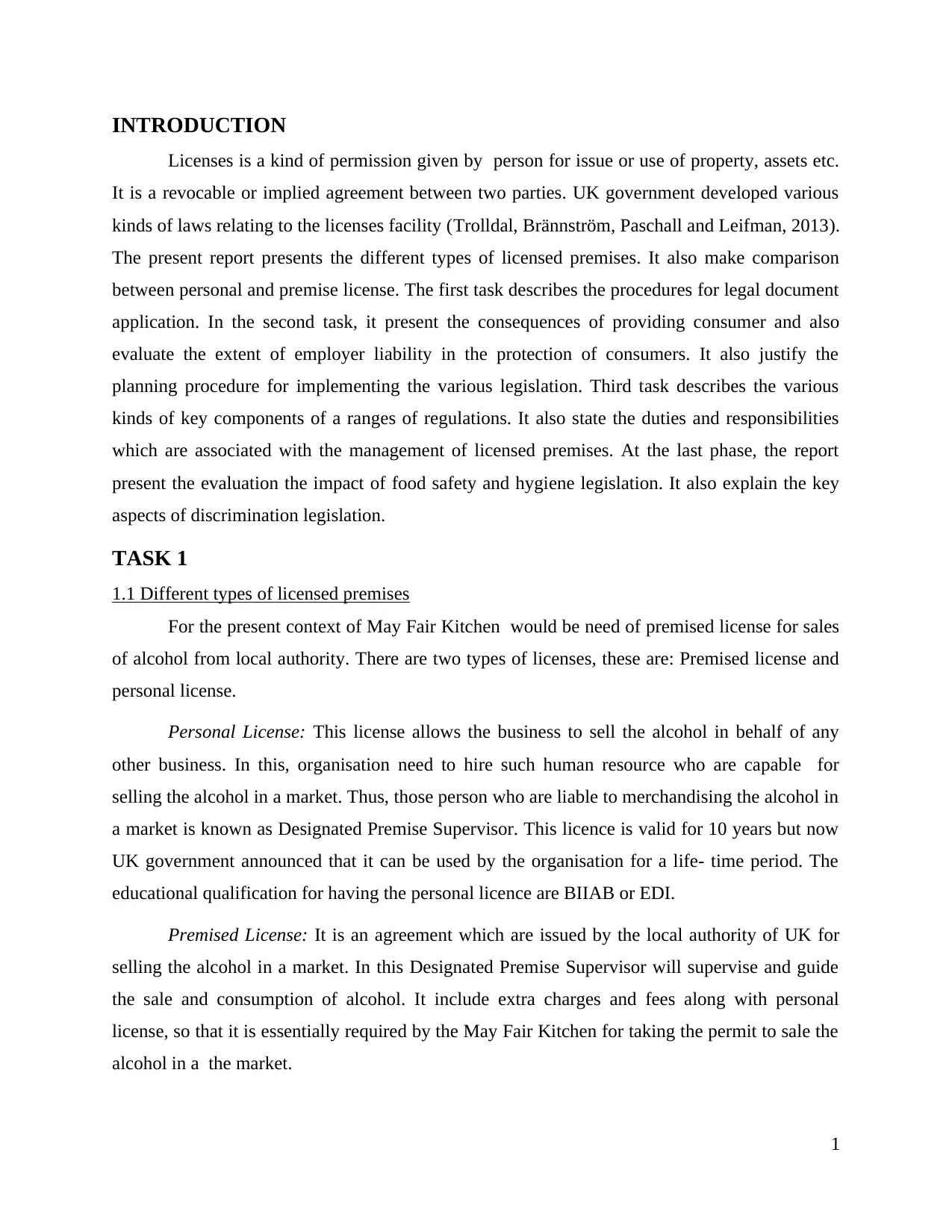
INTRODUCTION
Licenses is a kind of permission given by person for issue or use of property, assets etc.
It is a revocable or implied agreement between two parties. UK government developed various
kinds of laws relating to the licenses facility (Trolldal, Brännström, Paschall and Leifman, 2013).
The present report presents the different types of licensed premises. It also make comparison
between personal and premise license. The first task describes the procedures for legal document
application. In the second task, it present the consequences of providing consumer and also
evaluate the extent of employer liability in the protection of consumers. It also justify the
planning procedure for implementing the various legislation. Third task describes the various
kinds of key components of a ranges of regulations. It also state the duties and responsibilities
which are associated with the management of licensed premises. At the last phase, the report
present the evaluation the impact of food safety and hygiene legislation. It also explain the key
aspects of discrimination legislation.
TASK 1
1.1 Different types of licensed premises
For the present context of May Fair Kitchen would be need of premised license for sales
of alcohol from local authority. There are two types of licenses, these are: Premised license and
personal license.
Personal License: This license allows the business to sell the alcohol in behalf of any
other business. In this, organisation need to hire such human resource who are capable for
selling the alcohol in a market. Thus, those person who are liable to merchandising the alcohol in
a market is known as Designated Premise Supervisor. This licence is valid for 10 years but now
UK government announced that it can be used by the organisation for a life- time period. The
educational qualification for having the personal licence are BIIAB or EDI.
Premised License: It is an agreement which are issued by the local authority of UK for
selling the alcohol in a market. In this Designated Premise Supervisor will supervise and guide
the sale and consumption of alcohol. It include extra charges and fees along with personal
license, so that it is essentially required by the May Fair Kitchen for taking the permit to sale the
alcohol in a the market.
1
Licenses is a kind of permission given by person for issue or use of property, assets etc.
It is a revocable or implied agreement between two parties. UK government developed various
kinds of laws relating to the licenses facility (Trolldal, Brännström, Paschall and Leifman, 2013).
The present report presents the different types of licensed premises. It also make comparison
between personal and premise license. The first task describes the procedures for legal document
application. In the second task, it present the consequences of providing consumer and also
evaluate the extent of employer liability in the protection of consumers. It also justify the
planning procedure for implementing the various legislation. Third task describes the various
kinds of key components of a ranges of regulations. It also state the duties and responsibilities
which are associated with the management of licensed premises. At the last phase, the report
present the evaluation the impact of food safety and hygiene legislation. It also explain the key
aspects of discrimination legislation.
TASK 1
1.1 Different types of licensed premises
For the present context of May Fair Kitchen would be need of premised license for sales
of alcohol from local authority. There are two types of licenses, these are: Premised license and
personal license.
Personal License: This license allows the business to sell the alcohol in behalf of any
other business. In this, organisation need to hire such human resource who are capable for
selling the alcohol in a market. Thus, those person who are liable to merchandising the alcohol in
a market is known as Designated Premise Supervisor. This licence is valid for 10 years but now
UK government announced that it can be used by the organisation for a life- time period. The
educational qualification for having the personal licence are BIIAB or EDI.
Premised License: It is an agreement which are issued by the local authority of UK for
selling the alcohol in a market. In this Designated Premise Supervisor will supervise and guide
the sale and consumption of alcohol. It include extra charges and fees along with personal
license, so that it is essentially required by the May Fair Kitchen for taking the permit to sale the
alcohol in a the market.
1
⊘ This is a preview!⊘
Do you want full access?
Subscribe today to unlock all pages.

Trusted by 1+ million students worldwide
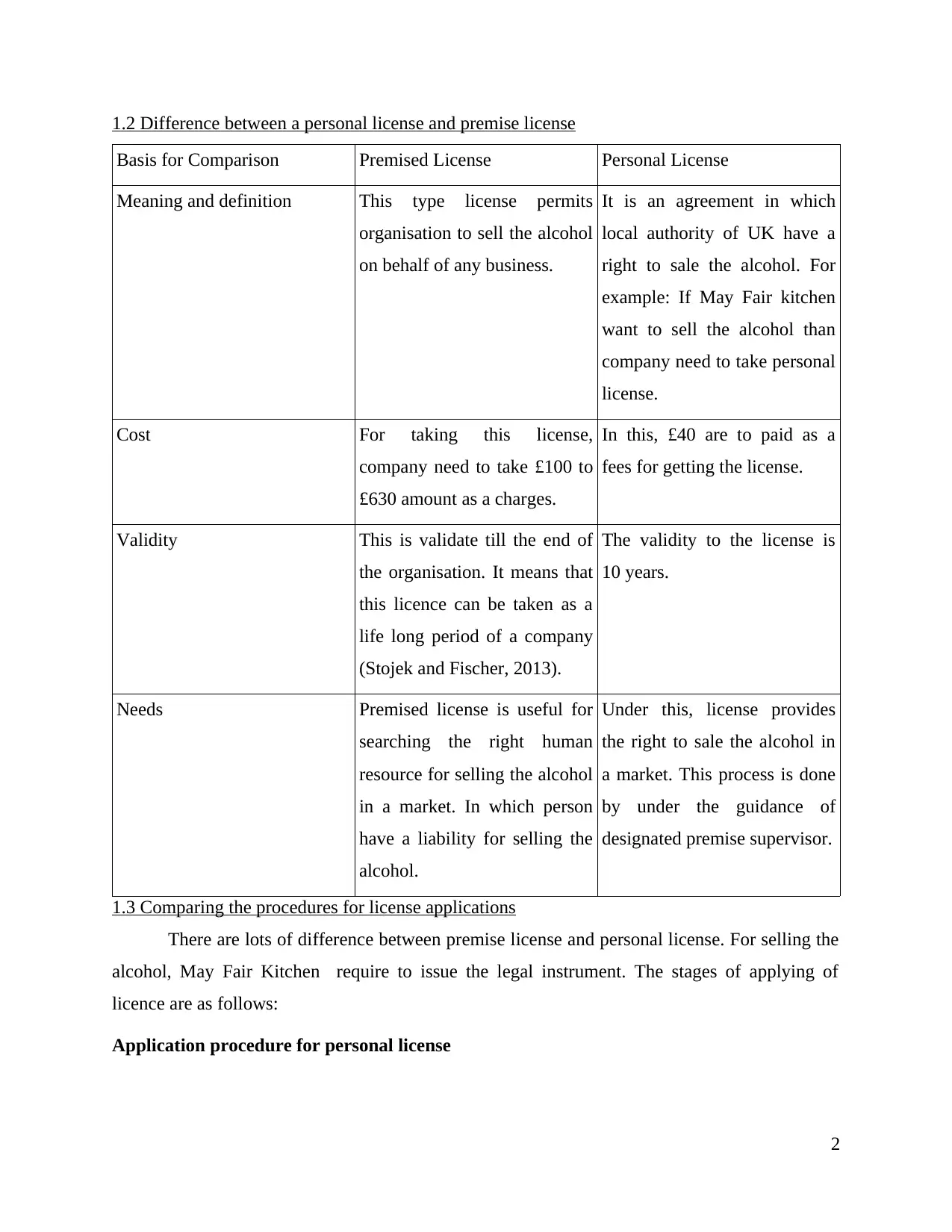
1.2 Difference between a personal license and premise license
Basis for Comparison Premised License Personal License
Meaning and definition This type license permits
organisation to sell the alcohol
on behalf of any business.
It is an agreement in which
local authority of UK have a
right to sale the alcohol. For
example: If May Fair kitchen
want to sell the alcohol than
company need to take personal
license.
Cost For taking this license,
company need to take £100 to
£630 amount as a charges.
In this, £40 are to paid as a
fees for getting the license.
Validity This is validate till the end of
the organisation. It means that
this licence can be taken as a
life long period of a company
(Stojek and Fischer, 2013).
The validity to the license is
10 years.
Needs Premised license is useful for
searching the right human
resource for selling the alcohol
in a market. In which person
have a liability for selling the
alcohol.
Under this, license provides
the right to sale the alcohol in
a market. This process is done
by under the guidance of
designated premise supervisor.
1.3 Comparing the procedures for license applications
There are lots of difference between premise license and personal license. For selling the
alcohol, May Fair Kitchen require to issue the legal instrument. The stages of applying of
licence are as follows:
Application procedure for personal license
2
Basis for Comparison Premised License Personal License
Meaning and definition This type license permits
organisation to sell the alcohol
on behalf of any business.
It is an agreement in which
local authority of UK have a
right to sale the alcohol. For
example: If May Fair kitchen
want to sell the alcohol than
company need to take personal
license.
Cost For taking this license,
company need to take £100 to
£630 amount as a charges.
In this, £40 are to paid as a
fees for getting the license.
Validity This is validate till the end of
the organisation. It means that
this licence can be taken as a
life long period of a company
(Stojek and Fischer, 2013).
The validity to the license is
10 years.
Needs Premised license is useful for
searching the right human
resource for selling the alcohol
in a market. In which person
have a liability for selling the
alcohol.
Under this, license provides
the right to sale the alcohol in
a market. This process is done
by under the guidance of
designated premise supervisor.
1.3 Comparing the procedures for license applications
There are lots of difference between premise license and personal license. For selling the
alcohol, May Fair Kitchen require to issue the legal instrument. The stages of applying of
licence are as follows:
Application procedure for personal license
2
Paraphrase This Document
Need a fresh take? Get an instant paraphrase of this document with our AI Paraphraser
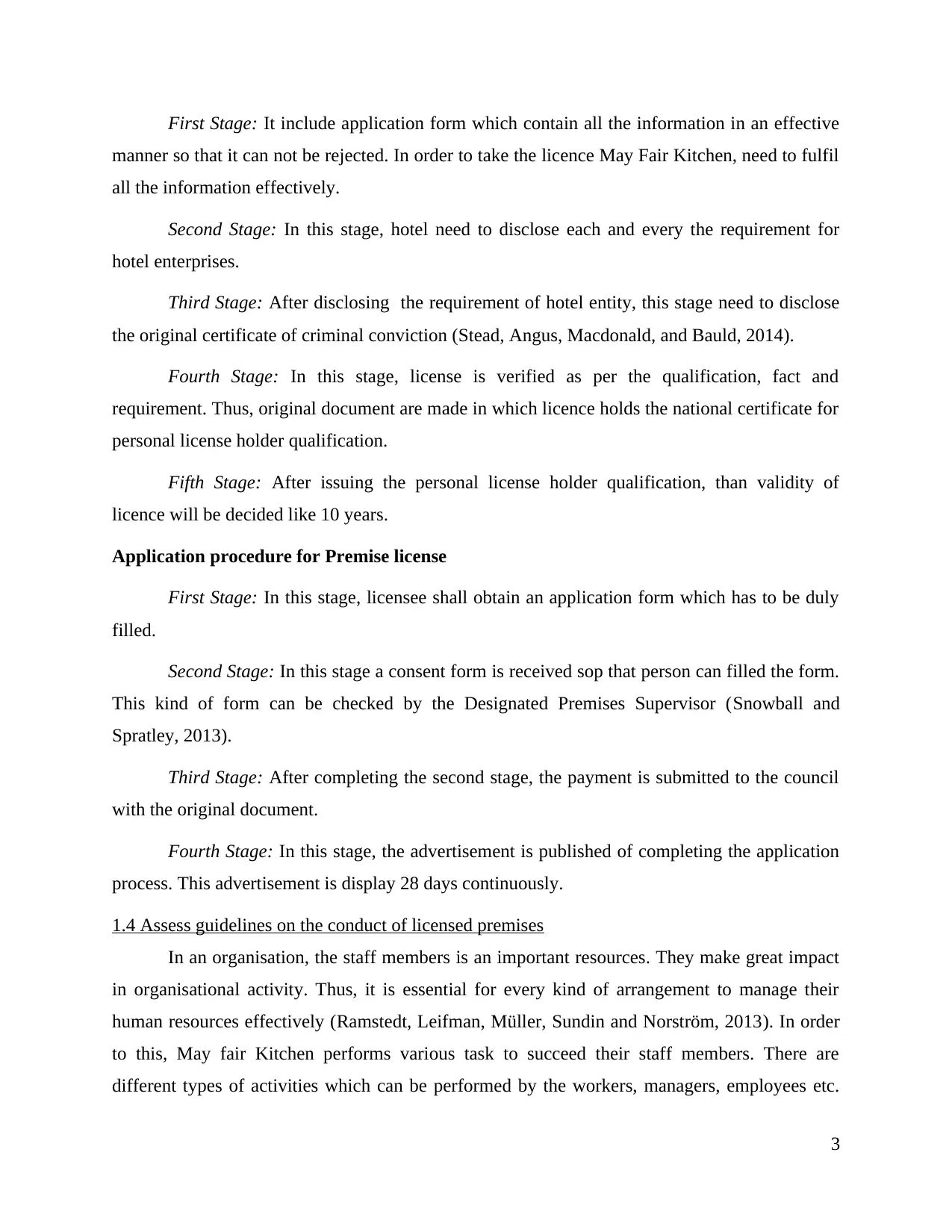
First Stage: It include application form which contain all the information in an effective
manner so that it can not be rejected. In order to take the licence May Fair Kitchen, need to fulfil
all the information effectively.
Second Stage: In this stage, hotel need to disclose each and every the requirement for
hotel enterprises.
Third Stage: After disclosing the requirement of hotel entity, this stage need to disclose
the original certificate of criminal conviction (Stead, Angus, Macdonald, and Bauld, 2014).
Fourth Stage: In this stage, license is verified as per the qualification, fact and
requirement. Thus, original document are made in which licence holds the national certificate for
personal license holder qualification.
Fifth Stage: After issuing the personal license holder qualification, than validity of
licence will be decided like 10 years.
Application procedure for Premise license
First Stage: In this stage, licensee shall obtain an application form which has to be duly
filled.
Second Stage: In this stage a consent form is received sop that person can filled the form.
This kind of form can be checked by the Designated Premises Supervisor (Snowball and
Spratley, 2013).
Third Stage: After completing the second stage, the payment is submitted to the council
with the original document.
Fourth Stage: In this stage, the advertisement is published of completing the application
process. This advertisement is display 28 days continuously.
1.4 Assess guidelines on the conduct of licensed premises
In an organisation, the staff members is an important resources. They make great impact
in organisational activity. Thus, it is essential for every kind of arrangement to manage their
human resources effectively (Ramstedt, Leifman, Müller, Sundin and Norström, 2013). In order
to this, May fair Kitchen performs various task to succeed their staff members. There are
different types of activities which can be performed by the workers, managers, employees etc.
3
manner so that it can not be rejected. In order to take the licence May Fair Kitchen, need to fulfil
all the information effectively.
Second Stage: In this stage, hotel need to disclose each and every the requirement for
hotel enterprises.
Third Stage: After disclosing the requirement of hotel entity, this stage need to disclose
the original certificate of criminal conviction (Stead, Angus, Macdonald, and Bauld, 2014).
Fourth Stage: In this stage, license is verified as per the qualification, fact and
requirement. Thus, original document are made in which licence holds the national certificate for
personal license holder qualification.
Fifth Stage: After issuing the personal license holder qualification, than validity of
licence will be decided like 10 years.
Application procedure for Premise license
First Stage: In this stage, licensee shall obtain an application form which has to be duly
filled.
Second Stage: In this stage a consent form is received sop that person can filled the form.
This kind of form can be checked by the Designated Premises Supervisor (Snowball and
Spratley, 2013).
Third Stage: After completing the second stage, the payment is submitted to the council
with the original document.
Fourth Stage: In this stage, the advertisement is published of completing the application
process. This advertisement is display 28 days continuously.
1.4 Assess guidelines on the conduct of licensed premises
In an organisation, the staff members is an important resources. They make great impact
in organisational activity. Thus, it is essential for every kind of arrangement to manage their
human resources effectively (Ramstedt, Leifman, Müller, Sundin and Norström, 2013). In order
to this, May fair Kitchen performs various task to succeed their staff members. There are
different types of activities which can be performed by the workers, managers, employees etc.
3
for selling the alcohol in a market. In this way, business need to carry off their responsibilities
and conducting lots of essential guidelines which are beneficial for organisation as well as staff
members too. They are:
Staff need to avoid risk and harm on the health due to perform unsafe work.
Training will be provided to the employees so that they can work without any kind of
health issues.
Workers should be attentive while performing the activity (Quigg, Hughes and Bellis,
2013).
They should be able to operate the accurate counting system.
They must be capable to manage the audit effectively.
They should avoid the over crowding.
TASK 2
2.1 Assessment of the consequences of providing consumer with misleading information
Misleading information provide wrong, unclear information to the trader. In order to this,
the main objective of subject matter is to perform a business transactions well (Newton, 2014).
In May Fair Kitchen, misleading here refers to provide wrong details, prices, policies, trade name
etc. This types of information make negative impact. By the use of such content, it make
confusion between customers and traders. In addition to this, it reduces the company's reputation
and loyalty by giving wrong details. Hence, UK government developed different kinds of rules
so that it can protect the customers by giving wrong information related to the product. Several
kinds of act like Consumer Right Act 2015, Trade regulation act 2-008 etc. are framed in order to
protect the customers.
It is a responsibility of May Fair Kitchen company to adopt all the rules and regulation
which are developed by the government. In order to this, May Fair Kitchen company follow the
customer protection against unfair trade regulation act 2008 so that firm protect the clients by
fake pricing, inaccurate labelling, improper information etc. By using all the customer protection
act, company manage all the conflicts and eliminate any kind of injustice related to the
consumers (Newberry, Williams and Caulfield, 2013).
4
and conducting lots of essential guidelines which are beneficial for organisation as well as staff
members too. They are:
Staff need to avoid risk and harm on the health due to perform unsafe work.
Training will be provided to the employees so that they can work without any kind of
health issues.
Workers should be attentive while performing the activity (Quigg, Hughes and Bellis,
2013).
They should be able to operate the accurate counting system.
They must be capable to manage the audit effectively.
They should avoid the over crowding.
TASK 2
2.1 Assessment of the consequences of providing consumer with misleading information
Misleading information provide wrong, unclear information to the trader. In order to this,
the main objective of subject matter is to perform a business transactions well (Newton, 2014).
In May Fair Kitchen, misleading here refers to provide wrong details, prices, policies, trade name
etc. This types of information make negative impact. By the use of such content, it make
confusion between customers and traders. In addition to this, it reduces the company's reputation
and loyalty by giving wrong details. Hence, UK government developed different kinds of rules
so that it can protect the customers by giving wrong information related to the product. Several
kinds of act like Consumer Right Act 2015, Trade regulation act 2-008 etc. are framed in order to
protect the customers.
It is a responsibility of May Fair Kitchen company to adopt all the rules and regulation
which are developed by the government. In order to this, May Fair Kitchen company follow the
customer protection against unfair trade regulation act 2008 so that firm protect the clients by
fake pricing, inaccurate labelling, improper information etc. By using all the customer protection
act, company manage all the conflicts and eliminate any kind of injustice related to the
consumers (Newberry, Williams and Caulfield, 2013).
4
⊘ This is a preview!⊘
Do you want full access?
Subscribe today to unlock all pages.
Trusted by 1+ million students worldwide
2.2 Evaluation of the extent of employers liability in the protection of consumers
In any organisation, customers, traders etc. mislead the information. Thus, their activity
will directly make negative impact in organisation reputation and goodwill. In this way, the
buyer decision and demand of a particular product will be change frequently and sometimes
company need to switch the brand in the market. To overcome all these situation, establishment
need to adopt fair pricing strategies and using different kinds of customer protection act. In
addition to this, it is a responsibilities of the company to handle all the disputes related to the
wrong information about the commodity and services. Firm also develop an impressive training
program for improving their work (Moore, O’Brien, Alam, Cohen, Hood, Huang, Moore,
Murphy, Playle, Sivarajasingam and Spasic, 2014). Thus, employees perform their task by using
specific skills, knowledge and ability in an organisation. There are various type of liabilities
which are performed by the employers for protecting the customers against fraud:
May Fair Kitchen company need to adopt right medium so that they can protect the
interest of the customers.
Company should organize effective training and development program to employees by
which they can perform well.
Firm need to follow fair pricing strategies, policies and regulations for providing
customer safety.
They need to develop and design effective working environment in which customers as
well as employees feeling safe (Martin, Freeman and Davey, 2013).
2.3 Plan and justify a policy for ensuring that all aspects of weight and measure legislation are
implemented
In order to send accurate information related to the product or service, May Fair Kitchen
company use various kinds of rules, regulation and policies which are framed by the government
for securing the customers against any kind of frauds. In addition to this, employees were
responsible for giving right information to the clients. Packer plays an important role for
maintaining the standard quality of the products. For providing safety, two main act have been
developed, theses are: Weight and Measure Act 1964 and Weight and Measure Act 1988.
According to this act, the quantity of the product in each packet should be equal and all the label,
information should be fair in the aggregation of a product. This act also shows that company
5
In any organisation, customers, traders etc. mislead the information. Thus, their activity
will directly make negative impact in organisation reputation and goodwill. In this way, the
buyer decision and demand of a particular product will be change frequently and sometimes
company need to switch the brand in the market. To overcome all these situation, establishment
need to adopt fair pricing strategies and using different kinds of customer protection act. In
addition to this, it is a responsibilities of the company to handle all the disputes related to the
wrong information about the commodity and services. Firm also develop an impressive training
program for improving their work (Moore, O’Brien, Alam, Cohen, Hood, Huang, Moore,
Murphy, Playle, Sivarajasingam and Spasic, 2014). Thus, employees perform their task by using
specific skills, knowledge and ability in an organisation. There are various type of liabilities
which are performed by the employers for protecting the customers against fraud:
May Fair Kitchen company need to adopt right medium so that they can protect the
interest of the customers.
Company should organize effective training and development program to employees by
which they can perform well.
Firm need to follow fair pricing strategies, policies and regulations for providing
customer safety.
They need to develop and design effective working environment in which customers as
well as employees feeling safe (Martin, Freeman and Davey, 2013).
2.3 Plan and justify a policy for ensuring that all aspects of weight and measure legislation are
implemented
In order to send accurate information related to the product or service, May Fair Kitchen
company use various kinds of rules, regulation and policies which are framed by the government
for securing the customers against any kind of frauds. In addition to this, employees were
responsible for giving right information to the clients. Packer plays an important role for
maintaining the standard quality of the products. For providing safety, two main act have been
developed, theses are: Weight and Measure Act 1964 and Weight and Measure Act 1988.
According to this act, the quantity of the product in each packet should be equal and all the label,
information should be fair in the aggregation of a product. This act also shows that company
5
Paraphrase This Document
Need a fresh take? Get an instant paraphrase of this document with our AI Paraphraser
should mention the expiry date in the package. Without having any of theses details no product is
eligible for selling in the market. In addition to this, their should not be any kind disputes related
to the price of product and services. The cost of the commodity is also same and it offers at the
equal price to the customers. In this way, the packaging of a product contain all the information
which is reliable, accurate in nature (Marsh, Doscher and Robertson, 2013).
TASK 3
3.1 Discussion about the key element of a range of regulation
UK government developed different kinds of rules and regulation for protecting the
customers against any kind of fraud. As per these rules, quantity, quality and price of the
products will be same (Labhart, Graham, Wells and Kuntsche, 2013). There are different types of
rule and regulation which are required by the May Fair Kitchen company, they are as follows:
General food law regulation: The main objective of this regulation is to provide safe
product in the market. It also focused that their will not be any kind of misleading in
advertisement. All these aims and objectives are covers the organisation of food under article 14.
Control of noise at work regulation 2005: This act is focus on controlling the noise at
workplace. According to this act, their will be a maximum hearing limit which is 85 decibel so
that every organisation need to maintain the noise in their working areas.
Display screen regulation: This act covers all those equipment which have display
screen. For example: Laptop, LCD etc. It is main responsibilities of every organisation to
maintain the display screen of such equipment so that it may not cause harm of employees
health. In addition to this, all the equipment should be used in an organisation is an effective
manner (Kypri, McElduff and Miller, 2014).
Health and safety at workplace act 1974: This act provide health safety and security of
employees against any uncertain events. It is the responsibilities of an organisation to provide
healthy workplace to the employees so that they can perform their work without facing any kind
of injuries and health issues. All equipments are well- maintained and will be use in an effective
manner.
6
eligible for selling in the market. In addition to this, their should not be any kind disputes related
to the price of product and services. The cost of the commodity is also same and it offers at the
equal price to the customers. In this way, the packaging of a product contain all the information
which is reliable, accurate in nature (Marsh, Doscher and Robertson, 2013).
TASK 3
3.1 Discussion about the key element of a range of regulation
UK government developed different kinds of rules and regulation for protecting the
customers against any kind of fraud. As per these rules, quantity, quality and price of the
products will be same (Labhart, Graham, Wells and Kuntsche, 2013). There are different types of
rule and regulation which are required by the May Fair Kitchen company, they are as follows:
General food law regulation: The main objective of this regulation is to provide safe
product in the market. It also focused that their will not be any kind of misleading in
advertisement. All these aims and objectives are covers the organisation of food under article 14.
Control of noise at work regulation 2005: This act is focus on controlling the noise at
workplace. According to this act, their will be a maximum hearing limit which is 85 decibel so
that every organisation need to maintain the noise in their working areas.
Display screen regulation: This act covers all those equipment which have display
screen. For example: Laptop, LCD etc. It is main responsibilities of every organisation to
maintain the display screen of such equipment so that it may not cause harm of employees
health. In addition to this, all the equipment should be used in an organisation is an effective
manner (Kypri, McElduff and Miller, 2014).
Health and safety at workplace act 1974: This act provide health safety and security of
employees against any uncertain events. It is the responsibilities of an organisation to provide
healthy workplace to the employees so that they can perform their work without facing any kind
of injuries and health issues. All equipments are well- maintained and will be use in an effective
manner.
6
3.2 Discussion about the duties and responsibility associated with the management of licensed
premises
Employers and managers of an organisation plays an important role which is related to
the licensed premises for food security (Kypri, Davie, McElduff, Connor and Langley, 2014).
There are following duties and responsibilities which are associated with the management of
licensed premises, these are:
May Fair Kitchen should participate in social welfare activity and public trust.
There should be strict rules and regulation for happing any crime and disorder.
Company should focus on providing public security (Humphreys and Smith, 2013).
Management need to update or renew their license as per their requirement.
Management should protect the children from any kinds of harm.
They must focus in working as per the Licence Act 2003.
3.3 Carry out a detailed risk assessment for one type of licensed premises
Local authority and HSE shows an important role for reducing the risk which are related
to the retail and licensed premises. It is a complete process which focus on choosing the right
ways for assessment the risk and working effectively to minimize the violence in a workplace.
These guidelines involves large number of information which help to make effective control in
uncertain event. The guidelines mainly describes the violence which is related to workplace
which make great imp-act on customers as well as employees in the organisation. There are wide
range of control measures are available which help to avoid the risk in an organisation. Company
also face risk related to the employees safety and health. Thus, it is most important for May Fair
Kitchen company to follow all the rules and regulations to protect the employees at the
workplace. Company also provide training and development program so that employees have
sufficient knowledge and skills to handle the uncertain event in future (Graham, Miller,
Chikritzhs, Bellis, Clapp, Hughes, Toomey and Wells, 2014).
3.4 Evaluation of the impact of food safety and hygiene legislation
UK's food agencies are responsible for providing high quality of food products to their
customers. By using this, the health of customers will be improved by managing the quality of
food products. The aim of these departments is to improve the health of customers and also make
7
premises
Employers and managers of an organisation plays an important role which is related to
the licensed premises for food security (Kypri, Davie, McElduff, Connor and Langley, 2014).
There are following duties and responsibilities which are associated with the management of
licensed premises, these are:
May Fair Kitchen should participate in social welfare activity and public trust.
There should be strict rules and regulation for happing any crime and disorder.
Company should focus on providing public security (Humphreys and Smith, 2013).
Management need to update or renew their license as per their requirement.
Management should protect the children from any kinds of harm.
They must focus in working as per the Licence Act 2003.
3.3 Carry out a detailed risk assessment for one type of licensed premises
Local authority and HSE shows an important role for reducing the risk which are related
to the retail and licensed premises. It is a complete process which focus on choosing the right
ways for assessment the risk and working effectively to minimize the violence in a workplace.
These guidelines involves large number of information which help to make effective control in
uncertain event. The guidelines mainly describes the violence which is related to workplace
which make great imp-act on customers as well as employees in the organisation. There are wide
range of control measures are available which help to avoid the risk in an organisation. Company
also face risk related to the employees safety and health. Thus, it is most important for May Fair
Kitchen company to follow all the rules and regulations to protect the employees at the
workplace. Company also provide training and development program so that employees have
sufficient knowledge and skills to handle the uncertain event in future (Graham, Miller,
Chikritzhs, Bellis, Clapp, Hughes, Toomey and Wells, 2014).
3.4 Evaluation of the impact of food safety and hygiene legislation
UK's food agencies are responsible for providing high quality of food products to their
customers. By using this, the health of customers will be improved by managing the quality of
food products. The aim of these departments is to improve the health of customers and also make
7
⊘ This is a preview!⊘
Do you want full access?
Subscribe today to unlock all pages.
Trusted by 1+ million students worldwide
aware them about their health. In addition to this, by making effective connection with all food
companies help them to give effective guidance for opting best food designing method. May Fair
Kitchen also have objectives to provide high quality of food and services and aware their
customers about their health. Company also check the quality and quantity of the products. For
example: Organisation check that each product have render in a same price, quality or quantity or
not. Firm also adopt various government's guidelines for giving best facility to their employees
and customers. For example: Firm always try to provide hygienic place for employees so that
they can work in safe place. Institution also follow the customer protection act and give their best
effort by providing high quality products in the market (Florence, Shepherd, Brennan and
Simon, 2013).
TASK 4
4.1 Justification of the responsibility of organisation in the employment of staff
UK government developed various kinds of rules and regulations to protect the interest of
employees. Every organisation should follow the rules and regulations to provide equal right and
opportunities to their employees. As per the developed regulations, structure use in an effective
manner and provide safety to the employees. Company also ensure that all the equipments are
well- managed and maintained so that it not make any harm to employees. In addition to this,
company also focus to make proper arrangement of medical facility like first add kit , emergency
room, rest room to the older and women workers. Not only firm but government also make
various schemes which is related to health of the workers like insurance plan, medical schemes
etc.
Organisation always try to give safe and hygienic environment to the employees, where
they will work freely ans as per their suitability. Firm give sufficient break, resting time,
refreshment to their workers. All theses activities help to motivate the staff members and
increases the performance level too. May Fair Kitchen always try to redesign their policies,
structure which are suitable for the workers. By arranging proper facility like air, light, seating
and giving time-to-time increment, salary, bonus, wages, promotion etc. are provided by the
firm. All these policies help to develop and motivate the employees so that they will perform
more efficiently in an organisation. All the efforts of a company help to achieve their desire
targets by managing their employees (Doran, Byrnes, Cobiac, Vandenberg and Vos, 2013).
8
companies help them to give effective guidance for opting best food designing method. May Fair
Kitchen also have objectives to provide high quality of food and services and aware their
customers about their health. Company also check the quality and quantity of the products. For
example: Organisation check that each product have render in a same price, quality or quantity or
not. Firm also adopt various government's guidelines for giving best facility to their employees
and customers. For example: Firm always try to provide hygienic place for employees so that
they can work in safe place. Institution also follow the customer protection act and give their best
effort by providing high quality products in the market (Florence, Shepherd, Brennan and
Simon, 2013).
TASK 4
4.1 Justification of the responsibility of organisation in the employment of staff
UK government developed various kinds of rules and regulations to protect the interest of
employees. Every organisation should follow the rules and regulations to provide equal right and
opportunities to their employees. As per the developed regulations, structure use in an effective
manner and provide safety to the employees. Company also ensure that all the equipments are
well- managed and maintained so that it not make any harm to employees. In addition to this,
company also focus to make proper arrangement of medical facility like first add kit , emergency
room, rest room to the older and women workers. Not only firm but government also make
various schemes which is related to health of the workers like insurance plan, medical schemes
etc.
Organisation always try to give safe and hygienic environment to the employees, where
they will work freely ans as per their suitability. Firm give sufficient break, resting time,
refreshment to their workers. All theses activities help to motivate the staff members and
increases the performance level too. May Fair Kitchen always try to redesign their policies,
structure which are suitable for the workers. By arranging proper facility like air, light, seating
and giving time-to-time increment, salary, bonus, wages, promotion etc. are provided by the
firm. All these policies help to develop and motivate the employees so that they will perform
more efficiently in an organisation. All the efforts of a company help to achieve their desire
targets by managing their employees (Doran, Byrnes, Cobiac, Vandenberg and Vos, 2013).
8
Paraphrase This Document
Need a fresh take? Get an instant paraphrase of this document with our AI Paraphraser
4.2 Discussion about the key aspects of discrimination legislation
All the rules and regulations which are framed by the government which are totally based
on the welfare and development of employees. Thus, there will be no right of any organisation to
discriminate such legislation on the basis of employee's caste, gender, age, nationality, colour
etc. As per the discrimination act 1975, no employees should treat differently as per their caste,
gender etc. All the workers are equal in the eyes of the organisation. Company should follow the
rules while hiring the employees and gives equal opportunities to them. All these efforts help to
improve the goodwill and reputation of a company. By using this rules, new employees also
attracted with the organisation which help to make growth in a competitive market (Council,
2014).
CONCLUSION
As per the above detailed report it have been concluded that licenses is essential for every
kind of business. It help to the organisation to operate in a competitive market by the support of
government. The present report discovered the different types of licensed premises and their role
in an organisation. It also explained the application procedure of both premise and personal
licensed organisation. Furthermore, it present the role of employees and customers in May Fair
Kitchen company for successful completion of their work. In the third phase, it discussed the key
components of a range of regulation and role of management of licensed companies. At last, it
evaluated the impact of food safety and hygiene legislation. It also justified the responsibilities of
employers in employment of staff (Burton, Spanjaard and Hoek, 2013).
9
All the rules and regulations which are framed by the government which are totally based
on the welfare and development of employees. Thus, there will be no right of any organisation to
discriminate such legislation on the basis of employee's caste, gender, age, nationality, colour
etc. As per the discrimination act 1975, no employees should treat differently as per their caste,
gender etc. All the workers are equal in the eyes of the organisation. Company should follow the
rules while hiring the employees and gives equal opportunities to them. All these efforts help to
improve the goodwill and reputation of a company. By using this rules, new employees also
attracted with the organisation which help to make growth in a competitive market (Council,
2014).
CONCLUSION
As per the above detailed report it have been concluded that licenses is essential for every
kind of business. It help to the organisation to operate in a competitive market by the support of
government. The present report discovered the different types of licensed premises and their role
in an organisation. It also explained the application procedure of both premise and personal
licensed organisation. Furthermore, it present the role of employees and customers in May Fair
Kitchen company for successful completion of their work. In the third phase, it discussed the key
components of a range of regulation and role of management of licensed companies. At last, it
evaluated the impact of food safety and hygiene legislation. It also justified the responsibilities of
employers in employment of staff (Burton, Spanjaard and Hoek, 2013).
9
REFERENCES
Books and Journals
Burton, S., Spanjaard, D. and Hoek, J., 2013. An investigation of tobacco retail outlets as a cue
for smoking. Australasian Marketing Journal (AMJ). 21(4). pp.234-239.
Council, N. Z. P., 2014. Statement of principles. URL: http://www. presscouncil. org.
nz/principles. php [Accessed 30 June 2014].
Doran, C. M., Byrnes, J. M., Cobiac, L. J., Vandenberg, B. and Vos, T., 2013. Estimated impacts
of alternative Australian alcohol taxation structures on consumption, public
health and government revenues. Med J Aust. 199(9). pp.619-622.
Florence, C., Shepherd, J., Brennan, I. and Simon, T. R., 2013. An economic evaluation of
anonymised information sharing in a partnership between health services,
police and local government for preventing violence-related injury. Injury
Prevention, pp.injuryprev-2012.
Graham, K., Miller, P., Chikritzhs, T., Bellis, M. A., Clapp, J. D., Hughes, K., Toomey, T. L.
and Wells, S., 2014. Reducing intoxication among bar patrons: some lessons
from prevention of drinking and driving. Addiction. 109(5). pp.693-698.
Humphreys, D. K. and Smith, D. M., 2013. Alcohol licensing data: Why is it an underused
resource in public health?. Health & place. 24. pp.110-114.
Kypri, K., Davie, G., McElduff, P., Connor, J. and Langley, J., 2014. Effects of lowering the
minimum alcohol purchasing age on weekend assaults resulting in
hospitalization in New Zealand. American journal of public health. 104(8).
pp.1396-1401.
Kypri, K., McElduff, P. and Miller, P., 2014. Restrictions in pub closing times and lockouts in
Newcastle, Australia five years on. Drug and alcohol review. 33(3). pp.323-
326.
Labhart, F., Graham, K., Wells, S. and Kuntsche, E., 2013. Drinking before going to licensed
premises: An event‐level analysis of predrinking, alcohol consumption, and
adverse outcomes. Alcoholism: Clinical and Experimental Research. 37(2).
pp.284-291.
10
Books and Journals
Burton, S., Spanjaard, D. and Hoek, J., 2013. An investigation of tobacco retail outlets as a cue
for smoking. Australasian Marketing Journal (AMJ). 21(4). pp.234-239.
Council, N. Z. P., 2014. Statement of principles. URL: http://www. presscouncil. org.
nz/principles. php [Accessed 30 June 2014].
Doran, C. M., Byrnes, J. M., Cobiac, L. J., Vandenberg, B. and Vos, T., 2013. Estimated impacts
of alternative Australian alcohol taxation structures on consumption, public
health and government revenues. Med J Aust. 199(9). pp.619-622.
Florence, C., Shepherd, J., Brennan, I. and Simon, T. R., 2013. An economic evaluation of
anonymised information sharing in a partnership between health services,
police and local government for preventing violence-related injury. Injury
Prevention, pp.injuryprev-2012.
Graham, K., Miller, P., Chikritzhs, T., Bellis, M. A., Clapp, J. D., Hughes, K., Toomey, T. L.
and Wells, S., 2014. Reducing intoxication among bar patrons: some lessons
from prevention of drinking and driving. Addiction. 109(5). pp.693-698.
Humphreys, D. K. and Smith, D. M., 2013. Alcohol licensing data: Why is it an underused
resource in public health?. Health & place. 24. pp.110-114.
Kypri, K., Davie, G., McElduff, P., Connor, J. and Langley, J., 2014. Effects of lowering the
minimum alcohol purchasing age on weekend assaults resulting in
hospitalization in New Zealand. American journal of public health. 104(8).
pp.1396-1401.
Kypri, K., McElduff, P. and Miller, P., 2014. Restrictions in pub closing times and lockouts in
Newcastle, Australia five years on. Drug and alcohol review. 33(3). pp.323-
326.
Labhart, F., Graham, K., Wells, S. and Kuntsche, E., 2013. Drinking before going to licensed
premises: An event‐level analysis of predrinking, alcohol consumption, and
adverse outcomes. Alcoholism: Clinical and Experimental Research. 37(2).
pp.284-291.
10
⊘ This is a preview!⊘
Do you want full access?
Subscribe today to unlock all pages.
Trusted by 1+ million students worldwide

1 out of 14


Related Documents


Your All-in-One AI-Powered Toolkit for Academic Success.
+13062052269
info@desklib.com
Available 24*7 on WhatsApp / Email
![[object Object]](/_next/static/media/star-bottom.7253800d.svg)
Unlock your academic potential
Copyright © 2020–2026 A2Z Services. All Rights Reserved. Developed and managed by ZUCOL.