Individual Strategic Management Report: Lidl's Expansion in Malaysia
VerifiedAdded on 2023/01/19
|15
|4537
|82
Report
AI Summary
This report provides a strategic management analysis for Lidl, focusing on its potential expansion into the Malaysian market. It begins with an executive summary and an introduction to strategic management, emphasizing the importance of adapting to the external business environment. The main body includes a detailed PESTLE analysis to assess the political, economic, social, technological, environmental, and legal factors impacting Lidl's operations in Malaysia. It also incorporates Porter's Five Forces to evaluate the competitive landscape of the retail industry in Malaysia. Furthermore, the report conducts an internal environment analysis, identifying Lidl's strengths and weaknesses using VRIO analysis. The analysis reveals Lidl's competitive advantages and disadvantages, guiding the formulation of appropriate competitive strategies. Finally, the report proposes strategic directions and recommendations for Lidl to successfully enter and thrive in the Malaysian market, offering insights into sustainable performance and market share growth. The report concludes with a summary of findings and recommendations, and references used in the analysis.
Individual Strategic
Management Report
Management Report

Paraphrase This Document
Need a fresh take? Get an instant paraphrase of this document with our AI Paraphraser
EXECUTIVE SUMMARY
This report is based on the Strategic Management that assist the Lidl firm to bind the
suitable policy which are designed for the effectively functioning within the confined
geographical or to expand business in the new geographical region. Here discussion is made on
the external environment for which PESTLE analysis is used to identify the threat or opportunity
particular company which is Lidl can face before expanding its operations to Asian market,
particularly in Malaysia. Along with that it is widely relevant to understand the internal
environment via VRIO analysis and internal strength and weaknesses are identified to gain
strategic advantage and control the competitive pressure. Moreover, competitive strategies helps
the firm to gain the advantage of strategic fit for the sustainable performance as on the basis of
which strategic direction is provide for the suitable development of the company and expand the
market share effectively.
This report is based on the Strategic Management that assist the Lidl firm to bind the
suitable policy which are designed for the effectively functioning within the confined
geographical or to expand business in the new geographical region. Here discussion is made on
the external environment for which PESTLE analysis is used to identify the threat or opportunity
particular company which is Lidl can face before expanding its operations to Asian market,
particularly in Malaysia. Along with that it is widely relevant to understand the internal
environment via VRIO analysis and internal strength and weaknesses are identified to gain
strategic advantage and control the competitive pressure. Moreover, competitive strategies helps
the firm to gain the advantage of strategic fit for the sustainable performance as on the basis of
which strategic direction is provide for the suitable development of the company and expand the
market share effectively.
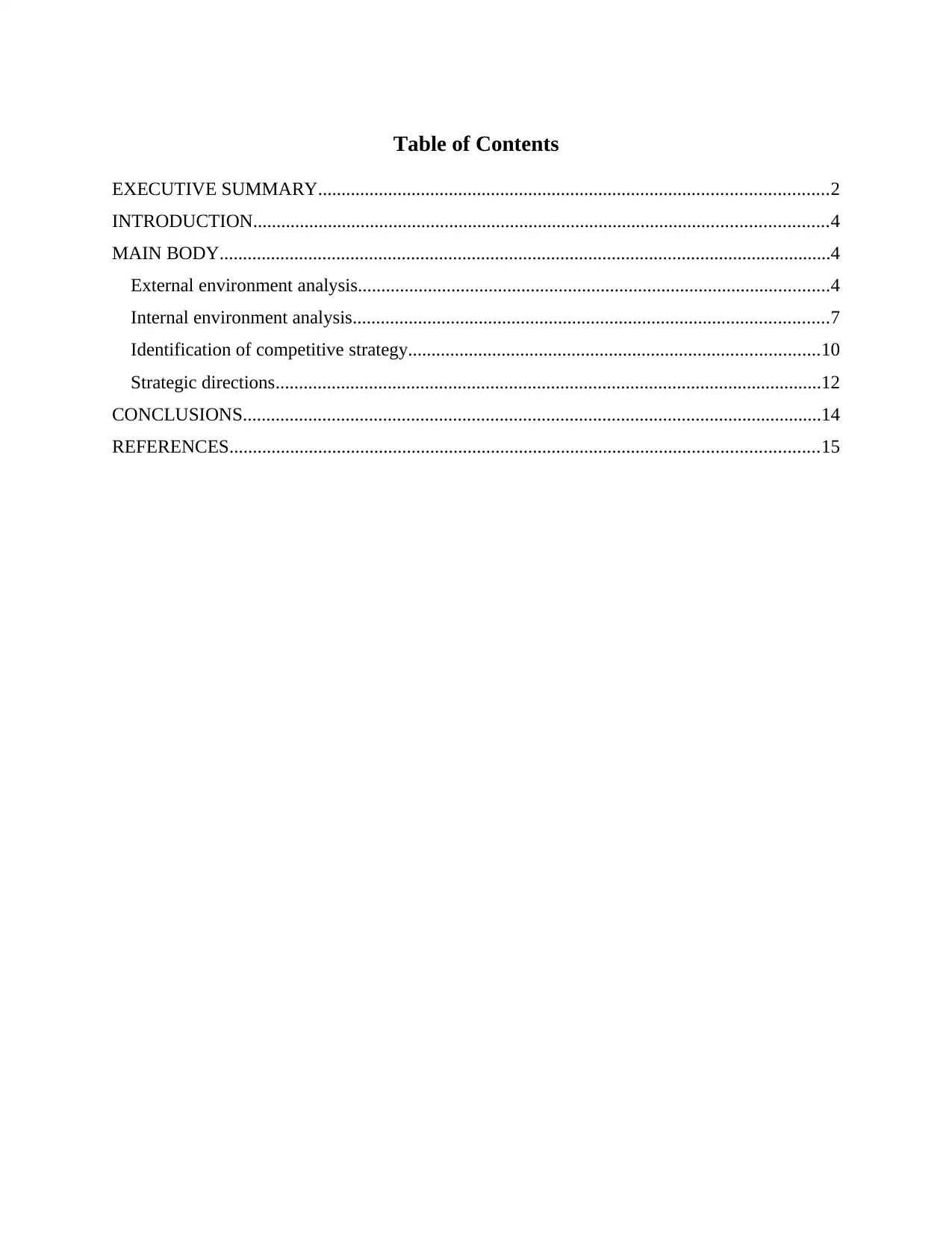
Table of Contents
EXECUTIVE SUMMARY.............................................................................................................2
INTRODUCTION...........................................................................................................................4
MAIN BODY...................................................................................................................................4
External environment analysis.....................................................................................................4
Internal environment analysis......................................................................................................7
Identification of competitive strategy........................................................................................10
Strategic directions.....................................................................................................................12
CONCLUSIONS............................................................................................................................14
REFERENCES..............................................................................................................................15
EXECUTIVE SUMMARY.............................................................................................................2
INTRODUCTION...........................................................................................................................4
MAIN BODY...................................................................................................................................4
External environment analysis.....................................................................................................4
Internal environment analysis......................................................................................................7
Identification of competitive strategy........................................................................................10
Strategic directions.....................................................................................................................12
CONCLUSIONS............................................................................................................................14
REFERENCES..............................................................................................................................15
⊘ This is a preview!⊘
Do you want full access?
Subscribe today to unlock all pages.

Trusted by 1+ million students worldwide
INTRODUCTION
Strategic management refers to the ongoing process of management that help to monitor
and access the business task in order to attain the desirable position. Changes are the part of
external business environment which require the organisation to access the best possible strategy
in order to gain the success and attain best possible position. The basic role of the strategic
management process is to anticipate the external situation as well as internal capabilities based
on which defective functioning is carried out (Ackermann and Eden, 2011). This provide the
overall direction by developing the suitable policies, programmes well as objective effectively
within specific duration.
Lidl is the lengthy super market chain of Germany that started its operation in 1930.
Currently, the company has become the global discount retailer that have over ten thousand brick
and mortar outlet All across the Europe as well as United State. Although the company has to
face various difficulties to carry forward its business and sustain strongly in the changing
environment. Additionally, which makes it vital for the firm to analyse the external environment
effective before diversifying into the new geographical area such as in Asian market, within
Malaysia. For the better understanding this report cover topics like analyse the current strategic
position of the organisation. Further, propose the strategic recommendations with the objective
to strengthen the position of the Lidl company in the Malaysian market are covered in this report.
MAIN BODY
External environment analysis
PESTLE analysis is the part of macro environment the provide the favourable insights to
the company in terms of challenges or opportunity they may get while starting operations in the
new geographical market. The explanation of the different external factors in context to the Lidl
company are defined below:
Political factor: This include the political stability as well as government regulation
which is mandatory for all the organisation to abide by them. As Lidl company has over 10,000
stores which function in the developed country where the political conditions as well as parties
are quite stable so there can plan and implement the strategy effectively (Ansoff and et.al.,
2018). On other side the company is planning to diversify its operations in Malaysian market so
Strategic management refers to the ongoing process of management that help to monitor
and access the business task in order to attain the desirable position. Changes are the part of
external business environment which require the organisation to access the best possible strategy
in order to gain the success and attain best possible position. The basic role of the strategic
management process is to anticipate the external situation as well as internal capabilities based
on which defective functioning is carried out (Ackermann and Eden, 2011). This provide the
overall direction by developing the suitable policies, programmes well as objective effectively
within specific duration.
Lidl is the lengthy super market chain of Germany that started its operation in 1930.
Currently, the company has become the global discount retailer that have over ten thousand brick
and mortar outlet All across the Europe as well as United State. Although the company has to
face various difficulties to carry forward its business and sustain strongly in the changing
environment. Additionally, which makes it vital for the firm to analyse the external environment
effective before diversifying into the new geographical area such as in Asian market, within
Malaysia. For the better understanding this report cover topics like analyse the current strategic
position of the organisation. Further, propose the strategic recommendations with the objective
to strengthen the position of the Lidl company in the Malaysian market are covered in this report.
MAIN BODY
External environment analysis
PESTLE analysis is the part of macro environment the provide the favourable insights to
the company in terms of challenges or opportunity they may get while starting operations in the
new geographical market. The explanation of the different external factors in context to the Lidl
company are defined below:
Political factor: This include the political stability as well as government regulation
which is mandatory for all the organisation to abide by them. As Lidl company has over 10,000
stores which function in the developed country where the political conditions as well as parties
are quite stable so there can plan and implement the strategy effectively (Ansoff and et.al.,
2018). On other side the company is planning to diversify its operations in Malaysian market so
Paraphrase This Document
Need a fresh take? Get an instant paraphrase of this document with our AI Paraphraser
there the unstable political conditions set strategies as well as operations can negatively affect the
operations.
Economical factor: These factor include the foreign exchange rate, gross domestic
product, inflation rate as so on that can affect the economy of Lidl company. So there are
different economic conditions which can affect the existing functioning of firm such as inflation
rate. So to cope up with this situation Lidl company need to change its policies as well as
strategies on the continuous basis. Like, during the time of inflation the local consumer only
prefer to invest in the necessity items as the basic prices of the overall commodities rises up.
Although this situation affect the overall market but cause less impact on the offerings of Lidl
company because they try to manage selling the goods at low prices and majority of the products
are necessity product which consumer require on the regular basis. Therefore, this is the foremost
advantage that help the respective company to expand its operations effectively within Malaysia.
Social factor: It include the taste, preferences as well as interest of the consumer that
switches after a short time being within the specific geographical area as well as outside it. So it
is vital for the global companies to move with the pace of customer's requirement otherwise this
may have to bear the negative consequences such as switching of customer to the other brand
that may directly affect the market share of company (Bettis and et. al., 2014). Herein, Lidl
company bring the modification in the operations of the retail store like earlier most of the
operations such as entry and billing was relatively slow and done manually. But with the
expansion of industries and evolution of sustainable technology most of the functioning of
company takes place via innovative technology. Like centralised database is used to store vital
details and customised software is use for quick billing of items. Thus, the data gained by the
company regarding the shopping habits of consumer are further used to bring modifications in
the existing functioning of the firm.
Technology factor: With the advancement of innovation and technology, Lidl company
has effectively improved the operations of the customer and provide them the better platform that
has reduced the waiting time of the customers. Like, different payment modes as well as
customised software for quick billing has positively affect the functioning of firm. Along with
that the company cater each and every corner of the market via physical outlet as well as online
platform. This lead the company to create its suitable image through the various digital media
platform like website, search engine optimisation, affiliate marketing, email marketing as well as
operations.
Economical factor: These factor include the foreign exchange rate, gross domestic
product, inflation rate as so on that can affect the economy of Lidl company. So there are
different economic conditions which can affect the existing functioning of firm such as inflation
rate. So to cope up with this situation Lidl company need to change its policies as well as
strategies on the continuous basis. Like, during the time of inflation the local consumer only
prefer to invest in the necessity items as the basic prices of the overall commodities rises up.
Although this situation affect the overall market but cause less impact on the offerings of Lidl
company because they try to manage selling the goods at low prices and majority of the products
are necessity product which consumer require on the regular basis. Therefore, this is the foremost
advantage that help the respective company to expand its operations effectively within Malaysia.
Social factor: It include the taste, preferences as well as interest of the consumer that
switches after a short time being within the specific geographical area as well as outside it. So it
is vital for the global companies to move with the pace of customer's requirement otherwise this
may have to bear the negative consequences such as switching of customer to the other brand
that may directly affect the market share of company (Bettis and et. al., 2014). Herein, Lidl
company bring the modification in the operations of the retail store like earlier most of the
operations such as entry and billing was relatively slow and done manually. But with the
expansion of industries and evolution of sustainable technology most of the functioning of
company takes place via innovative technology. Like centralised database is used to store vital
details and customised software is use for quick billing of items. Thus, the data gained by the
company regarding the shopping habits of consumer are further used to bring modifications in
the existing functioning of the firm.
Technology factor: With the advancement of innovation and technology, Lidl company
has effectively improved the operations of the customer and provide them the better platform that
has reduced the waiting time of the customers. Like, different payment modes as well as
customised software for quick billing has positively affect the functioning of firm. Along with
that the company cater each and every corner of the market via physical outlet as well as online
platform. This lead the company to create its suitable image through the various digital media
platform like website, search engine optimisation, affiliate marketing, email marketing as well as
search engine marketing with the objective to engage the wide traffic and expand the profitability
as well as productivity of firm. This would be a prominent advantage when the firm would be
expanding its operations within Malaysia as it is highly digitised and would provide the firm a
better options to enhance its marketplace.
Environmental factor: it is vital fro all organisation to give the suitable attention to the
environment. So by making this priority Lidl company take the initiative to use the environment
friendly methods like eradicating the use of plastic bags. It uses the modernized way to do
packaging of the food items with recycled products (David and David, 2013). So, by investing
the various new techniques that reduces carbon footprint and lead to green business has helped
company to build relation with the stakeholders. This would also be the advantage as the
Malaysian market requires company to be environmentally sustained.
Legal factor: It comprises of the inclusion of favourable laws and legislation that help the
firm to function ethically and retain the interest of external stakeholders especially employees. In
context to the Lidl company builds effective employment relationship for which it adopt various
regulations like health and safety law and offering fair wages to the employee. This positively
affect the company in terms of inviting the fresh talent and retain the existing ones suitable.
Porter’s five forces
In present time, it has been found that for every single business organisation it is required
not only to look into different strengths and weaknesses but, it is also necessary to analyse the
industry. In context to LIDL, which is dealing in retail industry it is vital for the company to
examine that how it is performing within the sector. In order to analyse this, company has
considered Porter’s five forces, which will help them in looking at different elements like current
level of competition and so on. For LIDL, Porter’s five forces model has been performed
underneath:
Bargaining power of suppliers – Basically, the retail industry of Malaysia is said to be a
blend of both small and large business organisations that helps customers in fulfilling their needs
and requirements in rightful manner through supplying products and services. If it is talked about
bargaining power of suppliers for LIDL, company has moderate power in regards to the
suppliers within Malaysia. In present context, it is moderate because power for LIDL is having
restricted management within Malaysia and this has raised concerns for them while managing
as well as productivity of firm. This would be a prominent advantage when the firm would be
expanding its operations within Malaysia as it is highly digitised and would provide the firm a
better options to enhance its marketplace.
Environmental factor: it is vital fro all organisation to give the suitable attention to the
environment. So by making this priority Lidl company take the initiative to use the environment
friendly methods like eradicating the use of plastic bags. It uses the modernized way to do
packaging of the food items with recycled products (David and David, 2013). So, by investing
the various new techniques that reduces carbon footprint and lead to green business has helped
company to build relation with the stakeholders. This would also be the advantage as the
Malaysian market requires company to be environmentally sustained.
Legal factor: It comprises of the inclusion of favourable laws and legislation that help the
firm to function ethically and retain the interest of external stakeholders especially employees. In
context to the Lidl company builds effective employment relationship for which it adopt various
regulations like health and safety law and offering fair wages to the employee. This positively
affect the company in terms of inviting the fresh talent and retain the existing ones suitable.
Porter’s five forces
In present time, it has been found that for every single business organisation it is required
not only to look into different strengths and weaknesses but, it is also necessary to analyse the
industry. In context to LIDL, which is dealing in retail industry it is vital for the company to
examine that how it is performing within the sector. In order to analyse this, company has
considered Porter’s five forces, which will help them in looking at different elements like current
level of competition and so on. For LIDL, Porter’s five forces model has been performed
underneath:
Bargaining power of suppliers – Basically, the retail industry of Malaysia is said to be a
blend of both small and large business organisations that helps customers in fulfilling their needs
and requirements in rightful manner through supplying products and services. If it is talked about
bargaining power of suppliers for LIDL, company has moderate power in regards to the
suppliers within Malaysia. In present context, it is moderate because power for LIDL is having
restricted management within Malaysia and this has raised concerns for them while managing
⊘ This is a preview!⊘
Do you want full access?
Subscribe today to unlock all pages.
Trusted by 1+ million students worldwide
the number of suppliers while expanding business in this continent (Eden and Ackermann,
2013).
Bargaining power of buyers – If it is talked about Malaysian retail industry, then it is
having particularly high bargaining power in regards to the buyers. Basic reason behind this is
that, there are various products and services that are available in this industry, where there are
multiple key players and ample small players that are looking forward to attain number of goals
and objectives. Therefore, it will be required by LIDL to develop strategies to sustain within
Malaysia for a longer period of time.
Threat of new entrants – In present context, threat of new entrants within the Malaysian
retail industry is high in nature, the reason behind this is that supermarkets that are operating at
small level has limited funding to execute number of unique strategies. In order to survive within
this industry, it will be required by LIDL to carry number of skills, and on the basis of analysis
company is already having them and this will lead them to gain ample number of opportunities.
Threat of Substitute – In present time, within the Malaysian industry, threat from
substitutes within the retail industry is low in nature, and the reason that came in front i.e. big
firms like LIDL and their goodwill cannot be replaced because of high societal living standards
of public.
Industry Rivalry – Rivalry in present time within the retail industry of Malaysia is high in
nature, where it is much needed for supermarkets like LIDL to develop unique strategies to
sustain within the market for a longer period of time. Through this, the desired goal of LIDL will
effectively be attained in short span but it will only happen once the challenges be covered by
company in a shorter span (Hill Jones and Schilling, 2014).
Therefore, considering the above information it can easily be said that despite of high
threats and high bargaining power, it will be required by LIDL to put some efforts to sustain
within the Malaysian market, because it is totally different from United Kingdom's retail
industry.
Internal environment analysis
Lidl company is one of the leading organisations that started its operation in Germany as
the small and independent grocery outlet. But now it has become the leading company as they
have various strength and have favourable help the company to strengthen its position with the
given market that is Europe and US. Along with that it can effectively diversify the business in
2013).
Bargaining power of buyers – If it is talked about Malaysian retail industry, then it is
having particularly high bargaining power in regards to the buyers. Basic reason behind this is
that, there are various products and services that are available in this industry, where there are
multiple key players and ample small players that are looking forward to attain number of goals
and objectives. Therefore, it will be required by LIDL to develop strategies to sustain within
Malaysia for a longer period of time.
Threat of new entrants – In present context, threat of new entrants within the Malaysian
retail industry is high in nature, the reason behind this is that supermarkets that are operating at
small level has limited funding to execute number of unique strategies. In order to survive within
this industry, it will be required by LIDL to carry number of skills, and on the basis of analysis
company is already having them and this will lead them to gain ample number of opportunities.
Threat of Substitute – In present time, within the Malaysian industry, threat from
substitutes within the retail industry is low in nature, and the reason that came in front i.e. big
firms like LIDL and their goodwill cannot be replaced because of high societal living standards
of public.
Industry Rivalry – Rivalry in present time within the retail industry of Malaysia is high in
nature, where it is much needed for supermarkets like LIDL to develop unique strategies to
sustain within the market for a longer period of time. Through this, the desired goal of LIDL will
effectively be attained in short span but it will only happen once the challenges be covered by
company in a shorter span (Hill Jones and Schilling, 2014).
Therefore, considering the above information it can easily be said that despite of high
threats and high bargaining power, it will be required by LIDL to put some efforts to sustain
within the Malaysian market, because it is totally different from United Kingdom's retail
industry.
Internal environment analysis
Lidl company is one of the leading organisations that started its operation in Germany as
the small and independent grocery outlet. But now it has become the leading company as they
have various strength and have favourable help the company to strengthen its position with the
given market that is Europe and US. Along with that it can effectively diversify the business in
Paraphrase This Document
Need a fresh take? Get an instant paraphrase of this document with our AI Paraphraser
the emerging economies that is Malaysian market if it analyse its weakness and strengthen its
capabilities in order to overcome the hurdle that is present in the external environment. Thus, the
strength and weakness can assist the Lidl company to protect its existing market share and
penetrate in the new market are defined below:
Strength
As most of the customer prefer to get the necessity or utility items with high quality but
at reasonable Lidl SWOT Analysis / Matrix prices. So Lidl company is the successfully
discounted store in terms of meeting the requirement of local residence as people gets the
essential goods at affordable pieces which is even lower to the other outlets. This has
strengthen the company to gain the advantage of huge loyal customer base.
With the help of enormous capital the company use the advance technology that reduce
the waiting time of customers during the time of check in or check out (Hitt, Ireland and
Hoskisson, 2012). This helped to build the positive experience of the customer and made
Lidl as the to most brands.
Weakness
Being discounted store the company has huge pressure in terms of pricing. Although it
adopts the competitive pricing strategy but still it tries to keep their price lower than the
competitors like Walmart. So this cut down their profit margin and the suppliers are
forced to cut the set prices.
Lidl company is quite effective in terms of demand forecasting which does not let the
store to full fill the requirement of people during hike. This affect the opportunity of firm
in comparison to the other rivalries (Lidl SWOT Analysis / Matrix. Such weakness can
even laid the problem of high dissonance rate that can switch the customer to other store
and help them to cater their requirement.
VRIO: It is an effective business tool which is used by the management of an
organisation to analyse their internal environment. This will includes the analysis of the
resources and competencies of an organisation on the basis of the four different determinants
which includes valuable, rare, inimitable and organisable. If all the determinants are fulfilled by
any resource and competency then this will be competitive in nature and able to provide edge to
the organisation. If all the determinants are not fulfilled then it demonstrates competitive
disadvantage (Hitt and Duane Ireland, 2017). The main importance behind the application of this
capabilities in order to overcome the hurdle that is present in the external environment. Thus, the
strength and weakness can assist the Lidl company to protect its existing market share and
penetrate in the new market are defined below:
Strength
As most of the customer prefer to get the necessity or utility items with high quality but
at reasonable Lidl SWOT Analysis / Matrix prices. So Lidl company is the successfully
discounted store in terms of meeting the requirement of local residence as people gets the
essential goods at affordable pieces which is even lower to the other outlets. This has
strengthen the company to gain the advantage of huge loyal customer base.
With the help of enormous capital the company use the advance technology that reduce
the waiting time of customers during the time of check in or check out (Hitt, Ireland and
Hoskisson, 2012). This helped to build the positive experience of the customer and made
Lidl as the to most brands.
Weakness
Being discounted store the company has huge pressure in terms of pricing. Although it
adopts the competitive pricing strategy but still it tries to keep their price lower than the
competitors like Walmart. So this cut down their profit margin and the suppliers are
forced to cut the set prices.
Lidl company is quite effective in terms of demand forecasting which does not let the
store to full fill the requirement of people during hike. This affect the opportunity of firm
in comparison to the other rivalries (Lidl SWOT Analysis / Matrix. Such weakness can
even laid the problem of high dissonance rate that can switch the customer to other store
and help them to cater their requirement.
VRIO: It is an effective business tool which is used by the management of an
organisation to analyse their internal environment. This will includes the analysis of the
resources and competencies of an organisation on the basis of the four different determinants
which includes valuable, rare, inimitable and organisable. If all the determinants are fulfilled by
any resource and competency then this will be competitive in nature and able to provide edge to
the organisation. If all the determinants are not fulfilled then it demonstrates competitive
disadvantage (Hitt and Duane Ireland, 2017). The main importance behind the application of this
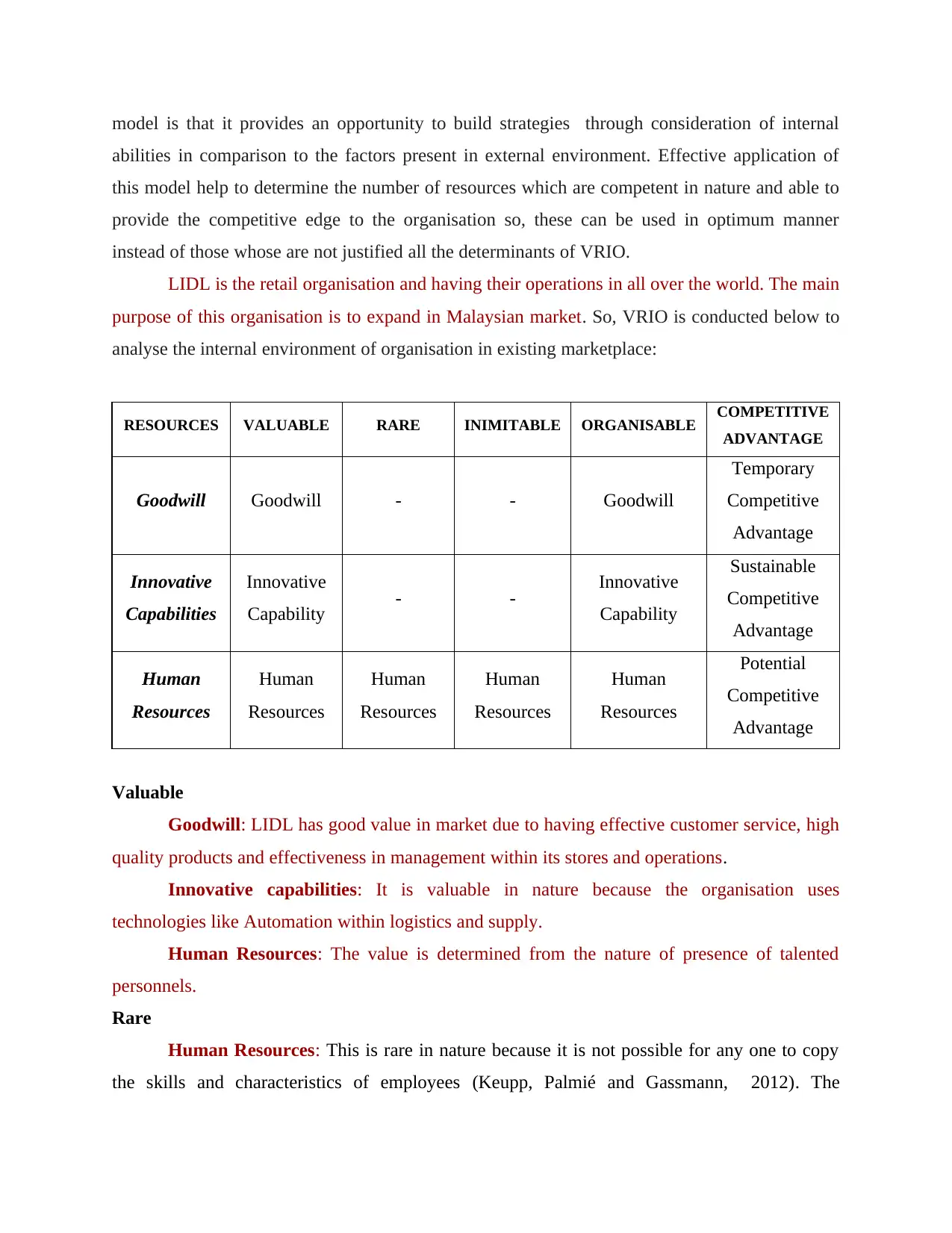
model is that it provides an opportunity to build strategies through consideration of internal
abilities in comparison to the factors present in external environment. Effective application of
this model help to determine the number of resources which are competent in nature and able to
provide the competitive edge to the organisation so, these can be used in optimum manner
instead of those whose are not justified all the determinants of VRIO.
LIDL is the retail organisation and having their operations in all over the world. The main
purpose of this organisation is to expand in Malaysian market. So, VRIO is conducted below to
analyse the internal environment of organisation in existing marketplace:
RESOURCES VALUABLE RARE INIMITABLE ORGANISABLE COMPETITIVE
ADVANTAGE
Goodwill Goodwill - - Goodwill
Temporary
Competitive
Advantage
Innovative
Capabilities
Innovative
Capability - - Innovative
Capability
Sustainable
Competitive
Advantage
Human
Resources
Human
Resources
Human
Resources
Human
Resources
Human
Resources
Potential
Competitive
Advantage
Valuable
Goodwill: LIDL has good value in market due to having effective customer service, high
quality products and effectiveness in management within its stores and operations.
Innovative capabilities: It is valuable in nature because the organisation uses
technologies like Automation within logistics and supply.
Human Resources: The value is determined from the nature of presence of talented
personnels.
Rare
Human Resources: This is rare in nature because it is not possible for any one to copy
the skills and characteristics of employees (Keupp, Palmié and Gassmann, 2012). The
abilities in comparison to the factors present in external environment. Effective application of
this model help to determine the number of resources which are competent in nature and able to
provide the competitive edge to the organisation so, these can be used in optimum manner
instead of those whose are not justified all the determinants of VRIO.
LIDL is the retail organisation and having their operations in all over the world. The main
purpose of this organisation is to expand in Malaysian market. So, VRIO is conducted below to
analyse the internal environment of organisation in existing marketplace:
RESOURCES VALUABLE RARE INIMITABLE ORGANISABLE COMPETITIVE
ADVANTAGE
Goodwill Goodwill - - Goodwill
Temporary
Competitive
Advantage
Innovative
Capabilities
Innovative
Capability - - Innovative
Capability
Sustainable
Competitive
Advantage
Human
Resources
Human
Resources
Human
Resources
Human
Resources
Human
Resources
Potential
Competitive
Advantage
Valuable
Goodwill: LIDL has good value in market due to having effective customer service, high
quality products and effectiveness in management within its stores and operations.
Innovative capabilities: It is valuable in nature because the organisation uses
technologies like Automation within logistics and supply.
Human Resources: The value is determined from the nature of presence of talented
personnels.
Rare
Human Resources: This is rare in nature because it is not possible for any one to copy
the skills and characteristics of employees (Keupp, Palmié and Gassmann, 2012). The
⊘ This is a preview!⊘
Do you want full access?
Subscribe today to unlock all pages.
Trusted by 1+ million students worldwide
personnels which are working in the organisation are highly talented and having unique ability to
perform in all conditions. The gone through the rigorous training which make them rare in
nature.
Inimitable
Manpower of employees of the organisation is inimitable in nature because it is not in the
capacity of any outsider to imitate the employees of any organisation. This is so because of the
unique abilities and skills poses by the employees. All the employees having their own
specialism and work accordingly in any kind of condition. This specialism in their filed build
them inimitable in nature.
Organisable
Goodwill, innovative capabilities and manpower all are organisable in nature due having
the possession of effective resources and capabilities by the organisation. This will includes the
use of all collectively by the organisation to grab the opportunities present in market along with
the attainment of the competitive edge.
Manpower of an organisation high highly competitive in nature which justified all the
four determinants of the organisation which provides edge in all the conditions. The presence of
this is beneficial for LIDL in expansion of business in Malaysian markets.
Identification of competitive strategy
Bowman’s Clock Model
This model considers as the best strategic evaluation technique that allows management of a
firm to explore various options, regarding with strategic positioning. So, taking this model help
Lidl to gain a high competitive advantage, by expanding its business within Malaysian market, as
explained below -
perform in all conditions. The gone through the rigorous training which make them rare in
nature.
Inimitable
Manpower of employees of the organisation is inimitable in nature because it is not in the
capacity of any outsider to imitate the employees of any organisation. This is so because of the
unique abilities and skills poses by the employees. All the employees having their own
specialism and work accordingly in any kind of condition. This specialism in their filed build
them inimitable in nature.
Organisable
Goodwill, innovative capabilities and manpower all are organisable in nature due having
the possession of effective resources and capabilities by the organisation. This will includes the
use of all collectively by the organisation to grab the opportunities present in market along with
the attainment of the competitive edge.
Manpower of an organisation high highly competitive in nature which justified all the
four determinants of the organisation which provides edge in all the conditions. The presence of
this is beneficial for LIDL in expansion of business in Malaysian markets.
Identification of competitive strategy
Bowman’s Clock Model
This model considers as the best strategic evaluation technique that allows management of a
firm to explore various options, regarding with strategic positioning. So, taking this model help
Lidl to gain a high competitive advantage, by expanding its business within Malaysian market, as
explained below -
Paraphrase This Document
Need a fresh take? Get an instant paraphrase of this document with our AI Paraphraser
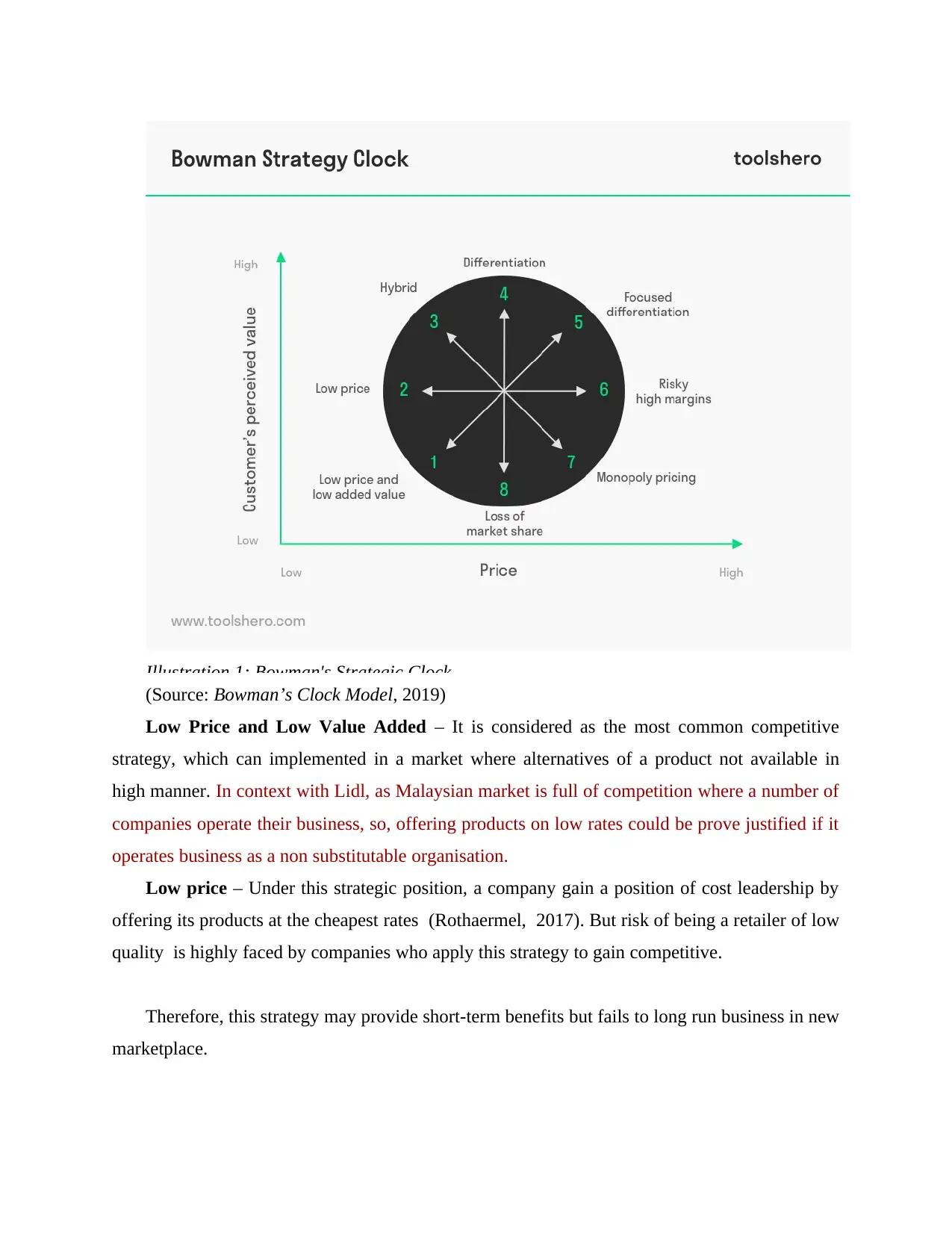
Illustration 1: Bowman's Strategic Clock
(Source: Bowman’s Clock Model, 2019)
Low Price and Low Value Added – It is considered as the most common competitive
strategy, which can implemented in a market where alternatives of a product not available in
high manner. In context with Lidl, as Malaysian market is full of competition where a number of
companies operate their business, so, offering products on low rates could be prove justified if it
operates business as a non substitutable organisation.
Low price – Under this strategic position, a company gain a position of cost leadership by
offering its products at the cheapest rates (Rothaermel, 2017). But risk of being a retailer of low
quality is highly faced by companies who apply this strategy to gain competitive.
Therefore, this strategy may provide short-term benefits but fails to long run business in new
marketplace.
(Source: Bowman’s Clock Model, 2019)
Low Price and Low Value Added – It is considered as the most common competitive
strategy, which can implemented in a market where alternatives of a product not available in
high manner. In context with Lidl, as Malaysian market is full of competition where a number of
companies operate their business, so, offering products on low rates could be prove justified if it
operates business as a non substitutable organisation.
Low price – Under this strategic position, a company gain a position of cost leadership by
offering its products at the cheapest rates (Rothaermel, 2017). But risk of being a retailer of low
quality is highly faced by companies who apply this strategy to gain competitive.
Therefore, this strategy may provide short-term benefits but fails to long run business in new
marketplace.
Differentiation – This strategy allows a firm to sell its value added products by
differentiating its products with high quality. So, using this strategy Lidl can offer its high
quality of goods on hike price to people of Malaysia. As this country is a mixture of upper and
middle class people, but they mostly like to buy branded clothes that are available on best
quality, regardless of price factor. So, offering them products as per their purchasing power, will
aid Lild in differentiating its business from other foreign and domestic retailers in Malaysia.
Hybrid – As the name suggest, it combines two strategies that are differentiation and low
cost, which may help Lidl in attaining interest of both upper and middle class people who desires
to purchase best quality of products with minimum rates. For this purpose, respective company
can offer quality-products on amazing discounts.
Focused Differentiation – This strategy states to sell high quality of products at high rates,
which will prove beneficial for high branded companies (López-Nicolás and Meroño-Cerdán,
2011). In this regard, Lidl can use this approach to raise its brand image in Malaysian
marketplace.
Risky High Margins – it states to offer products on high rates by not giving any special
benefits to customers. In Malaysia, people use to buy products from those companies that offer
products on high rates but with benefits. So, adopting this strategy will arise risk of failure for
Lidl in such a marketplace.
Monopoly Pricing – this policy is fit in those markets, where substitutes of a product is not
available at same marketplace. With respect to Lidl as it operates in retail section where
competition is already much intense, therefore, it cannot adopt monopoly policy.
Loss of Market Share – This strategy doesn't fit with Lidl expectation, because it focuses
on offering low value products at higher rates. So, for business expansion in Malaysian market,
where people demands for high quality of products.
From all over the discussion, it has recommended to Lidl to adopt hybrid and focused
differentiation strategy for expanding its business successfully in Malaysia.
Strategic directions
Strategic directions: It is considered as an activity which directs an organization to
expand its business to other nations through framing an effective plans and strategies by the
management. In the context of LIDL, it is an organization which is engaged in providing wide
range products in UK. Now this supermarket decides to expand its business to Malaysia with a
differentiating its products with high quality. So, using this strategy Lidl can offer its high
quality of goods on hike price to people of Malaysia. As this country is a mixture of upper and
middle class people, but they mostly like to buy branded clothes that are available on best
quality, regardless of price factor. So, offering them products as per their purchasing power, will
aid Lild in differentiating its business from other foreign and domestic retailers in Malaysia.
Hybrid – As the name suggest, it combines two strategies that are differentiation and low
cost, which may help Lidl in attaining interest of both upper and middle class people who desires
to purchase best quality of products with minimum rates. For this purpose, respective company
can offer quality-products on amazing discounts.
Focused Differentiation – This strategy states to sell high quality of products at high rates,
which will prove beneficial for high branded companies (López-Nicolás and Meroño-Cerdán,
2011). In this regard, Lidl can use this approach to raise its brand image in Malaysian
marketplace.
Risky High Margins – it states to offer products on high rates by not giving any special
benefits to customers. In Malaysia, people use to buy products from those companies that offer
products on high rates but with benefits. So, adopting this strategy will arise risk of failure for
Lidl in such a marketplace.
Monopoly Pricing – this policy is fit in those markets, where substitutes of a product is not
available at same marketplace. With respect to Lidl as it operates in retail section where
competition is already much intense, therefore, it cannot adopt monopoly policy.
Loss of Market Share – This strategy doesn't fit with Lidl expectation, because it focuses
on offering low value products at higher rates. So, for business expansion in Malaysian market,
where people demands for high quality of products.
From all over the discussion, it has recommended to Lidl to adopt hybrid and focused
differentiation strategy for expanding its business successfully in Malaysia.
Strategic directions
Strategic directions: It is considered as an activity which directs an organization to
expand its business to other nations through framing an effective plans and strategies by the
management. In the context of LIDL, it is an organization which is engaged in providing wide
range products in UK. Now this supermarket decides to expand its business to Malaysia with a
⊘ This is a preview!⊘
Do you want full access?
Subscribe today to unlock all pages.
Trusted by 1+ million students worldwide

1 out of 15


Related Documents


Your All-in-One AI-Powered Toolkit for Academic Success.
+13062052269
info@desklib.com
Available 24*7 on WhatsApp / Email
![[object Object]](/_next/static/media/star-bottom.7253800d.svg)
Unlock your academic potential
Copyright © 2020–2026 A2Z Services. All Rights Reserved. Developed and managed by ZUCOL.