Linear Algebra: Homework on Vectors, Matrices, and Subspaces

Verified

Added on  2020/04/29

|3
|669
|40
Homework Assignment
AI Summary
This document contains the solutions to a linear algebra homework assignment. The assignment covers a range of topics, including determining the truth or falsity of statements related to linear independence, vector addition, and vector spaces. It also involves solving problems related to vector operations, such as finding the vector component of a vector along another, and finding the cross-product of two vectors. Furthermore, the solutions explore concepts like determining whether a set of vectors forms a vector space, finding coordinate vectors, and determining the dimension of a vector space based on matrix transformations. The solutions demonstrate the application of linear algebra principles to solve specific problems involving vectors and matrices.
Document Page
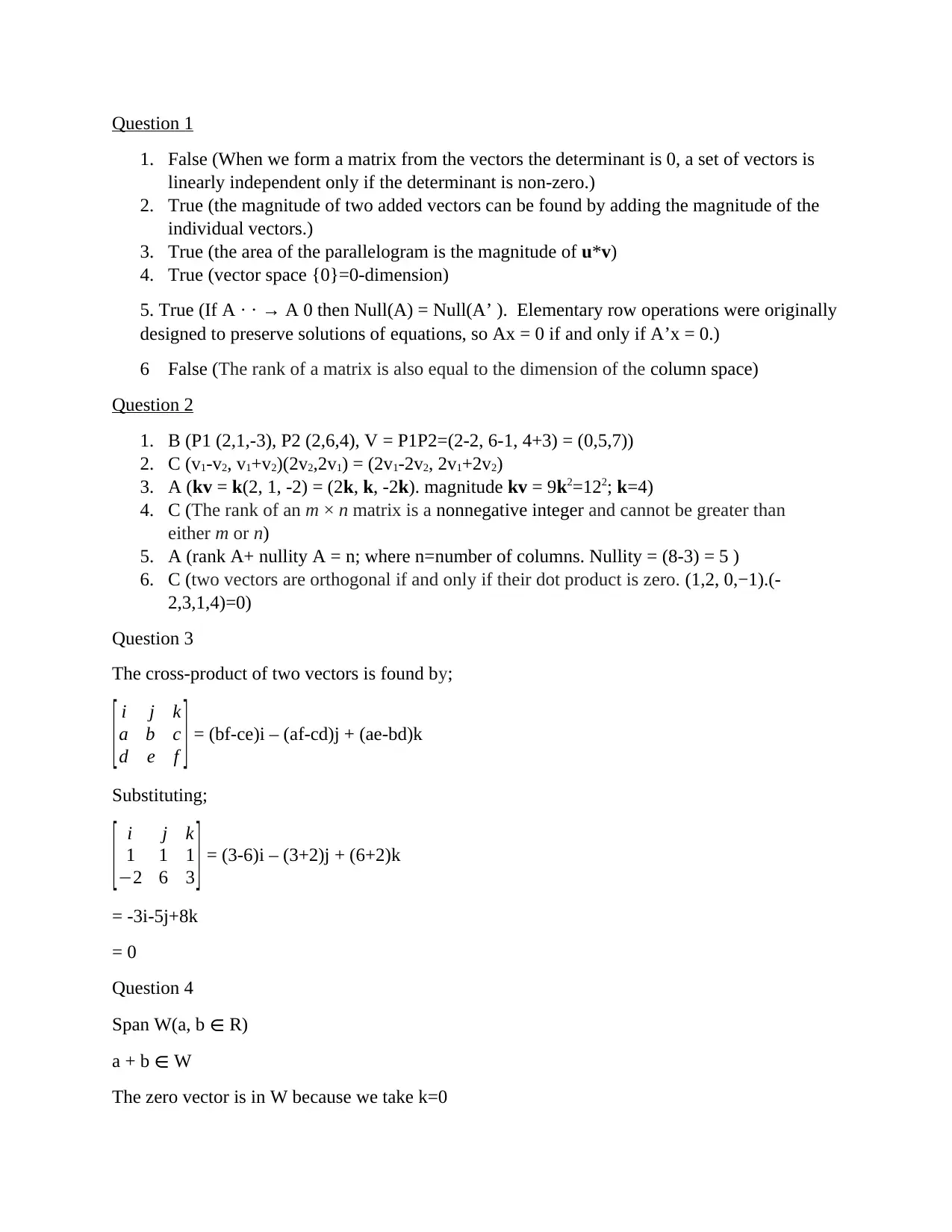
Question 1
1. False (When we form a matrix from the vectors the determinant is 0, a set of vectors is
linearly independent only if the determinant is non-zero.)
2. True (the magnitude of two added vectors can be found by adding the magnitude of the
individual vectors.)
3. True (the area of the parallelogram is the magnitude of u*v)
4. True (vector space {0}=0-dimension)
5. True (If A · · → A 0 then Null(A) = Null(A’ ). Elementary row operations were originally
designed to preserve solutions of equations, so Ax = 0 if and only if A’x = 0.)
6 False (The rank of a matrix is also equal to the dimension of the column space)
Question 2
1. B (P1 (2,1,-3), P2 (2,6,4), V = P1P2=(2-2, 6-1, 4+3) = (0,5,7))
2. C (v1-v2, v1+v2)(2v2,2v1) = (2v1-2v2, 2v1+2v2)
3. A (kv = k(2, 1, -2) = (2k, k, -2k). magnitude kv = 9k2=122; k=4)
4. C (The rank of an m × n matrix is a nonnegative integer and cannot be greater than
either m or n)
5. A (rank A+ nullity A = n; where n=number of columns. Nullity = (8-3) = 5 )
6. C (two vectors are orthogonal if and only if their dot product is zero. (1,2, 0,−1).(-
2,3,1,4)=0)
Question 3
The cross-product of two vectors is found by;
[ i j k
a b c
d e f ] = (bf-ce)i – (af-cd)j + (ae-bd)k
Substituting;
[ i j k
1 1 1
2 6 3 ] = (3-6)i – (3+2)j + (6+2)k
= -3i-5j+8k
= 0
Question 4
Span W(a, b R)
a + b W
The zero vector is in W because we take k=0
tabler-icon-diamond-filled.svg

Paraphrase This Document

Need a fresh take? Get an instant paraphrase of this document with our AI Paraphraser
Document Page
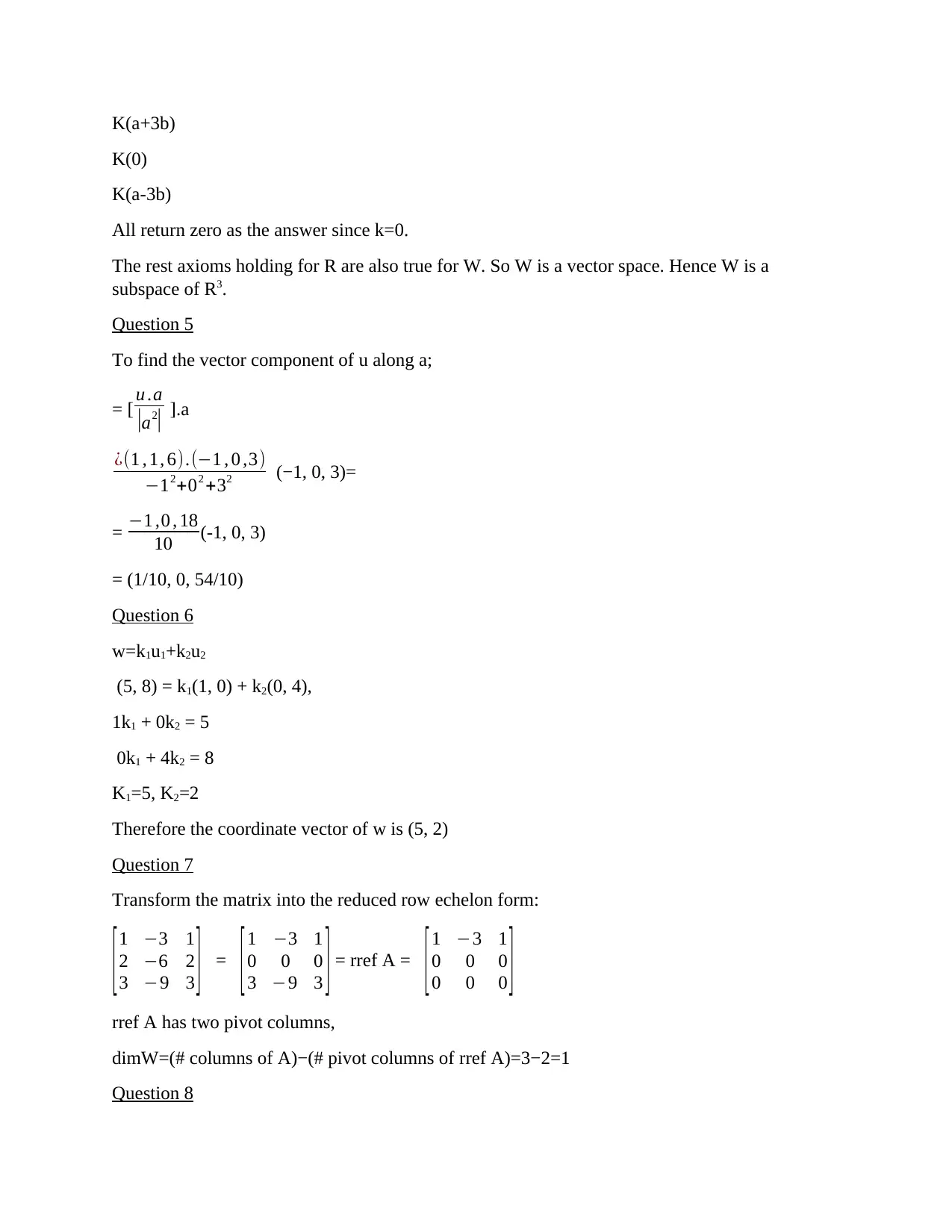
K(a+3b)
K(0)
K(a-3b)
All return zero as the answer since k=0.
The rest axioms holding for R are also true for W. So W is a vector space. Hence W is a
subspace of R3.
Question 5
To find the vector component of u along a;
= [ u .a
|a2
| ].a
¿(1 , 1, 6).(1 , 0 ,3)
12+02 +32 (−1, 0, 3)=
= 1 ,0 , 18
10 (-1, 0, 3)
= (1/10, 0, 54/10)
Question 6
w=k1u1+k2u2
(5, 8) = k1(1, 0) + k2(0, 4),
1k1 + 0k2 = 5
0k1 + 4k2 = 8
K1=5, K2=2
Therefore the coordinate vector of w is (5, 2)
Question 7
Transform the matrix into the reduced row echelon form:
[1 3 1
2 6 2
3 9 3 ] = [1 3 1
0 0 0
3 9 3 ] = rref A = [1 3 1
0 0 0
0 0 0 ]
rref A has two pivot columns,
dimW=(# columns of A)−(# pivot columns of rref A)=32=1
Question 8
Document Page
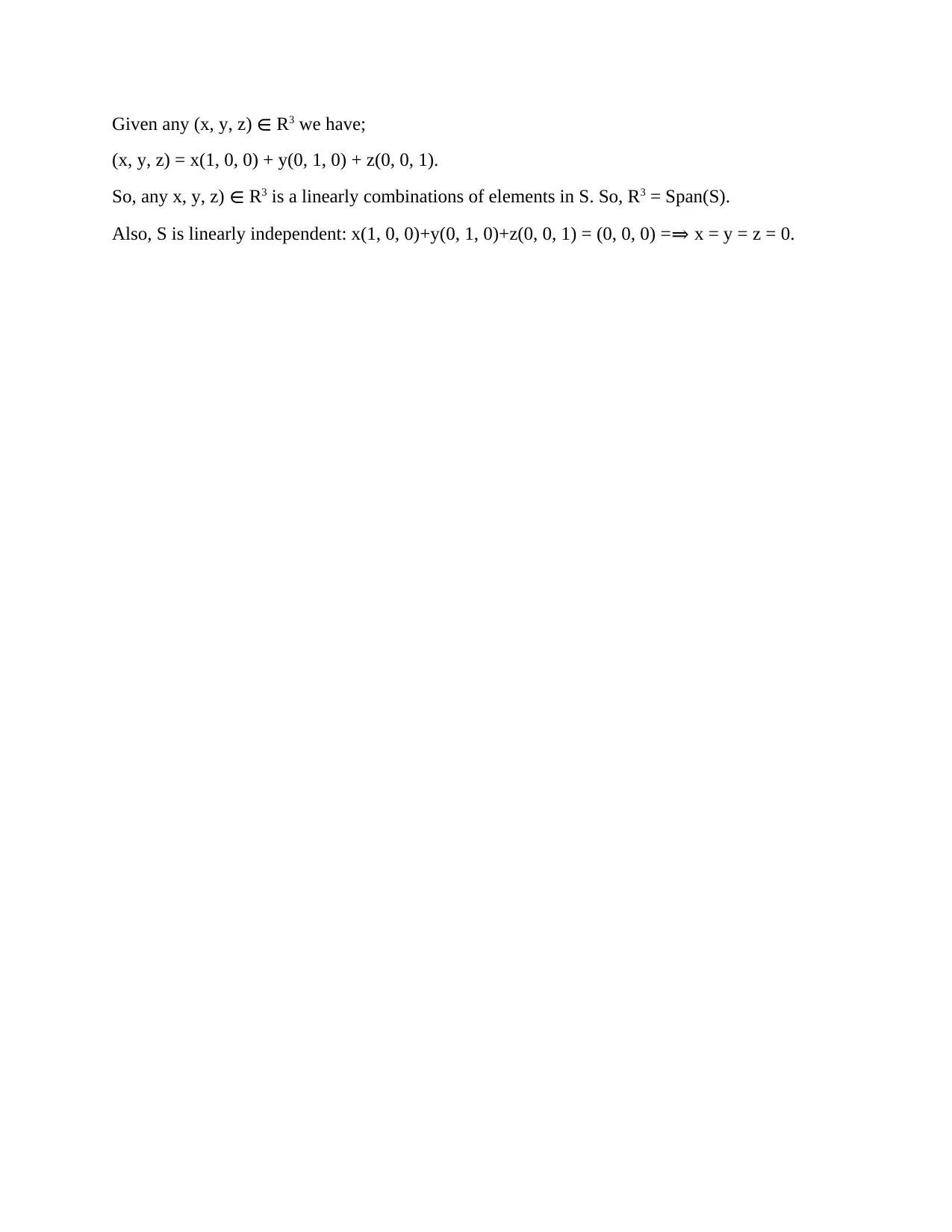
Given any (x, y, z) R3 we have;
(x, y, z) = x(1, 0, 0) + y(0, 1, 0) + z(0, 0, 1).
So, any x, y, z) R3 is a linearly combinations of elements in S. So, R3 = Span(S).
Also, S is linearly independent: x(1, 0, 0)+y(0, 1, 0)+z(0, 0, 1) = (0, 0, 0) = x = y = z = 0.
chevron_up_icon
1 out of 3
circle_padding
hide_on_mobile
zoom_out_icon
[object Object]