Linear Algebra Homework

Verified

Added on  2019/10/30

|5
|458
|418
Homework Assignment
AI Summary
This document presents solutions to a linear algebra homework assignment. The problems cover a range of topics, including proof by induction, determinant calculations, matrix factorization (LU decomposition), linear independence and rank of matrices, subspaces, properties of linear transformations, eigenvalues and eigenvectors, orthogonal bases (Gram-Schmidt process), and solving systems of linear equations. Each problem is worked out step-by-step, showing the detailed calculations and reasoning involved. The solutions demonstrate a strong understanding of fundamental linear algebra concepts and techniques.
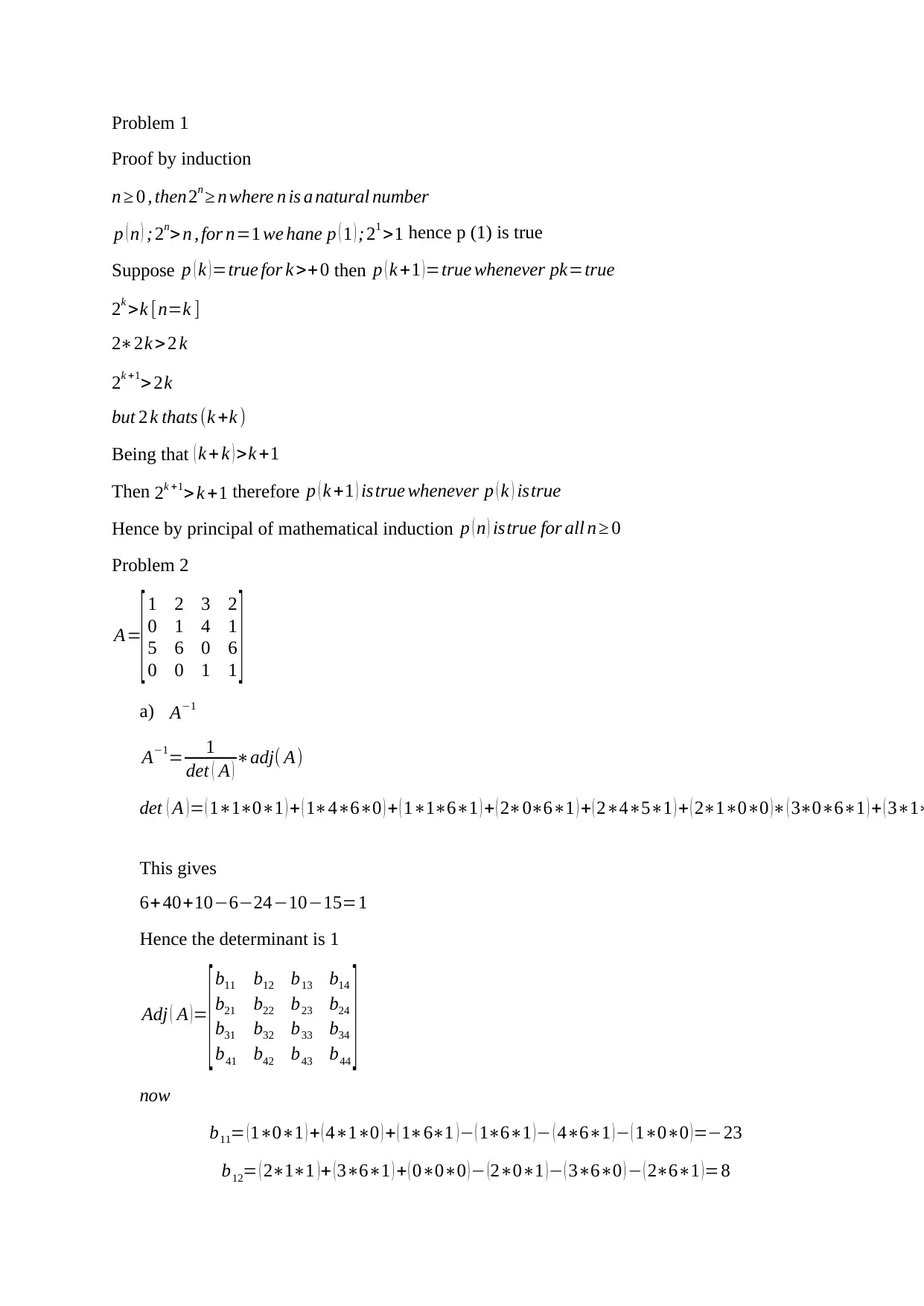
Document Page
Problem 1
Proof by induction
n 0 , then2n n where n is a natural number
p ( n ) ; 2n> n , for n=1 we hane p ( 1 ) ;21 >1 hence p (1) is true
Suppose p ( k )=true for k >+0 then p ( k +1 )=true whenever pk=true
2k >k [n=k ]
22k >2 k
2k +1> 2k
but 2 k thats (k +k )
Being that ( k + k ) >k +1
Then 2k +1> k +1 therefore p ( k +1 ) istrue whenever p ( k ) istrue
Hence by principal of mathematical induction p ( n ) istrue for all n 0
Problem 2
A=
[1 2 3 2
0 1 4 1
5 6 0 6
0 0 1 1 ]
a) A1
A1= 1
det ( A ) adj( A)
det ( A ) = ( 1101 ) + ( 1460 ) + ( 1161 ) + ( 2061 ) + ( 2451 ) + ( 2100 ) ( 3061 ) + ( 31
This gives
6+ 40+106241015=1
Hence the determinant is 1
Adj ( A )=
[b11 b12 b13 b14
b21 b22 b23 b24
b31 b32 b33 b34
b41 b42 b43 b44
]now
b11= ( 101 ) + ( 410 ) + ( 161 ) ( 161 ) ( 461 ) ( 100 ) =23
b12= ( 211 ) + ( 361 ) + ( 000 ) ( 201 ) ( 360 ) ( 261 ) =8
tabler-icon-diamond-filled.svg

Paraphrase This Document

Need a fresh take? Get an instant paraphrase of this document with our AI Paraphraser
Document Page
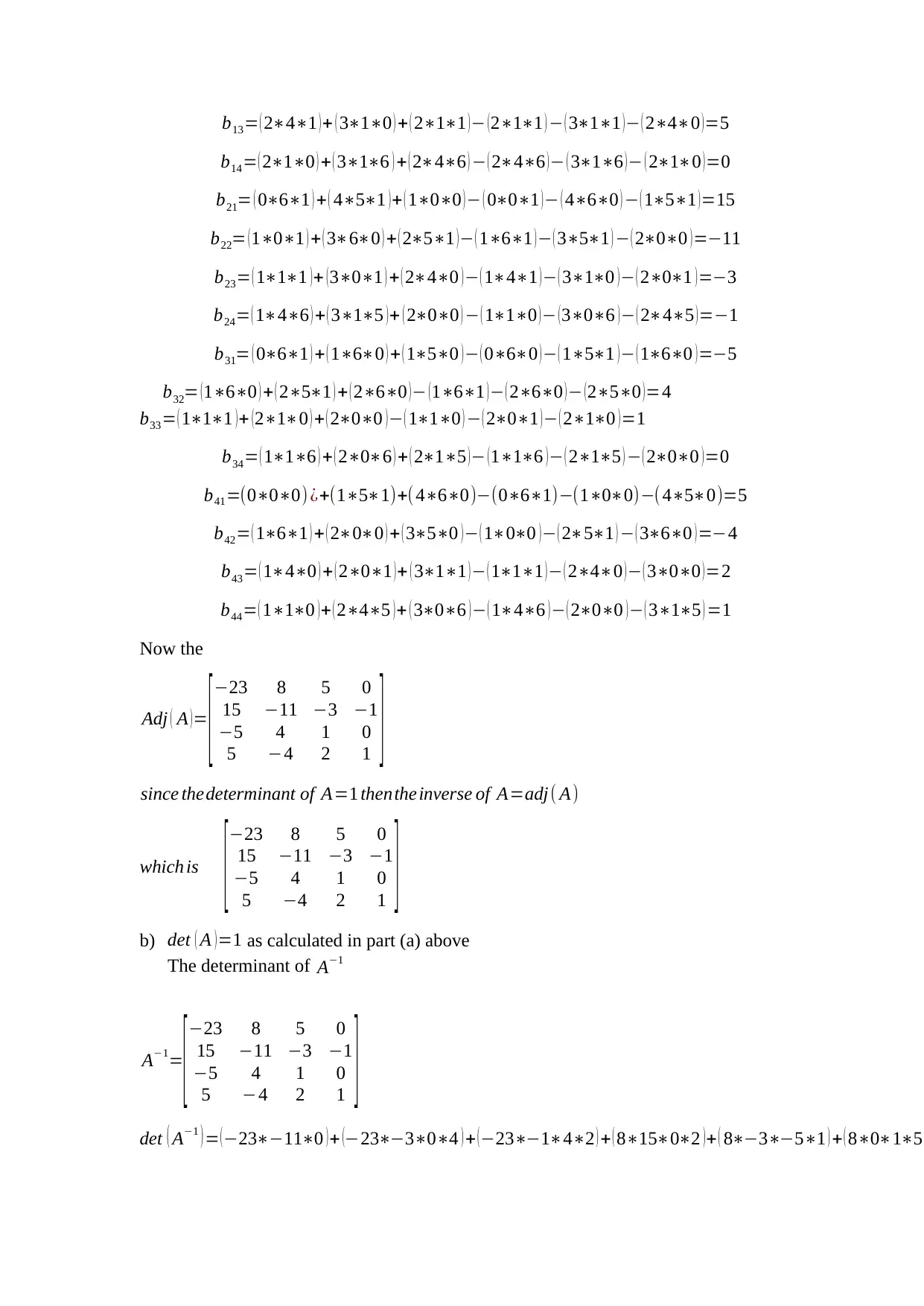
b13= ( 241 )+ ( 310 ) + ( 211 ) (211 ) ( 311 ) ( 240 )=5
b14= ( 210 ) + ( 316 ) + ( 246 ) ( 246 ) ( 316 ) ( 210 ) =0
b21= ( 061 ) + ( 451 )+ ( 100 ) ( 001 ) ( 460 ) ( 151 )=15
b22= (101 ) + ( 360 ) + ( 251 ) ( 161 ) ( 351 ) ( 200 )=11
b23= ( 111 )+ (301 ) + ( 240 ) ( 141 ) ( 310 ) ( 201 )=3
b24= ( 146 ) + ( 315 )+ ( 200 ) ( 110 ) (306 ) ( 245 )=1
b31= ( 061 ) + ( 160 ) + ( 150 ) ( 060 ) ( 151 ) ( 160 ) =5
b32= (160 ) + ( 251 ) + ( 260 ) (161 ) ( 260 ) (250 )=4
b33= ( 111 )+ (210 ) + ( 200 ) ( 110 ) ( 201 ) ( 210 )=1
b34= ( 116 ) + ( 206 ) + ( 215 ) (116 ) ( 215 ) ( 200 )=0
b41=(000) ¿+(151)+( 460)(061)(100)( 450)=5
b42= ( 161 ) + ( 200 ) + ( 350 ) ( 100 ) ( 251 ) ( 360 )=4
b43= ( 140 ) + ( 201 ) + ( 311 ) ( 111 ) ( 240 ) ( 300 ) =2
b44= ( 110 )+ ( 245 )+ ( 306 ) ( 146 ) ( 200 ) ( 315 ) =1
Now the
Adj ( A )=
[23 8 5 0
15 11 3 1
5 4 1 0
5 4 2 1 ]
since thedeterminant of A=1 thentheinverse of A=adj( A)
which is
[23 8 5 0
15 11 3 1
5 4 1 0
5 4 2 1 ]
b) det ( A ) =1 as calculated in part (a) above
The determinant of A1
A1=
[ 23 8 5 0
15 11 3 1
5 4 1 0
5 4 2 1 ]
det ( A1 ) = (23110 )+ (23304 ) + (23142 ) + ( 81502 )+ ( 8351 ) + ( 8015
Document Page
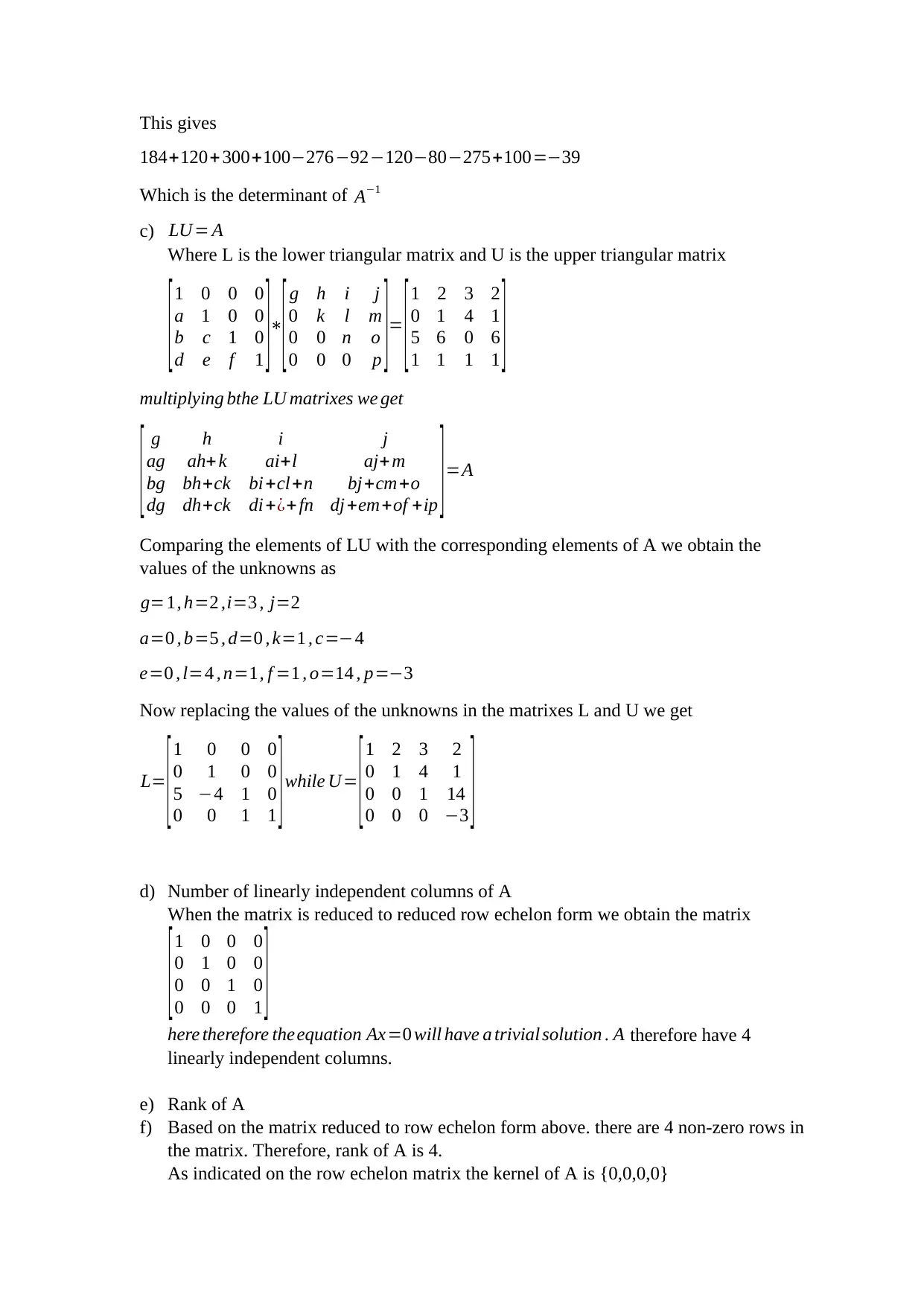
This gives
184+120+ 300+1002769212080275+100=39
Which is the determinant of A1
c) LU = A
Where L is the lower triangular matrix and U is the upper triangular matrix
[1 0 0 0
a 1 0 0
b c 1 0
d e f 1 ]
[ g h i j
0 k l m
0 0 n o
0 0 0 p ]=
[1 2 3 2
0 1 4 1
5 6 0 6
1 1 1 1 ]
multiplying bthe LU matrixes we get
[ g h i j
ag ah+ k ai+l aj+ m
bg bh+ck bi+cl+n bj+cm+o
dg dh+ck di+¿+ fn dj+em+of +ip ]=A
Comparing the elements of LU with the corresponding elements of A we obtain the
values of the unknowns as
g=1, h=2 ,i=3 , j=2
a=0 , b=5 , d=0 , k=1 , c=4
e=0 , l=4 , n=1, f =1 , o=14 , p=3
Now replacing the values of the unknowns in the matrixes L and U we get
L=
[1 0 0 0
0 1 0 0
5 4 1 0
0 0 1 1 ]while U=
[1 2 3 2
0 1 4 1
0 0 1 14
0 0 0 3 ]
d) Number of linearly independent columns of A
When the matrix is reduced to reduced row echelon form we obtain the matrix
[1 0 0 0
0 1 0 0
0 0 1 0
0 0 0 1 ]here therefore theequation Ax=0 will have a trivial solution . A therefore have 4
linearly independent columns.
e) Rank of A
f) Based on the matrix reduced to row echelon form above. there are 4 non-zero rows in
the matrix. Therefore, rank of A is 4.
As indicated on the row echelon matrix the kernel of A is {0,0,0,0}
Document Page
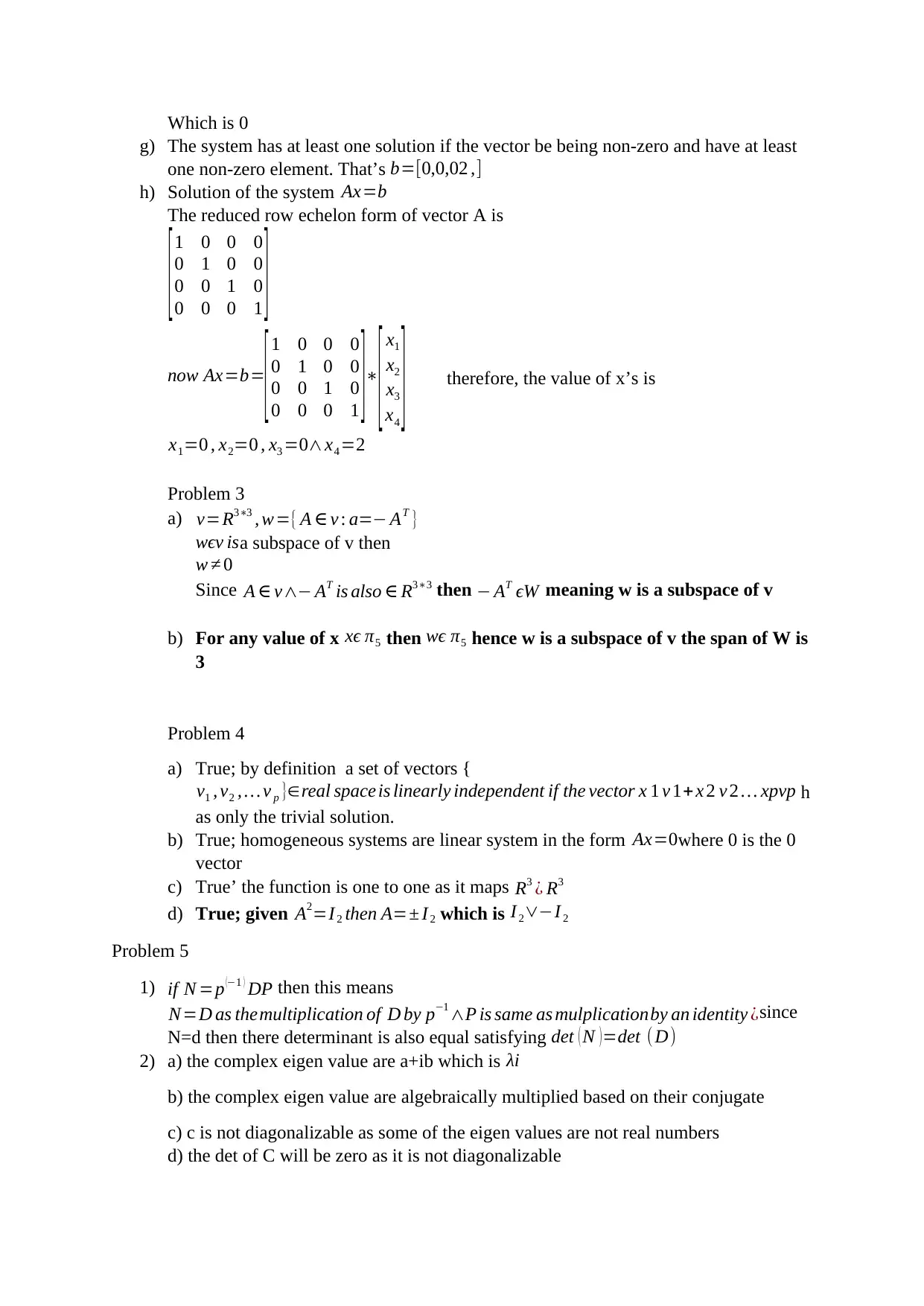
Which is 0
g) The system has at least one solution if the vector be being non-zero and have at least
one non-zero element. That’s b=[0,0,02 ,]
h) Solution of the system Ax=b
The reduced row echelon form of vector A is
[1 0 0 0
0 1 0 0
0 0 1 0
0 0 0 1 ]
now Ax=b=
[1 0 0 0
0 1 0 0
0 0 1 0
0 0 0 1 ]
[ x1
x2
x3
x4
] therefore, the value of x’s is
x1=0 , x2=0 , x3 =0x4 =2
Problem 3
a) v=R33 , w={ A v : a= AT }
wϵv isa subspace of v then
w 0
Since A v AT is also R33 then AT ϵW meaning w is a subspace of v
b) For any value of x π5 then π5 hence w is a subspace of v the span of W is
3
Problem 4
a) True; by definition a set of vectors {
v1 , v2 , v p }real space is linearly independent if the vector x 1 v 1+ x 2 v 2 xpvp h
as only the trivial solution.
b) True; homogeneous systems are linear system in the form Ax=0where 0 is the 0
vector
c) True’ the function is one to one as it maps R3 ¿ R3
d) True; given A2=I 2 then A=± I2 which is I 2I 2
Problem 5
1) if N =p (1 ) DP then this means
N=D as themultiplication of D by p1 P is same as mulplicationby an identity ¿since
N=d then there determinant is also equal satisfying det ( N )=det ( D)
2) a) the complex eigen value are a+ib which is λi
b) the complex eigen value are algebraically multiplied based on their conjugate
c) c is not diagonalizable as some of the eigen values are not real numbers
d) the det of C will be zero as it is not diagonalizable
tabler-icon-diamond-filled.svg

Paraphrase This Document

Need a fresh take? Get an instant paraphrase of this document with our AI Paraphraser
Document Page
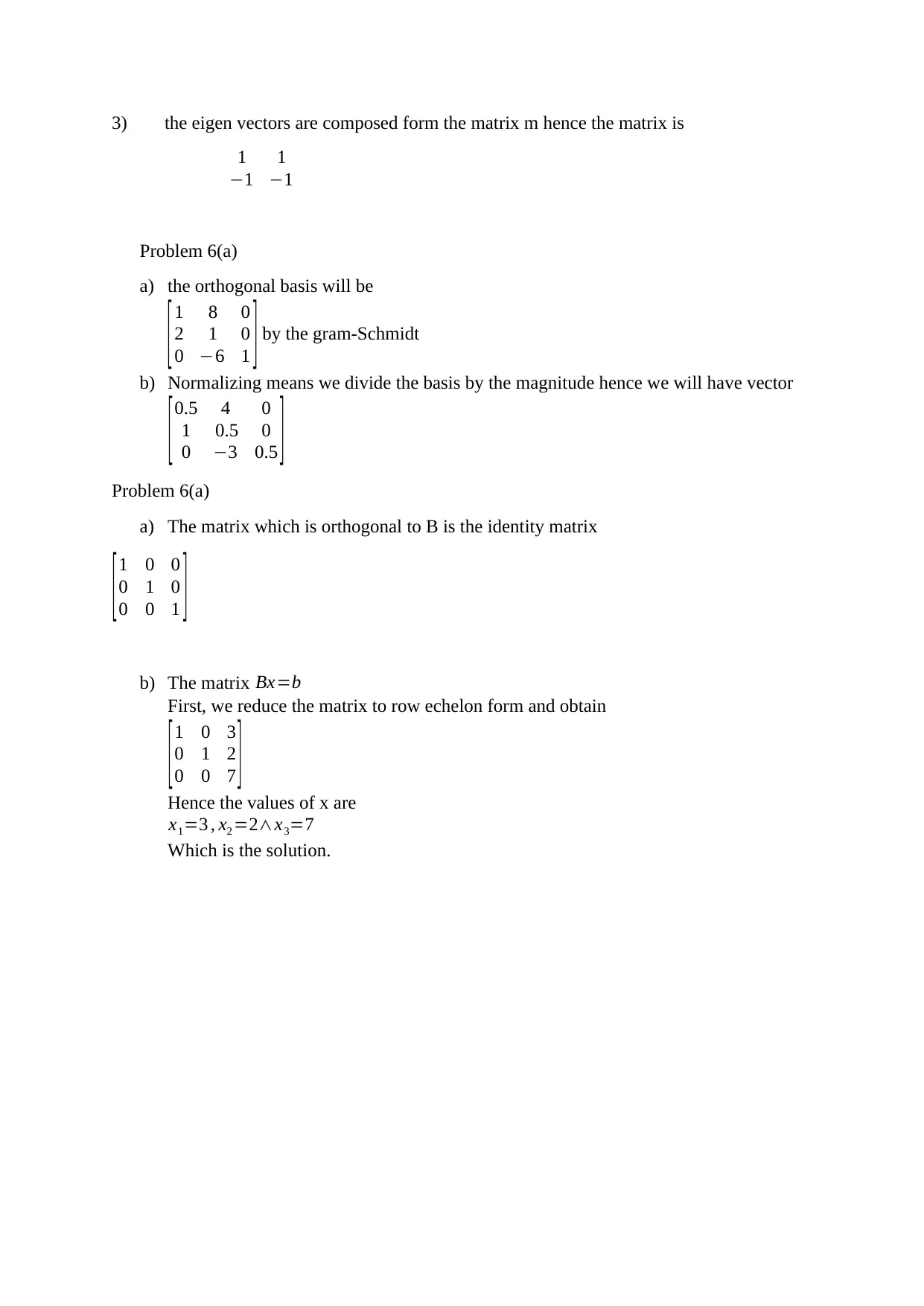
3) the eigen vectors are composed form the matrix m hence the matrix is
1 1
1 1
Problem 6(a)
a) the orthogonal basis will be
[ 1 8 0
2 1 0
0 6 1 ] by the gram-Schmidt
b) Normalizing means we divide the basis by the magnitude hence we will have vector
[0.5 4 0
1 0.5 0
0 3 0.5 ]
Problem 6(a)
a) The matrix which is orthogonal to B is the identity matrix
[1 0 0
0 1 0
0 0 1 ]
b) The matrix Bx=b
First, we reduce the matrix to row echelon form and obtain
[1 0 3
0 1 2
0 0 7 ]Hence the values of x are
x1=3 , x2 =2x3=7
Which is the solution.
chevron_up_icon
1 out of 5
circle_padding
hide_on_mobile
zoom_out_icon
[object Object]