Math Assignment: Series, Sequences, Linear Equations Solutions

Verified

Added on  2022/10/11

|4
|692
|339
Homework Assignment
AI Summary
This document presents solutions to a mathematics assignment. The assignment includes problems on vector operations, where scalar multiplication and vector addition are demonstrated. It also features a problem involving the solution of a system of linear equations, modeling a real-world scenario of sales of t-shirts and banners. Furthermore, the assignment covers arithmetic and geometric sequences, calculating the sum of terms in these sequences. The solutions provide step-by-step calculations and formulas, offering a comprehensive understanding of the mathematical concepts involved. The assignment is designed to reinforce fundamental mathematical principles and problem-solving skills.
Document Page
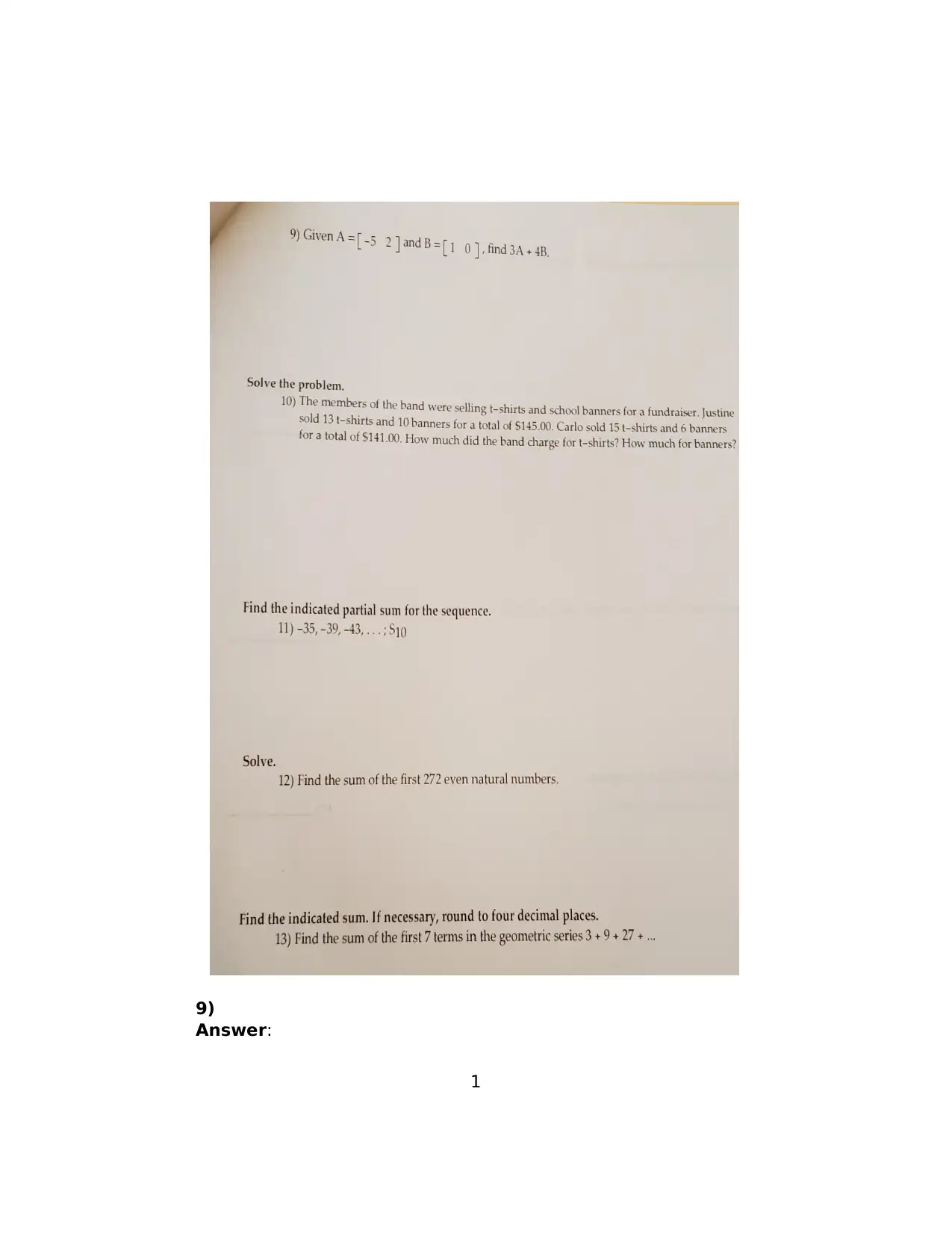
9)
Answer:
1
tabler-icon-diamond-filled.svg

Paraphrase This Document

Need a fresh take? Get an instant paraphrase of this document with our AI Paraphraser
Document Page
A = [5 2] & B = [1 0]
Vector multiplication property:
X = [xi1]
is a row vector, and α be any scalar, then:
α · X = [α · xi1]
Therefore,
3A = 3[5 2] = [3 × −53 × 2] = [15 6]
4B = 4[1 0] = [4 × 14 × 0] = [4 0]
Vector addition property:
X = [xi1] &Y = [yi1]
be two row vectors.Then:
X + Y = [xi1 + yi1]
Therefore,
3A + 4B = [15 6] + [4 0] = [15 + 4 6 + 0] = [11 6]
10)
Answer :
Let a t-shirt sell for t$ and a banner for b$.
Justine sells 13 t-shirts and 10 banners for 145$.Implies,
13t + 10b = 145(1)
Carlos sells 15 t-shirts and 6 banners for 141$.Implies,
15t + 6b = 141(2)
2
Document Page
Equation (1) and (2) together are a set of linear equations.They are solved
as:
13t + 10b = 145
15t + 6b = 141
[Multiply (1) by 6 and (2) by 10 and then subtract (2) from (1)]
78t + 60b = 870

150t + 60b = 1410
72t + 0 = 540
=⇒ t = 7.5
[Substitute t in (1)]
13 × 7.5 + 10b = 145
= 10b = 47.5
b = 4.75
Therefore, the band sells t-shirt for 7.5$ and banner for 4.75$ each.
11)
Answer:
35, −39, −43, . . .
is a arithmetic sequence with the initialterm: a = 35,and common dif-
ference:d = 39 (35) = 43 (39) = · · · = 4.
The sum of first n terms in the sequence is given by:
Sn = n
2(2a + (n − 1)d)
Therefore, sum of first 10 terms of the sequence is:
S10 = 10
2 (2 × −35 + 9 × −4) = 5 × −106 = 530
12)
3
Document Page
Sum of first 272 natural even numbers.
Answer:
The sum can be written as:
S = 2 + 4 + 6 + 8 + · · · + 270 + 272 + . . . 542 + 544
[Take the common factor 2 out]
= 2{1 + 2 + 3 + 4 + · · · + 135 + 136 + · · · + 271 + 272}
[Sum inside the bracket is the sum of first 272 natural numbers]
[Sum of n consecutive natural numbers is :
n(n + 1)
2 ]
S = 2 ×n(n + 1)
2
= n(n + 1)
[for n = 272]
S = 272 × 273 = 74256
13)
Answer:
The geometric sequence is:
3, 9, 27, . . .
The first term in the sequence is:a1 = 3.
Common ratio (r) is the ration of consecutive terms in the sequence:
r = 9
3 = 27
9 = · · · = 3
Sum of the first n terms in a geometric sequence is:
Sn = a1 + a2 + · · · + an
It is obtained using the formula:
Sn = a1 · rn 1
r − 1
For the given sequence, the sum of first 7 terms is:
S7 = 3 ×37 1
3 1= 3279
4
chevron_up_icon
1 out of 4
circle_padding
hide_on_mobile
zoom_out_icon
[object Object]