Linguistics for Literacy: An Analysis of Liam's Letter

Verified

Added on  2020/05/08

|6
|1353
|133
Essay
AI Summary
This report examines a persuasive letter by a young student named Liam, intended to convince his parents to allow him to choose his own bedtime. The analysis categorizes it as an exposition type of persuasive text due to its structured arguments supporting Liam's viewpoint. It identifies grammatical issues such as inappropriate use of conjunctions and pronouns, tense errors, and unnecessary word choices that complicate sentence structure. Additionally, the report critiques the lack of clear paragraph division affecting textual cohesion. Despite these issues, Liam demonstrates a good grasp of persuasive writing style by sequentially presenting arguments to justify his request. His frequent use of 'would' aligns with the text's persuasive mode, although he misses an opportunity for structural reinforcement in the conclusion.
Document Page
Running head: LINGUISTICS FOR LITERACY
Linguistics for Literacy
Name of the Student:
Name of the University:
Author note:
tabler-icon-diamond-filled.svg

Paraphrase This Document

Need a fresh take? Get an instant paraphrase of this document with our AI Paraphraser
Document Page
1LINGUISTICS FOR LITERACY
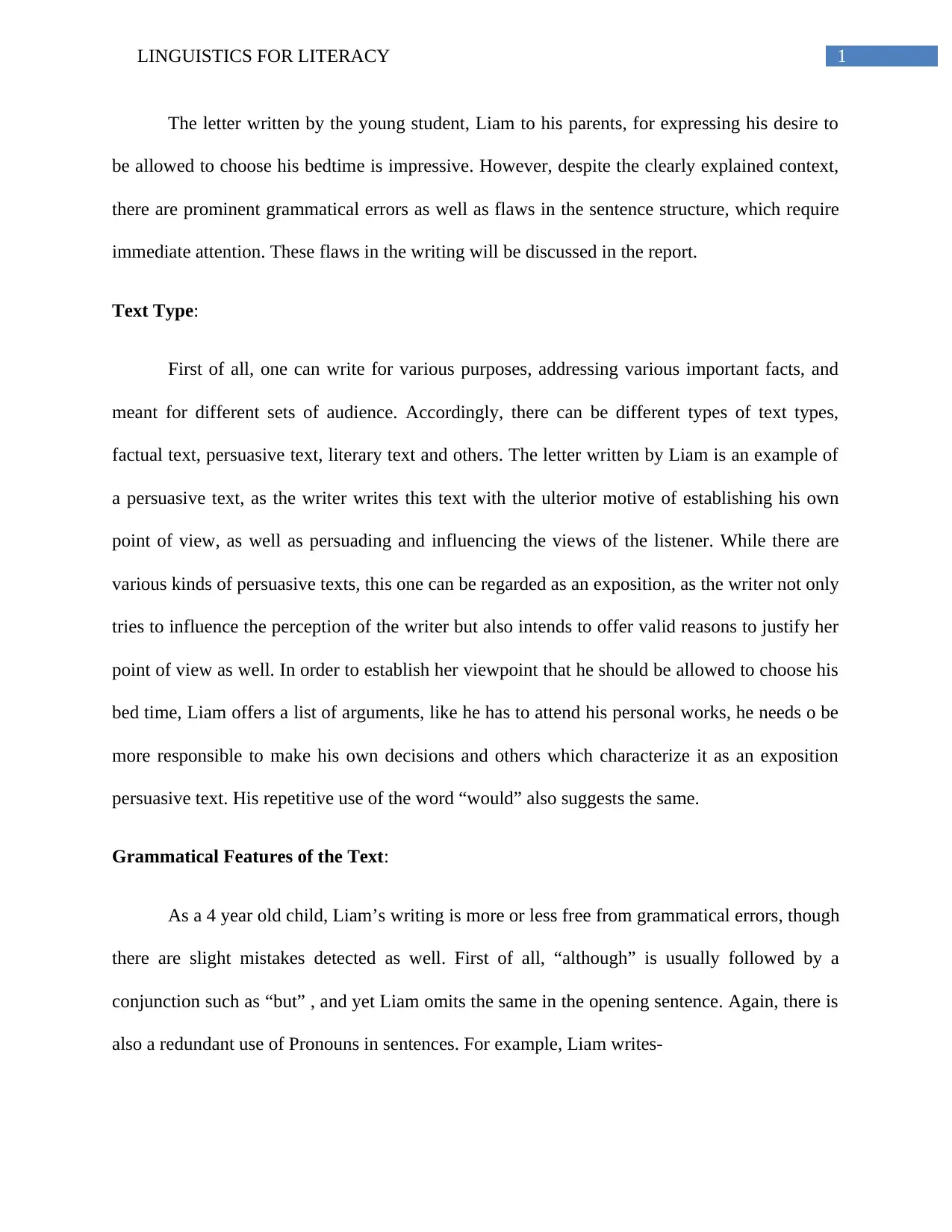
The letter written by the young student, Liam to his parents, for expressing his desire to
be allowed to choose his bedtime is impressive. However, despite the clearly explained context,
there are prominent grammatical errors as well as flaws in the sentence structure, which require
immediate attention. These flaws in the writing will be discussed in the report.
Text Type:
First of all, one can write for various purposes, addressing various important facts, and
meant for different sets of audience. Accordingly, there can be different types of text types,
factual text, persuasive text, literary text and others. The letter written by Liam is an example of
a persuasive text, as the writer writes this text with the ulterior motive of establishing his own
point of view, as well as persuading and influencing the views of the listener. While there are
various kinds of persuasive texts, this one can be regarded as an exposition, as the writer not only
tries to influence the perception of the writer but also intends to offer valid reasons to justify her
point of view as well. In order to establish her viewpoint that he should be allowed to choose his
bed time, Liam offers a list of arguments, like he has to attend his personal works, he needs o be
more responsible to make his own decisions and others which characterize it as an exposition
persuasive text. His repetitive use of the word “would” also suggests the same.
Grammatical Features of the Text:
As a 4 year old child, Liam’s writing is more or less free from grammatical errors, though
there are slight mistakes detected as well. First of all, “although” is usually followed by a
conjunction such as “but” , and yet Liam omits the same in the opening sentence. Again, there is
also a redundant use of Pronouns in sentences. For example, Liam writes-
Document Page
2LINGUISTICS FOR LITERACY
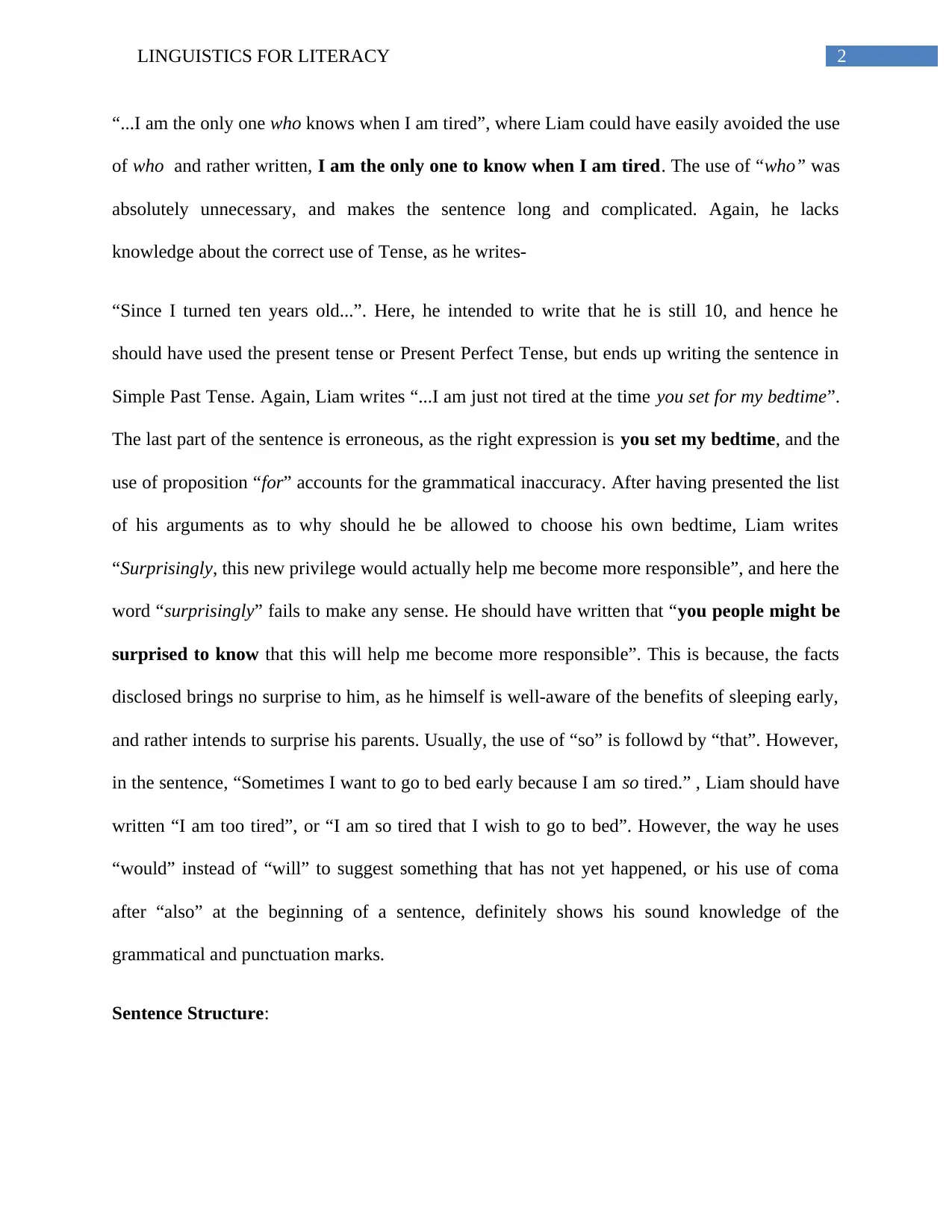
“...I am the only one who knows when I am tired”, where Liam could have easily avoided the use
of who and rather written, I am the only one to know when I am tired. The use of “who” was
absolutely unnecessary, and makes the sentence long and complicated. Again, he lacks
knowledge about the correct use of Tense, as he writes-
“Since I turned ten years old...”. Here, he intended to write that he is still 10, and hence he
should have used the present tense or Present Perfect Tense, but ends up writing the sentence in
Simple Past Tense. Again, Liam writes “...I am just not tired at the time you set for my bedtime”.
The last part of the sentence is erroneous, as the right expression is you set my bedtime, and the
use of proposition “for” accounts for the grammatical inaccuracy. After having presented the list
of his arguments as to why should he be allowed to choose his own bedtime, Liam writes
Surprisingly, this new privilege would actually help me become more responsible”, and here the
word “surprisingly” fails to make any sense. He should have written that “you people might be
surprised to know that this will help me become more responsible”. This is because, the facts
disclosed brings no surprise to him, as he himself is well-aware of the benefits of sleeping early,
and rather intends to surprise his parents. Usually, the use of “so” is followd by “that”. However,
in the sentence, “Sometimes I want to go to bed early because I am so tired.” , Liam should have
written “I am too tired”, or “I am so tired that I wish to go to bed”. However, the way he uses
“would” instead of “will” to suggest something that has not yet happened, or his use of coma
after “also” at the beginning of a sentence, definitely shows his sound knowledge of the
grammatical and punctuation marks.
Sentence Structure:
Document Page
3LINGUISTICS FOR LITERACY
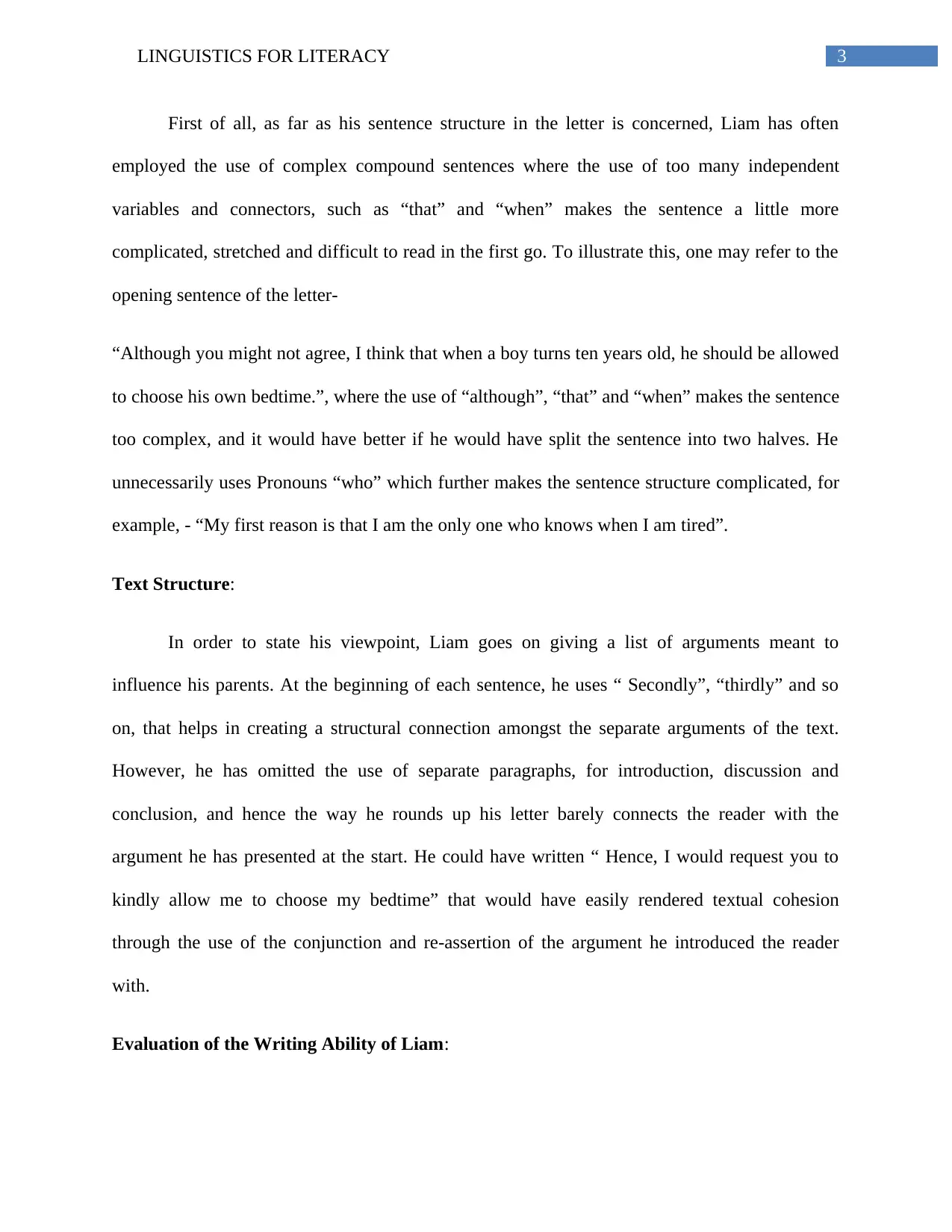
First of all, as far as his sentence structure in the letter is concerned, Liam has often
employed the use of complex compound sentences where the use of too many independent
variables and connectors, such as “that” and “when” makes the sentence a little more
complicated, stretched and difficult to read in the first go. To illustrate this, one may refer to the
opening sentence of the letter-
“Although you might not agree, I think that when a boy turns ten years old, he should be allowed
to choose his own bedtime.”, where the use of “although”, “that” and “when” makes the sentence
too complex, and it would have better if he would have split the sentence into two halves. He
unnecessarily uses Pronouns “who” which further makes the sentence structure complicated, for
example, - “My first reason is that I am the only one who knows when I am tired”.
Text Structure:
In order to state his viewpoint, Liam goes on giving a list of arguments meant to
influence his parents. At the beginning of each sentence, he uses “ Secondly”, “thirdly” and so
on, that helps in creating a structural connection amongst the separate arguments of the text.
However, he has omitted the use of separate paragraphs, for introduction, discussion and
conclusion, and hence the way he rounds up his letter barely connects the reader with the
argument he has presented at the start. He could have written “ Hence, I would request you to
kindly allow me to choose my bedtime” that would have easily rendered textual cohesion
through the use of the conjunction and re-assertion of the argument he introduced the reader
with.
Evaluation of the Writing Ability of Liam:
tabler-icon-diamond-filled.svg

Paraphrase This Document

Need a fresh take? Get an instant paraphrase of this document with our AI Paraphraser
Document Page
4LINGUISTICS FOR LITERACY
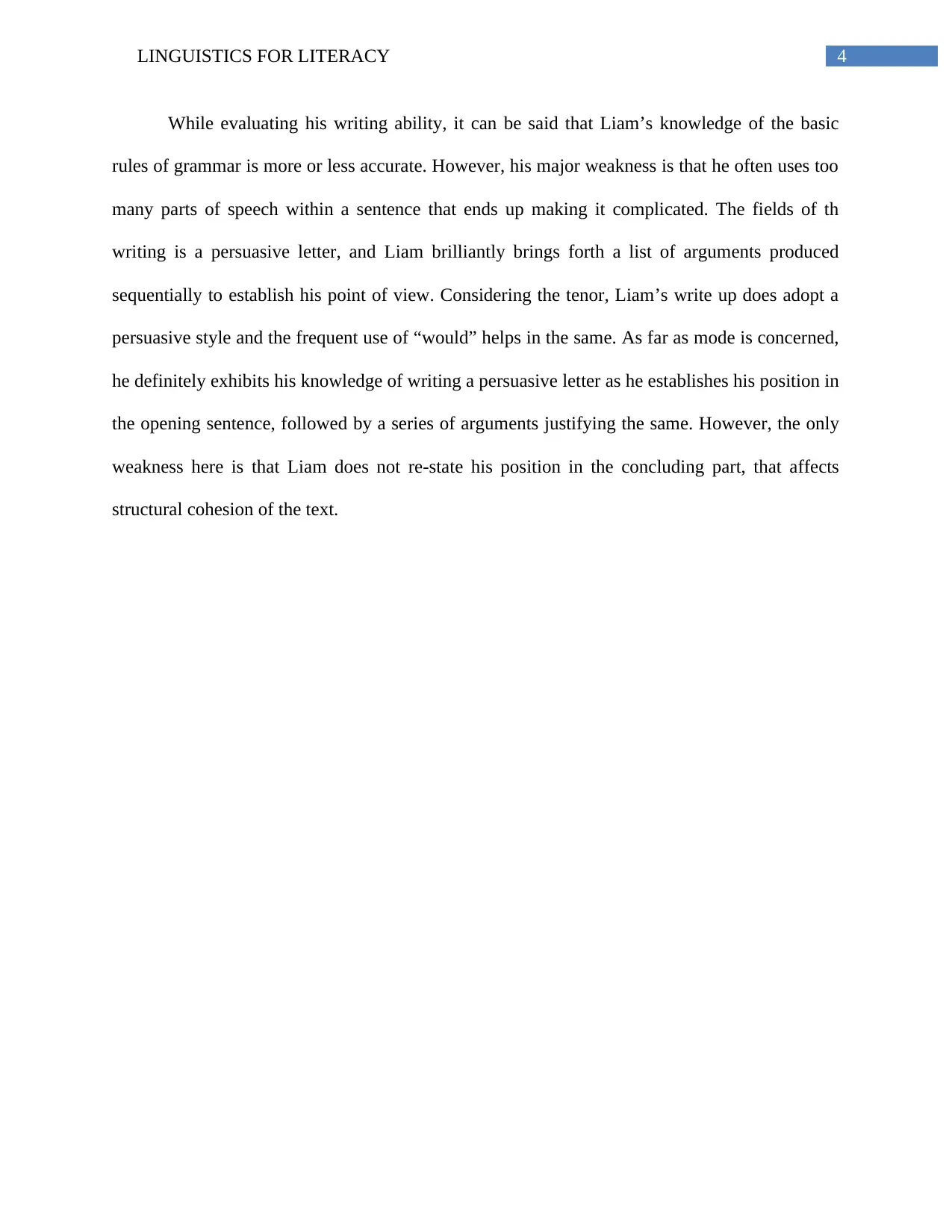
While evaluating his writing ability, it can be said that Liam’s knowledge of the basic
rules of grammar is more or less accurate. However, his major weakness is that he often uses too
many parts of speech within a sentence that ends up making it complicated. The fields of th
writing is a persuasive letter, and Liam brilliantly brings forth a list of arguments produced
sequentially to establish his point of view. Considering the tenor, Liam’s write up does adopt a
persuasive style and the frequent use of “would” helps in the same. As far as mode is concerned,
he definitely exhibits his knowledge of writing a persuasive letter as he establishes his position in
the opening sentence, followed by a series of arguments justifying the same. However, the only
weakness here is that Liam does not re-state his position in the concluding part, that affects
structural cohesion of the text.
Document Page
5LINGUISTICS FOR LITERACY
Reference List:
Derewianka, B. M., & Jones, P. T. (2016). Teaching language in context.
Winch, G., Johnston, R. R., March, P., Ljungdahl, L., & Holliday, M. (2015). Literacy Ebook:
Reading, Writing and Children's Literature. Oxford University Press Australia & New
Zealand.
chevron_up_icon
1 out of 6
circle_padding
hide_on_mobile
zoom_out_icon
[object Object]