Literacy Learning Activities: Trace Letters, Puzzles, and Five Senses
VerifiedAdded on 2021/02/19
|9
|2344
|31
Homework Assignment
AI Summary
This assignment presents three literacy learning activity plans designed for children aged 3 to 5 years old. The first activity focuses on tracing letters, emphasizing visual literacy and the use of resources like markers and colored paper, aligning with the Early Years Learning Framework (EYLF). The second activity involves puzzles, including building blocks and word hunts, with a focus on Information Communication and Technology (ICT) and its role in motivating children, connecting to the Australian Curriculum. The final activity centers on the five senses, integrating ICT and visual literacy to help children understand their senses, also aligning with the EYLF. Each activity includes resources, curriculum connections, and a focus concept, offering a comprehensive approach to early literacy development. The assignment includes a detailed reference list of relevant academic sources.
3B: FOLIO -
LANGUAGE AND
LITERACY LEARNING
LANGUAGE AND
LITERACY LEARNING
Paraphrase This Document
Need a fresh take? Get an instant paraphrase of this document with our AI Paraphraser

TABLE OF CONTENTS
Learning activity plan 1..........................................................................................................................................................3
Learning activity plan 2...........................................................................................................................................................4
Learning activity plan 3...........................................................................................................................................................7
Reference list:..........................................................................................................................................................................9
Learning activity plan 1..........................................................................................................................................................3
Learning activity plan 2...........................................................................................................................................................4
Learning activity plan 3...........................................................................................................................................................7
Reference list:..........................................................................................................................................................................9

Learning activity plan 1
Your name: ABC
1. Learning activity title Trace Letter Together
2. Age group 3 to 5 Years
3. Learning activity:
In teaching of children of age 3 to 5 years is to trace the letter together. This activity is the best way to teach the
child about the letters which is very important for the development of literacy. Without the knowledge of letter,
child cannot even spell the words. For oral languages development, it is very crucial to have proper knowledge and
understanding of letters ether mathematical, English or any image. Teacher will introduce this activities in-front of
children by telling them about the letters and will show all the colors, book, markers or pence which they are going
to use in the activity. Teacher will use penchant for arts by helping the trace letters. Teacher will buy paper meant
for this purpose with red dotted lines where the middle of the letters will lie. It will help children to learn the shape
of each and every letter. Further, for making children more perfect, teacher will draw letter in pencil and than allow
children go over that writing with marketers Lindsay & et.al., (2018). This activities also create fun for children
and it makes them learn about the letters in very interesting way. After presenting the activities, teacher will assign
task to them for completing the work and tell them they will get chocolates and other gifts if they will complete
their task.
4. Focus concept:
Teacher will also focus on using Visual literacy as it is the ability to negotiate and interpret with the help of images.
It helps in making meaningful information presented in the form of images, broaden the meaning of letters.
As per the Australian Context, Visual literary is very important for the children language or oral development as
them came into contact with them, it makes indivisible to interpret art as well as visual media O’Hare, (2016).
This is the best way to overcome all the obstacle of learning. In other words, children will also get close
investigation of different visual letters like pictures, alphabets, numeric etc.
Your name: ABC
1. Learning activity title Trace Letter Together
2. Age group 3 to 5 Years
3. Learning activity:
In teaching of children of age 3 to 5 years is to trace the letter together. This activity is the best way to teach the
child about the letters which is very important for the development of literacy. Without the knowledge of letter,
child cannot even spell the words. For oral languages development, it is very crucial to have proper knowledge and
understanding of letters ether mathematical, English or any image. Teacher will introduce this activities in-front of
children by telling them about the letters and will show all the colors, book, markers or pence which they are going
to use in the activity. Teacher will use penchant for arts by helping the trace letters. Teacher will buy paper meant
for this purpose with red dotted lines where the middle of the letters will lie. It will help children to learn the shape
of each and every letter. Further, for making children more perfect, teacher will draw letter in pencil and than allow
children go over that writing with marketers Lindsay & et.al., (2018). This activities also create fun for children
and it makes them learn about the letters in very interesting way. After presenting the activities, teacher will assign
task to them for completing the work and tell them they will get chocolates and other gifts if they will complete
their task.
4. Focus concept:
Teacher will also focus on using Visual literacy as it is the ability to negotiate and interpret with the help of images.
It helps in making meaningful information presented in the form of images, broaden the meaning of letters.
As per the Australian Context, Visual literary is very important for the children language or oral development as
them came into contact with them, it makes indivisible to interpret art as well as visual media O’Hare, (2016).
This is the best way to overcome all the obstacle of learning. In other words, children will also get close
investigation of different visual letters like pictures, alphabets, numeric etc.
⊘ This is a preview!⊘
Do you want full access?
Subscribe today to unlock all pages.

Trusted by 1+ million students worldwide

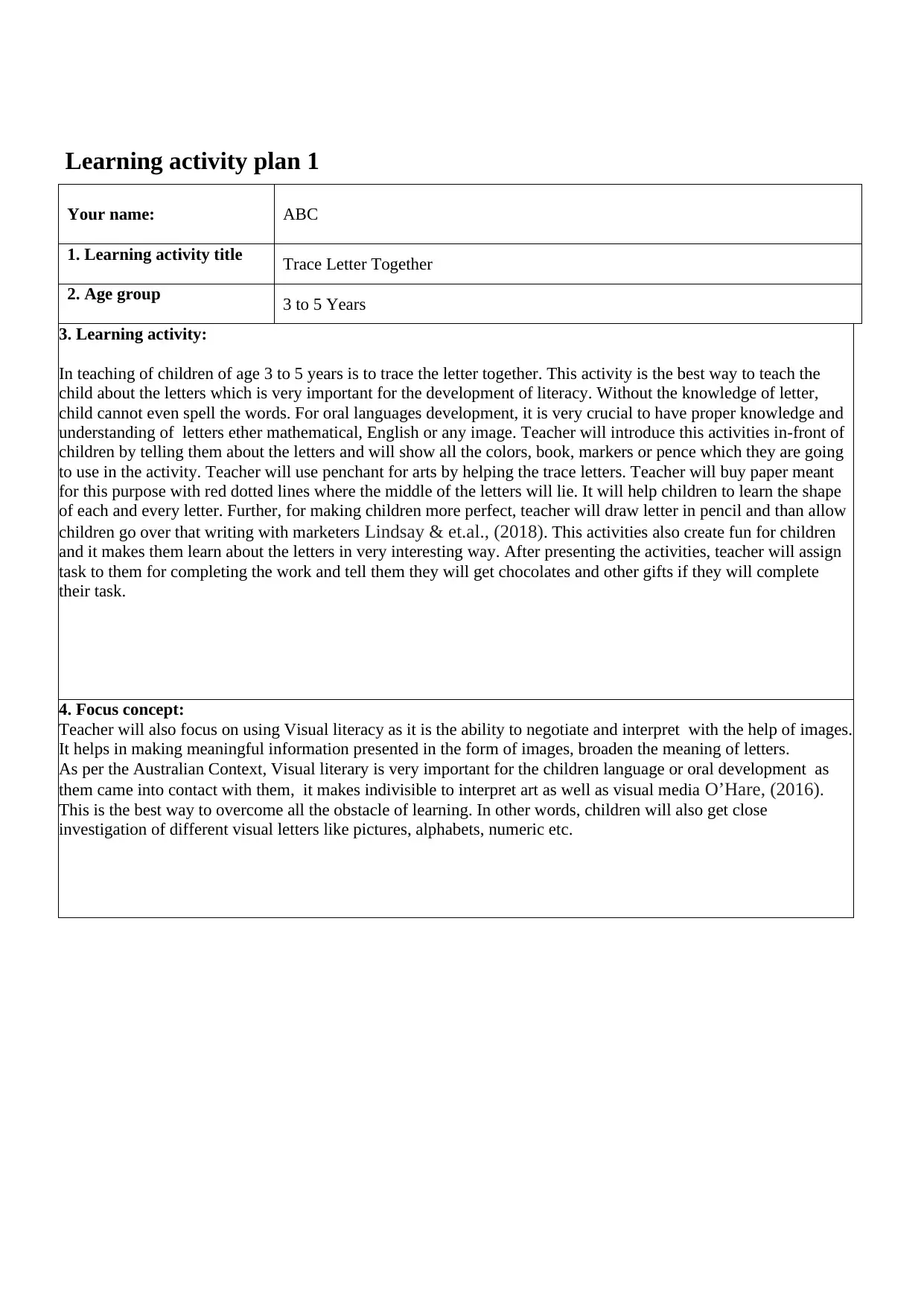
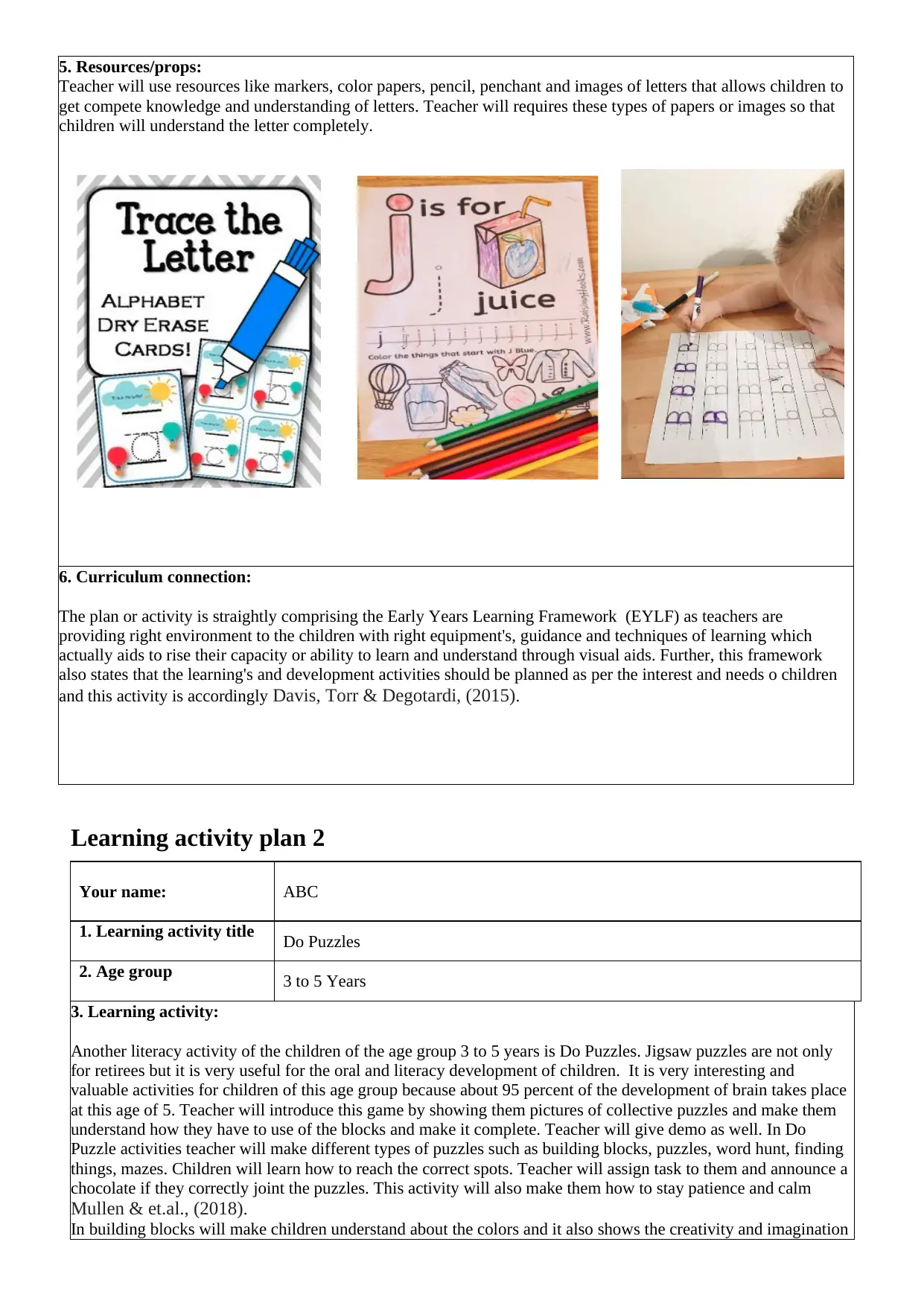
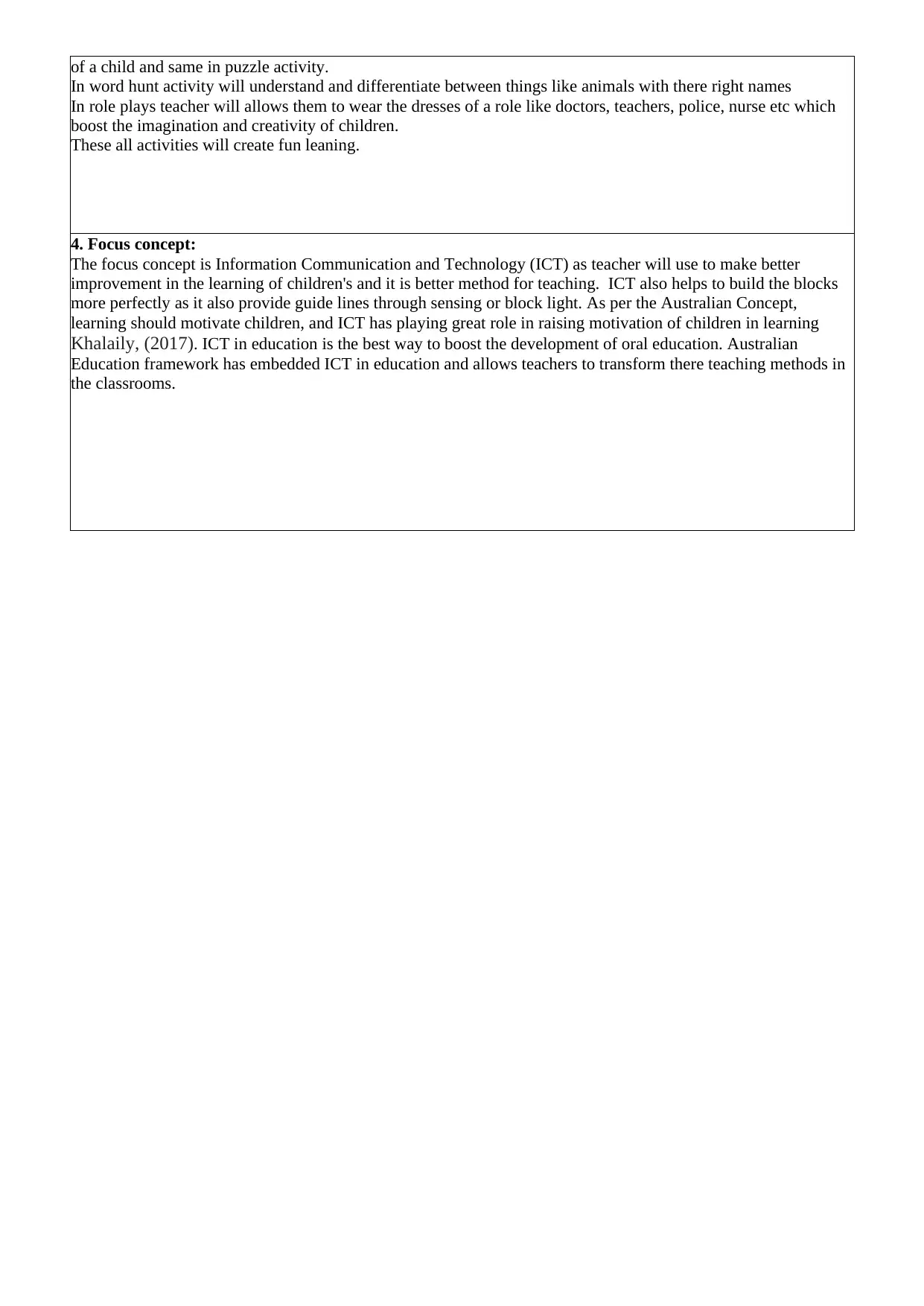
5. Resources/props:
Teacher will use resources like markers, color papers, pencil, penchant and images of letters that allows children to
get compete knowledge and understanding of letters. Teacher will requires these types of papers or images so that
children will understand the letter completely.
6. Curriculum connection:
The plan or activity is straightly comprising the Early Years Learning Framework (EYLF) as teachers are
providing right environment to the children with right equipment's, guidance and techniques of learning which
actually aids to rise their capacity or ability to learn and understand through visual aids. Further, this framework
also states that the learning's and development activities should be planned as per the interest and needs o children
and this activity is accordingly Davis, Torr & Degotardi, (2015).
Learning activity plan 2
Your name: ABC
1. Learning activity title Do Puzzles
2. Age group 3 to 5 Years
3. Learning activity:
Another literacy activity of the children of the age group 3 to 5 years is Do Puzzles. Jigsaw puzzles are not only
for retirees but it is very useful for the oral and literacy development of children. It is very interesting and
valuable activities for children of this age group because about 95 percent of the development of brain takes place
at this age of 5. Teacher will introduce this game by showing them pictures of collective puzzles and make them
understand how they have to use of the blocks and make it complete. Teacher will give demo as well. In Do
Puzzle activities teacher will make different types of puzzles such as building blocks, puzzles, word hunt, finding
things, mazes. Children will learn how to reach the correct spots. Teacher will assign task to them and announce a
chocolate if they correctly joint the puzzles. This activity will also make them how to stay patience and calm
Mullen & et.al., (2018).
In building blocks will make children understand about the colors and it also shows the creativity and imagination
Teacher will use resources like markers, color papers, pencil, penchant and images of letters that allows children to
get compete knowledge and understanding of letters. Teacher will requires these types of papers or images so that
children will understand the letter completely.
6. Curriculum connection:
The plan or activity is straightly comprising the Early Years Learning Framework (EYLF) as teachers are
providing right environment to the children with right equipment's, guidance and techniques of learning which
actually aids to rise their capacity or ability to learn and understand through visual aids. Further, this framework
also states that the learning's and development activities should be planned as per the interest and needs o children
and this activity is accordingly Davis, Torr & Degotardi, (2015).
Learning activity plan 2
Your name: ABC
1. Learning activity title Do Puzzles
2. Age group 3 to 5 Years
3. Learning activity:
Another literacy activity of the children of the age group 3 to 5 years is Do Puzzles. Jigsaw puzzles are not only
for retirees but it is very useful for the oral and literacy development of children. It is very interesting and
valuable activities for children of this age group because about 95 percent of the development of brain takes place
at this age of 5. Teacher will introduce this game by showing them pictures of collective puzzles and make them
understand how they have to use of the blocks and make it complete. Teacher will give demo as well. In Do
Puzzle activities teacher will make different types of puzzles such as building blocks, puzzles, word hunt, finding
things, mazes. Children will learn how to reach the correct spots. Teacher will assign task to them and announce a
chocolate if they correctly joint the puzzles. This activity will also make them how to stay patience and calm
Mullen & et.al., (2018).
In building blocks will make children understand about the colors and it also shows the creativity and imagination
Paraphrase This Document
Need a fresh take? Get an instant paraphrase of this document with our AI Paraphraser

of a child and same in puzzle activity.
In word hunt activity will understand and differentiate between things like animals with there right names
In role plays teacher will allows them to wear the dresses of a role like doctors, teachers, police, nurse etc which
boost the imagination and creativity of children.
These all activities will create fun leaning.
4. Focus concept:
The focus concept is Information Communication and Technology (ICT) as teacher will use to make better
improvement in the learning of children's and it is better method for teaching. ICT also helps to build the blocks
more perfectly as it also provide guide lines through sensing or block light. As per the Australian Concept,
learning should motivate children, and ICT has playing great role in raising motivation of children in learning
Khalaily, (2017). ICT in education is the best way to boost the development of oral education. Australian
Education framework has embedded ICT in education and allows teachers to transform there teaching methods in
the classrooms.
In word hunt activity will understand and differentiate between things like animals with there right names
In role plays teacher will allows them to wear the dresses of a role like doctors, teachers, police, nurse etc which
boost the imagination and creativity of children.
These all activities will create fun leaning.
4. Focus concept:
The focus concept is Information Communication and Technology (ICT) as teacher will use to make better
improvement in the learning of children's and it is better method for teaching. ICT also helps to build the blocks
more perfectly as it also provide guide lines through sensing or block light. As per the Australian Concept,
learning should motivate children, and ICT has playing great role in raising motivation of children in learning
Khalaily, (2017). ICT in education is the best way to boost the development of oral education. Australian
Education framework has embedded ICT in education and allows teachers to transform there teaching methods in
the classrooms.

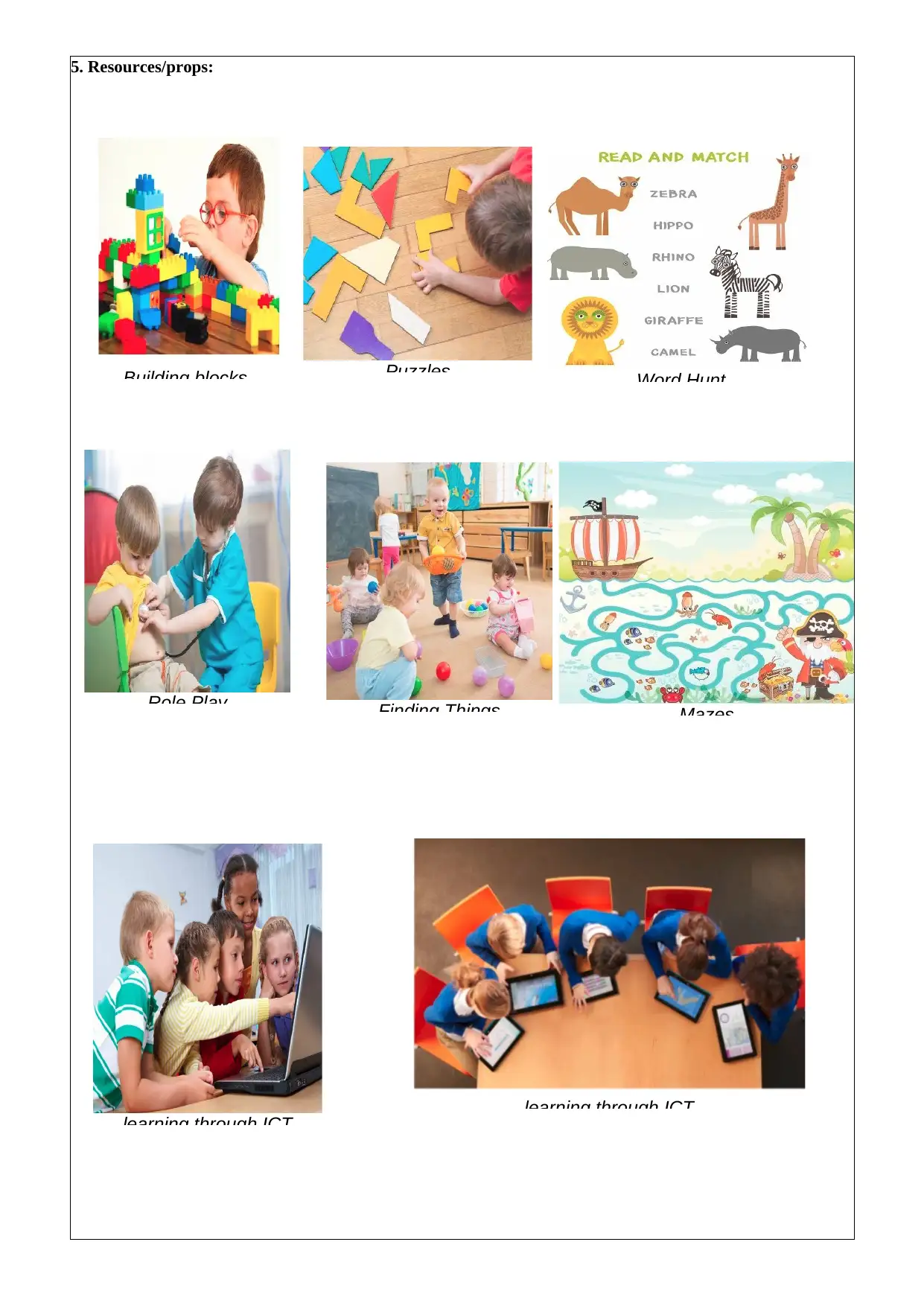
5. Resources/props:
Building blocks Puzzles Word Hunt
Role Play Finding Things Mazes
learning through ICT learning through ICT
Building blocks Puzzles Word Hunt
Role Play Finding Things Mazes
learning through ICT learning through ICT
⊘ This is a preview!⊘
Do you want full access?
Subscribe today to unlock all pages.

Trusted by 1+ million students worldwide

6. Curriculum connection:
This activity is planned keeping in mind the Australian Curriculum (AC) which mainly focus on improving the
leaning result through school. The development of children in schools in the area of English, Mathematics Arts,
Humanities, technologies, languages and etc. are the most important which teacher has indulges in this activity or
learning Zhang & et.al., (2018).
Learning activity plan 3
Your name: ABC
1. Learning activity title The five senses learning activity
2. Age group 3 to 5 years
3. Learning activity:
One more activity which is useful children oral and language development at the age of 3 to 5 years is The five
senses learning activity. This activity will also children to choose which sense they use when food is offers and
when bell rings or etc. This activity will allow to make the person completely aware about there senses which is
also an important part of learning. Teacher will introduce this learning through showing pictures, give them
something to taste and teacher will majorly use ICT for showing them videos and images of different things and
note the facial expressions of child Häkkinen & et.al., (2017). It also help teacher to understand that power of
sensing of kids sitting over there. Teacher will make children understand many things which are there in the
surroundings that helps them to explore the world as well as make senses of what is around them. After make them
know about the senses, teacher will assign them a task like one poem that should be address one senses in every
lines. Sense learning teaching is very important as it also makes them to understand what is right and what is wrong
like what type of touch they like or not and same in the case of taste.
4. Focus concept:
The focus concept is Information Communication and Technology and Visual literacy both as teacher will use to
show videos of senses like how they have to react when they feel hunger etc. Further, in this activity visual
learning is also important as teacher will show pictures and do practical activities with children to judge the sensing
power of kids sitting over there Sousa, (2016). ICT and Visual literacy for this activity plays a great role as it will
allows them to understand the senses which is essential for child literacy and language development.
This activity is planned keeping in mind the Australian Curriculum (AC) which mainly focus on improving the
leaning result through school. The development of children in schools in the area of English, Mathematics Arts,
Humanities, technologies, languages and etc. are the most important which teacher has indulges in this activity or
learning Zhang & et.al., (2018).
Learning activity plan 3
Your name: ABC
1. Learning activity title The five senses learning activity
2. Age group 3 to 5 years
3. Learning activity:
One more activity which is useful children oral and language development at the age of 3 to 5 years is The five
senses learning activity. This activity will also children to choose which sense they use when food is offers and
when bell rings or etc. This activity will allow to make the person completely aware about there senses which is
also an important part of learning. Teacher will introduce this learning through showing pictures, give them
something to taste and teacher will majorly use ICT for showing them videos and images of different things and
note the facial expressions of child Häkkinen & et.al., (2017). It also help teacher to understand that power of
sensing of kids sitting over there. Teacher will make children understand many things which are there in the
surroundings that helps them to explore the world as well as make senses of what is around them. After make them
know about the senses, teacher will assign them a task like one poem that should be address one senses in every
lines. Sense learning teaching is very important as it also makes them to understand what is right and what is wrong
like what type of touch they like or not and same in the case of taste.
4. Focus concept:
The focus concept is Information Communication and Technology and Visual literacy both as teacher will use to
show videos of senses like how they have to react when they feel hunger etc. Further, in this activity visual
learning is also important as teacher will show pictures and do practical activities with children to judge the sensing
power of kids sitting over there Sousa, (2016). ICT and Visual literacy for this activity plays a great role as it will
allows them to understand the senses which is essential for child literacy and language development.
Paraphrase This Document
Need a fresh take? Get an instant paraphrase of this document with our AI Paraphraser

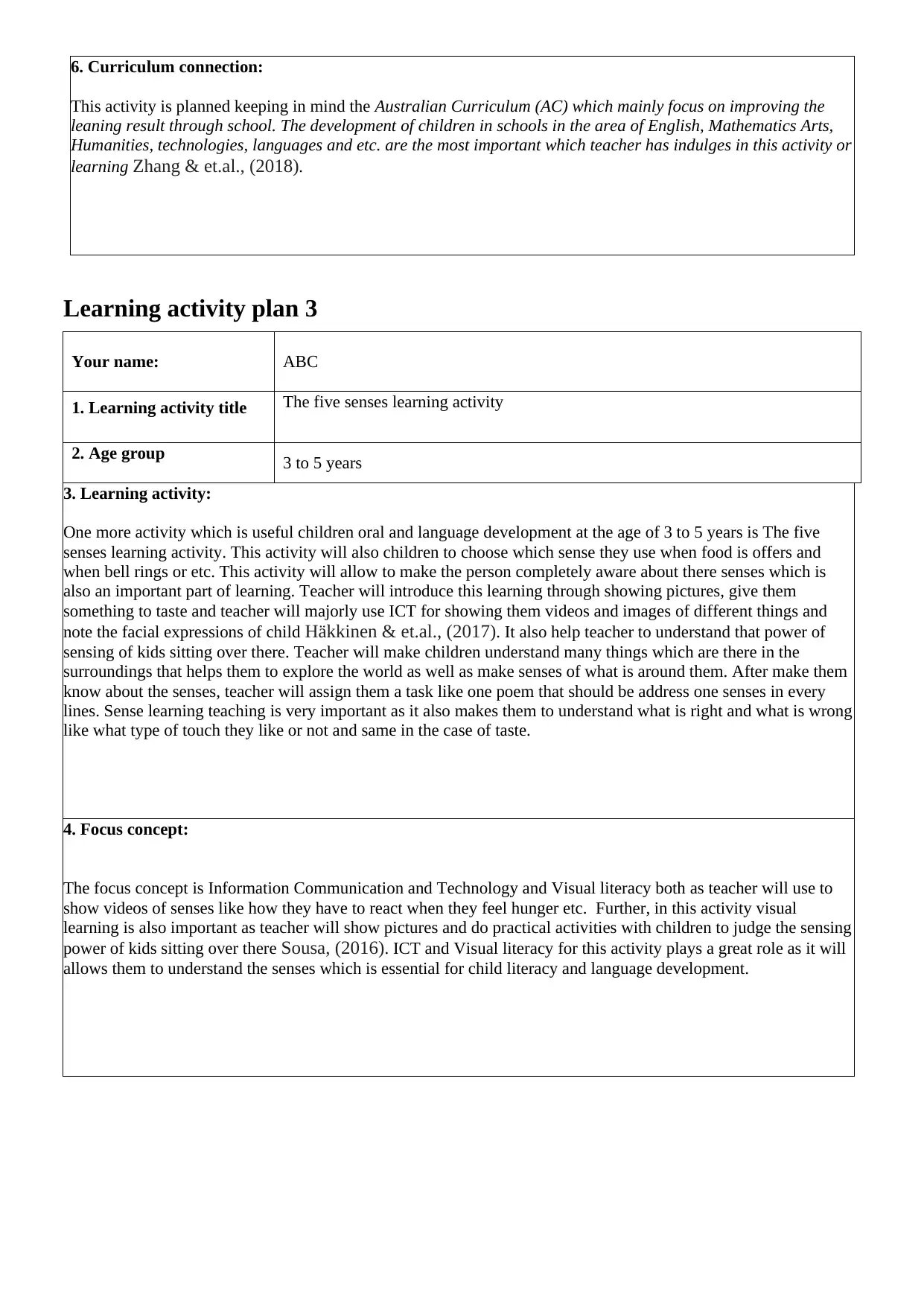
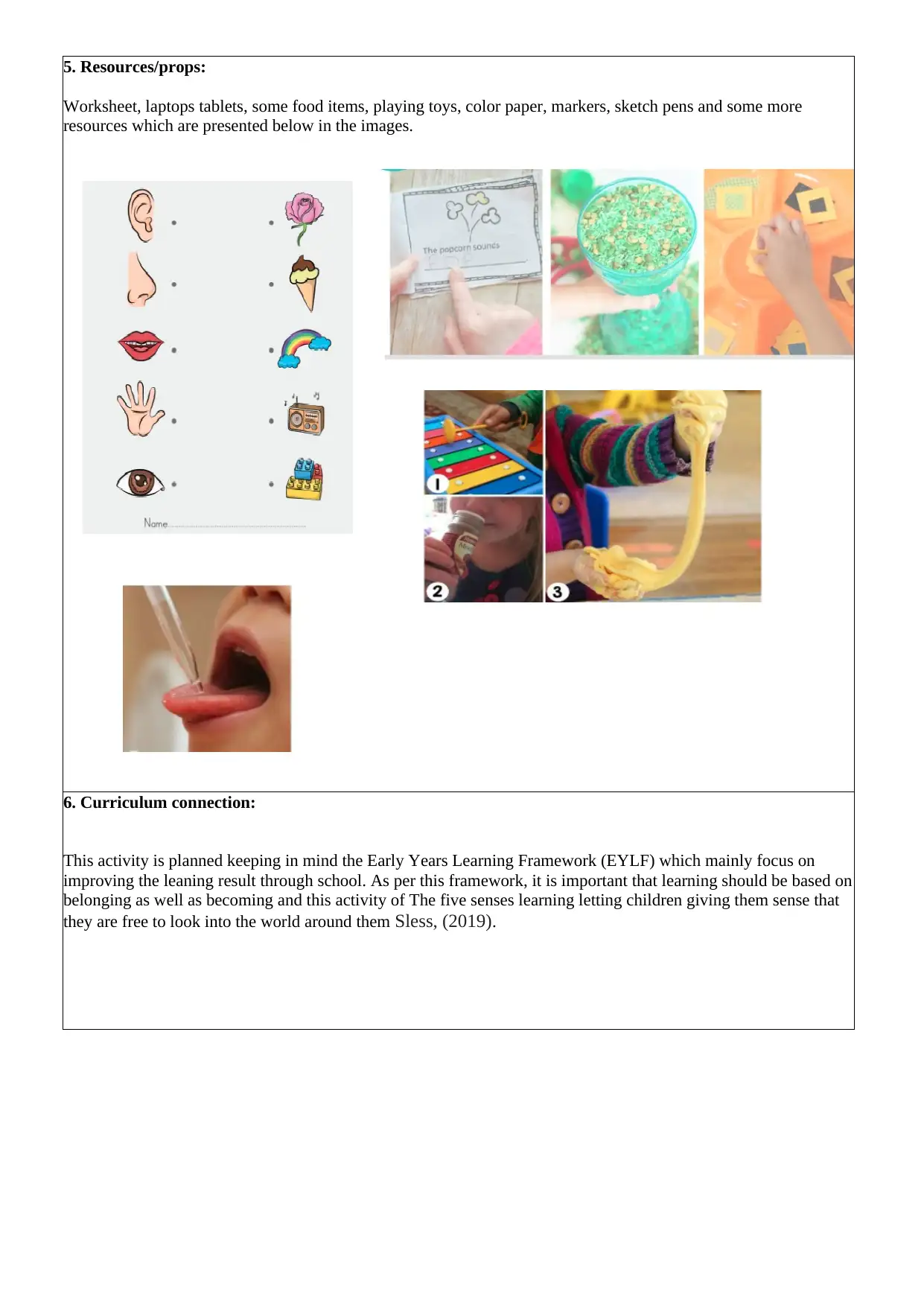
5. Resources/props:
Worksheet, laptops tablets, some food items, playing toys, color paper, markers, sketch pens and some more
resources which are presented below in the images.
6. Curriculum connection:
This activity is planned keeping in mind the Early Years Learning Framework (EYLF) which mainly focus on
improving the leaning result through school. As per this framework, it is important that learning should be based on
belonging as well as becoming and this activity of The five senses learning letting children giving them sense that
they are free to look into the world around them Sless, (2019).
Worksheet, laptops tablets, some food items, playing toys, color paper, markers, sketch pens and some more
resources which are presented below in the images.
6. Curriculum connection:
This activity is planned keeping in mind the Early Years Learning Framework (EYLF) which mainly focus on
improving the leaning result through school. As per this framework, it is important that learning should be based on
belonging as well as becoming and this activity of The five senses learning letting children giving them sense that
they are free to look into the world around them Sless, (2019).

Reference list:
Books and Journals:
Davis, B., Torr, J., & Degotardi, S. (2015). Infants and toddlers: how visible are they in the Early Years
Learning Framework?. International Journal of Child Care and Education Policy. 9(1). 12.
Häkkinen, P. & et.al., (2017). Preparing teacher-students for twenty-first-century learning practices (PREP 21):
a framework for enhancing collaborative problem-solving and strategic learning skills. Teachers and
Teaching, 23(1), 25-41.
Khalaily, M. (2017). Facilitating the development of critical thinking skills and self-directed learning: An
exploration of leadership and curriculum practice in a Palestinian kindergarten (Doctoral dissertation,
University of Derby).
Lindsay, A. R. & et.al., (2018). Interrater Reliability of a Field-Based Preschool Movement Skills
Assessment. Journal of nutrition education and behavior, 50(10), 1040-1045.
Mullen, J. & et.al., (2018). 1 CARING FOR CRITICALLY ILL CHILDREN AND THEIR FAMILIES. AACN
Core Curriculum for Pediatric High Acuity, Progressive, and Critical Care Nursing, 1.
O’Hare, M. (2016). Changes in New Zealand early childhood teachers’ use of strategies to facilitate children’s
emergent literacy development.
Sless, D. (2019). Learning and visual communication. Routledge.
Sousa, D. A. (2016). How the brain learns. Corwin Press.
Zhang, L. & et.al., (2018). Understanding performance and verbal-communication of children with ASD in a
collaborative virtual environment. Journal of autism and developmental disorders, 48(8), 2779-2789.
Books and Journals:
Davis, B., Torr, J., & Degotardi, S. (2015). Infants and toddlers: how visible are they in the Early Years
Learning Framework?. International Journal of Child Care and Education Policy. 9(1). 12.
Häkkinen, P. & et.al., (2017). Preparing teacher-students for twenty-first-century learning practices (PREP 21):
a framework for enhancing collaborative problem-solving and strategic learning skills. Teachers and
Teaching, 23(1), 25-41.
Khalaily, M. (2017). Facilitating the development of critical thinking skills and self-directed learning: An
exploration of leadership and curriculum practice in a Palestinian kindergarten (Doctoral dissertation,
University of Derby).
Lindsay, A. R. & et.al., (2018). Interrater Reliability of a Field-Based Preschool Movement Skills
Assessment. Journal of nutrition education and behavior, 50(10), 1040-1045.
Mullen, J. & et.al., (2018). 1 CARING FOR CRITICALLY ILL CHILDREN AND THEIR FAMILIES. AACN
Core Curriculum for Pediatric High Acuity, Progressive, and Critical Care Nursing, 1.
O’Hare, M. (2016). Changes in New Zealand early childhood teachers’ use of strategies to facilitate children’s
emergent literacy development.
Sless, D. (2019). Learning and visual communication. Routledge.
Sousa, D. A. (2016). How the brain learns. Corwin Press.
Zhang, L. & et.al., (2018). Understanding performance and verbal-communication of children with ASD in a
collaborative virtual environment. Journal of autism and developmental disorders, 48(8), 2779-2789.
⊘ This is a preview!⊘
Do you want full access?
Subscribe today to unlock all pages.

Trusted by 1+ million students worldwide
1 out of 9
Related Documents
Your All-in-One AI-Powered Toolkit for Academic Success.
+13062052269
info@desklib.com
Available 24*7 on WhatsApp / Email
Unlock your academic potential
Copyright © 2020–2025 A2Z Services. All Rights Reserved. Developed and managed by ZUCOL.