Analyzing Dystopian Equality in Vonnegut's 'Harrison Bergeron' Essay

Verified

Added on  2023/06/04

|7
|1830
|446
Essay
AI Summary
This essay provides a comprehensive analysis of Kurt Vonnegut's "Harrison Bergeron," focusing on the author's portrayal of a dystopian future in America where the pursuit of total equality has led to a dysfunctional society. The essay examines how strict government control suppresses individuality and innovation, turning citizens into passive, machine-like beings. Through rhetorical analysis, the narrative style, and interpretative claims, the essay highlights the dangers of enforced equality, drawing parallels to George Orwell's 1984. It discusses the symbolic use of television as a tool for sedation and government propaganda, as well as the disruptive noises that handicap individuals and stifle independent thought. The character of Harrison is presented as a symbol of defiance against this oppressive regime. The analysis concludes that Vonnegut's story serves as a cautionary tale, suggesting that complete equality can stifle progress, innovation, and individual expression, ultimately leading to a stagnant and politically problematic society.
Document Page
Running head: ENGLISH
ENGLISH
Name of the Student
Name of the University
Author Note
tabler-icon-diamond-filled.svg

Paraphrase This Document

Need a fresh take? Get an instant paraphrase of this document with our AI Paraphraser
Document Page
1ENGLISH
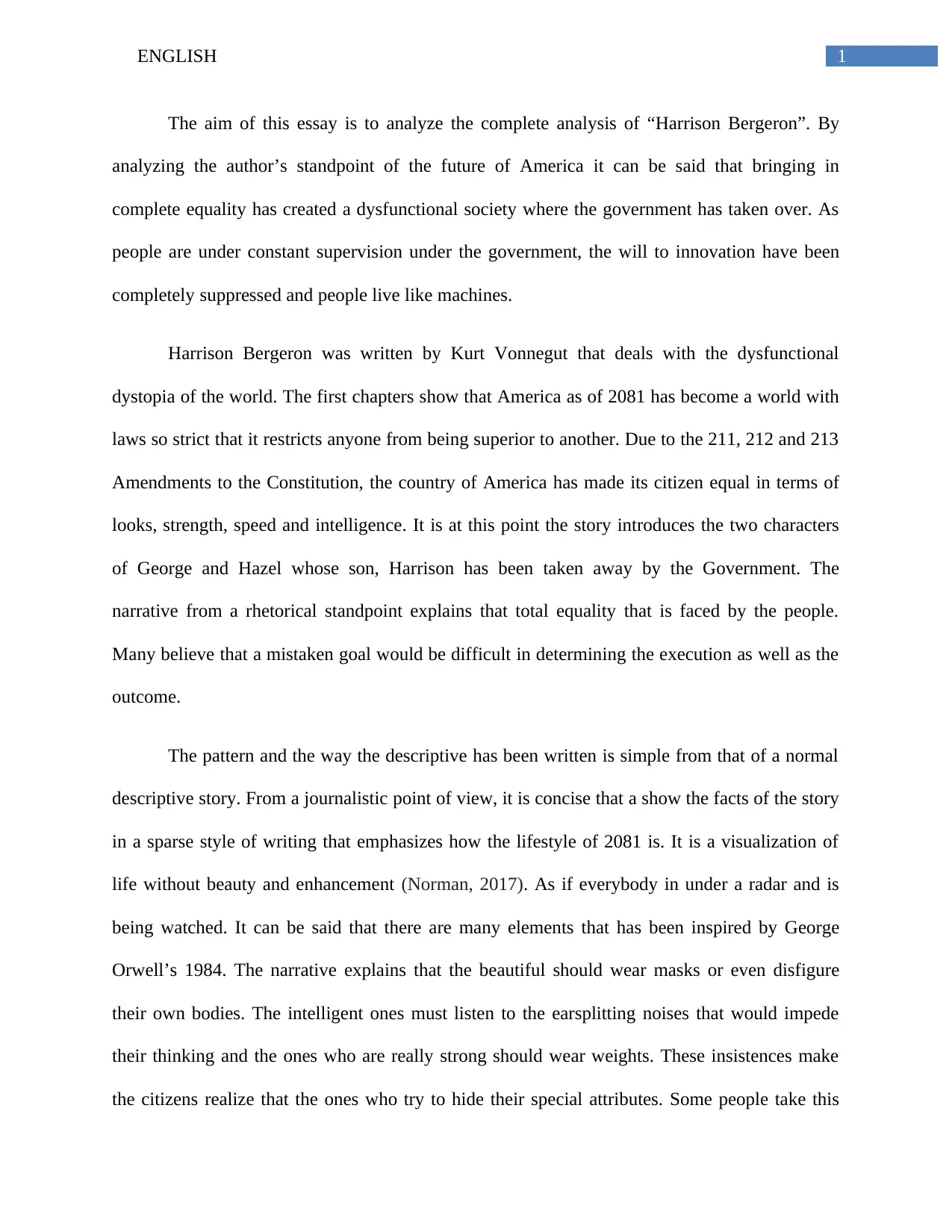
The aim of this essay is to analyze the complete analysis of “Harrison Bergeron”. By
analyzing the author’s standpoint of the future of America it can be said that bringing in
complete equality has created a dysfunctional society where the government has taken over. As
people are under constant supervision under the government, the will to innovation have been
completely suppressed and people live like machines.
Harrison Bergeron was written by Kurt Vonnegut that deals with the dysfunctional
dystopia of the world. The first chapters show that America as of 2081 has become a world with
laws so strict that it restricts anyone from being superior to another. Due to the 211, 212 and 213
Amendments to the Constitution, the country of America has made its citizen equal in terms of
looks, strength, speed and intelligence. It is at this point the story introduces the two characters
of George and Hazel whose son, Harrison has been taken away by the Government. The
narrative from a rhetorical standpoint explains that total equality that is faced by the people.
Many believe that a mistaken goal would be difficult in determining the execution as well as the
outcome.
The pattern and the way the descriptive has been written is simple from that of a normal
descriptive story. From a journalistic point of view, it is concise that a show the facts of the story
in a sparse style of writing that emphasizes how the lifestyle of 2081 is. It is a visualization of
life without beauty and enhancement (Norman, 2017). As if everybody in under a radar and is
being watched. It can be said that there are many elements that has been inspired by George
Orwell’s 1984. The narrative explains that the beautiful should wear masks or even disfigure
their own bodies. The intelligent ones must listen to the earsplitting noises that would impede
their thinking and the ones who are really strong should wear weights. These insistences make
the citizens realize that the ones who try to hide their special attributes. Some people take this
Document Page
2ENGLISH
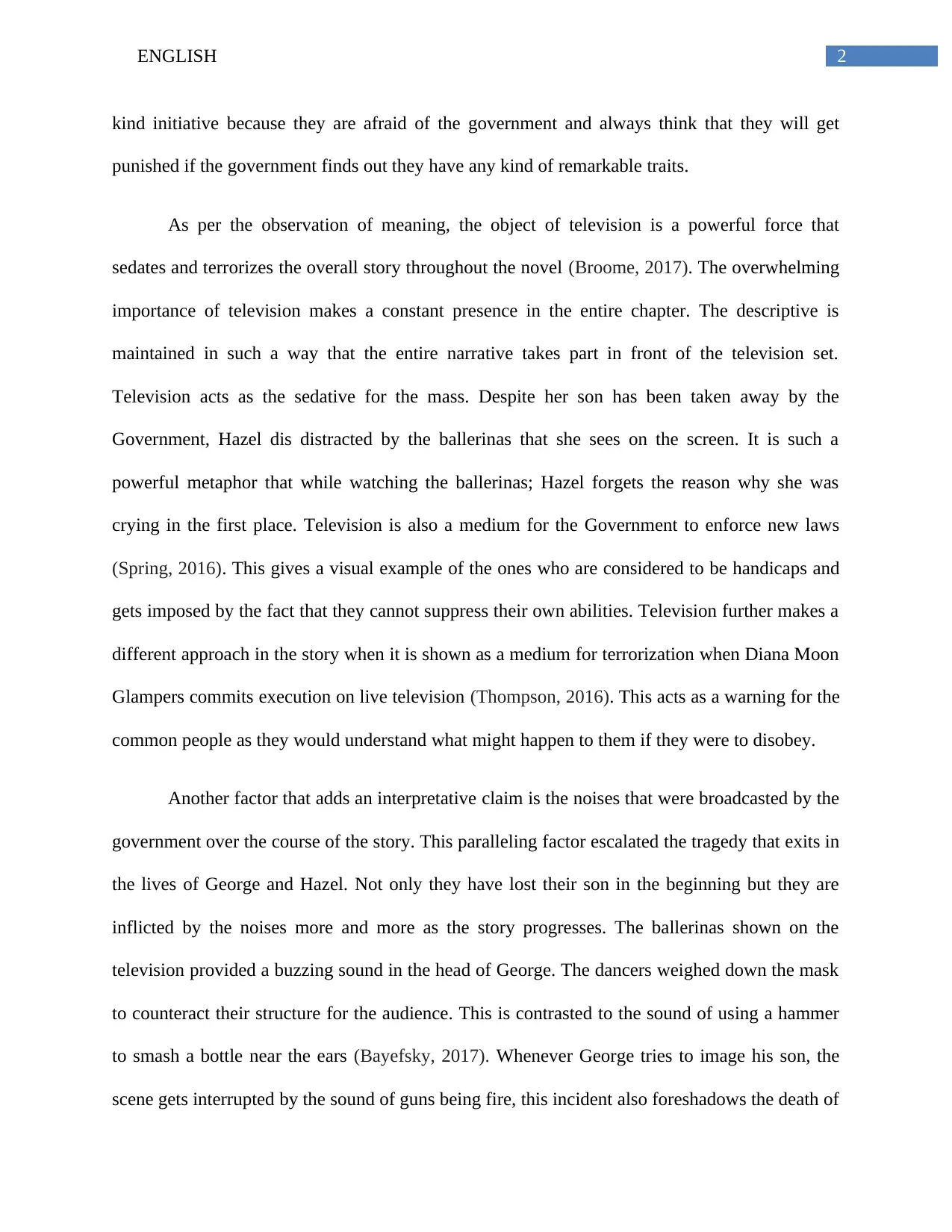
kind initiative because they are afraid of the government and always think that they will get
punished if the government finds out they have any kind of remarkable traits.
As per the observation of meaning, the object of television is a powerful force that
sedates and terrorizes the overall story throughout the novel (Broome, 2017). The overwhelming
importance of television makes a constant presence in the entire chapter. The descriptive is
maintained in such a way that the entire narrative takes part in front of the television set.
Television acts as the sedative for the mass. Despite her son has been taken away by the
Government, Hazel dis distracted by the ballerinas that she sees on the screen. It is such a
powerful metaphor that while watching the ballerinas; Hazel forgets the reason why she was
crying in the first place. Television is also a medium for the Government to enforce new laws
(Spring, 2016). This gives a visual example of the ones who are considered to be handicaps and
gets imposed by the fact that they cannot suppress their own abilities. Television further makes a
different approach in the story when it is shown as a medium for terrorization when Diana Moon
Glampers commits execution on live television (Thompson, 2016). This acts as a warning for the
common people as they would understand what might happen to them if they were to disobey.
Another factor that adds an interpretative claim is the noises that were broadcasted by the
government over the course of the story. This paralleling factor escalated the tragedy that exits in
the lives of George and Hazel. Not only they have lost their son in the beginning but they are
inflicted by the noises more and more as the story progresses. The ballerinas shown on the
television provided a buzzing sound in the head of George. The dancers weighed down the mask
to counteract their structure for the audience. This is contrasted to the sound of using a hammer
to smash a bottle near the ears (Bayefsky, 2017). Whenever George tries to image his son, the
scene gets interrupted by the sound of guns being fire, this incident also foreshadows the death of
Document Page
3ENGLISH
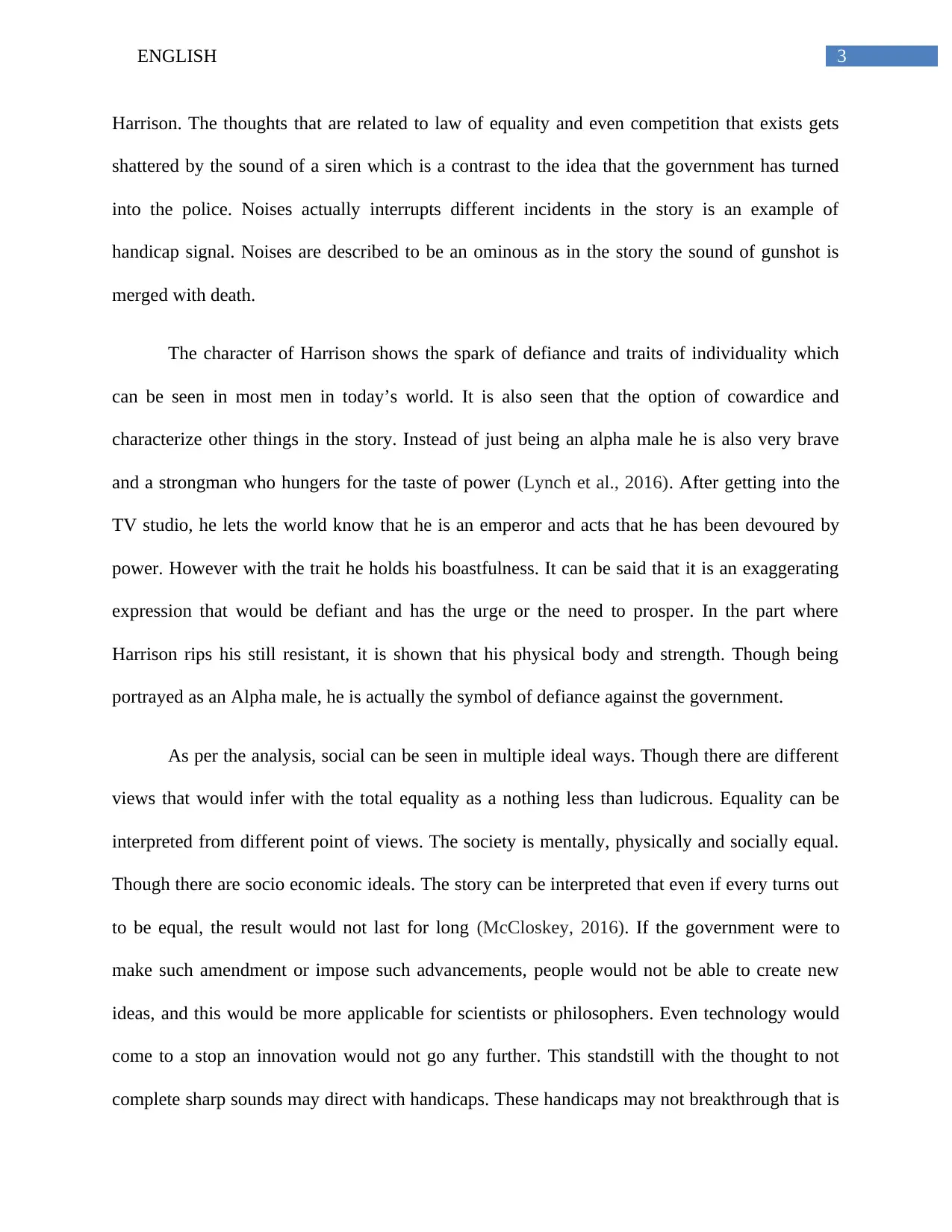
Harrison. The thoughts that are related to law of equality and even competition that exists gets
shattered by the sound of a siren which is a contrast to the idea that the government has turned
into the police. Noises actually interrupts different incidents in the story is an example of
handicap signal. Noises are described to be an ominous as in the story the sound of gunshot is
merged with death.
The character of Harrison shows the spark of defiance and traits of individuality which
can be seen in most men in today’s world. It is also seen that the option of cowardice and
characterize other things in the story. Instead of just being an alpha male he is also very brave
and a strongman who hungers for the taste of power (Lynch et al., 2016). After getting into the
TV studio, he lets the world know that he is an emperor and acts that he has been devoured by
power. However with the trait he holds his boastfulness. It can be said that it is an exaggerating
expression that would be defiant and has the urge or the need to prosper. In the part where
Harrison rips his still resistant, it is shown that his physical body and strength. Though being
portrayed as an Alpha male, he is actually the symbol of defiance against the government.
As per the analysis, social can be seen in multiple ideal ways. Though there are different
views that would infer with the total equality as a nothing less than ludicrous. Equality can be
interpreted from different point of views. The society is mentally, physically and socially equal.
Though there are socio economic ideals. The story can be interpreted that even if every turns out
to be equal, the result would not last for long (McCloskey, 2016). If the government were to
make such amendment or impose such advancements, people would not be able to create new
ideas, and this would be more applicable for scientists or philosophers. Even technology would
come to a stop an innovation would not go any further. This standstill with the thought to not
complete sharp sounds may direct with handicaps. These handicaps may not breakthrough that is
tabler-icon-diamond-filled.svg

Paraphrase This Document

Need a fresh take? Get an instant paraphrase of this document with our AI Paraphraser
Document Page
4ENGLISH
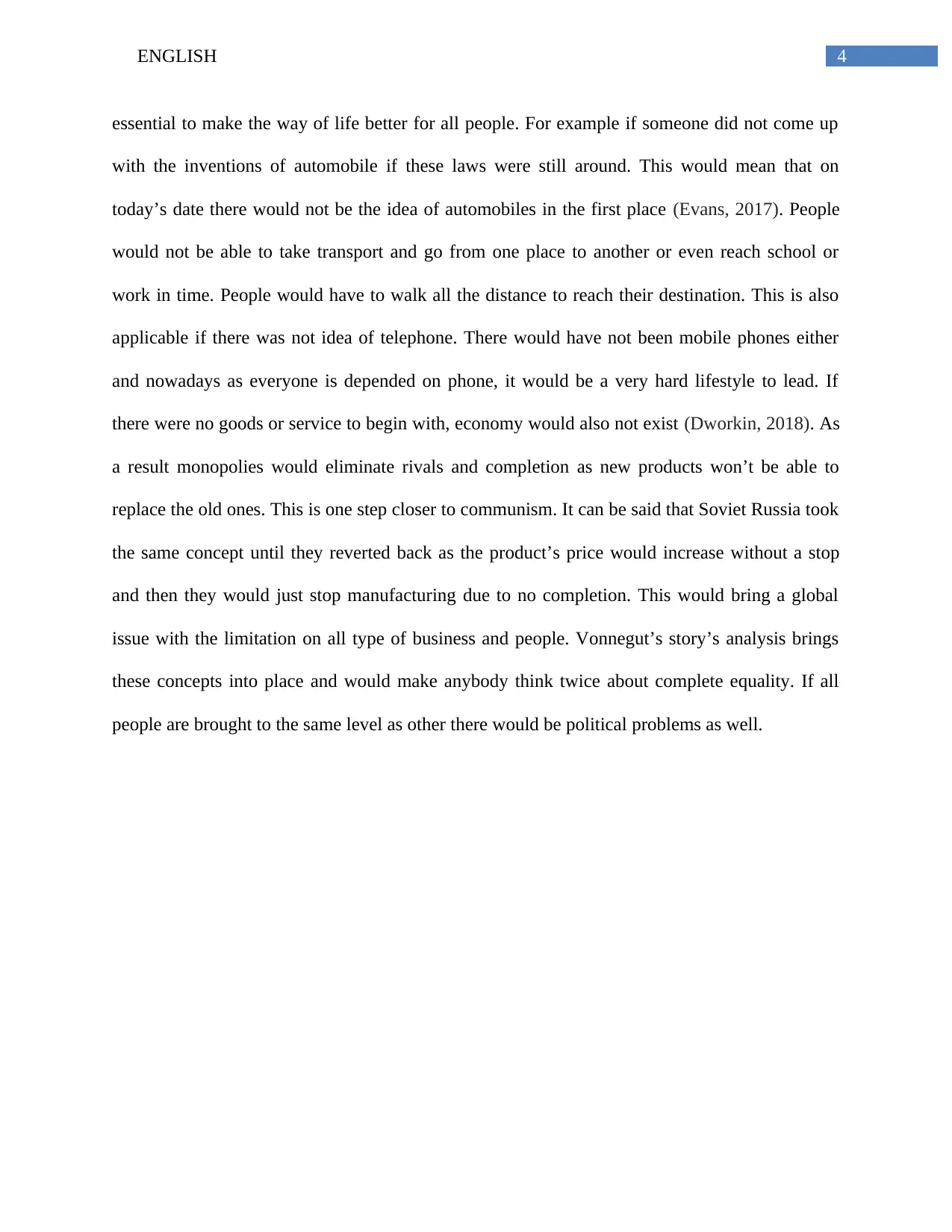
essential to make the way of life better for all people. For example if someone did not come up
with the inventions of automobile if these laws were still around. This would mean that on
today’s date there would not be the idea of automobiles in the first place (Evans, 2017). People
would not be able to take transport and go from one place to another or even reach school or
work in time. People would have to walk all the distance to reach their destination. This is also
applicable if there was not idea of telephone. There would have not been mobile phones either
and nowadays as everyone is depended on phone, it would be a very hard lifestyle to lead. If
there were no goods or service to begin with, economy would also not exist (Dworkin, 2018). As
a result monopolies would eliminate rivals and completion as new products won’t be able to
replace the old ones. This is one step closer to communism. It can be said that Soviet Russia took
the same concept until they reverted back as the product’s price would increase without a stop
and then they would just stop manufacturing due to no completion. This would bring a global
issue with the limitation on all type of business and people. Vonnegut’s story’s analysis brings
these concepts into place and would make anybody think twice about complete equality. If all
people are brought to the same level as other there would be political problems as well.
Document Page
5ENGLISH
Thesis Statement
The future of America has been taken over by the Government that has created negative impact
by enforcing total equality.
Research Question
How can the total equality cause a negative impact on the society?
Document Page
6ENGLISH
References
Bayefsky, A. F. (2017). The Principle of Equality Ornon-Discrimination in International Law.
In Equality and Non-Discrimination under International Law (pp. 71-104). Routledge.
Broome, J. (2017). Weighing goods: Equality, uncertainty and time. John Wiley & Sons.
Cole, M. (2017). Education, equality and human rights: issues of gender,'race', sexuality,
disability and social class. Routledge.
Dworkin, R. (2018). What is equality? Part 2: Equality of resources. In The Notion of
Equality (pp. 143-205). Routledge.
Evans, J. (2017). Equality, education, and physical education. Routledge.
Lynch, K., Baker, J., Lyons, M., Feeley, M., Hanlon, N., Walsh, J., & Cantillon, S.
(2016). Affective equality: Love, care and injustice. Springer.
McCloskey, D. N. (2016). Bourgeois equality: How ideas, not capital or institutions, enriched
the world (Vol. 3). Chicago: University of Chicago Press.
Norman, D. (2017). Equality of What: Welfare, Resources, or Capabilities? 1. In John
Rawls (pp. 169-192). Routledge.
Spring, J. (2016). Deculturalization and the struggle for equality: A brief history of the education
of dominated cultures in the United States. Routledge.
Thompson, N. (2016). Anti-discriminatory practice: Equality, diversity and social justice.
Macmillan International Higher Education.
chevron_up_icon
1 out of 7
circle_padding
hide_on_mobile
zoom_out_icon
[object Object]