Nursing Research: Literature Evaluation Table and PICOT Question
VerifiedAdded on 2023/03/30
|6
|1269
|167
Homework Assignment
AI Summary
This assignment focuses on a nursing research project examining the impact of Continuous Positive Airway Pressure (CPAP) on bariatric patients with Obstructive Sleep Apnea (OSA). The student begins by summarizing the clinical issue of OSA in this population, highlighting its prevalence and the challenges it presents, particularly regarding postoperative complications. A PICOT question is then formulated: "For bariatric patients with obstructive sleep apnea (OSA)(P) does the use of Continuous Positive Airway Pressure (CPAP) (I) reduce postoperative adverse events (O) compared with no-CPAP (C)?". The core of the assignment is a literature evaluation table, analyzing six peer-reviewed research articles. Each article is assessed based on how it relates to the PICOT question, the research methods employed, key findings, and recommendations. The articles explore various aspects, including risk factors for complications, the effectiveness of CPAP, and determinants of CPAP compliance. The table provides a structured overview of the existing research, supporting the student's understanding of the topic and providing a foundation for further research and potential capstone projects.
Literature Evaluation Table
Student Name:
Summary of Clinical Issue (200-250 words):
Obstructive sleep apnea is prevalent in the bariatric surgical population. It is a condition that is characterized by periodic apnea or
hypopnea of breathing as a result of narrowing of the upper airway when one is sleep. It is the reoriented breathing patterns the leads
to hypoxia and sleeps disturbances, thereby preventing restful sleep (Ingles et al., 2016). The signs and symptoms of this condition
may be characterized by loud snoring, daytime drowsiness, ability to fall asleep quickly and restlessness and periods of apnea while
sleeping (Shin, et al., 2016). Obstructive sleep apnea may be treatment with ventilator an excellent example being the continuous
positive airway pressure machine. It is also evidenced by various researches that Bariatric operations or major abdominal surgery and
weight loss are effective in reducing the symptoms of the condition.
Major abdominal surgery is linked with various numbers of serious complications that may hinder the process of patient recovery.
In particular, postoperative pulmonary complications, including respiratory complications like atelectasis and pneumonia, are some of
the key contributors to postoperative morbidity, which may even cause an increase in the rate of mortality (Subramani et al., 2017).
Continuous positive airway pressure is a treatment approach that involves the use of high-pressure gas, which delivers constant
© 2019. Grand Canyon University. All Rights Reserved.
Student Name:
Summary of Clinical Issue (200-250 words):
Obstructive sleep apnea is prevalent in the bariatric surgical population. It is a condition that is characterized by periodic apnea or
hypopnea of breathing as a result of narrowing of the upper airway when one is sleep. It is the reoriented breathing patterns the leads
to hypoxia and sleeps disturbances, thereby preventing restful sleep (Ingles et al., 2016). The signs and symptoms of this condition
may be characterized by loud snoring, daytime drowsiness, ability to fall asleep quickly and restlessness and periods of apnea while
sleeping (Shin, et al., 2016). Obstructive sleep apnea may be treatment with ventilator an excellent example being the continuous
positive airway pressure machine. It is also evidenced by various researches that Bariatric operations or major abdominal surgery and
weight loss are effective in reducing the symptoms of the condition.
Major abdominal surgery is linked with various numbers of serious complications that may hinder the process of patient recovery.
In particular, postoperative pulmonary complications, including respiratory complications like atelectasis and pneumonia, are some of
the key contributors to postoperative morbidity, which may even cause an increase in the rate of mortality (Subramani et al., 2017).
Continuous positive airway pressure is a treatment approach that involves the use of high-pressure gas, which delivers constant
© 2019. Grand Canyon University. All Rights Reserved.
Paraphrase This Document
Need a fresh take? Get an instant paraphrase of this document with our AI Paraphraser

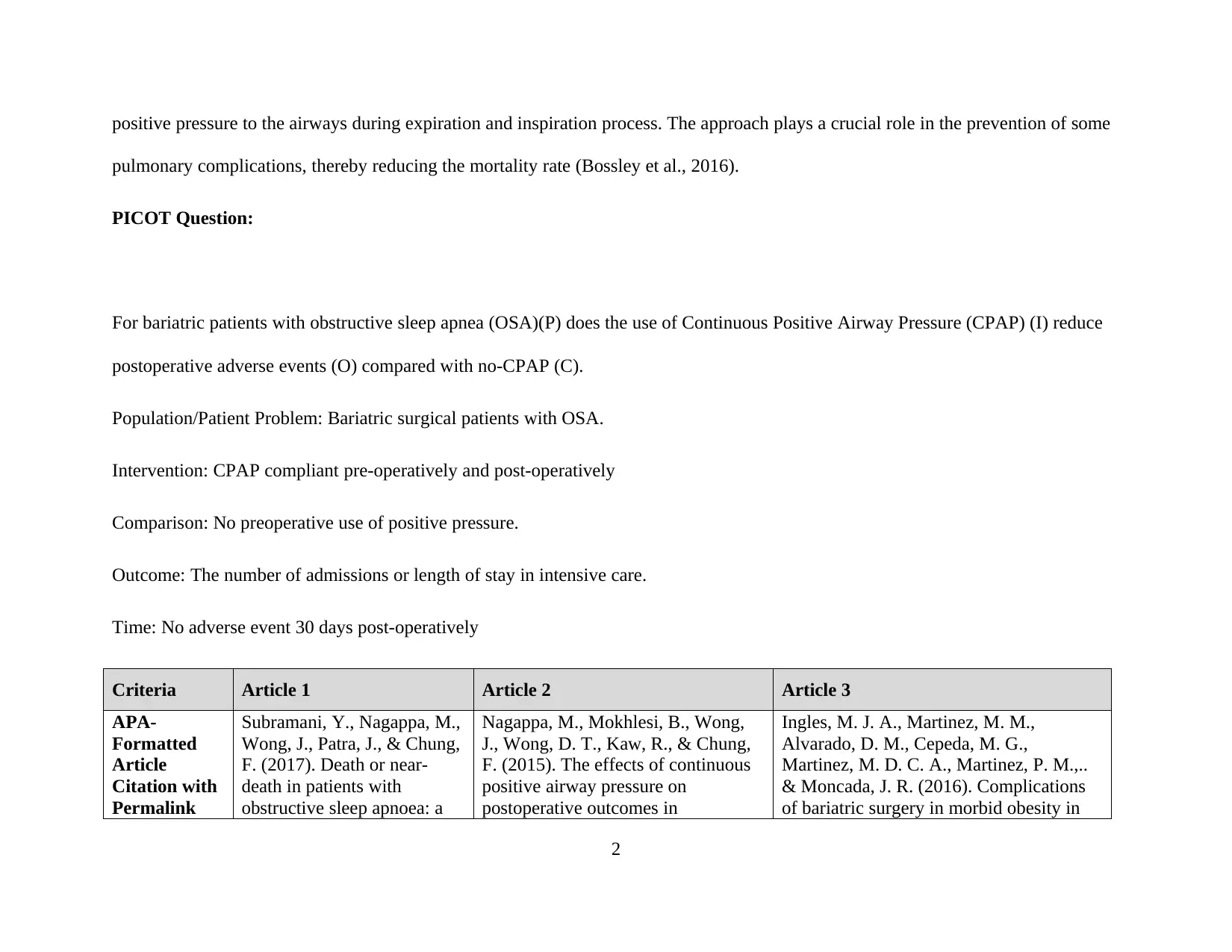
positive pressure to the airways during expiration and inspiration process. The approach plays a crucial role in the prevention of some
pulmonary complications, thereby reducing the mortality rate (Bossley et al., 2016).
PICOT Question:
For bariatric patients with obstructive sleep apnea (OSA)(P) does the use of Continuous Positive Airway Pressure (CPAP) (I) reduce
postoperative adverse events (O) compared with no-CPAP (C).
Population/Patient Problem: Bariatric surgical patients with OSA.
Intervention: CPAP compliant pre-operatively and post-operatively
Comparison: No preoperative use of positive pressure.
Outcome: The number of admissions or length of stay in intensive care.
Time: No adverse event 30 days post-operatively
Criteria Article 1 Article 2 Article 3
APA-
Formatted
Article
Citation with
Permalink
Subramani, Y., Nagappa, M.,
Wong, J., Patra, J., & Chung,
F. (2017). Death or near-
death in patients with
obstructive sleep apnoea: a
Nagappa, M., Mokhlesi, B., Wong,
J., Wong, D. T., Kaw, R., & Chung,
F. (2015). The effects of continuous
positive airway pressure on
postoperative outcomes in
Ingles, M. J. A., Martinez, M. M.,
Alvarado, D. M., Cepeda, M. G.,
Martinez, M. D. C. A., Martinez, P. M.,..
& Moncada, J. R. (2016). Complications
of bariatric surgery in morbid obesity in
2
pulmonary complications, thereby reducing the mortality rate (Bossley et al., 2016).
PICOT Question:
For bariatric patients with obstructive sleep apnea (OSA)(P) does the use of Continuous Positive Airway Pressure (CPAP) (I) reduce
postoperative adverse events (O) compared with no-CPAP (C).
Population/Patient Problem: Bariatric surgical patients with OSA.
Intervention: CPAP compliant pre-operatively and post-operatively
Comparison: No preoperative use of positive pressure.
Outcome: The number of admissions or length of stay in intensive care.
Time: No adverse event 30 days post-operatively
Criteria Article 1 Article 2 Article 3
APA-
Formatted
Article
Citation with
Permalink
Subramani, Y., Nagappa, M.,
Wong, J., Patra, J., & Chung,
F. (2017). Death or near-
death in patients with
obstructive sleep apnoea: a
Nagappa, M., Mokhlesi, B., Wong,
J., Wong, D. T., Kaw, R., & Chung,
F. (2015). The effects of continuous
positive airway pressure on
postoperative outcomes in
Ingles, M. J. A., Martinez, M. M.,
Alvarado, D. M., Cepeda, M. G.,
Martinez, M. D. C. A., Martinez, P. M.,..
& Moncada, J. R. (2016). Complications
of bariatric surgery in morbid obesity in
2

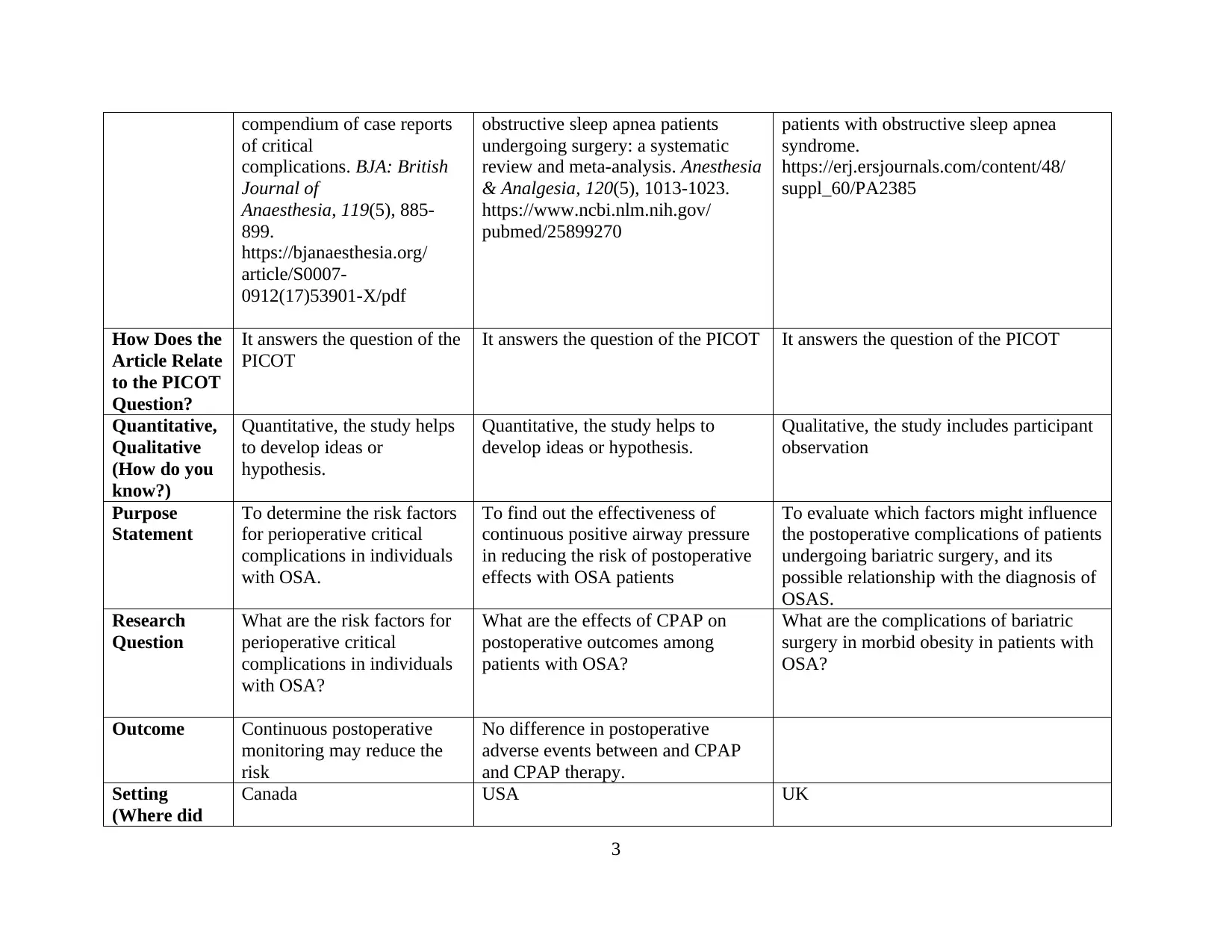
compendium of case reports
of critical
complications. BJA: British
Journal of
Anaesthesia, 119(5), 885-
899.
https://bjanaesthesia.org/
article/S0007-
0912(17)53901-X/pdf
obstructive sleep apnea patients
undergoing surgery: a systematic
review and meta-analysis. Anesthesia
& Analgesia, 120(5), 1013-1023.
https://www.ncbi.nlm.nih.gov/
pubmed/25899270
patients with obstructive sleep apnea
syndrome.
https://erj.ersjournals.com/content/48/
suppl_60/PA2385
How Does the
Article Relate
to the PICOT
Question?
It answers the question of the
PICOT
It answers the question of the PICOT It answers the question of the PICOT
Quantitative,
Qualitative
(How do you
know?)
Quantitative, the study helps
to develop ideas or
hypothesis.
Quantitative, the study helps to
develop ideas or hypothesis.
Qualitative, the study includes participant
observation
Purpose
Statement
To determine the risk factors
for perioperative critical
complications in individuals
with OSA.
To find out the effectiveness of
continuous positive airway pressure
in reducing the risk of postoperative
effects with OSA patients
To evaluate which factors might influence
the postoperative complications of patients
undergoing bariatric surgery, and its
possible relationship with the diagnosis of
OSAS.
Research
Question
What are the risk factors for
perioperative critical
complications in individuals
with OSA?
What are the effects of CPAP on
postoperative outcomes among
patients with OSA?
What are the complications of bariatric
surgery in morbid obesity in patients with
OSA?
Outcome Continuous postoperative
monitoring may reduce the
risk
No difference in postoperative
adverse events between and CPAP
and CPAP therapy.
Setting
(Where did
Canada USA UK
3
of critical
complications. BJA: British
Journal of
Anaesthesia, 119(5), 885-
899.
https://bjanaesthesia.org/
article/S0007-
0912(17)53901-X/pdf
obstructive sleep apnea patients
undergoing surgery: a systematic
review and meta-analysis. Anesthesia
& Analgesia, 120(5), 1013-1023.
https://www.ncbi.nlm.nih.gov/
pubmed/25899270
patients with obstructive sleep apnea
syndrome.
https://erj.ersjournals.com/content/48/
suppl_60/PA2385
How Does the
Article Relate
to the PICOT
Question?
It answers the question of the
PICOT
It answers the question of the PICOT It answers the question of the PICOT
Quantitative,
Qualitative
(How do you
know?)
Quantitative, the study helps
to develop ideas or
hypothesis.
Quantitative, the study helps to
develop ideas or hypothesis.
Qualitative, the study includes participant
observation
Purpose
Statement
To determine the risk factors
for perioperative critical
complications in individuals
with OSA.
To find out the effectiveness of
continuous positive airway pressure
in reducing the risk of postoperative
effects with OSA patients
To evaluate which factors might influence
the postoperative complications of patients
undergoing bariatric surgery, and its
possible relationship with the diagnosis of
OSAS.
Research
Question
What are the risk factors for
perioperative critical
complications in individuals
with OSA?
What are the effects of CPAP on
postoperative outcomes among
patients with OSA?
What are the complications of bariatric
surgery in morbid obesity in patients with
OSA?
Outcome Continuous postoperative
monitoring may reduce the
risk
No difference in postoperative
adverse events between and CPAP
and CPAP therapy.
Setting
(Where did
Canada USA UK
3
⊘ This is a preview!⊘
Do you want full access?
Subscribe today to unlock all pages.

Trusted by 1+ million students worldwide

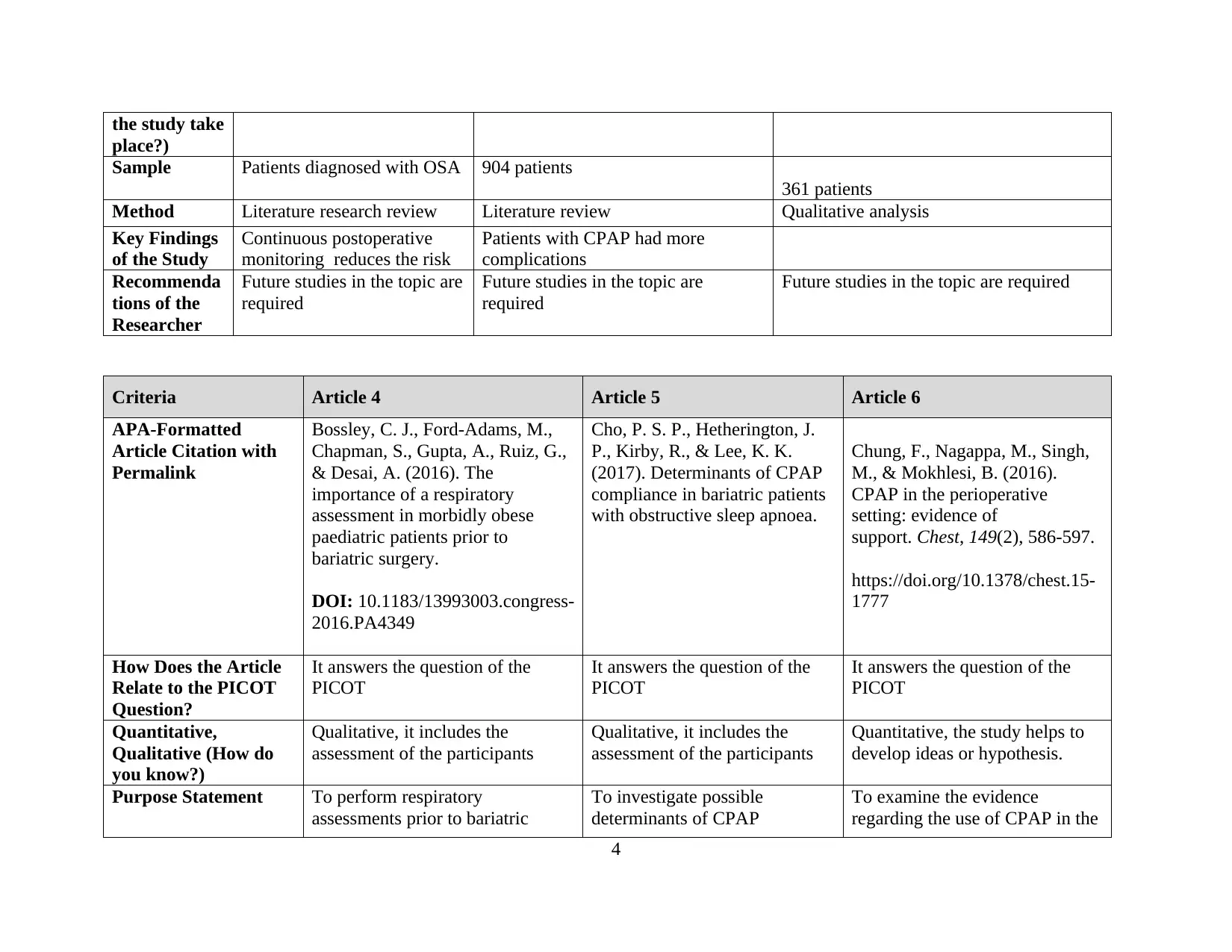
the study take
place?)
Sample Patients diagnosed with OSA 904 patients
361 patients
Method Literature research review Literature review Qualitative analysis
Key Findings
of the Study
Continuous postoperative
monitoring reduces the risk
Patients with CPAP had more
complications
Recommenda
tions of the
Researcher
Future studies in the topic are
required
Future studies in the topic are
required
Future studies in the topic are required
Criteria Article 4 Article 5 Article 6
APA-Formatted
Article Citation with
Permalink
Bossley, C. J., Ford-Adams, M.,
Chapman, S., Gupta, A., Ruiz, G.,
& Desai, A. (2016). The
importance of a respiratory
assessment in morbidly obese
paediatric patients prior to
bariatric surgery.
DOI: 10.1183/13993003.congress-
2016.PA4349
Cho, P. S. P., Hetherington, J.
P., Kirby, R., & Lee, K. K.
(2017). Determinants of CPAP
compliance in bariatric patients
with obstructive sleep apnoea.
Chung, F., Nagappa, M., Singh,
M., & Mokhlesi, B. (2016).
CPAP in the perioperative
setting: evidence of
support. Chest, 149(2), 586-597.
https://doi.org/10.1378/chest.15-
1777
How Does the Article
Relate to the PICOT
Question?
It answers the question of the
PICOT
It answers the question of the
PICOT
It answers the question of the
PICOT
Quantitative,
Qualitative (How do
you know?)
Qualitative, it includes the
assessment of the participants
Qualitative, it includes the
assessment of the participants
Quantitative, the study helps to
develop ideas or hypothesis.
Purpose Statement To perform respiratory
assessments prior to bariatric
To investigate possible
determinants of CPAP
To examine the evidence
regarding the use of CPAP in the
4
place?)
Sample Patients diagnosed with OSA 904 patients
361 patients
Method Literature research review Literature review Qualitative analysis
Key Findings
of the Study
Continuous postoperative
monitoring reduces the risk
Patients with CPAP had more
complications
Recommenda
tions of the
Researcher
Future studies in the topic are
required
Future studies in the topic are
required
Future studies in the topic are required
Criteria Article 4 Article 5 Article 6
APA-Formatted
Article Citation with
Permalink
Bossley, C. J., Ford-Adams, M.,
Chapman, S., Gupta, A., Ruiz, G.,
& Desai, A. (2016). The
importance of a respiratory
assessment in morbidly obese
paediatric patients prior to
bariatric surgery.
DOI: 10.1183/13993003.congress-
2016.PA4349
Cho, P. S. P., Hetherington, J.
P., Kirby, R., & Lee, K. K.
(2017). Determinants of CPAP
compliance in bariatric patients
with obstructive sleep apnoea.
Chung, F., Nagappa, M., Singh,
M., & Mokhlesi, B. (2016).
CPAP in the perioperative
setting: evidence of
support. Chest, 149(2), 586-597.
https://doi.org/10.1378/chest.15-
1777
How Does the Article
Relate to the PICOT
Question?
It answers the question of the
PICOT
It answers the question of the
PICOT
It answers the question of the
PICOT
Quantitative,
Qualitative (How do
you know?)
Qualitative, it includes the
assessment of the participants
Qualitative, it includes the
assessment of the participants
Quantitative, the study helps to
develop ideas or hypothesis.
Purpose Statement To perform respiratory
assessments prior to bariatric
To investigate possible
determinants of CPAP
To examine the evidence
regarding the use of CPAP in the
4
Paraphrase This Document
Need a fresh take? Get an instant paraphrase of this document with our AI Paraphraser

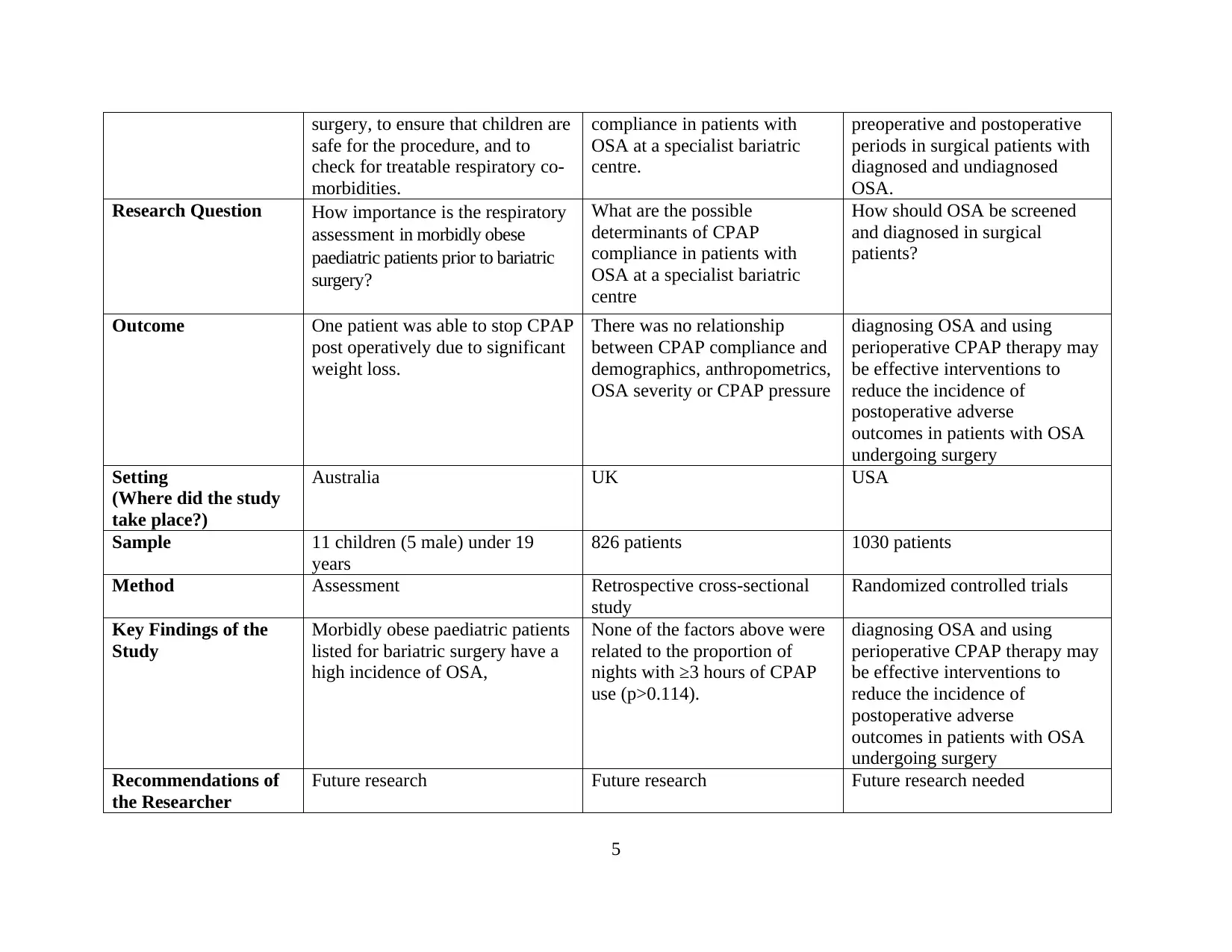
surgery, to ensure that children are
safe for the procedure, and to
check for treatable respiratory co-
morbidities.
compliance in patients with
OSA at a specialist bariatric
centre.
preoperative and postoperative
periods in surgical patients with
diagnosed and undiagnosed
OSA.
Research Question How importance is the respiratory
assessment in morbidly obese
paediatric patients prior to bariatric
surgery?
What are the possible
determinants of CPAP
compliance in patients with
OSA at a specialist bariatric
centre
How should OSA be screened
and diagnosed in surgical
patients?
Outcome One patient was able to stop CPAP
post operatively due to significant
weight loss.
There was no relationship
between CPAP compliance and
demographics, anthropometrics,
OSA severity or CPAP pressure
diagnosing OSA and using
perioperative CPAP therapy may
be effective interventions to
reduce the incidence of
postoperative adverse
outcomes in patients with OSA
undergoing surgery
Setting
(Where did the study
take place?)
Australia UK USA
Sample 11 children (5 male) under 19
years
826 patients 1030 patients
Method Assessment Retrospective cross-sectional
study
Randomized controlled trials
Key Findings of the
Study
Morbidly obese paediatric patients
listed for bariatric surgery have a
high incidence of OSA,
None of the factors above were
related to the proportion of
nights with ≥3 hours of CPAP
use (p>0.114).
diagnosing OSA and using
perioperative CPAP therapy may
be effective interventions to
reduce the incidence of
postoperative adverse
outcomes in patients with OSA
undergoing surgery
Recommendations of
the Researcher
Future research Future research Future research needed
5
safe for the procedure, and to
check for treatable respiratory co-
morbidities.
compliance in patients with
OSA at a specialist bariatric
centre.
preoperative and postoperative
periods in surgical patients with
diagnosed and undiagnosed
OSA.
Research Question How importance is the respiratory
assessment in morbidly obese
paediatric patients prior to bariatric
surgery?
What are the possible
determinants of CPAP
compliance in patients with
OSA at a specialist bariatric
centre
How should OSA be screened
and diagnosed in surgical
patients?
Outcome One patient was able to stop CPAP
post operatively due to significant
weight loss.
There was no relationship
between CPAP compliance and
demographics, anthropometrics,
OSA severity or CPAP pressure
diagnosing OSA and using
perioperative CPAP therapy may
be effective interventions to
reduce the incidence of
postoperative adverse
outcomes in patients with OSA
undergoing surgery
Setting
(Where did the study
take place?)
Australia UK USA
Sample 11 children (5 male) under 19
years
826 patients 1030 patients
Method Assessment Retrospective cross-sectional
study
Randomized controlled trials
Key Findings of the
Study
Morbidly obese paediatric patients
listed for bariatric surgery have a
high incidence of OSA,
None of the factors above were
related to the proportion of
nights with ≥3 hours of CPAP
use (p>0.114).
diagnosing OSA and using
perioperative CPAP therapy may
be effective interventions to
reduce the incidence of
postoperative adverse
outcomes in patients with OSA
undergoing surgery
Recommendations of
the Researcher
Future research Future research Future research needed
5

References
Subramani, Y., Nagappa, M., Wong, J., Patra, J., & Chung, F. (2017). Death or near-death in patients with obstructive sleep apnoea: a
compendium of case reports of critical complications. BJA: British Journal of Anaesthesia, 119(5), 885-899.
Shin, C. H., Zaremba, S., Devine, S., Nikolov, M., Kurth, T., & Eikermann, M. (2016). Effects of obstructive sleep apnoea risk on
postoperative respiratory complications.
Ingles, M. J. A., Martinez, M. M., Alvarado, D. M., Cepeda, M. G., Martinez, M. D. C. A., Martinez, P. M.,.. & Moncada, J. R.
(2016). Complications of bariatric surgery in morbid obesity in patients with obstructive sleep apnea syndrome.
Bossley, C. J., Ford-Adams, M., Chapman, S., Gupta, A., Ruiz, G., & Desai, A. (2016). The importance of a respiratory assessment in
morbidly obese paediatric patients prior to bariatric surgery.
6
Subramani, Y., Nagappa, M., Wong, J., Patra, J., & Chung, F. (2017). Death or near-death in patients with obstructive sleep apnoea: a
compendium of case reports of critical complications. BJA: British Journal of Anaesthesia, 119(5), 885-899.
Shin, C. H., Zaremba, S., Devine, S., Nikolov, M., Kurth, T., & Eikermann, M. (2016). Effects of obstructive sleep apnoea risk on
postoperative respiratory complications.
Ingles, M. J. A., Martinez, M. M., Alvarado, D. M., Cepeda, M. G., Martinez, M. D. C. A., Martinez, P. M.,.. & Moncada, J. R.
(2016). Complications of bariatric surgery in morbid obesity in patients with obstructive sleep apnea syndrome.
Bossley, C. J., Ford-Adams, M., Chapman, S., Gupta, A., Ruiz, G., & Desai, A. (2016). The importance of a respiratory assessment in
morbidly obese paediatric patients prior to bariatric surgery.
6
⊘ This is a preview!⊘
Do you want full access?
Subscribe today to unlock all pages.

Trusted by 1+ million students worldwide
1 out of 6
Your All-in-One AI-Powered Toolkit for Academic Success.
+13062052269
info@desklib.com
Available 24*7 on WhatsApp / Email
Unlock your academic potential
Copyright © 2020–2025 A2Z Services. All Rights Reserved. Developed and managed by ZUCOL.