Literature Review and Analysis: Corporate Social Responsibility
VerifiedAdded on 2021/01/02
|9
|2565
|331
Report
AI Summary
This report presents a comprehensive literature review on Corporate Social Responsibility (CSR), exploring its definition, importance, and various perspectives. The review highlights CSR's role in enhancing business practices and societal well-being, examining the influence of government policies, stakeholder theory, and the impact on small businesses. It discusses the benefits of CSR, such as improved customer relations, ethical considerations, and sustainable practices, while also addressing challenges like cost implications for small businesses. The report analyzes the views of multiple authors, including Manchanda, Lopatta, Chaudhri, De Bakker, Helmig, Rayman-Bacchus, Tran, Kim, and Ağan, to provide a nuanced understanding of CSR's multifaceted nature. It covers the five C's of CSR (Conviction, Commitment, Communication, Consistency, Credibility) and the implications of CSR for charitable organizations and environmental sustainability, concluding with a summary of key findings and the overall impact of CSR on business and society.
Corporate
Social
Responsibility
Social
Responsibility

Paraphrase This Document
Need a fresh take? Get an instant paraphrase of this document with our AI Paraphraser
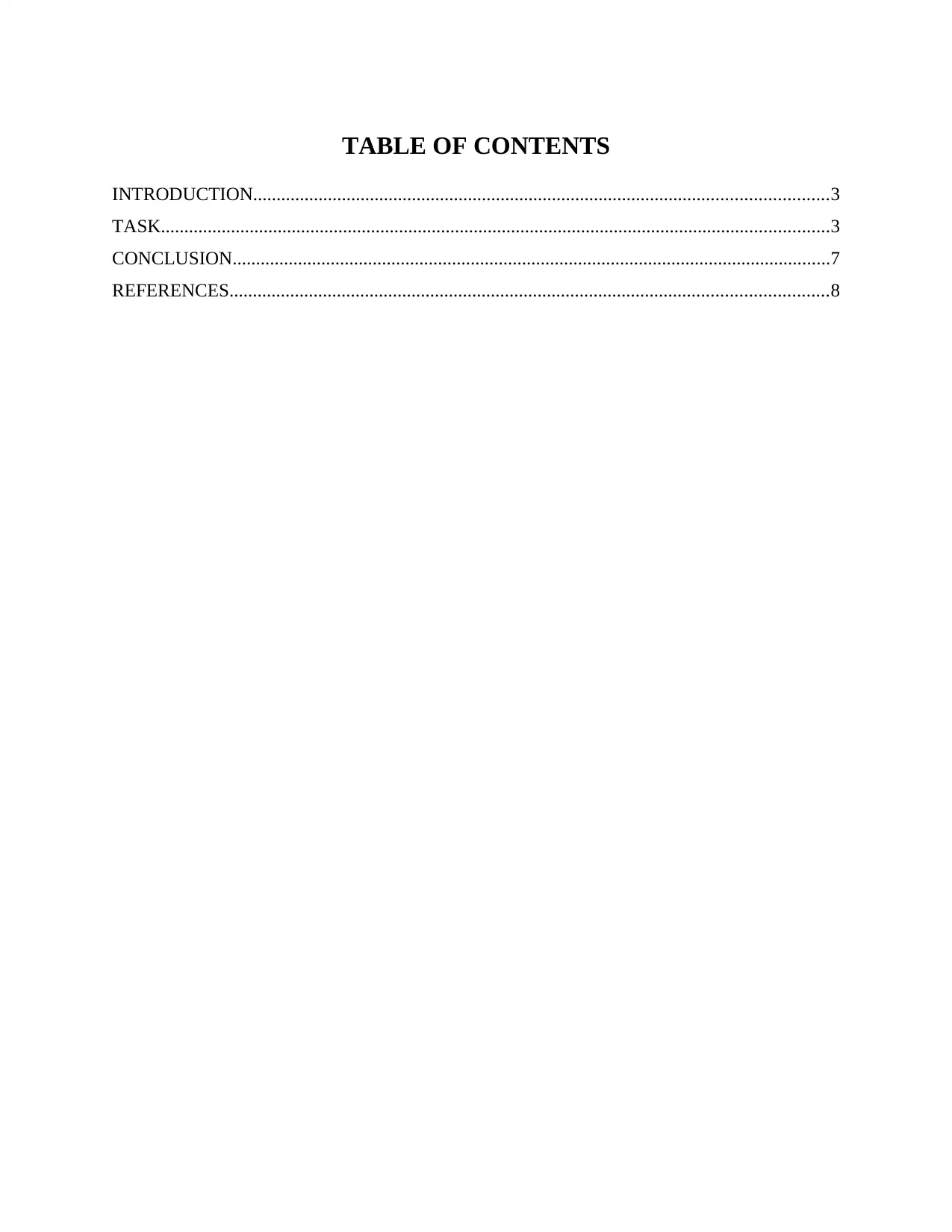
TABLE OF CONTENTS
INTRODUCTION...........................................................................................................................3
TASK...............................................................................................................................................3
CONCLUSION................................................................................................................................7
REFERENCES................................................................................................................................8
INTRODUCTION...........................................................................................................................3
TASK...............................................................................................................................................3
CONCLUSION................................................................................................................................7
REFERENCES................................................................................................................................8
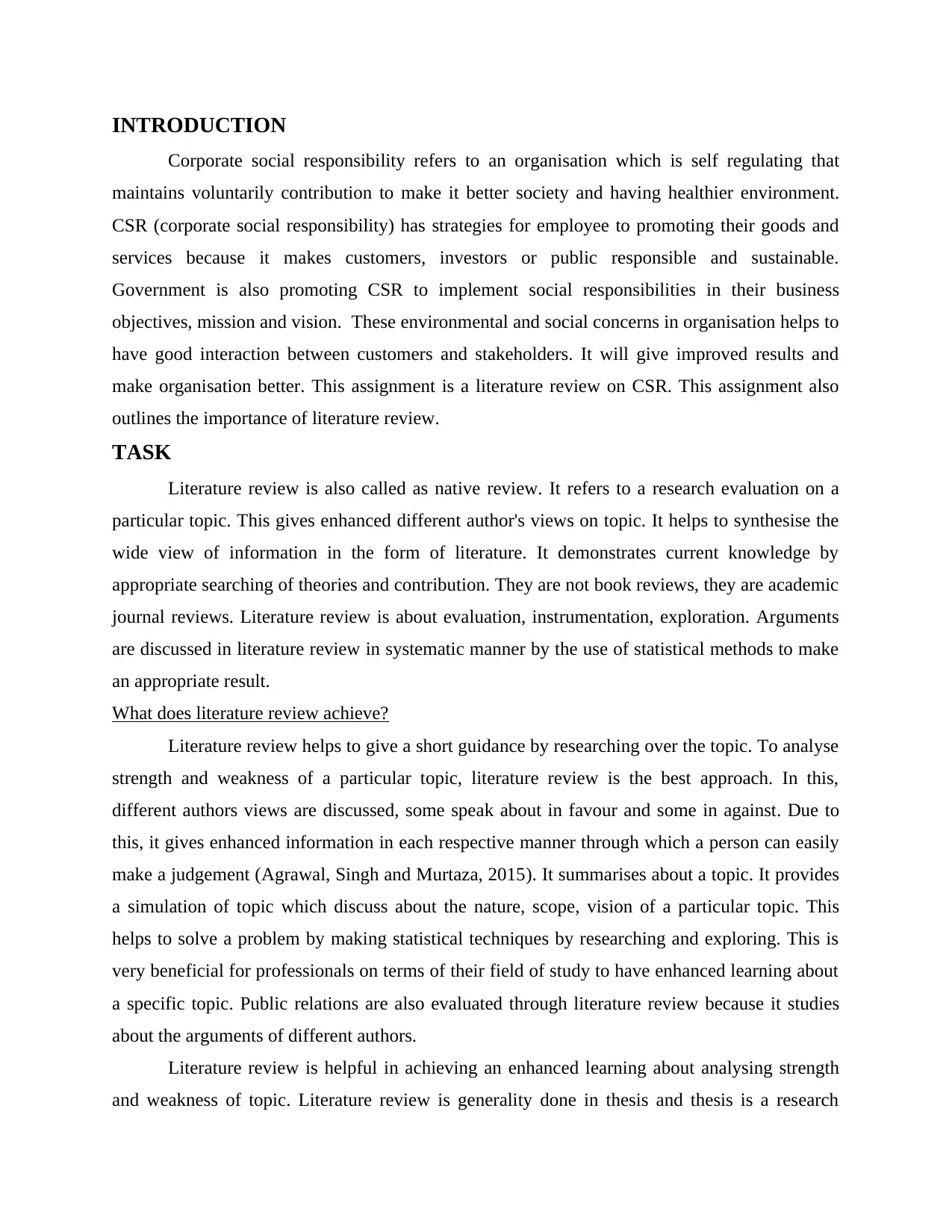
INTRODUCTION
Corporate social responsibility refers to an organisation which is self regulating that
maintains voluntarily contribution to make it better society and having healthier environment.
CSR (corporate social responsibility) has strategies for employee to promoting their goods and
services because it makes customers, investors or public responsible and sustainable.
Government is also promoting CSR to implement social responsibilities in their business
objectives, mission and vision. These environmental and social concerns in organisation helps to
have good interaction between customers and stakeholders. It will give improved results and
make organisation better. This assignment is a literature review on CSR. This assignment also
outlines the importance of literature review.
TASK
Literature review is also called as native review. It refers to a research evaluation on a
particular topic. This gives enhanced different author's views on topic. It helps to synthesise the
wide view of information in the form of literature. It demonstrates current knowledge by
appropriate searching of theories and contribution. They are not book reviews, they are academic
journal reviews. Literature review is about evaluation, instrumentation, exploration. Arguments
are discussed in literature review in systematic manner by the use of statistical methods to make
an appropriate result.
What does literature review achieve?
Literature review helps to give a short guidance by researching over the topic. To analyse
strength and weakness of a particular topic, literature review is the best approach. In this,
different authors views are discussed, some speak about in favour and some in against. Due to
this, it gives enhanced information in each respective manner through which a person can easily
make a judgement (Agrawal, Singh and Murtaza, 2015). It summarises about a topic. It provides
a simulation of topic which discuss about the nature, scope, vision of a particular topic. This
helps to solve a problem by making statistical techniques by researching and exploring. This is
very beneficial for professionals on terms of their field of study to have enhanced learning about
a specific topic. Public relations are also evaluated through literature review because it studies
about the arguments of different authors.
Literature review is helpful in achieving an enhanced learning about analysing strength
and weakness of topic. Literature review is generality done in thesis and thesis is a research
Corporate social responsibility refers to an organisation which is self regulating that
maintains voluntarily contribution to make it better society and having healthier environment.
CSR (corporate social responsibility) has strategies for employee to promoting their goods and
services because it makes customers, investors or public responsible and sustainable.
Government is also promoting CSR to implement social responsibilities in their business
objectives, mission and vision. These environmental and social concerns in organisation helps to
have good interaction between customers and stakeholders. It will give improved results and
make organisation better. This assignment is a literature review on CSR. This assignment also
outlines the importance of literature review.
TASK
Literature review is also called as native review. It refers to a research evaluation on a
particular topic. This gives enhanced different author's views on topic. It helps to synthesise the
wide view of information in the form of literature. It demonstrates current knowledge by
appropriate searching of theories and contribution. They are not book reviews, they are academic
journal reviews. Literature review is about evaluation, instrumentation, exploration. Arguments
are discussed in literature review in systematic manner by the use of statistical methods to make
an appropriate result.
What does literature review achieve?
Literature review helps to give a short guidance by researching over the topic. To analyse
strength and weakness of a particular topic, literature review is the best approach. In this,
different authors views are discussed, some speak about in favour and some in against. Due to
this, it gives enhanced information in each respective manner through which a person can easily
make a judgement (Agrawal, Singh and Murtaza, 2015). It summarises about a topic. It provides
a simulation of topic which discuss about the nature, scope, vision of a particular topic. This
helps to solve a problem by making statistical techniques by researching and exploring. This is
very beneficial for professionals on terms of their field of study to have enhanced learning about
a specific topic. Public relations are also evaluated through literature review because it studies
about the arguments of different authors.
Literature review is helpful in achieving an enhanced learning about analysing strength
and weakness of topic. Literature review is generality done in thesis and thesis is a research
⊘ This is a preview!⊘
Do you want full access?
Subscribe today to unlock all pages.

Trusted by 1+ million students worldwide
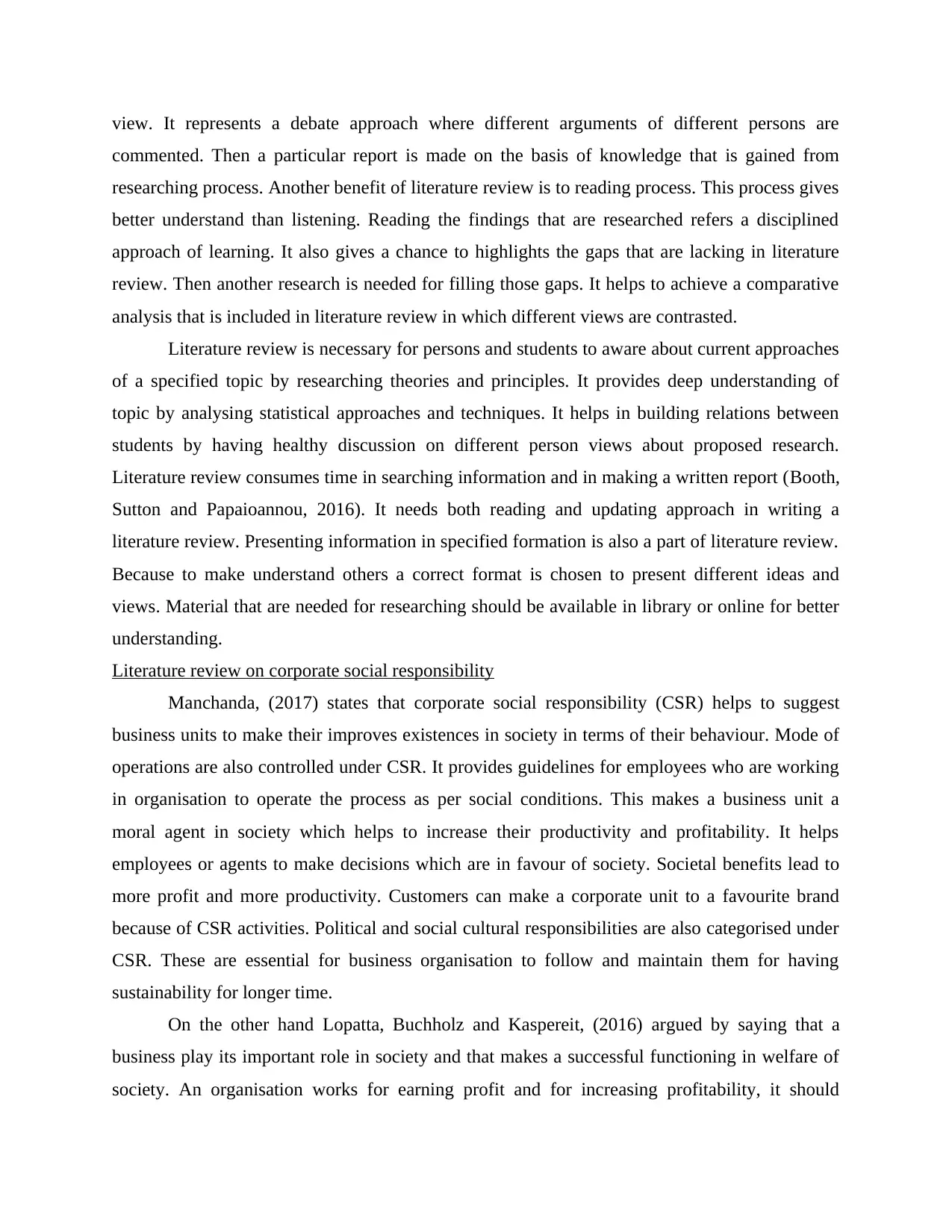
view. It represents a debate approach where different arguments of different persons are
commented. Then a particular report is made on the basis of knowledge that is gained from
researching process. Another benefit of literature review is to reading process. This process gives
better understand than listening. Reading the findings that are researched refers a disciplined
approach of learning. It also gives a chance to highlights the gaps that are lacking in literature
review. Then another research is needed for filling those gaps. It helps to achieve a comparative
analysis that is included in literature review in which different views are contrasted.
Literature review is necessary for persons and students to aware about current approaches
of a specified topic by researching theories and principles. It provides deep understanding of
topic by analysing statistical approaches and techniques. It helps in building relations between
students by having healthy discussion on different person views about proposed research.
Literature review consumes time in searching information and in making a written report (Booth,
Sutton and Papaioannou, 2016). It needs both reading and updating approach in writing a
literature review. Presenting information in specified formation is also a part of literature review.
Because to make understand others a correct format is chosen to present different ideas and
views. Material that are needed for researching should be available in library or online for better
understanding.
Literature review on corporate social responsibility
Manchanda, (2017) states that corporate social responsibility (CSR) helps to suggest
business units to make their improves existences in society in terms of their behaviour. Mode of
operations are also controlled under CSR. It provides guidelines for employees who are working
in organisation to operate the process as per social conditions. This makes a business unit a
moral agent in society which helps to increase their productivity and profitability. It helps
employees or agents to make decisions which are in favour of society. Societal benefits lead to
more profit and more productivity. Customers can make a corporate unit to a favourite brand
because of CSR activities. Political and social cultural responsibilities are also categorised under
CSR. These are essential for business organisation to follow and maintain them for having
sustainability for longer time.
On the other hand Lopatta, Buchholz and Kaspereit, (2016) argued by saying that a
business play its important role in society and that makes a successful functioning in welfare of
society. An organisation works for earning profit and for increasing profitability, it should
commented. Then a particular report is made on the basis of knowledge that is gained from
researching process. Another benefit of literature review is to reading process. This process gives
better understand than listening. Reading the findings that are researched refers a disciplined
approach of learning. It also gives a chance to highlights the gaps that are lacking in literature
review. Then another research is needed for filling those gaps. It helps to achieve a comparative
analysis that is included in literature review in which different views are contrasted.
Literature review is necessary for persons and students to aware about current approaches
of a specified topic by researching theories and principles. It provides deep understanding of
topic by analysing statistical approaches and techniques. It helps in building relations between
students by having healthy discussion on different person views about proposed research.
Literature review consumes time in searching information and in making a written report (Booth,
Sutton and Papaioannou, 2016). It needs both reading and updating approach in writing a
literature review. Presenting information in specified formation is also a part of literature review.
Because to make understand others a correct format is chosen to present different ideas and
views. Material that are needed for researching should be available in library or online for better
understanding.
Literature review on corporate social responsibility
Manchanda, (2017) states that corporate social responsibility (CSR) helps to suggest
business units to make their improves existences in society in terms of their behaviour. Mode of
operations are also controlled under CSR. It provides guidelines for employees who are working
in organisation to operate the process as per social conditions. This makes a business unit a
moral agent in society which helps to increase their productivity and profitability. It helps
employees or agents to make decisions which are in favour of society. Societal benefits lead to
more profit and more productivity. Customers can make a corporate unit to a favourite brand
because of CSR activities. Political and social cultural responsibilities are also categorised under
CSR. These are essential for business organisation to follow and maintain them for having
sustainability for longer time.
On the other hand Lopatta, Buchholz and Kaspereit, (2016) argued by saying that a
business play its important role in society and that makes a successful functioning in welfare of
society. An organisation works for earning profit and for increasing profitability, it should
Paraphrase This Document
Need a fresh take? Get an instant paraphrase of this document with our AI Paraphraser
enhanced its trust to public in society. This is only a strategy. They are not doing by representing
or considering as a responsibility. Owners are always in need of profit and sometimes they
choose illegal path which can harm the society. They are considering this an economic
responsibility in place of social responsibility. But then also, government has also rights to make
actions against such units by impeding illegal tax on them. This will help to stop diverting the
efficiency of economy.
As per view of Chaudhri, (2016) CSR is included in list of scientific research. This is not
only researched by philosophers, economists and sociologists but also by management
authorities of business unit to expand their branding level. It briefly gives analysis about social
and economic benefits. But it needs to follow moral and ethical conditions to make society
environment logical and beneficial. CSR focusses on maintaining relation between different
stakeholders to make them voluntarily responsible to do their work. Different stakeholders make
CSR strategies to help societies in different manner and in every year. This is to maintain ethical
and legitimate relations by taking strategical actions to make entrepreneurial environment. It
helps to strengthen the human dignity sense, their moral and ethical concerns, policies and laws.
These laws are considerable for both small and large business for contributing their part of
earning to societies for their welfare.
De Bakker, (2016) presented CSR by discussing two principles; social power equation
and iron law of responsibility. Social power equation refers to businessmen responsibilities
which are analysed by evaluating social power value that an individual have. Iron law of
responsibilities evaluates the negative consequences of social power use in absent mechanism. In
general, who do nowt follow social power, will lose unconditionally. Social power equation has
a dynamics of multi agents who are inspired by research background to make their business unit
socially responsible to make profits. It is like a simulation of agents socially to make them
responsible about legal frameworks which are valuable in favour of organisation.
According to Helmig, Spraul and Ingenhoff (2016) stakeholder theory has a special
contribution to CSR activities. This theory is related to business ethics and management of
organisation. It means moral and ethical values are addressing by management authorities of
organisation. Shareholders are responsible for a success business. This theory is to benefits both
customers and businessmen. Stakeholders are groups or can be individual which provides
support to organisation to expand their distribution network. Risks are also involved in taking
or considering as a responsibility. Owners are always in need of profit and sometimes they
choose illegal path which can harm the society. They are considering this an economic
responsibility in place of social responsibility. But then also, government has also rights to make
actions against such units by impeding illegal tax on them. This will help to stop diverting the
efficiency of economy.
As per view of Chaudhri, (2016) CSR is included in list of scientific research. This is not
only researched by philosophers, economists and sociologists but also by management
authorities of business unit to expand their branding level. It briefly gives analysis about social
and economic benefits. But it needs to follow moral and ethical conditions to make society
environment logical and beneficial. CSR focusses on maintaining relation between different
stakeholders to make them voluntarily responsible to do their work. Different stakeholders make
CSR strategies to help societies in different manner and in every year. This is to maintain ethical
and legitimate relations by taking strategical actions to make entrepreneurial environment. It
helps to strengthen the human dignity sense, their moral and ethical concerns, policies and laws.
These laws are considerable for both small and large business for contributing their part of
earning to societies for their welfare.
De Bakker, (2016) presented CSR by discussing two principles; social power equation
and iron law of responsibility. Social power equation refers to businessmen responsibilities
which are analysed by evaluating social power value that an individual have. Iron law of
responsibilities evaluates the negative consequences of social power use in absent mechanism. In
general, who do nowt follow social power, will lose unconditionally. Social power equation has
a dynamics of multi agents who are inspired by research background to make their business unit
socially responsible to make profits. It is like a simulation of agents socially to make them
responsible about legal frameworks which are valuable in favour of organisation.
According to Helmig, Spraul and Ingenhoff (2016) stakeholder theory has a special
contribution to CSR activities. This theory is related to business ethics and management of
organisation. It means moral and ethical values are addressing by management authorities of
organisation. Shareholders are responsible for a success business. This theory is to benefits both
customers and businessmen. Stakeholders are groups or can be individual which provides
support to organisation to expand their distribution network. Risks are also involved in taking
benefits. They invest some amount which makes a huge profit to fulfil interest of employees that
they want. Social contracts importance is evaluated through this theory. Interventions are also
part of this to make strategic CSR. It helps to change social level for both investments cost and
profit earned. According to government legal policies, company law are changed which affects
society view to avail services. It can be both positive and negative. An audit is a part of CSR in
which company's stakeholders work is evaluated.
On the other hand Rayman-Bacchus, (2017) contradicts the stakeholder theory by saying
that stakeholders are focussed to make their own interests. Both internal and external
stakeholders participate in company interest of earning profitability but they will concise about
their own benefits from company that what company offers to them on having a successful deal.
It has been analysed that stakeholder theory has not made sufficient decision making criteria
which helps in guiding corporate sectors. CSR is not about earning profit. It is to maintain
corporate sector socially, economically and environmentally. Not having efficient decision
making creates negotiations between different parties of stakeholders in organisation due to
which production of business unit influences. This will make huge loss for business. It is
expected a growth of business units which work for the benefits of public but social objectives
are considered by management authorities to increase wealth of stakeholders.
Tran, (2019) commented on CSR by introducing five C's. Conviction, commitment,
communication, consistency, credibility are categorised under five C's. Conviction refers to
improvement, commitment refers to promise for delivering, communication refers to interaction
process, consistency refers to regularity in improvement, credibility refers to corporation ability.
Business practices need to be regularly checked and modified accordingly for improvement in
work process. Communication should be attractive one to make operational relationship good. A
consistency is made in achieving objectives of socially responsible business units. This is like an
open system concept in which corporate units run on environmental conditions for survival. It all
goes to company's stakeholders ability to make their organisation a well brand in providing its
goods and services.
Kim, Qian (2018) presented negative views on CSR. Small businesses has most cost fall
due to CSR. A report is necessary to made in every business to present budget. But this is not for
small business which has employees between 10 to 200. Social media can be used by small
business to interact about CSR policies with customers and other society people. But it consumes
they want. Social contracts importance is evaluated through this theory. Interventions are also
part of this to make strategic CSR. It helps to change social level for both investments cost and
profit earned. According to government legal policies, company law are changed which affects
society view to avail services. It can be both positive and negative. An audit is a part of CSR in
which company's stakeholders work is evaluated.
On the other hand Rayman-Bacchus, (2017) contradicts the stakeholder theory by saying
that stakeholders are focussed to make their own interests. Both internal and external
stakeholders participate in company interest of earning profitability but they will concise about
their own benefits from company that what company offers to them on having a successful deal.
It has been analysed that stakeholder theory has not made sufficient decision making criteria
which helps in guiding corporate sectors. CSR is not about earning profit. It is to maintain
corporate sector socially, economically and environmentally. Not having efficient decision
making creates negotiations between different parties of stakeholders in organisation due to
which production of business unit influences. This will make huge loss for business. It is
expected a growth of business units which work for the benefits of public but social objectives
are considered by management authorities to increase wealth of stakeholders.
Tran, (2019) commented on CSR by introducing five C's. Conviction, commitment,
communication, consistency, credibility are categorised under five C's. Conviction refers to
improvement, commitment refers to promise for delivering, communication refers to interaction
process, consistency refers to regularity in improvement, credibility refers to corporation ability.
Business practices need to be regularly checked and modified accordingly for improvement in
work process. Communication should be attractive one to make operational relationship good. A
consistency is made in achieving objectives of socially responsible business units. This is like an
open system concept in which corporate units run on environmental conditions for survival. It all
goes to company's stakeholders ability to make their organisation a well brand in providing its
goods and services.
Kim, Qian (2018) presented negative views on CSR. Small businesses has most cost fall
due to CSR. A report is necessary to made in every business to present budget. But this is not for
small business which has employees between 10 to 200. Social media can be used by small
business to interact about CSR policies with customers and other society people. But it consumes
⊘ This is a preview!⊘
Do you want full access?
Subscribe today to unlock all pages.
Trusted by 1+ million students worldwide
time for managing changes and to monitor them. Sometimes also, an extra person is needed for
handling CSR policies but small business can not afford to have extra person. Customers are
attracted to social responsibilities of business. CSR policies are in written in context of
benefiting societies by the profit that are earned by business units. But small business can not
more contribution to societies because their earning is not too much.
According to Ağan (2016) CSR helps to charity organisations by donating some
percentage of their earnings to needed one. Charity work not for earning profit, they work for
helping poor persons whenever they are in need. Problem related to their health are solved b
NGOs. But it government make laws for corporate sector to help such charity organisation. This
is not possible for small business but those who have earning in billions and trillions can donate
some part of profit to charitable organisations. A commitment is made to charity that if such a
pofit earned by company than, about this such percentage will be donated. Not only for charity,
Corporate sector also helps in making societies environmental healthier. Some corporate sectors
helped society to have neat and clean area. Some corporate sectors made natural emergency
facilities in societies to make poor people comfortable to use them. Some business units help
schools to make their infrastructure or building sustainable for studious purpose to provide mid
day meals to them in better qualitative. These all are categorised under social responsibilities.
CONCLUSION
Above literature review is summarised about corporate social responsibilities which are
undertaken by business units. A society needs improvement in their functioning role.
Government made certain policies and laws that are followed by corporate sectors to increase the
facilities in societies. It has been analysed that customers are more attracted towards those
business units which takes interest in CSR activities. CSR activities also help organisation to
make them aware about their goods and services, but, it has been evaluated that small business
can not make their more contribution to social responsibilities because these social and economic
benefits are approached on the basis of earning that are made in terms of profit.
handling CSR policies but small business can not afford to have extra person. Customers are
attracted to social responsibilities of business. CSR policies are in written in context of
benefiting societies by the profit that are earned by business units. But small business can not
more contribution to societies because their earning is not too much.
According to Ağan (2016) CSR helps to charity organisations by donating some
percentage of their earnings to needed one. Charity work not for earning profit, they work for
helping poor persons whenever they are in need. Problem related to their health are solved b
NGOs. But it government make laws for corporate sector to help such charity organisation. This
is not possible for small business but those who have earning in billions and trillions can donate
some part of profit to charitable organisations. A commitment is made to charity that if such a
pofit earned by company than, about this such percentage will be donated. Not only for charity,
Corporate sector also helps in making societies environmental healthier. Some corporate sectors
helped society to have neat and clean area. Some corporate sectors made natural emergency
facilities in societies to make poor people comfortable to use them. Some business units help
schools to make their infrastructure or building sustainable for studious purpose to provide mid
day meals to them in better qualitative. These all are categorised under social responsibilities.
CONCLUSION
Above literature review is summarised about corporate social responsibilities which are
undertaken by business units. A society needs improvement in their functioning role.
Government made certain policies and laws that are followed by corporate sectors to increase the
facilities in societies. It has been analysed that customers are more attracted towards those
business units which takes interest in CSR activities. CSR activities also help organisation to
make them aware about their goods and services, but, it has been evaluated that small business
can not make their more contribution to social responsibilities because these social and economic
benefits are approached on the basis of earning that are made in terms of profit.
Paraphrase This Document
Need a fresh take? Get an instant paraphrase of this document with our AI Paraphraser
REFERENCES
Books and Journals
Ağan, Y. and et.al., 2016. The relationships between corporate social responsibility,
environmental supplier development, and firm performance. Journal of Cleaner
Production. 112. pp.1872-1881.
Agrawal, S., Singh, R.K. and Murtaza, Q., 2015. A literature review and perspectives in reverse
logistics. Resources, Conservation and Recycling. 97. pp.76-92.
Booth, A., Sutton, A. and Papaioannou, D., 2016. Systematic approaches to a successful
literature review. Sage.
Chaudhri, V., 2016. Corporate social responsibility and the communication imperative:
Perspectives from CSR managers. International Journal of Business
Communication. 53(4). pp.419-442.
de Bakker, F., 2016. Managing corporate social responsibility in action: talking, doing and
measuring. CRC Press.
Helmig, B., Spraul, K. and Ingenhoff, D., 2016. Under positive pressure: How stakeholder
pressure affects corporate social responsibility implementation. Business &
Society. 55(2). pp.151-187.
Kim, K.H., Kim, M. and Qian, C., 2018. Effects of corporate social responsibility on corporate
financial performance: A competitive-action perspective. Journal of
Management. 44(3). pp.1097-1118.
Lanis, R. and Richardson, G., 2015. Is corporate social responsibility performance associated
with tax avoidance?. Journal of Business Ethics. 127(2). pp.439-457.
Lopatta, K., Buchholz, F. and Kaspereit, T., 2016. Asymmetric information and corporate social
responsibility. Business & Society. 55(3). pp.458-488.
Manchanda, P., 2017. Corporate social Responsibility: Inventiveness by various
enterprises. JIMS8M: The Journal of Indian Management & Strategy. 22(3). pp.4-11.
Rayman-Bacchus, L., 2017. Perspectives on corporate social responsibility. Routledge.
Tran, B., 2019. Corporate social responsibility. In Advanced Methodologies and Technologies in
Business Operations and Management (pp. 270-281). IGI Global.
Books and Journals
Ağan, Y. and et.al., 2016. The relationships between corporate social responsibility,
environmental supplier development, and firm performance. Journal of Cleaner
Production. 112. pp.1872-1881.
Agrawal, S., Singh, R.K. and Murtaza, Q., 2015. A literature review and perspectives in reverse
logistics. Resources, Conservation and Recycling. 97. pp.76-92.
Booth, A., Sutton, A. and Papaioannou, D., 2016. Systematic approaches to a successful
literature review. Sage.
Chaudhri, V., 2016. Corporate social responsibility and the communication imperative:
Perspectives from CSR managers. International Journal of Business
Communication. 53(4). pp.419-442.
de Bakker, F., 2016. Managing corporate social responsibility in action: talking, doing and
measuring. CRC Press.
Helmig, B., Spraul, K. and Ingenhoff, D., 2016. Under positive pressure: How stakeholder
pressure affects corporate social responsibility implementation. Business &
Society. 55(2). pp.151-187.
Kim, K.H., Kim, M. and Qian, C., 2018. Effects of corporate social responsibility on corporate
financial performance: A competitive-action perspective. Journal of
Management. 44(3). pp.1097-1118.
Lanis, R. and Richardson, G., 2015. Is corporate social responsibility performance associated
with tax avoidance?. Journal of Business Ethics. 127(2). pp.439-457.
Lopatta, K., Buchholz, F. and Kaspereit, T., 2016. Asymmetric information and corporate social
responsibility. Business & Society. 55(3). pp.458-488.
Manchanda, P., 2017. Corporate social Responsibility: Inventiveness by various
enterprises. JIMS8M: The Journal of Indian Management & Strategy. 22(3). pp.4-11.
Rayman-Bacchus, L., 2017. Perspectives on corporate social responsibility. Routledge.
Tran, B., 2019. Corporate social responsibility. In Advanced Methodologies and Technologies in
Business Operations and Management (pp. 270-281). IGI Global.

⊘ This is a preview!⊘
Do you want full access?
Subscribe today to unlock all pages.
Trusted by 1+ million students worldwide

1 out of 9


Related Documents


Your All-in-One AI-Powered Toolkit for Academic Success.
+13062052269
info@desklib.com
Available 24*7 on WhatsApp / Email
![[object Object]](/_next/static/media/star-bottom.7253800d.svg)
Unlock your academic potential
Copyright © 2020–2026 A2Z Services. All Rights Reserved. Developed and managed by ZUCOL.