Higher Education and Business: Graduate Attribute Literature Review
VerifiedAdded on 2020/03/07
|10
|2666
|56
Literature Review
AI Summary
This literature review examines the significance of graduate attributes in higher education, particularly in the context of business. It explores how universities and other educational institutions in Australia prepare graduates to meet the needs of the business sector. The review highlights the importance of both hard and soft skills, with an emphasis on leadership, commitment, and critical thinking. It analyzes the skills gaps between academic curricula and employer expectations, as well as the growing demand for accountability and transparency in higher education. The review also discusses the role of graduate attributes in increasing employability, the importance of interpersonal skills, and the need for a balance between technical and non-technical skills. Several studies and reports are analyzed to provide a comprehensive overview of the current trends and challenges in business education and the expectations of employers. The review also touches upon the shift from elite to mass education and the financial burden on students, concluding with the importance of aligning educational outcomes with industry needs to ensure graduates are 'job-ready'.
Running head: LITERATURE REVIEW
Graduates Attribute In Higher Education Meeting The Needs Of Business
Name of the Student
Name of the University
Author’s note
Graduates Attribute In Higher Education Meeting The Needs Of Business
Name of the Student
Name of the University
Author’s note

Paraphrase This Document
Need a fresh take? Get an instant paraphrase of this document with our AI Paraphraser
1LITERATURE REVIEW
The significance of graduate attributes is being more and more recognized and
internationally in higher education and by industry, government, and accrediting bodies. Higher
education is the first step towards the career goal that an individual set. This is the phase where
people have to be in a mindset of setting specific target and moving towards developing skill set.
The training and skills acquired by an individual further helps that person in choosing a befitting
career for oneself. In Australia apart from universities there are several other options for a
student to choose from in accordance to the skill set and the knowledge he or she wants to
acquire in the long run. These options may be Technical and Further Education (TAFE) institutes
and Registered Training Organizations (RTOs). These institutes are backed by the guidelines and
policies of the department of education and training in the Australian government. There are
specific norms and conditions about the requirements and the facilities that are available to the
students according to the guidelines.
To back up the national qualification system in the country in the year 1995 Australia
qualification framework (AQF) was set up. It specifies the guidelines and rules regarding higher
education, vocational education etc.
According to Kavanagh and Drennan (2008), Business academics were defined as those
directly involved in lecturing within university level business undergraduate programs.
Universities have their own requirements to enroll students. Grades are one of the many
requirements.
People who are enrolling for business graduate are expected to be smart, think at the top
of the head, use common sense to understand analyze and find creative solution for complex
problems. These are some of the usual characteristic that is required by a graduate to meet the
The significance of graduate attributes is being more and more recognized and
internationally in higher education and by industry, government, and accrediting bodies. Higher
education is the first step towards the career goal that an individual set. This is the phase where
people have to be in a mindset of setting specific target and moving towards developing skill set.
The training and skills acquired by an individual further helps that person in choosing a befitting
career for oneself. In Australia apart from universities there are several other options for a
student to choose from in accordance to the skill set and the knowledge he or she wants to
acquire in the long run. These options may be Technical and Further Education (TAFE) institutes
and Registered Training Organizations (RTOs). These institutes are backed by the guidelines and
policies of the department of education and training in the Australian government. There are
specific norms and conditions about the requirements and the facilities that are available to the
students according to the guidelines.
To back up the national qualification system in the country in the year 1995 Australia
qualification framework (AQF) was set up. It specifies the guidelines and rules regarding higher
education, vocational education etc.
According to Kavanagh and Drennan (2008), Business academics were defined as those
directly involved in lecturing within university level business undergraduate programs.
Universities have their own requirements to enroll students. Grades are one of the many
requirements.
People who are enrolling for business graduate are expected to be smart, think at the top
of the head, use common sense to understand analyze and find creative solution for complex
problems. These are some of the usual characteristic that is required by a graduate to meet the
2LITERATURE REVIEW
requirements of any organization. This is of course apart from the skilled training that
individuals acquire in business schools. When a student steps in to the higher education system it
is taken that the student is capable of preparing oneself to garner knowledge and training to
develop a flourishing career (John 2009).
Some of the common qualities of a business graduates are: being a good leader: An individual
who is a business graduate and is looking for a job in the industry he or she should have the
quality to lead a group of people who will be working under the person. Commitment is another
common attribute that an organization looks for when hiring a business graduate. If there is a
lack of commitment in the person towards the institution then that person will also not have his
full heart in the job which will affect the business in the long run.
On the feet thinking ability: Apart from the academic knowledge that business education
offers a student the person is also expected to have a good common sense and quick and creative
in finding out solutions of the problems that are encountered. The management graduates are
supposes to have a vision which will help in the development and policy making of the
organization. A business graduate is expected to be far sighted to be able to at least work in a
direction of the benefit of the organization. A management graduate is also expected to be
respectful and have integrity in his or her nature so that the people who are working under him or
her will be able to (Forbes.com, 2017).
Employee skills and requirements by employers in Australia
According to Jackson and Chapman (2012), there is a huge requirement for skilled
management graduates in Australia. These skills have to be technical as well as non technical so
requirements of any organization. This is of course apart from the skilled training that
individuals acquire in business schools. When a student steps in to the higher education system it
is taken that the student is capable of preparing oneself to garner knowledge and training to
develop a flourishing career (John 2009).
Some of the common qualities of a business graduates are: being a good leader: An individual
who is a business graduate and is looking for a job in the industry he or she should have the
quality to lead a group of people who will be working under the person. Commitment is another
common attribute that an organization looks for when hiring a business graduate. If there is a
lack of commitment in the person towards the institution then that person will also not have his
full heart in the job which will affect the business in the long run.
On the feet thinking ability: Apart from the academic knowledge that business education
offers a student the person is also expected to have a good common sense and quick and creative
in finding out solutions of the problems that are encountered. The management graduates are
supposes to have a vision which will help in the development and policy making of the
organization. A business graduate is expected to be far sighted to be able to at least work in a
direction of the benefit of the organization. A management graduate is also expected to be
respectful and have integrity in his or her nature so that the people who are working under him or
her will be able to (Forbes.com, 2017).
Employee skills and requirements by employers in Australia
According to Jackson and Chapman (2012), there is a huge requirement for skilled
management graduates in Australia. These skills have to be technical as well as non technical so
⊘ This is a preview!⊘
Do you want full access?
Subscribe today to unlock all pages.

Trusted by 1+ million students worldwide
3LITERATURE REVIEW
that these students are ready for the job they are going to undertake once they are out of the
colleges and institutes. There authors recognize the skill gaps in the graduates by carrying out
primary research.
They found that there are few disparities in between the academic curriculum and
employer skill ratings of certain workplace behaviors. Some employers do believe that though
there are certain non technical skill sets among the fresh graduates there are some vital elements
of managerial skills that are missing.
Quality of business education
On the other hand the report by Azevedo, Apfelthaler and Hurst (2012), suggest the
growing importance of the quality of education in the last two decades. Because of some of the
external factors like concrete global competition, dynamic nature of consumer needs; higher
education institutes constantly face demand for accountability, transparency and comparability.
This is also dependent often some of the internal factors like the quality management initiatives
and internationalization efforts etc. the authors also go on to say that there is very little that has
been researched or done about the undergraduate or the primary level of business education
which further effects the quality in the higher education as elementary education is the
fundaments of the knowledge acquired by an individual.
Common attributes of a business graduate
Graduate abilities and attributes need development and incorporation, attributes like
critical thinking and critical reflection, has proved challenging in business education (Treleaven
that these students are ready for the job they are going to undertake once they are out of the
colleges and institutes. There authors recognize the skill gaps in the graduates by carrying out
primary research.
They found that there are few disparities in between the academic curriculum and
employer skill ratings of certain workplace behaviors. Some employers do believe that though
there are certain non technical skill sets among the fresh graduates there are some vital elements
of managerial skills that are missing.
Quality of business education
On the other hand the report by Azevedo, Apfelthaler and Hurst (2012), suggest the
growing importance of the quality of education in the last two decades. Because of some of the
external factors like concrete global competition, dynamic nature of consumer needs; higher
education institutes constantly face demand for accountability, transparency and comparability.
This is also dependent often some of the internal factors like the quality management initiatives
and internationalization efforts etc. the authors also go on to say that there is very little that has
been researched or done about the undergraduate or the primary level of business education
which further effects the quality in the higher education as elementary education is the
fundaments of the knowledge acquired by an individual.
Common attributes of a business graduate
Graduate abilities and attributes need development and incorporation, attributes like
critical thinking and critical reflection, has proved challenging in business education (Treleaven
Paraphrase This Document
Need a fresh take? Get an instant paraphrase of this document with our AI Paraphraser
4LITERATURE REVIEW
& Voola, 2008). In this report the authors have mentioned the significance of having a
constructive and packed management course that is at par with the positive graduate attributes so
that the students are “job-ready” in the industry they are hired in.
According to the authors the required graduate attributes are academic knowledge and
skills aligned with the selection requirements of the company, development of the aware mess
among the students regarding the necessary attributes, the learning process should have the
future prospect of the students in the education system and the curriculum should be based on
realism, generic or non technical skill sets should be given importance and should be given
opportunities to develop , the education process should be a two way communication where the
students are given the opportunity to give feedbacks to the educators and the program. The duo
also suggests that there should be a wide approach to enhance the popularity, develop and
integrate graduate attributes.
If graduate attributes were to be segmented they would be basically of two types
technical or hard skill set and non-technical or soft skill set. Where most of the curriculum of the
business schools revolve around developing the technical skill sets of the student very less
attention has been paid to soft skill development, where as many entrepreneurs and employers
believe that soft skills are equally important and are very rare quality to find in an individual.
Requirement and importance of hard skills as well as soft skills among business graduates
Robles (2012), in his paper has stated about the importance of interpersonal or soft skills
that are required in a graduate while working for a business organization. He emphasizes on the
development and the training of these soft skills in the education system as well so that a
& Voola, 2008). In this report the authors have mentioned the significance of having a
constructive and packed management course that is at par with the positive graduate attributes so
that the students are “job-ready” in the industry they are hired in.
According to the authors the required graduate attributes are academic knowledge and
skills aligned with the selection requirements of the company, development of the aware mess
among the students regarding the necessary attributes, the learning process should have the
future prospect of the students in the education system and the curriculum should be based on
realism, generic or non technical skill sets should be given importance and should be given
opportunities to develop , the education process should be a two way communication where the
students are given the opportunity to give feedbacks to the educators and the program. The duo
also suggests that there should be a wide approach to enhance the popularity, develop and
integrate graduate attributes.
If graduate attributes were to be segmented they would be basically of two types
technical or hard skill set and non-technical or soft skill set. Where most of the curriculum of the
business schools revolve around developing the technical skill sets of the student very less
attention has been paid to soft skill development, where as many entrepreneurs and employers
believe that soft skills are equally important and are very rare quality to find in an individual.
Requirement and importance of hard skills as well as soft skills among business graduates
Robles (2012), in his paper has stated about the importance of interpersonal or soft skills
that are required in a graduate while working for a business organization. He emphasizes on the
development and the training of these soft skills in the education system as well so that a
5LITERATURE REVIEW
business graduate is ready to join the job as soon as the completion of the course. He says these
soft skills are important to imbibe by the curriculum of the business education system so as to
increase the employability of the students after the course is over. The mindset of fresh
graduates are that of a student and that takes a lot of time to change and for them to think like a
professional. In this report the author has identified the top 10 soft skills that are deemed to be
most important by business executives: integrity, communication, courtesy, responsibility, social
skills, positive attitude, professionalism, flexibility, teamwork, and work ethic.
On the other hand, Jackson and Chapman (2012), have interviewed and surveyed to
gather information from two hundred and eleven Australian employers to come to a conclusion
and build a set of business graduate attribute profiles which precisely mirror the present
requirements of Australia employers. The authors suggest that there are three clusters graduates
that they have put together through the samples gathered. The groups were ‘Manager’, ‘People
Person’ and ‘Business Analyst’ and provide an insight of the Australian industry’s prime
requirements of business graduates. In the studies the repeated importance of technical or hard
skills were brought to the forefront. But he also states that a lot of people who have been
surveyed have mentioned that for the ‘Manager’ and ‘People Person’ profiles an increasingly
significant portion of undergraduate curriculum should be focused on developing emotional
intelligence, leadership skills, creativity and social skills kind of soft skills.
The duo further mentions that it is just not any one part of the skill set that is
important rather it is the balance of the two types of skills that are required for a job-ready
graduate.
business graduate is ready to join the job as soon as the completion of the course. He says these
soft skills are important to imbibe by the curriculum of the business education system so as to
increase the employability of the students after the course is over. The mindset of fresh
graduates are that of a student and that takes a lot of time to change and for them to think like a
professional. In this report the author has identified the top 10 soft skills that are deemed to be
most important by business executives: integrity, communication, courtesy, responsibility, social
skills, positive attitude, professionalism, flexibility, teamwork, and work ethic.
On the other hand, Jackson and Chapman (2012), have interviewed and surveyed to
gather information from two hundred and eleven Australian employers to come to a conclusion
and build a set of business graduate attribute profiles which precisely mirror the present
requirements of Australia employers. The authors suggest that there are three clusters graduates
that they have put together through the samples gathered. The groups were ‘Manager’, ‘People
Person’ and ‘Business Analyst’ and provide an insight of the Australian industry’s prime
requirements of business graduates. In the studies the repeated importance of technical or hard
skills were brought to the forefront. But he also states that a lot of people who have been
surveyed have mentioned that for the ‘Manager’ and ‘People Person’ profiles an increasingly
significant portion of undergraduate curriculum should be focused on developing emotional
intelligence, leadership skills, creativity and social skills kind of soft skills.
The duo further mentions that it is just not any one part of the skill set that is
important rather it is the balance of the two types of skills that are required for a job-ready
graduate.
⊘ This is a preview!⊘
Do you want full access?
Subscribe today to unlock all pages.
Trusted by 1+ million students worldwide
6LITERATURE REVIEW
In the paper Harris (2009), points out the different types of ways in which knowledge that
is acquired, levels of the knowledge process, assessment of the classes and standards are put
together. By analyzing various academic standards so that students are of the employers
expectation levels, the authors has said that the higher education systems are now more
concentrated on the nature, quality, and level of student learning.
The author in his report with the help of the corporate code of ethics developed 18 cases
for evaluating business students’ for the employers while interviewing them for hiring. In the
paper he has mentioned the 5 pressure point areas, which are (a) unethical behavior being failed
to report, (b) misuse and improper delegation of company assets, (c) conflict of interest in
between the employer and the employee or lack of company commitment, (d) inaccurate
accounting records by way of channel stuffing (offering a deep discount to customers to
overbuy), and (e) trading on inside information. He states that the main intention study was to
make teachers and educators become aware of students’ mannerisms and objective, which may
further violate the code (Persons, 2009).
According to Martin and Mahat (2017), there has been an observed rise in trend of
Australian universities to show that their students have received knowledge and skills sets as
specified by them in the form of graduate attributes or institutional learning outcomes. In this
paper the authors have marked the general skill set that are suitable for undergraduate courses at
the national level. The research has been conducted by the authors keeping in mind two
perspectives one is from the institutions point of view about the graduate attributes and the other
is from the perspective of the national guidelines or the framework that suggests some criterions.
The authors says that one of the determinants that has led to an considerable change on
Australian higher education and the learning systems of students involve the shift from elite to
In the paper Harris (2009), points out the different types of ways in which knowledge that
is acquired, levels of the knowledge process, assessment of the classes and standards are put
together. By analyzing various academic standards so that students are of the employers
expectation levels, the authors has said that the higher education systems are now more
concentrated on the nature, quality, and level of student learning.
The author in his report with the help of the corporate code of ethics developed 18 cases
for evaluating business students’ for the employers while interviewing them for hiring. In the
paper he has mentioned the 5 pressure point areas, which are (a) unethical behavior being failed
to report, (b) misuse and improper delegation of company assets, (c) conflict of interest in
between the employer and the employee or lack of company commitment, (d) inaccurate
accounting records by way of channel stuffing (offering a deep discount to customers to
overbuy), and (e) trading on inside information. He states that the main intention study was to
make teachers and educators become aware of students’ mannerisms and objective, which may
further violate the code (Persons, 2009).
According to Martin and Mahat (2017), there has been an observed rise in trend of
Australian universities to show that their students have received knowledge and skills sets as
specified by them in the form of graduate attributes or institutional learning outcomes. In this
paper the authors have marked the general skill set that are suitable for undergraduate courses at
the national level. The research has been conducted by the authors keeping in mind two
perspectives one is from the institutions point of view about the graduate attributes and the other
is from the perspective of the national guidelines or the framework that suggests some criterions.
The authors says that one of the determinants that has led to an considerable change on
Australian higher education and the learning systems of students involve the shift from elite to
Paraphrase This Document
Need a fresh take? Get an instant paraphrase of this document with our AI Paraphraser
7LITERATURE REVIEW
mass education that has taken place over the last two decades. He also says that in Australia there
is one of the main concern areas that has originated as a direct result of the mass education
system is that the quality of education has dropped substantially. Another determinant of the
change in the education system is the financial burden on the students of the tuition fee. The
point that this research needs to focus on from this paper is that the higher education has now
become an investment from which graduates expect an employment and monetary return.
As the previous literatures show that there is a constant reminder about the significance
of the soft skills along with the hard skills in a graduate to successfully meet the requirements of
the employers. Similarly, Boyatzis (2009) says to maximize the performance of the workplace
several present and future manager models should be studies to develop effective management
skills set.
In the report Yorke (2014), has analyzed the accountability and the standard policies
regarding the learning standards of the assessment in the higher education. He states that there is
a skill gap in between what the industry requires and what the education system has to offer. He
says that there have been several reforms in the guidelines by the Australian government for the
development of the skilled job ready managers.
mass education that has taken place over the last two decades. He also says that in Australia there
is one of the main concern areas that has originated as a direct result of the mass education
system is that the quality of education has dropped substantially. Another determinant of the
change in the education system is the financial burden on the students of the tuition fee. The
point that this research needs to focus on from this paper is that the higher education has now
become an investment from which graduates expect an employment and monetary return.
As the previous literatures show that there is a constant reminder about the significance
of the soft skills along with the hard skills in a graduate to successfully meet the requirements of
the employers. Similarly, Boyatzis (2009) says to maximize the performance of the workplace
several present and future manager models should be studies to develop effective management
skills set.
In the report Yorke (2014), has analyzed the accountability and the standard policies
regarding the learning standards of the assessment in the higher education. He states that there is
a skill gap in between what the industry requires and what the education system has to offer. He
says that there have been several reforms in the guidelines by the Australian government for the
development of the skilled job ready managers.
8LITERATURE REVIEW
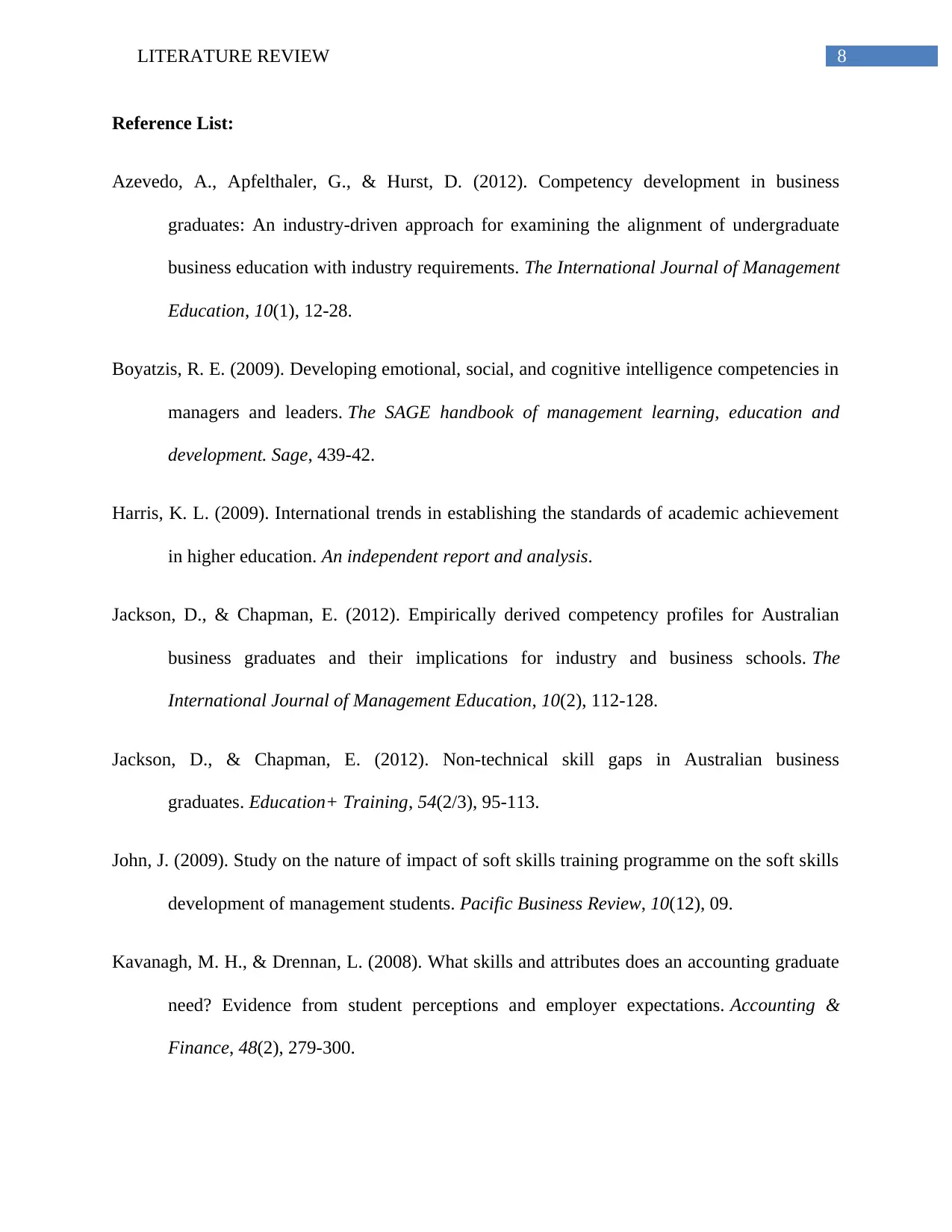
Reference List:
Azevedo, A., Apfelthaler, G., & Hurst, D. (2012). Competency development in business
graduates: An industry-driven approach for examining the alignment of undergraduate
business education with industry requirements. The International Journal of Management
Education, 10(1), 12-28.
Boyatzis, R. E. (2009). Developing emotional, social, and cognitive intelligence competencies in
managers and leaders. The SAGE handbook of management learning, education and
development. Sage, 439-42.
Harris, K. L. (2009). International trends in establishing the standards of academic achievement
in higher education. An independent report and analysis.
Jackson, D., & Chapman, E. (2012). Empirically derived competency profiles for Australian
business graduates and their implications for industry and business schools. The
International Journal of Management Education, 10(2), 112-128.
Jackson, D., & Chapman, E. (2012). Non-technical skill gaps in Australian business
graduates. Education+ Training, 54(2/3), 95-113.
John, J. (2009). Study on the nature of impact of soft skills training programme on the soft skills
development of management students. Pacific Business Review, 10(12), 09.
Kavanagh, M. H., & Drennan, L. (2008). What skills and attributes does an accounting graduate
need? Evidence from student perceptions and employer expectations. Accounting &
Finance, 48(2), 279-300.
Reference List:
Azevedo, A., Apfelthaler, G., & Hurst, D. (2012). Competency development in business
graduates: An industry-driven approach for examining the alignment of undergraduate
business education with industry requirements. The International Journal of Management
Education, 10(1), 12-28.
Boyatzis, R. E. (2009). Developing emotional, social, and cognitive intelligence competencies in
managers and leaders. The SAGE handbook of management learning, education and
development. Sage, 439-42.
Harris, K. L. (2009). International trends in establishing the standards of academic achievement
in higher education. An independent report and analysis.
Jackson, D., & Chapman, E. (2012). Empirically derived competency profiles for Australian
business graduates and their implications for industry and business schools. The
International Journal of Management Education, 10(2), 112-128.
Jackson, D., & Chapman, E. (2012). Non-technical skill gaps in Australian business
graduates. Education+ Training, 54(2/3), 95-113.
John, J. (2009). Study on the nature of impact of soft skills training programme on the soft skills
development of management students. Pacific Business Review, 10(12), 09.
Kavanagh, M. H., & Drennan, L. (2008). What skills and attributes does an accounting graduate
need? Evidence from student perceptions and employer expectations. Accounting &
Finance, 48(2), 279-300.
⊘ This is a preview!⊘
Do you want full access?
Subscribe today to unlock all pages.
Trusted by 1+ million students worldwide
9LITERATURE REVIEW
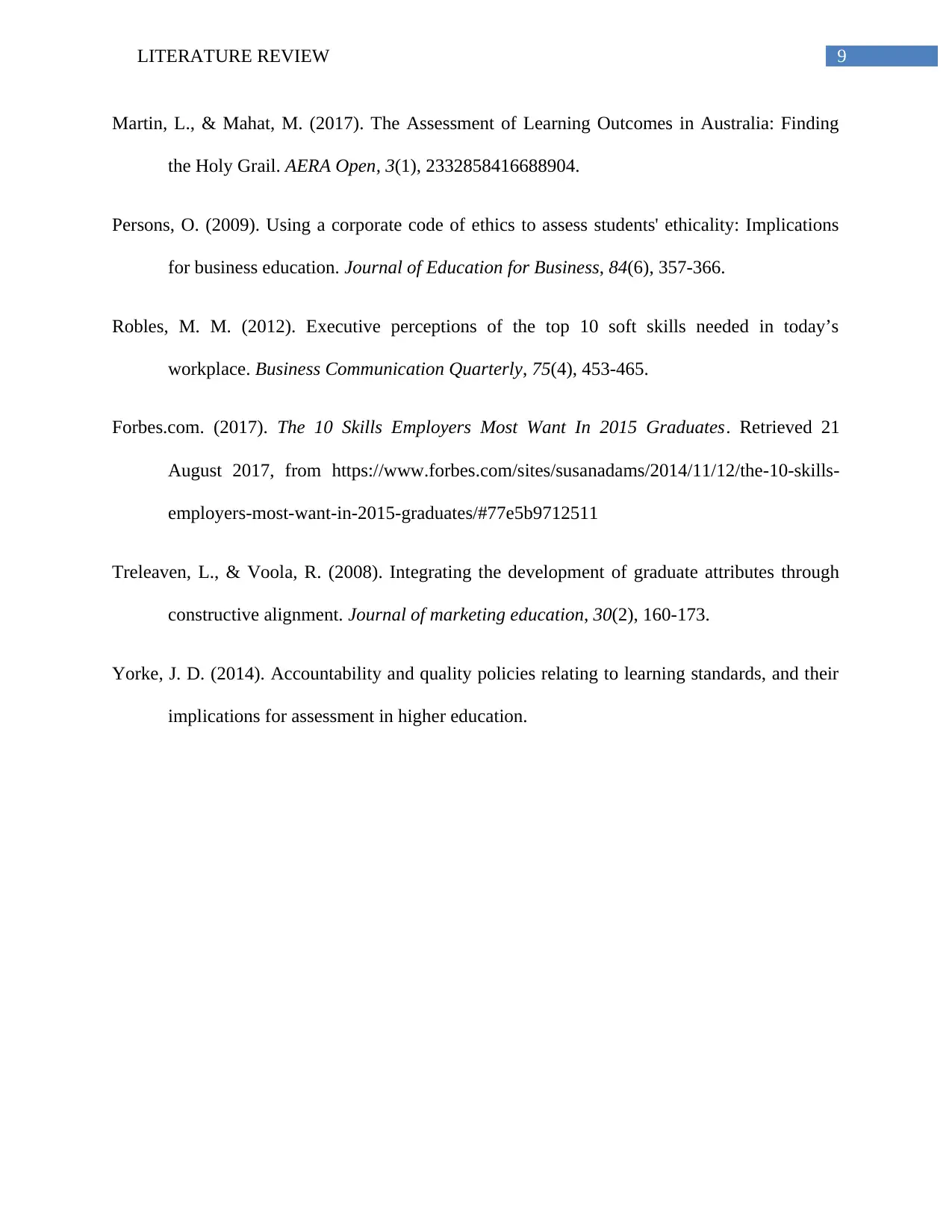
Martin, L., & Mahat, M. (2017). The Assessment of Learning Outcomes in Australia: Finding
the Holy Grail. AERA Open, 3(1), 2332858416688904.
Persons, O. (2009). Using a corporate code of ethics to assess students' ethicality: Implications
for business education. Journal of Education for Business, 84(6), 357-366.
Robles, M. M. (2012). Executive perceptions of the top 10 soft skills needed in today’s
workplace. Business Communication Quarterly, 75(4), 453-465.
Forbes.com. (2017). The 10 Skills Employers Most Want In 2015 Graduates. Retrieved 21
August 2017, from https://www.forbes.com/sites/susanadams/2014/11/12/the-10-skills-
employers-most-want-in-2015-graduates/#77e5b9712511
Treleaven, L., & Voola, R. (2008). Integrating the development of graduate attributes through
constructive alignment. Journal of marketing education, 30(2), 160-173.
Yorke, J. D. (2014). Accountability and quality policies relating to learning standards, and their
implications for assessment in higher education.
Martin, L., & Mahat, M. (2017). The Assessment of Learning Outcomes in Australia: Finding
the Holy Grail. AERA Open, 3(1), 2332858416688904.
Persons, O. (2009). Using a corporate code of ethics to assess students' ethicality: Implications
for business education. Journal of Education for Business, 84(6), 357-366.
Robles, M. M. (2012). Executive perceptions of the top 10 soft skills needed in today’s
workplace. Business Communication Quarterly, 75(4), 453-465.
Forbes.com. (2017). The 10 Skills Employers Most Want In 2015 Graduates. Retrieved 21
August 2017, from https://www.forbes.com/sites/susanadams/2014/11/12/the-10-skills-
employers-most-want-in-2015-graduates/#77e5b9712511
Treleaven, L., & Voola, R. (2008). Integrating the development of graduate attributes through
constructive alignment. Journal of marketing education, 30(2), 160-173.
Yorke, J. D. (2014). Accountability and quality policies relating to learning standards, and their
implications for assessment in higher education.

1 out of 10


Related Documents


Your All-in-One AI-Powered Toolkit for Academic Success.
+13062052269
info@desklib.com
Available 24*7 on WhatsApp / Email
![[object Object]](/_next/static/media/star-bottom.7253800d.svg)
Unlock your academic potential
Copyright © 2020–2026 A2Z Services. All Rights Reserved. Developed and managed by ZUCOL.