Literature Review: Management and Ethical Dilemmas

Verified

Added on  2022/10/03

|4
|825
|209
Literature Review
AI Summary
This literature review analyzes the article "Black International Business - Critical Issues and Ethical Dilemmas" by As-Saber and Cairns (2015), focusing on ethical dilemmas in international business and their impact on globalization. The review highlights the article's key concepts, including the negative effects of unethical practices on business productivity and corporate social responsibility. It assesses the strengths, such as the development of a framework to address the alarming situations created by black activities in business, and weaknesses, such as the lack of a constructive conclusion and moral relativism. The review also discusses the article's significance in relation to existing literature, citing examples of how unethical practices, like corruption and bribery, can lead to economic collapse and damage a company's reputation. The review emphasizes the importance of ethical planning and customer relationship management for building trust and ensuring long-term business success, referencing additional scholarly sources to support its arguments.
Document Page
Running head: MANAGEMENT
Article review
Name of the student:
Name of the university:
Author note:
tabler-icon-diamond-filled.svg

Paraphrase This Document

Need a fresh take? Get an instant paraphrase of this document with our AI Paraphraser
Document Page
MANAGEMENT
Source: As-Saber, S. and Cairns, G. 2015. 'Black International Business' - Critical
Issues and Ethical Dilemmas’, in Pullen, A. and Rhodes, C (eds.), The Routledge
Companion to Ethics, Politics and Organizations, Routledge, London, pp.119-131.
Key concepts and theories
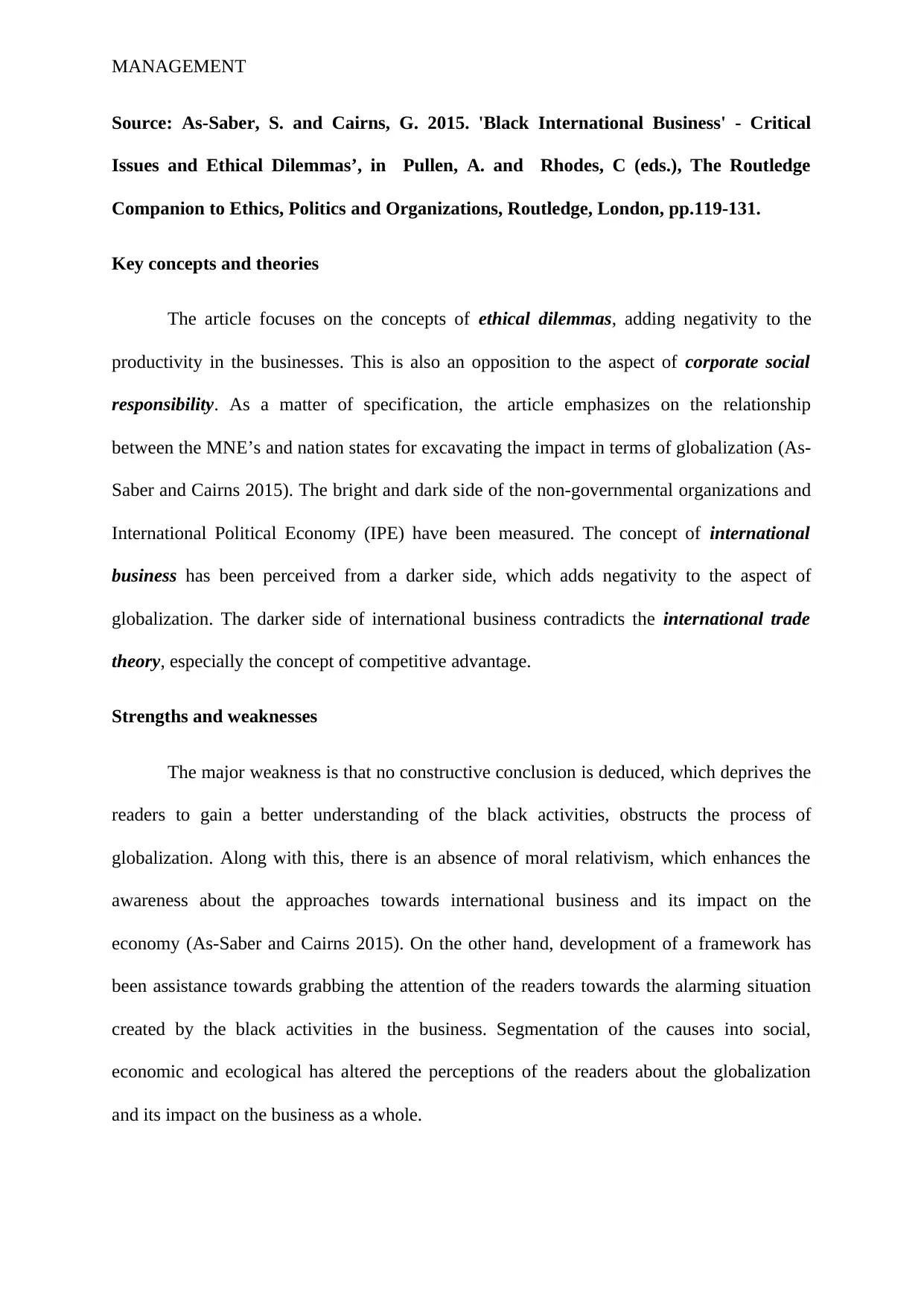
The article focuses on the concepts of ethical dilemmas, adding negativity to the
productivity in the businesses. This is also an opposition to the aspect of corporate social
responsibility. As a matter of specification, the article emphasizes on the relationship
between the MNE’s and nation states for excavating the impact in terms of globalization (As-
Saber and Cairns 2015). The bright and dark side of the non-governmental organizations and
International Political Economy (IPE) have been measured. The concept of international
business has been perceived from a darker side, which adds negativity to the aspect of
globalization. The darker side of international business contradicts the international trade
theory, especially the concept of competitive advantage.
Strengths and weaknesses
The major weakness is that no constructive conclusion is deduced, which deprives the
readers to gain a better understanding of the black activities, obstructs the process of
globalization. Along with this, there is an absence of moral relativism, which enhances the
awareness about the approaches towards international business and its impact on the
economy (As-Saber and Cairns 2015). On the other hand, development of a framework has
been assistance towards grabbing the attention of the readers towards the alarming situation
created by the black activities in the business. Segmentation of the causes into social,
economic and ecological has altered the perceptions of the readers about the globalization
and its impact on the business as a whole.
Document Page
MANAGEMENT
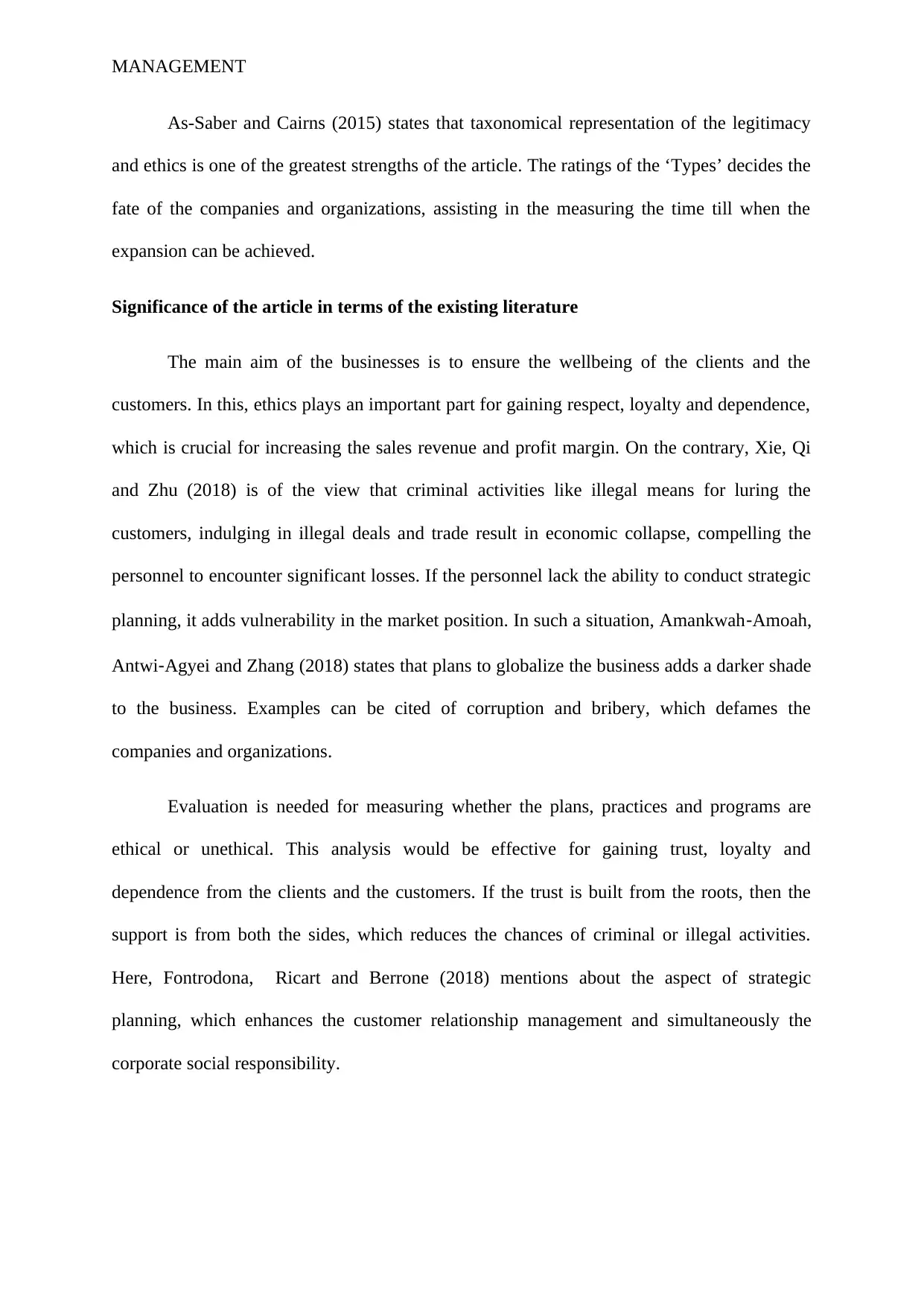
As-Saber and Cairns (2015) states that taxonomical representation of the legitimacy
and ethics is one of the greatest strengths of the article. The ratings of the ‘Types’ decides the
fate of the companies and organizations, assisting in the measuring the time till when the
expansion can be achieved.
Significance of the article in terms of the existing literature
The main aim of the businesses is to ensure the wellbeing of the clients and the
customers. In this, ethics plays an important part for gaining respect, loyalty and dependence,
which is crucial for increasing the sales revenue and profit margin. On the contrary, Xie, Qi
and Zhu (2018) is of the view that criminal activities like illegal means for luring the
customers, indulging in illegal deals and trade result in economic collapse, compelling the
personnel to encounter significant losses. If the personnel lack the ability to conduct strategic
planning, it adds vulnerability in the market position. In such a situation, AmankwahAmoah,
AntwiAgyei and Zhang (2018) states that plans to globalize the business adds a darker shade
to the business. Examples can be cited of corruption and bribery, which defames the
companies and organizations.
Evaluation is needed for measuring whether the plans, practices and programs are
ethical or unethical. This analysis would be effective for gaining trust, loyalty and
dependence from the clients and the customers. If the trust is built from the roots, then the
support is from both the sides, which reduces the chances of criminal or illegal activities.
Here, Fontrodona, Ricart and Berrone (2018) mentions about the aspect of strategic
planning, which enhances the customer relationship management and simultaneously the
corporate social responsibility.
Document Page
MANAGEMENT
References
AmankwahAmoah, J., AntwiAgyei, I. and Zhang, H., 2018. Integrating the dark side of
competition into explanations of business failures: Evidence from a developing economy.
European Management Review, 15(1), pp.97-109.
As-Saber, S. and Cairns, G. 2015. 'Black International Business' - Critical Issues and Ethical
Dilemmas’, in Pullen, A. and Rhodes, C (eds.), The Routledge Companion to Ethics,
Politics and Organizations, Routledge, London, pp.119-131.
Fontrodona, J., Ricart, J.E. and Berrone, P., 2018. Ethical challenges in strategic
management: the 19th IESE International Symposium on Ethics, Business and Society.
Journal of Business Ethics, 152(4), pp.887-898.
Xie, X., Qi, G. and Zhu, K.X., 2018. Corruption and new product innovation: Examining
firms’ ethical dilemmas in transition economies. Journal of Business Ethics, pp.1-19.
chevron_up_icon
1 out of 4
circle_padding
hide_on_mobile
zoom_out_icon
[object Object]