Grand Canyon University ORG 807 Literature Review Resources
VerifiedAdded on 2022/08/20
|31
|6594
|20
Homework Assignment
AI Summary
This literature review assignment comprises summaries and annotations of twelve research articles. The articles cover a wide range of topics including practice leadership in residential services for individuals with intellectual disabilities, the impact of leadership on staff experience, and the role of direct support professionals (DSPs) in the quality of life of those with intellectual disabilities. Other articles examine the effects of leader intelligence and emotional intelligence on leadership, stakeholder analysis, community resilience through system thinking, corporate social performance, and stakeholder engagement in business and nonprofit organizations. The assignment provides a comprehensive overview of each article, including the research methods, key findings, and limitations, offering valuable insights into leadership, organizational behavior, and the challenges and opportunities within the fields of intellectual disabilities and community development.
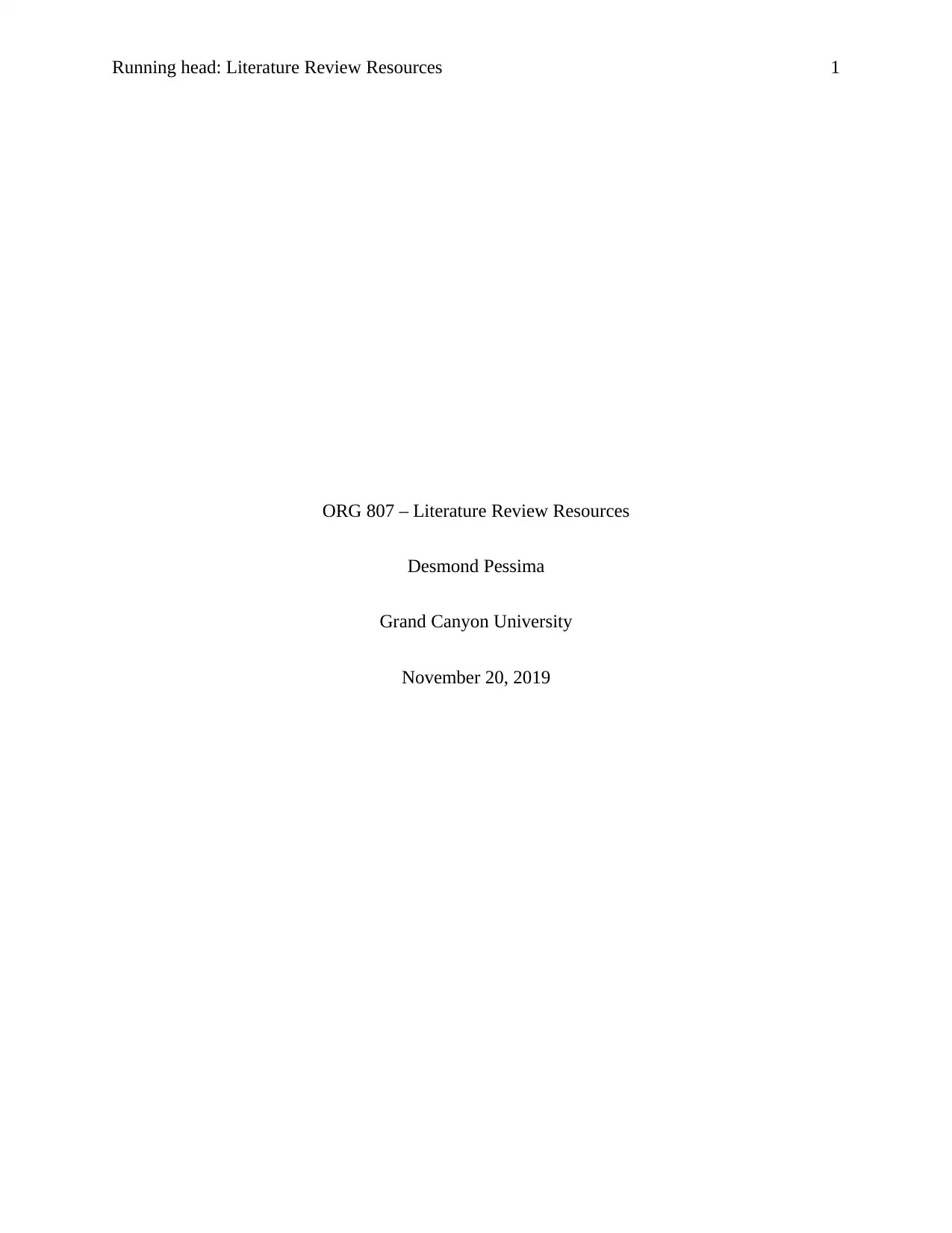
Running head: Literature Review Resources 1
ORG 807 – Literature Review Resources
Desmond Pessima
Grand Canyon University
November 20, 2019
ORG 807 – Literature Review Resources
Desmond Pessima
Grand Canyon University
November 20, 2019

Paraphrase This Document
Need a fresh take? Get an instant paraphrase of this document with our AI Paraphraser
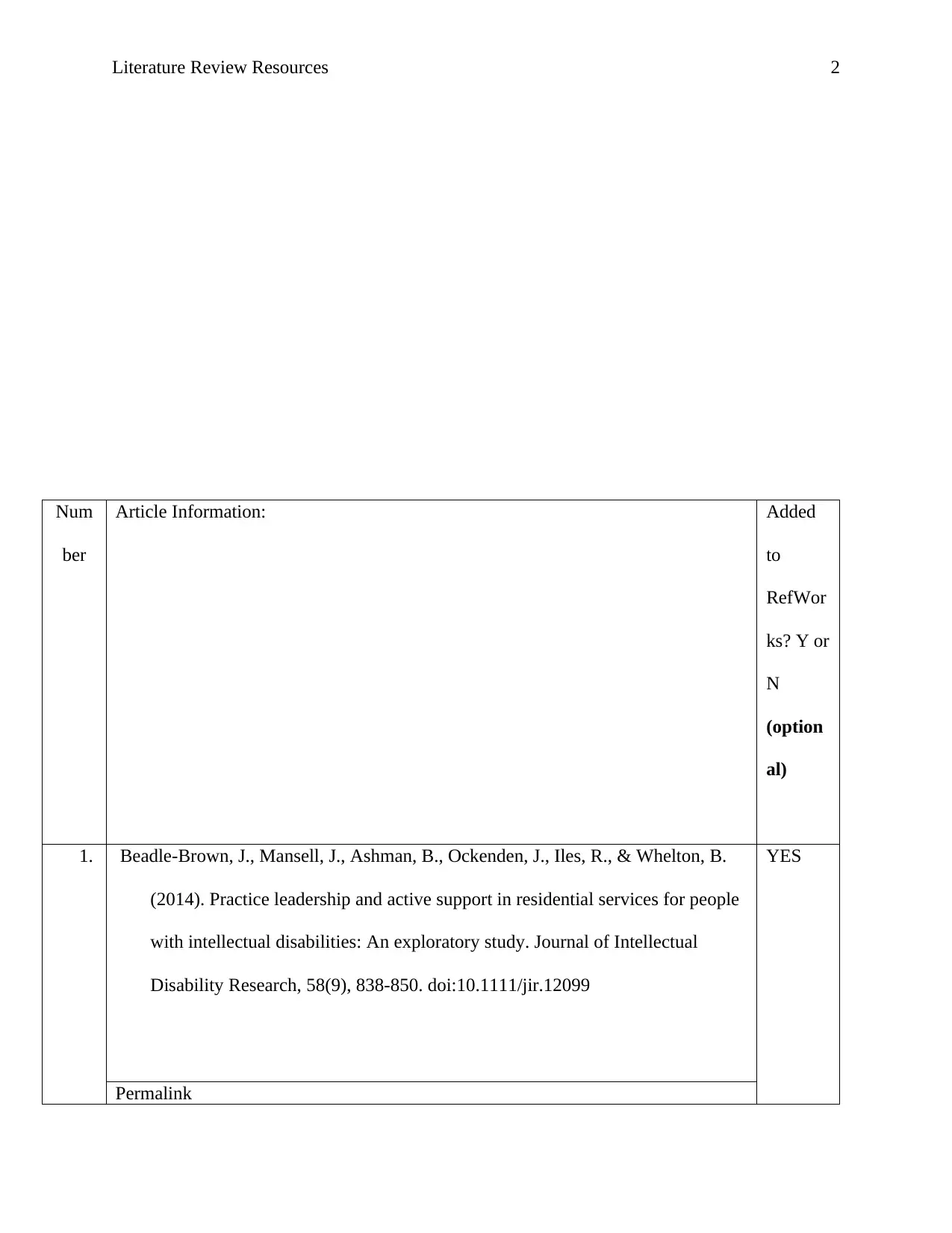
Literature Review Resources 2
Num
ber
Article Information: Added
to
RefWor
ks? Y or
N
(option
al)
1. Beadle-Brown, J., Mansell, J., Ashman, B., Ockenden, J., Iles, R., & Whelton, B.
(2014). Practice leadership and active support in residential services for people
with intellectual disabilities: An exploratory study. Journal of Intellectual
Disability Research, 58(9), 838-850. doi:10.1111/jir.12099
YES
Permalink
Num
ber
Article Information: Added
to
RefWor
ks? Y or
N
(option
al)
1. Beadle-Brown, J., Mansell, J., Ashman, B., Ockenden, J., Iles, R., & Whelton, B.
(2014). Practice leadership and active support in residential services for people
with intellectual disabilities: An exploratory study. Journal of Intellectual
Disability Research, 58(9), 838-850. doi:10.1111/jir.12099
YES
Permalink
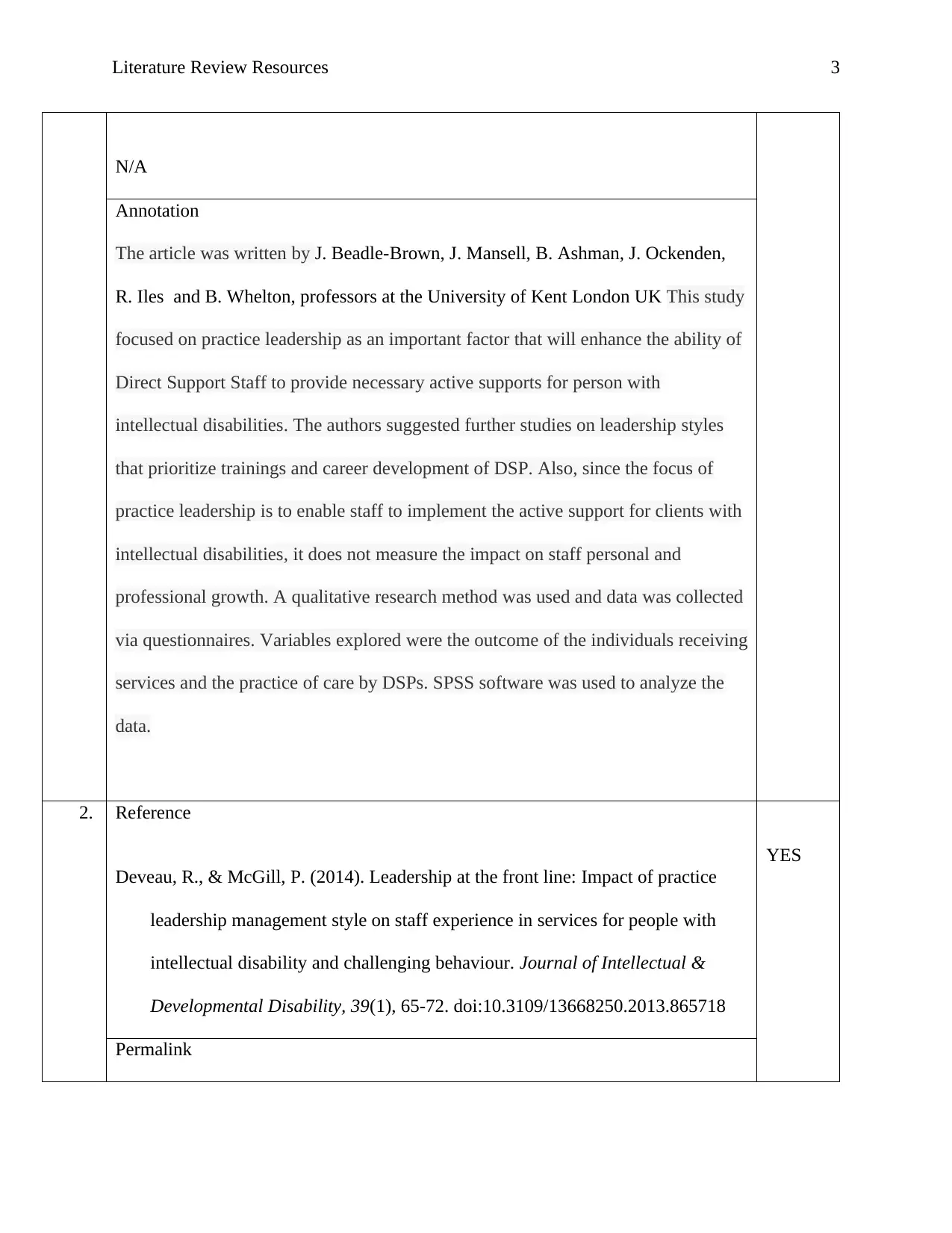
Literature Review Resources 3
N/A
Annotation
The article was written by J. Beadle-Brown, J. Mansell, B. Ashman, J. Ockenden,
R. Iles and B. Whelton, professors at the University of Kent London UK This study
focused on practice leadership as an important factor that will enhance the ability of
Direct Support Staff to provide necessary active supports for person with
intellectual disabilities. The authors suggested further studies on leadership styles
that prioritize trainings and career development of DSP. Also, since the focus of
practice leadership is to enable staff to implement the active support for clients with
intellectual disabilities, it does not measure the impact on staff personal and
professional growth. A qualitative research method was used and data was collected
via questionnaires. Variables explored were the outcome of the individuals receiving
services and the practice of care by DSPs. SPSS software was used to analyze the
data.
2. Reference
Deveau, R., & McGill, P. (2014). Leadership at the front line: Impact of practice
leadership management style on staff experience in services for people with
intellectual disability and challenging behaviour. Journal of Intellectual &
Developmental Disability, 39(1), 65-72. doi:10.3109/13668250.2013.865718
YES
Permalink
N/A
Annotation
The article was written by J. Beadle-Brown, J. Mansell, B. Ashman, J. Ockenden,
R. Iles and B. Whelton, professors at the University of Kent London UK This study
focused on practice leadership as an important factor that will enhance the ability of
Direct Support Staff to provide necessary active supports for person with
intellectual disabilities. The authors suggested further studies on leadership styles
that prioritize trainings and career development of DSP. Also, since the focus of
practice leadership is to enable staff to implement the active support for clients with
intellectual disabilities, it does not measure the impact on staff personal and
professional growth. A qualitative research method was used and data was collected
via questionnaires. Variables explored were the outcome of the individuals receiving
services and the practice of care by DSPs. SPSS software was used to analyze the
data.
2. Reference
Deveau, R., & McGill, P. (2014). Leadership at the front line: Impact of practice
leadership management style on staff experience in services for people with
intellectual disability and challenging behaviour. Journal of Intellectual &
Developmental Disability, 39(1), 65-72. doi:10.3109/13668250.2013.865718
YES
Permalink
⊘ This is a preview!⊘
Do you want full access?
Subscribe today to unlock all pages.

Trusted by 1+ million students worldwide
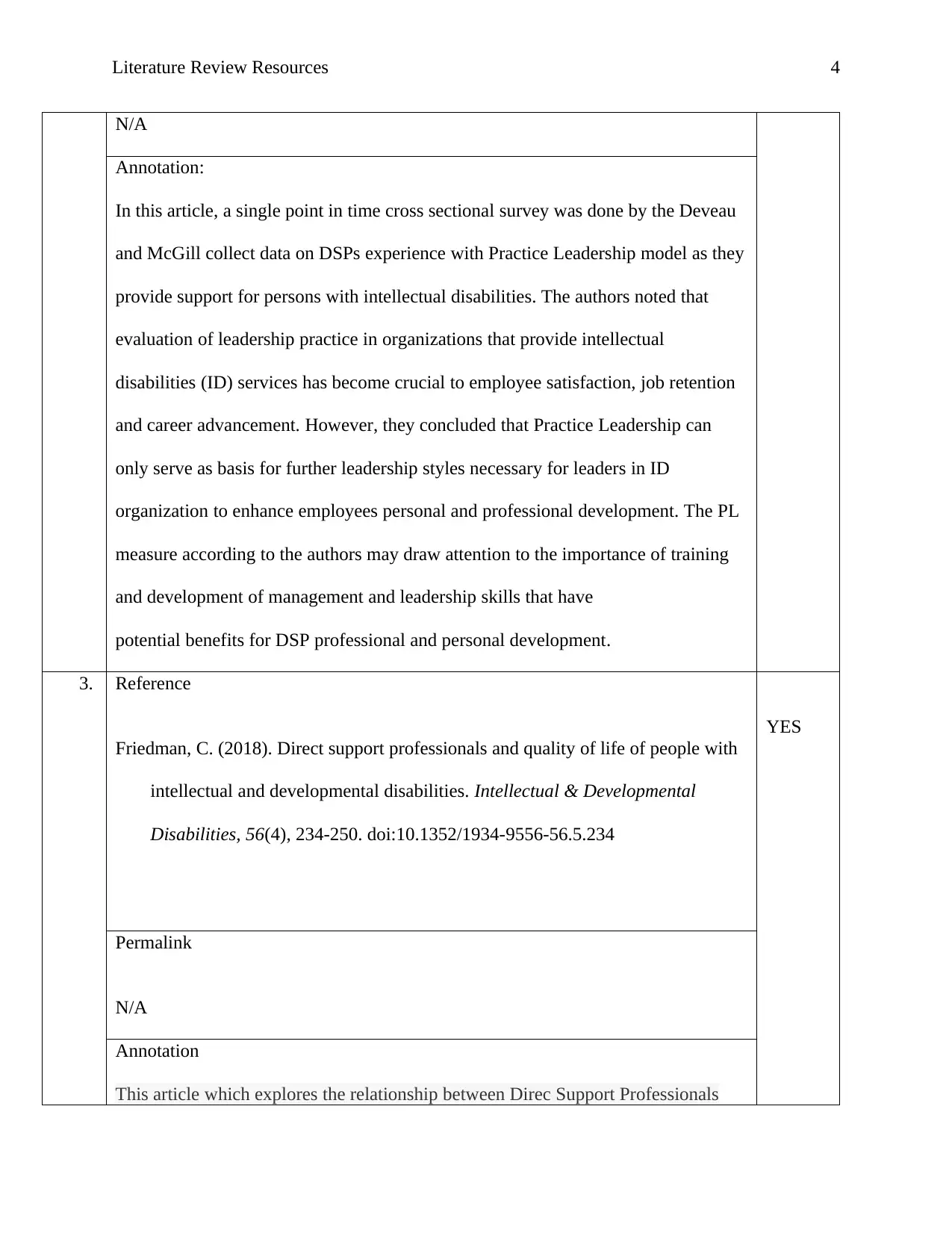
Literature Review Resources 4
N/A
Annotation:
In this article, a single point in time cross sectional survey was done by the Deveau
and McGill collect data on DSPs experience with Practice Leadership model as they
provide support for persons with intellectual disabilities. The authors noted that
evaluation of leadership practice in organizations that provide intellectual
disabilities (ID) services has become crucial to employee satisfaction, job retention
and career advancement. However, they concluded that Practice Leadership can
only serve as basis for further leadership styles necessary for leaders in ID
organization to enhance employees personal and professional development. The PL
measure according to the authors may draw attention to the importance of training
and development of management and leadership skills that have
potential benefits for DSP professional and personal development.
3. Reference
Friedman, C. (2018). Direct support professionals and quality of life of people with
intellectual and developmental disabilities. Intellectual & Developmental
Disabilities, 56(4), 234-250. doi:10.1352/1934-9556-56.5.234
YES
Permalink
N/A
Annotation
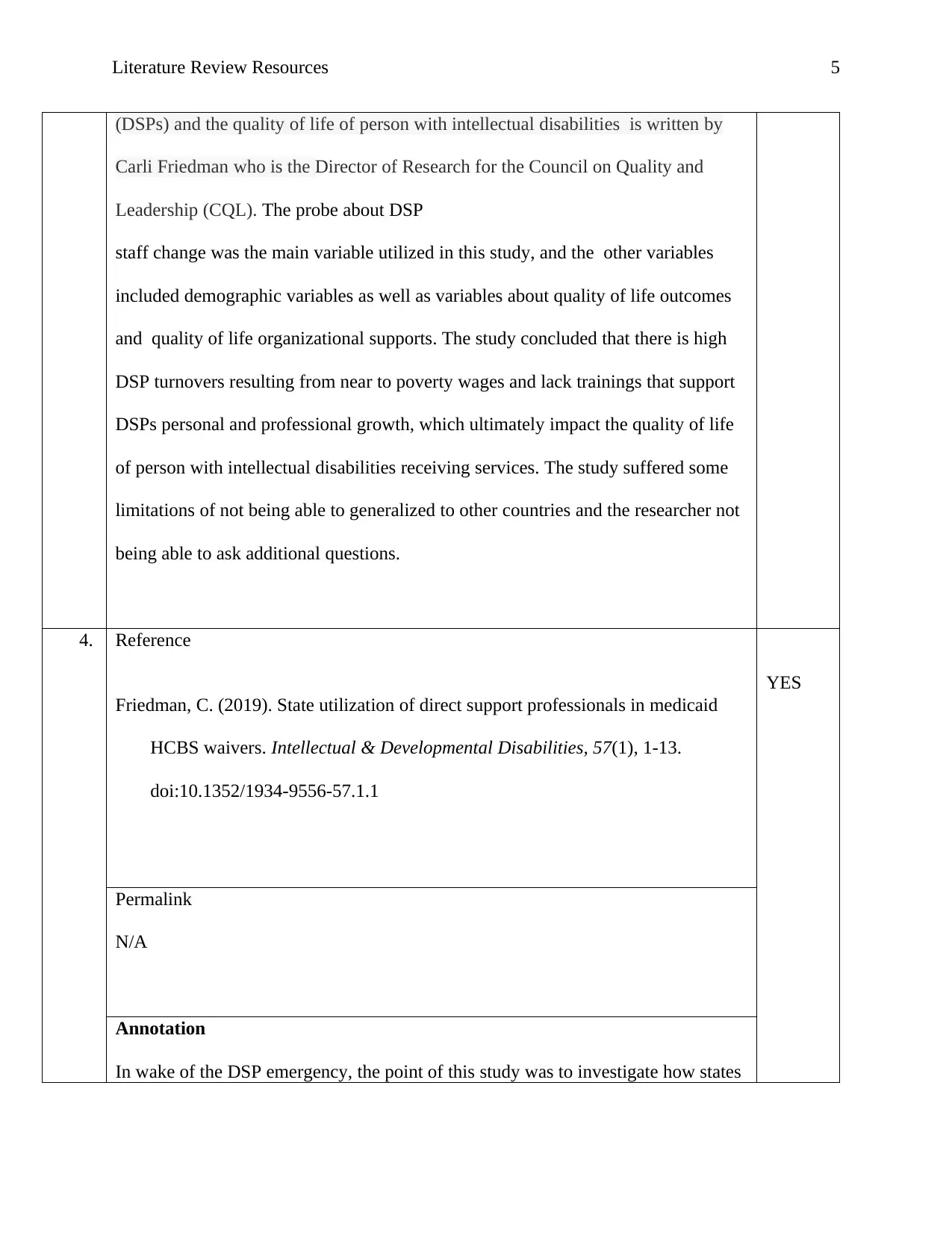
This article which explores the relationship between Direc Support Professionals
N/A
Annotation:
In this article, a single point in time cross sectional survey was done by the Deveau
and McGill collect data on DSPs experience with Practice Leadership model as they
provide support for persons with intellectual disabilities. The authors noted that
evaluation of leadership practice in organizations that provide intellectual
disabilities (ID) services has become crucial to employee satisfaction, job retention
and career advancement. However, they concluded that Practice Leadership can
only serve as basis for further leadership styles necessary for leaders in ID
organization to enhance employees personal and professional development. The PL
measure according to the authors may draw attention to the importance of training
and development of management and leadership skills that have
potential benefits for DSP professional and personal development.
3. Reference
Friedman, C. (2018). Direct support professionals and quality of life of people with
intellectual and developmental disabilities. Intellectual & Developmental
Disabilities, 56(4), 234-250. doi:10.1352/1934-9556-56.5.234
YES
Permalink
N/A
Annotation
This article which explores the relationship between Direc Support Professionals
Paraphrase This Document
Need a fresh take? Get an instant paraphrase of this document with our AI Paraphraser
Literature Review Resources 5
(DSPs) and the quality of life of person with intellectual disabilities is written by
Carli Friedman who is the Director of Research for the Council on Quality and
Leadership (CQL). The probe about DSP
staff change was the main variable utilized in this study, and the other variables
included demographic variables as well as variables about quality of life outcomes
and quality of life organizational supports. The study concluded that there is high
DSP turnovers resulting from near to poverty wages and lack trainings that support
DSPs personal and professional growth, which ultimately impact the quality of life
of person with intellectual disabilities receiving services. The study suffered some
limitations of not being able to generalized to other countries and the researcher not
being able to ask additional questions.
4. Reference
Friedman, C. (2019). State utilization of direct support professionals in medicaid
HCBS waivers. Intellectual & Developmental Disabilities, 57(1), 1-13.
doi:10.1352/1934-9556-57.1.1
YES
Permalink
N/A
Annotation
In wake of the DSP emergency, the point of this study was to investigate how states
(DSPs) and the quality of life of person with intellectual disabilities is written by
Carli Friedman who is the Director of Research for the Council on Quality and
Leadership (CQL). The probe about DSP
staff change was the main variable utilized in this study, and the other variables
included demographic variables as well as variables about quality of life outcomes
and quality of life organizational supports. The study concluded that there is high
DSP turnovers resulting from near to poverty wages and lack trainings that support
DSPs personal and professional growth, which ultimately impact the quality of life
of person with intellectual disabilities receiving services. The study suffered some
limitations of not being able to generalized to other countries and the researcher not
being able to ask additional questions.
4. Reference
Friedman, C. (2019). State utilization of direct support professionals in medicaid
HCBS waivers. Intellectual & Developmental Disabilities, 57(1), 1-13.
doi:10.1352/1934-9556-57.1.1
YES
Permalink
N/A
Annotation
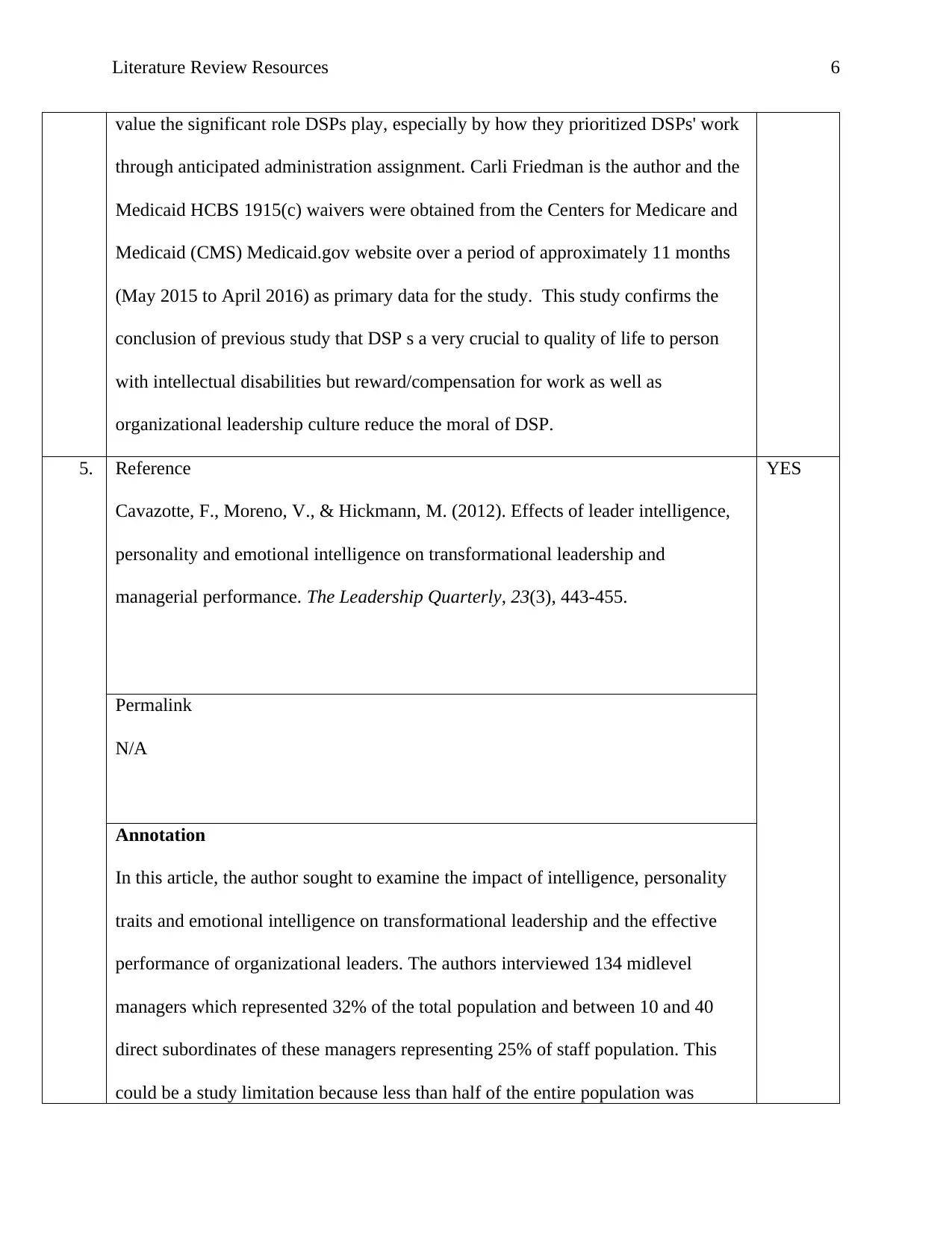
In wake of the DSP emergency, the point of this study was to investigate how states
Literature Review Resources 6
value the significant role DSPs play, especially by how they prioritized DSPs' work
through anticipated administration assignment. Carli Friedman is the author and the
Medicaid HCBS 1915(c) waivers were obtained from the Centers for Medicare and
Medicaid (CMS) Medicaid.gov website over a period of approximately 11 months
(May 2015 to April 2016) as primary data for the study. This study confirms the
conclusion of previous study that DSP s a very crucial to quality of life to person
with intellectual disabilities but reward/compensation for work as well as
organizational leadership culture reduce the moral of DSP.
5. Reference
Cavazotte, F., Moreno, V., & Hickmann, M. (2012). Effects of leader intelligence,
personality and emotional intelligence on transformational leadership and
managerial performance. The Leadership Quarterly, 23(3), 443-455.
YES
Permalink
N/A
Annotation
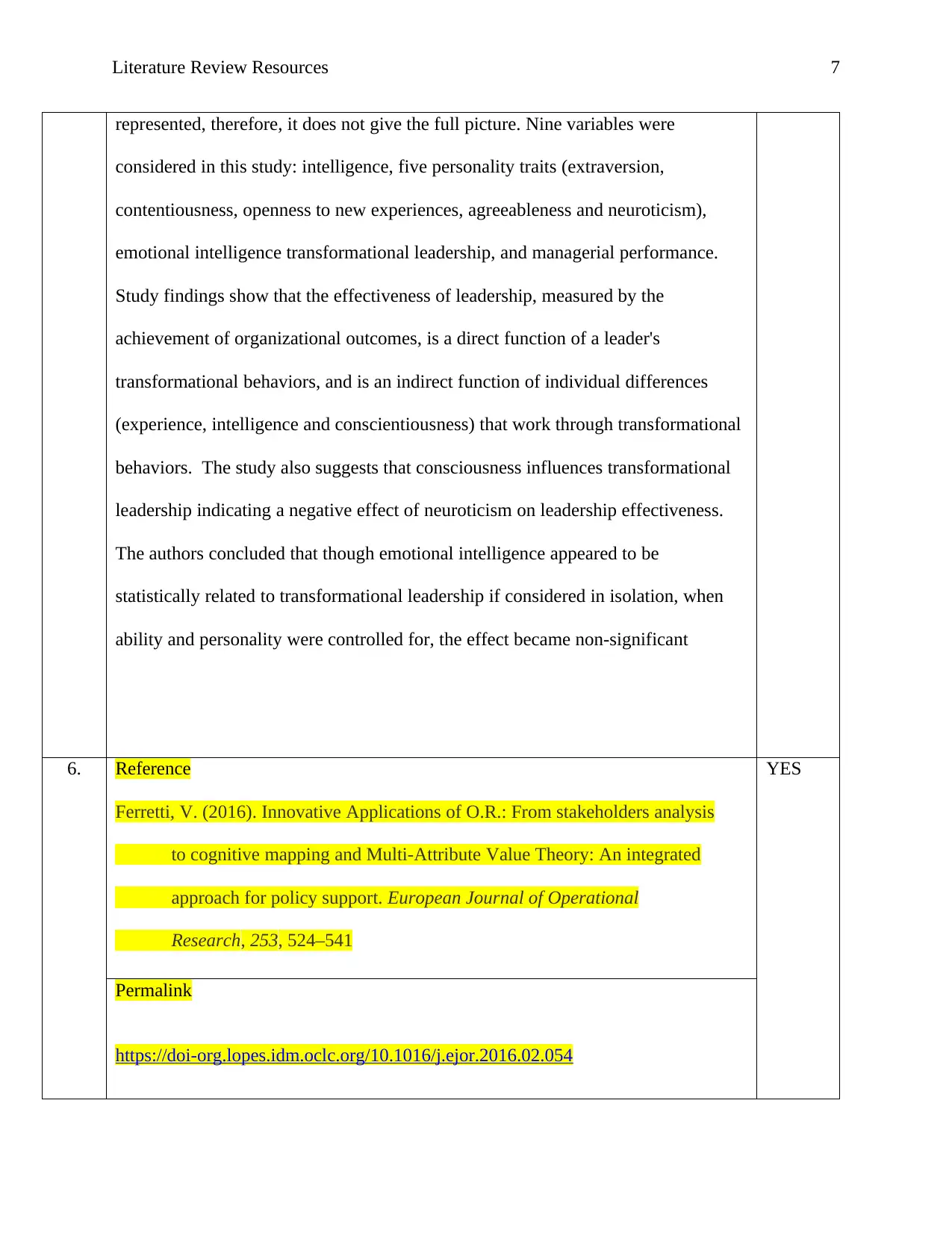
In this article, the author sought to examine the impact of intelligence, personality
traits and emotional intelligence on transformational leadership and the effective
performance of organizational leaders. The authors interviewed 134 midlevel
managers which represented 32% of the total population and between 10 and 40
direct subordinates of these managers representing 25% of staff population. This
could be a study limitation because less than half of the entire population was
value the significant role DSPs play, especially by how they prioritized DSPs' work
through anticipated administration assignment. Carli Friedman is the author and the
Medicaid HCBS 1915(c) waivers were obtained from the Centers for Medicare and
Medicaid (CMS) Medicaid.gov website over a period of approximately 11 months
(May 2015 to April 2016) as primary data for the study. This study confirms the
conclusion of previous study that DSP s a very crucial to quality of life to person
with intellectual disabilities but reward/compensation for work as well as
organizational leadership culture reduce the moral of DSP.
5. Reference
Cavazotte, F., Moreno, V., & Hickmann, M. (2012). Effects of leader intelligence,
personality and emotional intelligence on transformational leadership and
managerial performance. The Leadership Quarterly, 23(3), 443-455.
YES
Permalink
N/A
Annotation
In this article, the author sought to examine the impact of intelligence, personality
traits and emotional intelligence on transformational leadership and the effective
performance of organizational leaders. The authors interviewed 134 midlevel
managers which represented 32% of the total population and between 10 and 40
direct subordinates of these managers representing 25% of staff population. This
could be a study limitation because less than half of the entire population was
⊘ This is a preview!⊘
Do you want full access?
Subscribe today to unlock all pages.
Trusted by 1+ million students worldwide
Literature Review Resources 7
represented, therefore, it does not give the full picture. Nine variables were
considered in this study: intelligence, five personality traits (extraversion,
contentiousness, openness to new experiences, agreeableness and neuroticism),
emotional intelligence transformational leadership, and managerial performance.
Study findings show that the effectiveness of leadership, measured by the
achievement of organizational outcomes, is a direct function of a leader's
transformational behaviors, and is an indirect function of individual differences
(experience, intelligence and conscientiousness) that work through transformational
behaviors. The study also suggests that consciousness influences transformational
leadership indicating a negative effect of neuroticism on leadership effectiveness.
The authors concluded that though emotional intelligence appeared to be
statistically related to transformational leadership if considered in isolation, when
ability and personality were controlled for, the effect became non-significant
6. Reference
Ferretti, V. (2016). Innovative Applications of O.R.: From stakeholders analysis
to cognitive mapping and Multi-Attribute Value Theory: An integrated
approach for policy support. European Journal of Operational
Research, 253, 524–541
YES
Permalink
https://doi-org.lopes.idm.oclc.org/10.1016/j.ejor.2016.02.054
represented, therefore, it does not give the full picture. Nine variables were
considered in this study: intelligence, five personality traits (extraversion,
contentiousness, openness to new experiences, agreeableness and neuroticism),
emotional intelligence transformational leadership, and managerial performance.
Study findings show that the effectiveness of leadership, measured by the
achievement of organizational outcomes, is a direct function of a leader's
transformational behaviors, and is an indirect function of individual differences
(experience, intelligence and conscientiousness) that work through transformational
behaviors. The study also suggests that consciousness influences transformational
leadership indicating a negative effect of neuroticism on leadership effectiveness.
The authors concluded that though emotional intelligence appeared to be
statistically related to transformational leadership if considered in isolation, when
ability and personality were controlled for, the effect became non-significant
6. Reference
Ferretti, V. (2016). Innovative Applications of O.R.: From stakeholders analysis
to cognitive mapping and Multi-Attribute Value Theory: An integrated
approach for policy support. European Journal of Operational
Research, 253, 524–541
YES
Permalink
https://doi-org.lopes.idm.oclc.org/10.1016/j.ejor.2016.02.054
Paraphrase This Document
Need a fresh take? Get an instant paraphrase of this document with our AI Paraphraser
Literature Review Resources 8
Annotation
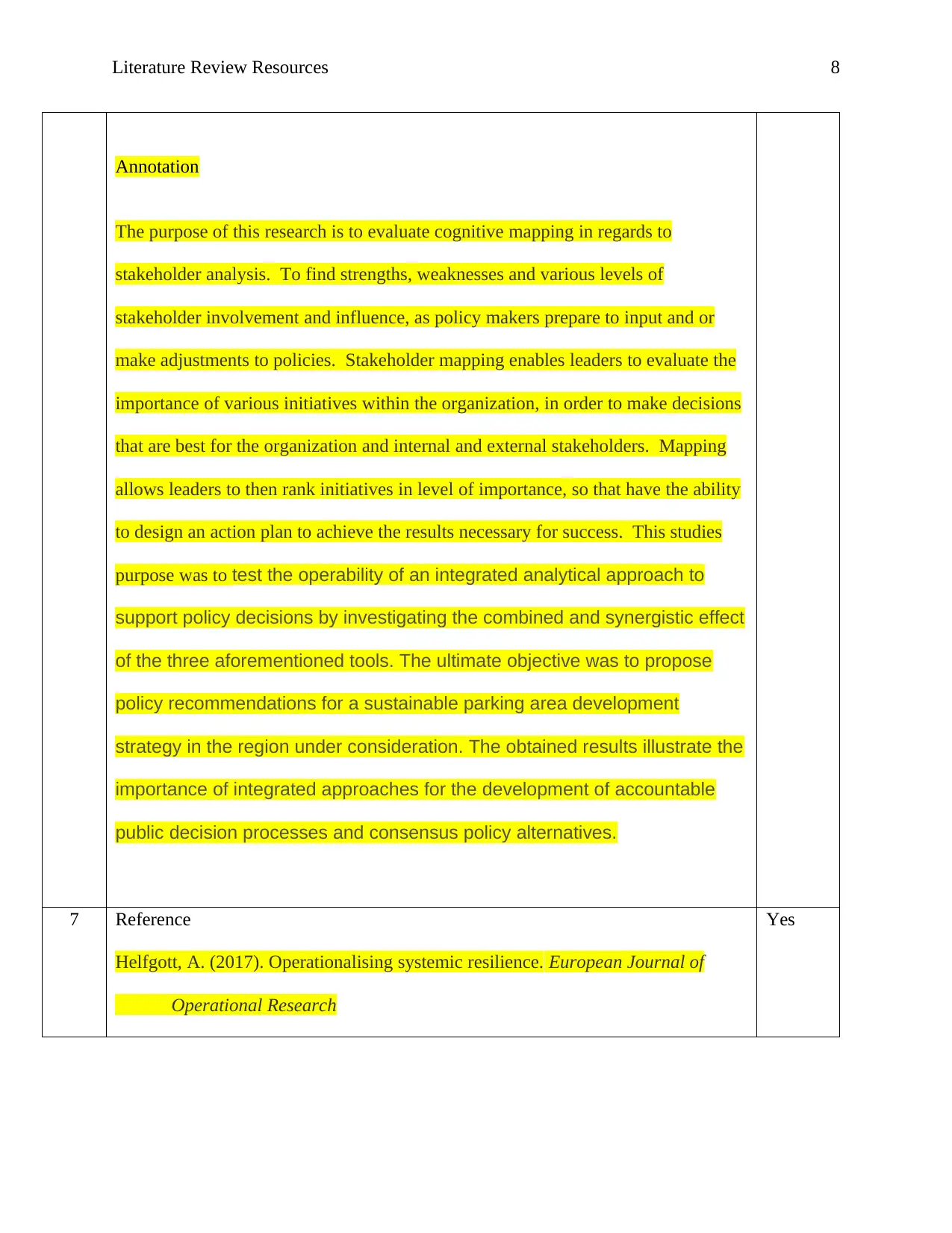
The purpose of this research is to evaluate cognitive mapping in regards to
stakeholder analysis. To find strengths, weaknesses and various levels of
stakeholder involvement and influence, as policy makers prepare to input and or
make adjustments to policies. Stakeholder mapping enables leaders to evaluate the
importance of various initiatives within the organization, in order to make decisions
that are best for the organization and internal and external stakeholders. Mapping
allows leaders to then rank initiatives in level of importance, so that have the ability
to design an action plan to achieve the results necessary for success. This studies
purpose was to test the operability of an integrated analytical approach to
support policy decisions by investigating the combined and synergistic effect
of the three aforementioned tools. The ultimate objective was to propose
policy recommendations for a sustainable parking area development
strategy in the region under consideration. The obtained results illustrate the
importance of integrated approaches for the development of accountable
public decision processes and consensus policy alternatives.
7 Reference
Helfgott, A. (2017). Operationalising systemic resilience. European Journal of
Operational Research
Yes
Annotation
The purpose of this research is to evaluate cognitive mapping in regards to
stakeholder analysis. To find strengths, weaknesses and various levels of
stakeholder involvement and influence, as policy makers prepare to input and or
make adjustments to policies. Stakeholder mapping enables leaders to evaluate the
importance of various initiatives within the organization, in order to make decisions
that are best for the organization and internal and external stakeholders. Mapping
allows leaders to then rank initiatives in level of importance, so that have the ability
to design an action plan to achieve the results necessary for success. This studies
purpose was to test the operability of an integrated analytical approach to
support policy decisions by investigating the combined and synergistic effect
of the three aforementioned tools. The ultimate objective was to propose
policy recommendations for a sustainable parking area development
strategy in the region under consideration. The obtained results illustrate the
importance of integrated approaches for the development of accountable
public decision processes and consensus policy alternatives.
7 Reference
Helfgott, A. (2017). Operationalising systemic resilience. European Journal of
Operational Research
Yes
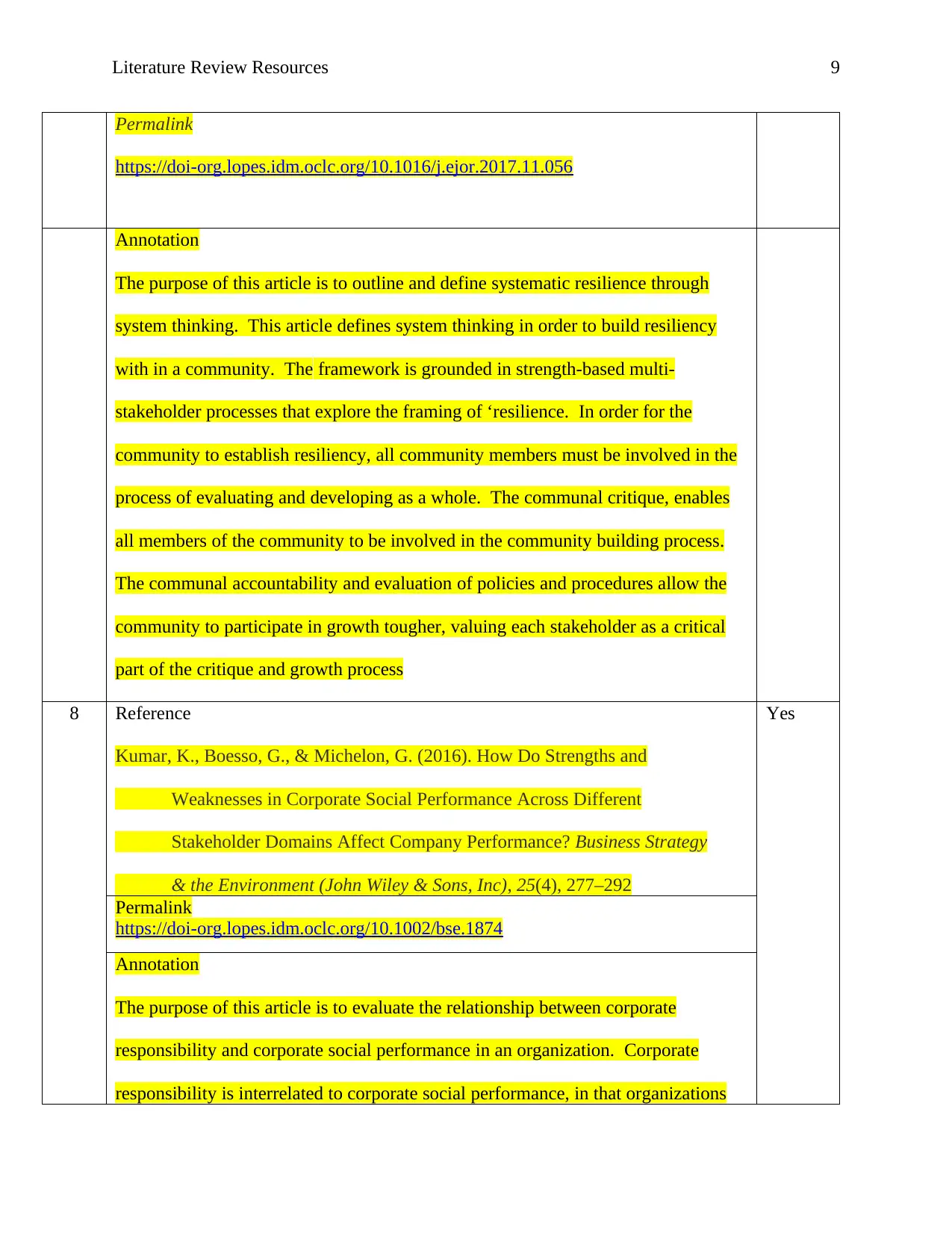
Literature Review Resources 9
Permalink
https://doi-org.lopes.idm.oclc.org/10.1016/j.ejor.2017.11.056
Annotation
The purpose of this article is to outline and define systematic resilience through
system thinking. This article defines system thinking in order to build resiliency
with in a community. The framework is grounded in strength-based multi-
stakeholder processes that explore the framing of ‘resilience. In order for the
community to establish resiliency, all community members must be involved in the
process of evaluating and developing as a whole. The communal critique, enables
all members of the community to be involved in the community building process.
The communal accountability and evaluation of policies and procedures allow the
community to participate in growth tougher, valuing each stakeholder as a critical
part of the critique and growth process
8 Reference
Kumar, K., Boesso, G., & Michelon, G. (2016). How Do Strengths and
Weaknesses in Corporate Social Performance Across Different
Stakeholder Domains Affect Company Performance? Business Strategy
& the Environment (John Wiley & Sons, Inc), 25(4), 277–292
Yes
Permalink
https://doi-org.lopes.idm.oclc.org/10.1002/bse.1874
Annotation
The purpose of this article is to evaluate the relationship between corporate
responsibility and corporate social performance in an organization. Corporate
responsibility is interrelated to corporate social performance, in that organizations
Permalink
https://doi-org.lopes.idm.oclc.org/10.1016/j.ejor.2017.11.056
Annotation
The purpose of this article is to outline and define systematic resilience through
system thinking. This article defines system thinking in order to build resiliency
with in a community. The framework is grounded in strength-based multi-
stakeholder processes that explore the framing of ‘resilience. In order for the
community to establish resiliency, all community members must be involved in the
process of evaluating and developing as a whole. The communal critique, enables
all members of the community to be involved in the community building process.
The communal accountability and evaluation of policies and procedures allow the
community to participate in growth tougher, valuing each stakeholder as a critical
part of the critique and growth process
8 Reference
Kumar, K., Boesso, G., & Michelon, G. (2016). How Do Strengths and
Weaknesses in Corporate Social Performance Across Different
Stakeholder Domains Affect Company Performance? Business Strategy
& the Environment (John Wiley & Sons, Inc), 25(4), 277–292
Yes
Permalink
https://doi-org.lopes.idm.oclc.org/10.1002/bse.1874
Annotation
The purpose of this article is to evaluate the relationship between corporate
responsibility and corporate social performance in an organization. Corporate
responsibility is interrelated to corporate social performance, in that organizations
⊘ This is a preview!⊘
Do you want full access?
Subscribe today to unlock all pages.
Trusted by 1+ million students worldwide
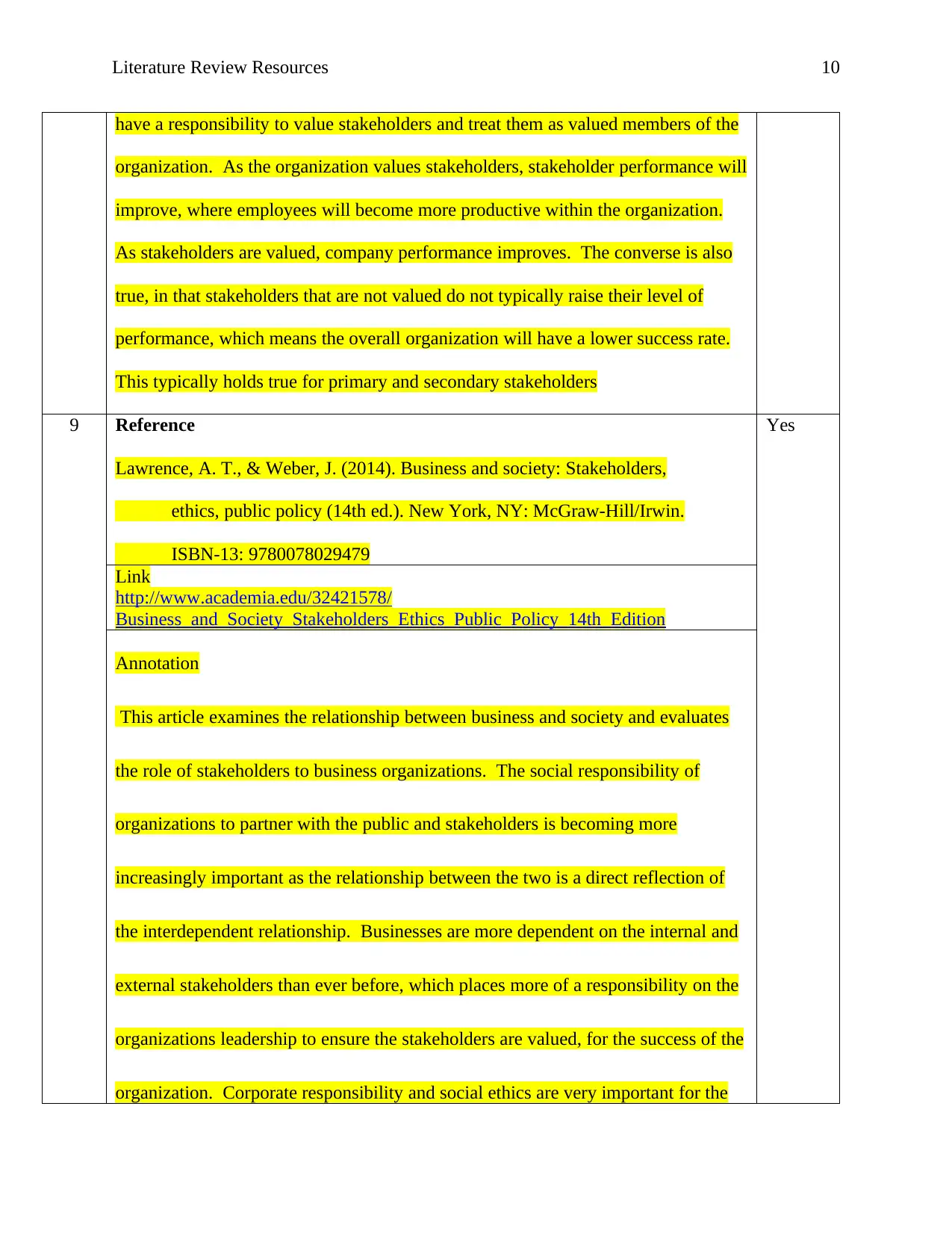
Literature Review Resources 10
have a responsibility to value stakeholders and treat them as valued members of the
organization. As the organization values stakeholders, stakeholder performance will
improve, where employees will become more productive within the organization.
As stakeholders are valued, company performance improves. The converse is also
true, in that stakeholders that are not valued do not typically raise their level of
performance, which means the overall organization will have a lower success rate.
This typically holds true for primary and secondary stakeholders
9 Reference
Lawrence, A. T., & Weber, J. (2014). Business and society: Stakeholders,
ethics, public policy (14th ed.). New York, NY: McGraw-Hill/Irwin.
ISBN-13: 9780078029479
Yes
Link
http://www.academia.edu/32421578/
Business_and_Society_Stakeholders_Ethics_Public_Policy_14th_Edition
Annotation
This article examines the relationship between business and society and evaluates
the role of stakeholders to business organizations. The social responsibility of
organizations to partner with the public and stakeholders is becoming more
increasingly important as the relationship between the two is a direct reflection of
the interdependent relationship. Businesses are more dependent on the internal and
external stakeholders than ever before, which places more of a responsibility on the
organizations leadership to ensure the stakeholders are valued, for the success of the
organization. Corporate responsibility and social ethics are very important for the
have a responsibility to value stakeholders and treat them as valued members of the
organization. As the organization values stakeholders, stakeholder performance will
improve, where employees will become more productive within the organization.
As stakeholders are valued, company performance improves. The converse is also
true, in that stakeholders that are not valued do not typically raise their level of
performance, which means the overall organization will have a lower success rate.
This typically holds true for primary and secondary stakeholders
9 Reference
Lawrence, A. T., & Weber, J. (2014). Business and society: Stakeholders,
ethics, public policy (14th ed.). New York, NY: McGraw-Hill/Irwin.
ISBN-13: 9780078029479
Yes
Link
http://www.academia.edu/32421578/
Business_and_Society_Stakeholders_Ethics_Public_Policy_14th_Edition
Annotation
This article examines the relationship between business and society and evaluates
the role of stakeholders to business organizations. The social responsibility of
organizations to partner with the public and stakeholders is becoming more
increasingly important as the relationship between the two is a direct reflection of
the interdependent relationship. Businesses are more dependent on the internal and
external stakeholders than ever before, which places more of a responsibility on the
organizations leadership to ensure the stakeholders are valued, for the success of the
organization. Corporate responsibility and social ethics are very important for the
Paraphrase This Document
Need a fresh take? Get an instant paraphrase of this document with our AI Paraphraser
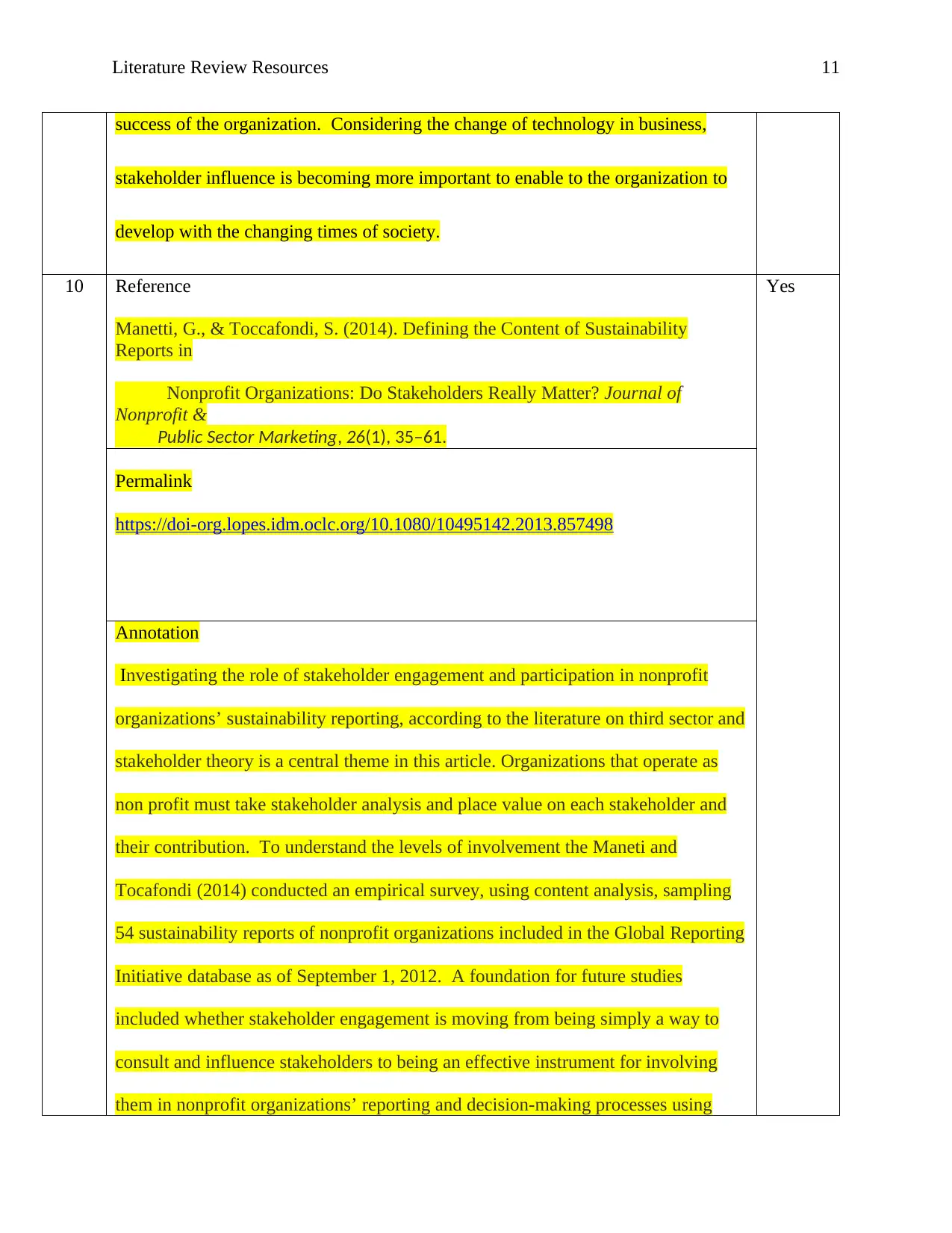
Literature Review Resources 11
success of the organization. Considering the change of technology in business,
stakeholder influence is becoming more important to enable to the organization to
develop with the changing times of society.
10 Reference
Manetti, G., & Toccafondi, S. (2014). Defining the Content of Sustainability
Reports in
Nonprofit Organizations: Do Stakeholders Really Matter? Journal of
Nonprofit &
Public Sector Marketing, 26(1), 35–61.
Yes
Permalink
https://doi-org.lopes.idm.oclc.org/10.1080/10495142.2013.857498
Annotation
Investigating the role of stakeholder engagement and participation in nonprofit
organizations’ sustainability reporting, according to the literature on third sector and
stakeholder theory is a central theme in this article. Organizations that operate as
non profit must take stakeholder analysis and place value on each stakeholder and
their contribution. To understand the levels of involvement the Maneti and
Tocafondi (2014) conducted an empirical survey, using content analysis, sampling
54 sustainability reports of nonprofit organizations included in the Global Reporting
Initiative database as of September 1, 2012. A foundation for future studies
included whether stakeholder engagement is moving from being simply a way to
consult and influence stakeholders to being an effective instrument for involving
them in nonprofit organizations’ reporting and decision-making processes using
success of the organization. Considering the change of technology in business,
stakeholder influence is becoming more important to enable to the organization to
develop with the changing times of society.
10 Reference
Manetti, G., & Toccafondi, S. (2014). Defining the Content of Sustainability
Reports in
Nonprofit Organizations: Do Stakeholders Really Matter? Journal of
Nonprofit &
Public Sector Marketing, 26(1), 35–61.
Yes
Permalink
https://doi-org.lopes.idm.oclc.org/10.1080/10495142.2013.857498
Annotation
Investigating the role of stakeholder engagement and participation in nonprofit
organizations’ sustainability reporting, according to the literature on third sector and
stakeholder theory is a central theme in this article. Organizations that operate as
non profit must take stakeholder analysis and place value on each stakeholder and
their contribution. To understand the levels of involvement the Maneti and
Tocafondi (2014) conducted an empirical survey, using content analysis, sampling
54 sustainability reports of nonprofit organizations included in the Global Reporting
Initiative database as of September 1, 2012. A foundation for future studies
included whether stakeholder engagement is moving from being simply a way to
consult and influence stakeholders to being an effective instrument for involving
them in nonprofit organizations’ reporting and decision-making processes using
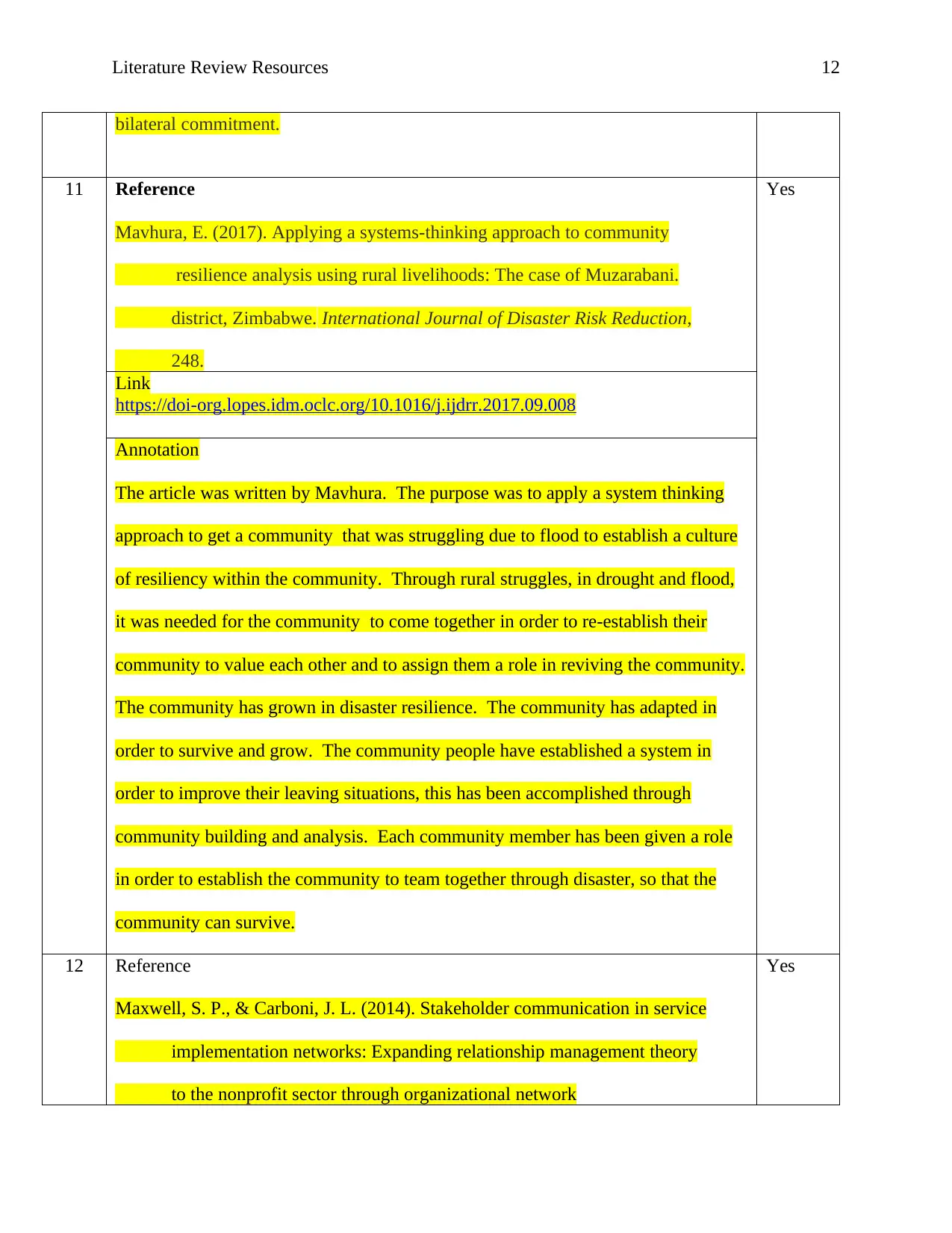
Literature Review Resources 12
bilateral commitment.
11 Reference
Mavhura, E. (2017). Applying a systems-thinking approach to community
resilience analysis using rural livelihoods: The case of Muzarabani.
district, Zimbabwe. International Journal of Disaster Risk Reduction,
248.
Yes
Link
https://doi-org.lopes.idm.oclc.org/10.1016/j.ijdrr.2017.09.008
Annotation
The article was written by Mavhura. The purpose was to apply a system thinking
approach to get a community that was struggling due to flood to establish a culture
of resiliency within the community. Through rural struggles, in drought and flood,
it was needed for the community to come together in order to re-establish their
community to value each other and to assign them a role in reviving the community.
The community has grown in disaster resilience. The community has adapted in
order to survive and grow. The community people have established a system in
order to improve their leaving situations, this has been accomplished through
community building and analysis. Each community member has been given a role
in order to establish the community to team together through disaster, so that the
community can survive.
12 Reference
Maxwell, S. P., & Carboni, J. L. (2014). Stakeholder communication in service
implementation networks: Expanding relationship management theory
to the nonprofit sector through organizational network
Yes
bilateral commitment.
11 Reference
Mavhura, E. (2017). Applying a systems-thinking approach to community
resilience analysis using rural livelihoods: The case of Muzarabani.
district, Zimbabwe. International Journal of Disaster Risk Reduction,
248.
Yes
Link
https://doi-org.lopes.idm.oclc.org/10.1016/j.ijdrr.2017.09.008
Annotation
The article was written by Mavhura. The purpose was to apply a system thinking
approach to get a community that was struggling due to flood to establish a culture
of resiliency within the community. Through rural struggles, in drought and flood,
it was needed for the community to come together in order to re-establish their
community to value each other and to assign them a role in reviving the community.
The community has grown in disaster resilience. The community has adapted in
order to survive and grow. The community people have established a system in
order to improve their leaving situations, this has been accomplished through
community building and analysis. Each community member has been given a role
in order to establish the community to team together through disaster, so that the
community can survive.
12 Reference
Maxwell, S. P., & Carboni, J. L. (2014). Stakeholder communication in service
implementation networks: Expanding relationship management theory
to the nonprofit sector through organizational network
Yes
⊘ This is a preview!⊘
Do you want full access?
Subscribe today to unlock all pages.
Trusted by 1+ million students worldwide

1 out of 31


Your All-in-One AI-Powered Toolkit for Academic Success.
+13062052269
info@desklib.com
Available 24*7 on WhatsApp / Email
![[object Object]](/_next/static/media/star-bottom.7253800d.svg)
Unlock your academic potential
Copyright © 2020–2026 A2Z Services. All Rights Reserved. Developed and managed by ZUCOL.