AED5001 - Literature Review: Engaging Students in Science Classrooms

Verified

Added on  2023/06/10

|8
|2488
|190
Literature Review
AI Summary
This literature review, authored by Ramandeep Kaur, examines pedagogical strategies for engaging middle-level students in science classrooms, focusing on enhancing critical thinking and nurturing scientific temperament. The review, prepared for the AED5001 Education Research Design and Methods unit, synthesizes research from various sources including articles and doctoral studies, exploring the impact of STEM education, technological advancements, and teacher-student interactions on student engagement. Key findings highlight the need for innovative pedagogical approaches, including the optimization of technology and fostering active communication between teachers and students, while also considering the importance of addressing the potential decline in critical thinking skills due to the ease of access to information. The review concludes with a research question that seeks to identify specific pedagogical strategies used by science teachers to enhance student engagement, critical thinking, and scientific temperament. The review emphasizes the need for continuous innovation in pedagogy to meet the evolving needs of students in a technologically advanced world. The student has provided a detailed overview of the literature review, including the methodology, key findings, and recommendations for future research. The assignment is a comprehensive analysis of the current state of pedagogical practices in science education.
Document Page
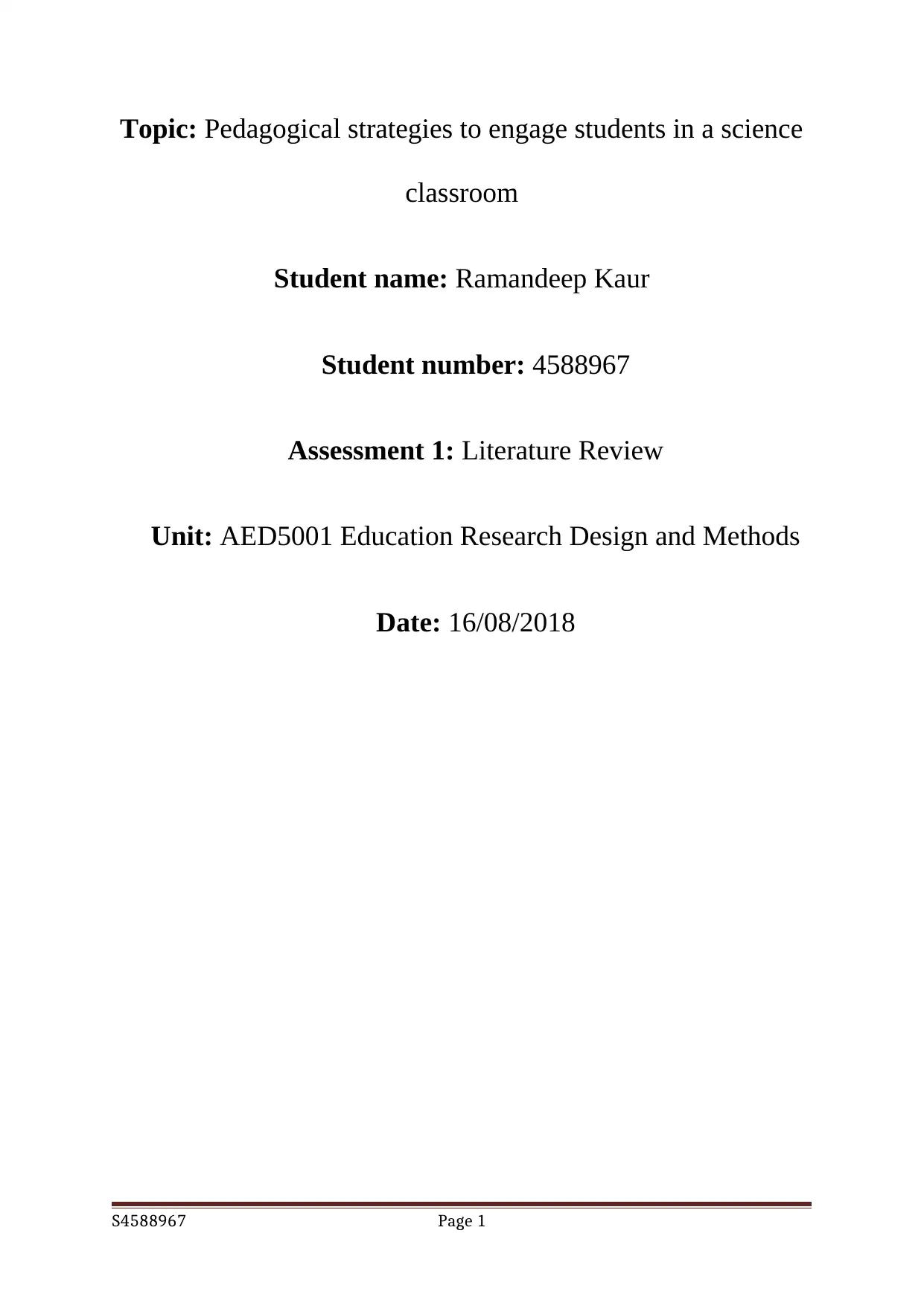
Topic: Pedagogical strategies to engage students in a science
classroom
Student name: Ramandeep Kaur
Student number: 4588967
Assessment 1: Literature Review
Unit: AED5001 Education Research Design and Methods
Date: 16/08/2018
S4588967 Page 1
tabler-icon-diamond-filled.svg

Paraphrase This Document

Need a fresh take? Get an instant paraphrase of this document with our AI Paraphraser
Document Page
Introduction
Club together Science, Technology, Engineering and Math in an interdisciplinary fashion,
add some innovative methods of teaching beyond the books and what we have in our hands
will be a class learning with the help of STEM. At the turn of the previous century, the four
components of the STEM (Science, Technology, Engineering, and Math) served as the
foundation of the development of Industrial revolution (Ross, 2016). During the previous
century STEM subjects were productive subjects for the students that were seeking for skills
to earn their livelihood, it indeed was an important stream of education. Under the schemes of
STEM they were incorporating scientific theories along with the real world applications; they
were also introducing Pedagogical practices so that students can grasp this knowledge easily.
(Stone, 2017).
STEM subjects are in a process of transformation where technology and the demands of the
industries of the future have a great role to play. Information levels of the students are very
high; they have a filtered and convenient access to the data. STEM subjects are important at
the middle levels of the education because they play a crucial role in the “critical thinking
faculty of an individual.” In the current assignment we are reviewing some sources of
literature that deals with the Pedagogical Practices for middle year science teachers to engage
their students in critical thinking in this changing environment.
The Literature Review
1. Saxena, A. (2014). Understanding scientific temperament and assessing its social
relevance. Journal of Scientific Temper. Viewed On 14th August 2.
https://web.stanford.edu/group/redlab/cgi-bin/materials/Kwek-Innovation%20In%20The
%20Classroom.pdf
Author Abhishek Saxena (2014) says that science was present to offer magical solutions to
the day to day problems in the past. Now, this magical spell has become a state of the factory
affair. In the future, the main role of the science will be to predict probable solutions. He
connected the scientific practices with social issues and quite frequently quoted some
international scientists of the world.
S4588967 Page 2
Document Page
In this paper, he gave us the breakdown of the nine elements of the scientific temper. This
piece of the literature is important for our study because it presents a sociological account of
some traditional theories that gave rise to a liberal thought process. He connected an
important thread of learning methods of the past to the present methods. According to him the
concept of "Do it yourself" was always present; however, the internet and other such
mediums gave it a new recognition for the current generation of the learners (Andrew
Gibbson, 2018).
This research paper is certainly helpful for us because it connects humanitarians with the
scientific temper and allows us to explore certain Pedagogical practices that were present in
the society in the past. The identification of these existing practices and a framework to
revamp them for the future students can always give us a new line of thought for the research
that we are undertaking.
2. Earp.J, STEM learning – international best practice, Australian Council for Educational
Research, Viewed on 14th August, https://www.teachermagazine.com.au/articles/stem-
learning-international-best-practice.
Australian middle-level students are losing interest in STEM-related studies and it can cause
a deficiency of STEM-based skill workers in the coming future says, Jo Earp (2017). Experts
at the Australian Council for Educational Research support this vision because it is an
outcome of some systematic studies that they did over the decades.
This article also gives us an access to the international viewpoints connected to the
Pedagogical Practices that are prevailing in various other countries. This article gives us an
insight into the international perspective that is surrounding the issue. This article also gives
us some takeaway points in the form of Key Findings of various surveys that have been done
in this direction.
Development of a standardized STEM ecosystem is emerging as an international concern.
Australia is not alone many other countries of the world are also facing the same problem. In
the first few paragraphs, this article establishes migration from the STEM as a future national
crisis (Yap, 2017). It also signifies the importance of user-friendly language to describe
STEM-related concepts. A summary of 18 in-depth case studies and experimental solutions
S4588967 Page 3
Document Page
in the direction of Pedagogical practices makes it an accomplish document to become the
framework for an elaborated study on the issue.
This article is very important for our research; it gives us the leads to various other keywords
that can be incorporated into our primary research plan. This article will also help us in fixing
the variables of the research because it caters to a big sample and presents a holistic point of
view of the problem.
3. Kyere. J, (2017), Effectiveness of Hands-on Pedagogy in STEM Education, Walden
Dissertations and Doctoral Studies Collection, Viewed on 14th August,
https://scholarworks.waldenu.edu/cgi/viewcontent.cgi?article=4035&context=dissertations
A doctoral study submitted by John Kyere (2017) presents an exhaustive account of the
current pedagogy practices in the STEM. This report checks the performance of the students
in the stream on a yearly basis and presents an account that shows the decline in the interests’
levels of the students.
In this report, the author has dedicated an entire chapter related to teacher preparation and
their critical role in the implementation of various STEM-related pedagogy practices.
Most of the other researchers in the field have talked about the role of the gadgets and other
devices. Johy Kyere (2017) also discussed the same from a different point of view. He
introduced the concept of the social change due to the smart electronic devices. This piece of
literature also presents an account of the stakeholders in the process. For instance, students
are stakeholders, parents are stakeholder and teachers are stakeholders.
This doctoral study is very rich in data because the author had left no stone unturned in
interviewing the people. The report represents both qualitative and quantitative data samples
to support its findings and recommendations. While developing a thesis on the topic, the rich
and consolidated databases present in this literature can help us a great deal to substantiate
the findings and information that we will collect from other sources. We can compare and
contrast them with the data present in this report and chalk a course of action for our research
essay.
S4588967 Page 4
tabler-icon-diamond-filled.svg

Paraphrase This Document

Need a fresh take? Get an instant paraphrase of this document with our AI Paraphraser
Document Page
4. Kwek, S.H. (2011). Innovation in the Classroom: Design Thinking for 21st Century
Learning. (Master’s thesis). Viewed 14th August,
http://www.stanford.edu/group/redlab/cgibin/publications_resources.php
The title “Innovation in the classroom” sets the nature of the content in the mind of the
reader. However when we explore the content then we find that it is much more than that and
deals with a bigger picture. Author Sweet Hong David Kwek in his essay based on the
qualitative research raised this question from a very poignant point of view. Machines are
gradually eating up the pie of the human labor from the economic activities. Unfortunately,
the underdeveloped countries and the developing countries are going to suffer the pangs of
this machine based evolutions (Means, 2018). STEM classrooms of these countries are not in
a position to meet this challenge that the future is holding for them.
The inclusion of the terms like a virtual world and emotional intelligence in the STEM
teaching methods is a strong recommendation. This report advocates for a 21st-century
classroom where inclusion of the passion to learn and critical thinking are a must. An
alternative progressive vision is the need of the hour. Where certain barriers like high stake
testing of the STEM proficiency should be removed to attract the students in this stream of
the education (Schyrlet Cameron, 2015).
This master's thesis also introduces us to the concept of Design thinking, design thinking is a
method of learning that allows a kid to build up a creative confidence in him. Activity-guided
problem-solving capacity of the students at the middle level is also a big area of concern. The
technologies are killing the essence of an activity and making it a beaten track for the
students. This master's thesis can help us a great deal on the path where we can find the root
causes behind the decreasing performance levels of the STEM students.
5. Sidelinger.R, Dialogic Pedagogy in the College Classroom: Overcoming Students’
Negative Perceptions of the Talkaholic Teacher, Currents in Teaching and learning. Viewed
on 14th August, Worcester-State-University-Currents-2018-V10-N1-Final.pdf, May 2018, PP
21-22
The personality of the teacher plays a crucial role in the process of the student engagement,
says, Robert Sidelinger. If a teacher is talkative then it can emerge as a big problem. Since
our study has its focus on the techniques of the teaching. It is very important for us to cover
S4588967 Page 5
Document Page
this tangent of the main problem. This particular essay introduces us to the terminology of the
pedagogy in an exhaustive manner. For instance, he introduced the concept of the student
satisfaction level during the process of learning. He emphasized that learning should be an
active process where the teacher should play the role of the active campaigner.
Constant interaction between a student and teacher can increase the attention span. This study
says that during a dialogic pedagogy the process of talking should continue and they should
be designed in a fashion where students can express themselves more freely (David
Skidmore, 2016).
This study is important for our research because apart from the fruits the means are also
important. Our thesis of the study revolves around the role of the teachers at the middle level,
though the findings and recommendation of the study are universal in nature; however, they
are applicable on our target group as well.
Conclusion
The exercise of the literature review gives us this prima facie impression that innovation in
the field of pedagogy is required. There are many aspects to the problem. Virtual world and
smart gadgets are definitely easing out the life of the middle-level students. Answers are
instantly available and the capacity to think critically is losing its importance. In the current
research where we are trying to find the Pedagogical strategy to engage middle-level
students, this current literature review gives us an idea that we don't need to drift down from
the regular processes. Instead, we should go for an optimization of the current gadgets and
internet in the favor of active Pedagogical methods. The communication between the teacher
and the student can play a crucial role in the exercise by giving it a human touch.
The crux of this literature review brings us to the conclusion that the introduction of a fresh
set of Pedagogical strategies is the need of the hour for the middle-level students.
Organizations like ACER has an elaborated policy document for the measurement and
implementation of healthy STEM standards in Australia. Their agenda is dependent on two
facts, first, they are focusing on global STEM standards and second, they are focusing on the
differences that the school sector can make.
S4588967 Page 6
Document Page
With the help of the current research program, we are going to explore the effectiveness of
prevailing pedagogical strategies for middle-level students. Based on our findings and
opinions we wish to recommend a framework of reforms so that they can fill the gap if it is
present.
Research Question: What pedagogical strategies do middle years science teachers use to
engage students in order to enhance critical thinking and nurture scientific temperament?
References:
Andrew Gibbson, E. S. (2018). DIY (Do-it-Yourself) pedagogy: a future-less.Open Review of
Educational Research viewed on 14th August,
https://www.tandfonline.com/doi/pdf/10.1080/23265507.2018.1457453.
David Skidmore, K. M. (2016). Dialogic Pedagogy: The Importance of Dialogue in Teaching and
Learning. Bristol: Multilingual Matters.
Earp.J, STEM learning – international best practice, Australian Council for Educational
Research, Viewed on 14th August, HYPERLINK
"https://www.teachermagazine.com.au/articles/stem-learning-international-best-practice"
https://www.teachermagazine.com.au/articles/stem-learning-international-best-practice.
Kwek, S.H. (2011). Innovation in the Classroom: Design Thinking for 21st Century
Learning. (Master’s thesis). Viewed 14th August,
http://www.stanford.edu/group/redlab/cgibin/publications_resources.php
Kyere. J, (2017), Effectiveness of Hands-on Pedagogy in STEM Education, Walden
Dissertations and Doctoral Studies Collection, Viewed on 14th August,
https://scholarworks.waldenu.edu/cgi/viewcontent.cgi?article=4035&context=dissertations
S4588967 Page 7
tabler-icon-diamond-filled.svg

Paraphrase This Document

Need a fresh take? Get an instant paraphrase of this document with our AI Paraphraser
Document Page
Means, A. J. (2018). Learning to Save the Future: Rethinking Education and Work in an Era
of Digital Capitalism. Abingdon: Routledge.
Ross, A. (2016). The industries of the future. New York: Simon & Schuster.
Saxena, A. (2014). Understanding scientific temperament and assessing its social relevance.
Journal of Scientific Temper. Viewed On 14th August 2.
https://web.stanford.edu/group/redlab/cgi-bin/materials/Kwek-Innovation%20In%20The
%20Classroom.pdf
Schyrlet Cameron, C. C. (2015). STEM Labs for Middle Grades, Grades 5 - 8. North
Carolina: Carson Dellosa Publishing Group.
Sidelinger.R, Dialogic Pedagogy in the College Classroom: Overcoming Students’ Negative
Perceptions of the Talkaholic Teacher, Currents in Teaching and learning. Viewed on 14th
August, Worcester-State-University-Currents-2018-V10-N1-Final.pdf, May 2018, PP 21-22
Stone, E. (2017). Psychology of Education: A Pedagogical Approach. Abingdon: Routledge.
Yap, A. (2017). Distilling the STEM experience. The Australian,
https://www.theaustralian.com.au/higher-education/distilling-the-stem-experience/news-
story/d17a583e52bce626708f3fabfe57a0ab.
S4588967 Page 8
chevron_up_icon
1 out of 8
circle_padding
hide_on_mobile
zoom_out_icon
[object Object]