IB Literature Review: Performance Factors in International Business
VerifiedAdded on 2020/02/24
|14
|4634
|201
Literature Review
AI Summary
This literature review examines key performance factors in international business organizations, focusing on technology, sustainability, employees, and customers as crucial measures for continuous improvement. It discusses the role of technology in knowledge sharing and innovation, highlighting the importance of leadership in developing competent network systems while acknowledging security and privacy challenges. The review explores sustainability as a strategy for business practice, emphasizing its multidimensional nature and impact on stakeholders and financial turnover. It also delves into the significance of employee engagement and the relationship between managers and employees in driving performance, underlining the importance of human resource management practices and motivational factors. Lastly, the importance of customer satisfaction and its impact on organizational performance is discussed. The review integrates various perspectives to provide a holistic understanding of performance management in a global context, providing insights into both the benefits and limitations of each factor.
International Business 1
Literature Review
Performance factors in Business Organizations
Literature Review
Performance factors in Business Organizations

Paraphrase This Document
Need a fresh take? Get an instant paraphrase of this document with our AI Paraphraser
International Business 2
Introduction
The global market is highly competitive and there are performance factors, which
organizations use to measure their success (Daley, 2012). Different industries have different goals
therefore require varied measures of performance. However, there are common factors that
contemporary organizations should invest in today. The global environment is highly competitive
and brands keep inventing and reinventing themselves in order to survive. These are important
tools for measuring performance in different operations. Among the most important functions are
customer service, marketing, financial and human resource. The agenda for the implementation of
these factors depends on the organization’s goals, objectives and criteria for success (Braun, et
al., 2013). An organization may have measures for specific departments or a centralized approach
to defining performance. The success of the plan depends on the implementation of the strategies.
This review of literature discusses four aspects of performance that are necessary for
organizational performance in a global organization. The survival of modern organizations
depends on an integrated approach because there is no alternatives to these elements (Callister &
Rethwisch, 2012). This review discusses technology, sustainability, employees and customers as
crucial measures for continuous improvement in organizations. It looks at the pros and cons in
order to suggest an integrated approach.
1. Technology as a performance measure
Wang &Jian (2012) examine leadership and competence in organizations to point out the role of
technology in knowledge sharing. Leadership styles in organizations today cannot survive without
technology. From the article’s point of view, innovation is important in all areas of business
management. The research terms the current global market as te surbodinates. Its analysis
indicates that leaders need to instil innovative approaches to their employees in order for the
organization to excel in its goals. The artcicle uses the example of service innovation to explain
the role of knowledge sharing in personnel development. Most researchers suport the use of
Introduction
The global market is highly competitive and there are performance factors, which
organizations use to measure their success (Daley, 2012). Different industries have different goals
therefore require varied measures of performance. However, there are common factors that
contemporary organizations should invest in today. The global environment is highly competitive
and brands keep inventing and reinventing themselves in order to survive. These are important
tools for measuring performance in different operations. Among the most important functions are
customer service, marketing, financial and human resource. The agenda for the implementation of
these factors depends on the organization’s goals, objectives and criteria for success (Braun, et
al., 2013). An organization may have measures for specific departments or a centralized approach
to defining performance. The success of the plan depends on the implementation of the strategies.
This review of literature discusses four aspects of performance that are necessary for
organizational performance in a global organization. The survival of modern organizations
depends on an integrated approach because there is no alternatives to these elements (Callister &
Rethwisch, 2012). This review discusses technology, sustainability, employees and customers as
crucial measures for continuous improvement in organizations. It looks at the pros and cons in
order to suggest an integrated approach.
1. Technology as a performance measure
Wang &Jian (2012) examine leadership and competence in organizations to point out the role of
technology in knowledge sharing. Leadership styles in organizations today cannot survive without
technology. From the article’s point of view, innovation is important in all areas of business
management. The research terms the current global market as te surbodinates. Its analysis
indicates that leaders need to instil innovative approaches to their employees in order for the
organization to excel in its goals. The artcicle uses the example of service innovation to explain
the role of knowledge sharing in personnel development. Most researchers suport the use of
International Business 3
technological innovation in the improvement of service and product development processes
(Bocken, et al., 2014). Technology has a wide array of applications for workplace, supply chain
and customer functions. This artcles’ focus is on on workplace and interorganizational
perfomance. From the findings, knowledge sharing, network competencies and organizational
relationships interconnect to define innovation performance in the service industry. the article
conclusively states that the organization needs quality structures and network capcity for high tech
performance. This model is good for businesses and knowledge sharing sytems such as the
online entreprises which depend on the internet for various functions.
The article’s discussion mentions the role of leadership in leading the improvement process.
Research into the concept of innovation and leadership points at organizational strategy as the
news strategies through leadership (Davila, et al., 2012). Online technology connects the
organizations to the global markets. Leaders in the organization have a responsibility of
developing competent network systems that positions the organization for suces. Perfomance
measured through competence includes technology skills such as email communication, microsoft
office, database management and digital applications. The article refer to interorganizational
collaborations using technology support systems. Cloud computing is one of the common shared
technology platforms for global organizations. Creating a competitve edge is about adding
strategic importance to the processes such as value chain and customer care among others. The
article stresses the importance of leaders developing these technology competencies. Proponents
of Key perfomance Indicators ( KPIs) agree (Parameter, 2015). Leaders in all sectors know how
to manipulate technology tools and software applications for excellence because it provides
artifical intelligence. In the article, competencies help organizations to excell. It encourages
personal innovation as well as knowledge transfer. Effective performance techniques should not
focus on the organizational alone but a holistic approach (Callister & Rethwisch, 2012).
technological innovation in the improvement of service and product development processes
(Bocken, et al., 2014). Technology has a wide array of applications for workplace, supply chain
and customer functions. This artcles’ focus is on on workplace and interorganizational
perfomance. From the findings, knowledge sharing, network competencies and organizational
relationships interconnect to define innovation performance in the service industry. the article
conclusively states that the organization needs quality structures and network capcity for high tech
performance. This model is good for businesses and knowledge sharing sytems such as the
online entreprises which depend on the internet for various functions.
The article’s discussion mentions the role of leadership in leading the improvement process.
Research into the concept of innovation and leadership points at organizational strategy as the
news strategies through leadership (Davila, et al., 2012). Online technology connects the
organizations to the global markets. Leaders in the organization have a responsibility of
developing competent network systems that positions the organization for suces. Perfomance
measured through competence includes technology skills such as email communication, microsoft
office, database management and digital applications. The article refer to interorganizational
collaborations using technology support systems. Cloud computing is one of the common shared
technology platforms for global organizations. Creating a competitve edge is about adding
strategic importance to the processes such as value chain and customer care among others. The
article stresses the importance of leaders developing these technology competencies. Proponents
of Key perfomance Indicators ( KPIs) agree (Parameter, 2015). Leaders in all sectors know how
to manipulate technology tools and software applications for excellence because it provides
artifical intelligence. In the article, competencies help organizations to excell. It encourages
personal innovation as well as knowledge transfer. Effective performance techniques should not
focus on the organizational alone but a holistic approach (Callister & Rethwisch, 2012).
⊘ This is a preview!⊘
Do you want full access?
Subscribe today to unlock all pages.

Trusted by 1+ million students worldwide
International Business 4
The article acknowledges the challenge of knowledge sharing through technology. Its limiting
factors discourages the development of inter-organizational network systems. Among the issues
of concern is security and privacy violations, which places organizational data at risk of
manipulation (FTC, 2017). Business organizations face the risk of data breach when unauthorized
persons get access to confidential links. This is not good for a brand whose image is respectable
(Rizkallah, 2017). Performance is about shaping the brand through reputation. This poses a
challenge when technology becomes a negative influence rather than a plus. The exposure of
strategic ideas to competitors nullifies the essence of performance. The information could
compromise the strategic plan of the organization. This article ignores the challenge presented by
lack of, limited access to technology as well as constant maintenance (Bharadwaj, et al., 2013).
Digital business initiatives have a challenge of elaborating the technology strategy according to
the organizational needs. Using concepts and applications from a customer care system in a
supply chain could result in chaos. Capturing the organizational objectives in each unit helps to
narrow down the implementation with specific tools and devices. The article also fails to mention
lack of transparency in knowledge sharing for stakeholders in the same industry.
2. Sustainability as a performance tool
Andrea, S., 2012. The sustainable firm. International Journal of Business and
Management, 7(21), pp. 34-47
Andrea (2012) presents a theoretical dicourse on sustainability as a strategy for business
practice. In the article, he emphasises the interdependency that exists in the business processes.
He brings out the role of external and internal stakeholders. The article starts by reinforcing the
importance of sustainability and sustainable development as signficant in busines management. In
the discussion, sustainability is multidimensional and it comprises of green practices, employee
welfare as well as community activities. In the article, perfomance uses sustanability to gauge the
impact of its processes or projects. Further studies into the phenomenon agree that the concept
has social and economic benefits (Elliot, 2011: Orlitzky, et al., 2011). Although the research points
The article acknowledges the challenge of knowledge sharing through technology. Its limiting
factors discourages the development of inter-organizational network systems. Among the issues
of concern is security and privacy violations, which places organizational data at risk of
manipulation (FTC, 2017). Business organizations face the risk of data breach when unauthorized
persons get access to confidential links. This is not good for a brand whose image is respectable
(Rizkallah, 2017). Performance is about shaping the brand through reputation. This poses a
challenge when technology becomes a negative influence rather than a plus. The exposure of
strategic ideas to competitors nullifies the essence of performance. The information could
compromise the strategic plan of the organization. This article ignores the challenge presented by
lack of, limited access to technology as well as constant maintenance (Bharadwaj, et al., 2013).
Digital business initiatives have a challenge of elaborating the technology strategy according to
the organizational needs. Using concepts and applications from a customer care system in a
supply chain could result in chaos. Capturing the organizational objectives in each unit helps to
narrow down the implementation with specific tools and devices. The article also fails to mention
lack of transparency in knowledge sharing for stakeholders in the same industry.
2. Sustainability as a performance tool
Andrea, S., 2012. The sustainable firm. International Journal of Business and
Management, 7(21), pp. 34-47
Andrea (2012) presents a theoretical dicourse on sustainability as a strategy for business
practice. In the article, he emphasises the interdependency that exists in the business processes.
He brings out the role of external and internal stakeholders. The article starts by reinforcing the
importance of sustainability and sustainable development as signficant in busines management. In
the discussion, sustainability is multidimensional and it comprises of green practices, employee
welfare as well as community activities. In the article, perfomance uses sustanability to gauge the
impact of its processes or projects. Further studies into the phenomenon agree that the concept
has social and economic benefits (Elliot, 2011: Orlitzky, et al., 2011). Although the research points
Paraphrase This Document
Need a fresh take? Get an instant paraphrase of this document with our AI Paraphraser
International Business 5
out that sustainability has financial returns, most organizations undertake it voluntarily. The article
points out that this is due to its limited presence in managerial studies. In disagreement to this
notion, Willard (2012) gives examples of how modern organizations are embracing sustainability
for risk management in inventory and value chains. Branding experts agree that the concept is
more than the social and environmental aspects because it gives brands value and a future (Chu
& Arun, 2012). Its appication varies in research, manufacturing, greeen energy, health care and
branding.
Bocken, et al.( 2014) supports eco-friendly CSR practices including corporate innovation.
Most businesses ignore the incorporation of sustainability in innovation. Technology is one of the
techniques which require energy saving tactics. In the article, business activities exhaust
resources through wastage, pollution and gas emissions. The suggestion in the discussion is that
business management startegies which target sustainability should focus on an integrated
approach. Giving the example of greener production, it points to the implication of ignoring
sustainailtity. Unlike other perfromance metrics, it has a macroeconomic impact. In the study,
there is concern across the globe on sustainable management practices featuring in policies and
practices. Research shows that the concept continues to evolve into a value concept that
influences stakeholders and financial turnover (Hearly & Palepu, 2012). Business analysis shows
the adoption of sustainability in the supply chains for value chain. This tranformation of operational
concepts has created a corporate culture that allocates funds and startegies to it. As a
perfomance measure, it supports quality development of brands through effcient approaches to
operational management. Unfortunately, the article does not discuss the limitation of sustainability
as indicated by Ashby, et al (2012). Sustainability also faces future challenges of remaininig
relevant to energy production which is on the increase (Sandler, 2011).
out that sustainability has financial returns, most organizations undertake it voluntarily. The article
points out that this is due to its limited presence in managerial studies. In disagreement to this
notion, Willard (2012) gives examples of how modern organizations are embracing sustainability
for risk management in inventory and value chains. Branding experts agree that the concept is
more than the social and environmental aspects because it gives brands value and a future (Chu
& Arun, 2012). Its appication varies in research, manufacturing, greeen energy, health care and
branding.
Bocken, et al.( 2014) supports eco-friendly CSR practices including corporate innovation.
Most businesses ignore the incorporation of sustainability in innovation. Technology is one of the
techniques which require energy saving tactics. In the article, business activities exhaust
resources through wastage, pollution and gas emissions. The suggestion in the discussion is that
business management startegies which target sustainability should focus on an integrated
approach. Giving the example of greener production, it points to the implication of ignoring
sustainailtity. Unlike other perfromance metrics, it has a macroeconomic impact. In the study,
there is concern across the globe on sustainable management practices featuring in policies and
practices. Research shows that the concept continues to evolve into a value concept that
influences stakeholders and financial turnover (Hearly & Palepu, 2012). Business analysis shows
the adoption of sustainability in the supply chains for value chain. This tranformation of operational
concepts has created a corporate culture that allocates funds and startegies to it. As a
perfomance measure, it supports quality development of brands through effcient approaches to
operational management. Unfortunately, the article does not discuss the limitation of sustainability
as indicated by Ashby, et al (2012). Sustainability also faces future challenges of remaininig
relevant to energy production which is on the increase (Sandler, 2011).
International Business 6
Andrea (2012) agrees that sustainability lacks a clear definintion because of this wide
perspective. Howevever, he reiterates that the agenda behind sustainability is in environmental
protection and social good. Its focus on environmental concerns explains the global adoption of
ecofriendly activities in business activities. One of this is the use of Public Relations tactics under
the CSR umbrella. However, sustainability as a perfomance element affects industries in energy,
technology, waste management, recycling, economics, renewble energy, agriculture and
production among others (Reichardt & Rogge, 2016). This calls for a synthesis of different
approaches for success. The article includes a clear definition of the process of developing an
effective strategy for sustainability. This includes the design of a plan and definition of boundaries
for the instruments or tools of measure. This approach gives an indepth analysis that broadens the
application of sustainability in empirical research and practice. This identification prioriticizes the
concept to help organizations to have a plan for performance using sustainability in customer
segment, suppliers, community and industry stakeholders (Rogers, et al., 2012). This brings out
another discusion of criteria and cost factors in sustainable management.
.
3. Employees as performance measure
Alfes, K., Trus, C., Soane, E. C. R. C. & Gatenby, M., 2013. The relationship between line
manager behavior, percieved HRM practicecs and individual perfomance: Examining the
mediating role of engagement. Human Resource Management, 52(6), pp. 839-59.
This article explains the role of individuals in performance management. From the analysis,
the relationship between managers and employees leads to performance. Each has a role to play
within the allocated tasks. In a study involving 1796 participants within the service sector in the
UK, the article unfolds why employee involvement is critical (Alfes, et al., 2013). In organizational
Andrea (2012) agrees that sustainability lacks a clear definintion because of this wide
perspective. Howevever, he reiterates that the agenda behind sustainability is in environmental
protection and social good. Its focus on environmental concerns explains the global adoption of
ecofriendly activities in business activities. One of this is the use of Public Relations tactics under
the CSR umbrella. However, sustainability as a perfomance element affects industries in energy,
technology, waste management, recycling, economics, renewble energy, agriculture and
production among others (Reichardt & Rogge, 2016). This calls for a synthesis of different
approaches for success. The article includes a clear definition of the process of developing an
effective strategy for sustainability. This includes the design of a plan and definition of boundaries
for the instruments or tools of measure. This approach gives an indepth analysis that broadens the
application of sustainability in empirical research and practice. This identification prioriticizes the
concept to help organizations to have a plan for performance using sustainability in customer
segment, suppliers, community and industry stakeholders (Rogers, et al., 2012). This brings out
another discusion of criteria and cost factors in sustainable management.
.
3. Employees as performance measure
Alfes, K., Trus, C., Soane, E. C. R. C. & Gatenby, M., 2013. The relationship between line
manager behavior, percieved HRM practicecs and individual perfomance: Examining the
mediating role of engagement. Human Resource Management, 52(6), pp. 839-59.
This article explains the role of individuals in performance management. From the analysis,
the relationship between managers and employees leads to performance. Each has a role to play
within the allocated tasks. In a study involving 1796 participants within the service sector in the
UK, the article unfolds why employee involvement is critical (Alfes, et al., 2013). In organizational
⊘ This is a preview!⊘
Do you want full access?
Subscribe today to unlock all pages.
Trusted by 1+ million students worldwide
International Business 7
performance, the study of Human Resource has continued to evolve over time. With new ideas,
Strategic Human Resource Management was born. The realization that an employee is a
significant stakeholder in an organization enables employers to handle each employee individually
(Avey, et al., 2011). Investment in motivation and talent management continues to transform
global organizations. The article uses social exchange theory to explain the human behavioral
factors that influence performance. The theory encourages the use of psychological as well as
social factors to understand performance. The article points out that tools used in HRM such as
appraisals should have a human face. Other researchers agree that this rationalism guides the
development of functional structures for strategic performance. This is the practice and theoretical
model used in global organizations whose perspective is in cross-cultural regions.
The findings of the research explain organizational relationships using structural equation
model ( SEM).As a recipe for performance it defines the alignment of employees in their task
areas according to competencies and talent. Researchers who support this notion state that this
approach encourages the use of human intelligence and skills in the organization (Toplak, et al.,
2011). The article finds that people are individuals first before they form a team. Therefore,
managers need to form teams according to the capacities in an organization. An effective HRM
approach does not exclude some employees based on their inadequate abilities. The discussion
emphasizes the importance of complementing weaknesses through training and employee
interaction (Moynian, et al., 2011). An organization, which strategically positions itself using key
performance indicators, needs to balance leadership as well as the subordinates. An effective
ranking system provides motivation to the employee who works hard for the performance. Human
Resource Management practices support the use of various motivational factors in behavioral
management (Meng, 2012). Among this is the use of monetary and non-monetary rewards.
Professionals feel attracted to organizations that have good management practices and
opportunities for growth.
performance, the study of Human Resource has continued to evolve over time. With new ideas,
Strategic Human Resource Management was born. The realization that an employee is a
significant stakeholder in an organization enables employers to handle each employee individually
(Avey, et al., 2011). Investment in motivation and talent management continues to transform
global organizations. The article uses social exchange theory to explain the human behavioral
factors that influence performance. The theory encourages the use of psychological as well as
social factors to understand performance. The article points out that tools used in HRM such as
appraisals should have a human face. Other researchers agree that this rationalism guides the
development of functional structures for strategic performance. This is the practice and theoretical
model used in global organizations whose perspective is in cross-cultural regions.
The findings of the research explain organizational relationships using structural equation
model ( SEM).As a recipe for performance it defines the alignment of employees in their task
areas according to competencies and talent. Researchers who support this notion state that this
approach encourages the use of human intelligence and skills in the organization (Toplak, et al.,
2011). The article finds that people are individuals first before they form a team. Therefore,
managers need to form teams according to the capacities in an organization. An effective HRM
approach does not exclude some employees based on their inadequate abilities. The discussion
emphasizes the importance of complementing weaknesses through training and employee
interaction (Moynian, et al., 2011). An organization, which strategically positions itself using key
performance indicators, needs to balance leadership as well as the subordinates. An effective
ranking system provides motivation to the employee who works hard for the performance. Human
Resource Management practices support the use of various motivational factors in behavioral
management (Meng, 2012). Among this is the use of monetary and non-monetary rewards.
Professionals feel attracted to organizations that have good management practices and
opportunities for growth.
Paraphrase This Document
Need a fresh take? Get an instant paraphrase of this document with our AI Paraphraser
International Business 8
The research focuses on the service sector; it leaves out other industries where technology
is intensive. Some researchers would therefore argue that having an approach that looks at all
industries is beneficial (Wilson, et al., 2012). Although relationships and structures are significant
in performance, modern HRM practices encompass culture and diversity management. Cross
border, workers are searching for more than simple rewards. The need for security, social
acceptance and health benefits is wide (Bratton & Jeff, 2012). Performance management needs to
look at all these elements including the role of online recruitment and communications. Research
proves that employees perform better in areas with advanced technology (Schechner, 2013).
However training employees equips them with the necessary skills for the technology. The article
does not discuss the improvement of skills to fill in the deficits. Professionals in customer care
require modern training to handle smartphone devices, web chats among others. Managers in
leadership posts also need orientation on effective video conferencing. The improvement of their
competencies adds value to their experience for better jobs and performance levels as Alfes, et al
(2013) notes. Proper structures for training and employee recruitment needs to include these as a
performance measure.
4. Customers as Performance factors
Sperdin, B., Plank, A. & Grissemann, U., 2013. Enhancing business perfomance of hotels: The
role of innovation and customer orientation. International Journal of Hospitality Management,
Volume 33, p. 347-356
Sperdin, et al ( 2013) presents a discussion on customer satisfaction and how this
stimulates innovation within the organization. The center of the researrch is on business
perfomance in the hospitality industry. Besides investing in technology, organizations should
influence organizational behavior for customer satisafction. From the article, focusing on the
consumer has monetary and non monetary benefits. Acknowledging the globalization and
The research focuses on the service sector; it leaves out other industries where technology
is intensive. Some researchers would therefore argue that having an approach that looks at all
industries is beneficial (Wilson, et al., 2012). Although relationships and structures are significant
in performance, modern HRM practices encompass culture and diversity management. Cross
border, workers are searching for more than simple rewards. The need for security, social
acceptance and health benefits is wide (Bratton & Jeff, 2012). Performance management needs to
look at all these elements including the role of online recruitment and communications. Research
proves that employees perform better in areas with advanced technology (Schechner, 2013).
However training employees equips them with the necessary skills for the technology. The article
does not discuss the improvement of skills to fill in the deficits. Professionals in customer care
require modern training to handle smartphone devices, web chats among others. Managers in
leadership posts also need orientation on effective video conferencing. The improvement of their
competencies adds value to their experience for better jobs and performance levels as Alfes, et al
(2013) notes. Proper structures for training and employee recruitment needs to include these as a
performance measure.
4. Customers as Performance factors
Sperdin, B., Plank, A. & Grissemann, U., 2013. Enhancing business perfomance of hotels: The
role of innovation and customer orientation. International Journal of Hospitality Management,
Volume 33, p. 347-356
Sperdin, et al ( 2013) presents a discussion on customer satisfaction and how this
stimulates innovation within the organization. The center of the researrch is on business
perfomance in the hospitality industry. Besides investing in technology, organizations should
influence organizational behavior for customer satisafction. From the article, focusing on the
consumer has monetary and non monetary benefits. Acknowledging the globalization and
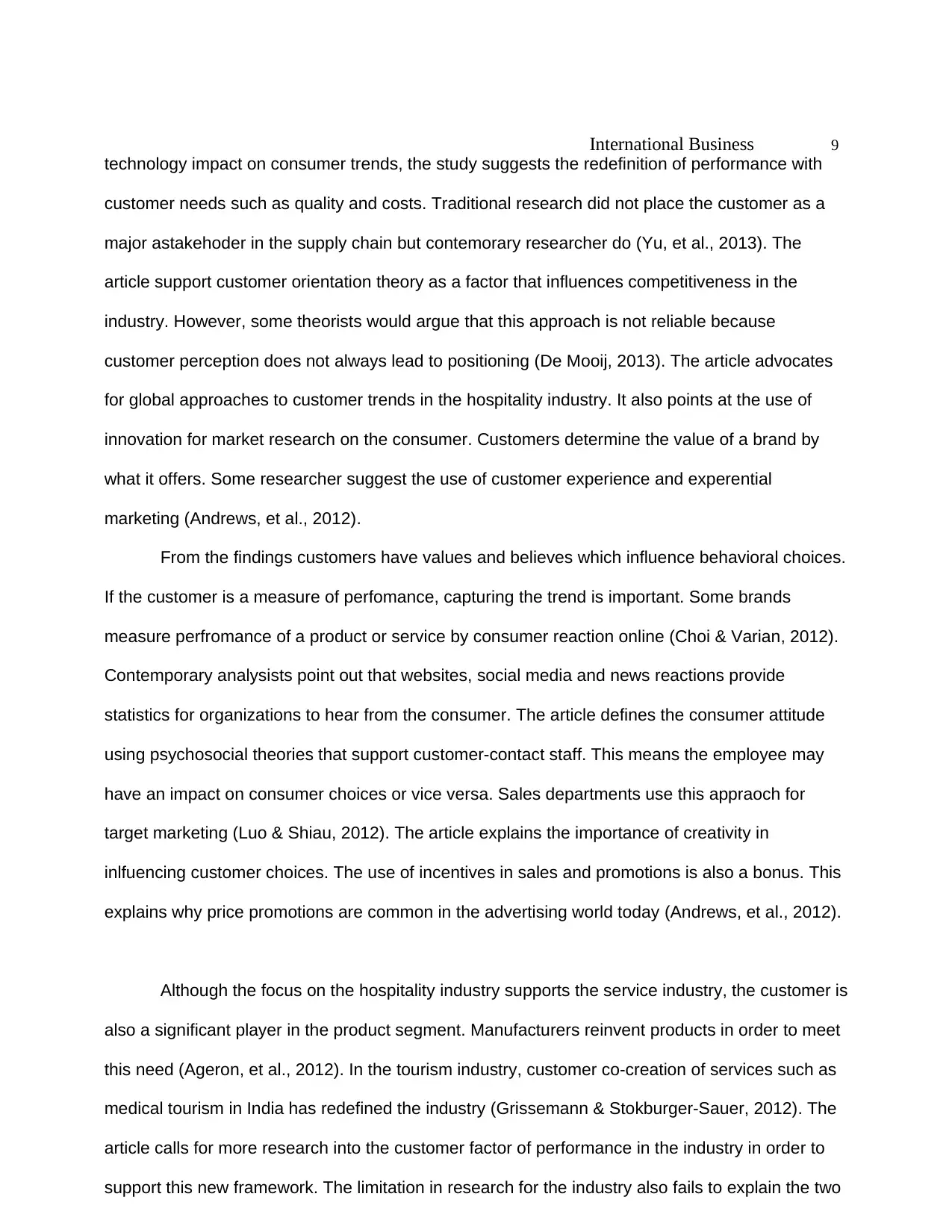
International Business 9
technology impact on consumer trends, the study suggests the redefinition of performance with
customer needs such as quality and costs. Traditional research did not place the customer as a
major astakehoder in the supply chain but contemorary researcher do (Yu, et al., 2013). The
article support customer orientation theory as a factor that influences competitiveness in the
industry. However, some theorists would argue that this approach is not reliable because
customer perception does not always lead to positioning (De Mooij, 2013). The article advocates
for global approaches to customer trends in the hospitality industry. It also points at the use of
innovation for market research on the consumer. Customers determine the value of a brand by
what it offers. Some researcher suggest the use of customer experience and experential
marketing (Andrews, et al., 2012).
From the findings customers have values and believes which influence behavioral choices.
If the customer is a measure of perfomance, capturing the trend is important. Some brands
measure perfromance of a product or service by consumer reaction online (Choi & Varian, 2012).
Contemporary analysists point out that websites, social media and news reactions provide
statistics for organizations to hear from the consumer. The article defines the consumer attitude
using psychosocial theories that support customer-contact staff. This means the employee may
have an impact on consumer choices or vice versa. Sales departments use this appraoch for
target marketing (Luo & Shiau, 2012). The article explains the importance of creativity in
inlfuencing customer choices. The use of incentives in sales and promotions is also a bonus. This
explains why price promotions are common in the advertising world today (Andrews, et al., 2012).
Although the focus on the hospitality industry supports the service industry, the customer is
also a significant player in the product segment. Manufacturers reinvent products in order to meet
this need (Ageron, et al., 2012). In the tourism industry, customer co-creation of services such as
medical tourism in India has redefined the industry (Grissemann & Stokburger-Sauer, 2012). The
article calls for more research into the customer factor of performance in the industry in order to
support this new framework. The limitation in research for the industry also fails to explain the two
technology impact on consumer trends, the study suggests the redefinition of performance with
customer needs such as quality and costs. Traditional research did not place the customer as a
major astakehoder in the supply chain but contemorary researcher do (Yu, et al., 2013). The
article support customer orientation theory as a factor that influences competitiveness in the
industry. However, some theorists would argue that this approach is not reliable because
customer perception does not always lead to positioning (De Mooij, 2013). The article advocates
for global approaches to customer trends in the hospitality industry. It also points at the use of
innovation for market research on the consumer. Customers determine the value of a brand by
what it offers. Some researcher suggest the use of customer experience and experential
marketing (Andrews, et al., 2012).
From the findings customers have values and believes which influence behavioral choices.
If the customer is a measure of perfomance, capturing the trend is important. Some brands
measure perfromance of a product or service by consumer reaction online (Choi & Varian, 2012).
Contemporary analysists point out that websites, social media and news reactions provide
statistics for organizations to hear from the consumer. The article defines the consumer attitude
using psychosocial theories that support customer-contact staff. This means the employee may
have an impact on consumer choices or vice versa. Sales departments use this appraoch for
target marketing (Luo & Shiau, 2012). The article explains the importance of creativity in
inlfuencing customer choices. The use of incentives in sales and promotions is also a bonus. This
explains why price promotions are common in the advertising world today (Andrews, et al., 2012).
Although the focus on the hospitality industry supports the service industry, the customer is
also a significant player in the product segment. Manufacturers reinvent products in order to meet
this need (Ageron, et al., 2012). In the tourism industry, customer co-creation of services such as
medical tourism in India has redefined the industry (Grissemann & Stokburger-Sauer, 2012). The
article calls for more research into the customer factor of performance in the industry in order to
support this new framework. The limitation in research for the industry also fails to explain the two
⊘ This is a preview!⊘
Do you want full access?
Subscribe today to unlock all pages.
Trusted by 1+ million students worldwide
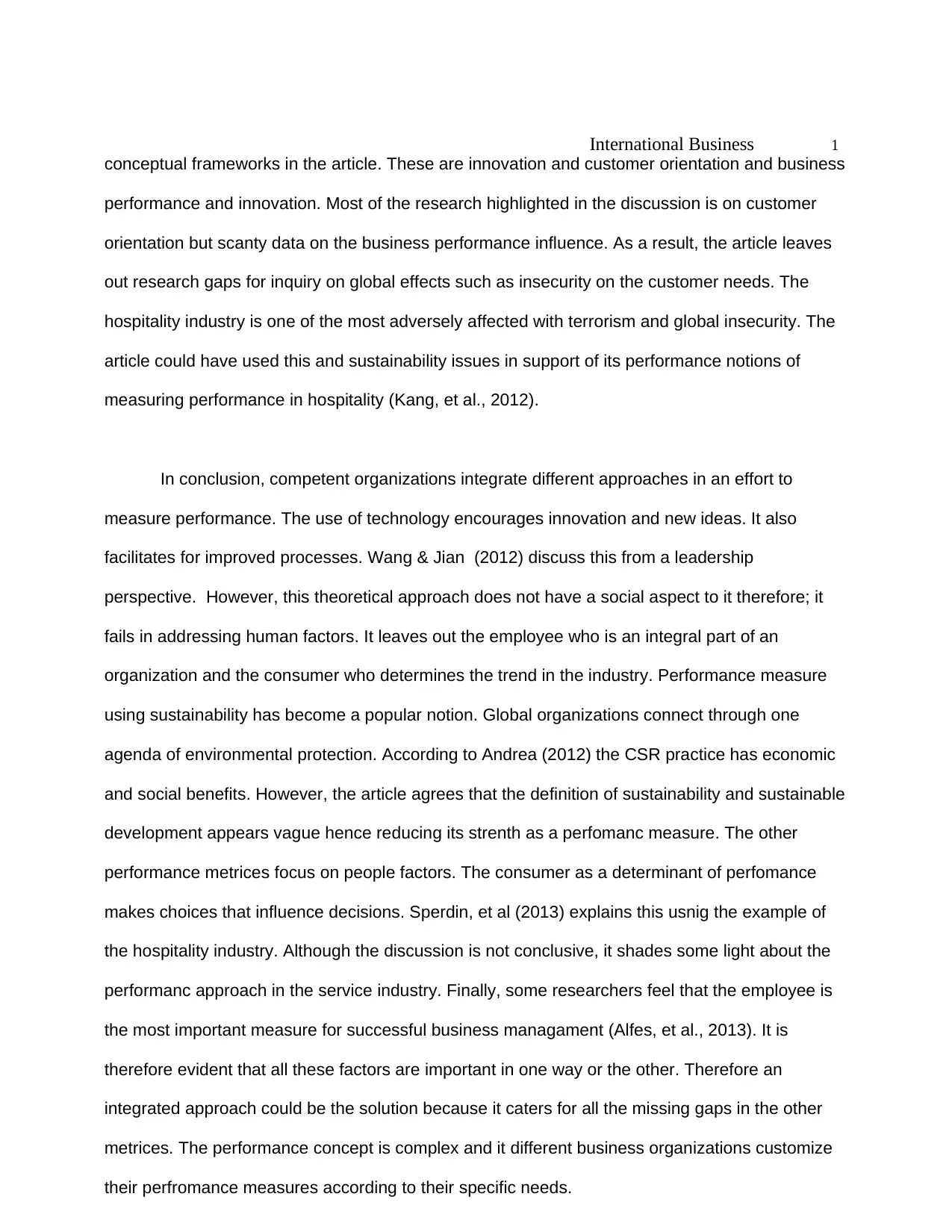
International Business 1
0conceptual frameworks in the article. These are innovation and customer orientation and business
performance and innovation. Most of the research highlighted in the discussion is on customer
orientation but scanty data on the business performance influence. As a result, the article leaves
out research gaps for inquiry on global effects such as insecurity on the customer needs. The
hospitality industry is one of the most adversely affected with terrorism and global insecurity. The
article could have used this and sustainability issues in support of its performance notions of
measuring performance in hospitality (Kang, et al., 2012).
In conclusion, competent organizations integrate different approaches in an effort to
measure performance. The use of technology encourages innovation and new ideas. It also
facilitates for improved processes. Wang & Jian (2012) discuss this from a leadership
perspective. However, this theoretical approach does not have a social aspect to it therefore; it
fails in addressing human factors. It leaves out the employee who is an integral part of an
organization and the consumer who determines the trend in the industry. Performance measure
using sustainability has become a popular notion. Global organizations connect through one
agenda of environmental protection. According to Andrea (2012) the CSR practice has economic
and social benefits. However, the article agrees that the definition of sustainability and sustainable
development appears vague hence reducing its strenth as a perfomanc measure. The other
performance metrices focus on people factors. The consumer as a determinant of perfomance
makes choices that influence decisions. Sperdin, et al (2013) explains this usnig the example of
the hospitality industry. Although the discussion is not conclusive, it shades some light about the
performanc approach in the service industry. Finally, some researchers feel that the employee is
the most important measure for successful business managament (Alfes, et al., 2013). It is
therefore evident that all these factors are important in one way or the other. Therefore an
integrated approach could be the solution because it caters for all the missing gaps in the other
metrices. The performance concept is complex and it different business organizations customize
their perfromance measures according to their specific needs.
0conceptual frameworks in the article. These are innovation and customer orientation and business
performance and innovation. Most of the research highlighted in the discussion is on customer
orientation but scanty data on the business performance influence. As a result, the article leaves
out research gaps for inquiry on global effects such as insecurity on the customer needs. The
hospitality industry is one of the most adversely affected with terrorism and global insecurity. The
article could have used this and sustainability issues in support of its performance notions of
measuring performance in hospitality (Kang, et al., 2012).
In conclusion, competent organizations integrate different approaches in an effort to
measure performance. The use of technology encourages innovation and new ideas. It also
facilitates for improved processes. Wang & Jian (2012) discuss this from a leadership
perspective. However, this theoretical approach does not have a social aspect to it therefore; it
fails in addressing human factors. It leaves out the employee who is an integral part of an
organization and the consumer who determines the trend in the industry. Performance measure
using sustainability has become a popular notion. Global organizations connect through one
agenda of environmental protection. According to Andrea (2012) the CSR practice has economic
and social benefits. However, the article agrees that the definition of sustainability and sustainable
development appears vague hence reducing its strenth as a perfomanc measure. The other
performance metrices focus on people factors. The consumer as a determinant of perfomance
makes choices that influence decisions. Sperdin, et al (2013) explains this usnig the example of
the hospitality industry. Although the discussion is not conclusive, it shades some light about the
performanc approach in the service industry. Finally, some researchers feel that the employee is
the most important measure for successful business managament (Alfes, et al., 2013). It is
therefore evident that all these factors are important in one way or the other. Therefore an
integrated approach could be the solution because it caters for all the missing gaps in the other
metrices. The performance concept is complex and it different business organizations customize
their perfromance measures according to their specific needs.
Paraphrase This Document
Need a fresh take? Get an instant paraphrase of this document with our AI Paraphraser
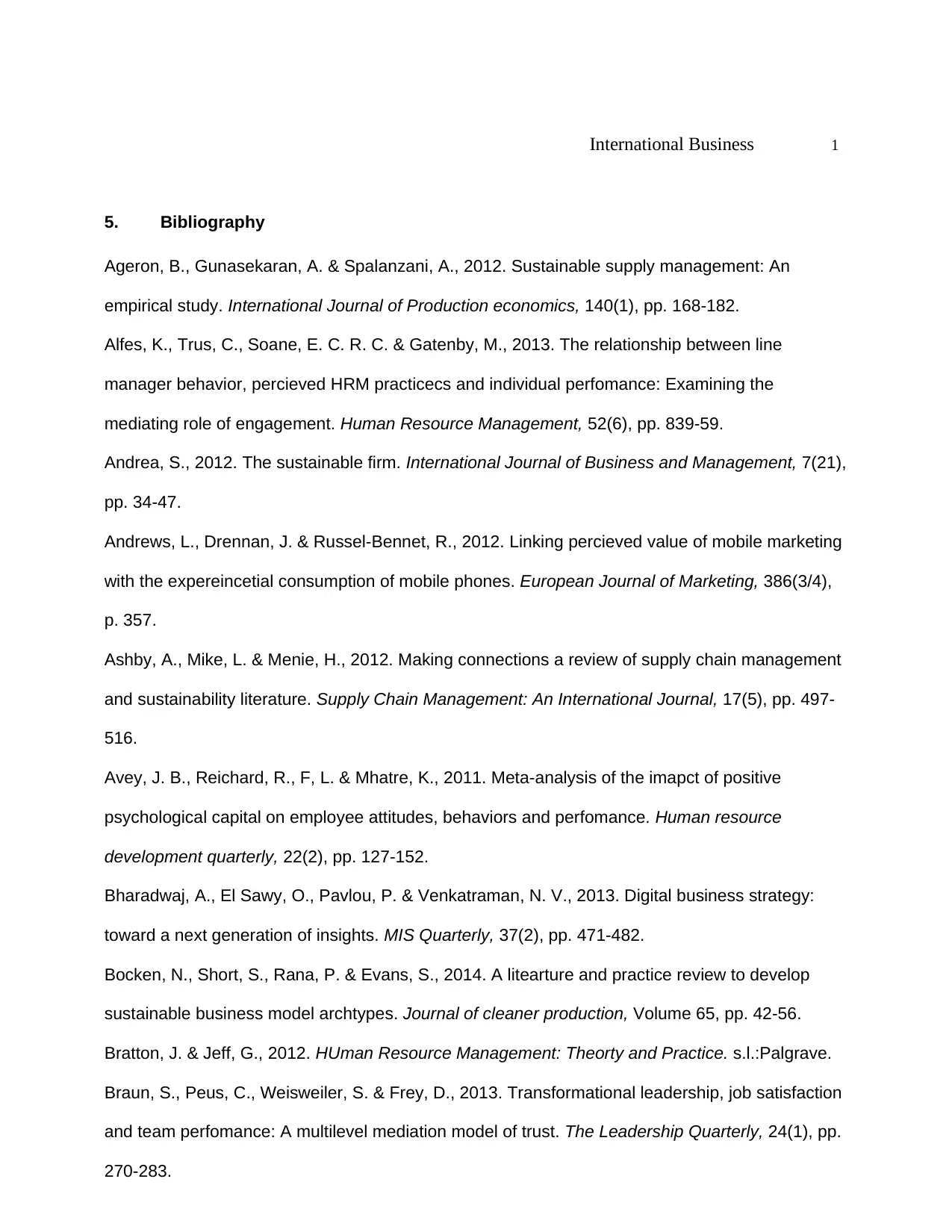
International Business 1
1
5. Bibliography
Ageron, B., Gunasekaran, A. & Spalanzani, A., 2012. Sustainable supply management: An
empirical study. International Journal of Production economics, 140(1), pp. 168-182.
Alfes, K., Trus, C., Soane, E. C. R. C. & Gatenby, M., 2013. The relationship between line
manager behavior, percieved HRM practicecs and individual perfomance: Examining the
mediating role of engagement. Human Resource Management, 52(6), pp. 839-59.
Andrea, S., 2012. The sustainable firm. International Journal of Business and Management, 7(21),
pp. 34-47.
Andrews, L., Drennan, J. & Russel-Bennet, R., 2012. Linking percieved value of mobile marketing
with the expereincetial consumption of mobile phones. European Journal of Marketing, 386(3/4),
p. 357.
Ashby, A., Mike, L. & Menie, H., 2012. Making connections a review of supply chain management
and sustainability literature. Supply Chain Management: An International Journal, 17(5), pp. 497-
516.
Avey, J. B., Reichard, R., F, L. & Mhatre, K., 2011. Meta-analysis of the imapct of positive
psychological capital on employee attitudes, behaviors and perfomance. Human resource
development quarterly, 22(2), pp. 127-152.
Bharadwaj, A., El Sawy, O., Pavlou, P. & Venkatraman, N. V., 2013. Digital business strategy:
toward a next generation of insights. MIS Quarterly, 37(2), pp. 471-482.
Bocken, N., Short, S., Rana, P. & Evans, S., 2014. A litearture and practice review to develop
sustainable business model archtypes. Journal of cleaner production, Volume 65, pp. 42-56.
Bratton, J. & Jeff, G., 2012. HUman Resource Management: Theorty and Practice. s.l.:Palgrave.
Braun, S., Peus, C., Weisweiler, S. & Frey, D., 2013. Transformational leadership, job satisfaction
and team perfomance: A multilevel mediation model of trust. The Leadership Quarterly, 24(1), pp.
270-283.
1
5. Bibliography
Ageron, B., Gunasekaran, A. & Spalanzani, A., 2012. Sustainable supply management: An
empirical study. International Journal of Production economics, 140(1), pp. 168-182.
Alfes, K., Trus, C., Soane, E. C. R. C. & Gatenby, M., 2013. The relationship between line
manager behavior, percieved HRM practicecs and individual perfomance: Examining the
mediating role of engagement. Human Resource Management, 52(6), pp. 839-59.
Andrea, S., 2012. The sustainable firm. International Journal of Business and Management, 7(21),
pp. 34-47.
Andrews, L., Drennan, J. & Russel-Bennet, R., 2012. Linking percieved value of mobile marketing
with the expereincetial consumption of mobile phones. European Journal of Marketing, 386(3/4),
p. 357.
Ashby, A., Mike, L. & Menie, H., 2012. Making connections a review of supply chain management
and sustainability literature. Supply Chain Management: An International Journal, 17(5), pp. 497-
516.
Avey, J. B., Reichard, R., F, L. & Mhatre, K., 2011. Meta-analysis of the imapct of positive
psychological capital on employee attitudes, behaviors and perfomance. Human resource
development quarterly, 22(2), pp. 127-152.
Bharadwaj, A., El Sawy, O., Pavlou, P. & Venkatraman, N. V., 2013. Digital business strategy:
toward a next generation of insights. MIS Quarterly, 37(2), pp. 471-482.
Bocken, N., Short, S., Rana, P. & Evans, S., 2014. A litearture and practice review to develop
sustainable business model archtypes. Journal of cleaner production, Volume 65, pp. 42-56.
Bratton, J. & Jeff, G., 2012. HUman Resource Management: Theorty and Practice. s.l.:Palgrave.
Braun, S., Peus, C., Weisweiler, S. & Frey, D., 2013. Transformational leadership, job satisfaction
and team perfomance: A multilevel mediation model of trust. The Leadership Quarterly, 24(1), pp.
270-283.
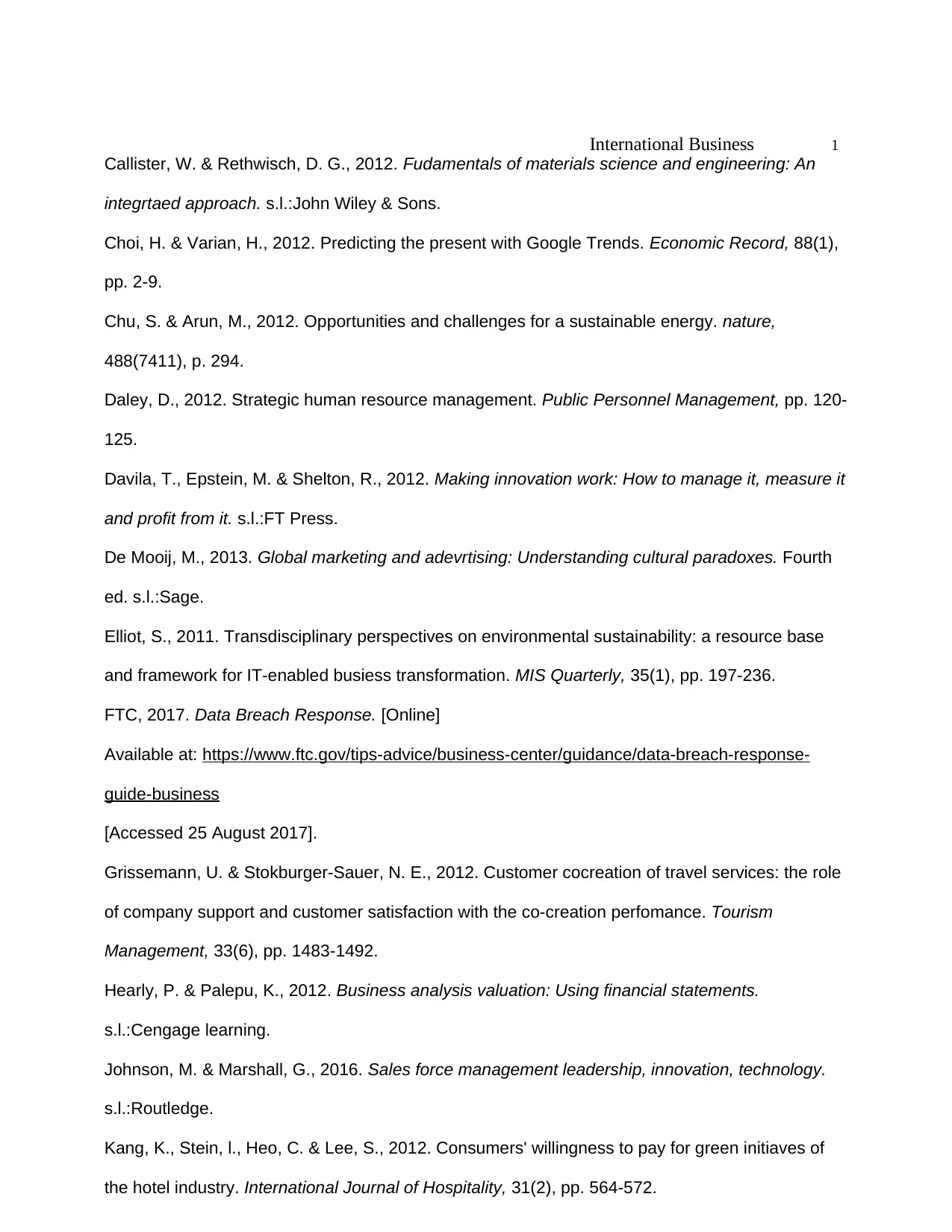
International Business 1
2Callister, W. & Rethwisch, D. G., 2012. Fudamentals of materials science and engineering: An
integrtaed approach. s.l.:John Wiley & Sons.
Choi, H. & Varian, H., 2012. Predicting the present with Google Trends. Economic Record, 88(1),
pp. 2-9.
Chu, S. & Arun, M., 2012. Opportunities and challenges for a sustainable energy. nature,
488(7411), p. 294.
Daley, D., 2012. Strategic human resource management. Public Personnel Management, pp. 120-
125.
Davila, T., Epstein, M. & Shelton, R., 2012. Making innovation work: How to manage it, measure it
and profit from it. s.l.:FT Press.
De Mooij, M., 2013. Global marketing and adevrtising: Understanding cultural paradoxes. Fourth
ed. s.l.:Sage.
Elliot, S., 2011. Transdisciplinary perspectives on environmental sustainability: a resource base
and framework for IT-enabled busiess transformation. MIS Quarterly, 35(1), pp. 197-236.
FTC, 2017. Data Breach Response. [Online]
Available at: https://www.ftc.gov/tips-advice/business-center/guidance/data-breach-response-
guide-business
[Accessed 25 August 2017].
Grissemann, U. & Stokburger-Sauer, N. E., 2012. Customer cocreation of travel services: the role
of company support and customer satisfaction with the co-creation perfomance. Tourism
Management, 33(6), pp. 1483-1492.
Hearly, P. & Palepu, K., 2012. Business analysis valuation: Using financial statements.
s.l.:Cengage learning.
Johnson, M. & Marshall, G., 2016. Sales force management leadership, innovation, technology.
s.l.:Routledge.
Kang, K., Stein, l., Heo, C. & Lee, S., 2012. Consumers' willingness to pay for green initiaves of
the hotel industry. International Journal of Hospitality, 31(2), pp. 564-572.
2Callister, W. & Rethwisch, D. G., 2012. Fudamentals of materials science and engineering: An
integrtaed approach. s.l.:John Wiley & Sons.
Choi, H. & Varian, H., 2012. Predicting the present with Google Trends. Economic Record, 88(1),
pp. 2-9.
Chu, S. & Arun, M., 2012. Opportunities and challenges for a sustainable energy. nature,
488(7411), p. 294.
Daley, D., 2012. Strategic human resource management. Public Personnel Management, pp. 120-
125.
Davila, T., Epstein, M. & Shelton, R., 2012. Making innovation work: How to manage it, measure it
and profit from it. s.l.:FT Press.
De Mooij, M., 2013. Global marketing and adevrtising: Understanding cultural paradoxes. Fourth
ed. s.l.:Sage.
Elliot, S., 2011. Transdisciplinary perspectives on environmental sustainability: a resource base
and framework for IT-enabled busiess transformation. MIS Quarterly, 35(1), pp. 197-236.
FTC, 2017. Data Breach Response. [Online]
Available at: https://www.ftc.gov/tips-advice/business-center/guidance/data-breach-response-
guide-business
[Accessed 25 August 2017].
Grissemann, U. & Stokburger-Sauer, N. E., 2012. Customer cocreation of travel services: the role
of company support and customer satisfaction with the co-creation perfomance. Tourism
Management, 33(6), pp. 1483-1492.
Hearly, P. & Palepu, K., 2012. Business analysis valuation: Using financial statements.
s.l.:Cengage learning.
Johnson, M. & Marshall, G., 2016. Sales force management leadership, innovation, technology.
s.l.:Routledge.
Kang, K., Stein, l., Heo, C. & Lee, S., 2012. Consumers' willingness to pay for green initiaves of
the hotel industry. International Journal of Hospitality, 31(2), pp. 564-572.
⊘ This is a preview!⊘
Do you want full access?
Subscribe today to unlock all pages.
Trusted by 1+ million students worldwide

1 out of 14


Related Documents


Your All-in-One AI-Powered Toolkit for Academic Success.
+13062052269
info@desklib.com
Available 24*7 on WhatsApp / Email
![[object Object]](/_next/static/media/star-bottom.7253800d.svg)
Unlock your academic potential
Copyright © 2020–2026 A2Z Services. All Rights Reserved. Developed and managed by ZUCOL.