Leadership & Management Theories in Lloyds and Barclays: A Report
VerifiedAdded on 2023/06/14
|11
|3042
|472
Report
AI Summary
This report examines the leadership and management theories applied within Lloyds and Barclays, analyzing their impact on organizational effectiveness. It explores theories such as the Great Man Theory, Transactional Theory, and Transformational Theory in relation to leadership, and Bureaucratic Theory, Scientific Theory, and Human Relations Theory in relation to management. The report further investigates how different leadership and management styles are employed in various business situations, including COVID-19 challenges, employee retention strategies, and cultural issue resolutions. It also examines the factors influencing the development of organizational culture within Lloyds and Barclays, highlighting the importance of employee environment, management styles, and organizational structure in fostering a productive and motivated workforce.

LEADERSHIP AND
MANAGEMENTAT
WORKPLACE
MANAGEMENTAT
WORKPLACE

Paraphrase This Document
Need a fresh take? Get an instant paraphrase of this document with our AI Paraphraser
Table of Contents
INTRODUCTION...........................................................................................................................3
MAIN BODY...................................................................................................................................3
Theories of Leadership in relation to the management of Lloyds and Barclays and its analysis
and impact....................................................................................................................................3
Theories of Management in relation to Lloyds and Barclays, its analysis and impact................4
Leadership and management styles in different business situations, its impact and importance
......................................................................................................................................................6
CONCLUSION................................................................................................................................9
REFERENCES................................................................................................................................1
INTRODUCTION...........................................................................................................................3
MAIN BODY...................................................................................................................................3
Theories of Leadership in relation to the management of Lloyds and Barclays and its analysis
and impact....................................................................................................................................3
Theories of Management in relation to Lloyds and Barclays, its analysis and impact................4
Leadership and management styles in different business situations, its impact and importance
......................................................................................................................................................6
CONCLUSION................................................................................................................................9
REFERENCES................................................................................................................................1
INTRODUCTION
Leadership in management refers to the potential of a company to achieve the targetted
objectives set by the company. Leadership in management involves fast decision making,
utilizing the company's calibre to the fullest and beat the existing competition. This report is
going to study the leadership and management theories and principles implemented in the Lloyds
and Barclays and how their use enhances the effectiveness of the organization. Further, it will
analyze the impact of different leadership and management styles on the organizational culture.
It will create a strategy of motivation in order to increase the efficiency of the organization. The
study will implement the approaches and techniques for the purpose of identifying the constant
growth of the company.
MAIN BODY
Theories of Leadership in relation to the management of Lloyds and Barclays and its analysis
and impact
Leadership theories are used by different companies in order to define their leaders on the
basis of certain features. It states few characteristics which are necessary for handling the
position of an enterprise as a leader. The theories in relation to the management of Lloyds and
Barclays have been explained below:
The Great Man Theory
This theory states that leaders are born, and not developed. This means that the trait of
leadership in an individual is heredeitary and thus it cannot be created or developed in an
individual. The in born leadership traits includes confidence, intelligence, communication skills
and charm. In other words, this theory states that the individuals who are born with features of
leading should be served with the position of power and authority (Ablyakimova, 2020). For
instance, Lloyds believes in The Great Man Theory of leadership and thus, provides a leadership
position to those employees which have the inherent traits of leadership in them. This helps the
company in saving time as well cost as they do not have to spend additional money training for
the development of these leadership skills. Instead, the company can directly use those
employees which have these traits in the times of need.
Transactional Theory
Leadership in management refers to the potential of a company to achieve the targetted
objectives set by the company. Leadership in management involves fast decision making,
utilizing the company's calibre to the fullest and beat the existing competition. This report is
going to study the leadership and management theories and principles implemented in the Lloyds
and Barclays and how their use enhances the effectiveness of the organization. Further, it will
analyze the impact of different leadership and management styles on the organizational culture.
It will create a strategy of motivation in order to increase the efficiency of the organization. The
study will implement the approaches and techniques for the purpose of identifying the constant
growth of the company.
MAIN BODY
Theories of Leadership in relation to the management of Lloyds and Barclays and its analysis
and impact
Leadership theories are used by different companies in order to define their leaders on the
basis of certain features. It states few characteristics which are necessary for handling the
position of an enterprise as a leader. The theories in relation to the management of Lloyds and
Barclays have been explained below:
The Great Man Theory
This theory states that leaders are born, and not developed. This means that the trait of
leadership in an individual is heredeitary and thus it cannot be created or developed in an
individual. The in born leadership traits includes confidence, intelligence, communication skills
and charm. In other words, this theory states that the individuals who are born with features of
leading should be served with the position of power and authority (Ablyakimova, 2020). For
instance, Lloyds believes in The Great Man Theory of leadership and thus, provides a leadership
position to those employees which have the inherent traits of leadership in them. This helps the
company in saving time as well cost as they do not have to spend additional money training for
the development of these leadership skills. Instead, the company can directly use those
employees which have these traits in the times of need.
Transactional Theory
⊘ This is a preview!⊘
Do you want full access?
Subscribe today to unlock all pages.

Trusted by 1+ million students worldwide
Transactional Theory of leadership can be defined as a system in which leaders develop
ways in order to influence the subordinates. Under this theory, the leaders motivate their
subordinates by giving them rewards when performed well, and punishing them when the
employees do not meet their set of responsibilities. Barclays implements the transactional theory
of leadership in their organization (Adams, 2018). The management team of Barclays plans out
a set of instructions which should be followed by the subordinates working in its organization.
The company clearly defines its expectations in terms of work needed and provides them with
the necessary resources in order to achieve the objectives of the company. On successful
completion of specific tasks, the company serves the employees with rewards to motivate them.
This theory helps Barclays in improving the productivity of their employees by way providing
time-to-time rewards. This theory is only successful in meeting simple and clear problems.
Transformational Theory
This theory of leadership works on the basis of motivation, intellect and idealized
influence. This means the theory focuses on influencing the subordinates by motivating them in
different ways such as listening to their ideas, challenging their capabilities and allowing them to
be innovative. This theory allows them to make mistakes (Bratton, 2020). The leader corrects
their mistakes by guiding them personally and appreciate their efforts in front of whole team.
One of the theories implemented by the management of Lloyds is Transformational theory of
leadership. This helps the company in getting new and innovative ideas from their emloyees. The
actual appreciation received in front of the whole enterprise motivates and inspires the
employees to work hard and achieve the set goals of the company. This theory helps Lloyds in
the times of need as under this theory, employees feel a sense of satisfaction from their jobs and
appreciation keeps them engaged with the company.
Theories of Management in relation to Lloyds and Barclays, its analysis and impact
Management theories work as a guide to the management of an organization. The
theories of management helps a company to gain a better understanding of the organization by
implementing these theories. The management theories in relation to the management of
Barclays and Llyods have been explained below:
Bureaucratic Theory
The bureaucratic theory follows a hierarchical management structure within the
organization. It means the main power and authority remains in the hands of the top level
ways in order to influence the subordinates. Under this theory, the leaders motivate their
subordinates by giving them rewards when performed well, and punishing them when the
employees do not meet their set of responsibilities. Barclays implements the transactional theory
of leadership in their organization (Adams, 2018). The management team of Barclays plans out
a set of instructions which should be followed by the subordinates working in its organization.
The company clearly defines its expectations in terms of work needed and provides them with
the necessary resources in order to achieve the objectives of the company. On successful
completion of specific tasks, the company serves the employees with rewards to motivate them.
This theory helps Barclays in improving the productivity of their employees by way providing
time-to-time rewards. This theory is only successful in meeting simple and clear problems.
Transformational Theory
This theory of leadership works on the basis of motivation, intellect and idealized
influence. This means the theory focuses on influencing the subordinates by motivating them in
different ways such as listening to their ideas, challenging their capabilities and allowing them to
be innovative. This theory allows them to make mistakes (Bratton, 2020). The leader corrects
their mistakes by guiding them personally and appreciate their efforts in front of whole team.
One of the theories implemented by the management of Lloyds is Transformational theory of
leadership. This helps the company in getting new and innovative ideas from their emloyees. The
actual appreciation received in front of the whole enterprise motivates and inspires the
employees to work hard and achieve the set goals of the company. This theory helps Lloyds in
the times of need as under this theory, employees feel a sense of satisfaction from their jobs and
appreciation keeps them engaged with the company.
Theories of Management in relation to Lloyds and Barclays, its analysis and impact
Management theories work as a guide to the management of an organization. The
theories of management helps a company to gain a better understanding of the organization by
implementing these theories. The management theories in relation to the management of
Barclays and Llyods have been explained below:
Bureaucratic Theory
The bureaucratic theory follows a hierarchical management structure within the
organization. It means the main power and authority remains in the hands of the top level
Paraphrase This Document
Need a fresh take? Get an instant paraphrase of this document with our AI Paraphraser
management in the organization. The top level then delegates the power and responsibilities to
middle and lower level management. Barclays implements bureaucratic management theory
within their enterprise. Barclays defines the role, responsibility and power by following the
Hierarchical Management Structure (Deshwal, and Ali, 2020). This helps the company in
enhancing the current skillset of their workforce as it keeps on alloting tasks on the basis of
their specialization. This theory makes sure if the rules are applied in the same manner to
everyone or not. The benefits of using this theory is that it helps the company in achieving great
level of efficiency and satisfaction. But one negative impact of using this theory is that
employees might feel powerless as they cannot reach to the top management directly.
Scientific Theory
The scientific theory of management states that the process of doing any work in an
organization should be constantly improved in order to make it easy. This theory lays emphasises
on providing a friendly working environment to its employees and equal treatment to all
employees. It focuses on providing an environment in which employees cooperate each other in
achieving efficiency. This theory of management is executed by Lloyds in its organization (Hunt,
and Fitzgerald, 2018). The implementation of this theory helps in avoiding labour and
management disputes as this theory promotes cooperation among employees. Better use of
technology in the process of manufaturing helps in increasing the productivity of the enterprise.
This helps the company in achieving greater efficiency and attaining the set goals of the
organization. The scientific management theory is expensive and time consuming process as it
involves a lot of work and study.
Human Relations Theory
The management theory of human relation lays emphasis on people instead of machines.
It states that it is important for an organization to build as well as maintain good employee
relations in order to motivate them. Companies can efficiently motivate their employees by way
of teamwork and developing coordination and cooperations between them. Barclays uses the
human relations theory of management in its enterprise. This theory helps the company in
increasing the productivity by maintaining good employee relations (Kareem, 2020). A healthy,
safe and friendly work environment engages the employees with the company and retains them
for a long period of time. This theory further helps in building a great bond between the
subordinates and manager by focusing on developing team work spirit. The negative aspect of
middle and lower level management. Barclays implements bureaucratic management theory
within their enterprise. Barclays defines the role, responsibility and power by following the
Hierarchical Management Structure (Deshwal, and Ali, 2020). This helps the company in
enhancing the current skillset of their workforce as it keeps on alloting tasks on the basis of
their specialization. This theory makes sure if the rules are applied in the same manner to
everyone or not. The benefits of using this theory is that it helps the company in achieving great
level of efficiency and satisfaction. But one negative impact of using this theory is that
employees might feel powerless as they cannot reach to the top management directly.
Scientific Theory
The scientific theory of management states that the process of doing any work in an
organization should be constantly improved in order to make it easy. This theory lays emphasises
on providing a friendly working environment to its employees and equal treatment to all
employees. It focuses on providing an environment in which employees cooperate each other in
achieving efficiency. This theory of management is executed by Lloyds in its organization (Hunt,
and Fitzgerald, 2018). The implementation of this theory helps in avoiding labour and
management disputes as this theory promotes cooperation among employees. Better use of
technology in the process of manufaturing helps in increasing the productivity of the enterprise.
This helps the company in achieving greater efficiency and attaining the set goals of the
organization. The scientific management theory is expensive and time consuming process as it
involves a lot of work and study.
Human Relations Theory
The management theory of human relation lays emphasis on people instead of machines.
It states that it is important for an organization to build as well as maintain good employee
relations in order to motivate them. Companies can efficiently motivate their employees by way
of teamwork and developing coordination and cooperations between them. Barclays uses the
human relations theory of management in its enterprise. This theory helps the company in
increasing the productivity by maintaining good employee relations (Kareem, 2020). A healthy,
safe and friendly work environment engages the employees with the company and retains them
for a long period of time. This theory further helps in building a great bond between the
subordinates and manager by focusing on developing team work spirit. The negative aspect of
the implementation of human relations theory is that it makes hard to predict the workplace
environment as it oversimplifies the relationship between the employees and the manager.
Leadership and management styles in different business situations, its impact and importance
There are various forms of leadership and management theories implemented by
organizations which works as a guide for the company in dealing with different business
situations. They are:
COVID19
The outbreak of COVID19 created a havoc in the whole world. It made hard for the
companies to function at the time of the lockdown. In that phase, many companies applied
different approches of leadership in their organizations. Similarly, Llyods made use of
transformational, charismatic, and supportive leadership styles in its organization (Mango,
2018.). It worked on motivating its employees and listening to their troubles for the purpose of
maintaing the quality of work in those times. The use of transformational and charismatic
leadership styles helps the company in creating new business opportunities and providing a clear
goal to the whole management.
Employee retention
In today's world, employees keeps on switching from one organization to another in
search of better opportunities, growth and the level of satisfaction. Under such circumstances,
Barclays follows human relations management theory and transactional style of leadership.
Barclays believes that employees can be retained in an organization only when they can get a
sense of belonging at their workplace. For this purpose, the company plans a set of rewards for
their employees on the successful completion of a given task (Megheirkouni, and Mejheirkouni,
2020). This motivates them to work hard for the organization and engages them with the
company. Further, Barclays uses the human relation management theory in order to create a
healthy environment for its employees. Barclays also works for the job satisfaction of their
employees in order to keep the employees engaged with the enterprise.
Cultural issues
People from different cultures and ethnicities work in an organization together. Similarly,
they find it difficult to adjust within the organization with people coming from different
backgrouds (Onuecheta, 2020). For the purpose of the same, Llyods executes the
environment as it oversimplifies the relationship between the employees and the manager.
Leadership and management styles in different business situations, its impact and importance
There are various forms of leadership and management theories implemented by
organizations which works as a guide for the company in dealing with different business
situations. They are:
COVID19
The outbreak of COVID19 created a havoc in the whole world. It made hard for the
companies to function at the time of the lockdown. In that phase, many companies applied
different approches of leadership in their organizations. Similarly, Llyods made use of
transformational, charismatic, and supportive leadership styles in its organization (Mango,
2018.). It worked on motivating its employees and listening to their troubles for the purpose of
maintaing the quality of work in those times. The use of transformational and charismatic
leadership styles helps the company in creating new business opportunities and providing a clear
goal to the whole management.
Employee retention
In today's world, employees keeps on switching from one organization to another in
search of better opportunities, growth and the level of satisfaction. Under such circumstances,
Barclays follows human relations management theory and transactional style of leadership.
Barclays believes that employees can be retained in an organization only when they can get a
sense of belonging at their workplace. For this purpose, the company plans a set of rewards for
their employees on the successful completion of a given task (Megheirkouni, and Mejheirkouni,
2020). This motivates them to work hard for the organization and engages them with the
company. Further, Barclays uses the human relation management theory in order to create a
healthy environment for its employees. Barclays also works for the job satisfaction of their
employees in order to keep the employees engaged with the enterprise.
Cultural issues
People from different cultures and ethnicities work in an organization together. Similarly,
they find it difficult to adjust within the organization with people coming from different
backgrouds (Onuecheta, 2020). For the purpose of the same, Llyods executes the
⊘ This is a preview!⊘
Do you want full access?
Subscribe today to unlock all pages.
Trusted by 1+ million students worldwide
transformational style of leadership and scientific theory of management within the organization.
Scientific theory of management allows the employees to come to the manager and express their
issues without the feeling of being judged. This helps the employees in developing the feeling
that they are being heard and necessary changes will be made in order to resolve the issues
(Saxena, 2019). It further provides an evironment in which employees cooperate each other for
attaining the objectives of the company. And the use of transformational style of leadership
makes sure that the employees feel motivated regardless of the cultural issues in the organization
while the management works on solving the issues faced by their team.
P4 Examining the factors which are influence development of the culture in organisation.
Lloyds & Barclays
There are some of the factors which are influencing both the organisation such as
individual who are working with the company nature of business, goals and objectives,
management and its style, etc. In Lloyds it has been analysed there are free environment for the
employees for the working hours because they are more focus on the outcome which are given
by them not depend on their working method. On the others hand, Barclays are more focus on
the organisation cultural because it has follow strict rules end regulations for the employees who
are working with them. At this kind of situation employees are not feel free to work and this
culture can demotivate the employees (Zeimers, Anagnostopoulos and Willem, 2019). Also,
Lloyds have the clear mindset about hiring youngsters because they are actively listen the things
and work on it more faster as other. On another side, Barclays are more focused on hiring those
who are belongs to the same field and have experience but the strategy not working well for the
organisations because it can be allow the people not to learn new things according to current era.
The another factor is related to nature of business in which the first one organisation is
using hierarchical organisational structure so that it can be affected in order to flow of authority
into one direction only in which employees are not free to take the decision. Also, employees are
not giving any suggestion or feedback in order to maintain organisational culture. In order to
contradicted that the functional structure followed by the Barclays for creating good
environment also employees are free to choose their field according to their interest it helps to
increase the productivity of the organisation (Smith, Ball and Van Der Meer, 2019). Furthers,
some there are different types of department in this structure which help to maintain good
environment as well as help to corporate with organisation top management. Also, this structure
Scientific theory of management allows the employees to come to the manager and express their
issues without the feeling of being judged. This helps the employees in developing the feeling
that they are being heard and necessary changes will be made in order to resolve the issues
(Saxena, 2019). It further provides an evironment in which employees cooperate each other for
attaining the objectives of the company. And the use of transformational style of leadership
makes sure that the employees feel motivated regardless of the cultural issues in the organization
while the management works on solving the issues faced by their team.
P4 Examining the factors which are influence development of the culture in organisation.
Lloyds & Barclays
There are some of the factors which are influencing both the organisation such as
individual who are working with the company nature of business, goals and objectives,
management and its style, etc. In Lloyds it has been analysed there are free environment for the
employees for the working hours because they are more focus on the outcome which are given
by them not depend on their working method. On the others hand, Barclays are more focus on
the organisation cultural because it has follow strict rules end regulations for the employees who
are working with them. At this kind of situation employees are not feel free to work and this
culture can demotivate the employees (Zeimers, Anagnostopoulos and Willem, 2019). Also,
Lloyds have the clear mindset about hiring youngsters because they are actively listen the things
and work on it more faster as other. On another side, Barclays are more focused on hiring those
who are belongs to the same field and have experience but the strategy not working well for the
organisations because it can be allow the people not to learn new things according to current era.
The another factor is related to nature of business in which the first one organisation is
using hierarchical organisational structure so that it can be affected in order to flow of authority
into one direction only in which employees are not free to take the decision. Also, employees are
not giving any suggestion or feedback in order to maintain organisational culture. In order to
contradicted that the functional structure followed by the Barclays for creating good
environment also employees are free to choose their field according to their interest it helps to
increase the productivity of the organisation (Smith, Ball and Van Der Meer, 2019). Furthers,
some there are different types of department in this structure which help to maintain good
environment as well as help to corporate with organisation top management. Also, this structure
Paraphrase This Document
Need a fresh take? Get an instant paraphrase of this document with our AI Paraphraser
are goal and objective focused which are help to generate more profit. That is why the growth of
first company is less than the second one because there are major difference between
organisational structure and culture.
Leadership is the most essential factor that influence the organisation culture at advanced level.
The leader of the organisation Lloyds communicate with the workers on the regular bases
enhance the positive culture within the organisation (Gandolfi and Stone,2018) . Along with the
manger of the organisation resolve the issue of the employees which are related to the personal
as well as professional. It provides satisfaction to the consumer as well as the employees able to
decrease the stress and work with the positivity. The leader of the organisation do not provide
motivational programmes for the workers which increase the demotivation among the people
working for the organisation. It is essential for the both banks or the organisation to motivate the
employees on the regular bases. On the other hand the manger of the company provide feedbacks
to the employees that encourage the employees to improve the productivity and become
inspiration in the organisation. Moreover, because of that the organisation able to appreciate the
better performer. Simultaneously the manger of the Barclays provide briefing to the employees
on the regular base and allot the task in a group. This plan of action increase the coordination and
cooperation among the people. Therefore, it also decreases the burden of the employees without
decreasing the workflow (Al Khajeh,2018). Beside this the leader of the organisation involve the
workers in decision-making process of the company which give the feeling of being asset to the
organisation rather than being liability of the company.
Part-B (COVERED IN PPT)
first company is less than the second one because there are major difference between
organisational structure and culture.
Leadership is the most essential factor that influence the organisation culture at advanced level.
The leader of the organisation Lloyds communicate with the workers on the regular bases
enhance the positive culture within the organisation (Gandolfi and Stone,2018) . Along with the
manger of the organisation resolve the issue of the employees which are related to the personal
as well as professional. It provides satisfaction to the consumer as well as the employees able to
decrease the stress and work with the positivity. The leader of the organisation do not provide
motivational programmes for the workers which increase the demotivation among the people
working for the organisation. It is essential for the both banks or the organisation to motivate the
employees on the regular bases. On the other hand the manger of the company provide feedbacks
to the employees that encourage the employees to improve the productivity and become
inspiration in the organisation. Moreover, because of that the organisation able to appreciate the
better performer. Simultaneously the manger of the Barclays provide briefing to the employees
on the regular base and allot the task in a group. This plan of action increase the coordination and
cooperation among the people. Therefore, it also decreases the burden of the employees without
decreasing the workflow (Al Khajeh,2018). Beside this the leader of the organisation involve the
workers in decision-making process of the company which give the feeling of being asset to the
organisation rather than being liability of the company.
Part-B (COVERED IN PPT)
CONCLUSION
It has been concluded that both the organisation Lloyds & Barclays are doing greats in
their own field but at the same time the study discussed different theories of leadership in
relation to management activities. Also explored the different theories of management which are
related to both of the organisation on the basis of rang of business in different situation.
Moreover, examined the factors which are influence the development of culture as well as it
depend on the nature of organisational which is followed by the organisation. Further, produced
the motivational strategy for organisation which are supporting optimal achievement in the
organisational objectives. Also, it includes intrinsic and extrinsic motivation for using strategy
which are effectively addressing all the variables of the motivation that help to enhancing
performance of the organisation. Lastly, the report applied for the range of situation of business
which are using appropriate management and leadership approaches that are managing the
performance as well as continuous improvement.
It has been concluded that both the organisation Lloyds & Barclays are doing greats in
their own field but at the same time the study discussed different theories of leadership in
relation to management activities. Also explored the different theories of management which are
related to both of the organisation on the basis of rang of business in different situation.
Moreover, examined the factors which are influence the development of culture as well as it
depend on the nature of organisational which is followed by the organisation. Further, produced
the motivational strategy for organisation which are supporting optimal achievement in the
organisational objectives. Also, it includes intrinsic and extrinsic motivation for using strategy
which are effectively addressing all the variables of the motivation that help to enhancing
performance of the organisation. Lastly, the report applied for the range of situation of business
which are using appropriate management and leadership approaches that are managing the
performance as well as continuous improvement.
⊘ This is a preview!⊘
Do you want full access?
Subscribe today to unlock all pages.
Trusted by 1+ million students worldwide
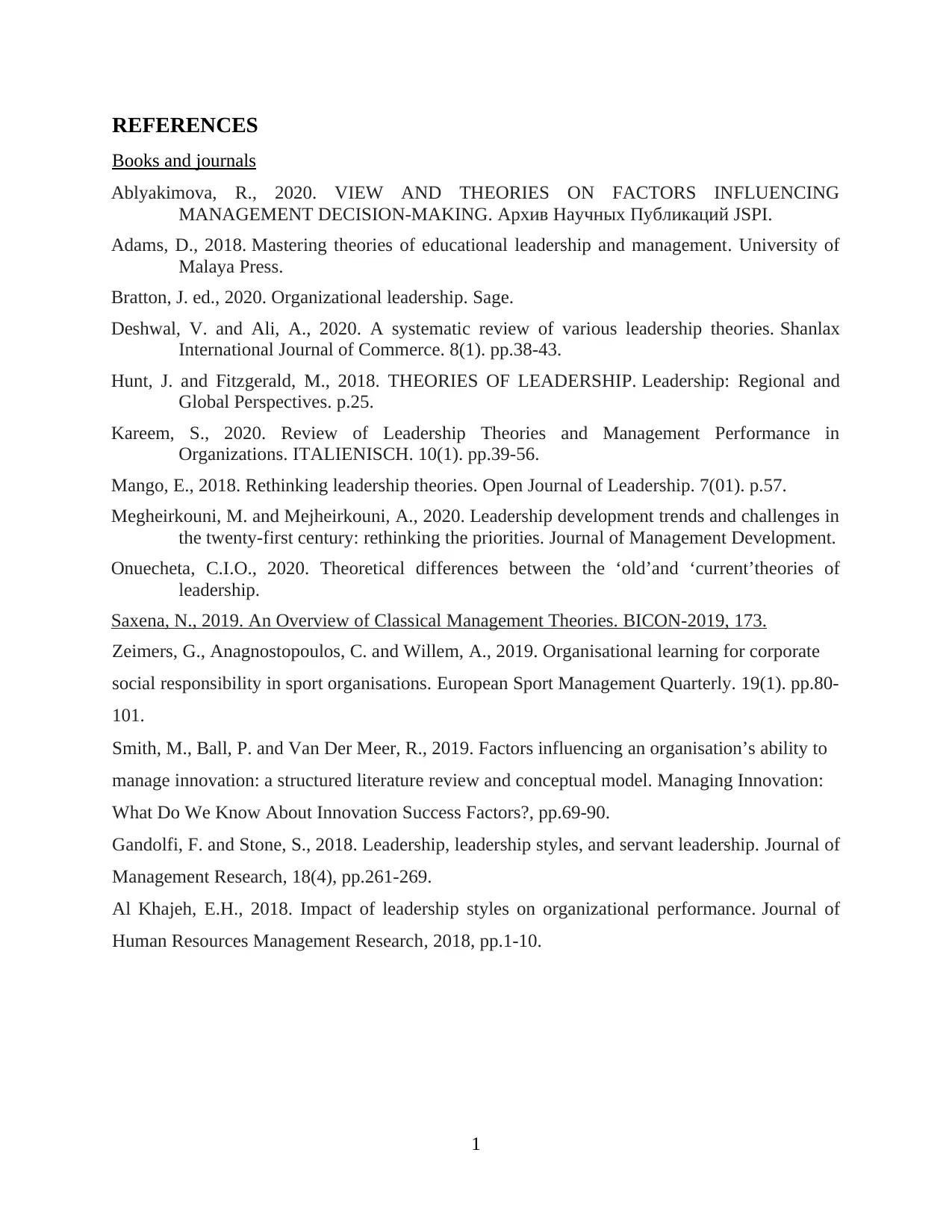
REFERENCES
Books and journals
Ablyakimova, R., 2020. VIEW AND THEORIES ON FACTORS INFLUENCING
MANAGEMENT DECISION-MAKING. Архив Научных Публикаций JSPI.
Adams, D., 2018. Mastering theories of educational leadership and management. University of
Malaya Press.
Bratton, J. ed., 2020. Organizational leadership. Sage.
Deshwal, V. and Ali, A., 2020. A systematic review of various leadership theories. Shanlax
International Journal of Commerce. 8(1). pp.38-43.
Hunt, J. and Fitzgerald, M., 2018. THEORIES OF LEADERSHIP. Leadership: Regional and
Global Perspectives. p.25.
Kareem, S., 2020. Review of Leadership Theories and Management Performance in
Organizations. ITALIENISCH. 10(1). pp.39-56.
Mango, E., 2018. Rethinking leadership theories. Open Journal of Leadership. 7(01). p.57.
Megheirkouni, M. and Mejheirkouni, A., 2020. Leadership development trends and challenges in
the twenty-first century: rethinking the priorities. Journal of Management Development.
Onuecheta, C.I.O., 2020. Theoretical differences between the ‘old’and ‘current’theories of
leadership.
Saxena, N., 2019. An Overview of Classical Management Theories. BICON-2019, 173.
Zeimers, G., Anagnostopoulos, C. and Willem, A., 2019. Organisational learning for corporate
social responsibility in sport organisations. European Sport Management Quarterly. 19(1). pp.80-
101.
Smith, M., Ball, P. and Van Der Meer, R., 2019. Factors influencing an organisation’s ability to
manage innovation: a structured literature review and conceptual model. Managing Innovation:
What Do We Know About Innovation Success Factors?, pp.69-90.
Gandolfi, F. and Stone, S., 2018. Leadership, leadership styles, and servant leadership. Journal of
Management Research, 18(4), pp.261-269.
Al Khajeh, E.H., 2018. Impact of leadership styles on organizational performance. Journal of
Human Resources Management Research, 2018, pp.1-10.
1
Books and journals
Ablyakimova, R., 2020. VIEW AND THEORIES ON FACTORS INFLUENCING
MANAGEMENT DECISION-MAKING. Архив Научных Публикаций JSPI.
Adams, D., 2018. Mastering theories of educational leadership and management. University of
Malaya Press.
Bratton, J. ed., 2020. Organizational leadership. Sage.
Deshwal, V. and Ali, A., 2020. A systematic review of various leadership theories. Shanlax
International Journal of Commerce. 8(1). pp.38-43.
Hunt, J. and Fitzgerald, M., 2018. THEORIES OF LEADERSHIP. Leadership: Regional and
Global Perspectives. p.25.
Kareem, S., 2020. Review of Leadership Theories and Management Performance in
Organizations. ITALIENISCH. 10(1). pp.39-56.
Mango, E., 2018. Rethinking leadership theories. Open Journal of Leadership. 7(01). p.57.
Megheirkouni, M. and Mejheirkouni, A., 2020. Leadership development trends and challenges in
the twenty-first century: rethinking the priorities. Journal of Management Development.
Onuecheta, C.I.O., 2020. Theoretical differences between the ‘old’and ‘current’theories of
leadership.
Saxena, N., 2019. An Overview of Classical Management Theories. BICON-2019, 173.
Zeimers, G., Anagnostopoulos, C. and Willem, A., 2019. Organisational learning for corporate
social responsibility in sport organisations. European Sport Management Quarterly. 19(1). pp.80-
101.
Smith, M., Ball, P. and Van Der Meer, R., 2019. Factors influencing an organisation’s ability to
manage innovation: a structured literature review and conceptual model. Managing Innovation:
What Do We Know About Innovation Success Factors?, pp.69-90.
Gandolfi, F. and Stone, S., 2018. Leadership, leadership styles, and servant leadership. Journal of
Management Research, 18(4), pp.261-269.
Al Khajeh, E.H., 2018. Impact of leadership styles on organizational performance. Journal of
Human Resources Management Research, 2018, pp.1-10.
1
Paraphrase This Document
Need a fresh take? Get an instant paraphrase of this document with our AI Paraphraser

2

1 out of 11


Related Documents


Your All-in-One AI-Powered Toolkit for Academic Success.
+13062052269
info@desklib.com
Available 24*7 on WhatsApp / Email
![[object Object]](/_next/static/media/star-bottom.7253800d.svg)
Unlock your academic potential
Copyright © 2020–2026 A2Z Services. All Rights Reserved. Developed and managed by ZUCOL.