BSC in HSC Management: LEV Systems Design, Operation, and Maintenance
VerifiedAdded on 2021/12/08
|18
|3537
|156
Report
AI Summary
This report offers a comprehensive overview of local exhaust ventilation (LEV) systems, crucial for controlling employee exposure to airborne contaminants in workplaces. It details the design, maintenance, and testing phases necessary for effective LEV systems, emphasizing the importance of each component: hoods, fans, ductwork, air cleaners, and exhaust vents. The report explores different hood designs, including captor, partial enclosure, and receptor hoods, and discusses factors influencing their efficiency, such as contaminant nature, generation process, and air velocity. It also covers ductwork design considerations, material selection, and recommended transport velocities to minimize resistance and maintain smooth airflow. Furthermore, the report highlights legal requirements and emphasizes the significance of proper design and maintenance for ensuring workplace safety and the effective removal of hazardous substances. The report is based on research from various sources and provides a detailed analysis of the topic.

BSC IN HSC MANAGEMENT
By Name
Course
Instructor
Institution
Location
Date
By Name
Course
Instructor
Institution
Location
Date

Paraphrase This Document
Need a fresh take? Get an instant paraphrase of this document with our AI Paraphraser
LOCAL EXHAUST VENTILATION (LEV) SYSTEMS
Introduction
Local exhaust ventilation (LEV) systems are one of the most common and widely used methods
in the control of the exposure of the employees to the airborne contaminants in their places of
work. For a local exhaust ventilation systems to be efficient and effective in the control of
contaminants, significant and meaningful work has to be done at the design, maintenance as well
as testing stages. The aim of this report is to offer details of the different kinds of Local exhaust
ventilation systems, guidance associated with their maintenance, deign as well as testing
alongside the legal requirements (Persily, 2016).
Design of Local exhaust ventilation
One of the frequency used mechanisms of regulating the extent of exposure of hazardous
substances in the place of work is through the use of local exhaust ventilation. Other strategies
may as well be more effective including:
Removal of the hazardous substances that are being used or even the process that
generate them
Replacement using substances having less hazardous options or replacement of the tools
which generate the contamination with those that generate minimal contamination
Being in control of the process that generates the contaminants (Dunn, Topmiller,
McCleery and Whalen, 2018)
Introduction
Local exhaust ventilation (LEV) systems are one of the most common and widely used methods
in the control of the exposure of the employees to the airborne contaminants in their places of
work. For a local exhaust ventilation systems to be efficient and effective in the control of
contaminants, significant and meaningful work has to be done at the design, maintenance as well
as testing stages. The aim of this report is to offer details of the different kinds of Local exhaust
ventilation systems, guidance associated with their maintenance, deign as well as testing
alongside the legal requirements (Persily, 2016).
Design of Local exhaust ventilation
One of the frequency used mechanisms of regulating the extent of exposure of hazardous
substances in the place of work is through the use of local exhaust ventilation. Other strategies
may as well be more effective including:
Removal of the hazardous substances that are being used or even the process that
generate them
Replacement using substances having less hazardous options or replacement of the tools
which generate the contamination with those that generate minimal contamination
Being in control of the process that generates the contaminants (Dunn, Topmiller,
McCleery and Whalen, 2018)
Nonetheless, in most of the situations, Local exhaust ventilation systems tend to be the most
applicable solution. It is often possible to come up with a system through which the contaminants
may be taken charge of in most of the scenarios inclusive of the prevailing processes.
There are five main components of a Local exhaust ventilation systems including:
Hoods-the extraction inlets
A fan which offers the flow of air
Ductwork that transfers the contaminated air via the system
Air cleaners which are not found in all the systems; and
An exhaust vent or stack
A proper design of each of the parts of the systems is very important where there is need to trap
the contaminants from the source as well as prevent them from spreading into the working
surrounding. Nonetheless, the hood is the most fundamental components from the contamination
collection point of view (Khalqihi, Rahayu and Rendra, 2017). Chances that all the contaminants
will be captured and collected are reduced in case the hood is not properly designed. The
following considerations are significant prior to the beginning of designing an extraction system:
the contaminant nature
the process of generation
other considerations including air temperature and rate of generation
The system may thereafter be designed to handle the specific problem at hand
applicable solution. It is often possible to come up with a system through which the contaminants
may be taken charge of in most of the scenarios inclusive of the prevailing processes.
There are five main components of a Local exhaust ventilation systems including:
Hoods-the extraction inlets
A fan which offers the flow of air
Ductwork that transfers the contaminated air via the system
Air cleaners which are not found in all the systems; and
An exhaust vent or stack
A proper design of each of the parts of the systems is very important where there is need to trap
the contaminants from the source as well as prevent them from spreading into the working
surrounding. Nonetheless, the hood is the most fundamental components from the contamination
collection point of view (Khalqihi, Rahayu and Rendra, 2017). Chances that all the contaminants
will be captured and collected are reduced in case the hood is not properly designed. The
following considerations are significant prior to the beginning of designing an extraction system:
the contaminant nature
the process of generation
other considerations including air temperature and rate of generation
The system may thereafter be designed to handle the specific problem at hand
⊘ This is a preview!⊘
Do you want full access?
Subscribe today to unlock all pages.

Trusted by 1+ million students worldwide
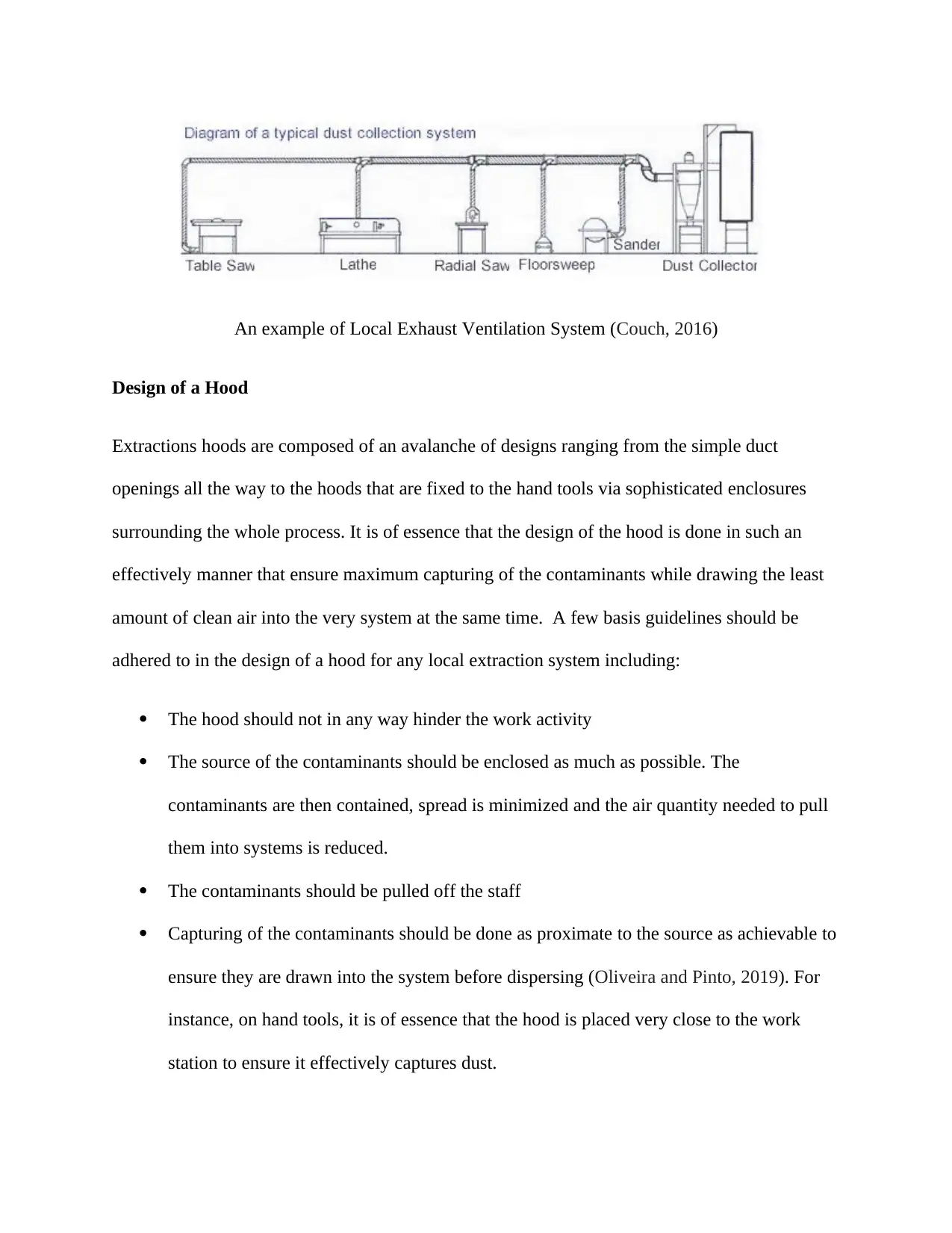
An example of Local Exhaust Ventilation System (Couch, 2016)
Design of a Hood
Extractions hoods are composed of an avalanche of designs ranging from the simple duct
openings all the way to the hoods that are fixed to the hand tools via sophisticated enclosures
surrounding the whole process. It is of essence that the design of the hood is done in such an
effectively manner that ensure maximum capturing of the contaminants while drawing the least
amount of clean air into the very system at the same time. A few basis guidelines should be
adhered to in the design of a hood for any local extraction system including:
The hood should not in any way hinder the work activity
The source of the contaminants should be enclosed as much as possible. The
contaminants are then contained, spread is minimized and the air quantity needed to pull
them into systems is reduced.
The contaminants should be pulled off the staff
Capturing of the contaminants should be done as proximate to the source as achievable to
ensure they are drawn into the system before dispersing (Oliveira and Pinto, 2019). For
instance, on hand tools, it is of essence that the hood is placed very close to the work
station to ensure it effectively captures dust.
Design of a Hood
Extractions hoods are composed of an avalanche of designs ranging from the simple duct
openings all the way to the hoods that are fixed to the hand tools via sophisticated enclosures
surrounding the whole process. It is of essence that the design of the hood is done in such an
effectively manner that ensure maximum capturing of the contaminants while drawing the least
amount of clean air into the very system at the same time. A few basis guidelines should be
adhered to in the design of a hood for any local extraction system including:
The hood should not in any way hinder the work activity
The source of the contaminants should be enclosed as much as possible. The
contaminants are then contained, spread is minimized and the air quantity needed to pull
them into systems is reduced.
The contaminants should be pulled off the staff
Capturing of the contaminants should be done as proximate to the source as achievable to
ensure they are drawn into the system before dispersing (Oliveira and Pinto, 2019). For
instance, on hand tools, it is of essence that the hood is placed very close to the work
station to ensure it effectively captures dust.
Paraphrase This Document
Need a fresh take? Get an instant paraphrase of this document with our AI Paraphraser
Make use of the contaminants momentum. Attempt locating the hood so they are moving
into it already as they are produced
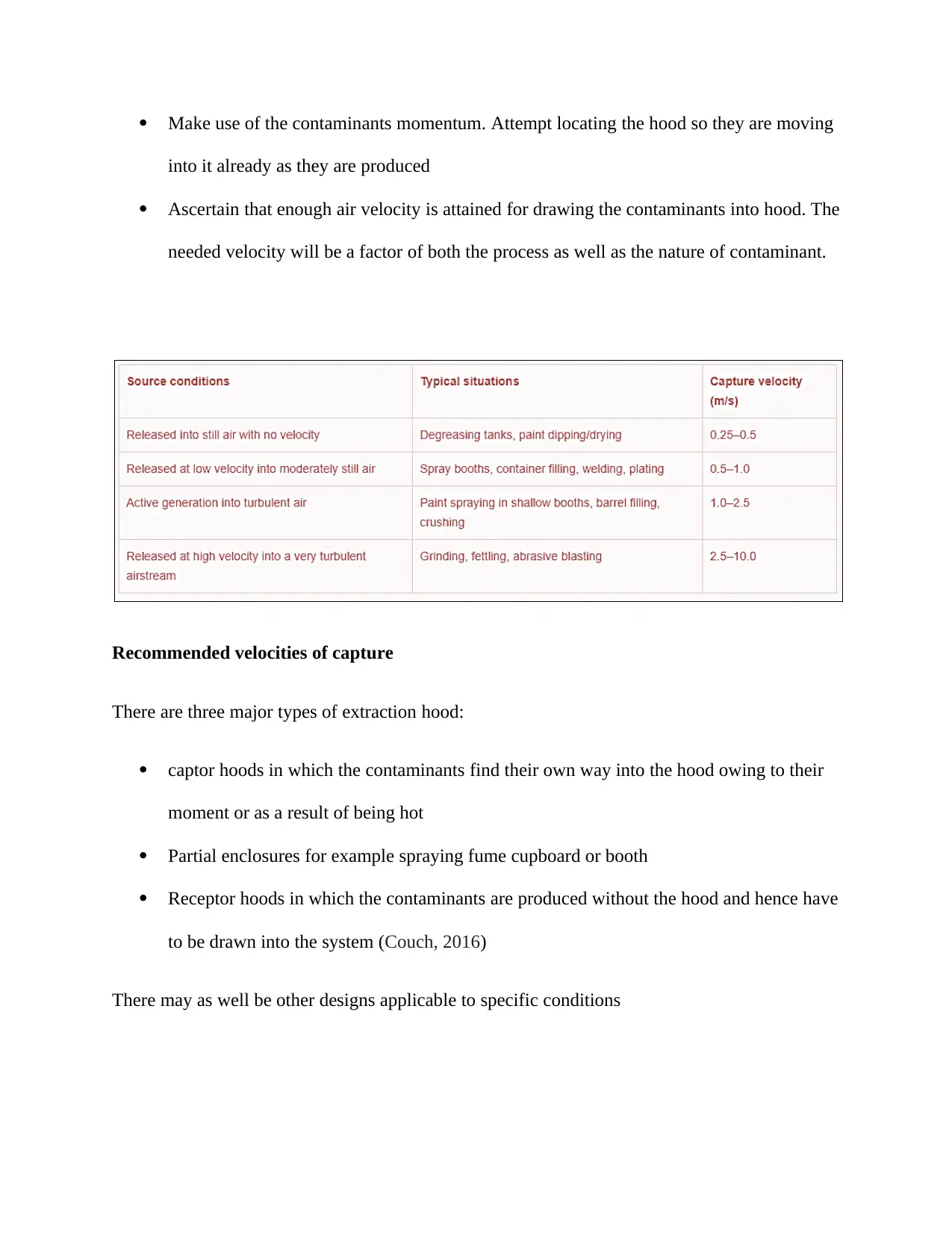
Ascertain that enough air velocity is attained for drawing the contaminants into hood. The
needed velocity will be a factor of both the process as well as the nature of contaminant.
Recommended velocities of capture
There are three major types of extraction hood:
captor hoods in which the contaminants find their own way into the hood owing to their
moment or as a result of being hot
Partial enclosures for example spraying fume cupboard or booth
Receptor hoods in which the contaminants are produced without the hood and hence have
to be drawn into the system (Couch, 2016)
There may as well be other designs applicable to specific conditions
into it already as they are produced
Ascertain that enough air velocity is attained for drawing the contaminants into hood. The
needed velocity will be a factor of both the process as well as the nature of contaminant.
Recommended velocities of capture
There are three major types of extraction hood:
captor hoods in which the contaminants find their own way into the hood owing to their
moment or as a result of being hot
Partial enclosures for example spraying fume cupboard or booth
Receptor hoods in which the contaminants are produced without the hood and hence have
to be drawn into the system (Couch, 2016)
There may as well be other designs applicable to specific conditions
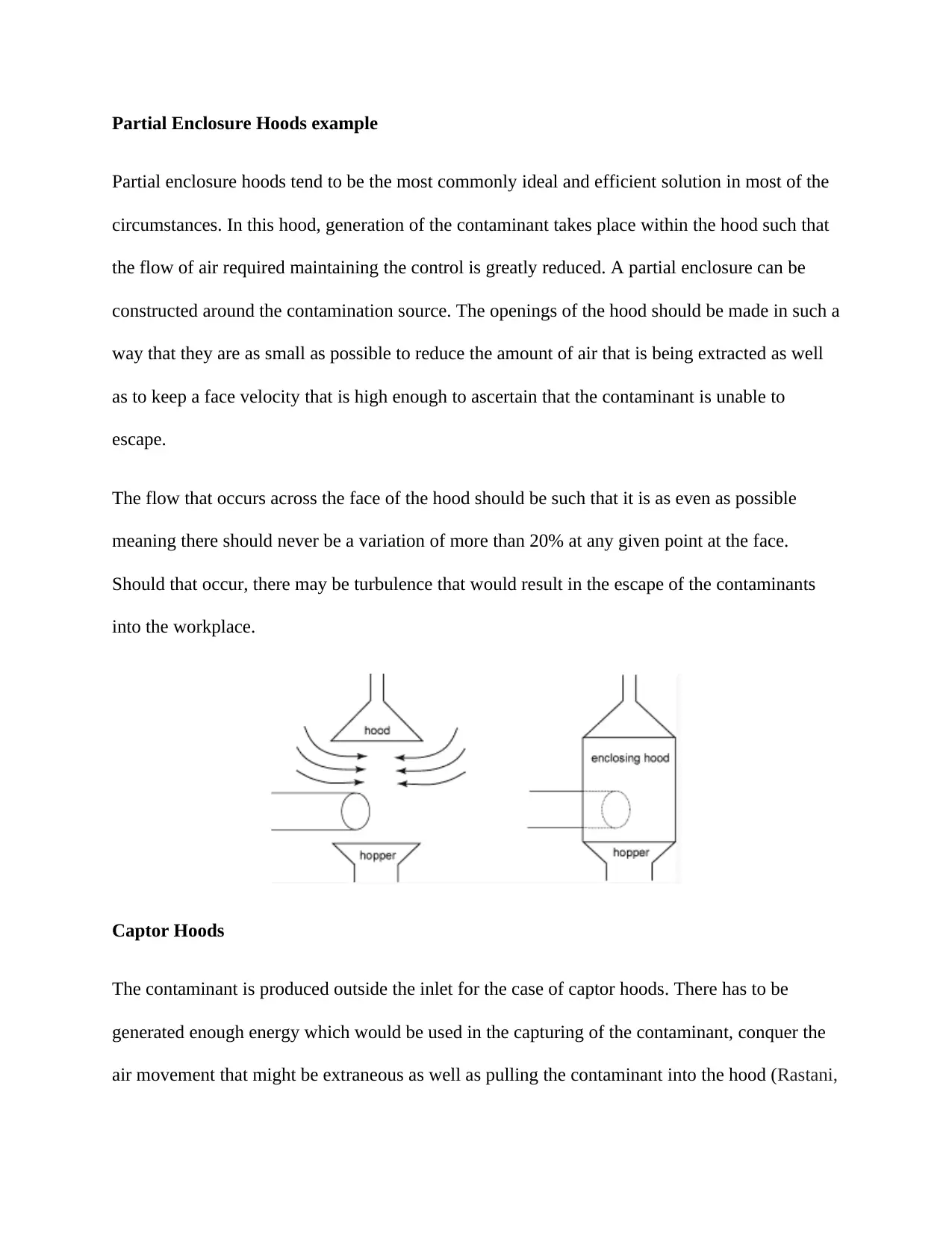
Partial Enclosure Hoods example
Partial enclosure hoods tend to be the most commonly ideal and efficient solution in most of the
circumstances. In this hood, generation of the contaminant takes place within the hood such that
the flow of air required maintaining the control is greatly reduced. A partial enclosure can be
constructed around the contamination source. The openings of the hood should be made in such a
way that they are as small as possible to reduce the amount of air that is being extracted as well
as to keep a face velocity that is high enough to ascertain that the contaminant is unable to
escape.
The flow that occurs across the face of the hood should be such that it is as even as possible
meaning there should never be a variation of more than 20% at any given point at the face.
Should that occur, there may be turbulence that would result in the escape of the contaminants
into the workplace.
Captor Hoods
The contaminant is produced outside the inlet for the case of captor hoods. There has to be
generated enough energy which would be used in the capturing of the contaminant, conquer the
air movement that might be extraneous as well as pulling the contaminant into the hood (Rastani,
Partial enclosure hoods tend to be the most commonly ideal and efficient solution in most of the
circumstances. In this hood, generation of the contaminant takes place within the hood such that
the flow of air required maintaining the control is greatly reduced. A partial enclosure can be
constructed around the contamination source. The openings of the hood should be made in such a
way that they are as small as possible to reduce the amount of air that is being extracted as well
as to keep a face velocity that is high enough to ascertain that the contaminant is unable to
escape.
The flow that occurs across the face of the hood should be such that it is as even as possible
meaning there should never be a variation of more than 20% at any given point at the face.
Should that occur, there may be turbulence that would result in the escape of the contaminants
into the workplace.
Captor Hoods
The contaminant is produced outside the inlet for the case of captor hoods. There has to be
generated enough energy which would be used in the capturing of the contaminant, conquer the
air movement that might be extraneous as well as pulling the contaminant into the hood (Rastani,
⊘ This is a preview!⊘
Do you want full access?
Subscribe today to unlock all pages.
Trusted by 1+ million students worldwide
Shahna, Bahrami and Hosseini, 2016). The capture velocity defines the velocity that is needed in
the achievement of such and the needed capture velocity in a specific condition is a factor of the
nature of generation of the contaminant i.e. if it has a high or low velocity as well as the density
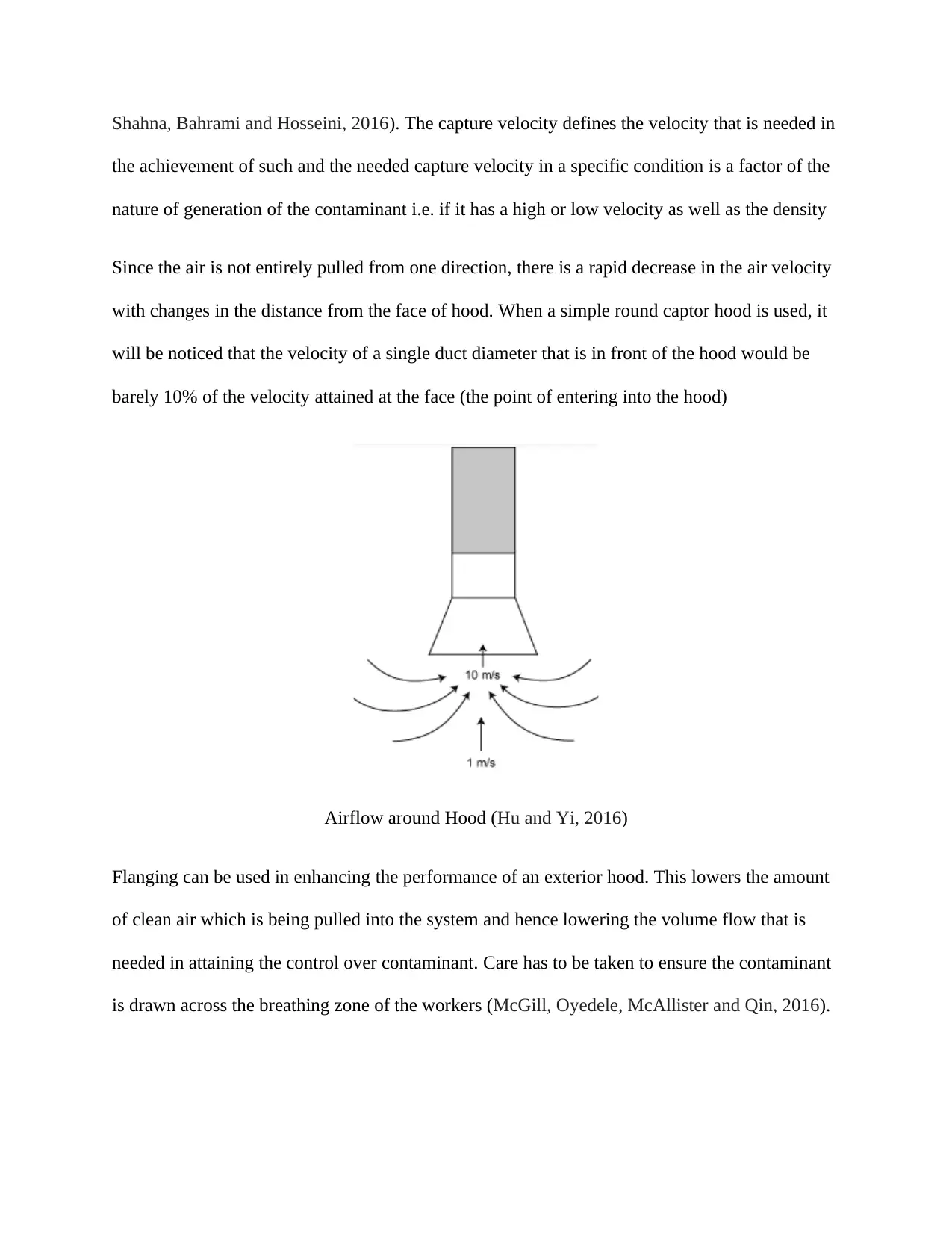
Since the air is not entirely pulled from one direction, there is a rapid decrease in the air velocity
with changes in the distance from the face of hood. When a simple round captor hood is used, it
will be noticed that the velocity of a single duct diameter that is in front of the hood would be
barely 10% of the velocity attained at the face (the point of entering into the hood)
Airflow around Hood (Hu and Yi, 2016)
Flanging can be used in enhancing the performance of an exterior hood. This lowers the amount
of clean air which is being pulled into the system and hence lowering the volume flow that is
needed in attaining the control over contaminant. Care has to be taken to ensure the contaminant
is drawn across the breathing zone of the workers (McGill, Oyedele, McAllister and Qin, 2016).
the achievement of such and the needed capture velocity in a specific condition is a factor of the
nature of generation of the contaminant i.e. if it has a high or low velocity as well as the density
Since the air is not entirely pulled from one direction, there is a rapid decrease in the air velocity
with changes in the distance from the face of hood. When a simple round captor hood is used, it
will be noticed that the velocity of a single duct diameter that is in front of the hood would be
barely 10% of the velocity attained at the face (the point of entering into the hood)
Airflow around Hood (Hu and Yi, 2016)
Flanging can be used in enhancing the performance of an exterior hood. This lowers the amount
of clean air which is being pulled into the system and hence lowering the volume flow that is
needed in attaining the control over contaminant. Care has to be taken to ensure the contaminant
is drawn across the breathing zone of the workers (McGill, Oyedele, McAllister and Qin, 2016).
Paraphrase This Document
Need a fresh take? Get an instant paraphrase of this document with our AI Paraphraser
Receptor Hoods
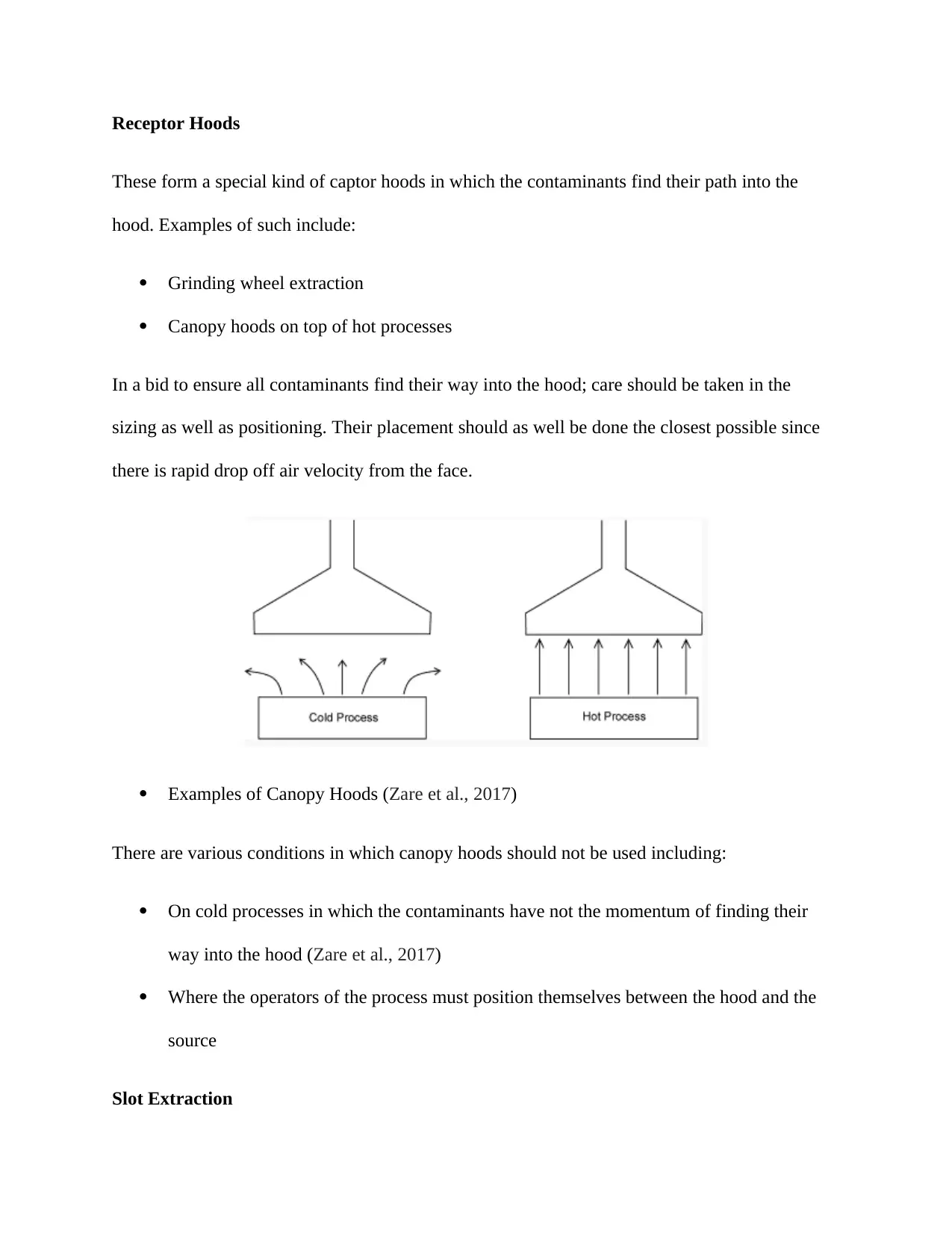
These form a special kind of captor hoods in which the contaminants find their path into the
hood. Examples of such include:
Grinding wheel extraction
Canopy hoods on top of hot processes
In a bid to ensure all contaminants find their way into the hood; care should be taken in the
sizing as well as positioning. Their placement should as well be done the closest possible since
there is rapid drop off air velocity from the face.
Examples of Canopy Hoods (Zare et al., 2017)
There are various conditions in which canopy hoods should not be used including:
On cold processes in which the contaminants have not the momentum of finding their
way into the hood (Zare et al., 2017)
Where the operators of the process must position themselves between the hood and the
source
Slot Extraction
These form a special kind of captor hoods in which the contaminants find their path into the
hood. Examples of such include:
Grinding wheel extraction
Canopy hoods on top of hot processes
In a bid to ensure all contaminants find their way into the hood; care should be taken in the
sizing as well as positioning. Their placement should as well be done the closest possible since
there is rapid drop off air velocity from the face.
Examples of Canopy Hoods (Zare et al., 2017)
There are various conditions in which canopy hoods should not be used including:
On cold processes in which the contaminants have not the momentum of finding their
way into the hood (Zare et al., 2017)
Where the operators of the process must position themselves between the hood and the
source
Slot Extraction
Most of the processes in the industries are conducted in enormous and open surface tanks for
example vapors degreasing, paint dipping, electroplating as well as galvanising. It is normally
impossible to erect a partial enclosure about the process since the surface requires being
uncovered to allow the components to be lowered into and eliminated out of the tank. In this
case, extraction slot is the commonly used extraction hood type.
Push-pull Hoods
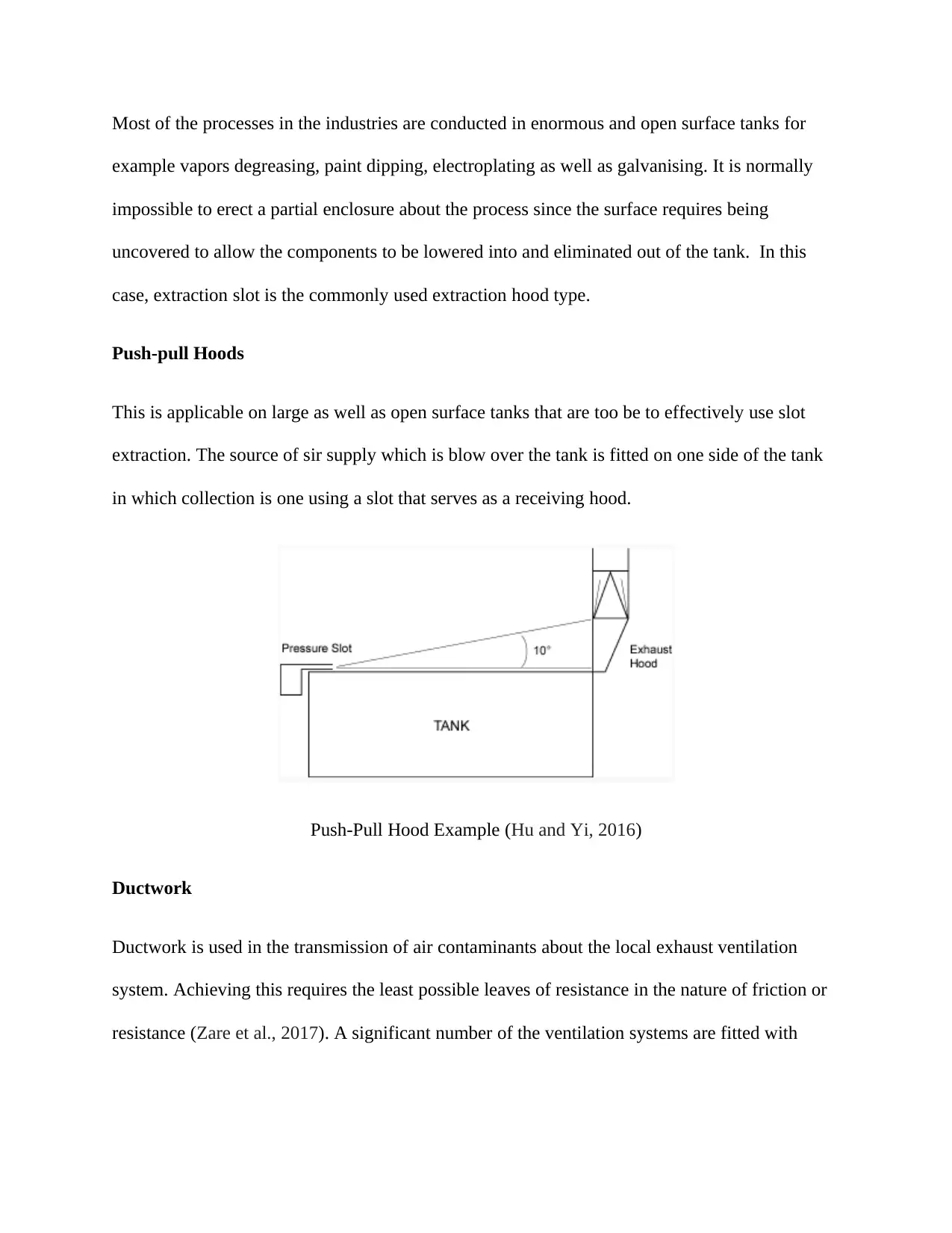
This is applicable on large as well as open surface tanks that are too be to effectively use slot
extraction. The source of sir supply which is blow over the tank is fitted on one side of the tank
in which collection is one using a slot that serves as a receiving hood.
Push-Pull Hood Example (Hu and Yi, 2016)
Ductwork
Ductwork is used in the transmission of air contaminants about the local exhaust ventilation
system. Achieving this requires the least possible leaves of resistance in the nature of friction or
resistance (Zare et al., 2017). A significant number of the ventilation systems are fitted with
example vapors degreasing, paint dipping, electroplating as well as galvanising. It is normally
impossible to erect a partial enclosure about the process since the surface requires being
uncovered to allow the components to be lowered into and eliminated out of the tank. In this
case, extraction slot is the commonly used extraction hood type.
Push-pull Hoods
This is applicable on large as well as open surface tanks that are too be to effectively use slot
extraction. The source of sir supply which is blow over the tank is fitted on one side of the tank
in which collection is one using a slot that serves as a receiving hood.
Push-Pull Hood Example (Hu and Yi, 2016)
Ductwork
Ductwork is used in the transmission of air contaminants about the local exhaust ventilation
system. Achieving this requires the least possible leaves of resistance in the nature of friction or
resistance (Zare et al., 2017). A significant number of the ventilation systems are fitted with
⊘ This is a preview!⊘
Do you want full access?
Subscribe today to unlock all pages.
Trusted by 1+ million students worldwide
bends, changes of cross-section, straight ducts, and dampers as well as other fitting which are
required for the connection of the exhaust hood to the discharge point.
The systems will be composed of other hardware aspects including fans and filters which are all
designed in such a way that the system can be accommodated in the building where the
workplace is enclosed. The design of the ductwork should be done in such a way that the:
Velocity of air is not very high since that would be wastages of power and may result in
noise problems
Air that contains contaminants may move in the most efficient manner reducing noise as
well as turbulence
The velocity of transport is adequately high to ensure not settling out of any suspended
mist, dust or even fume
Tubing is used in the connection of the hood to the extraction unit for the case of portable
tools of construction
Construction of Ductwork
Some of the contaminants, specifically heavy dusts, are quite abrasive and may result in tear and
wear on the material of the duct since they move about the system (Carrer et al., 2018). Still,
some chemical have the tendency of attacking as well as corroding other materials and hence
there is need to take caution to ascertain that the material used in the construction of th ductwork
is most suitable. The most commonly used material in the construction of ducts is galvanized
sheet steel which is attributed to historical reasons except for the case of the need of conveying
hot corrosive vapors or gases.
required for the connection of the exhaust hood to the discharge point.
The systems will be composed of other hardware aspects including fans and filters which are all
designed in such a way that the system can be accommodated in the building where the
workplace is enclosed. The design of the ductwork should be done in such a way that the:
Velocity of air is not very high since that would be wastages of power and may result in
noise problems
Air that contains contaminants may move in the most efficient manner reducing noise as
well as turbulence
The velocity of transport is adequately high to ensure not settling out of any suspended
mist, dust or even fume
Tubing is used in the connection of the hood to the extraction unit for the case of portable
tools of construction
Construction of Ductwork
Some of the contaminants, specifically heavy dusts, are quite abrasive and may result in tear and
wear on the material of the duct since they move about the system (Carrer et al., 2018). Still,
some chemical have the tendency of attacking as well as corroding other materials and hence
there is need to take caution to ascertain that the material used in the construction of th ductwork
is most suitable. The most commonly used material in the construction of ducts is galvanized
sheet steel which is attributed to historical reasons except for the case of the need of conveying
hot corrosive vapors or gases.
Paraphrase This Document
Need a fresh take? Get an instant paraphrase of this document with our AI Paraphraser
In case where the chemicals to be conveyed have the potential of destroying steel, plastic piping
is adopted while stainless steel is used in cases of gases with high temperatures. The shape of
ducts is often more of circulation cross section than rectangular as the former shapes has been
established to be not only economical but also mechanically strong. The variable space in some
building may nonetheless be best suited for the rectangular shaped ducts for example above a
virtual ceiling. The right length and diameter of the tubing used on portable tools has to be
observed and fitted security to hood outlet as well as the unit inlet of extraction (Dunn,
Topmiller, McCleery and Whalen, 2018).
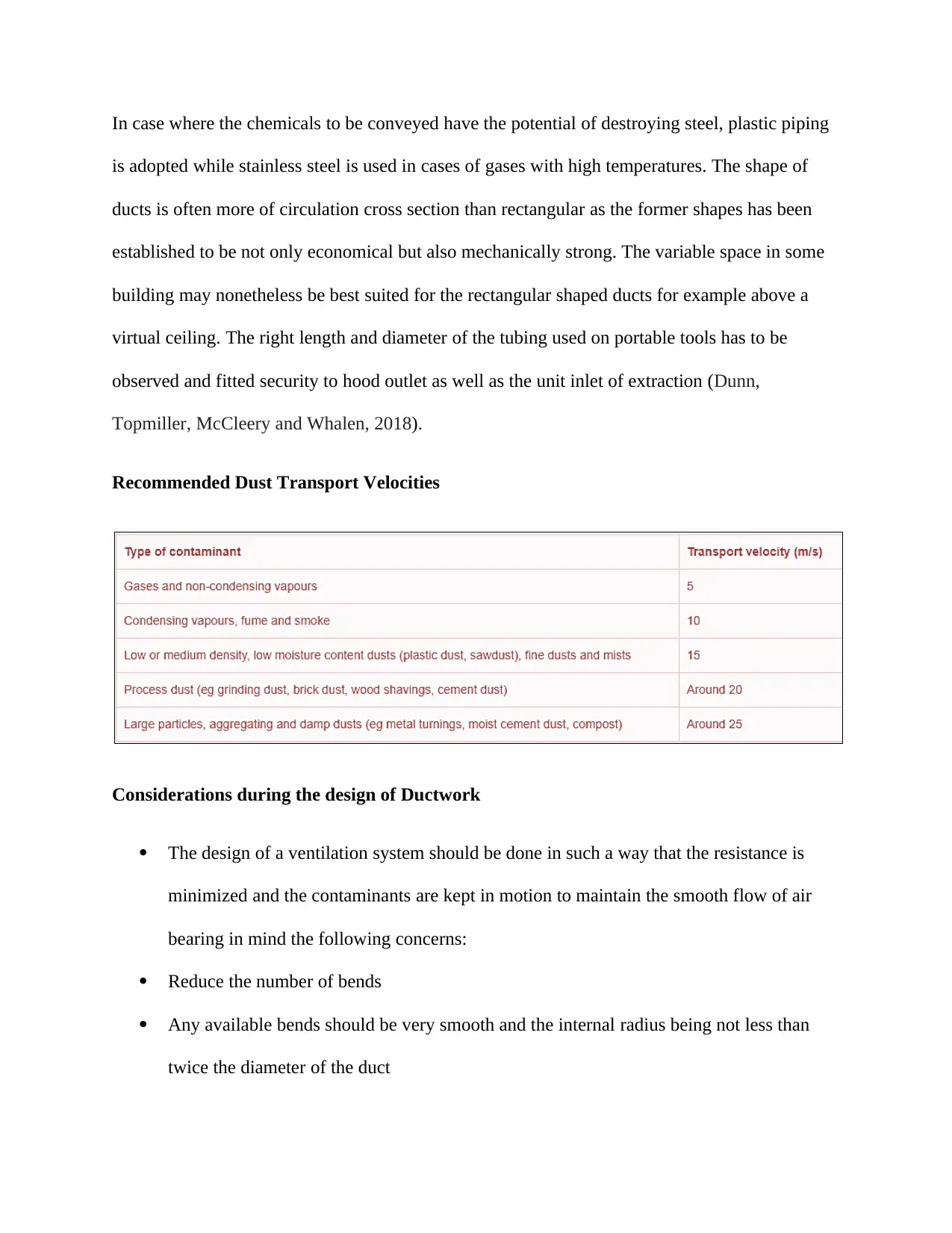
Recommended Dust Transport Velocities
Considerations during the design of Ductwork
The design of a ventilation system should be done in such a way that the resistance is
minimized and the contaminants are kept in motion to maintain the smooth flow of air
bearing in mind the following concerns:
Reduce the number of bends
Any available bends should be very smooth and the internal radius being not less than
twice the diameter of the duct
is adopted while stainless steel is used in cases of gases with high temperatures. The shape of
ducts is often more of circulation cross section than rectangular as the former shapes has been
established to be not only economical but also mechanically strong. The variable space in some
building may nonetheless be best suited for the rectangular shaped ducts for example above a
virtual ceiling. The right length and diameter of the tubing used on portable tools has to be
observed and fitted security to hood outlet as well as the unit inlet of extraction (Dunn,
Topmiller, McCleery and Whalen, 2018).
Recommended Dust Transport Velocities
Considerations during the design of Ductwork
The design of a ventilation system should be done in such a way that the resistance is
minimized and the contaminants are kept in motion to maintain the smooth flow of air
bearing in mind the following concerns:
Reduce the number of bends
Any available bends should be very smooth and the internal radius being not less than
twice the diameter of the duct
Flexible ducting is undesirable and should most be avoided
Side branched need to join main duct at angles ranging between 30 and 45
Avoid sudden variations in the cross section (Lstiburek, 2017)
The diameters of the ducts need to be increased upon intersections to cater for the
enhanced volume flow
Introduction of the side branches should be from the top or side of the main duct as
opposed to from the bottom
Fans
The main role of a fan in the extraction system is drawing the air through the system. Its
location should be:
Off the main working regions which reduces the risk from noise as well as preventing
contaminants for entering again into the workplace
After the air cleaner that will prevent contaminants from finding their way into the fan
Two main types of fans are common:
Centrifugal fans which operate by drawing air to the center of fan and thereafter
exhausting it perpendicularly (Matveev and Zelentsov, 2018)
Axial fans draw air directly along the axis of their operation which is straight through the
fan and mostly used in place having low air volumes that need to be moved
Side branched need to join main duct at angles ranging between 30 and 45
Avoid sudden variations in the cross section (Lstiburek, 2017)
The diameters of the ducts need to be increased upon intersections to cater for the
enhanced volume flow
Introduction of the side branches should be from the top or side of the main duct as
opposed to from the bottom
Fans
The main role of a fan in the extraction system is drawing the air through the system. Its
location should be:
Off the main working regions which reduces the risk from noise as well as preventing
contaminants for entering again into the workplace
After the air cleaner that will prevent contaminants from finding their way into the fan
Two main types of fans are common:
Centrifugal fans which operate by drawing air to the center of fan and thereafter
exhausting it perpendicularly (Matveev and Zelentsov, 2018)
Axial fans draw air directly along the axis of their operation which is straight through the
fan and mostly used in place having low air volumes that need to be moved
⊘ This is a preview!⊘
Do you want full access?
Subscribe today to unlock all pages.
Trusted by 1+ million students worldwide

1 out of 18


Related Documents


Your All-in-One AI-Powered Toolkit for Academic Success.
+13062052269
info@desklib.com
Available 24*7 on WhatsApp / Email
![[object Object]](/_next/static/media/star-bottom.7253800d.svg)
Unlock your academic potential
Copyright © 2020–2026 A2Z Services. All Rights Reserved. Developed and managed by ZUCOL.