University Plant Location Strategy: Christchurch vs. Upper Hutt
VerifiedAdded on 2022/09/18
|10
|1463
|19
Report
AI Summary
This report presents a comprehensive analysis of plant location strategies, focusing on the establishment of an adventure sports gear and equipment business in New Zealand. The report considers two potential locations, Christchurch and Upper Hutt, evaluating them based on factors such as cost and availability of labor, customer density and demographics, market demand, and the attractiveness of the location. The analysis employs the factor-rating method to compare the two cities, ultimately identifying Auckland as the most suitable location for the proposed business. The report highlights the importance of attractiveness of the location, market demand, and other key factors, providing a detailed rationale for the decision-making process. The report also provides a comparative analysis based on four criteria, including cost, labor, customer demographics, market demand, and the attractiveness of the location. The report includes a table of contents, introduction, analysis using factor-rating method, and references.
Running head: LOCATION STRATEGY
Analysis for selecting Plant location
Name of the student:
Name of the university:
Author note:
Analysis for selecting Plant location
Name of the student:
Name of the university:
Author note:
Paraphrase This Document
Need a fresh take? Get an instant paraphrase of this document with our AI Paraphraser

1LOCATION STRATEGY
Executive summary
This report deals with the factors that affects the location of a plant. It highlights the various
factors like Cost, market demand, demographics, attractiveness etc. of the location which is
analysed in the report for setting up industry in the Christchurch city and the Upper Hutt city.
Furthermore, market analyses is done using factor rating method.
Executive summary
This report deals with the factors that affects the location of a plant. It highlights the various
factors like Cost, market demand, demographics, attractiveness etc. of the location which is
analysed in the report for setting up industry in the Christchurch city and the Upper Hutt city.
Furthermore, market analyses is done using factor rating method.

2LOCATION STRATEGY
Table of Contents
Introduction................................................................................................................................3
Business in Auckland and Wellington.......................................................................................3
Analysis using Factor Rating Method........................................................................................5
References..................................................................................................................................7
Table of Contents
Introduction................................................................................................................................3
Business in Auckland and Wellington.......................................................................................3
Analysis using Factor Rating Method........................................................................................5
References..................................................................................................................................7
⊘ This is a preview!⊘
Do you want full access?
Subscribe today to unlock all pages.

Trusted by 1+ million students worldwide

3LOCATION STRATEGY
Introduction
New Zealand, along with its exotic destinations and colonial attractions, is also known
for its extreme sports, strong mountaineering tradition and adventure tourism. Domestic as
well as international tourists visit every year to enjoy the various adventure sports like bungy
jumping, ski diving, river rafting, caving, off road driving, heli-skiing etc. (Balli & Tsui,
2016). Hence, we will propose to establish an outlet of adventure sports gears and equipments
here. This business is largely associated with tourism so analysis will have a tourism
perspective assessment. The store will contain equipments like Bungee cord, parachute
equipments, climbing accessories, trekking equipments, mountaineering equipments,
ascenders etc. Also, a travel booklet will be provided for the customers for their convenience
to explore the nearby recreational destinations. We will consider two cities for our project
namely Auckland and Wellington. Analysis will be done on the location based on four
criteria using Factor-Rating Method.
Business in Auckland and Wellington
Cost and availability of Labour
Cost plays a vital role in plant location. In 2019, the average labour cost is around the
index of 1192. According to statistics, the employment rate of Auckland rose up to 26,600
(2.9 %) of which 20,500 were women while. Auckland employed 55,000 people (6.2% of
Auckland workforce) in tourism. It has 20,000+ university graduates each year. 83%
population have a formal qualification. It offers 90 days trial periods for new employees
(www.aucklandnz.com, 2019). On the other hand, Wellington saw an increase up to 11,200
(3.8 %) and employed 188,000 people in tourism. It contributed 13% in national GDP and
also provided 11.5% of national employment. 28% residents have a bachelor’s degree or
higher.
Introduction
New Zealand, along with its exotic destinations and colonial attractions, is also known
for its extreme sports, strong mountaineering tradition and adventure tourism. Domestic as
well as international tourists visit every year to enjoy the various adventure sports like bungy
jumping, ski diving, river rafting, caving, off road driving, heli-skiing etc. (Balli & Tsui,
2016). Hence, we will propose to establish an outlet of adventure sports gears and equipments
here. This business is largely associated with tourism so analysis will have a tourism
perspective assessment. The store will contain equipments like Bungee cord, parachute
equipments, climbing accessories, trekking equipments, mountaineering equipments,
ascenders etc. Also, a travel booklet will be provided for the customers for their convenience
to explore the nearby recreational destinations. We will consider two cities for our project
namely Auckland and Wellington. Analysis will be done on the location based on four
criteria using Factor-Rating Method.
Business in Auckland and Wellington
Cost and availability of Labour
Cost plays a vital role in plant location. In 2019, the average labour cost is around the
index of 1192. According to statistics, the employment rate of Auckland rose up to 26,600
(2.9 %) of which 20,500 were women while. Auckland employed 55,000 people (6.2% of
Auckland workforce) in tourism. It has 20,000+ university graduates each year. 83%
population have a formal qualification. It offers 90 days trial periods for new employees
(www.aucklandnz.com, 2019). On the other hand, Wellington saw an increase up to 11,200
(3.8 %) and employed 188,000 people in tourism. It contributed 13% in national GDP and
also provided 11.5% of national employment. 28% residents have a bachelor’s degree or
higher.
Paraphrase This Document
Need a fresh take? Get an instant paraphrase of this document with our AI Paraphraser

4LOCATION STRATEGY

5LOCATION STRATEGY
Customer density and demographics
Revenue is generated by both domestic and international visitors. Around 2.5 million
people take part in recreation and sport activities in any given week (Sportnz.org.nz, 2019).
In Auckland, 2.74 million International tourists visited accounting for a rise of 7% over the
past five years. 5.59 million Overnight visits were made by domestic visitors accounting for
increase of 1.7% over previous year (aucklandnz.com, 2019). It has a population of
1,628,900. On the other hand, Wellington has a population of 418,500. It saw 2.3 million p.a.
commercial guest night (Domestic), 937,000 p.a. commercial guest nights (international) and
211,000 p.a. direct international visit via wellington airport (aucklandnz.com, 2019).
Attractiveness of the location
In New Zealand, there is no stamp duties, no payroll tax, no estate tax and no capital
gain tax. According to World Bank’s 2017 Doing Business report, Auckland was ranked as
the easiest place for business in the world (www.mbie.govt.nz, 2019). It offers oceanic
climate and typically suffers from air pollution. It provides an urban environment with
Polynesian culture and wide range of delicious cuisines and shopping experiences. On the
contrary, wellington offers a vibrant culture with great food, coffee, craft beer and events
(Kaufmann & Arnold, 2018). The climate here is temperate marine and is famous for its
compact nature, award-winning restaurants, cultural attractions and government agencies.
Market Demand
New Zealanders are adventure enthusiasts. It has spent $165 million on the import of
sports and other recreation equipment. Expenditure by private households on Sport and other
recreational equipment was $384.2 million (Sportnz.org.nz, 2019). Auckland is famous for
sailing. About 135,000 yachts and launches are registered here. The Auckland Harbour
Bridge is a bungy site where bungy equipments can be used. There are 10 famous places in
Customer density and demographics
Revenue is generated by both domestic and international visitors. Around 2.5 million
people take part in recreation and sport activities in any given week (Sportnz.org.nz, 2019).
In Auckland, 2.74 million International tourists visited accounting for a rise of 7% over the
past five years. 5.59 million Overnight visits were made by domestic visitors accounting for
increase of 1.7% over previous year (aucklandnz.com, 2019). It has a population of
1,628,900. On the other hand, Wellington has a population of 418,500. It saw 2.3 million p.a.
commercial guest night (Domestic), 937,000 p.a. commercial guest nights (international) and
211,000 p.a. direct international visit via wellington airport (aucklandnz.com, 2019).
Attractiveness of the location
In New Zealand, there is no stamp duties, no payroll tax, no estate tax and no capital
gain tax. According to World Bank’s 2017 Doing Business report, Auckland was ranked as
the easiest place for business in the world (www.mbie.govt.nz, 2019). It offers oceanic
climate and typically suffers from air pollution. It provides an urban environment with
Polynesian culture and wide range of delicious cuisines and shopping experiences. On the
contrary, wellington offers a vibrant culture with great food, coffee, craft beer and events
(Kaufmann & Arnold, 2018). The climate here is temperate marine and is famous for its
compact nature, award-winning restaurants, cultural attractions and government agencies.
Market Demand
New Zealanders are adventure enthusiasts. It has spent $165 million on the import of
sports and other recreation equipment. Expenditure by private households on Sport and other
recreational equipment was $384.2 million (Sportnz.org.nz, 2019). Auckland is famous for
sailing. About 135,000 yachts and launches are registered here. The Auckland Harbour
Bridge is a bungy site where bungy equipments can be used. There are 10 famous places in
⊘ This is a preview!⊘
Do you want full access?
Subscribe today to unlock all pages.

Trusted by 1+ million students worldwide

6LOCATION STRATEGY
Auckland for adventure sports. In Wellington case, approximately 540,000 international
tourists visits each year and has spent NZ$436 million on tourism (www.wellingtonnz.com,
2019). Jet boating, luge and glacier walks are popular adventure sports done by the
international tourists.
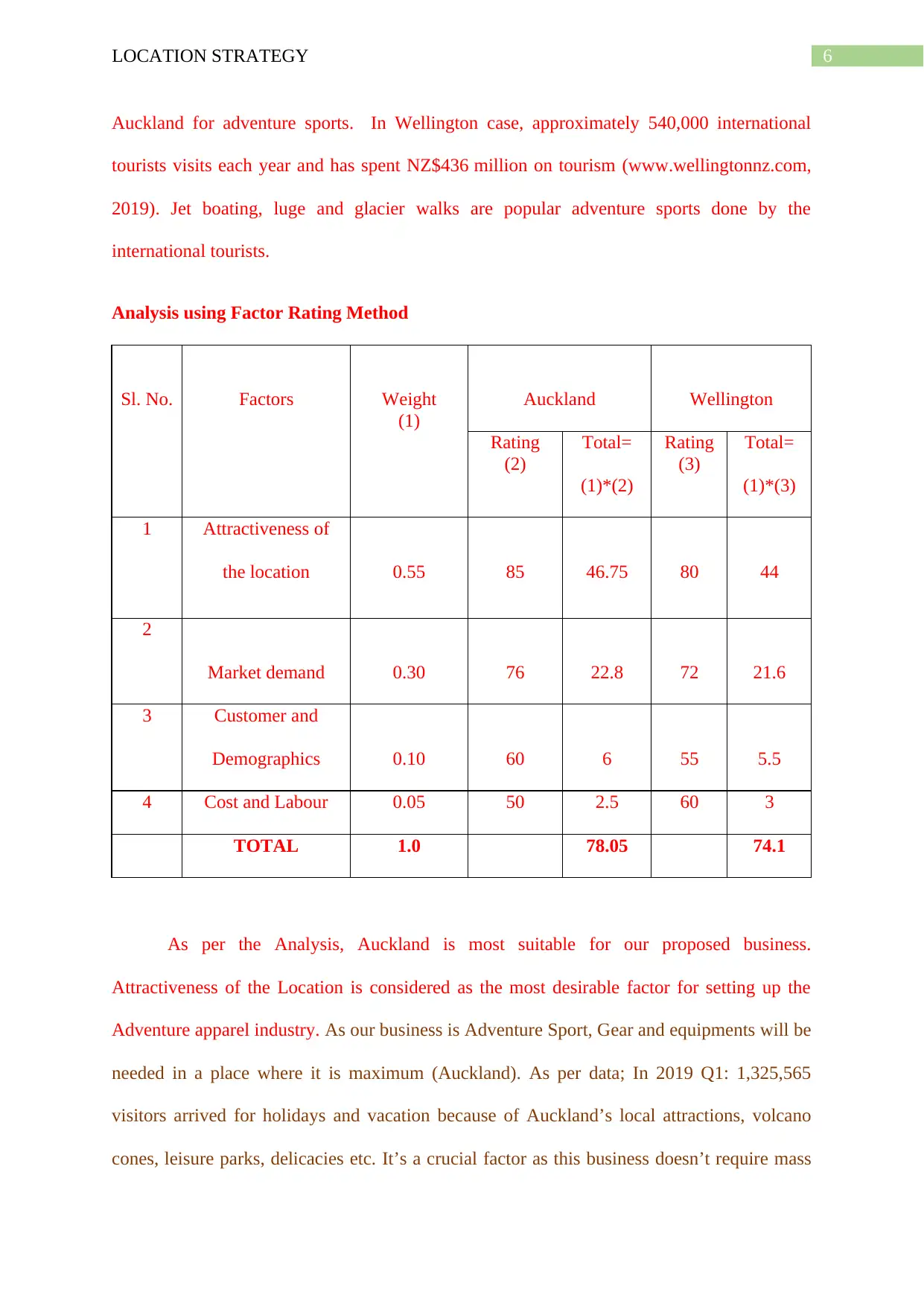
Analysis using Factor Rating Method
Sl. No. Factors Weight
(1)
Auckland Wellington
Rating
(2)
Total=
(1)*(2)
Rating
(3)
Total=
(1)*(3)
1 Attractiveness of
the location 0.55 85 46.75 80 44
2
Market demand 0.30 76 22.8 72 21.6
3 Customer and
Demographics 0.10 60 6 55 5.5
4 Cost and Labour 0.05 50 2.5 60 3
TOTAL 1.0 78.05 74.1
As per the Analysis, Auckland is most suitable for our proposed business.
Attractiveness of the Location is considered as the most desirable factor for setting up the
Adventure apparel industry. As our business is Adventure Sport, Gear and equipments will be
needed in a place where it is maximum (Auckland). As per data; In 2019 Q1: 1,325,565
visitors arrived for holidays and vacation because of Auckland’s local attractions, volcano
cones, leisure parks, delicacies etc. It’s a crucial factor as this business doesn’t require mass
Auckland for adventure sports. In Wellington case, approximately 540,000 international
tourists visits each year and has spent NZ$436 million on tourism (www.wellingtonnz.com,
2019). Jet boating, luge and glacier walks are popular adventure sports done by the
international tourists.
Analysis using Factor Rating Method
Sl. No. Factors Weight
(1)
Auckland Wellington
Rating
(2)
Total=
(1)*(2)
Rating
(3)
Total=
(1)*(3)
1 Attractiveness of
the location 0.55 85 46.75 80 44
2
Market demand 0.30 76 22.8 72 21.6
3 Customer and
Demographics 0.10 60 6 55 5.5
4 Cost and Labour 0.05 50 2.5 60 3
TOTAL 1.0 78.05 74.1
As per the Analysis, Auckland is most suitable for our proposed business.
Attractiveness of the Location is considered as the most desirable factor for setting up the
Adventure apparel industry. As our business is Adventure Sport, Gear and equipments will be
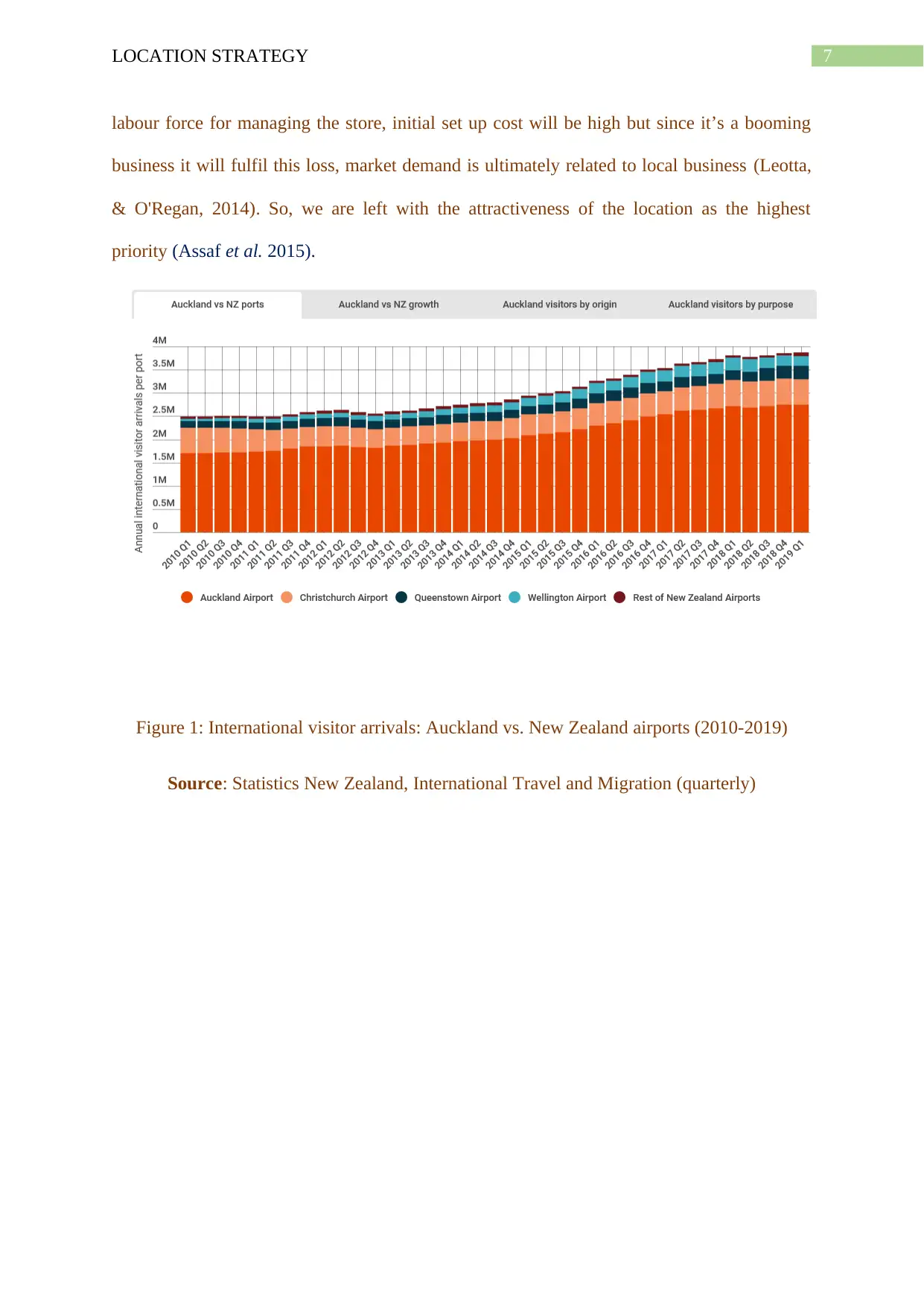
needed in a place where it is maximum (Auckland). As per data; In 2019 Q1: 1,325,565
visitors arrived for holidays and vacation because of Auckland’s local attractions, volcano
cones, leisure parks, delicacies etc. It’s a crucial factor as this business doesn’t require mass
Paraphrase This Document
Need a fresh take? Get an instant paraphrase of this document with our AI Paraphraser

7LOCATION STRATEGY
labour force for managing the store, initial set up cost will be high but since it’s a booming
business it will fulfil this loss, market demand is ultimately related to local business (Leotta,
& O'Regan, 2014). So, we are left with the attractiveness of the location as the highest
priority (Assaf et al. 2015).
Figure 1: International visitor arrivals: Auckland vs. New Zealand airports (2010-2019)
Source: Statistics New Zealand, International Travel and Migration (quarterly)
labour force for managing the store, initial set up cost will be high but since it’s a booming
business it will fulfil this loss, market demand is ultimately related to local business (Leotta,
& O'Regan, 2014). So, we are left with the attractiveness of the location as the highest
priority (Assaf et al. 2015).
Figure 1: International visitor arrivals: Auckland vs. New Zealand airports (2010-2019)
Source: Statistics New Zealand, International Travel and Migration (quarterly)

8LOCATION STRATEGY
References
Assaf, A. G., Josiassen, A., & Agbola, F. W. (2015). Attracting international hotels:
Locational factors that matter most. Tourism Management, 47, 329-340.
Balli, F., & Tsui, W. H. K. (2016). Tourism demand spillovers between Australia and New
Zealand: evidence from the partner countries. Journal of Travel Research, 55(6), 804-
812.
Kaufmann, D., & Arnold, T. (2018). Strategies of cities in globalised interurban competition:
The locational policies framework. Urban Studies, 55(12), 2703-2720.
Laurens, P., Le Bas, C., Schoen, A., & Larédo, P. (2015). Internationalisation of European
MNCs R&D:“deglobalisation” and evolution of the locational strategies. Management
international/International Management/Gestiòn Internacional, 19(4), 18-33.
Leotta, A., & O'Regan, T. (2014). Wellington and Auckland as Australasian media cities.
Studies in Australasian Cinema, 8(2-3), 96-109.
Mayer, H., Sager, F., Kaufmann, D., & Warland, M. (2016). Capital city dynamics: Linking
regional innovation systems, locational policies and policy regimes. Cities, 51, 11-20.
Solnet, D. J., Ford, R. C., Robinson, R. N., Ritchie, B. W., & Olsen, M. (2014). Modeling
locational factors for tourism employment. Annals of Tourism Research, 45, 30-45.
www.aucklandnz.com. (2019). Business and investment. Retrieved 23 August 2019, from
https://www.aucklandnz.com/business-and-investment
References
Assaf, A. G., Josiassen, A., & Agbola, F. W. (2015). Attracting international hotels:
Locational factors that matter most. Tourism Management, 47, 329-340.
Balli, F., & Tsui, W. H. K. (2016). Tourism demand spillovers between Australia and New
Zealand: evidence from the partner countries. Journal of Travel Research, 55(6), 804-
812.
Kaufmann, D., & Arnold, T. (2018). Strategies of cities in globalised interurban competition:
The locational policies framework. Urban Studies, 55(12), 2703-2720.
Laurens, P., Le Bas, C., Schoen, A., & Larédo, P. (2015). Internationalisation of European
MNCs R&D:“deglobalisation” and evolution of the locational strategies. Management
international/International Management/Gestiòn Internacional, 19(4), 18-33.
Leotta, A., & O'Regan, T. (2014). Wellington and Auckland as Australasian media cities.
Studies in Australasian Cinema, 8(2-3), 96-109.
Mayer, H., Sager, F., Kaufmann, D., & Warland, M. (2016). Capital city dynamics: Linking
regional innovation systems, locational policies and policy regimes. Cities, 51, 11-20.
Solnet, D. J., Ford, R. C., Robinson, R. N., Ritchie, B. W., & Olsen, M. (2014). Modeling
locational factors for tourism employment. Annals of Tourism Research, 45, 30-45.
www.aucklandnz.com. (2019). Business and investment. Retrieved 23 August 2019, from
https://www.aucklandnz.com/business-and-investment
⊘ This is a preview!⊘
Do you want full access?
Subscribe today to unlock all pages.

Trusted by 1+ million students worldwide

9LOCATION STRATEGY
www.mbie.govt.nz. (2019). Home | Ministry of Business, Innovation & Employment.
Retrieved 23 August 2019, from https://www.mbie.govt.nz/
www.wellingtonnz.com. (2019). Discover Wellington. Retrieved 23 August 2019, from
https://www.wellingtonnz.com/
www.mbie.govt.nz. (2019). Home | Ministry of Business, Innovation & Employment.
Retrieved 23 August 2019, from https://www.mbie.govt.nz/
www.wellingtonnz.com. (2019). Discover Wellington. Retrieved 23 August 2019, from
https://www.wellingtonnz.com/
1 out of 10
Your All-in-One AI-Powered Toolkit for Academic Success.
+13062052269
info@desklib.com
Available 24*7 on WhatsApp / Email
Unlock your academic potential
Copyright © 2020–2025 A2Z Services. All Rights Reserved. Developed and managed by ZUCOL.