University Name: Sales Force Management - Loewe Case Study Report
VerifiedAdded on 2022/09/07
|42
|11667
|15
Report
AI Summary
This report provides a detailed analysis of the Loewe case study, focusing on sales force management within the context of its expansion strategies. The report is divided into sections discussing retail options, training plans, POS systems, and e-tailing. The analysis includes an examination of Loewe's current market presence, potential international expansion strategies, and the role of e-commerce and social media in the luxury market. The report also provides recommendations for e-tailing strategies and training plans, considering the brand's position and target audience. The study further explores the concept of e-tailing, its benefits for luxury brands like Loewe, and the importance of adapting to evolving consumer behaviors in the digital landscape. The report provides recommendations for Loewe to improve their sales and marketing strategies. The content is contributed by a student to Desklib, a platform offering AI-based study tools.

Running head: Sales Force Management
Sales Force Management
Name of the Student
Name of the University
Author Note
Sales Force Management
Name of the Student
Name of the University
Author Note

Paraphrase This Document
Need a fresh take? Get an instant paraphrase of this document with our AI Paraphraser
Sales Force Management
Executive Summary
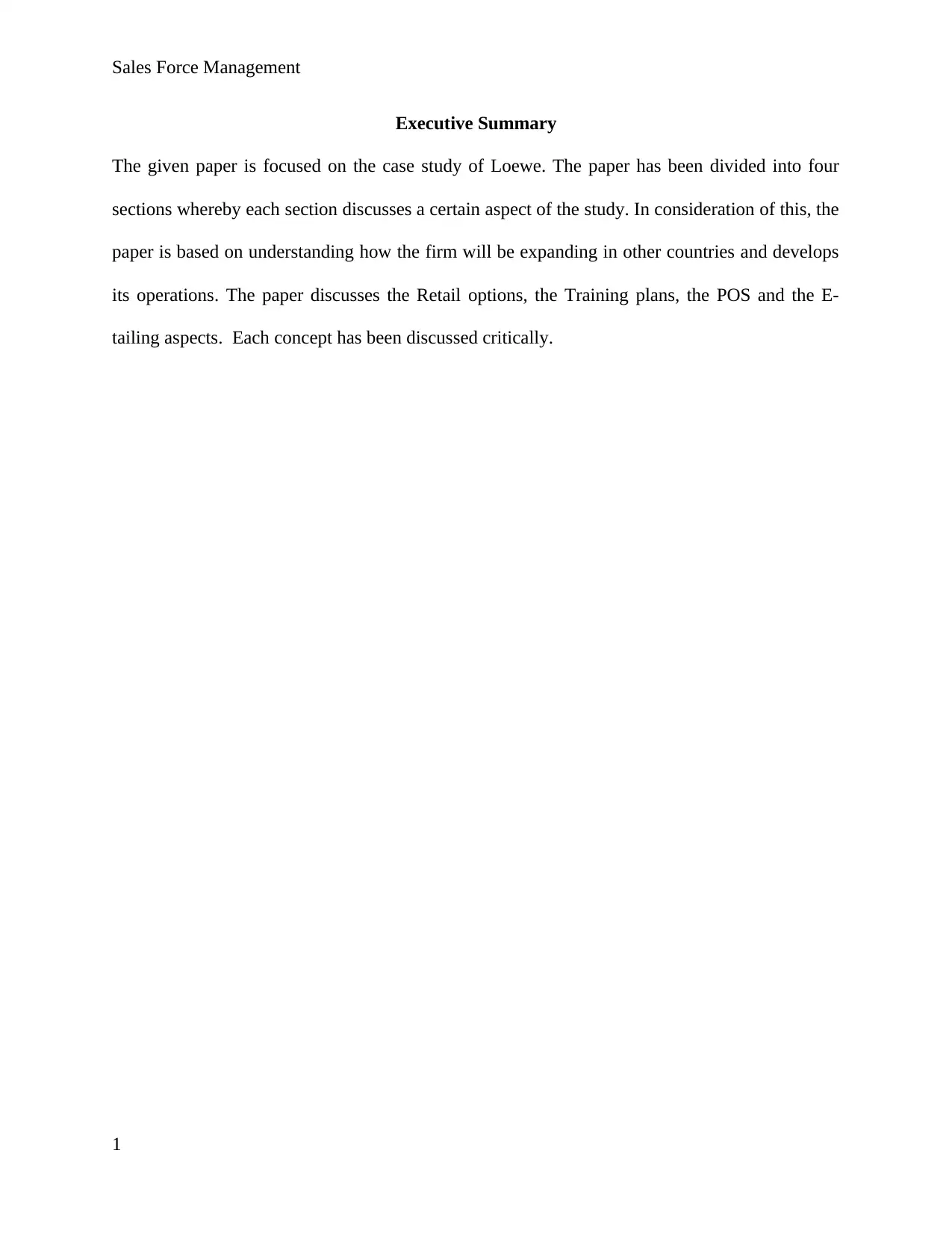
The given paper is focused on the case study of Loewe. The paper has been divided into four
sections whereby each section discusses a certain aspect of the study. In consideration of this, the
paper is based on understanding how the firm will be expanding in other countries and develops
its operations. The paper discusses the Retail options, the Training plans, the POS and the E-
tailing aspects. Each concept has been discussed critically.
1
Executive Summary
The given paper is focused on the case study of Loewe. The paper has been divided into four
sections whereby each section discusses a certain aspect of the study. In consideration of this, the
paper is based on understanding how the firm will be expanding in other countries and develops
its operations. The paper discusses the Retail options, the Training plans, the POS and the E-
tailing aspects. Each concept has been discussed critically.
1
Sales Force Management
Table of Contents
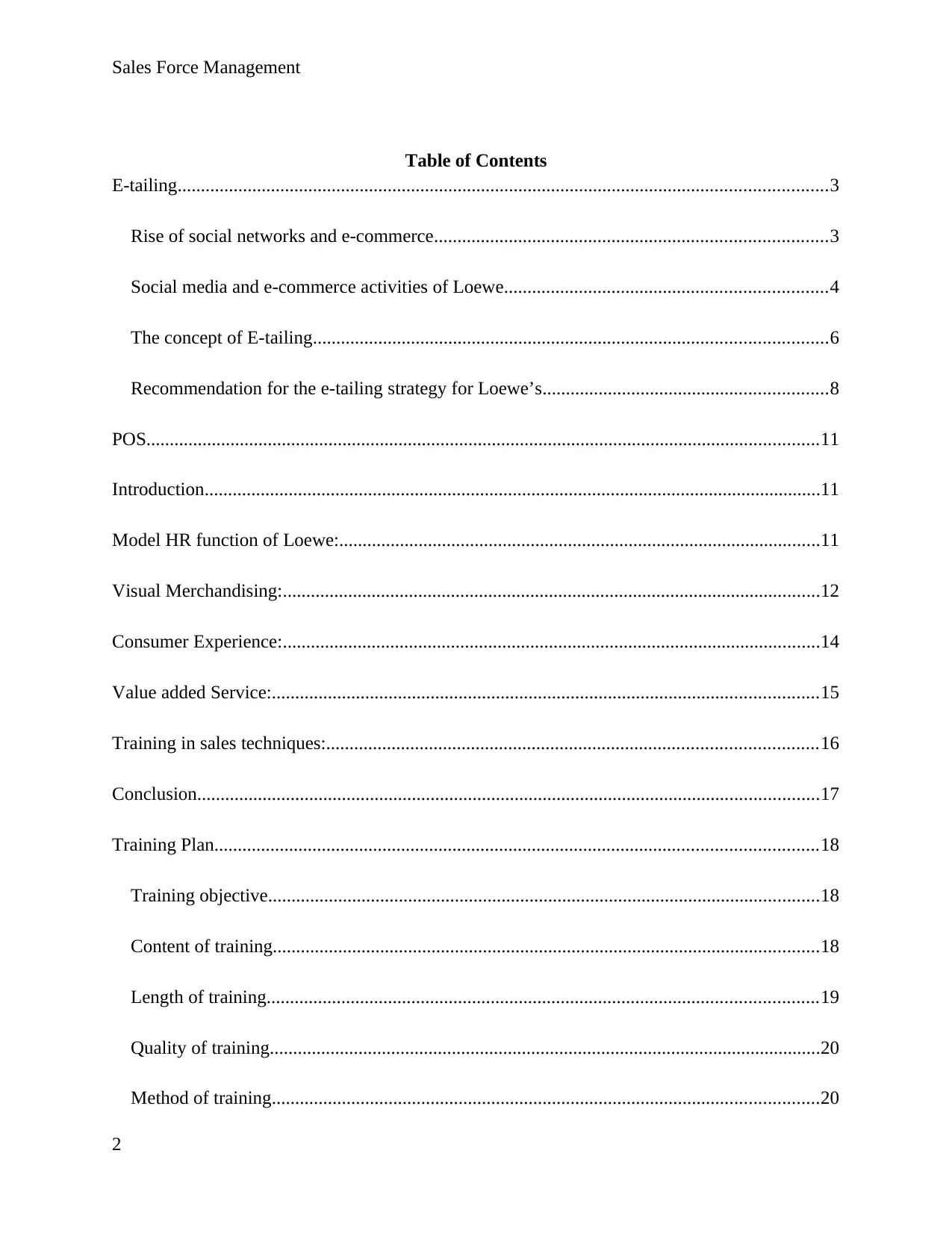
E-tailing...........................................................................................................................................3
Rise of social networks and e-commerce....................................................................................3
Social media and e-commerce activities of Loewe.....................................................................4
The concept of E-tailing..............................................................................................................6
Recommendation for the e-tailing strategy for Loewe’s.............................................................8
POS................................................................................................................................................11
Introduction....................................................................................................................................11
Model HR function of Loewe:.......................................................................................................11
Visual Merchandising:...................................................................................................................12
Consumer Experience:...................................................................................................................14
Value added Service:.....................................................................................................................15
Training in sales techniques:.........................................................................................................16
Conclusion.....................................................................................................................................17
Training Plan.................................................................................................................................18
Training objective......................................................................................................................18
Content of training.....................................................................................................................18
Length of training......................................................................................................................19
Quality of training......................................................................................................................20
Method of training.....................................................................................................................20
2
Table of Contents
E-tailing...........................................................................................................................................3
Rise of social networks and e-commerce....................................................................................3
Social media and e-commerce activities of Loewe.....................................................................4
The concept of E-tailing..............................................................................................................6
Recommendation for the e-tailing strategy for Loewe’s.............................................................8
POS................................................................................................................................................11
Introduction....................................................................................................................................11
Model HR function of Loewe:.......................................................................................................11
Visual Merchandising:...................................................................................................................12
Consumer Experience:...................................................................................................................14
Value added Service:.....................................................................................................................15
Training in sales techniques:.........................................................................................................16
Conclusion.....................................................................................................................................17
Training Plan.................................................................................................................................18
Training objective......................................................................................................................18
Content of training.....................................................................................................................18
Length of training......................................................................................................................19
Quality of training......................................................................................................................20
Method of training.....................................................................................................................20
2
⊘ This is a preview!⊘
Do you want full access?
Subscribe today to unlock all pages.

Trusted by 1+ million students worldwide
Sales Force Management
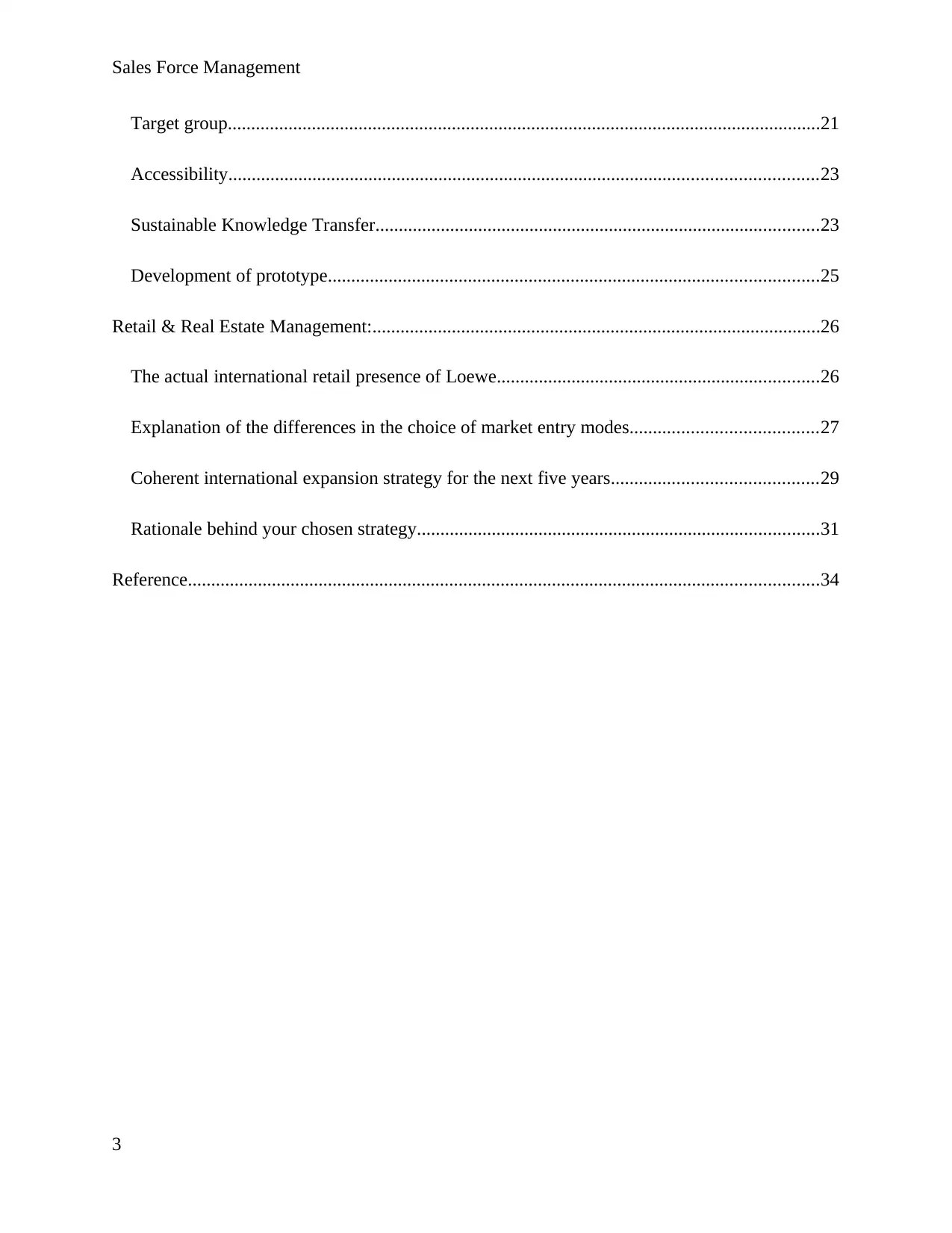
Target group...............................................................................................................................21
Accessibility..............................................................................................................................23
Sustainable Knowledge Transfer...............................................................................................23
Development of prototype.........................................................................................................25
Retail & Real Estate Management:................................................................................................26
The actual international retail presence of Loewe.....................................................................26
Explanation of the differences in the choice of market entry modes........................................27
Coherent international expansion strategy for the next five years............................................29
Rationale behind your chosen strategy......................................................................................31
Reference.......................................................................................................................................34
3
Target group...............................................................................................................................21
Accessibility..............................................................................................................................23
Sustainable Knowledge Transfer...............................................................................................23
Development of prototype.........................................................................................................25
Retail & Real Estate Management:................................................................................................26
The actual international retail presence of Loewe.....................................................................26
Explanation of the differences in the choice of market entry modes........................................27
Coherent international expansion strategy for the next five years............................................29
Rationale behind your chosen strategy......................................................................................31
Reference.......................................................................................................................................34
3
Paraphrase This Document
Need a fresh take? Get an instant paraphrase of this document with our AI Paraphraser
Sales Force Management
E-tailing
Rise of social networks and e-commerce
The social commerce allows business towards bringing services and goods directly to the
consumers via their preferred medium. The social networking sites has long been used as the tool
for capturing the attention of the customers as well as direct them towards the e-commerce
webpage. However, in the current decade, the social media has become to new e-commerce
website. It is thus essential for the business firms to reap the benefits of the social commerce
towards best possible profit maximization from the customers. According to
Knowledge@Wharton. (2020), the social commerce tends to offer a more convenient
experiences for shopping for the consumers. For the business sellers, the social networks and the
e-commerce gives another chance towards reaching the masses as well as target the main
demographics. With the changing time, the social networks have evolved to develop as one of
the powerful tools for the customers while looking forward to discovering, shop and well as
interact with the other new brands. As per the literature, the social commerce has not only
becoming the essential factor or the necessity for any of the business organization for investing
but has also changing the expectations of the consumer (Åvall 2017). Though the new and the
innovative terrain might be very much tricky towards navigation, there lies some of the essential
factors that the business brand must keep in mind for smooth usage of the e-commerce webpages
and reaching out to the customers.
Regarding the context of the luxury brands, the research studies stated that the social
networks and the e-commerce has been increasingly gaining importance due to the luxury brand.
The luxury brands of the top fashion industry in slowly entering the e-commerce market with the
4
E-tailing
Rise of social networks and e-commerce
The social commerce allows business towards bringing services and goods directly to the
consumers via their preferred medium. The social networking sites has long been used as the tool
for capturing the attention of the customers as well as direct them towards the e-commerce
webpage. However, in the current decade, the social media has become to new e-commerce
website. It is thus essential for the business firms to reap the benefits of the social commerce
towards best possible profit maximization from the customers. According to
Knowledge@Wharton. (2020), the social commerce tends to offer a more convenient
experiences for shopping for the consumers. For the business sellers, the social networks and the
e-commerce gives another chance towards reaching the masses as well as target the main
demographics. With the changing time, the social networks have evolved to develop as one of
the powerful tools for the customers while looking forward to discovering, shop and well as
interact with the other new brands. As per the literature, the social commerce has not only
becoming the essential factor or the necessity for any of the business organization for investing
but has also changing the expectations of the consumer (Åvall 2017). Though the new and the
innovative terrain might be very much tricky towards navigation, there lies some of the essential
factors that the business brand must keep in mind for smooth usage of the e-commerce webpages
and reaching out to the customers.
Regarding the context of the luxury brands, the research studies stated that the social
networks and the e-commerce has been increasingly gaining importance due to the luxury brand.
The luxury brands of the top fashion industry in slowly entering the e-commerce market with the
4
Sales Force Management
launch of several serves. According to the data gathered from Wertz (2020), LVMH (Moët
Hennessy Louis Vuitton) is initiating to enter the social networking and e-commerce market in
the following year by launching a website as the experiential platform of online shopping as well
as the digital outpost for the iconic luxury department store of the brand (Helal and Ozuem
2019). These alteration at the luxury retail platform of ecosystem will be largely attributing to the
rise of the importance of the social networks and the e-commerce as well as the shopping
behaviors of the consumers.
As per the current research, the affluent and modern customers are inclined towards
shopping at the multi rand environment. By the recognizing the requirement of capitalization of
the rising appetite for the online luxury purchases and selling, the luxury brands are slowly
investing on the e-commerce and social networking websites. The high-end retailers are slowly
embracing to the e-commerce as the distribution channel (Guercini and Runfola 2015). The
luxury industry has now been playing the catch up for answering the evolving digital habits of
some of the affluent customers. As per the reports, the consumers are clear that they view the
future of the luxury brands within the digital platform. The specialty as well as the essence of the
luxury has been changing from the emphasis over the physical products towards the focus over
the digital pictures.
Social media and e-commerce activities of Loewe
LVMH (Moët Hennessy Louis Vuitton) is currently moving to the London flagship at the
Bond Street for catering the burgeoning business ready to wears. The brand went to a revival
under Anderson who joined the brand in the year 2013 with the aim of reconfiguring the codes of
the brand for the millennial audience. These includes the launch of successful handbags and
growing business wear of women. The brand is initiating towards further investments with a
5
launch of several serves. According to the data gathered from Wertz (2020), LVMH (Moët
Hennessy Louis Vuitton) is initiating to enter the social networking and e-commerce market in
the following year by launching a website as the experiential platform of online shopping as well
as the digital outpost for the iconic luxury department store of the brand (Helal and Ozuem
2019). These alteration at the luxury retail platform of ecosystem will be largely attributing to the
rise of the importance of the social networks and the e-commerce as well as the shopping
behaviors of the consumers.
As per the current research, the affluent and modern customers are inclined towards
shopping at the multi rand environment. By the recognizing the requirement of capitalization of
the rising appetite for the online luxury purchases and selling, the luxury brands are slowly
investing on the e-commerce and social networking websites. The high-end retailers are slowly
embracing to the e-commerce as the distribution channel (Guercini and Runfola 2015). The
luxury industry has now been playing the catch up for answering the evolving digital habits of
some of the affluent customers. As per the reports, the consumers are clear that they view the
future of the luxury brands within the digital platform. The specialty as well as the essence of the
luxury has been changing from the emphasis over the physical products towards the focus over
the digital pictures.
Social media and e-commerce activities of Loewe
LVMH (Moët Hennessy Louis Vuitton) is currently moving to the London flagship at the
Bond Street for catering the burgeoning business ready to wears. The brand went to a revival
under Anderson who joined the brand in the year 2013 with the aim of reconfiguring the codes of
the brand for the millennial audience. These includes the launch of successful handbags and
growing business wear of women. The brand is initiating towards further investments with a
5
⊘ This is a preview!⊘
Do you want full access?
Subscribe today to unlock all pages.
Trusted by 1+ million students worldwide
Sales Force Management
good collection of the leather goods. LVMH is furthermore planning to invest in the London
maison for exploiting the positive momentum of the brand. According to the brand owners, the
old store of Loewe, which was situated in the Mount Street was too small for a fashion capital,
hence the new prime location will provide the brand with enough space for proper showcase of
accessories and clothing followed by the host of pop ups and art programs (Helal and Ozuem
2018).
Regarding the social media and e-commerce activities of Loewe, it can be stated that the
luxury brand has not yet initiated and enrolled themselves in the field of e-commerce and social
networking. For the luxury brands like Loewe, it has always been all about the brick and the
mortar. As per these luxury brands, the physical stores allow it to roll out the red carpet feeling
as well as deliver some of the premium and white glove services to its customers together with
the maintenance of the full control over the experience of the targeted customers. According to
Broillet, Dubosson and Varone (2009), the luxury brand, Loewe have shied away from the
platform of social networking and e-commerce with the fear of the factor that online e-commerce
and retailing might dilute the brand image of the luxury brand and might also reduce the
sensitivity towards its exclusivity. Another reason which instigated Loewe from staying away
from the e-commerce was the perceived lack of control, that is the quality related to pricing, the
sales environment, the customer experiences at the store as well and the third party pure play of
multiple brand in the online platform.
Thus, from the given case study, it can be summarized that Loewe is not involved in the
online platform and this luxury brand prefers to open store and investing in physical location
rather than engaging in social media and e-commerce activities.
6
good collection of the leather goods. LVMH is furthermore planning to invest in the London
maison for exploiting the positive momentum of the brand. According to the brand owners, the
old store of Loewe, which was situated in the Mount Street was too small for a fashion capital,
hence the new prime location will provide the brand with enough space for proper showcase of
accessories and clothing followed by the host of pop ups and art programs (Helal and Ozuem
2018).
Regarding the social media and e-commerce activities of Loewe, it can be stated that the
luxury brand has not yet initiated and enrolled themselves in the field of e-commerce and social
networking. For the luxury brands like Loewe, it has always been all about the brick and the
mortar. As per these luxury brands, the physical stores allow it to roll out the red carpet feeling
as well as deliver some of the premium and white glove services to its customers together with
the maintenance of the full control over the experience of the targeted customers. According to
Broillet, Dubosson and Varone (2009), the luxury brand, Loewe have shied away from the
platform of social networking and e-commerce with the fear of the factor that online e-commerce
and retailing might dilute the brand image of the luxury brand and might also reduce the
sensitivity towards its exclusivity. Another reason which instigated Loewe from staying away
from the e-commerce was the perceived lack of control, that is the quality related to pricing, the
sales environment, the customer experiences at the store as well and the third party pure play of
multiple brand in the online platform.
Thus, from the given case study, it can be summarized that Loewe is not involved in the
online platform and this luxury brand prefers to open store and investing in physical location
rather than engaging in social media and e-commerce activities.
6
Paraphrase This Document
Need a fresh take? Get an instant paraphrase of this document with our AI Paraphraser
Sales Force Management
The concept of E-tailing
The word, “E-tail” belongs from the root within the word, ‘retail’ (Fazal-e-Hasan et al.
2019). The letter E within the word stands for electronic since the process of shopping happens
through the electronic media. The concept involves the use of the web space for the development
of a virtual shop where the products are being displayed with attractive images with all the
features and the price tags. E-tailing enables access to the shopping sites for the customers for
choosing product from multiple options. The concept of e-tailing can be described as the selling
of the retail products over the platform of internet or social network (Kim 2013). The word e-
tailing is somewhat synonymous with business to consumer transactions. This buzzword that
takes place over the internet platform for any of the B2C transactions is simply the selling of the
goods by brands and sellers via the online platform. Electronic Retailing enables the business
organizations to reach its potential customers within and over its territory via the online platform.
This is furthermore enabling firms and the brands to explore a wide range of customer
population , while their products and services are available to a wide range of customers via the
online platform, which are resulting in increase of their profit margin.
According to the research studies, e-tailing has resulted towards the development of e-tail
ware, a software tools which is used for the development of online catalogs as well as
management of the business that are connected with e-tailing (dos Santos 2016).
The entire process or the steps of e-tailing involves 5 general steps. These are customer
visit, product choice, online payment, delivery of product and the customer feedback. There are
several benefits of the process of e-tailing. These are that it reduces the occupied space by the
retail outlets at the real world. E-tailing furthermore gives easy and quick access towards the
shopping space any of the convenient time from any location with proper internet access (Holten,
Olsen and Lind 2016). E-tailing helps in saving time of the consumers which they spent over
7
The concept of E-tailing
The word, “E-tail” belongs from the root within the word, ‘retail’ (Fazal-e-Hasan et al.
2019). The letter E within the word stands for electronic since the process of shopping happens
through the electronic media. The concept involves the use of the web space for the development
of a virtual shop where the products are being displayed with attractive images with all the
features and the price tags. E-tailing enables access to the shopping sites for the customers for
choosing product from multiple options. The concept of e-tailing can be described as the selling
of the retail products over the platform of internet or social network (Kim 2013). The word e-
tailing is somewhat synonymous with business to consumer transactions. This buzzword that
takes place over the internet platform for any of the B2C transactions is simply the selling of the
goods by brands and sellers via the online platform. Electronic Retailing enables the business
organizations to reach its potential customers within and over its territory via the online platform.
This is furthermore enabling firms and the brands to explore a wide range of customer
population , while their products and services are available to a wide range of customers via the
online platform, which are resulting in increase of their profit margin.
According to the research studies, e-tailing has resulted towards the development of e-tail
ware, a software tools which is used for the development of online catalogs as well as
management of the business that are connected with e-tailing (dos Santos 2016).
The entire process or the steps of e-tailing involves 5 general steps. These are customer
visit, product choice, online payment, delivery of product and the customer feedback. There are
several benefits of the process of e-tailing. These are that it reduces the occupied space by the
retail outlets at the real world. E-tailing furthermore gives easy and quick access towards the
shopping space any of the convenient time from any location with proper internet access (Holten,
Olsen and Lind 2016). E-tailing helps in saving time of the consumers which they spent over
7
Sales Force Management
travelling to several shopping places at the real world. E-tailing develops an innovative and a
new platform for goods and services from several parts of the globe which could be imported to
other part of world. Apart from these, e-tailing has lot of unique benefits towards both the
consumers as well as the marketers as compared to the offline process of retailing (Xu 2017).
These includes the availability and the rapid transaction. Attracting more customers for the
business and expanding the customer circle. As a platform, E-tailing also eliminated the barriers
among the consumers and the business due to the easy and full access of the information related
to the services or the products.
Regarding the luxury brands, e-tailing is also beneficial since this platform enables the
luxury brands to reach all the potential and the targeted customers who can afford the price range
but cannot afford to visit the exclusive showrooms which are situated at some of the specific
location. As per this case study, Loewe should engage in e-tailing platform since it will help the
luxury brand to reach all its targeted customers together with deeper market penetration. The e-
tailing has been extremely essential for Loewe, since this will enable the brand to maintain an
upscale image. According to Gautam and Sharma (2017), not only Loewe can sell counterfeit
products, but can also be able to publish quality content replicating the posh fashion magazine as
well as the huge cost for printing those. In short, e-tailing platform is enabling the luxury e-
tailers like Loewe to make some of the high-end fashion goods and handbags readily and widely
accessible to people throughout the globe. According to Lee, Hur and Watkins (2018), there are
some major reasons behind the rapid growth of the online luxury e-commerce webpages and
Loewe needs to adopt to this strategy. These includes improved boost sale of the luxury brands;
the luxury brands can see themselves in an Omni channel world while quickly embracing the e-
commerce opportunities.
8
travelling to several shopping places at the real world. E-tailing develops an innovative and a
new platform for goods and services from several parts of the globe which could be imported to
other part of world. Apart from these, e-tailing has lot of unique benefits towards both the
consumers as well as the marketers as compared to the offline process of retailing (Xu 2017).
These includes the availability and the rapid transaction. Attracting more customers for the
business and expanding the customer circle. As a platform, E-tailing also eliminated the barriers
among the consumers and the business due to the easy and full access of the information related
to the services or the products.
Regarding the luxury brands, e-tailing is also beneficial since this platform enables the
luxury brands to reach all the potential and the targeted customers who can afford the price range
but cannot afford to visit the exclusive showrooms which are situated at some of the specific
location. As per this case study, Loewe should engage in e-tailing platform since it will help the
luxury brand to reach all its targeted customers together with deeper market penetration. The e-
tailing has been extremely essential for Loewe, since this will enable the brand to maintain an
upscale image. According to Gautam and Sharma (2017), not only Loewe can sell counterfeit
products, but can also be able to publish quality content replicating the posh fashion magazine as
well as the huge cost for printing those. In short, e-tailing platform is enabling the luxury e-
tailers like Loewe to make some of the high-end fashion goods and handbags readily and widely
accessible to people throughout the globe. According to Lee, Hur and Watkins (2018), there are
some major reasons behind the rapid growth of the online luxury e-commerce webpages and
Loewe needs to adopt to this strategy. These includes improved boost sale of the luxury brands;
the luxury brands can see themselves in an Omni channel world while quickly embracing the e-
commerce opportunities.
8
⊘ This is a preview!⊘
Do you want full access?
Subscribe today to unlock all pages.
Trusted by 1+ million students worldwide
Sales Force Management
Recommendation for the e-tailing strategy for Loewe’s
It is important for the luxury brand, Loewe to develop and implement a e-tailing strategy
as one of the essential recommended steps for entering the world of social networking and e-
commerce. As stated in the case study, Loewe, the luxury brand is planning to open its exclusive
store in bond street and also invested in renovation of its Casa Loewe flagship at Madrid. The
chief executive furthermore stated regarding the investments within the store for the extensions
as one of the luxury strategies. However, the brand did not focus majorly over the e-commerce
and online platform for selling and publicizing their luxury product (Moreno-Gavara and
Jiménez-Zarco 2018). E-tailing will help Loewe to lower its intermediate costing, enabling high
end publicity throughout the globe and eliminating the cost borne by the physical marketing and
printing of posh fashion magazine. It is to note that going to the luxury store has not always been
a pleasant activity. According to the data, many customers tend to feel out of the place at the
luxury stores with the sense and the feeling that they are being judged. Hence, Loewe need to
focus and enroll in the e-tailing platform.
Regarding the opening of the new and exclusive store, it is important for Loewe to focus over
some of the e-tailing strategies.
Targeting consumers who are very much ready to buy the luxury products of Loewe -
The easiest consumer to sell is the consumer who have already been looking to purchase.
The Google shopping is thus an essential tool for the retail marketers. Google shopping is
one of the convenient and easiest ways for online retail marketing. It is thus essential for
Loewe to target the customers who can afford their products together with the
maintenance of the exclusivity of the luxury products.
9
Recommendation for the e-tailing strategy for Loewe’s
It is important for the luxury brand, Loewe to develop and implement a e-tailing strategy
as one of the essential recommended steps for entering the world of social networking and e-
commerce. As stated in the case study, Loewe, the luxury brand is planning to open its exclusive
store in bond street and also invested in renovation of its Casa Loewe flagship at Madrid. The
chief executive furthermore stated regarding the investments within the store for the extensions
as one of the luxury strategies. However, the brand did not focus majorly over the e-commerce
and online platform for selling and publicizing their luxury product (Moreno-Gavara and
Jiménez-Zarco 2018). E-tailing will help Loewe to lower its intermediate costing, enabling high
end publicity throughout the globe and eliminating the cost borne by the physical marketing and
printing of posh fashion magazine. It is to note that going to the luxury store has not always been
a pleasant activity. According to the data, many customers tend to feel out of the place at the
luxury stores with the sense and the feeling that they are being judged. Hence, Loewe need to
focus and enroll in the e-tailing platform.
Regarding the opening of the new and exclusive store, it is important for Loewe to focus over
some of the e-tailing strategies.
Targeting consumers who are very much ready to buy the luxury products of Loewe -
The easiest consumer to sell is the consumer who have already been looking to purchase.
The Google shopping is thus an essential tool for the retail marketers. Google shopping is
one of the convenient and easiest ways for online retail marketing. It is thus essential for
Loewe to target the customers who can afford their products together with the
maintenance of the exclusivity of the luxury products.
9
Paraphrase This Document
Need a fresh take? Get an instant paraphrase of this document with our AI Paraphraser
Sales Force Management
Getting the consumers ready to purchase
Provision of more details regarding the products with online videos
Focusing over the premium and exclusivity of the luxury brands with reputed film stars
Development of the trust with the influencer marketing
Analysis of everything
The above strategies are extremely essential for Loewe to adopt for reaping the complete
benefit from the social networks and the e-commerce , thereby increasing their profit margin as
well as the publicity and reducing their intermediate cost followed by deeper market penetration.
Some of the characteristics of successful e-tailing for Loewe includes guarantees and brand
recognition, digitalized products, products with detailed and standard specification and well
packaging. The e-tailing business models that will be relevant in the case includes the
classification of direct marketing by the retailers of mail order and the internet malls.
Source - (Helal and Ozuem 2019)
10
Getting the consumers ready to purchase
Provision of more details regarding the products with online videos
Focusing over the premium and exclusivity of the luxury brands with reputed film stars
Development of the trust with the influencer marketing
Analysis of everything
The above strategies are extremely essential for Loewe to adopt for reaping the complete
benefit from the social networks and the e-commerce , thereby increasing their profit margin as
well as the publicity and reducing their intermediate cost followed by deeper market penetration.
Some of the characteristics of successful e-tailing for Loewe includes guarantees and brand
recognition, digitalized products, products with detailed and standard specification and well
packaging. The e-tailing business models that will be relevant in the case includes the
classification of direct marketing by the retailers of mail order and the internet malls.
Source - (Helal and Ozuem 2019)
10
Sales Force Management
As per the model, this is applicable in this case study due to direct marketing without any
intermediaries among the buyers and the manufacturers. One of the most essential factors is the
B2C in the social networking which can be used by this luxury brand as the platform for
publishing and supporting purchases of the exclusive materials. Virtual shopping is another
factor that will provide the brand with 3D experience. It is thus essential for Loewe to adopt this
model and the strategies for expanding its business in the online platform as well as maximize its
profit margin.
11
As per the model, this is applicable in this case study due to direct marketing without any
intermediaries among the buyers and the manufacturers. One of the most essential factors is the
B2C in the social networking which can be used by this luxury brand as the platform for
publishing and supporting purchases of the exclusive materials. Virtual shopping is another
factor that will provide the brand with 3D experience. It is thus essential for Loewe to adopt this
model and the strategies for expanding its business in the online platform as well as maximize its
profit margin.
11
⊘ This is a preview!⊘
Do you want full access?
Subscribe today to unlock all pages.
Trusted by 1+ million students worldwide

1 out of 42


Related Documents


Your All-in-One AI-Powered Toolkit for Academic Success.
+13062052269
info@desklib.com
Available 24*7 on WhatsApp / Email
![[object Object]](/_next/static/media/star-bottom.7253800d.svg)
Unlock your academic potential
Copyright © 2020–2026 A2Z Services. All Rights Reserved. Developed and managed by ZUCOL.