Logistics Engineering IV: System Design and Case Study Assignment
VerifiedAdded on 2022/11/26
|9
|1583
|483
Homework Assignment
AI Summary
This assignment solution addresses key concepts in logistics engineering and system design, providing detailed explanations and practical examples. The first part of the solution defines logistics engineering, differentiating it from logistics management, and then applies these concepts to a case study of Chevron Corporation, analyzing the company's activities related to oil and gas exploration, specifically horizontal drilling and the use of downhole pumps. The solution outlines the conceptualization, design, prototyping, testing, production, deployment, operation, support, evolution, and retirement of these pumps. The second part of the assignment focuses on preliminary system design, using the construction of a house as an example. It explains the conceptual design process, including studying client needs, developing a design brief, budgeting, and site analysis. The solution also details the steps involved in the design process, from selecting a designer and analyzing the site to developing house plans, securing permits, and addressing interior design considerations, providing a comprehensive overview of the project's lifecycle.
QUESTION 1
1.1 Explain the concept of logistics engineering. How does it differ from logistics management?
1.2 Using a business organization of your choice, explain the following activities of logistics
engineering
1.2.1 Conceptualize the support of the product
1.2.2 evaluate the support of the product
1.2.3 design the support of the product
1.2.4 prototype the support of the product
1.2.5 test the support of the product
1.2.6 produce the support of the product
1.2.7 deploy the support of the product
1.2.8 operate the support of the product
1.2.9 support the support of the product
1.2.10 evolve the support of the product
1.2.11 retire the support of the product
1.2.12 manage the support of the product
1.1
Logistics engineering is concerned about the organization of companies scientifically. It can be
said that such organization may include property purchases, warehousing or even
transportation (David Swanson, 2017).
Logistics management on the other hand is more concerned about efficient production
processes, material handling procedures, sales, transportation services, that ma]y occur within
or outside a particular company. It also handles company and customer relations (David
Swanson, 2017).
1.1 Explain the concept of logistics engineering. How does it differ from logistics management?
1.2 Using a business organization of your choice, explain the following activities of logistics
engineering
1.2.1 Conceptualize the support of the product
1.2.2 evaluate the support of the product
1.2.3 design the support of the product
1.2.4 prototype the support of the product
1.2.5 test the support of the product
1.2.6 produce the support of the product
1.2.7 deploy the support of the product
1.2.8 operate the support of the product
1.2.9 support the support of the product
1.2.10 evolve the support of the product
1.2.11 retire the support of the product
1.2.12 manage the support of the product
1.1
Logistics engineering is concerned about the organization of companies scientifically. It can be
said that such organization may include property purchases, warehousing or even
transportation (David Swanson, 2017).
Logistics management on the other hand is more concerned about efficient production
processes, material handling procedures, sales, transportation services, that ma]y occur within
or outside a particular company. It also handles company and customer relations (David
Swanson, 2017).
Paraphrase This Document
Need a fresh take? Get an instant paraphrase of this document with our AI Paraphraser

1.2
Chevron Corporation is America-based Energy Corporation that aims at fulfilling all the growing
energy demands with the most efficient oil and natural gas exploration technologies, storage
and transportation services. They are known for their horizontal method of drilling.
1.2.1
Horizontal drilling is conceptualized to reduce the effects of oil drilling to the environment while
increasing productivity and reaching challenging oil wells especially in sandy environments.
1.2.2
This method of oil well drilling is not only approved but also recommended by the American
Petroleum Institute but also the United States Environmental Protection Agency.
1.2.3
The design of the drilling machinery involves employing or incorporating the use of downhole
pumps at the bore of the wells.
1.2.4
Prototyping the downhole pumps involves the incorporation both the travel and stand valves, a
plunger, a pull-tube, a barrel, valve rod, seating and fitting components into a conventional
drilling pump.
1.2.5
The pump can be tested in sandy or coastal environments with both natural gas and potent oil
wells after drilling past the underground water table.
1.2.6
Support offered to the product by using hardened plungers and a stainless steel barrel. A
software system is used to analyze the pump efficiency and performance various components.
1.2.7
Chevron Corporation is America-based Energy Corporation that aims at fulfilling all the growing
energy demands with the most efficient oil and natural gas exploration technologies, storage
and transportation services. They are known for their horizontal method of drilling.
1.2.1
Horizontal drilling is conceptualized to reduce the effects of oil drilling to the environment while
increasing productivity and reaching challenging oil wells especially in sandy environments.
1.2.2
This method of oil well drilling is not only approved but also recommended by the American
Petroleum Institute but also the United States Environmental Protection Agency.
1.2.3
The design of the drilling machinery involves employing or incorporating the use of downhole
pumps at the bore of the wells.
1.2.4
Prototyping the downhole pumps involves the incorporation both the travel and stand valves, a
plunger, a pull-tube, a barrel, valve rod, seating and fitting components into a conventional
drilling pump.
1.2.5
The pump can be tested in sandy or coastal environments with both natural gas and potent oil
wells after drilling past the underground water table.
1.2.6
Support offered to the product by using hardened plungers and a stainless steel barrel. A
software system is used to analyze the pump efficiency and performance various components.
1.2.7

The pump is incorporated after consulting with oil exploration experts and hydraulic
manufacturers. The pump can be used after being declared safe to the environment, especially
marine life by the EPA.
1.2.8
Pump efficiency and life is analyzed by a computer system. The performance and resilience of
the components are recorded by onboard sensors and feedback send back to the software on
the ground for analysis. A Computer Analysis System or CAS is used.
1.2.9
The downhole rod pump consumes less energy, saves drilling time limiting human presence on
a particular natural environment and accesses previously inexplorable marine oil wells.
1.2.10
Energy demands can be met with much ease while at the same time causing lesser harm to the
environment, especially marine life.
1.2.11
These pumps are not only limited to oil drilling but can also be customized and used to drill
water wells in arid places and deserts solving the problem of water shortage in those particular
regions.
1.2.12
The product will be used only when necessary and in specified areas. Efficiency and output of
the pumps are the two most important factors that are considered.
QUESTION 4
manufacturers. The pump can be used after being declared safe to the environment, especially
marine life by the EPA.
1.2.8
Pump efficiency and life is analyzed by a computer system. The performance and resilience of
the components are recorded by onboard sensors and feedback send back to the software on
the ground for analysis. A Computer Analysis System or CAS is used.
1.2.9
The downhole rod pump consumes less energy, saves drilling time limiting human presence on
a particular natural environment and accesses previously inexplorable marine oil wells.
1.2.10
Energy demands can be met with much ease while at the same time causing lesser harm to the
environment, especially marine life.
1.2.11
These pumps are not only limited to oil drilling but can also be customized and used to drill
water wells in arid places and deserts solving the problem of water shortage in those particular
regions.
1.2.12
The product will be used only when necessary and in specified areas. Efficiency and output of
the pumps are the two most important factors that are considered.
QUESTION 4
⊘ This is a preview!⊘
Do you want full access?
Subscribe today to unlock all pages.

Trusted by 1+ million students worldwide

The preliminary system design (conceptual design) begins with the system level requirements
that are documented in the A-specification (system level specification) and the support concept
documents. These system level requirements are translated into detailed qualitative and
quantitative design requirements through the processes of functional analysis and
requirements allocation
Required:
Carry out a preliminary system design of a product or service you wish to invent of your choice.
Illustrate the concepts noted above.
In this particular preliminary design, the construction of a house will be considered for the
activity. It will not only help in conceptualization of the project but also assist in identifying all
the necessary requirements that help in the actual realization of the same (Hernando Jimenez,
2005).
HOUSE CONSTRUCTION
Conceptual Design
This is the first step which will also involve the designer, the client who is interested to own a
home and the person responsible in the actual building of the house, which may be a
contractor. The preliminary design of the house is conceptualized and all involved professionals
are allowed to put in their contribution towards its development.
The steps undertaken include (Hernando Jimenez, 2005):
that are documented in the A-specification (system level specification) and the support concept
documents. These system level requirements are translated into detailed qualitative and
quantitative design requirements through the processes of functional analysis and
requirements allocation
Required:
Carry out a preliminary system design of a product or service you wish to invent of your choice.
Illustrate the concepts noted above.
In this particular preliminary design, the construction of a house will be considered for the
activity. It will not only help in conceptualization of the project but also assist in identifying all
the necessary requirements that help in the actual realization of the same (Hernando Jimenez,
2005).
HOUSE CONSTRUCTION
Conceptual Design
This is the first step which will also involve the designer, the client who is interested to own a
home and the person responsible in the actual building of the house, which may be a
contractor. The preliminary design of the house is conceptualized and all involved professionals
are allowed to put in their contribution towards its development.
The steps undertaken include (Hernando Jimenez, 2005):
Paraphrase This Document
Need a fresh take? Get an instant paraphrase of this document with our AI Paraphraser

Studying the way of living of the client or person interested in owning the house, it will
be carried out by examining his already existing home.
The second thing to be one will be to develop a brief for the identified design.
Coming up with or estimating the base budget.
Seeking of advice from those experienced in the design and construction of houses. This
can also involve secondary sources.
Application of the gathered knowledge and advice to the design brief.
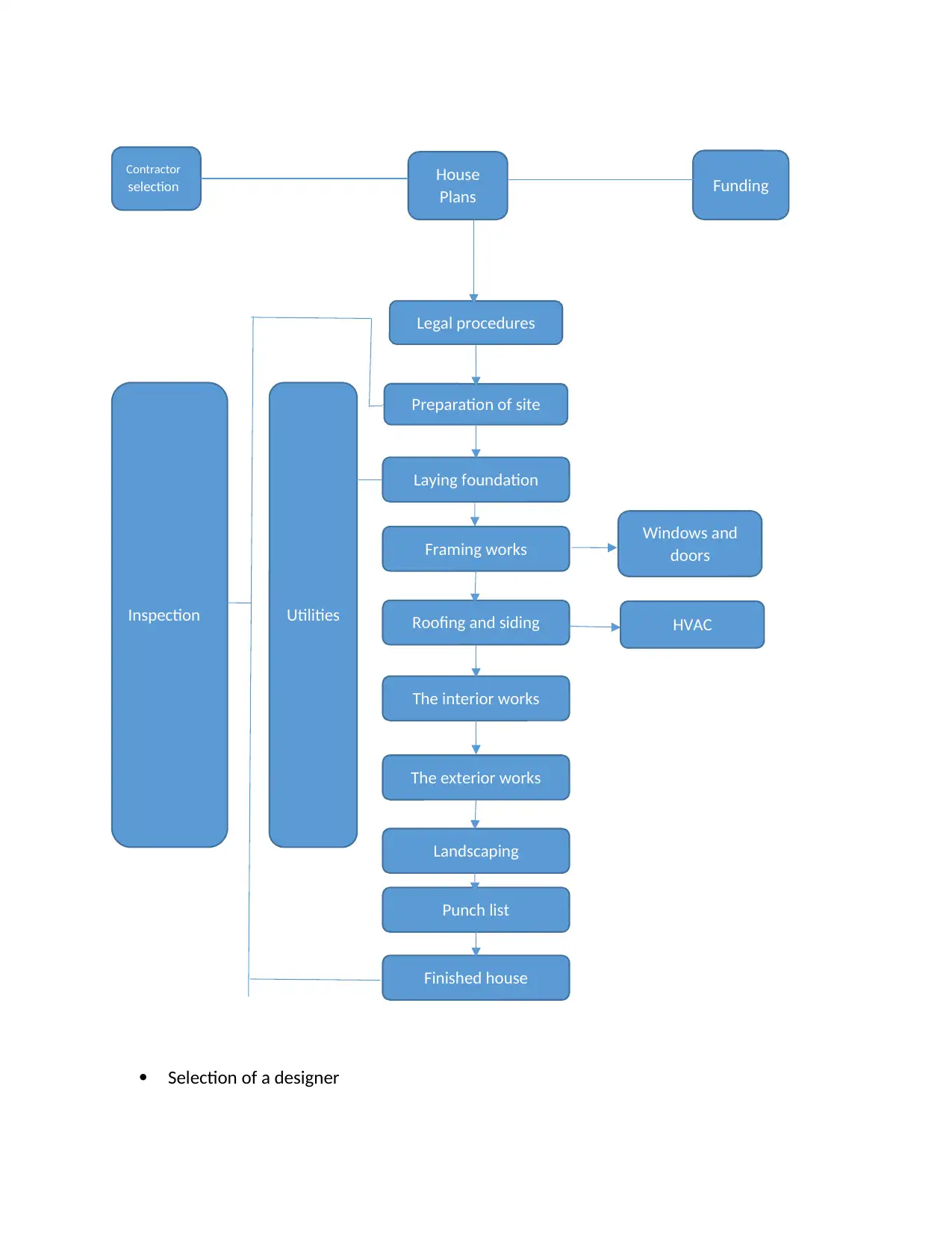
Diagram showing all the activities that will be undertaken
be carried out by examining his already existing home.
The second thing to be one will be to develop a brief for the identified design.
Coming up with or estimating the base budget.
Seeking of advice from those experienced in the design and construction of houses. This
can also involve secondary sources.
Application of the gathered knowledge and advice to the design brief.
Diagram showing all the activities that will be undertaken

Selection of a designer
House
Plans
Contractor
selection Funding
Laying foundation
Preparation of site
Legal procedures
Framing works
Roofing and siding
The interior works
The exterior works
Landscaping
Punch list
Finished house
Windows and
doors
HVAC
Inspection Utilities
House
Plans
Contractor
selection Funding
Laying foundation
Preparation of site
Legal procedures
Framing works
Roofing and siding
The interior works
The exterior works
Landscaping
Punch list
Finished house
Windows and
doors
HVAC
Inspection Utilities
⊘ This is a preview!⊘
Do you want full access?
Subscribe today to unlock all pages.

Trusted by 1+ million students worldwide

This is a very important step as the right designer will determine how the construction of the
house will proceed, such a group may include an architect who will determine most of the
design parameters of the project.
Analysis of the site
Analysis of the site includes studying and evaluating most of the factors that will not only
determine the realization of the finished project but also its lifespan, such factors or
parameters include the strength of the soil or materials, various weaknesses, the opportunity
factor and existing hazards or threatening factors.
The following are put under consideration:
The climatic factors.
Orientation.
Exposure to sunlight.
Drainage.
Infrastructure.
Soil properties.
Access to water.
After reaching, studying the site and carefully considering all the above factors at the site, the
conceptualized plan will be developed. These will in turn aid in coming up with the provisional
fee which will be developed from the initial budget.
Opinion of estimated cost
In this preliminary design of a two-bedroom house, it was initially estimated that the cost
would be $ 1400 per square meter.
The amount is the most friendly putting the on-off method of production in mind. Project is to
be done with the lowest amount of financial input possible. The building materials are to be
produced in periodic bulks or batches to lower the cost of construction.
house will proceed, such a group may include an architect who will determine most of the
design parameters of the project.
Analysis of the site
Analysis of the site includes studying and evaluating most of the factors that will not only
determine the realization of the finished project but also its lifespan, such factors or
parameters include the strength of the soil or materials, various weaknesses, the opportunity
factor and existing hazards or threatening factors.
The following are put under consideration:
The climatic factors.
Orientation.
Exposure to sunlight.
Drainage.
Infrastructure.
Soil properties.
Access to water.
After reaching, studying the site and carefully considering all the above factors at the site, the
conceptualized plan will be developed. These will in turn aid in coming up with the provisional
fee which will be developed from the initial budget.
Opinion of estimated cost
In this preliminary design of a two-bedroom house, it was initially estimated that the cost
would be $ 1400 per square meter.
The amount is the most friendly putting the on-off method of production in mind. Project is to
be done with the lowest amount of financial input possible. The building materials are to be
produced in periodic bulks or batches to lower the cost of construction.
Paraphrase This Document
Need a fresh take? Get an instant paraphrase of this document with our AI Paraphraser

Project is to have a floor area of 150 square meters. Therefore, opinion of the probable cost is
$ 125, 000.
Additional costs are:
Air conditioning installation $ 4500
Construction of a car shade $ 5000
Perimeter wall $ 8000
Construction of a septic tank 3000
Development of the design
After putting together all the requirements and determining that the project is feasible and
realizable, all the design components and put together, including all the drawings and used to
acquire a permit. The property developers will use the information to come up with the
structural details of the project.
They will base their development of the design on the selected materials and the parameters
that have been provided together with the architect or the designer.
The permit
The development team will have to come up with the detailed plan about the project. Showing
all the materials, dimensions, parameters and all the factors that will actualize the proposed
project. These will not only cover the house plans, but also its structural information and the
site characteristics. They will defend the project in order to be granted the permit to proceed.
Upon approval of the design plan, the development team will then come up with the plans of
the site. These may include floor, exterior and interior plans.
Interior Design
$ 125, 000.
Additional costs are:
Air conditioning installation $ 4500
Construction of a car shade $ 5000
Perimeter wall $ 8000
Construction of a septic tank 3000
Development of the design
After putting together all the requirements and determining that the project is feasible and
realizable, all the design components and put together, including all the drawings and used to
acquire a permit. The property developers will use the information to come up with the
structural details of the project.
They will base their development of the design on the selected materials and the parameters
that have been provided together with the architect or the designer.
The permit
The development team will have to come up with the detailed plan about the project. Showing
all the materials, dimensions, parameters and all the factors that will actualize the proposed
project. These will not only cover the house plans, but also its structural information and the
site characteristics. They will defend the project in order to be granted the permit to proceed.
Upon approval of the design plan, the development team will then come up with the plans of
the site. These may include floor, exterior and interior plans.
Interior Design

The development team will then work with the other stakeholders in the project on this final
stage in actualizing all the details related to the interior of the house, these will be influenced
b]y the selected materials, electrical system, plumb-work, aesthetics and other finishing works.
References
David Swanson, L. G. (2017). Applying Theories from Other Disciples to Logistics and Supply Chain
Management: A systematic Literature Review . Trnasportation Journal, 299-356.
Hernando Jimenez, D. M. (2005). Conceptual Design of Current Technology and Advanced Concepts for
an Efficicent Multi-Mach Aircraft. SAE Transactions, 1343-1353.
stage in actualizing all the details related to the interior of the house, these will be influenced
b]y the selected materials, electrical system, plumb-work, aesthetics and other finishing works.
References
David Swanson, L. G. (2017). Applying Theories from Other Disciples to Logistics and Supply Chain
Management: A systematic Literature Review . Trnasportation Journal, 299-356.
Hernando Jimenez, D. M. (2005). Conceptual Design of Current Technology and Advanced Concepts for
an Efficicent Multi-Mach Aircraft. SAE Transactions, 1343-1353.
⊘ This is a preview!⊘
Do you want full access?
Subscribe today to unlock all pages.

Trusted by 1+ million students worldwide
1 out of 9
Your All-in-One AI-Powered Toolkit for Academic Success.
+13062052269
info@desklib.com
Available 24*7 on WhatsApp / Email
Unlock your academic potential
Copyright © 2020–2026 A2Z Services. All Rights Reserved. Developed and managed by ZUCOL.