Analysis of Fast Goods Logistics and Supply Chain Management Report
VerifiedAdded on 2022/09/06
|13
|2748
|18
Report
AI Summary
This report provides a detailed analysis of the Fast Goods company's logistics and supply chain management. It begins with an executive summary outlining the company's current challenges, including negative cash flow and inefficiencies in reaching markets. The report then delves into the existing supply chain, highlighting issues such as long lead times and poor communication. Recommendations for a new supply chain are proposed, focusing on improvements to the physical supply networks, product demand forecasting, and value-adding innovations. Contingencies surrounding the existing and proposed strategies are discussed, including cost minimization schedules, customer service enhancements, and supply chain redesign. The report also covers the company's operational structure, transportation costs, and performance measures, concluding with a focus on achieving the company's objectives through the implementation of the new supply chain and logistic strategy. The report emphasizes the importance of innovation, strategic partnerships, and data-driven decision-making to improve efficiency and profitability. The company's structure of operations, including supply, transportation, and inventory costs, are broken down to showcase the potential for cost reduction and improved customer service.
Submission Number 1
Logistics and supply chain management
Student’s name
Institutional affiliation
Date
Logistics and supply chain management
Student’s name
Institutional affiliation
Date

Paraphrase This Document
Need a fresh take? Get an instant paraphrase of this document with our AI Paraphraser
Submission Number 2
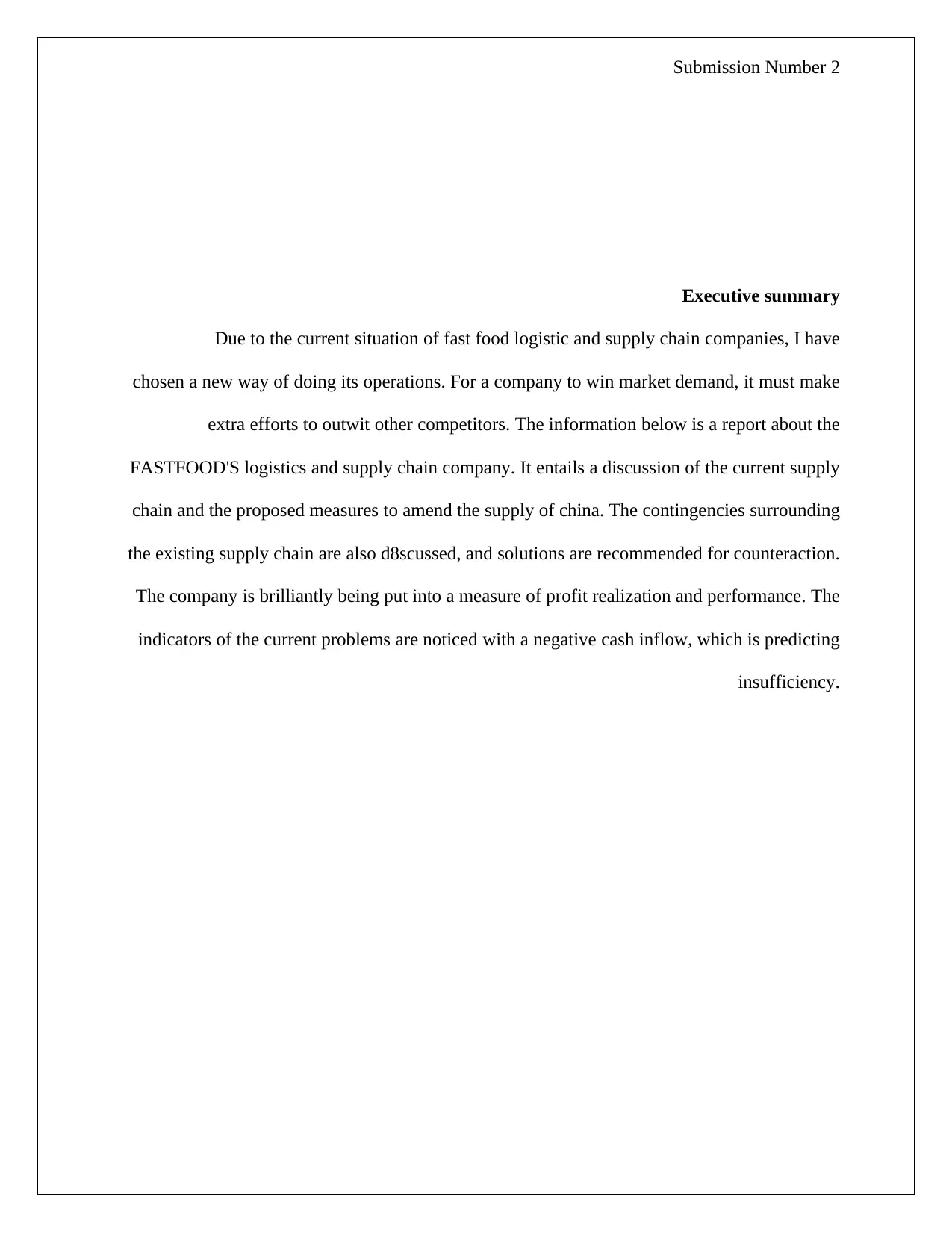
Executive summary
Due to the current situation of fast food logistic and supply chain companies, I have
chosen a new way of doing its operations. For a company to win market demand, it must make
extra efforts to outwit other competitors. The information below is a report about the
FASTFOOD'S logistics and supply chain company. It entails a discussion of the current supply
chain and the proposed measures to amend the supply of china. The contingencies surrounding
the existing supply chain are also d8scussed, and solutions are recommended for counteraction.
The company is brilliantly being put into a measure of profit realization and performance. The
indicators of the current problems are noticed with a negative cash inflow, which is predicting
insufficiency.
Executive summary
Due to the current situation of fast food logistic and supply chain companies, I have
chosen a new way of doing its operations. For a company to win market demand, it must make
extra efforts to outwit other competitors. The information below is a report about the
FASTFOOD'S logistics and supply chain company. It entails a discussion of the current supply
chain and the proposed measures to amend the supply of china. The contingencies surrounding
the existing supply chain are also d8scussed, and solutions are recommended for counteraction.
The company is brilliantly being put into a measure of profit realization and performance. The
indicators of the current problems are noticed with a negative cash inflow, which is predicting
insufficiency.
Submission Number 3
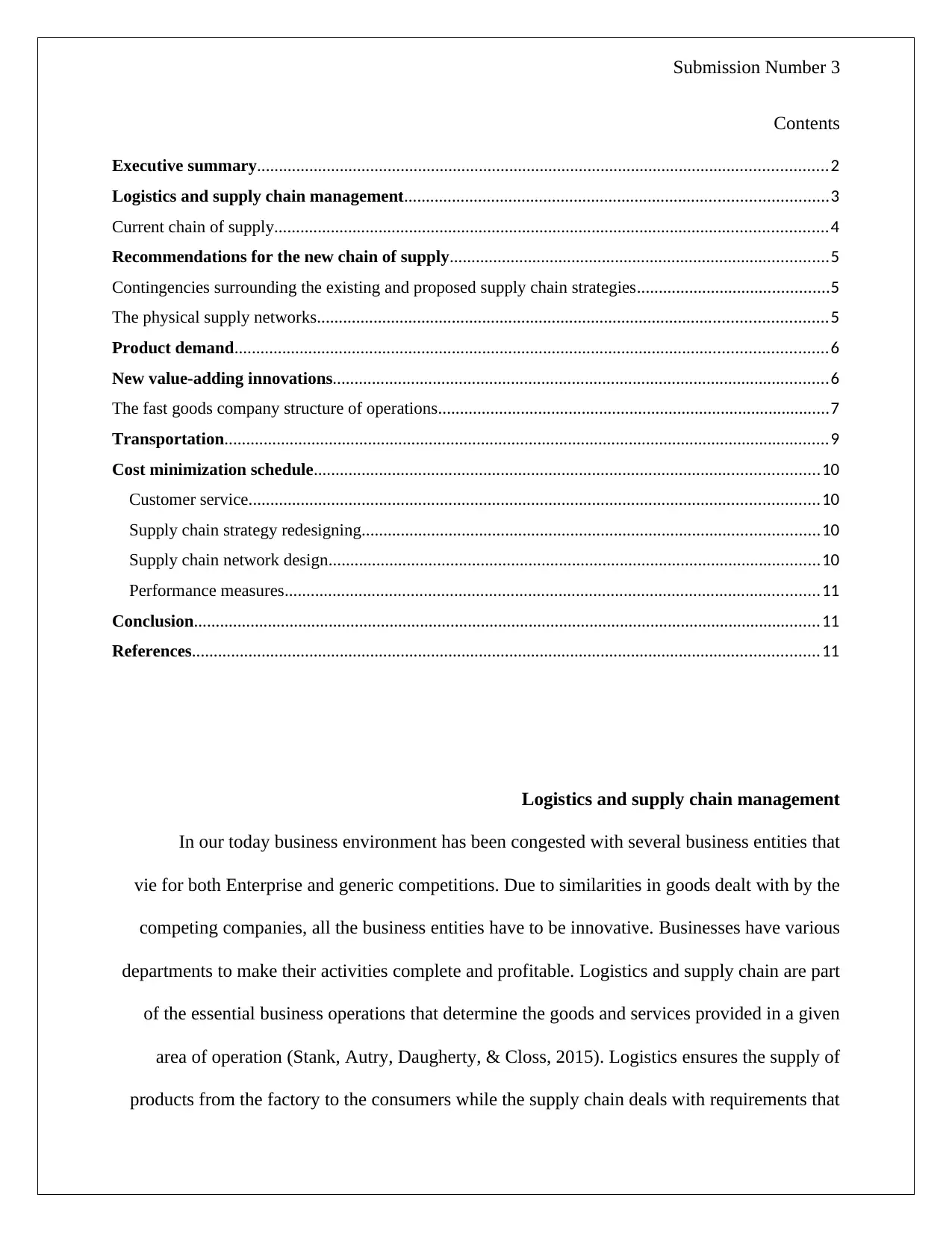
Contents
Executive summary...................................................................................................................................2
Logistics and supply chain management.................................................................................................3
Current chain of supply...............................................................................................................................4
Recommendations for the new chain of supply.......................................................................................5
Contingencies surrounding the existing and proposed supply chain strategies............................................5
The physical supply networks.....................................................................................................................5
Product demand........................................................................................................................................6
New value-adding innovations..................................................................................................................6
The fast goods company structure of operations..........................................................................................7
Transportation...........................................................................................................................................9
Cost minimization schedule....................................................................................................................10
Customer service...................................................................................................................................10
Supply chain strategy redesigning.........................................................................................................10
Supply chain network design.................................................................................................................10
Performance measures...........................................................................................................................11
Conclusion................................................................................................................................................11
References................................................................................................................................................11
Logistics and supply chain management
In our today business environment has been congested with several business entities that
vie for both Enterprise and generic competitions. Due to similarities in goods dealt with by the
competing companies, all the business entities have to be innovative. Businesses have various
departments to make their activities complete and profitable. Logistics and supply chain are part
of the essential business operations that determine the goods and services provided in a given
area of operation (Stank, Autry, Daugherty, & Closs, 2015). Logistics ensures the supply of
products from the factory to the consumers while the supply chain deals with requirements that
Contents
Executive summary...................................................................................................................................2
Logistics and supply chain management.................................................................................................3
Current chain of supply...............................................................................................................................4
Recommendations for the new chain of supply.......................................................................................5
Contingencies surrounding the existing and proposed supply chain strategies............................................5
The physical supply networks.....................................................................................................................5
Product demand........................................................................................................................................6
New value-adding innovations..................................................................................................................6
The fast goods company structure of operations..........................................................................................7
Transportation...........................................................................................................................................9
Cost minimization schedule....................................................................................................................10
Customer service...................................................................................................................................10
Supply chain strategy redesigning.........................................................................................................10
Supply chain network design.................................................................................................................10
Performance measures...........................................................................................................................11
Conclusion................................................................................................................................................11
References................................................................................................................................................11
Logistics and supply chain management
In our today business environment has been congested with several business entities that
vie for both Enterprise and generic competitions. Due to similarities in goods dealt with by the
competing companies, all the business entities have to be innovative. Businesses have various
departments to make their activities complete and profitable. Logistics and supply chain are part
of the essential business operations that determine the goods and services provided in a given
area of operation (Stank, Autry, Daugherty, & Closs, 2015). Logistics ensures the supply of
products from the factory to the consumers while the supply chain deals with requirements that
⊘ This is a preview!⊘
Do you want full access?
Subscribe today to unlock all pages.

Trusted by 1+ million students worldwide
Submission Number 4
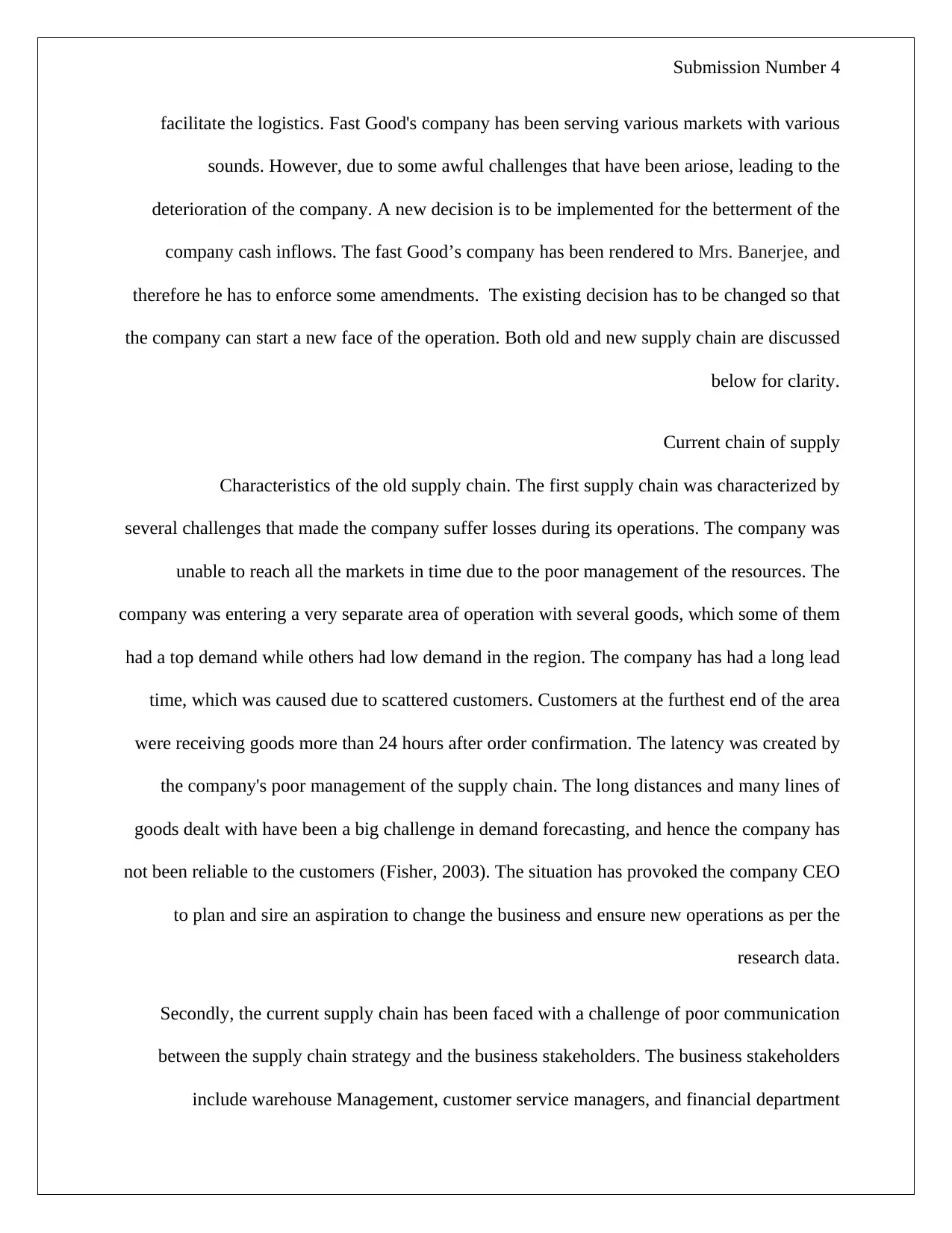
facilitate the logistics. Fast Good's company has been serving various markets with various
sounds. However, due to some awful challenges that have been ariose, leading to the
deterioration of the company. A new decision is to be implemented for the betterment of the
company cash inflows. The fast Good’s company has been rendered to Mrs. Banerjee, and
therefore he has to enforce some amendments. The existing decision has to be changed so that
the company can start a new face of the operation. Both old and new supply chain are discussed
below for clarity.
Current chain of supply
Characteristics of the old supply chain. The first supply chain was characterized by
several challenges that made the company suffer losses during its operations. The company was
unable to reach all the markets in time due to the poor management of the resources. The
company was entering a very separate area of operation with several goods, which some of them
had a top demand while others had low demand in the region. The company has had a long lead
time, which was caused due to scattered customers. Customers at the furthest end of the area
were receiving goods more than 24 hours after order confirmation. The latency was created by
the company's poor management of the supply chain. The long distances and many lines of
goods dealt with have been a big challenge in demand forecasting, and hence the company has
not been reliable to the customers (Fisher, 2003). The situation has provoked the company CEO
to plan and sire an aspiration to change the business and ensure new operations as per the
research data.
Secondly, the current supply chain has been faced with a challenge of poor communication
between the supply chain strategy and the business stakeholders. The business stakeholders
include warehouse Management, customer service managers, and financial department
facilitate the logistics. Fast Good's company has been serving various markets with various
sounds. However, due to some awful challenges that have been ariose, leading to the
deterioration of the company. A new decision is to be implemented for the betterment of the
company cash inflows. The fast Good’s company has been rendered to Mrs. Banerjee, and
therefore he has to enforce some amendments. The existing decision has to be changed so that
the company can start a new face of the operation. Both old and new supply chain are discussed
below for clarity.
Current chain of supply
Characteristics of the old supply chain. The first supply chain was characterized by
several challenges that made the company suffer losses during its operations. The company was
unable to reach all the markets in time due to the poor management of the resources. The
company was entering a very separate area of operation with several goods, which some of them
had a top demand while others had low demand in the region. The company has had a long lead
time, which was caused due to scattered customers. Customers at the furthest end of the area
were receiving goods more than 24 hours after order confirmation. The latency was created by
the company's poor management of the supply chain. The long distances and many lines of
goods dealt with have been a big challenge in demand forecasting, and hence the company has
not been reliable to the customers (Fisher, 2003). The situation has provoked the company CEO
to plan and sire an aspiration to change the business and ensure new operations as per the
research data.
Secondly, the current supply chain has been faced with a challenge of poor communication
between the supply chain strategy and the business stakeholders. The business stakeholders
include warehouse Management, customer service managers, and financial department
Paraphrase This Document
Need a fresh take? Get an instant paraphrase of this document with our AI Paraphraser
Submission Number 5
managers, among others. According to the provided dataset, the business has had very many
customers who have been depending on their goods. But, due to the weak strategy, the business
has not been able to operate well (Marshall & Fisher, 1997). It has not been reaching all the
customers in time hence dissatisfaction. The cost of supply has been high due to poor allocation
of the resources in the former chain of supply.
Recommendations for the new chain of supply
The unique string of amount is purposed to improve the profits of the business. The
former chain of supply has not been meeting the demands of the business and the shareholders.
Therefore, it has been found that there is a need for a new chain of supply and laid down
policies. For advancements and improvements in the performance, new strategies are laid down,
which will go up to eliminating some overheads which drain the company finances (Christopher,
Peck, & Towill, 2006).
Contingencies surrounding the existing and proposed supply chain strategies
The physical supply networks
We are going to maintain the three factories in Indonesia, Thailand, and Malaysia. The
factories will continue being supplied by the five leading suppliers to serve the need. However,
the company will deal with the four top products in terms of demand, according to the research
(Towill & Christopher, 2003). The products proposed are facial cream, detergents, coffee, and
shampoo. The selection is also based on the four hundred and forty customers. And the
distribution will be done by them through thirteen distribution centers. The company is expected
to expedite the expenditures to ensure there are maximum profit realizations. According to the
managers, among others. According to the provided dataset, the business has had very many
customers who have been depending on their goods. But, due to the weak strategy, the business
has not been able to operate well (Marshall & Fisher, 1997). It has not been reaching all the
customers in time hence dissatisfaction. The cost of supply has been high due to poor allocation
of the resources in the former chain of supply.
Recommendations for the new chain of supply
The unique string of amount is purposed to improve the profits of the business. The
former chain of supply has not been meeting the demands of the business and the shareholders.
Therefore, it has been found that there is a need for a new chain of supply and laid down
policies. For advancements and improvements in the performance, new strategies are laid down,
which will go up to eliminating some overheads which drain the company finances (Christopher,
Peck, & Towill, 2006).
Contingencies surrounding the existing and proposed supply chain strategies
The physical supply networks
We are going to maintain the three factories in Indonesia, Thailand, and Malaysia. The
factories will continue being supplied by the five leading suppliers to serve the need. However,
the company will deal with the four top products in terms of demand, according to the research
(Towill & Christopher, 2003). The products proposed are facial cream, detergents, coffee, and
shampoo. The selection is also based on the four hundred and forty customers. And the
distribution will be done by them through thirteen distribution centers. The company is expected
to expedite the expenditures to ensure there are maximum profit realizations. According to the
Submission Number 6
given data, very many customers were initially captured and whose longitude and latitude
coordinates were not too close to serving efficiently; however, the company has been striving to
satisfy the demand. The company is expected to ensure there is a well laid down strategy that
will capture the market without latency.
Product demand
Since the market demand for the products is the command of the production. And the
determinant of the outcome to be supplied, the company has to deal with the most demanded
goods. The demand for these products will be ensured through the reliability and creation of a
new portfolio. The new collection will ensure customer satisfaction and reputation enhancement
(Frohlich & Westbrook, 2001).
New value-adding innovations
The company is going to make its operations successful thorough the following steps
Investing in the right infrastructure and people. The company is going to ensure the activities are
limited to trustworthy people and with the proper support. Both manufacturers, retailers,
suppliers, and even warehouse management should be involved in all the plans so that there will
be a teamwork operation (Stank et al., 2015). Secondly, the company will select partners based
on the capabilities, strategic goals, and value potential. All partners might seem capable in terms
of finances and resources; however, the strategic goals might defer due to objectives stipulated in
the articles of registration, such as the memorandum and articles of association. The execution
of the collaboration will depend on the lines of operation to match the achievements of each
company(Myerson, 2012). The partnering companies will work accordingly to meet the demands
of the customers. The other innovative ideas are to establish a robust, joint performance
given data, very many customers were initially captured and whose longitude and latitude
coordinates were not too close to serving efficiently; however, the company has been striving to
satisfy the demand. The company is expected to ensure there is a well laid down strategy that
will capture the market without latency.
Product demand
Since the market demand for the products is the command of the production. And the
determinant of the outcome to be supplied, the company has to deal with the most demanded
goods. The demand for these products will be ensured through the reliability and creation of a
new portfolio. The new collection will ensure customer satisfaction and reputation enhancement
(Frohlich & Westbrook, 2001).
New value-adding innovations
The company is going to make its operations successful thorough the following steps
Investing in the right infrastructure and people. The company is going to ensure the activities are
limited to trustworthy people and with the proper support. Both manufacturers, retailers,
suppliers, and even warehouse management should be involved in all the plans so that there will
be a teamwork operation (Stank et al., 2015). Secondly, the company will select partners based
on the capabilities, strategic goals, and value potential. All partners might seem capable in terms
of finances and resources; however, the strategic goals might defer due to objectives stipulated in
the articles of registration, such as the memorandum and articles of association. The execution
of the collaboration will depend on the lines of operation to match the achievements of each
company(Myerson, 2012). The partnering companies will work accordingly to meet the demands
of the customers. The other innovative ideas are to establish a robust, joint performance
⊘ This is a preview!⊘
Do you want full access?
Subscribe today to unlock all pages.
Trusted by 1+ million students worldwide
Submission Number 7
Management system. (Ballou, 2007a). The company should also collaborate for the long term
(Tan, 2001).The company should also turn to win-lose situations to win-win opportunities with
the right benefit-sharing models.
All the above ideas lead to the success of the business. However, it is only under close
supervision and proper allocation of resources. The company management has to ensure there is
close supervision of the operations to avoid or minimize the lead time. The company has planned
to reduce the lead time to less than twenty-four hours(Cooper & Ellram, 1993). The company
should build a lead time-driven MRP system that is most basic in management.
The company should also ensure consistent data collection and canonicalization. Regular
data collection provides feedback on the arising issues, which may affect the business in long
terms. After noticing any challenge, the management should design or plot for the solution
immediately to enhance efficiency. (Huemer, 2012). After canonicalization, the company should
consider data validation. Since the supply chain is a network of interdependencies, the company
should have one language in data analysis for decision making. The analysis data should be easy
to interpret and work. All the necessities should apply, such as the translations, among others for
the data to be useful and reliable. There should also be a consideration of real time data
validation. The real time data validation can easily be ensured by the use of modern technology
in data analysis.
The fast goods company structure of operations
The company's physical structure is flowing from five suppliers. The five suppliers
typically supply the raw materials to the available three factories which are capable of production
of the required goods. The three companies produce products depending on the demand forecast
Management system. (Ballou, 2007a). The company should also collaborate for the long term
(Tan, 2001).The company should also turn to win-lose situations to win-win opportunities with
the right benefit-sharing models.
All the above ideas lead to the success of the business. However, it is only under close
supervision and proper allocation of resources. The company management has to ensure there is
close supervision of the operations to avoid or minimize the lead time. The company has planned
to reduce the lead time to less than twenty-four hours(Cooper & Ellram, 1993). The company
should build a lead time-driven MRP system that is most basic in management.
The company should also ensure consistent data collection and canonicalization. Regular
data collection provides feedback on the arising issues, which may affect the business in long
terms. After noticing any challenge, the management should design or plot for the solution
immediately to enhance efficiency. (Huemer, 2012). After canonicalization, the company should
consider data validation. Since the supply chain is a network of interdependencies, the company
should have one language in data analysis for decision making. The analysis data should be easy
to interpret and work. All the necessities should apply, such as the translations, among others for
the data to be useful and reliable. There should also be a consideration of real time data
validation. The real time data validation can easily be ensured by the use of modern technology
in data analysis.
The fast goods company structure of operations
The company's physical structure is flowing from five suppliers. The five suppliers
typically supply the raw materials to the available three factories which are capable of production
of the required goods. The three companies produce products depending on the demand forecast
Paraphrase This Document
Need a fresh take? Get an instant paraphrase of this document with our AI Paraphraser
Submission Number 8
provided by the researchers (Kannan, Haq, & Sasikumar, 2008). It is expected that the three
factories should produce five tons multiplied by four hundred and forty customers, which is
equivalent to 2200 tones every week. The products are therefore moved from factories and
transported to thirteen distribution centers where goods are now moved to the customers using
home-based means of transport. Carrying vessels are expected to ferry six tons per trip and hence
charged an overall amount of money in which profit is determined. The following structure
shows the entire system of operation.
Supply
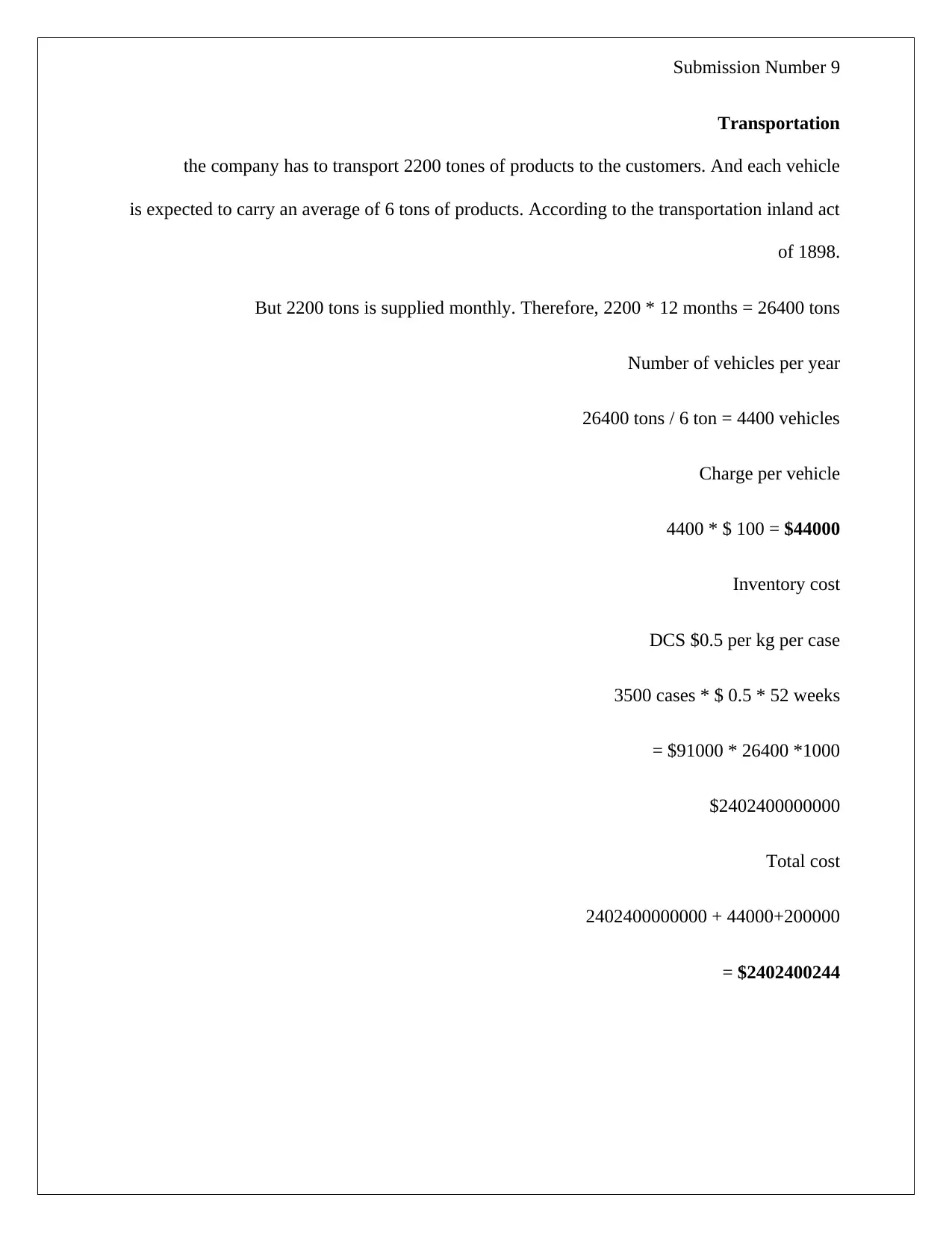
The fast goods companies pay $200000 to cover the supply to all factories monthly. The
price is fixed, and the amount given covers a quantity of 5 tones of each raw material to the
factories on the first day of each month. Therefore, 200000 * 12 moths per annum are equivalent
to $ 2400,000.
5raw mterial
supliers 3 factories 13 distribution
centers
home based
transporters
and DCs
440 customers
provided by the researchers (Kannan, Haq, & Sasikumar, 2008). It is expected that the three
factories should produce five tons multiplied by four hundred and forty customers, which is
equivalent to 2200 tones every week. The products are therefore moved from factories and
transported to thirteen distribution centers where goods are now moved to the customers using
home-based means of transport. Carrying vessels are expected to ferry six tons per trip and hence
charged an overall amount of money in which profit is determined. The following structure
shows the entire system of operation.
Supply
The fast goods companies pay $200000 to cover the supply to all factories monthly. The
price is fixed, and the amount given covers a quantity of 5 tones of each raw material to the
factories on the first day of each month. Therefore, 200000 * 12 moths per annum are equivalent
to $ 2400,000.
5raw mterial
supliers 3 factories 13 distribution
centers
home based
transporters
and DCs
440 customers
Submission Number 9
Transportation
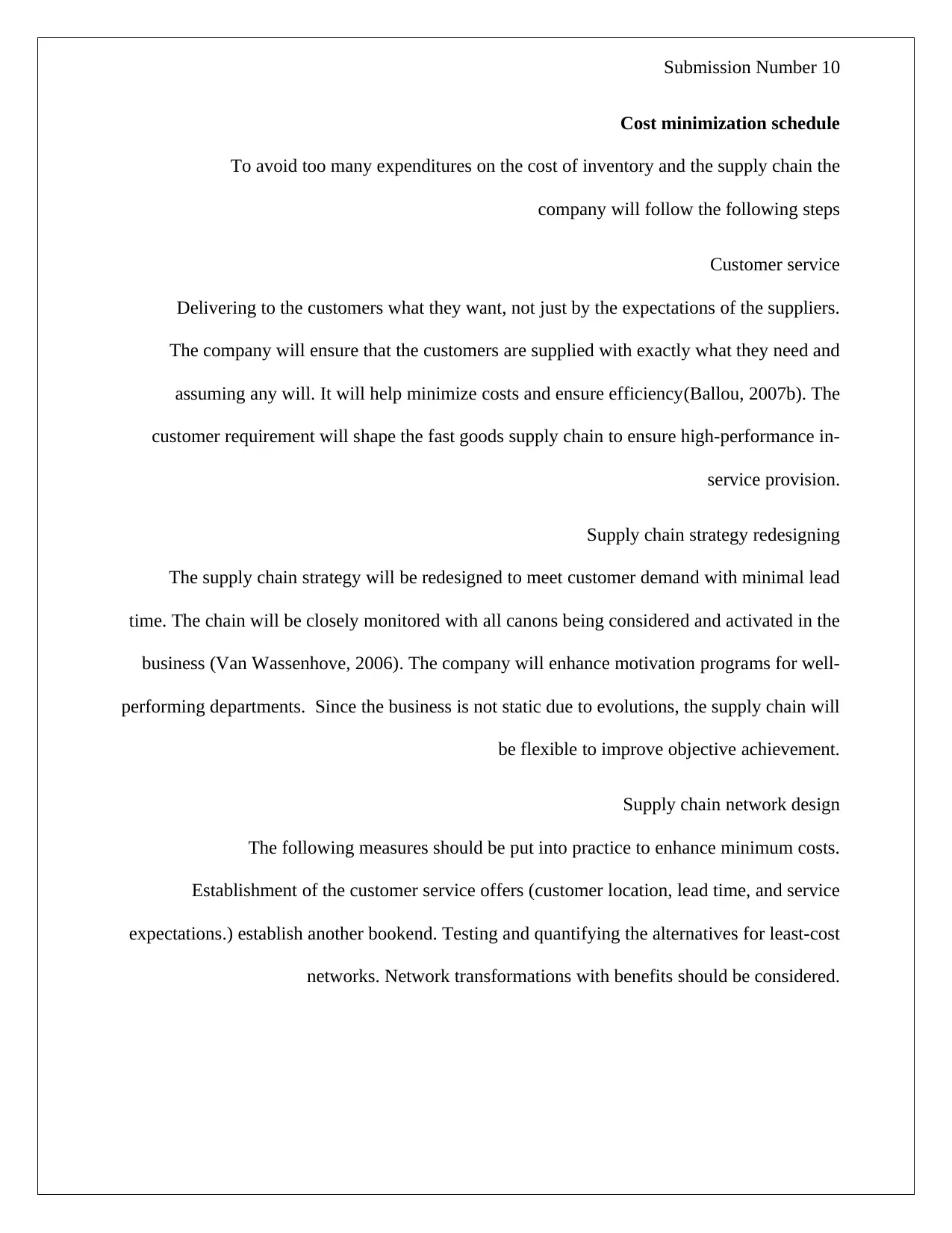
the company has to transport 2200 tones of products to the customers. And each vehicle
is expected to carry an average of 6 tons of products. According to the transportation inland act
of 1898.
But 2200 tons is supplied monthly. Therefore, 2200 * 12 months = 26400 tons
Number of vehicles per year
26400 tons / 6 ton = 4400 vehicles
Charge per vehicle
4400 * $ 100 = $44000
Inventory cost
DCS $0.5 per kg per case
3500 cases * $ 0.5 * 52 weeks
= $91000 * 26400 *1000
$2402400000000
Total cost
2402400000000 + 44000+200000
= $2402400244
Transportation
the company has to transport 2200 tones of products to the customers. And each vehicle
is expected to carry an average of 6 tons of products. According to the transportation inland act
of 1898.
But 2200 tons is supplied monthly. Therefore, 2200 * 12 months = 26400 tons
Number of vehicles per year
26400 tons / 6 ton = 4400 vehicles
Charge per vehicle
4400 * $ 100 = $44000
Inventory cost
DCS $0.5 per kg per case
3500 cases * $ 0.5 * 52 weeks
= $91000 * 26400 *1000
$2402400000000
Total cost
2402400000000 + 44000+200000
= $2402400244
⊘ This is a preview!⊘
Do you want full access?
Subscribe today to unlock all pages.
Trusted by 1+ million students worldwide
Submission Number 10
Cost minimization schedule
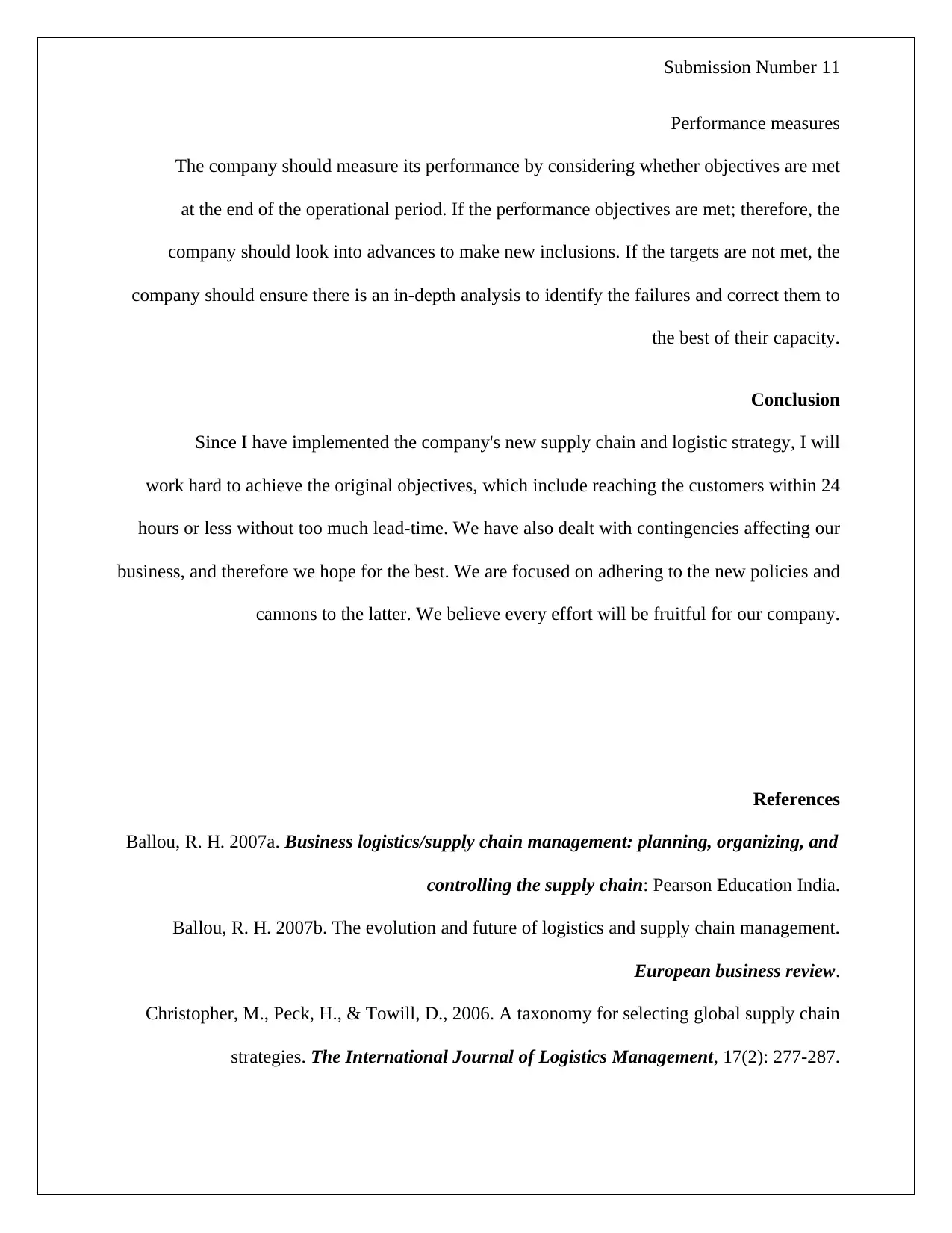
To avoid too many expenditures on the cost of inventory and the supply chain the
company will follow the following steps
Customer service
Delivering to the customers what they want, not just by the expectations of the suppliers.
The company will ensure that the customers are supplied with exactly what they need and
assuming any will. It will help minimize costs and ensure efficiency(Ballou, 2007b). The
customer requirement will shape the fast goods supply chain to ensure high-performance in-
service provision.
Supply chain strategy redesigning
The supply chain strategy will be redesigned to meet customer demand with minimal lead
time. The chain will be closely monitored with all canons being considered and activated in the
business (Van Wassenhove, 2006). The company will enhance motivation programs for well-
performing departments. Since the business is not static due to evolutions, the supply chain will
be flexible to improve objective achievement.
Supply chain network design
The following measures should be put into practice to enhance minimum costs.
Establishment of the customer service offers (customer location, lead time, and service
expectations.) establish another bookend. Testing and quantifying the alternatives for least-cost
networks. Network transformations with benefits should be considered.
Cost minimization schedule
To avoid too many expenditures on the cost of inventory and the supply chain the
company will follow the following steps
Customer service
Delivering to the customers what they want, not just by the expectations of the suppliers.
The company will ensure that the customers are supplied with exactly what they need and
assuming any will. It will help minimize costs and ensure efficiency(Ballou, 2007b). The
customer requirement will shape the fast goods supply chain to ensure high-performance in-
service provision.
Supply chain strategy redesigning
The supply chain strategy will be redesigned to meet customer demand with minimal lead
time. The chain will be closely monitored with all canons being considered and activated in the
business (Van Wassenhove, 2006). The company will enhance motivation programs for well-
performing departments. Since the business is not static due to evolutions, the supply chain will
be flexible to improve objective achievement.
Supply chain network design
The following measures should be put into practice to enhance minimum costs.
Establishment of the customer service offers (customer location, lead time, and service
expectations.) establish another bookend. Testing and quantifying the alternatives for least-cost
networks. Network transformations with benefits should be considered.
Paraphrase This Document
Need a fresh take? Get an instant paraphrase of this document with our AI Paraphraser
Submission Number 11
Performance measures
The company should measure its performance by considering whether objectives are met
at the end of the operational period. If the performance objectives are met; therefore, the
company should look into advances to make new inclusions. If the targets are not met, the
company should ensure there is an in-depth analysis to identify the failures and correct them to
the best of their capacity.
Conclusion
Since I have implemented the company's new supply chain and logistic strategy, I will
work hard to achieve the original objectives, which include reaching the customers within 24
hours or less without too much lead-time. We have also dealt with contingencies affecting our
business, and therefore we hope for the best. We are focused on adhering to the new policies and
cannons to the latter. We believe every effort will be fruitful for our company.
References
Ballou, R. H. 2007a. Business logistics/supply chain management: planning, organizing, and
controlling the supply chain: Pearson Education India.
Ballou, R. H. 2007b. The evolution and future of logistics and supply chain management.
European business review.
Christopher, M., Peck, H., & Towill, D., 2006. A taxonomy for selecting global supply chain
strategies. The International Journal of Logistics Management, 17(2): 277-287.
Performance measures
The company should measure its performance by considering whether objectives are met
at the end of the operational period. If the performance objectives are met; therefore, the
company should look into advances to make new inclusions. If the targets are not met, the
company should ensure there is an in-depth analysis to identify the failures and correct them to
the best of their capacity.
Conclusion
Since I have implemented the company's new supply chain and logistic strategy, I will
work hard to achieve the original objectives, which include reaching the customers within 24
hours or less without too much lead-time. We have also dealt with contingencies affecting our
business, and therefore we hope for the best. We are focused on adhering to the new policies and
cannons to the latter. We believe every effort will be fruitful for our company.
References
Ballou, R. H. 2007a. Business logistics/supply chain management: planning, organizing, and
controlling the supply chain: Pearson Education India.
Ballou, R. H. 2007b. The evolution and future of logistics and supply chain management.
European business review.
Christopher, M., Peck, H., & Towill, D., 2006. A taxonomy for selecting global supply chain
strategies. The International Journal of Logistics Management, 17(2): 277-287.
Submission Number 12
Cooper, M. C., & Ellram, L. M., 1993. Characteristics of supply chain management and the
implications for purchasing and logistics strategy. The international journal of logistics
management.
Fisher, M. L., 2003. What is the right supply chain for your product? Operations management:
critical perspectives on business and management, 4: 73.
Frohlich, M. T., & Westbrook, R., 2001. Arcs of integration: an international study of supply
chain strategies. Journal of operations management, 19(2): 185-200.
Huemer, L., 2012. Unchained from the chain: Supply management from a logistics service
provider perspective. Journal of Business Research, 65(2): 258-264.
Kannan, G., Haq, A. N., & Sasikumar, P. 2008. An application of the analytical hierarchy
process and fuzzy systematic hierarchy process in the selection of collecting center
location for the reverse logistics multicriteria decision-making supply chain model.
International Journal of Management and Decision Making, 9(4): 350-365.
Marshall, L. F., & Fisher, L., 1997. What is the right supply chain for your product? Harvard
Business Review, 75(2): 83-93.
Myerson, P., 2012. Lean supply chain and logistics management: McGraw-Hill New York,
NY.
Stank, T., Autry, C., Daugherty, P., & Closs, D. 2015. Reimagining the ten megatrends that will
revolutionize supply chain logistics. Transportation Journal, 54(1): 7-32.
Tan, K. C., 2001. A framework of supply chain management literature. European Journal of
Purchasing & Supply Management, 7(1): 39-48.
Towill, D. R., & Christopher, M., 2003. A taxonomy for selecting global supply chain strategies.
Cooper, M. C., & Ellram, L. M., 1993. Characteristics of supply chain management and the
implications for purchasing and logistics strategy. The international journal of logistics
management.
Fisher, M. L., 2003. What is the right supply chain for your product? Operations management:
critical perspectives on business and management, 4: 73.
Frohlich, M. T., & Westbrook, R., 2001. Arcs of integration: an international study of supply
chain strategies. Journal of operations management, 19(2): 185-200.
Huemer, L., 2012. Unchained from the chain: Supply management from a logistics service
provider perspective. Journal of Business Research, 65(2): 258-264.
Kannan, G., Haq, A. N., & Sasikumar, P. 2008. An application of the analytical hierarchy
process and fuzzy systematic hierarchy process in the selection of collecting center
location for the reverse logistics multicriteria decision-making supply chain model.
International Journal of Management and Decision Making, 9(4): 350-365.
Marshall, L. F., & Fisher, L., 1997. What is the right supply chain for your product? Harvard
Business Review, 75(2): 83-93.
Myerson, P., 2012. Lean supply chain and logistics management: McGraw-Hill New York,
NY.
Stank, T., Autry, C., Daugherty, P., & Closs, D. 2015. Reimagining the ten megatrends that will
revolutionize supply chain logistics. Transportation Journal, 54(1): 7-32.
Tan, K. C., 2001. A framework of supply chain management literature. European Journal of
Purchasing & Supply Management, 7(1): 39-48.
Towill, D. R., & Christopher, M., 2003. A taxonomy for selecting global supply chain strategies.
⊘ This is a preview!⊘
Do you want full access?
Subscribe today to unlock all pages.
Trusted by 1+ million students worldwide

1 out of 13


Related Documents


Your All-in-One AI-Powered Toolkit for Academic Success.
+13062052269
info@desklib.com
Available 24*7 on WhatsApp / Email
![[object Object]](/_next/static/media/star-bottom.7253800d.svg)
Unlock your academic potential
Copyright © 2020–2026 A2Z Services. All Rights Reserved. Developed and managed by ZUCOL.