Economics Assignment 1: Analysis of London Congestion Charge Impacts

Verified

Added on  2021/04/16

|4
|658
|24
Homework Assignment
AI Summary
This economics assignment analyzes the London congestion charge implemented in 2003, focusing on its impact on different income groups. The assignment discusses the charge of 11.50 pounds per day for non-exempt vehicles and the potential penalty for non-payment. It examines whether the charge significantly affects wealthier individuals compared to those with lower incomes, considering factors like average income levels and the affordability of electric vehicles. Furthermore, the assignment explores the need for exemptions for low-paid workers and market laborers who rely on their vehicles for daily commuting, and it considers the implications on public transport availability. The assignment references several academic sources to support its analysis.
Document Page
Running head: ECONOMICS ASSIGNMENT
ECONOMICS ASSIGNMENT
Name of the Student
Name of the University
Author’s Note
tabler-icon-diamond-filled.svg

Paraphrase This Document

Need a fresh take? Get an instant paraphrase of this document with our AI Paraphraser
Document Page
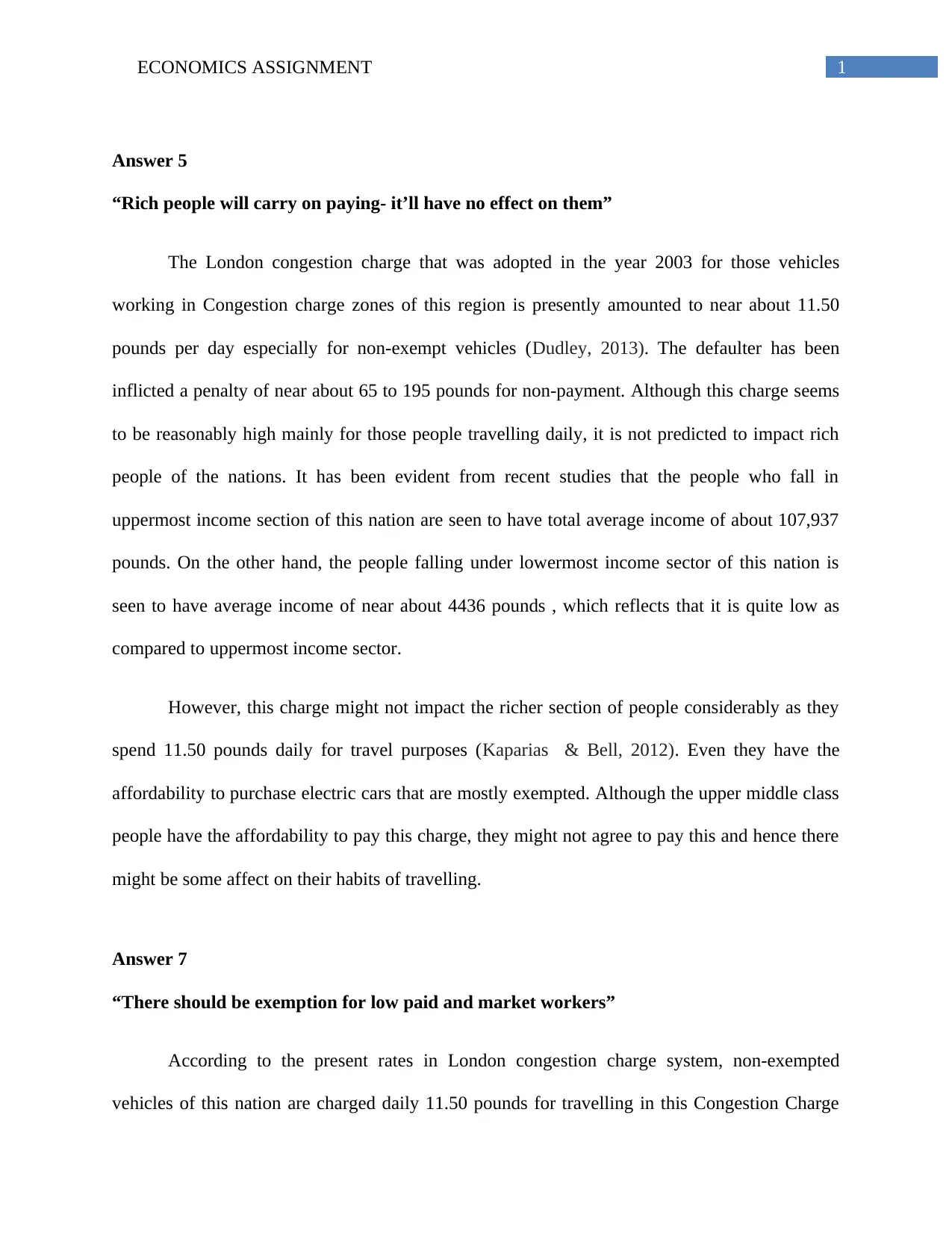
1ECONOMICS ASSIGNMENT
Answer 5
“Rich people will carry on paying- it’ll have no effect on them”
The London congestion charge that was adopted in the year 2003 for those vehicles
working in Congestion charge zones of this region is presently amounted to near about 11.50
pounds per day especially for non-exempt vehicles (Dudley, 2013). The defaulter has been
inflicted a penalty of near about 65 to 195 pounds for non-payment. Although this charge seems
to be reasonably high mainly for those people travelling daily, it is not predicted to impact rich
people of the nations. It has been evident from recent studies that the people who fall in
uppermost income section of this nation are seen to have total average income of about 107,937
pounds. On the other hand, the people falling under lowermost income sector of this nation is
seen to have average income of near about 4436 pounds , which reflects that it is quite low as
compared to uppermost income sector.
However, this charge might not impact the richer section of people considerably as they
spend 11.50 pounds daily for travel purposes (Kaparias & Bell, 2012). Even they have the
affordability to purchase electric cars that are mostly exempted. Although the upper middle class
people have the affordability to pay this charge, they might not agree to pay this and hence there
might be some affect on their habits of travelling.
Answer 7
“There should be exemption for low paid and market workers”
According to the present rates in London congestion charge system, non-exempted
vehicles of this nation are charged daily 11.50 pounds for travelling in this Congestion Charge
Document Page
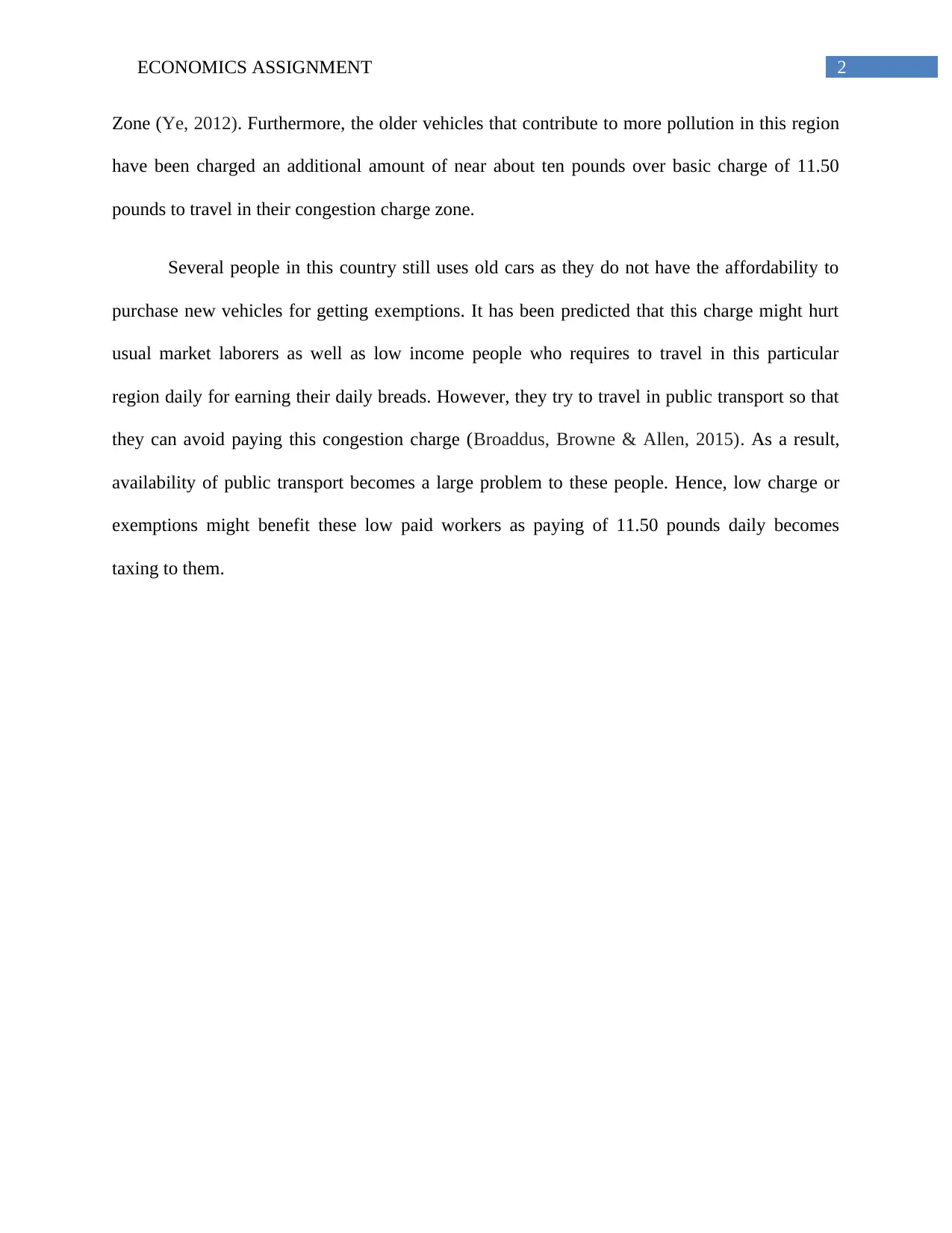
2ECONOMICS ASSIGNMENT
Zone (Ye, 2012). Furthermore, the older vehicles that contribute to more pollution in this region
have been charged an additional amount of near about ten pounds over basic charge of 11.50
pounds to travel in their congestion charge zone.
Several people in this country still uses old cars as they do not have the affordability to
purchase new vehicles for getting exemptions. It has been predicted that this charge might hurt
usual market laborers as well as low income people who requires to travel in this particular
region daily for earning their daily breads. However, they try to travel in public transport so that
they can avoid paying this congestion charge (Broaddus, Browne & Allen, 2015). As a result,
availability of public transport becomes a large problem to these people. Hence, low charge or
exemptions might benefit these low paid workers as paying of 11.50 pounds daily becomes
taxing to them.
Document Page
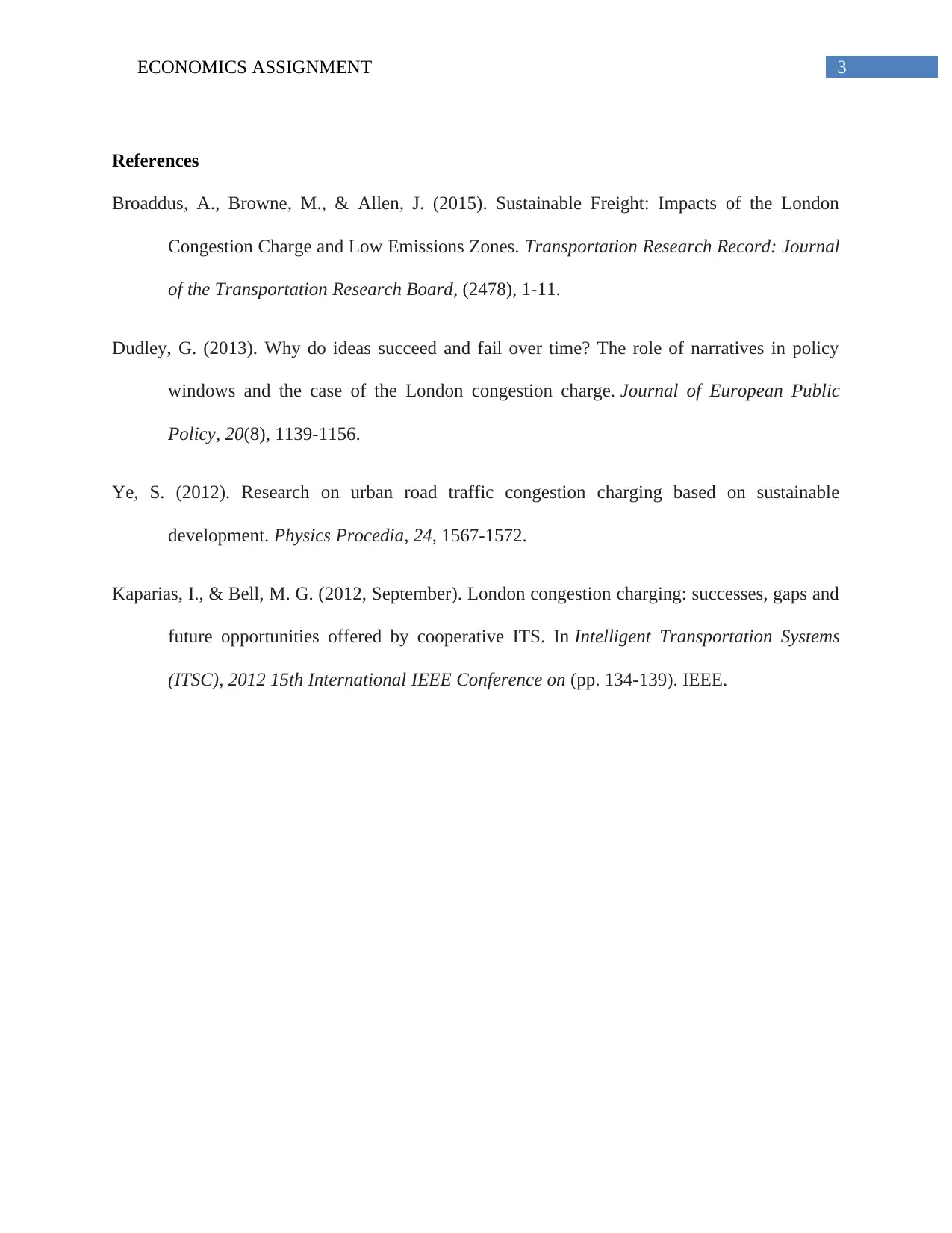
3ECONOMICS ASSIGNMENT
References
Broaddus, A., Browne, M., & Allen, J. (2015). Sustainable Freight: Impacts of the London
Congestion Charge and Low Emissions Zones. Transportation Research Record: Journal
of the Transportation Research Board, (2478), 1-11.
Dudley, G. (2013). Why do ideas succeed and fail over time? The role of narratives in policy
windows and the case of the London congestion charge. Journal of European Public
Policy, 20(8), 1139-1156.
Ye, S. (2012). Research on urban road traffic congestion charging based on sustainable
development. Physics Procedia, 24, 1567-1572.
Kaparias, I., & Bell, M. G. (2012, September). London congestion charging: successes, gaps and
future opportunities offered by cooperative ITS. In Intelligent Transportation Systems
(ITSC), 2012 15th International IEEE Conference on (pp. 134-139). IEEE.
chevron_up_icon
1 out of 4
circle_padding
hide_on_mobile
zoom_out_icon
[object Object]