Low Impact Manufacturing Assignment B: The Circular Economy Report
VerifiedAdded on 2023/01/03
|21
|5360
|44
Report
AI Summary
This report, submitted by Salehabanu Jafarhussain Shaikh, examines the application of the circular economy concept to the manufacture of electric motorcycles. It analyzes the current linear economic model and proposes a shift towards a circular system that minimizes waste and maximizes the reuse and recycling of materials. The report details the various components of an electric motorcycle—structural, electrical, and miscellaneous—and suggests strategies for incorporating circular economy principles at each stage. These strategies include redesigning motorcycles for disassembly, reusing components, remanufacturing parts, component refurbishment, and recycling materials. The report also outlines a vision for a future industrial system that prioritizes sustainability and discusses short-term and long-term standards and policies needed to facilitate the transition. Furthermore, the report considers the life cycle stages of electric motorcycles, including sources, manufacturing processes, environmental impacts, and sustainability measures, ultimately advocating for a more environmentally responsible approach to electric motorcycle production.
Name: Salehabanu Jafarhussain Shaikh
Student No: P17512046
Course Code: ENGT5220
Module Name: Low Impact Manufacturing
Assignment-B: The Circular Economy
Date: 15/05/2019
Student No: P17512046
Course Code: ENGT5220
Module Name: Low Impact Manufacturing
Assignment-B: The Circular Economy
Date: 15/05/2019

Paraphrase This Document
Need a fresh take? Get an instant paraphrase of this document with our AI Paraphraser
The Circular Economy 1
EXECUTIVE SUMMARY
The circular economy concept is an economic system aimed at reducing wastes released during
the manufacture of electric motorcycles and making good use of the miscellaneous structural,
and electrical components used in electric motorcycle manufacturing. This paper evaluates the
application and description of the circular economy concept, description of the future system and
life cycle phases, description of short-term and short-term standards and policies that should be
implemented to make the material flow circular. The components used in the manufacture of
electric motorcycle can be categorized into electrical, structural, and miscellaneous. The
proposed concept of circular economy that can be incorporated in the manufacture of the electric
motorcycle include redesigning motorcycle, component recycling, components remanufacturing,
refurbishment, and reuse of parts.
EXECUTIVE SUMMARY
The circular economy concept is an economic system aimed at reducing wastes released during
the manufacture of electric motorcycles and making good use of the miscellaneous structural,
and electrical components used in electric motorcycle manufacturing. This paper evaluates the
application and description of the circular economy concept, description of the future system and
life cycle phases, description of short-term and short-term standards and policies that should be
implemented to make the material flow circular. The components used in the manufacture of
electric motorcycle can be categorized into electrical, structural, and miscellaneous. The
proposed concept of circular economy that can be incorporated in the manufacture of the electric
motorcycle include redesigning motorcycle, component recycling, components remanufacturing,
refurbishment, and reuse of parts.
The Circular Economy 2
Table of Contents
EXECUTIVE SUMMARY.................................................................................................................................2
INTRODUCTION...........................................................................................................................................3
Structural Components............................................................................................................................4
Electrical Components.............................................................................................................................4
Miscellaneous Components....................................................................................................................5
CIRCULAR ECONOMY CONCEPT...................................................................................................................6
Electric Motorcycle Design......................................................................................................................6
Reuse of Components.............................................................................................................................7
Components Remanufacturing................................................................................................................8
Component Refurbishment.....................................................................................................................8
Components Recycling............................................................................................................................9
FUTURE INDUSTRIAL SYSTEM......................................................................................................................9
Electric Motorcycle Design......................................................................................................................9
Functionality Economy..........................................................................................................................10
Reuse, Recycling, and Remanufacturing Policies...................................................................................10
LIFE CYCLE STAGES....................................................................................................................................11
Sources and Composition......................................................................................................................10
Manufacturing process..........................................................................................................................11
Environmental Impacts..........................................................................................................................12
Electric Motorcycle Sustainability..........................................................................................................12
LONG-TERM AND SHORT-TERM STANDARDS, POLICIES, AND STEPS........................................................13
CONCLUSION.............................................................................................................................................16
BIBLIOGRAPHY...........................................................................................................................................17
APPENDICES…………………………………………………………………………………………………………………………………………..19
Table of Contents
EXECUTIVE SUMMARY.................................................................................................................................2
INTRODUCTION...........................................................................................................................................3
Structural Components............................................................................................................................4
Electrical Components.............................................................................................................................4
Miscellaneous Components....................................................................................................................5
CIRCULAR ECONOMY CONCEPT...................................................................................................................6
Electric Motorcycle Design......................................................................................................................6
Reuse of Components.............................................................................................................................7
Components Remanufacturing................................................................................................................8
Component Refurbishment.....................................................................................................................8
Components Recycling............................................................................................................................9
FUTURE INDUSTRIAL SYSTEM......................................................................................................................9
Electric Motorcycle Design......................................................................................................................9
Functionality Economy..........................................................................................................................10
Reuse, Recycling, and Remanufacturing Policies...................................................................................10
LIFE CYCLE STAGES....................................................................................................................................11
Sources and Composition......................................................................................................................10
Manufacturing process..........................................................................................................................11
Environmental Impacts..........................................................................................................................12
Electric Motorcycle Sustainability..........................................................................................................12
LONG-TERM AND SHORT-TERM STANDARDS, POLICIES, AND STEPS........................................................13
CONCLUSION.............................................................................................................................................16
BIBLIOGRAPHY...........................................................................................................................................17
APPENDICES…………………………………………………………………………………………………………………………………………..19
⊘ This is a preview!⊘
Do you want full access?
Subscribe today to unlock all pages.

Trusted by 1+ million students worldwide
The Circular Economy 3
INTRODUCTION:
This research investigates the application of the concept of Circular Economy in the manufacture
of electric motorcycles to replace the current linear energy and material flows with no reuse and
recycling. The major components used in the manufacture of electric motorcycles include
electrical components, namely wheels, suspension, chassis, and seat assembly miscellaneous
components such as upholstery, tyres, bodywork, and transmission, and also structural
components, namely batteries, motors, circuit boards, switches, and wires. These components are
either delivered to the company by other manufacturers and then assembled when manufacturing
electric motorcycle or manufactured internally by the company (Lothar, 2013).
As a sustainability manager, there is a need to investigate the implementation of Circular
Economy concept which entails environmentally sustainability strategy involving the
development of economic models such that there is no production of serious effects to the
environment. This research seeks to evaluate the application and description of the circular
economy concept, description of the future system and life cycle phases, description of short-
term and short-term standards and policies that should be implemented to make the material flow
circular (Lothar, 2013).
Structural Components:
The structural parts used during the manufacture of electric motorcycles include wheels, seat
assembly, suspension, and chassis. There are two different categories of suspension system used
in motorcycles, the rear suspension and front suspension and the system entails the collection of
springs and shock absorbers. The suspension system is used in insulation of both the operator
and the motorcycle and provides control of the rider. The chassis is essentially the framework or
INTRODUCTION:
This research investigates the application of the concept of Circular Economy in the manufacture
of electric motorcycles to replace the current linear energy and material flows with no reuse and
recycling. The major components used in the manufacture of electric motorcycles include
electrical components, namely wheels, suspension, chassis, and seat assembly miscellaneous
components such as upholstery, tyres, bodywork, and transmission, and also structural
components, namely batteries, motors, circuit boards, switches, and wires. These components are
either delivered to the company by other manufacturers and then assembled when manufacturing
electric motorcycle or manufactured internally by the company (Lothar, 2013).
As a sustainability manager, there is a need to investigate the implementation of Circular
Economy concept which entails environmentally sustainability strategy involving the
development of economic models such that there is no production of serious effects to the
environment. This research seeks to evaluate the application and description of the circular
economy concept, description of the future system and life cycle phases, description of short-
term and short-term standards and policies that should be implemented to make the material flow
circular (Lothar, 2013).
Structural Components:
The structural parts used during the manufacture of electric motorcycles include wheels, seat
assembly, suspension, and chassis. There are two different categories of suspension system used
in motorcycles, the rear suspension and front suspension and the system entails the collection of
springs and shock absorbers. The suspension system is used in insulation of both the operator
and the motorcycle and provides control of the rider. The chassis is essentially the framework or
Paraphrase This Document
Need a fresh take? Get an instant paraphrase of this document with our AI Paraphraser
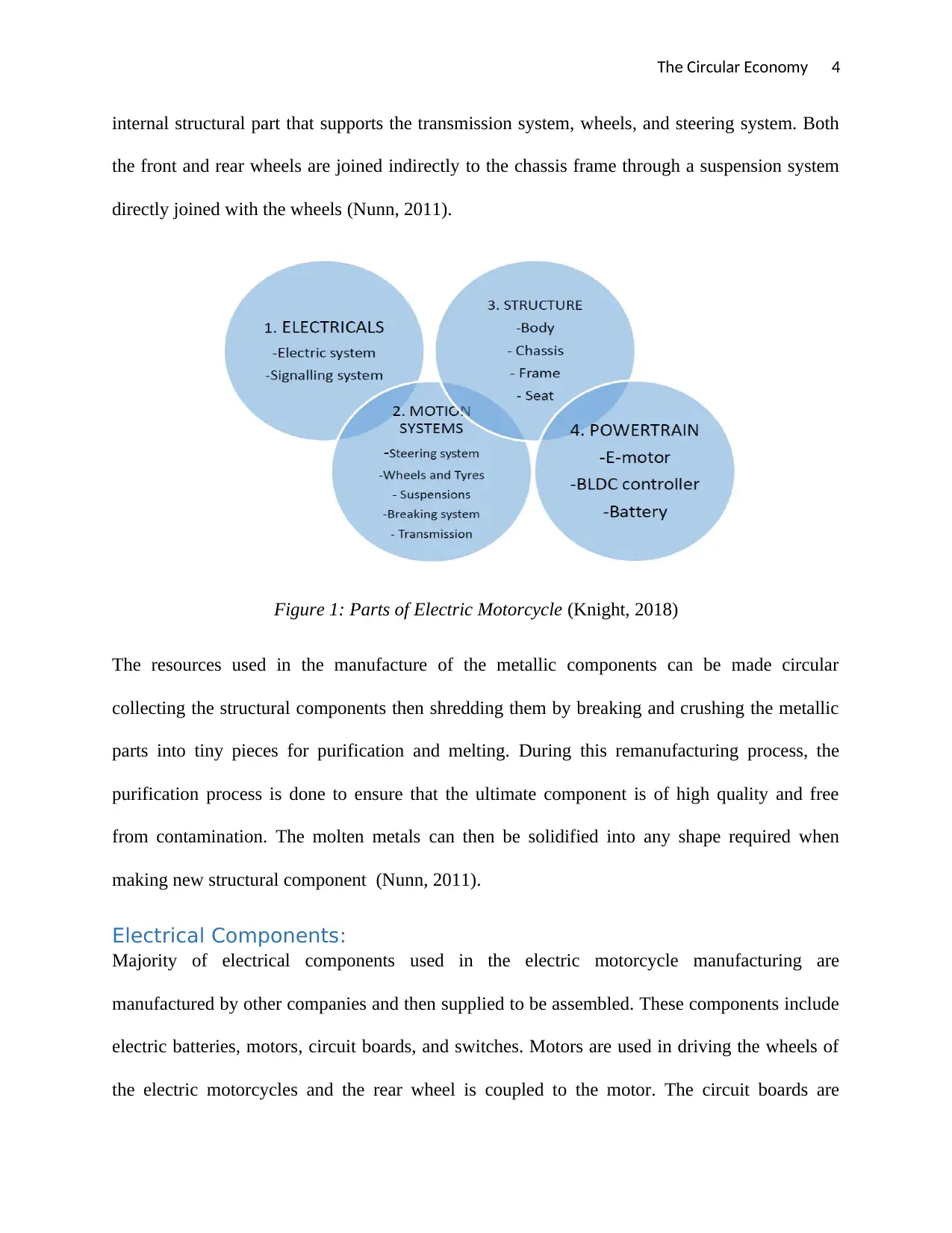
The Circular Economy 4
internal structural part that supports the transmission system, wheels, and steering system. Both
the front and rear wheels are joined indirectly to the chassis frame through a suspension system
directly joined with the wheels (Nunn, 2011).
Figure 1: Parts of Electric Motorcycle (Knight, 2018)
The resources used in the manufacture of the metallic components can be made circular
collecting the structural components then shredding them by breaking and crushing the metallic
parts into tiny pieces for purification and melting. During this remanufacturing process, the
purification process is done to ensure that the ultimate component is of high quality and free
from contamination. The molten metals can then be solidified into any shape required when
making new structural component (Nunn, 2011).
Electrical Components:
Majority of electrical components used in the electric motorcycle manufacturing are
manufactured by other companies and then supplied to be assembled. These components include
electric batteries, motors, circuit boards, and switches. Motors are used in driving the wheels of
the electric motorcycles and the rear wheel is coupled to the motor. The circuit boards are
internal structural part that supports the transmission system, wheels, and steering system. Both
the front and rear wheels are joined indirectly to the chassis frame through a suspension system
directly joined with the wheels (Nunn, 2011).
Figure 1: Parts of Electric Motorcycle (Knight, 2018)
The resources used in the manufacture of the metallic components can be made circular
collecting the structural components then shredding them by breaking and crushing the metallic
parts into tiny pieces for purification and melting. During this remanufacturing process, the
purification process is done to ensure that the ultimate component is of high quality and free
from contamination. The molten metals can then be solidified into any shape required when
making new structural component (Nunn, 2011).
Electrical Components:
Majority of electrical components used in the electric motorcycle manufacturing are
manufactured by other companies and then supplied to be assembled. These components include
electric batteries, motors, circuit boards, and switches. Motors are used in driving the wheels of
the electric motorcycles and the rear wheel is coupled to the motor. The circuit boards are
The Circular Economy 5
electrical connections that are used in the connection of electrical parts to permit the transmission
of electrical signals and current. The circuit boards are intended by other companies and then
delivered to the company for assembly purposes. The batteries used in powering the electric
motorcycles are the lead-acid batteries which are supplied from another company (Daemi &
Ebrahimi, 2012).
The flow of resources used in manufacturing electrical components can be made circular by first
collecting the dumped motorcycle or damaged components, and the disassembling the electrical
component safely by starting with the delicate components such as lead acid batteries to avoid
spillage of the acid. The electrical components can then be reused in other motorcycle if they are
still in working condition or returned to the company that supplied them for their recycling. The
energy flow of batteries can be made circular through recycling of the lead acid batteries after
they have been disassembled from the old motorcycles by first grinding the batteries,
neutralizing the acids, and then polymer separation from the lead. The materials recovered can be
reused in making new batteries (Daemi & Ebrahimi, 2012).
Miscellaneous Components:
The upholstery and transmission systems are delivered to the company by manufacturers as well
as tyres. The upholstery is used in covering the tires and seats for the purposes of beautification
and also last longer. It implies that the recycling of these parts is completely up to their
manufacturing companies but their reuse can be done by the company by removing them from
old or damaged motorcycles are then reusing them as spare parts or in the manufacture of
second-hand motorcycles (Ma’arof, et al., 2015).
electrical connections that are used in the connection of electrical parts to permit the transmission
of electrical signals and current. The circuit boards are intended by other companies and then
delivered to the company for assembly purposes. The batteries used in powering the electric
motorcycles are the lead-acid batteries which are supplied from another company (Daemi &
Ebrahimi, 2012).
The flow of resources used in manufacturing electrical components can be made circular by first
collecting the dumped motorcycle or damaged components, and the disassembling the electrical
component safely by starting with the delicate components such as lead acid batteries to avoid
spillage of the acid. The electrical components can then be reused in other motorcycle if they are
still in working condition or returned to the company that supplied them for their recycling. The
energy flow of batteries can be made circular through recycling of the lead acid batteries after
they have been disassembled from the old motorcycles by first grinding the batteries,
neutralizing the acids, and then polymer separation from the lead. The materials recovered can be
reused in making new batteries (Daemi & Ebrahimi, 2012).
Miscellaneous Components:
The upholstery and transmission systems are delivered to the company by manufacturers as well
as tyres. The upholstery is used in covering the tires and seats for the purposes of beautification
and also last longer. It implies that the recycling of these parts is completely up to their
manufacturing companies but their reuse can be done by the company by removing them from
old or damaged motorcycles are then reusing them as spare parts or in the manufacture of
second-hand motorcycles (Ma’arof, et al., 2015).
⊘ This is a preview!⊘
Do you want full access?
Subscribe today to unlock all pages.
Trusted by 1+ million students worldwide
The Circular Economy 6
CIRCULAR ECONOMY CONCEPT:
The circular economy concept is an economic system aimed at reducing wastes released during
the manufacture of electric motorcycles and making good use of the miscellaneous structural,
and electrical components used in electric motorcycle manufacturing. This concept is an
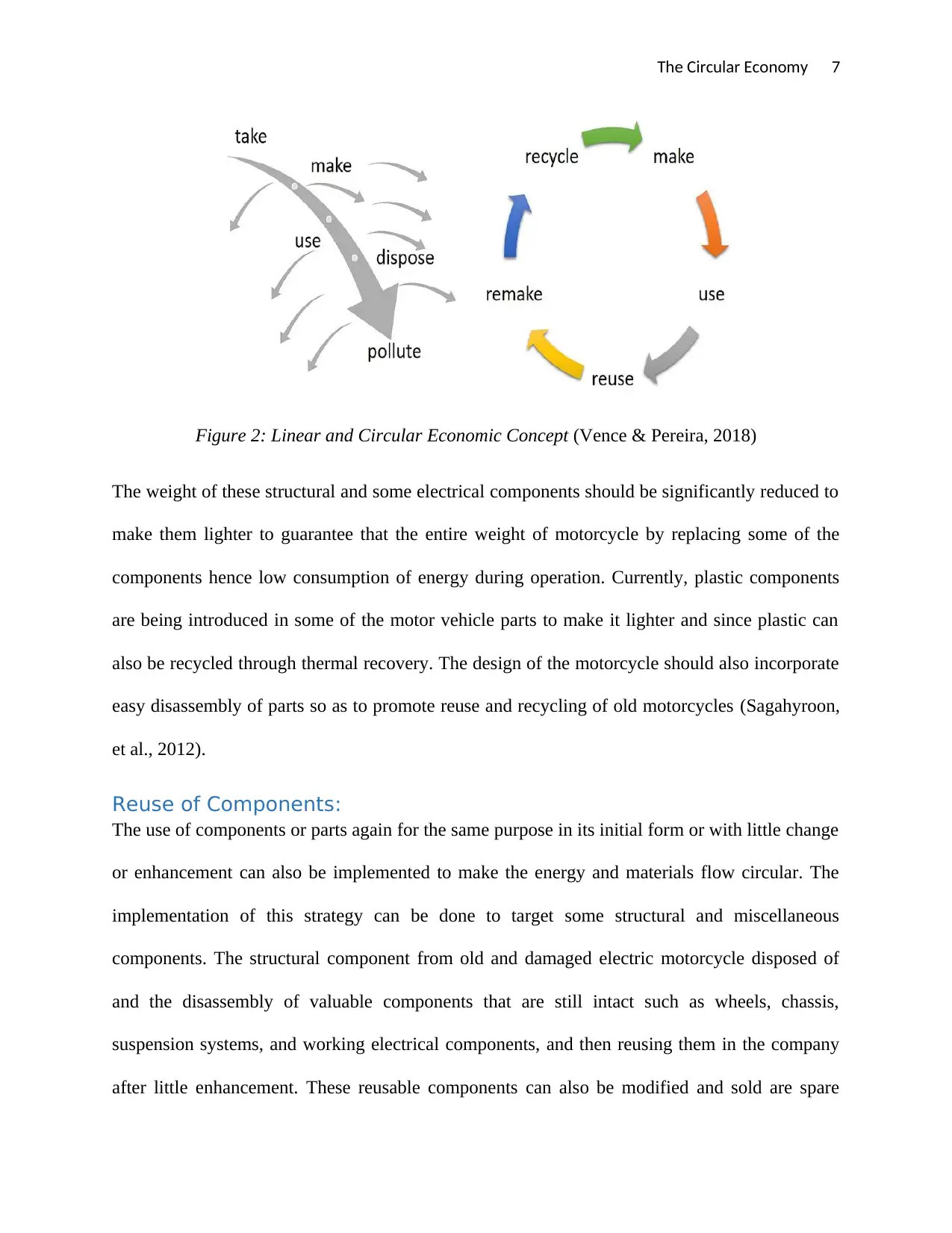
alternative to the conventional linear economy that is currently being used in the manufacture of
the electric motorcycle which involves, manufacture, reuse, and disposal (Deborah, 2015). This
concept will involve minimization of energy leakage, emission, waste, and resource input by
narrowing, closing, and slowing energy and material loop. It could be achieved via enduring
design, servicing, fix, replant, refurbish, restoration, and recycling (Ostojic, 2016).
The circular economy is more sustainable compared to the current linear economic system.
Companies are currently moving away from the current linear in which raw materials are
synthesized, components used in the manufacture of electric motorcycle, used by consumers,
discarded eventually by the consumers (Sariatli, 2017).
Electric Motorcycle Design:
The first step of that should be considered to ensure that the current system of linear economy is
replaced by the circular economy concept is redesigning new motorcycles. Wastes will be
reduced significantly when structural, miscellaneous, and electrical components are designed by
intention to fit within a refurbishment, designed for disassembly, and material cycle. The
components of the motorcycle, such as chassis, suspension, bodywork, and seat assembly, should
be designed to be used again with the highest retention and minimal energy. The metallic
structural components should be manufactured by the use of steel since this material is cheaper
and readily available with a longer lifespan (Daemi & Ebrahimi, 2012).
CIRCULAR ECONOMY CONCEPT:
The circular economy concept is an economic system aimed at reducing wastes released during
the manufacture of electric motorcycles and making good use of the miscellaneous structural,
and electrical components used in electric motorcycle manufacturing. This concept is an
alternative to the conventional linear economy that is currently being used in the manufacture of
the electric motorcycle which involves, manufacture, reuse, and disposal (Deborah, 2015). This
concept will involve minimization of energy leakage, emission, waste, and resource input by
narrowing, closing, and slowing energy and material loop. It could be achieved via enduring
design, servicing, fix, replant, refurbish, restoration, and recycling (Ostojic, 2016).
The circular economy is more sustainable compared to the current linear economic system.
Companies are currently moving away from the current linear in which raw materials are
synthesized, components used in the manufacture of electric motorcycle, used by consumers,
discarded eventually by the consumers (Sariatli, 2017).
Electric Motorcycle Design:
The first step of that should be considered to ensure that the current system of linear economy is
replaced by the circular economy concept is redesigning new motorcycles. Wastes will be
reduced significantly when structural, miscellaneous, and electrical components are designed by
intention to fit within a refurbishment, designed for disassembly, and material cycle. The
components of the motorcycle, such as chassis, suspension, bodywork, and seat assembly, should
be designed to be used again with the highest retention and minimal energy. The metallic
structural components should be manufactured by the use of steel since this material is cheaper
and readily available with a longer lifespan (Daemi & Ebrahimi, 2012).
Paraphrase This Document
Need a fresh take? Get an instant paraphrase of this document with our AI Paraphraser
The Circular Economy 7
Figure 2: Linear and Circular Economic Concept (Vence & Pereira, 2018)
The weight of these structural and some electrical components should be significantly reduced to
make them lighter to guarantee that the entire weight of motorcycle by replacing some of the
components hence low consumption of energy during operation. Currently, plastic components
are being introduced in some of the motor vehicle parts to make it lighter and since plastic can
also be recycled through thermal recovery. The design of the motorcycle should also incorporate
easy disassembly of parts so as to promote reuse and recycling of old motorcycles (Sagahyroon,
et al., 2012).
Reuse of Components:
The use of components or parts again for the same purpose in its initial form or with little change
or enhancement can also be implemented to make the energy and materials flow circular. The
implementation of this strategy can be done to target some structural and miscellaneous
components. The structural component from old and damaged electric motorcycle disposed of
and the disassembly of valuable components that are still intact such as wheels, chassis,
suspension systems, and working electrical components, and then reusing them in the company
after little enhancement. These reusable components can also be modified and sold are spare
Figure 2: Linear and Circular Economic Concept (Vence & Pereira, 2018)
The weight of these structural and some electrical components should be significantly reduced to
make them lighter to guarantee that the entire weight of motorcycle by replacing some of the
components hence low consumption of energy during operation. Currently, plastic components
are being introduced in some of the motor vehicle parts to make it lighter and since plastic can
also be recycled through thermal recovery. The design of the motorcycle should also incorporate
easy disassembly of parts so as to promote reuse and recycling of old motorcycles (Sagahyroon,
et al., 2012).
Reuse of Components:
The use of components or parts again for the same purpose in its initial form or with little change
or enhancement can also be implemented to make the energy and materials flow circular. The
implementation of this strategy can be done to target some structural and miscellaneous
components. The structural component from old and damaged electric motorcycle disposed of
and the disassembly of valuable components that are still intact such as wheels, chassis,
suspension systems, and working electrical components, and then reusing them in the company
after little enhancement. These reusable components can also be modified and sold are spare
The Circular Economy 8
parts sold to be used in replacing broken or damaged parts by the dealers. The completely
damaged parts can be retrieved from the dealers or setting up a collection point for operators to
dump old components (Basha, 2011).
Components Remanufacturing:
Remanufacturing is a technique of recovery or disassembly at the component subassembly level.
Reusable or functioning components are removed out of the old or disposed motorcycles and
then rebuilt into a new one. This process entails potential changes or enhancements and quality
assurance to the components. In case the structural components such as bodywork, metal parts of
the metal assembly, chassis, and seat assembly are seriously damaged beyond repair, they can be
taken back to the company from the collection point by first shredding, crushing into tiny pieces
then melting and purification. The melting process can be done using a large furnace and the
resulting molted used in designing new chassis or other metal components of the scooter (Wang
& Chen, 2013).
Component Refurbishment:
Refurbishment is the process of returning a component or parts of components to perfect
operating condition by repairing or replacing major parts which are near to failure or faulty and
getting small tweaks to update the product appearance through refinishing, painting, and
changing the fabric. The batteries, circuit boards, switches, suspension, and motors can be
repaired and then used in new motorcycles or as spare parts. The chassis and bodywork should
be painted to refurbish them before being sold as spare parts or used in the manufacture of new
motorcycles. The fabrics of the seat assembly can be replaced with new ones to make new seats
for new motorcycles and also wheels can be replaced with new tyres and used again (Wang &
Chan, 2013).
parts sold to be used in replacing broken or damaged parts by the dealers. The completely
damaged parts can be retrieved from the dealers or setting up a collection point for operators to
dump old components (Basha, 2011).
Components Remanufacturing:
Remanufacturing is a technique of recovery or disassembly at the component subassembly level.
Reusable or functioning components are removed out of the old or disposed motorcycles and
then rebuilt into a new one. This process entails potential changes or enhancements and quality
assurance to the components. In case the structural components such as bodywork, metal parts of
the metal assembly, chassis, and seat assembly are seriously damaged beyond repair, they can be
taken back to the company from the collection point by first shredding, crushing into tiny pieces
then melting and purification. The melting process can be done using a large furnace and the
resulting molted used in designing new chassis or other metal components of the scooter (Wang
& Chen, 2013).
Component Refurbishment:
Refurbishment is the process of returning a component or parts of components to perfect
operating condition by repairing or replacing major parts which are near to failure or faulty and
getting small tweaks to update the product appearance through refinishing, painting, and
changing the fabric. The batteries, circuit boards, switches, suspension, and motors can be
repaired and then used in new motorcycles or as spare parts. The chassis and bodywork should
be painted to refurbish them before being sold as spare parts or used in the manufacture of new
motorcycles. The fabrics of the seat assembly can be replaced with new ones to make new seats
for new motorcycles and also wheels can be replaced with new tyres and used again (Wang &
Chan, 2013).
⊘ This is a preview!⊘
Do you want full access?
Subscribe today to unlock all pages.
Trusted by 1+ million students worldwide
The Circular Economy 9
Components Recycling:
Recycling involves recovering the materials for other purposes or original purposes while
excluding the recovery of energy. Recycling of components can be done of those parts that are
still functional and in running condition. The components disposed or collected from damaged
motorcycles should first be disassembled and valuable parts removed, and parts to be used for
recycling. The electric batteries may be recycled over a national disposal union and also brake
fluid, transmission oil, and engine oil. Recycling of tyres can be done by first shredding and then
applied in road construction on roads linking the company (Domingo & Aguado, 2015).
FUTURE INDUSTRIAL SYSTEM:
This electric manufacturing company is presently considering the incorporation of the Circular
Economy by making the energy and material flows as circular as possible. This concept is
sustainable to the environment and involves the development of economic models with no
advanced environmental impact is realized. The future of this industrial system is expected to
implement the concept of the circular economy by embracing reuse of components, component
refurbishment, component remanufacturing, and material recycling (Sørensen, 2018).
Electric Motorcycle Design:
The future design electric motorcycle is expected to be different from the current design being
manufactured. The new motorcycle design will implement sustainability aspects such as
reducing the overall weight of the entire motorcycle so as to minimize energy consumption
during its operation. The company should consider replacing some of the steel component used
in making structural components with polypropylene which has lower weight and can also be
Components Recycling:
Recycling involves recovering the materials for other purposes or original purposes while
excluding the recovery of energy. Recycling of components can be done of those parts that are
still functional and in running condition. The components disposed or collected from damaged
motorcycles should first be disassembled and valuable parts removed, and parts to be used for
recycling. The electric batteries may be recycled over a national disposal union and also brake
fluid, transmission oil, and engine oil. Recycling of tyres can be done by first shredding and then
applied in road construction on roads linking the company (Domingo & Aguado, 2015).
FUTURE INDUSTRIAL SYSTEM:
This electric manufacturing company is presently considering the incorporation of the Circular
Economy by making the energy and material flows as circular as possible. This concept is
sustainable to the environment and involves the development of economic models with no
advanced environmental impact is realized. The future of this industrial system is expected to
implement the concept of the circular economy by embracing reuse of components, component
refurbishment, component remanufacturing, and material recycling (Sørensen, 2018).
Electric Motorcycle Design:
The future design electric motorcycle is expected to be different from the current design being
manufactured. The new motorcycle design will implement sustainability aspects such as
reducing the overall weight of the entire motorcycle so as to minimize energy consumption
during its operation. The company should consider replacing some of the steel component used
in making structural components with polypropylene which has lower weight and can also be
Paraphrase This Document
Need a fresh take? Get an instant paraphrase of this document with our AI Paraphraser
The Circular Economy 10
recycled. By replacing polypropylene with half of the metallic structural components, then the
entire weight of the motorcycle will significantly be reduced (Lundgren, et al., 2018).
Functionality Economy:
The functionality economy principle will also be implemented in the future industrial system and
this principle focuses on the removal of the product on sale or in operation through the
establishment of a rental property system. This aspect majorly focuses on returning seriously
damaged products by the motorcycles operators back to the company for the purposes of
remanufacturing, recycling, component refurbishment, and energy recovery. This principle will
promote circular system since there will be no energy leakage, waste emission, and no wastage
of resources (Velte, et al., 2018).
Reuse, Recycling, and Remanufacturing Policies:
The future industrial system is expected to incorporate reuse, recycling, and remanufacturing of
the damaged motorcycles from accidents, replaced components, and old parts of the motorcycles.
These processes will ensure that the circular economy concept is fully implemented to
incorporate services, equipment, infrastructure, and components (Xuan, et al., 2013). These
policies will also help in dematerializing, intensifying, slowing, narrowing, and closing loops to
reduce inputs into the emission and waste leakage out of the company system. This comprises a
more rigorous use stage (intensifying), use stage extension (slowing), efficiency improvements
(narrowing), and recycling measures (closing) (Quan & Wang, 2012).
LIFE CYCLE STAGES:
Sources and Composition:
The composition of the parts and components used during the manufacturing of electric
motorcycle include transmission system, tyres, seat assembly, bodywork, suspension, upholstery,
recycled. By replacing polypropylene with half of the metallic structural components, then the
entire weight of the motorcycle will significantly be reduced (Lundgren, et al., 2018).
Functionality Economy:
The functionality economy principle will also be implemented in the future industrial system and
this principle focuses on the removal of the product on sale or in operation through the
establishment of a rental property system. This aspect majorly focuses on returning seriously
damaged products by the motorcycles operators back to the company for the purposes of
remanufacturing, recycling, component refurbishment, and energy recovery. This principle will
promote circular system since there will be no energy leakage, waste emission, and no wastage
of resources (Velte, et al., 2018).
Reuse, Recycling, and Remanufacturing Policies:
The future industrial system is expected to incorporate reuse, recycling, and remanufacturing of
the damaged motorcycles from accidents, replaced components, and old parts of the motorcycles.
These processes will ensure that the circular economy concept is fully implemented to
incorporate services, equipment, infrastructure, and components (Xuan, et al., 2013). These
policies will also help in dematerializing, intensifying, slowing, narrowing, and closing loops to
reduce inputs into the emission and waste leakage out of the company system. This comprises a
more rigorous use stage (intensifying), use stage extension (slowing), efficiency improvements
(narrowing), and recycling measures (closing) (Quan & Wang, 2012).
LIFE CYCLE STAGES:
Sources and Composition:
The composition of the parts and components used during the manufacturing of electric
motorcycle include transmission system, tyres, seat assembly, bodywork, suspension, upholstery,
The Circular Economy 11
wheels, electric motors, chassis, switches, batteries, circuit boards, and electrical wires. The
major raw materials used during the manufacturing process of the electric motorcycle include
rubber, plastic, and metal. The tires are made from rubber, frame made from plastic, and other
parts are metal. The structural components are manufactured from metallic materials such as
steel, and the majority of electric components are supplied to the company. The seat is rendered
from polyurethane which is a synthetic substance. The transmission system is made up of a
sprocket, metal chains, pulleys, gears, and clutch consisting of metal plates and steel ball
flyweights (Ma’arof, et al., 2015).
Manufacturing process:
The processes followed when manufacturing electric motorcycle includes the manufacture of
components and parts of the motorcycle, importation of electrical components, production of
chassis, components assembly, fabrication of the entire vehicle, and final finishes through
painting. The process of manufacturing starts with welding using computer-controlled
fabrication of the frame from materials of high strength. The parts are formed out of hollow
metal sheet. The numerous sections are welded together. The process entails robotic equipment,
automatic, and manual equipment. Minute plastic resin pellets are injected after being melted
into moulds under high pressure to make numerous plastic body trim components. Painting of
the metal and plastic parts are a dome in booths in the paint department through powder-coating
(MARQUES, et al., 2017).
At the end of the production line, the inspectors of quality control perform a routine check of the
painted finish of motorcycle and fit of components. The inspectors of quality control also inspect
defects using gloved hands. Every finished motorcycle is tested using dynamometer. The
inspectors accelerate the speed of every motorcycle from 0mph to 60mph and during
wheels, electric motors, chassis, switches, batteries, circuit boards, and electrical wires. The
major raw materials used during the manufacturing process of the electric motorcycle include
rubber, plastic, and metal. The tires are made from rubber, frame made from plastic, and other
parts are metal. The structural components are manufactured from metallic materials such as
steel, and the majority of electric components are supplied to the company. The seat is rendered
from polyurethane which is a synthetic substance. The transmission system is made up of a
sprocket, metal chains, pulleys, gears, and clutch consisting of metal plates and steel ball
flyweights (Ma’arof, et al., 2015).
Manufacturing process:
The processes followed when manufacturing electric motorcycle includes the manufacture of
components and parts of the motorcycle, importation of electrical components, production of
chassis, components assembly, fabrication of the entire vehicle, and final finishes through
painting. The process of manufacturing starts with welding using computer-controlled
fabrication of the frame from materials of high strength. The parts are formed out of hollow
metal sheet. The numerous sections are welded together. The process entails robotic equipment,
automatic, and manual equipment. Minute plastic resin pellets are injected after being melted
into moulds under high pressure to make numerous plastic body trim components. Painting of
the metal and plastic parts are a dome in booths in the paint department through powder-coating
(MARQUES, et al., 2017).
At the end of the production line, the inspectors of quality control perform a routine check of the
painted finish of motorcycle and fit of components. The inspectors of quality control also inspect
defects using gloved hands. Every finished motorcycle is tested using dynamometer. The
inspectors accelerate the speed of every motorcycle from 0mph to 60mph and during
⊘ This is a preview!⊘
Do you want full access?
Subscribe today to unlock all pages.
Trusted by 1+ million students worldwide

1 out of 21


Related Documents


Your All-in-One AI-Powered Toolkit for Academic Success.
+13062052269
info@desklib.com
Available 24*7 on WhatsApp / Email
![[object Object]](/_next/static/media/star-bottom.7253800d.svg)
Unlock your academic potential
Copyright © 2020–2026 A2Z Services. All Rights Reserved. Developed and managed by ZUCOL.