The Effectiveness of Loyalty Cards on Business: A Comprehensive Study
VerifiedAdded on 2022/09/02
|36
|12295
|18
Project
AI Summary
This project investigates the effectiveness of loyalty card programs on business performance. It begins with an introduction to the topic, research questions, and hypotheses, followed by a literature review exploring the benefits and challenges of loyalty card programs. The methodology section outlines the research design, approach, and data analysis methods used, including descriptive analysis and regression models. The core of the project, Chapter 4, presents and analyzes the collected data from a survey of five organizations, discussing the impact of loyalty cards on revenue generation, consumer base, consumer retention, and data accessibility. The study finds significant associations between loyalty card usage and these key business factors. The project concludes with a summary of findings, conclusions, and recommendations, along with a bibliography and appendices.

Running head: MANAGEMENT
Management
Name of the Student
Name of the University
Author Note
Management
Name of the Student
Name of the University
Author Note

Paraphrase This Document
Need a fresh take? Get an instant paraphrase of this document with our AI Paraphraser
1MANAGEMENT
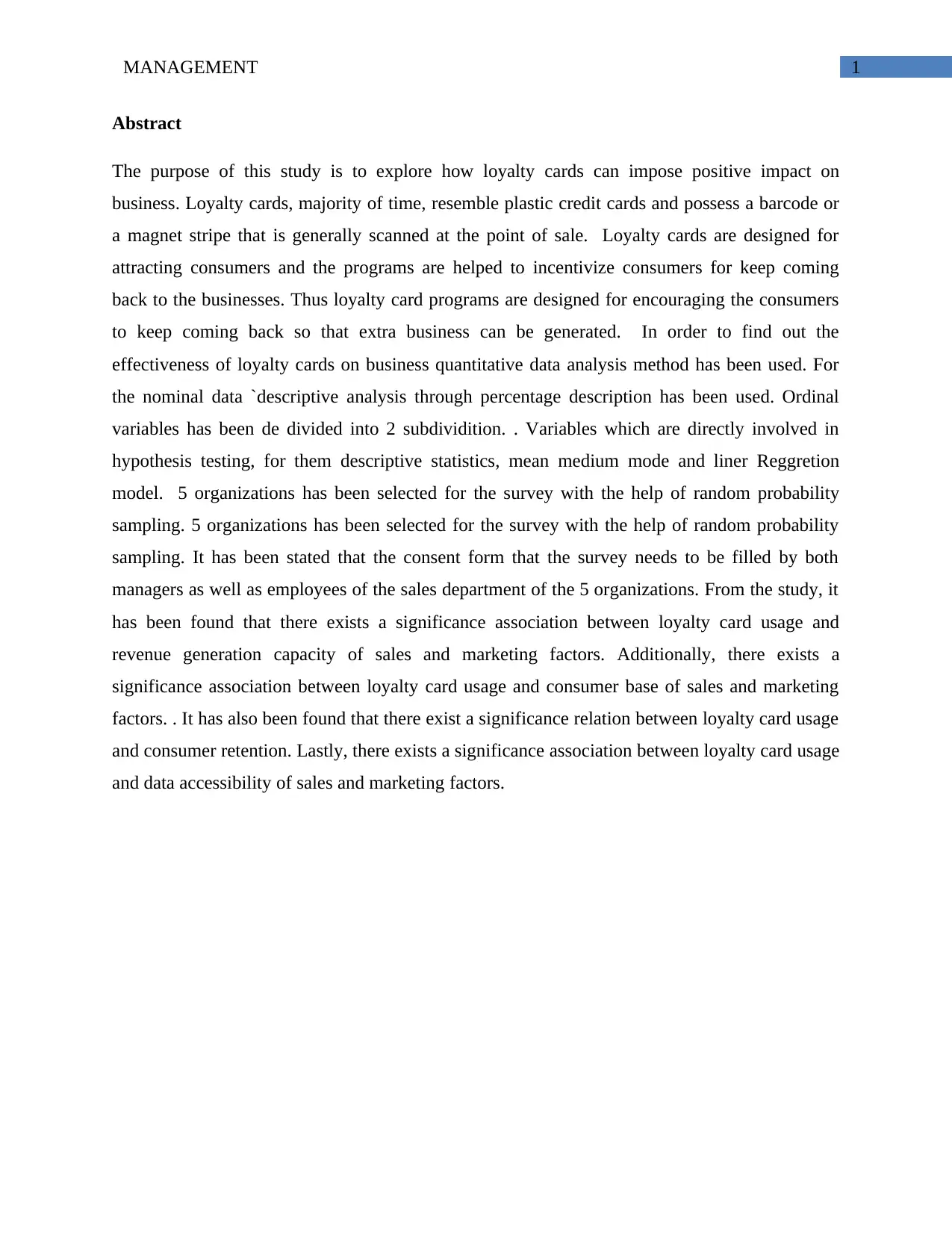
Abstract
The purpose of this study is to explore how loyalty cards can impose positive impact on
business. Loyalty cards, majority of time, resemble plastic credit cards and possess a barcode or
a magnet stripe that is generally scanned at the point of sale. Loyalty cards are designed for
attracting consumers and the programs are helped to incentivize consumers for keep coming
back to the businesses. Thus loyalty card programs are designed for encouraging the consumers
to keep coming back so that extra business can be generated. In order to find out the
effectiveness of loyalty cards on business quantitative data analysis method has been used. For
the nominal data `descriptive analysis through percentage description has been used. Ordinal
variables has been de divided into 2 subdividition. . Variables which are directly involved in
hypothesis testing, for them descriptive statistics, mean medium mode and liner Reggretion
model. 5 organizations has been selected for the survey with the help of random probability
sampling. 5 organizations has been selected for the survey with the help of random probability
sampling. It has been stated that the consent form that the survey needs to be filled by both
managers as well as employees of the sales department of the 5 organizations. From the study, it
has been found that there exists a significance association between loyalty card usage and
revenue generation capacity of sales and marketing factors. Additionally, there exists a
significance association between loyalty card usage and consumer base of sales and marketing
factors. . It has also been found that there exist a significance relation between loyalty card usage
and consumer retention. Lastly, there exists a significance association between loyalty card usage
and data accessibility of sales and marketing factors.
Abstract
The purpose of this study is to explore how loyalty cards can impose positive impact on
business. Loyalty cards, majority of time, resemble plastic credit cards and possess a barcode or
a magnet stripe that is generally scanned at the point of sale. Loyalty cards are designed for
attracting consumers and the programs are helped to incentivize consumers for keep coming
back to the businesses. Thus loyalty card programs are designed for encouraging the consumers
to keep coming back so that extra business can be generated. In order to find out the
effectiveness of loyalty cards on business quantitative data analysis method has been used. For
the nominal data `descriptive analysis through percentage description has been used. Ordinal
variables has been de divided into 2 subdividition. . Variables which are directly involved in
hypothesis testing, for them descriptive statistics, mean medium mode and liner Reggretion
model. 5 organizations has been selected for the survey with the help of random probability
sampling. 5 organizations has been selected for the survey with the help of random probability
sampling. It has been stated that the consent form that the survey needs to be filled by both
managers as well as employees of the sales department of the 5 organizations. From the study, it
has been found that there exists a significance association between loyalty card usage and
revenue generation capacity of sales and marketing factors. Additionally, there exists a
significance association between loyalty card usage and consumer base of sales and marketing
factors. . It has also been found that there exist a significance relation between loyalty card usage
and consumer retention. Lastly, there exists a significance association between loyalty card usage
and data accessibility of sales and marketing factors.
2MANAGEMENT
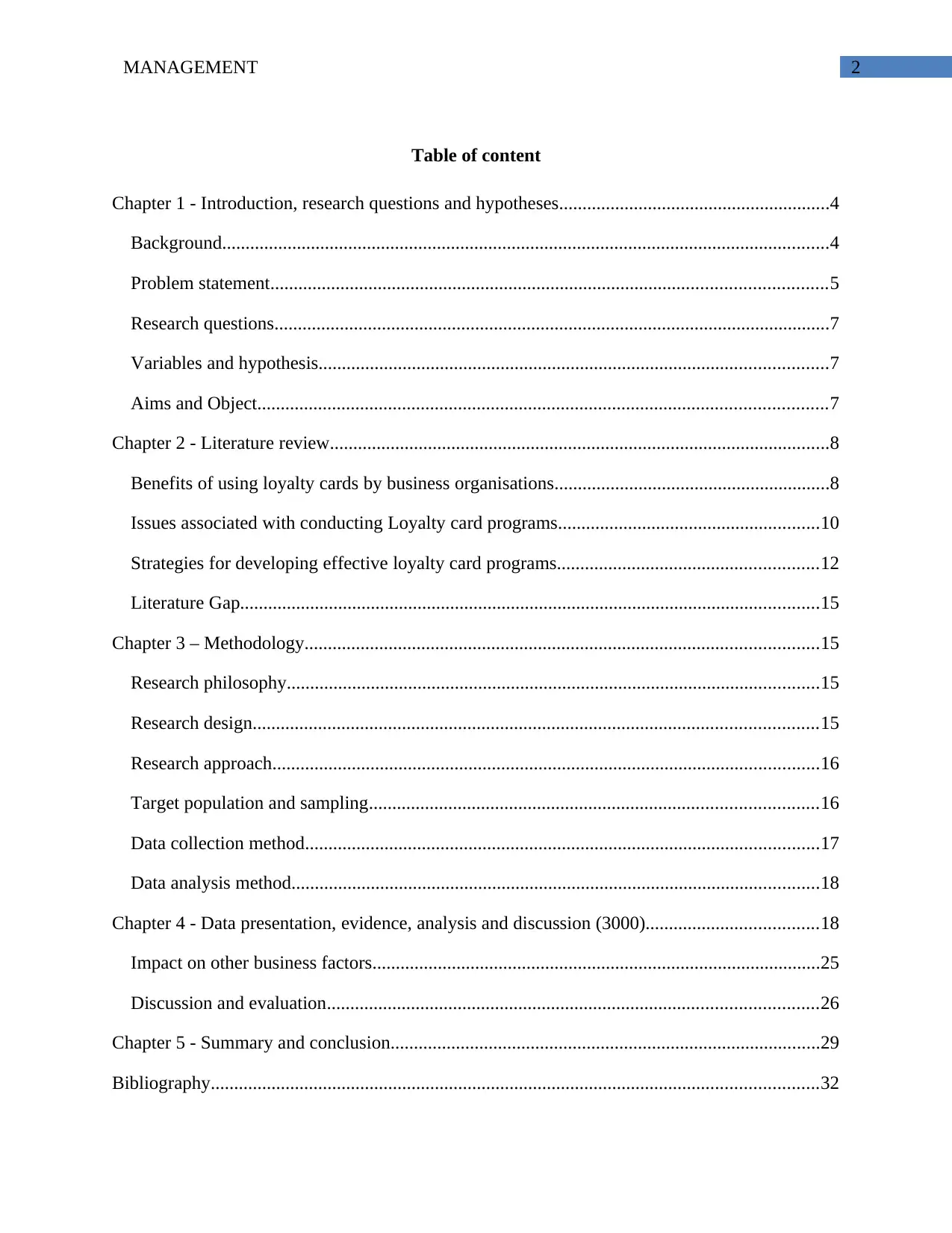
Table of content
Chapter 1 - Introduction, research questions and hypotheses..........................................................4
Background..................................................................................................................................4
Problem statement.......................................................................................................................5
Research questions.......................................................................................................................7
Variables and hypothesis.............................................................................................................7
Aims and Object..........................................................................................................................7
Chapter 2 - Literature review...........................................................................................................8
Benefits of using loyalty cards by business organisations...........................................................8
Issues associated with conducting Loyalty card programs........................................................10
Strategies for developing effective loyalty card programs........................................................12
Literature Gap............................................................................................................................15
Chapter 3 – Methodology..............................................................................................................15
Research philosophy..................................................................................................................15
Research design.........................................................................................................................15
Research approach.....................................................................................................................16
Target population and sampling................................................................................................16
Data collection method..............................................................................................................17
Data analysis method.................................................................................................................18
Chapter 4 - Data presentation, evidence, analysis and discussion (3000).....................................18
Impact on other business factors................................................................................................25
Discussion and evaluation.........................................................................................................26
Chapter 5 - Summary and conclusion............................................................................................29
Bibliography..................................................................................................................................32
Table of content
Chapter 1 - Introduction, research questions and hypotheses..........................................................4
Background..................................................................................................................................4
Problem statement.......................................................................................................................5
Research questions.......................................................................................................................7
Variables and hypothesis.............................................................................................................7
Aims and Object..........................................................................................................................7
Chapter 2 - Literature review...........................................................................................................8
Benefits of using loyalty cards by business organisations...........................................................8
Issues associated with conducting Loyalty card programs........................................................10
Strategies for developing effective loyalty card programs........................................................12
Literature Gap............................................................................................................................15
Chapter 3 – Methodology..............................................................................................................15
Research philosophy..................................................................................................................15
Research design.........................................................................................................................15
Research approach.....................................................................................................................16
Target population and sampling................................................................................................16
Data collection method..............................................................................................................17
Data analysis method.................................................................................................................18
Chapter 4 - Data presentation, evidence, analysis and discussion (3000).....................................18
Impact on other business factors................................................................................................25
Discussion and evaluation.........................................................................................................26
Chapter 5 - Summary and conclusion............................................................................................29
Bibliography..................................................................................................................................32
⊘ This is a preview!⊘
Do you want full access?
Subscribe today to unlock all pages.

Trusted by 1+ million students worldwide

3MANAGEMENT
Paraphrase This Document
Need a fresh take? Get an instant paraphrase of this document with our AI Paraphraser
4MANAGEMENT
Thesis Topic: How Loyalty cards help Business?
Chapter 1 - Introduction, research questions and hypotheses
Background
In this era in technological advancement, the competition between business organizations
in order to ensure competitive advantage in the market has got enhanced to a great level. In order
to ensure maintenance as well as enhancement of competitive advantage, business companies are
investing on innovative business strategies in order to attract consumers. Loyalty programs came
in existence while organizations realized that the competitive advantages that has been
experienced due to the product differentiation no longer holds good as a result of proliferation of
similar looking products. In this type of environment, possessing loyal consumers has become
more and more crucial yet difficult so much that consumer loyalty is considered to be one of the
rarest commodities. In order to ensure effective enhancement as well as maintenance of
consumer loyalty, management of business organizations are using various kinds of commence
loyalty platforms. The chief aim of commence loyalty program is to ensure that the management
is selecting the right type of audience at the right time for the organization.
Retail organizations were the first who came up with the concept of loyalty card and
loyalty program. Loyalty card program can be defined as an incentive plan which allows
businesses for gathering data about their consumers. consumers are offered with discounts on
purchase of products, coupons, points for purchasing merchandise along with other rewards in
exchange of voluntary participation in the loyalty program. Along with gathering crucial data
about the consumers, the second goal associated with loyalty card program includes building
repeat business by offering the participating consumers with products or services that are not
available to the non-participating consumers.
One of the chief benefits of loyalty program includes effective consumer retention. The
primary motive behind commencing a loyalty card program is to retain the consumers by
providing them with extra benefits that is not provided to consumers who does not possess the
loyalty card. A good number of studies have found that the relationship perception of a consumer
can be explained as 10 percent of the total variation in consumer retention as well as consumer
share. The fact that consumer retention strategies possess direct relation with the bottom line of
the business cannot be ignored. A business with a 60 percent consumer retention is found to be
Thesis Topic: How Loyalty cards help Business?
Chapter 1 - Introduction, research questions and hypotheses
Background
In this era in technological advancement, the competition between business organizations
in order to ensure competitive advantage in the market has got enhanced to a great level. In order
to ensure maintenance as well as enhancement of competitive advantage, business companies are
investing on innovative business strategies in order to attract consumers. Loyalty programs came
in existence while organizations realized that the competitive advantages that has been
experienced due to the product differentiation no longer holds good as a result of proliferation of
similar looking products. In this type of environment, possessing loyal consumers has become
more and more crucial yet difficult so much that consumer loyalty is considered to be one of the
rarest commodities. In order to ensure effective enhancement as well as maintenance of
consumer loyalty, management of business organizations are using various kinds of commence
loyalty platforms. The chief aim of commence loyalty program is to ensure that the management
is selecting the right type of audience at the right time for the organization.
Retail organizations were the first who came up with the concept of loyalty card and
loyalty program. Loyalty card program can be defined as an incentive plan which allows
businesses for gathering data about their consumers. consumers are offered with discounts on
purchase of products, coupons, points for purchasing merchandise along with other rewards in
exchange of voluntary participation in the loyalty program. Along with gathering crucial data
about the consumers, the second goal associated with loyalty card program includes building
repeat business by offering the participating consumers with products or services that are not
available to the non-participating consumers.
One of the chief benefits of loyalty program includes effective consumer retention. The
primary motive behind commencing a loyalty card program is to retain the consumers by
providing them with extra benefits that is not provided to consumers who does not possess the
loyalty card. A good number of studies have found that the relationship perception of a consumer
can be explained as 10 percent of the total variation in consumer retention as well as consumer
share. The fact that consumer retention strategies possess direct relation with the bottom line of
the business cannot be ignored. A business with a 60 percent consumer retention is found to be
5MANAGEMENT
losing 3 to 4 times as many consumers compared to a business with 80 percent consumer
retention rate.
This innovative strategy has been found to a great way of generating extra businesses which has
encouraged a good number of consumers to come back to the business. Thus, loyalty cards are
considered to be an effective tool for marketing that helps spreading the words about the
company or brand. However, over time, a good number of limitations of the usage of loyalty
card for business has also been detected. Considering the fact that loyalty data does not possess
the potential to look into the purchase of other brands or stores, it provides limited picture to the
overall purchasing behaviours of the consumers. In this study, the aim of the researcher is to find
out how Loyalty cards can helps Business. Along with this, this research paper will also find
out the advantages as well as the disadvantages of loyalty cards and whether, business
organizations should opt for using loyalty card programs as an effective strategy to enhance their
business or not.
Problem statement
Loyalty cards are designed for attracting consumers and the programs are helped to
incentivize consumers for keep coming back to the businesses. In exchange to their willing
participation in the program, consumers are offered with special product discounts and rewards.
Loyalty cards are basically an incentive plan which aloe the retail businesses to another data
about their consumers. Loyalty cards, majority of time, resemble plastic credit cards and possess
a barcode or a magnet stripe that is generally scanned at the point of sale. The card ad been
designed to identify the consumer and send information about the purchase done by the same to
the database. This information is used by the retailers to understand the specific needs and
choices of the consumers and this in turn helps them to influence the buying habit of the same.
According to Evanschitzky et al. (2012), 86 percent of the shoppers in UK are listed in the
loyalty data base. This proves that according to a good number of consumers receiving the
benefits provided by the shops is worth giving up some measure of the privacy.
Thus loyalty card programs are designed for encouraging the consumers to keep coming
back so that extra business can be generated. According to a good number of researchers loyalty
card programs possess the potential to enhance the yearly revenue of an organization through
consumer retention, enhance sales, power awareness as well as effective consumer company
losing 3 to 4 times as many consumers compared to a business with 80 percent consumer
retention rate.
This innovative strategy has been found to a great way of generating extra businesses which has
encouraged a good number of consumers to come back to the business. Thus, loyalty cards are
considered to be an effective tool for marketing that helps spreading the words about the
company or brand. However, over time, a good number of limitations of the usage of loyalty
card for business has also been detected. Considering the fact that loyalty data does not possess
the potential to look into the purchase of other brands or stores, it provides limited picture to the
overall purchasing behaviours of the consumers. In this study, the aim of the researcher is to find
out how Loyalty cards can helps Business. Along with this, this research paper will also find
out the advantages as well as the disadvantages of loyalty cards and whether, business
organizations should opt for using loyalty card programs as an effective strategy to enhance their
business or not.
Problem statement
Loyalty cards are designed for attracting consumers and the programs are helped to
incentivize consumers for keep coming back to the businesses. In exchange to their willing
participation in the program, consumers are offered with special product discounts and rewards.
Loyalty cards are basically an incentive plan which aloe the retail businesses to another data
about their consumers. Loyalty cards, majority of time, resemble plastic credit cards and possess
a barcode or a magnet stripe that is generally scanned at the point of sale. The card ad been
designed to identify the consumer and send information about the purchase done by the same to
the database. This information is used by the retailers to understand the specific needs and
choices of the consumers and this in turn helps them to influence the buying habit of the same.
According to Evanschitzky et al. (2012), 86 percent of the shoppers in UK are listed in the
loyalty data base. This proves that according to a good number of consumers receiving the
benefits provided by the shops is worth giving up some measure of the privacy.
Thus loyalty card programs are designed for encouraging the consumers to keep coming
back so that extra business can be generated. According to a good number of researchers loyalty
card programs possess the potential to enhance the yearly revenue of an organization through
consumer retention, enhance sales, power awareness as well as effective consumer company
⊘ This is a preview!⊘
Do you want full access?
Subscribe today to unlock all pages.
Trusted by 1+ million students worldwide
6MANAGEMENT
relationship. Organizations like Designer Shoe Warehouse (DSW), Sephora, Starbucks, Tarte
and Amazon are some of the well known organization that have invested a lump some amount of
their revenue for conducting loyalty card programs. Thus it can be clearly understood the
mentioned strategy is getting popular in all types of industries, be it retail, beauty and other
industries.
While in various industries, loyalty program has been proved to be a highly effective
method of attracting consumers and retain loyalty, a good number of concerns are associate with
the usage of loyalty card for developing business. For instance, it is highly difficult to pinpoint
where the loyal behaviour of the consumers actually comes from. This is because, loyalty
framework cannot break from the transactional spirit. Majority of time, it appears that the
consumer who buys on a frequent rate is a loyal one. However, this may not be the case since the
consumers often opt to conduct repeated buy from an organization not due to satisfaction but
also since it is more convenient for him or her, or due to the provision of rewards. Hence,
loyalty, which in essence is an emotion, may not be gauged by the loyalty program.
Another major concern that is face by a good number start-up organization while
implementing loyalty card as a strategy to enhance competitive advantage is balancing the
bottom line. Considering the fact that in a start-up business the investment costs is high and the
yearly profit is low, offering high discounts to the consumers, regardless of the form, offers the
bottoline of the company. For instance, a loyalty discount of 10 percent, that is 5 dollar discount
on a 50 dollar sale, results in a 500 percent decrement in its profit. that is while the cost remains
the same, the organization, instead of earning 10 dollars for the same end up earning 5 dollars.
What appears to be a small discount, in this case, 5 percent can significantly impact profits.
While a good number of organizations are investing their finances in loyalty programs,
lack of effective researchers on how exactly the loyalty programs can help a business to flourish
has been evident. Not only has his, lack of researches been conducted about the concerns
associated with the implementation of loyalty card program for business purpose. Along with
this, lack of academic researchers associated with the concerns that the management of an
organization must be aware about before using loyalty cards as a revenue enhancement technique
has been detected. Hence this research has been conducted in order to help the management of
already established as well as start-up organizations to use loyalty card in an effective way.
relationship. Organizations like Designer Shoe Warehouse (DSW), Sephora, Starbucks, Tarte
and Amazon are some of the well known organization that have invested a lump some amount of
their revenue for conducting loyalty card programs. Thus it can be clearly understood the
mentioned strategy is getting popular in all types of industries, be it retail, beauty and other
industries.
While in various industries, loyalty program has been proved to be a highly effective
method of attracting consumers and retain loyalty, a good number of concerns are associate with
the usage of loyalty card for developing business. For instance, it is highly difficult to pinpoint
where the loyal behaviour of the consumers actually comes from. This is because, loyalty
framework cannot break from the transactional spirit. Majority of time, it appears that the
consumer who buys on a frequent rate is a loyal one. However, this may not be the case since the
consumers often opt to conduct repeated buy from an organization not due to satisfaction but
also since it is more convenient for him or her, or due to the provision of rewards. Hence,
loyalty, which in essence is an emotion, may not be gauged by the loyalty program.
Another major concern that is face by a good number start-up organization while
implementing loyalty card as a strategy to enhance competitive advantage is balancing the
bottom line. Considering the fact that in a start-up business the investment costs is high and the
yearly profit is low, offering high discounts to the consumers, regardless of the form, offers the
bottoline of the company. For instance, a loyalty discount of 10 percent, that is 5 dollar discount
on a 50 dollar sale, results in a 500 percent decrement in its profit. that is while the cost remains
the same, the organization, instead of earning 10 dollars for the same end up earning 5 dollars.
What appears to be a small discount, in this case, 5 percent can significantly impact profits.
While a good number of organizations are investing their finances in loyalty programs,
lack of effective researchers on how exactly the loyalty programs can help a business to flourish
has been evident. Not only has his, lack of researches been conducted about the concerns
associated with the implementation of loyalty card program for business purpose. Along with
this, lack of academic researchers associated with the concerns that the management of an
organization must be aware about before using loyalty cards as a revenue enhancement technique
has been detected. Hence this research has been conducted in order to help the management of
already established as well as start-up organizations to use loyalty card in an effective way.
Paraphrase This Document
Need a fresh take? Get an instant paraphrase of this document with our AI Paraphraser
7MANAGEMENT
These researches will also pave the way for future researchers who are willingly to conduct study
on the impact of loyalty cards on businesses.
Research questions
The chief research questions for the mentioned research are as follows:
1. what are the positive impacts of loyalty cards on business
2. What are the risks associated with the usage of loyalty cards for business growth?
3. what are the strategies that are applied by the management for successful implementation
of loyalty cards for business growth?
Variables and hypothesis
H0: Loyalty cards do not impose any effects on the business growth.
H1: Loyalty cards help the business to boost its revenue
H2: Loyalty cards help the business to enhance consumer base
H3: Loyalty cards help the business to enhance access to valuable data.
Aims and Object
The aim of the mentioned research is to find out how Loyalty cards can enhance the growth of
businesses.
The objectives of the research paper are as follows:
4. To find out the positive impacts of loyalty cards on business.
5. To find out the risks associated with the use of loyalty cards for business growth
6. To find out strategies those are applied by the management for successful implementation
of loyalty cards for business growth.
These researches will also pave the way for future researchers who are willingly to conduct study
on the impact of loyalty cards on businesses.
Research questions
The chief research questions for the mentioned research are as follows:
1. what are the positive impacts of loyalty cards on business
2. What are the risks associated with the usage of loyalty cards for business growth?
3. what are the strategies that are applied by the management for successful implementation
of loyalty cards for business growth?
Variables and hypothesis
H0: Loyalty cards do not impose any effects on the business growth.
H1: Loyalty cards help the business to boost its revenue
H2: Loyalty cards help the business to enhance consumer base
H3: Loyalty cards help the business to enhance access to valuable data.
Aims and Object
The aim of the mentioned research is to find out how Loyalty cards can enhance the growth of
businesses.
The objectives of the research paper are as follows:
4. To find out the positive impacts of loyalty cards on business.
5. To find out the risks associated with the use of loyalty cards for business growth
6. To find out strategies those are applied by the management for successful implementation
of loyalty cards for business growth.
8MANAGEMENT
Chapter 2 - Literature review
Benefits of using loyalty cards by business organisations
There exist a good number of reasons behind creating consumer loyalty programs by the
organizations. It can be considered to be a cost effective way of winning the consumer’s trust as
well as ensure the growth of the business. According to Tanford (2013), loyalty program if
performed in an effective way it possess the potential to work as a marketing campaign. Kang,
Alejandro and Groza (2015) stated that amongst the most popular competitive advantage gaining
campaigns, loyalty card programs can be considered as an crucial one since it provide numerous
benefits to the businesses if conducted in an efficient way. One of the most crucial benefits of
conducting a loyalty card program includes retention of consumers. With the enhancement in
technology, the number of organizations selling similar products or service is increasing. As a
result competition between such organizations is high consumers have possess the power to shift
from one brand to another in case of nominal dissatisfaction. Thus consumer loyalty is
considered to be a highly rare yet valuable asset in today’s world of business. Loyalty programs
possess the potential to help the management of a business organization to retain the consumers
by building trust between the consumers as well as the company which encourage them to come
back for repurchasing. Lee et al. (2014) stated that well targeted and well organized loyalty
program possess the potential to help business organizations move ahead of the competition. It
can add great value to the products or services offered to the consumers by the organization.
According to psychologists rewarding consumers lead to creation of connection with the same at
an emotional level. This enhances the consumer company relationship and consumers often tend
to see the brand as something more than a place for purchasing product or services.
According to Singh and Khan (2012), for start-up businesses, loyalty programs acts as a
medium that can enhance awareness as well as reputation of the brand amongst the target
consumers. Loyalty programs are found to serve one dual purpose that include incentivize new
customers to stay around and to ensure that existing loyal customers still feel they are valued by
your operation after buying their goods and services.
Thus marketers not only improve customer appreciation in the business by establishing a
loyalty program, but also increase the likelihood that existing customers share this joy with their
near and dear ones. The more satisfied a customer is by a product, the more likely he or she is to
Chapter 2 - Literature review
Benefits of using loyalty cards by business organisations
There exist a good number of reasons behind creating consumer loyalty programs by the
organizations. It can be considered to be a cost effective way of winning the consumer’s trust as
well as ensure the growth of the business. According to Tanford (2013), loyalty program if
performed in an effective way it possess the potential to work as a marketing campaign. Kang,
Alejandro and Groza (2015) stated that amongst the most popular competitive advantage gaining
campaigns, loyalty card programs can be considered as an crucial one since it provide numerous
benefits to the businesses if conducted in an efficient way. One of the most crucial benefits of
conducting a loyalty card program includes retention of consumers. With the enhancement in
technology, the number of organizations selling similar products or service is increasing. As a
result competition between such organizations is high consumers have possess the power to shift
from one brand to another in case of nominal dissatisfaction. Thus consumer loyalty is
considered to be a highly rare yet valuable asset in today’s world of business. Loyalty programs
possess the potential to help the management of a business organization to retain the consumers
by building trust between the consumers as well as the company which encourage them to come
back for repurchasing. Lee et al. (2014) stated that well targeted and well organized loyalty
program possess the potential to help business organizations move ahead of the competition. It
can add great value to the products or services offered to the consumers by the organization.
According to psychologists rewarding consumers lead to creation of connection with the same at
an emotional level. This enhances the consumer company relationship and consumers often tend
to see the brand as something more than a place for purchasing product or services.
According to Singh and Khan (2012), for start-up businesses, loyalty programs acts as a
medium that can enhance awareness as well as reputation of the brand amongst the target
consumers. Loyalty programs are found to serve one dual purpose that include incentivize new
customers to stay around and to ensure that existing loyal customers still feel they are valued by
your operation after buying their goods and services.
Thus marketers not only improve customer appreciation in the business by establishing a
loyalty program, but also increase the likelihood that existing customers share this joy with their
near and dear ones. The more satisfied a customer is by a product, the more likely he or she is to
⊘ This is a preview!⊘
Do you want full access?
Subscribe today to unlock all pages.
Trusted by 1+ million students worldwide
9MANAGEMENT
help and recommend the business to others. In turn, this is a cyclical word of mouth which keeps
growing for the enterprise.
Berezan et al. (2015) have stated that loyalty card programs have gained high popularity
amongst the business industries due to its impact on the revenue of the organizations in a limited
period of time. A loyalty card program helps in increasing the profit margin of an organization.
Loyal consumers develop trust on the business that in turn encourages them to spend more on the
same. According to researchers, increment in consumer retention by 5 percent, results in
increment in revenue by a minimum of 25 percent to as high as 100 percent. The loyalty card
program helps the organization to provide incentives to the consumer that they actually desire
for. This creates a circle of consumer retention by bringing back the consumers along with
encouraging them to spend more on their products and services. Stathopoulou and Balabanis
(2016) have pointed out that loyalty card programs, along with retaining the existing consumers
also possess the potential to draw new consumers. A good number of organizations like Nike and
Sephora offer the consumers with discounts and points for signing up for their loyalty card
programs. This process has been proved not only to draw the attention of new consumers in a
successful way but also to encourage them for joining the mailing list.
Xie and Chen (2013) pointed out that one of the chief purpose of the loyalty cards is to
provide relevant consumer data as well as make the same aware of the current consumer trends.
Such data are used by businesses for all parts of the market, offline as well as e-commerce, to
identify their best customers along with tailoring their offerings to different consumer groups.
The organizations using loyalty cards uses this information to for optimizing inventory
management, pricing as well as promotional strategies since loyalty program data provides the
business with a complete analysis of customer behavior, purchasing patterns and preferences.
The outcomes of special offers can also be assessed on the basis of additional purchases, with the
help of using other platforms or reducing the time between purchases. These details are also
useful to advertisers. According to the chairman of Tesco, loyalty programs are highly efficient
when it comes to extracting valuable information from the consumers.
According to Schumann, Wünderlich and Evanschitzky (2014), One of the chief features
of the loyalty programs which is often rarely considered is that they allow organizations to lose
help and recommend the business to others. In turn, this is a cyclical word of mouth which keeps
growing for the enterprise.
Berezan et al. (2015) have stated that loyalty card programs have gained high popularity
amongst the business industries due to its impact on the revenue of the organizations in a limited
period of time. A loyalty card program helps in increasing the profit margin of an organization.
Loyal consumers develop trust on the business that in turn encourages them to spend more on the
same. According to researchers, increment in consumer retention by 5 percent, results in
increment in revenue by a minimum of 25 percent to as high as 100 percent. The loyalty card
program helps the organization to provide incentives to the consumer that they actually desire
for. This creates a circle of consumer retention by bringing back the consumers along with
encouraging them to spend more on their products and services. Stathopoulou and Balabanis
(2016) have pointed out that loyalty card programs, along with retaining the existing consumers
also possess the potential to draw new consumers. A good number of organizations like Nike and
Sephora offer the consumers with discounts and points for signing up for their loyalty card
programs. This process has been proved not only to draw the attention of new consumers in a
successful way but also to encourage them for joining the mailing list.
Xie and Chen (2013) pointed out that one of the chief purpose of the loyalty cards is to
provide relevant consumer data as well as make the same aware of the current consumer trends.
Such data are used by businesses for all parts of the market, offline as well as e-commerce, to
identify their best customers along with tailoring their offerings to different consumer groups.
The organizations using loyalty cards uses this information to for optimizing inventory
management, pricing as well as promotional strategies since loyalty program data provides the
business with a complete analysis of customer behavior, purchasing patterns and preferences.
The outcomes of special offers can also be assessed on the basis of additional purchases, with the
help of using other platforms or reducing the time between purchases. These details are also
useful to advertisers. According to the chairman of Tesco, loyalty programs are highly efficient
when it comes to extracting valuable information from the consumers.
According to Schumann, Wünderlich and Evanschitzky (2014), One of the chief features
of the loyalty programs which is often rarely considered is that they allow organizations to lose
Paraphrase This Document
Need a fresh take? Get an instant paraphrase of this document with our AI Paraphraser
10MANAGEMENT
unnecessary expanses. A successfully designed loyalty program enables businesses of
segmenting customers and find rentable as well as unprofitable consumers. It helps the
organizations to get rid of those who purchase only discounted lines and almost regularly avoid
premium supply. These client profiles will cost more than they deliver. With the help of loyalty
program, businesses gains the potentiality to only reward the best customer and thus reduce
payouts to consumers that are not so successful. This can be considered as one of the most
efficient way without a doubt to attract those consumers from whom the firm earns the greatest
income.
According to Kim et al. (2013), communication between the consumer and the company
can be considered as one of the effective ways to maintain an effective company consumer
relationship. A loyalty program provides consumers with a direct line that encourages and makes
communication easier (Aluri, Price and McIntyre 2019). Apart from announcing new service or
products, promoting sales, loyalty card programs facilitates recalls whenever necessary. This
take place due to the purchase date as well as barcode of the recalled items. The recall notice
gains more weight as well as significance, as it is based on the actual purchase of the consumers
affected good. Compared to a store sign or newspaper notice, the chance that this email-borne
recall notice will get read by the people is high.
It has been found that for simple program as well as easier access to rewards more
consumers demonstrates the urge of buying products from the organization. Besides, word of
mouth publicity by the existing consumers promotes the program of the organization to new
consumers. The best consumer program also possesses the potential to turn the consumers into
brand advocate. Kang, Alejandro and Groza (2015) stated that highly satisfied consumers often
helps other to make right buying decision. According to a survey 7 out of 10 millennial are
found to prefer helping their family as well as friends for making smart buying decisions.
Issues associated with conducting Loyalty card programs
Steinhoff and Palmatier (2016) pointed out that instead of being a highly ubiquitous
marketing tactic, several times it has been seen that loyalty programs are not giving the expected
results. The chief reason behind this is that a good number of demerits of the loyalty programs
are there that can be pointed out. One of the chief disadvantages of loyalty card programs is that
it is difficult to pinpoint or understand the chief factor s that are associated with the loyal
behaviour of the consumers. It is hard for the loyalty framework to break away from the
unnecessary expanses. A successfully designed loyalty program enables businesses of
segmenting customers and find rentable as well as unprofitable consumers. It helps the
organizations to get rid of those who purchase only discounted lines and almost regularly avoid
premium supply. These client profiles will cost more than they deliver. With the help of loyalty
program, businesses gains the potentiality to only reward the best customer and thus reduce
payouts to consumers that are not so successful. This can be considered as one of the most
efficient way without a doubt to attract those consumers from whom the firm earns the greatest
income.
According to Kim et al. (2013), communication between the consumer and the company
can be considered as one of the effective ways to maintain an effective company consumer
relationship. A loyalty program provides consumers with a direct line that encourages and makes
communication easier (Aluri, Price and McIntyre 2019). Apart from announcing new service or
products, promoting sales, loyalty card programs facilitates recalls whenever necessary. This
take place due to the purchase date as well as barcode of the recalled items. The recall notice
gains more weight as well as significance, as it is based on the actual purchase of the consumers
affected good. Compared to a store sign or newspaper notice, the chance that this email-borne
recall notice will get read by the people is high.
It has been found that for simple program as well as easier access to rewards more
consumers demonstrates the urge of buying products from the organization. Besides, word of
mouth publicity by the existing consumers promotes the program of the organization to new
consumers. The best consumer program also possesses the potential to turn the consumers into
brand advocate. Kang, Alejandro and Groza (2015) stated that highly satisfied consumers often
helps other to make right buying decision. According to a survey 7 out of 10 millennial are
found to prefer helping their family as well as friends for making smart buying decisions.
Issues associated with conducting Loyalty card programs
Steinhoff and Palmatier (2016) pointed out that instead of being a highly ubiquitous
marketing tactic, several times it has been seen that loyalty programs are not giving the expected
results. The chief reason behind this is that a good number of demerits of the loyalty programs
are there that can be pointed out. One of the chief disadvantages of loyalty card programs is that
it is difficult to pinpoint or understand the chief factor s that are associated with the loyal
behaviour of the consumers. It is hard for the loyalty framework to break away from the
11MANAGEMENT
transactional spirit. Majority of time, it appears that the consumer who frequently but products or
services from a certain organization is a loyal one. However, that may not be an actual case since
consumers often purchase from a specific organization just because it is convenient for them or
just for the benefits provided by the loyalty program. Thus, loyalty, which is the essence of an
emotion, often cannot be measured with the help of loyalty program.
Another major issue faced by the management of the organizations who opt for
conducting, loyal card programs is balancing the bottom line. The adverse impact that loyalty
card imposed on fanatical component is highly stressful. Discounts, regardless of the form,
results in the bottom line of the business a typical 50 dollar sales transaction can be break down
to 40 dollar investment cost and 10 dollar profit (Chaudhuri, Voorhees and Beck 2019). Now,
even a 5 dollar offer on a 50 dollar sale results in 50 percent decrement in the profit. While the
cost remains the same, instead of earning 10 dollars from the same, the profit gets reduced to 5
dollar. This 5 dollar which seems to be a small discount, often impose negative impact on the
profit margin of the organization. In order to deal with the mentioned issue, financial loss
includes making sure that the loyalty program is fairly priced as well as effective (Hwang and
Mattila 2018). If the program really is increasing repeated purchases as well as average order
value then the discount will be balanced and this possess no problem recouping the losses.
Another issue that is faced by the marketers while opting for the loyalty card program is market
saturation. With the popularity of loyalty cards an effective technique to retain consumers a good
number of organizations are found to be opting for the same. Loyalty programs are everywhere
and may appear to be identical. They all possess similar membership provisions, benefits as well
as purchase requirements. However, in this ultra competitive world, firms needs to be unable of
pulling back from their loyalty program commitments as a result of fearing lost sales. Schumann,
Wünderlich and Evanschitzky (2014) stated that while the average household that participating
in over nine reward programs, there is a necessity for businesses for creating programs which are
unique a well a distinguishable. However, it is highly tough to design loyalty program which is
based on the sustainable competitive advantage which cannot be copied. Advocacy loyalty
programs are a good way for standing out though since the marketers can reward the consumers
for their unique actions as well as work for the audience. Loyalty programs hope for bringing out
more repurchasing on the basis of the historical behaviours of the consumers. However, with
time, their incomes, requirements as well as lifestyles change.
transactional spirit. Majority of time, it appears that the consumer who frequently but products or
services from a certain organization is a loyal one. However, that may not be an actual case since
consumers often purchase from a specific organization just because it is convenient for them or
just for the benefits provided by the loyalty program. Thus, loyalty, which is the essence of an
emotion, often cannot be measured with the help of loyalty program.
Another major issue faced by the management of the organizations who opt for
conducting, loyal card programs is balancing the bottom line. The adverse impact that loyalty
card imposed on fanatical component is highly stressful. Discounts, regardless of the form,
results in the bottom line of the business a typical 50 dollar sales transaction can be break down
to 40 dollar investment cost and 10 dollar profit (Chaudhuri, Voorhees and Beck 2019). Now,
even a 5 dollar offer on a 50 dollar sale results in 50 percent decrement in the profit. While the
cost remains the same, instead of earning 10 dollars from the same, the profit gets reduced to 5
dollar. This 5 dollar which seems to be a small discount, often impose negative impact on the
profit margin of the organization. In order to deal with the mentioned issue, financial loss
includes making sure that the loyalty program is fairly priced as well as effective (Hwang and
Mattila 2018). If the program really is increasing repeated purchases as well as average order
value then the discount will be balanced and this possess no problem recouping the losses.
Another issue that is faced by the marketers while opting for the loyalty card program is market
saturation. With the popularity of loyalty cards an effective technique to retain consumers a good
number of organizations are found to be opting for the same. Loyalty programs are everywhere
and may appear to be identical. They all possess similar membership provisions, benefits as well
as purchase requirements. However, in this ultra competitive world, firms needs to be unable of
pulling back from their loyalty program commitments as a result of fearing lost sales. Schumann,
Wünderlich and Evanschitzky (2014) stated that while the average household that participating
in over nine reward programs, there is a necessity for businesses for creating programs which are
unique a well a distinguishable. However, it is highly tough to design loyalty program which is
based on the sustainable competitive advantage which cannot be copied. Advocacy loyalty
programs are a good way for standing out though since the marketers can reward the consumers
for their unique actions as well as work for the audience. Loyalty programs hope for bringing out
more repurchasing on the basis of the historical behaviours of the consumers. However, with
time, their incomes, requirements as well as lifestyles change.
⊘ This is a preview!⊘
Do you want full access?
Subscribe today to unlock all pages.
Trusted by 1+ million students worldwide

1 out of 36


Related Documents


Your All-in-One AI-Powered Toolkit for Academic Success.
+13062052269
info@desklib.com
Available 24*7 on WhatsApp / Email
![[object Object]](/_next/static/media/star-bottom.7253800d.svg)
Unlock your academic potential
Copyright © 2020–2026 A2Z Services. All Rights Reserved. Developed and managed by ZUCOL.